




It’s not a secret anymore — ranking on Google is no longer enough. Your brand also needs to be mentioned, cited, and recommended by AI systems like ChatGPT, Perplexity, and Gemini. Traditional SEO tools weren’t designed to track or optimize for this new reality. Meanwhile, the market has exploded with AI search engine optimization tools — but not all of them deliver real results. This guide cuts through the noise. We tested and categorized the best tools across AI visibility tracking, content optimization, and all-in-one platforms to help you choose the right stack for your goals. Whether you’re an agency managing dozens of brands or a solo marketer protecting one, the 15 tools below represent the strongest options available right now.
What Are AI Search Engine Optimization Tools?
AI search engine optimization tools help brands track and improve visibility in AI-generated answers, not just Google rankings.
These platforms are built for a world where where ChatGPT has 900 million weekly active users. They help brands optimize for and monitor visibility across ChatGPT, Perplexity, Gemini, Google AI Overviews, and Claude. Here’s the terminology you need to know:
- GEO (Generative Engine Optimization): Optimizing content to be cited in AI-generated responses. Methods like statistics addition and fluency optimization outperform keyword-based SEO approaches in generative engines.
- AEO (Answer Engine Optimization): Optimizing for direct answers in AI assistants and answer engines. This focuses on structured, citable content that AI systems select as trusted sources.
- AI SEO: The umbrella term covering both traditional search optimization enhanced by AI and optimization for AI search platforms themselves.
Traditional SEO tools measure rankings and clicks. They don’t track whether AI models mention or recommend your brand. That blind spot is critical when AI Overviews now appear on approximately 48% of tracked Google queries — up from 25% a year ago and 93% of AI search sessions end without a website visit. The core capability split in this market breaks into three lanes: AI visibility monitoring tools, AI-powered content optimization tools, and hybrid platforms that combine both. The rise of zero-click AI answers has turned this from a niche concern into a strategic imperative.
How We Evaluated and Ranked These AI Search Engine Optimization Tools
We scored each tool on AI visibility tracking, content optimization, platform coverage, integrations, and value.
Every tool in this guide was evaluated through hands-on testing, not just feature lists. We focused on the capabilities that matter most in the current AI search landscape:
- AI visibility tracking: Does it monitor brand mentions across ChatGPT, Perplexity, Gemini, Claude, and Google AI Overviews?
- Content optimization capability: Does it help create or improve content that AI systems are more likely to cite?
- AI platform coverage breadth: How many AI engines does it support?
- Integration with existing SEO workflows: Can it connect with Google Search Console, rank tracking, and backlink data?
- Pricing transparency and value: Are pricing tiers clear and scalable for different team sizes?
- Hands-on testing: Each tool was evaluated through actual use — setting up tracking, running content through optimization features, and assessing data accuracy.
AI SEO Tools Comparison Table 👀

Conductor
Enterprise AEO Hub
Best For
Free Trial
Key Strength

Scrunch AI
AI Crawl Optimizer
Best For
Free Trial
Key Strength

XFunnel AI
CRM-Linked Attribution
Best For
Free Trial
Key Strength

Rankscale.ai
Precision GEO Tracker
Best For
Free Trial
Key Strength

Profound
AEO Category Leader
Best For
Free Trial
Key Strength

Otterly AI
Budget-Friendly Monitor
Best For
Free Trial
Key Strength

Peec AI
Multilingual Visibility
Best For
Free Trial
Key Strength

Botify AI Search
Infrastructure Intelligence
Best For
Free Trial
Key Strength

Clearscope
Topical Authority Engine
Best For
Free Trial
Key Strength

Frase
Answer-First Optimizer
Best For
Free Trial
Key Strength

MarketMuse
Content Gap Planner
Best For
Free Trial
Key Strength

Lumar GEO Toolkit
Technical GEO Auditor
Best For
Free Trial
Key Strength

Writesonic
Monitor + Create
Best For
Free Trial
Key Strength

Koala AI
One-Click SEO Writer
Best For
Free Trial
Key Strength

Alli AI
Auto-Deploy at Scale
Best For
Free Trial
Key Strength
🌐 All-in-One Platforms (Traditional SEO + AI Visibility)
1. Conductor
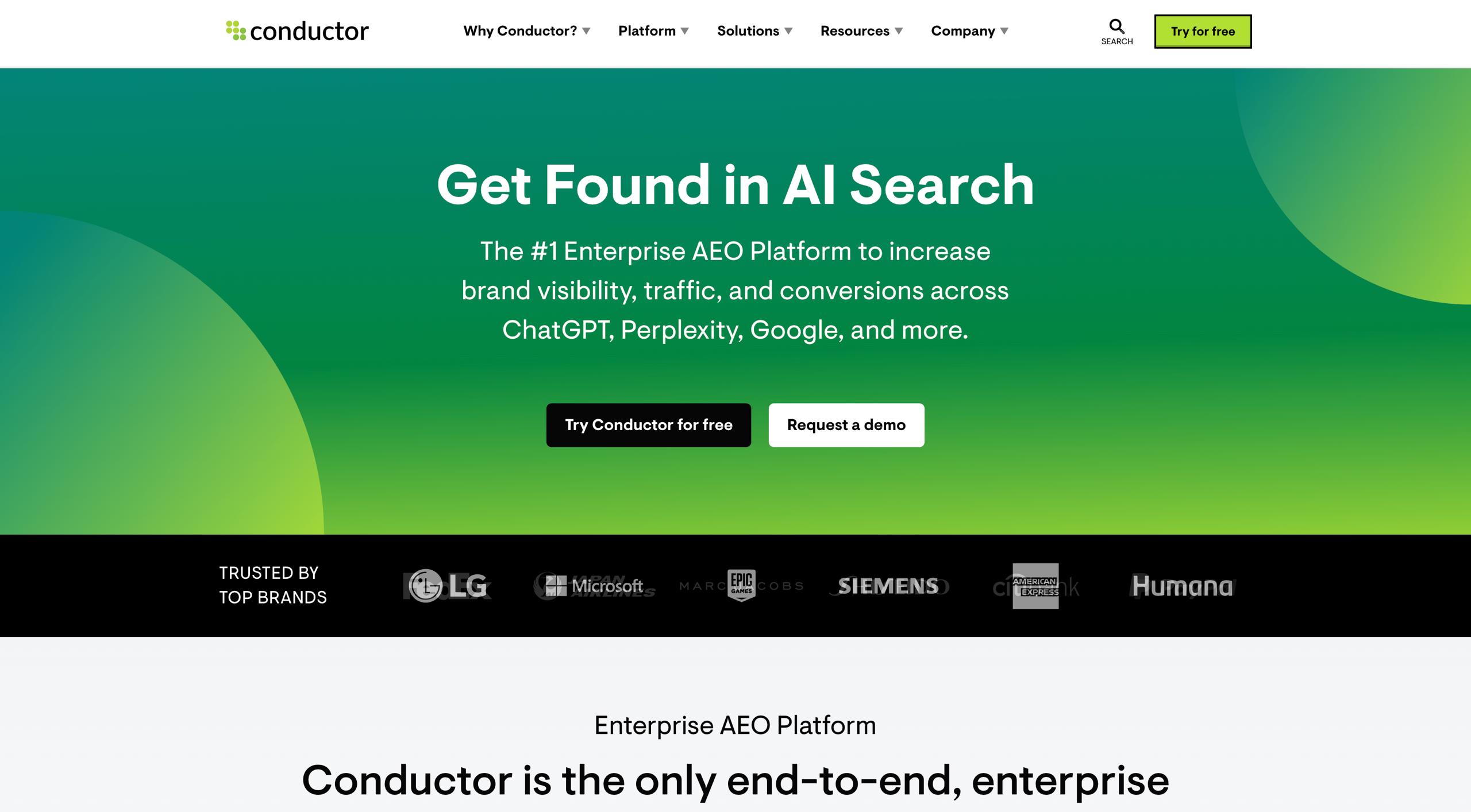
Conductor is the only end-to-end enterprise AEO platform unifying a decade of SEO data with AI search intelligence.
Conductor brings together traditional SEO infrastructure and AI visibility tracking under one roof. The platform analyzed 21.9 million searches and 3.3 billion sessions across 13,770+ domains for its 2026 AEO/GEO Benchmarks Report — the industry’s first large-scale AI search study. Its AI search performance dashboards track brand citations across ChatGPT, Perplexity, Gemini, and Google AI Overviews, while content generation tools help teams create AI-optimized assets at scale. Named a Leader in the Forrester Wave for SEO platforms and rated #1 on TrustRadius, Conductor offers MCP integration for connecting AI data to broader marketing workflows. The platform is enterprise-only, which limits accessibility for smaller teams.
Key differentiator: Proprietary benchmark dataset from 13,770+ enterprise domains bridging traditional SEO metrics with AI visibility data.
Pricing: Custom enterprise pricing (reported range: $5,000–$10,000+/mo); no public list prices. Demo required.
Best for: Large enterprises that want to unify legacy SEO operations with AI search visibility under a single platform.
2. Scrunch AI
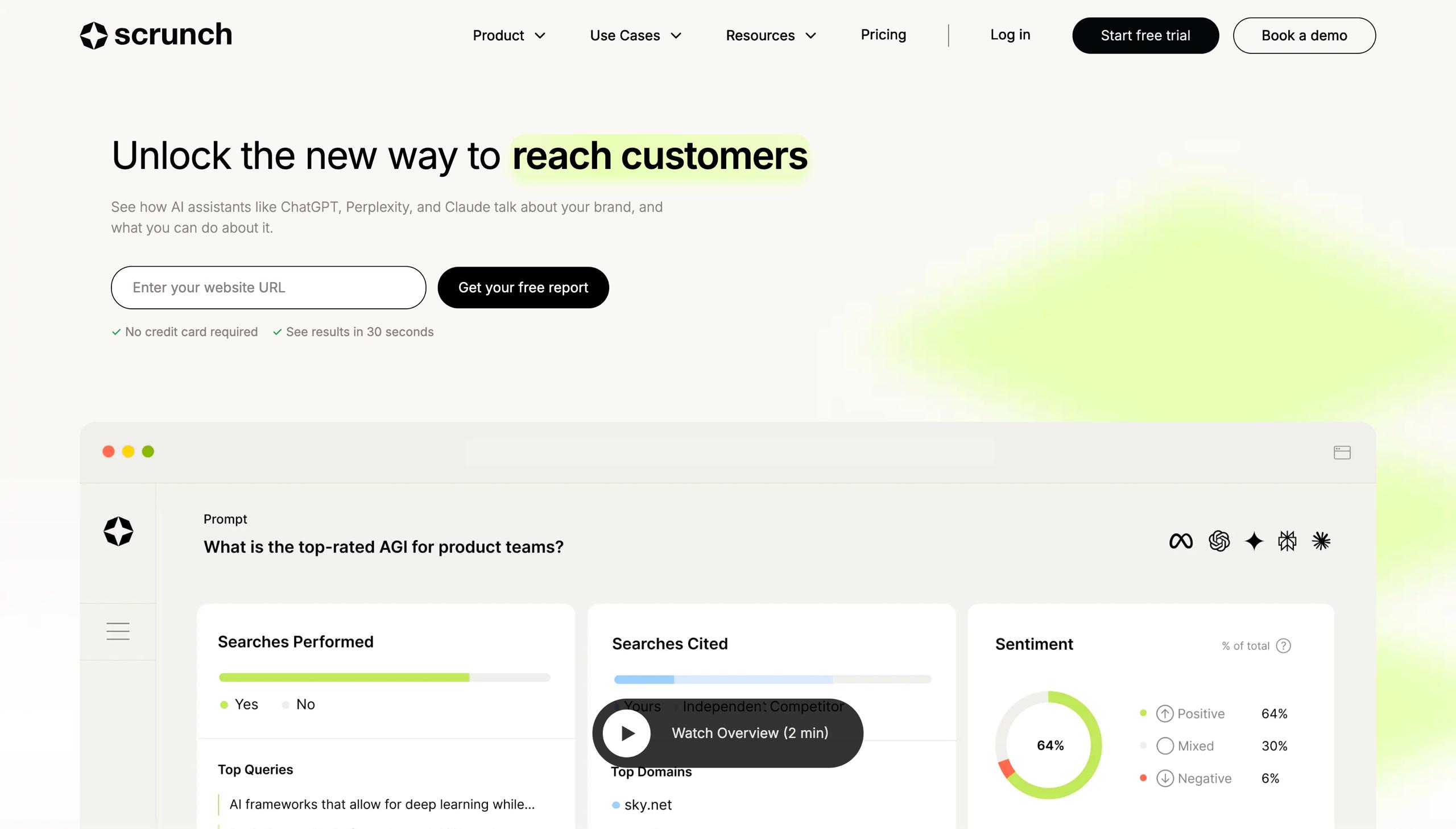
Scrunch AI serves an AI-readable version of your site to AI crawlers through its proprietary AXP technology layer.
Scrunch approaches AI search optimization from the technical infrastructure side. Its AXP (AI Experience Platform) layer creates an optimized version of your content specifically for AI crawlers — without affecting what human visitors or traditional search bots see. The platform combines this with prompt-level tracking, citation monitoring, and a technical audit system. At the mid-tier plan, it unlocks 8 AI engines including ChatGPT, Gemini, AI Overviews, Google AI Mode, Perplexity, Copilot, Meta AI, and Claude. Users praise its ease of use compared to enterprise competitors. The agency workspace makes it practical for consultancies. In June 2026, Scrunch was acquired by Sitecore, a digital experience platform with $1.23B raised and $500M+ ARR. The platform continues to operate as a standalone product under Sitecore’s ownership.
Key differentiator: AXP layer that serves AI-optimized content to AI crawlers while keeping the human experience unchanged.
Pricing: Starter from $300/mo (ChatGPT only, 350 custom prompts); Growth $500/mo (8 AI engines, 700 prompts); Enterprise custom. Additional user seats $25/mo each.
Best for: Technical SEO teams and agencies that want to control how AI crawlers read and interpret site content.
3. XFunnel AI (HubSpot)
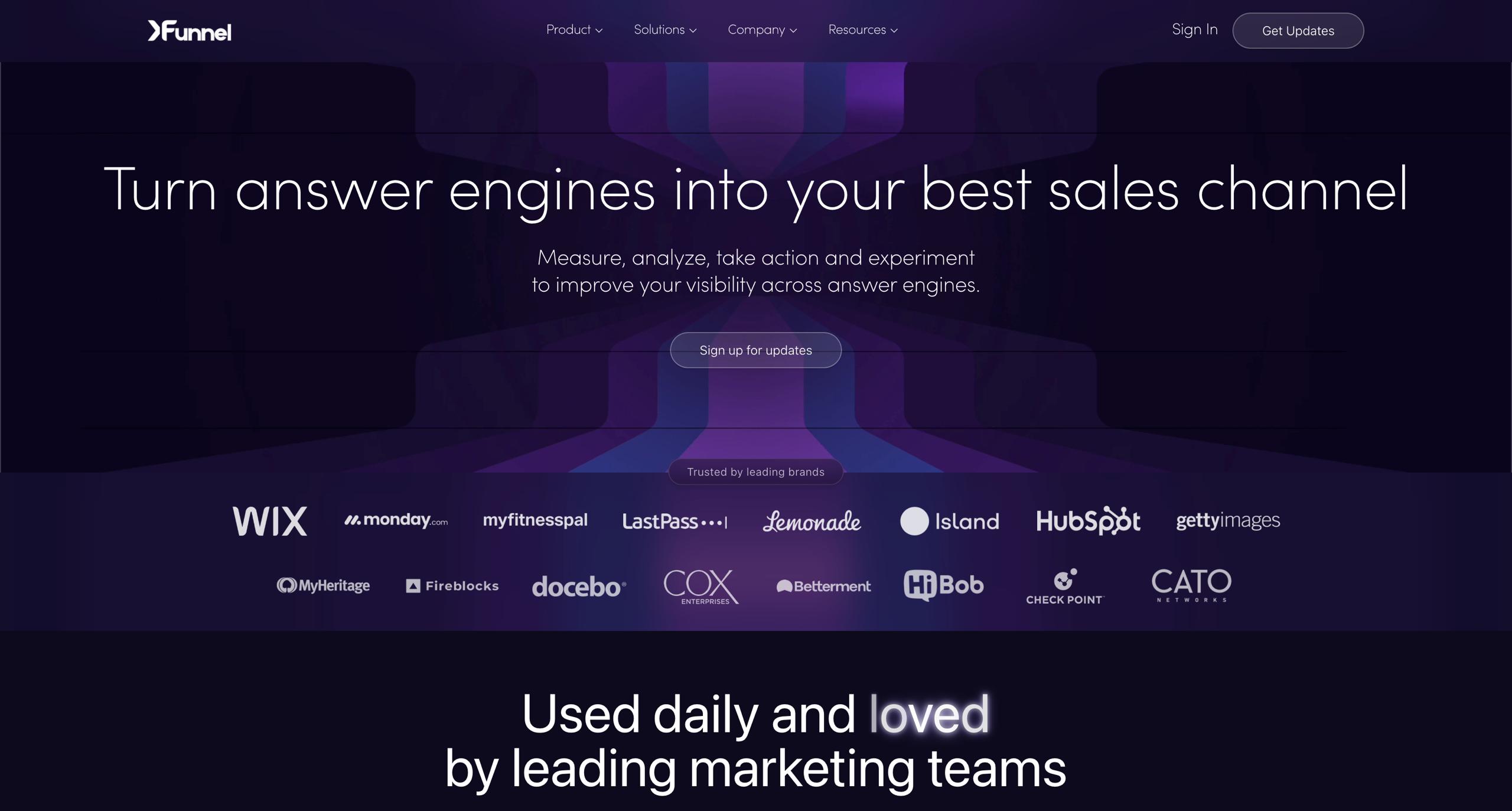
XFunnel AI connects AI search visibility directly to CRM attribution after being acquired by HubSpot in January 2025.
XFunnel made headlines when HubSpot acquired it, signaling that AI visibility is converging with mainstream marketing automation. The platform’s xFlow citation mapping traces how AI-generated responses link back to specific content, while its bot detection and GA4 integration provide AI traffic attribution that most standalone GEO tools lack. HubSpot also launched a free AEO Grader built on XFunnel’s technology, offering one-time brand assessments across ChatGPT, Perplexity, and Gemini. For HubSpot customers, AEO capabilities will be increasingly embedded into the CRM and marketing hub. In April 2026, HubSpot completed the integration and launched HubSpot AEO as a standalone product (currently in beta at $50/month for 25 prompts across ChatGPT, Gemini, and Perplexity). XFunnel’s standalone roadmap has effectively merged into the HubSpot product suite.
Key differentiator: xFlow citation mapping with GA4 attribution — tying AI visibility directly to revenue data inside HubSpot’s CRM.
Pricing: Custom; free AI Search Grader tool available for one-time assessments.
Best for: HubSpot ecosystem users who want AI visibility intelligence tied to their existing CRM and attribution stack.
🔍 Purpose-Built GEO / AI Visibility Trackers
4. Rankscale.ai
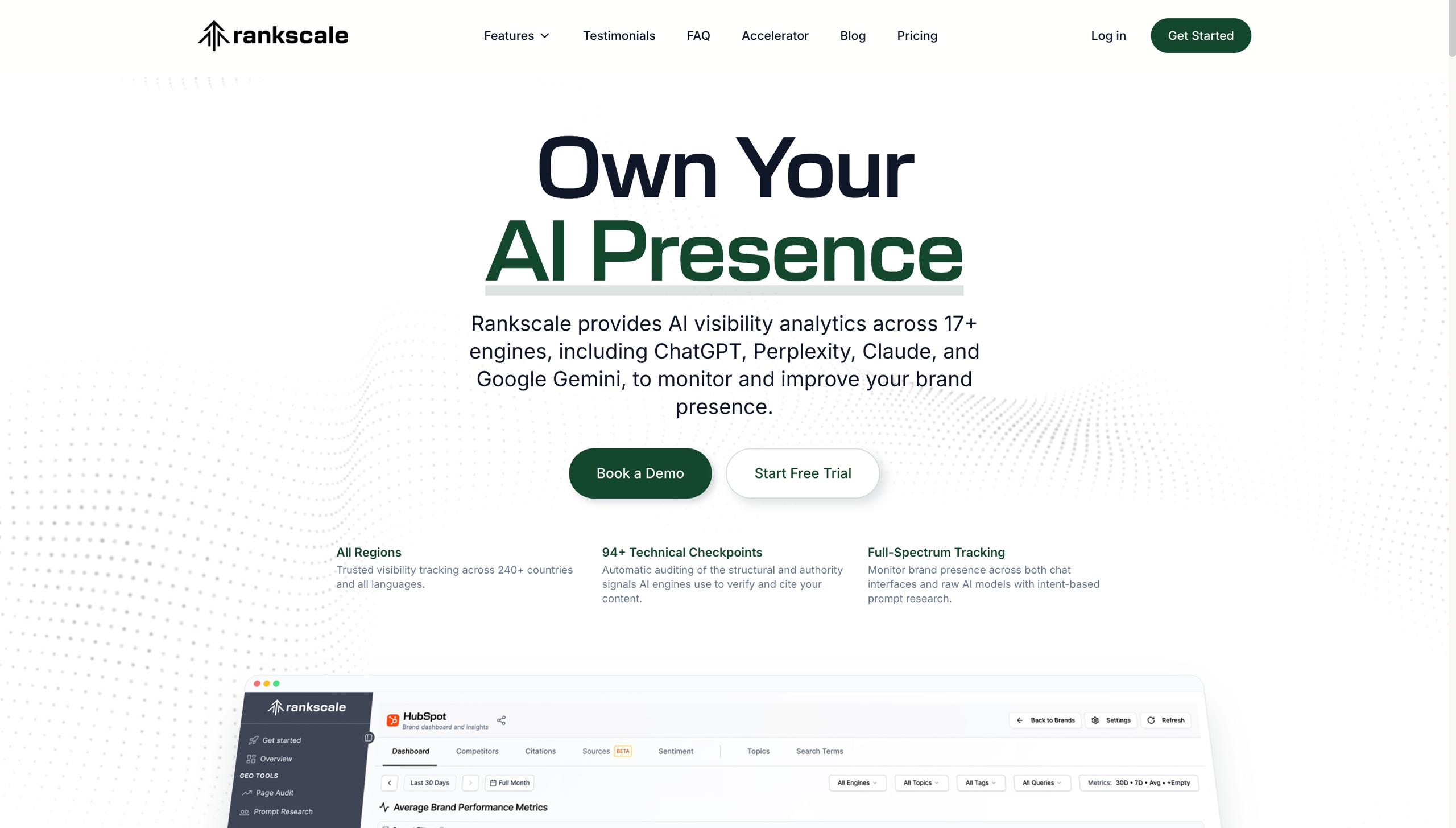
Rankscale.ai delivers the most granular AI rank tracking on the market, with hourly monitoring and region-specific precision.
Most AI visibility tracking tools give you a general score. Rankscale takes a different approach — it lets you track specific search terms on specific AI models at specific intervals for specific regions. Hourly tracking results arrive within minutes. This solves the precision problem that plagues many generative engine optimization tools: AI search is subjective based on geography and query framing. Rankscale accounts for those variables. The platform monitors 7+ AI engines and includes radar chart sentiment analysis. At the most affordable entry point in the dedicated GEO category, it holds a 4.8/5 rating on SourceForge.
Key differentiator: Hourly, region-specific AI rank tracking with drill-down precision no competitor matches at this price.
Pricing: Essentials from €20/mo (120 credits, 10 web audits); Pro €99/mo (1,200 credits, 50 audits, 25 brand dashboards); Enterprise €780/mo. Credit-based model.
Best for: Data-driven marketers and SEO specialists who want maximum control over AI tracking parameters.
5. Profound
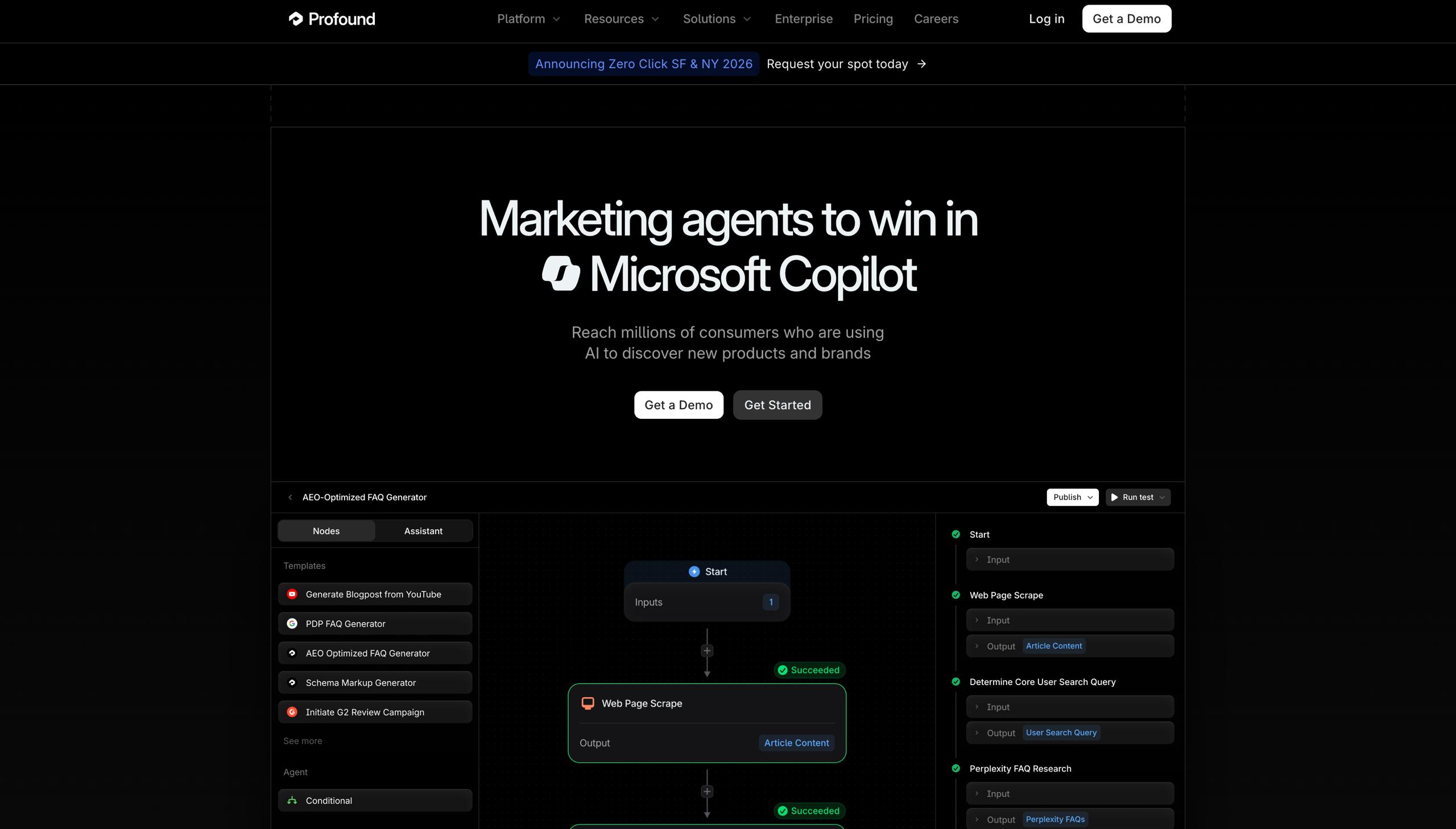
Profound is the G2 Winter 2026 Leader in answer engine optimization, tracking 10+ AI engines with proprietary prompt volume data.
Profound dominates the AEO category with 140+ G2 reviews and enterprise customers including Ramp, MongoDB, Figma, Zapier, Docusign, and Walmart. The platform tracks brand visibility across 10+ AI engines — including ChatGPT with GPT-5.2 support, Perplexity, Claude, Gemini, Grok, and DeepSeek. Its proprietary Prompt Volumes dataset estimates actual AI search conversation demand, not just brand position. The “Agents” feature generates content briefs and article drafts based on what AI models cite. Having raised $155M across four rounds — including a $96M Series C at a $1B valuation led by Lightspeed Venture Partners (February 2026) — Profound is now the category’s first unicorn. The effective entry point for meaningful functionality sits above the industry average.
Key differentiator: Proprietary Prompt Volumes — the only dataset estimating real AI search demand per topic, not just brand visibility.
Pricing: Starter $99/mo (ChatGPT only, 50 prompts); Growth $399/mo (3 engines, 100 prompts, content Agents); Enterprise custom (10+ engines). SOC 2 Type II certified.
Best for: Enterprise marketing teams that need the deepest AI visibility analytics and content operations in one platform.
6. Otterly AI
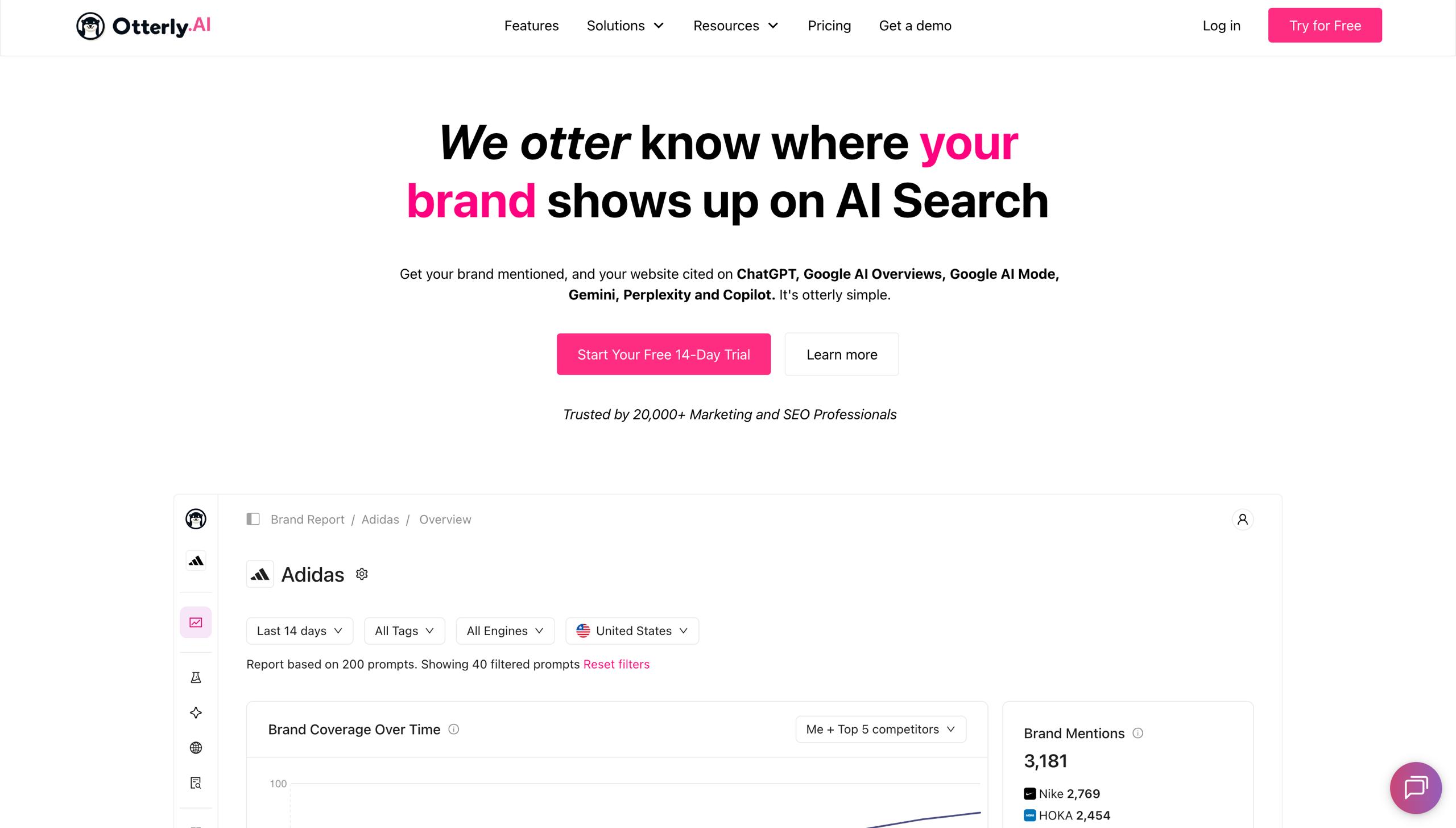
Otterly AI is the most accessible entry point for GEO tracking, with a 25-point audit and unlimited seats on all plans.
For teams just beginning to build an AI search strategy, Otterly removes barriers to entry. It monitors AI visibility across 6 platforms and includes a deep GEO audit evaluating 25+ technical and content factors. All plans include unlimited seats and reports — rare in a market where per-seat pricing inflates quickly. The 14-day free trial provides enough time for meaningful evaluation. Otterly excels at surfacing where you stand but offers less guidance on improvement compared to platforms with built-in content optimization. Frequently recommended alongside Peec AI as a strong lightweight option among AI visibility tracking tools.
Key differentiator: Unlimited seats and reports on all plans with a 25-point GEO audit — no per-user cost inflation.
Pricing: Lite $29/mo (10 prompts); Standard $189/mo (100 prompts); Premium $489/mo; Enterprise custom. Add-ons available for Gemini and Google AI Mode. 14-day free trial.
Best for: Small businesses, startups, and solo marketers who need affordable AI visibility tracking without enterprise complexity.
7. Peec AI
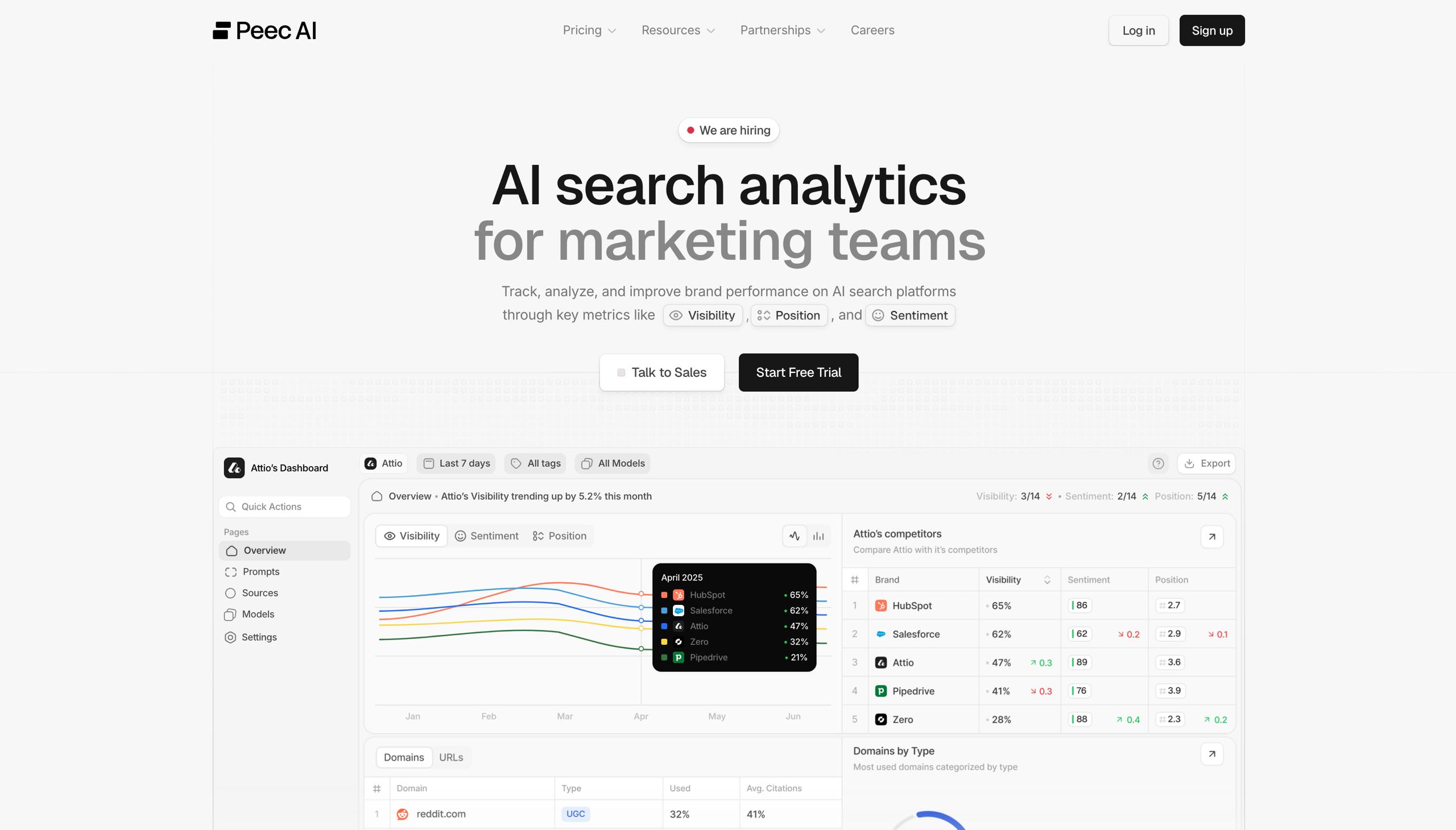
Peec AI tracks AI visibility across 115+ languages with GDPR compliance, serving international and European brands.
Berlin-based Peec AI has carved out a distinct position through multilingual capabilities. While most GEO tools default to English-first monitoring, Peec tracks brand mentions in AI-generated responses across 115+ languages. It evaluates visibility across three dimensions: Visibility (frequency), Position (placement within answers), and Sentiment (tone). All plans include unlimited seats. Peec is designed primarily for monitoring — it surfaces data clearly but leaves optimization strategy to you. Teams needing actionable content recommendations will supplement Peec with a content optimizer.
Key differentiator: 115+ language support with GDPR compliance — the strongest multilingual AI visibility tracker available.
Pricing: Starter from €89/mo; Pro from €199/mo; Enterprise custom. Unlimited seats on all plans.
Best for: International and European teams needing multilingual AI visibility monitoring with unlimited team access.
8. Botify AI Search
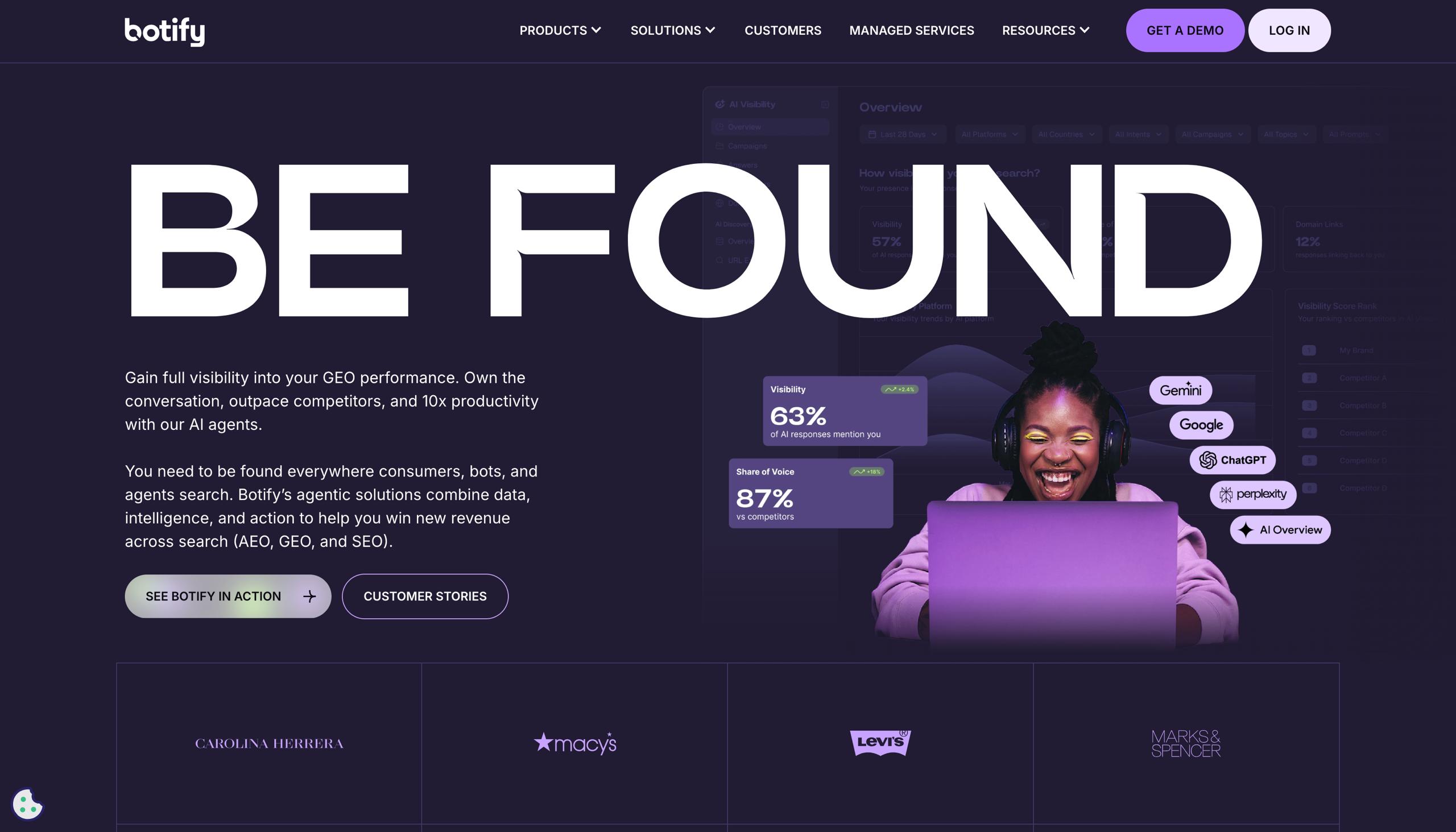
Botify combines first-party crawl data with AI visibility tracking to show enterprise brands exactly where they stand in AI search.
Botify approaches AI search from the infrastructure layer. The platform tracks share of voice, citations, and sentiment across ChatGPT, Perplexity, Google AI Mode, AI Overviews, and Gemini — but its real strength is connecting that data to first-party crawl logs and Google Search Console data. This means teams can see not just whether AI mentions their brand, but whether AI bots can actually access their content. The SpeedWorkers feature delivers fully-rendered pages to AI bots that can’t process JavaScript. Named a Strong Performer in the 2025 Forrester Wave for SEO Solutions with the highest score in 11 criteria. Enterprise-only with complex pricing.
Key differentiator: First-party log file analysis revealing exactly how AI bots interact with your site — not just scraping AI responses.
Pricing: Custom enterprise pricing based on URL volume, log analysis, and modules. Typical mid-market contracts range $75,000–$150,000/year; enterprise 1M+ URL deployments higher.
Best for: Enterprise technical SEO teams managing large, complex sites that need full visibility into AI crawler behavior.
🧠 AI-Powered Content Optimization
9. Clearscope
Clearscope delivers best-in-class topical authority analysis, helping editorial teams cover every angle AI models look for.
Clearscope focuses on one thing: ensuring your content comprehensively covers the topics that matter. It analyzes search intent and competitor content, then grades your writing in real time. For AI search visibility, this focus on topical completeness is increasingly valuable — AI models cite content that demonstrates deep, authoritative coverage rather than mere keyword targeting. The interface is widely considered the most intuitive in the content optimization category. The trade-off is scope: no keyword research, rank tracking, or AI visibility monitoring. It’s a pure AI content optimization tool that pairs well with a GEO tracker.
Key differentiator: The most intuitive content grading interface in the market, focused purely on topical depth and completeness.
Pricing: Essentials from $189/mo (single user); Business and Enterprise tiers available with expanded seats and volume.
Best for: Editorial teams and enterprise content operations that prioritize comprehensive coverage as their path to AI citations.
10. Frase
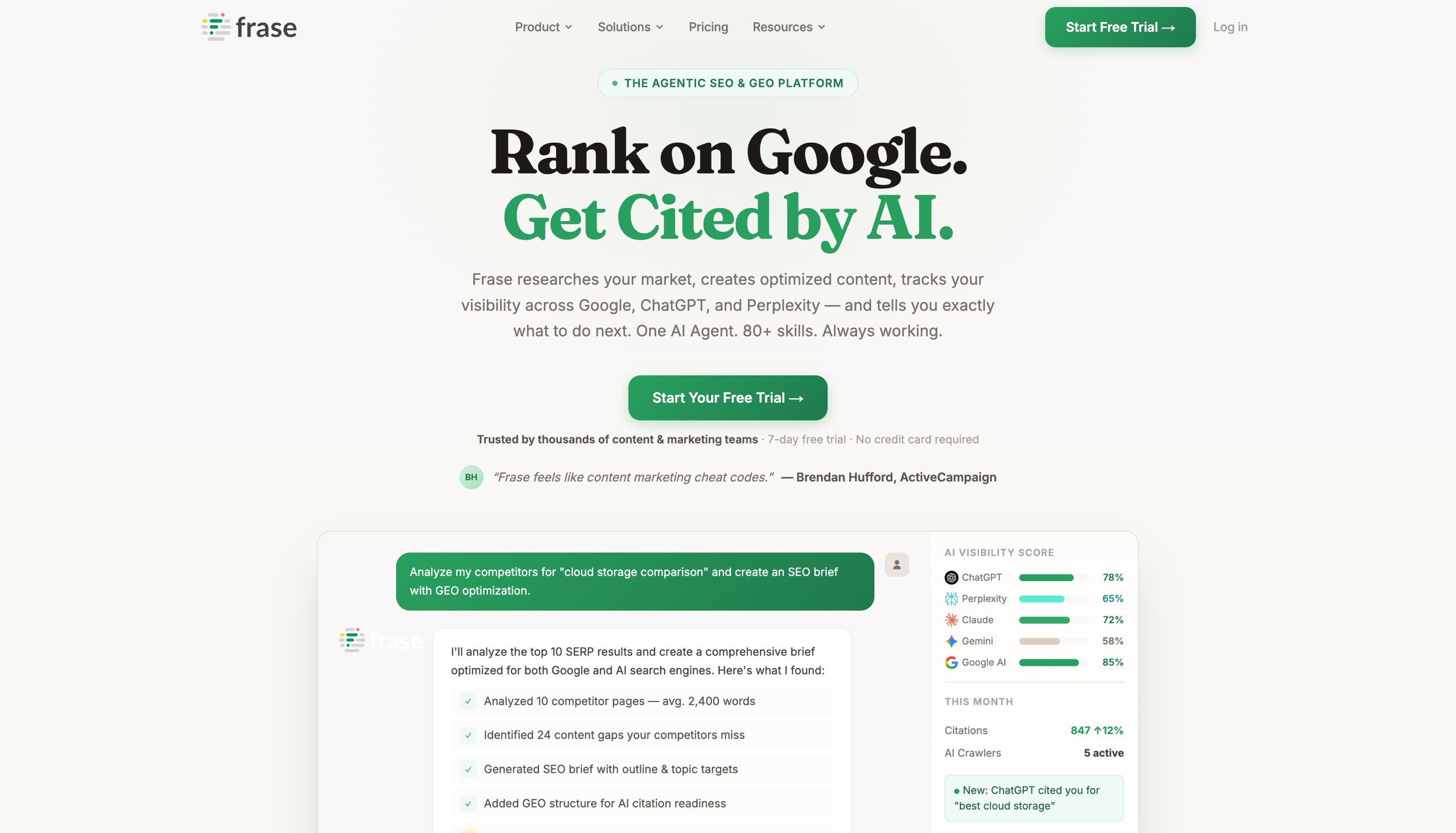
Frase consolidates research, brief creation, writing, and optimization into one interface built around answering questions.
Frase analyzes the top 20 Google results for your keyword and generates detailed content briefs with recommended headings, questions, and topics. The AI writing assistant drafts sections based on those briefs. For AI search optimization, this question-oriented approach is strategically sound — AI assistants are answer engines that favor content structured around clear questions with authoritative responses. The answer engine optimization features help format content for featured snippets and answer boxes, which increasingly feed into AI training data. Keyword research is less developed than dedicated SEO platforms.
Key differentiator: Question-first workflow that structures content around the exact queries AI assistants are designed to answer.
Pricing: Solo from $15/mo; Basic $45/mo; Team $115/mo (3 users). All plans include AI writing and optimization features.
Best for: Content creators focused on answering user questions comprehensively and capturing featured snippets that feed AI-generated search results.
11. MarketMuse
MarketMuse — now part of Siteimprove following an acquisition completed in October 2024 — uses AI-driven content intelligence to identify topical authority gaps and prioritize winnable opportunities. Teams evaluating MarketMuse should assess it as part of the broader Siteimprove platform rather than as a standalone product.
MarketMuse analyzes your entire content library to find topical gaps, competitive advantages, and opportunities where new content can have the biggest impact. The personalized difficulty scoring evaluates how hard it will be for your specific domain to rank — not general competition. For AI search strategy, this matters because generative engines favor sources with deep expertise across topic clusters. MarketMuse answers “what should we write about?” rather than “how should we write this?” Teams benefit from pairing it with a real-time content optimizer like Clearscope.
Key differentiator: Personalized keyword difficulty scores based on your existing domain authority — not generic competition data.
Pricing: Now bundled within Siteimprove’s platform. Verify current standalone availability and pricing directly with Siteimprove, as packaging has changed post-acquisition.
Best for: Content strategists who need data-driven guidance on which topics to pursue for maximum AI and organic search impact.
12. Lumar GEO Toolkit
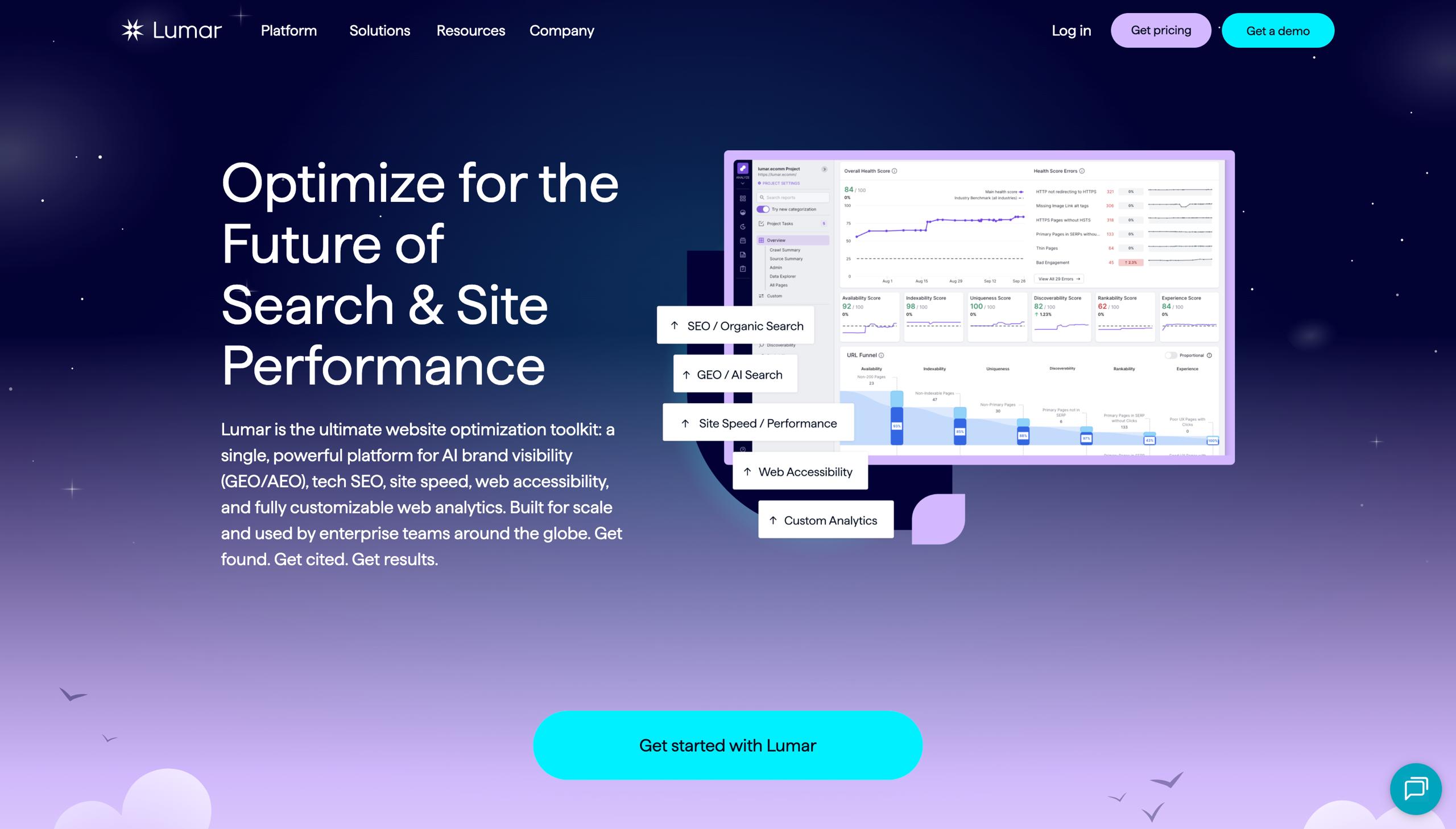
Lumar (formerly Deepcrawl) brings enterprise-grade technical auditing to GEO with a structured 3-part AI readiness framework.
Lumar extends its industry-leading website crawler into the GEO space with dedicated AI visibility dashboards. The GEO Toolkit evaluates your site through a three-part funnel — AI Discoverability (can AI bots find your content?), AI Understanding (can they interpret it?), and AI Inclusion (will they cite it?). GEO health scores and data visualizations give teams an instant view of AI readiness, while the Content Evaluator assesses pages using the same logic as generative AI. SOC 2 Type 2 certified. The platform identifies technical barriers like robots.txt blocks on GPTBot and PerplexityBot that silently kill AI visibility.
Key differentiator: Three-part GEO funnel framework (Discover → Understand → Include) with enterprise crawl technology scanning millions of pages.
Pricing: Custom enterprise pricing; professional services available as an add-on.
Best for: Enterprise SEO teams that need to audit and fix the technical foundations of AI visibility at scale.
📝 AI Content Generation + SEO
13. Writesonic
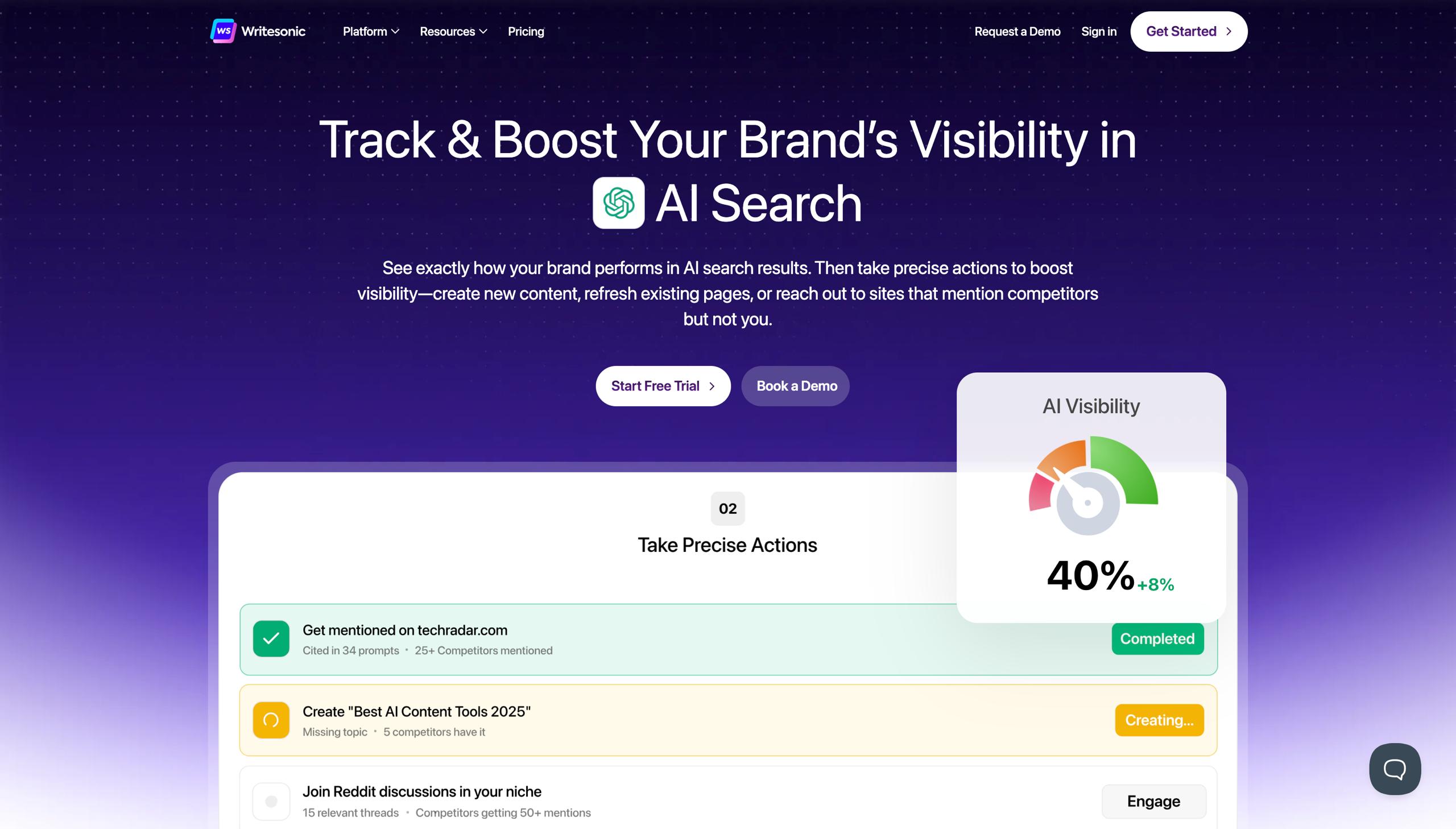
Writesonic bundles AI visibility monitoring, content optimization, and content generation into a single workflow for content-heavy teams.
Writesonic has evolved from a pure AI writer into an integrated AI SEO software platform. The current offering bundles SEO tools, content creation, and AI search tracking. The monitoring side lets teams simulate prompts and analyze how their brand appears in AI-generated responses. The content side integrates with Ahrefs and Semrush for keyword research and includes automated workflows. Users describe it as “Ahrefs for AI.” Content requires editing to match expert-level quality, as with any AI generation tool. The platform is actively evolving, with AI crawler analytics added in recent updates.
Key differentiator: Unified platform combining AI visibility monitoring with content generation — reducing tool sprawl for content teams.
Pricing: Individual from $49/mo; Professional from $249/mo (includes full AI SEO suite); Enterprise custom. Free plan available with limited features.
Best for: Content-heavy marketing teams that need AI visibility monitoring and content production without managing multiple tools.
14. Koala AI
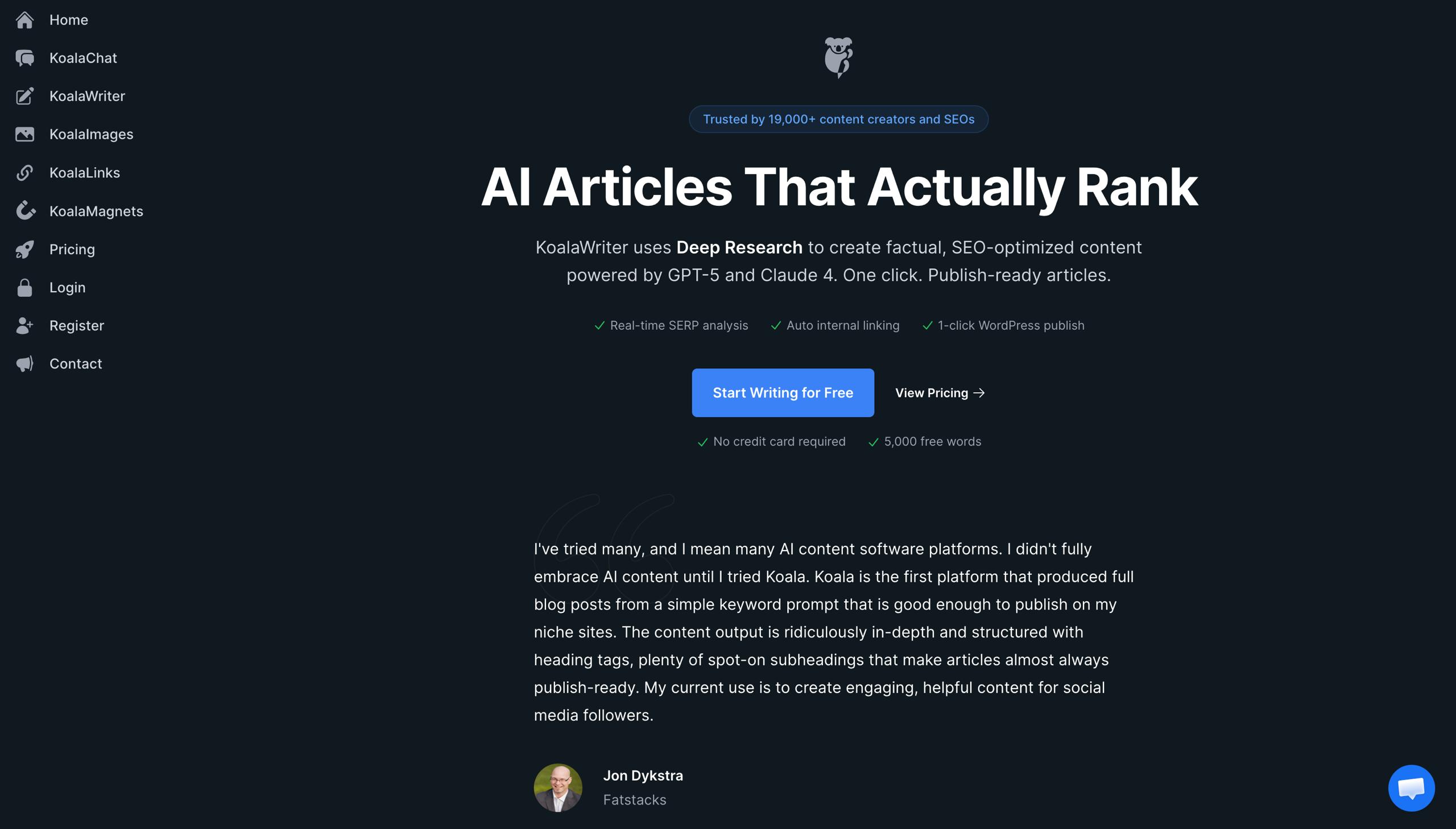
Koala AI generates publish-ready SEO articles from a single keyword using real-time SERP analysis and GPT-5/Claude 4.
Koala targets a specific need: producing high volumes of SEO-optimized content quickly. It combines GPT-5 and Claude 4 family models with live SERP analysis to generate articles structured around actual search intent. KoalaWriter v2 (launched April 2026) adds Brand DNA controls and improved long-form coherence. The automatic internal linking feature has created over 10 million links. Publishing integrations with WordPress, Shopify, Webflow, and Ghost push content directly to your CMS. Content quality is strong for first drafts but needs expert editing for unique insights. Koala is not a GEO tool — it doesn’t track AI visibility. Its relevance is indirect: well-structured, entity-rich content is what AI models prefer to cite.
Key differentiator: One-click article generation with automatic internal linking and real-time SERP optimization — 10M+ links created.
Pricing: Essentials from $9/mo; Professional $39/mo (annual); Boost $79/mo; Growth $143/mo. Free trial with 5,000 words, no credit card required.
Best for: Affiliate marketers and content teams that need to scale SEO content production rapidly with minimal manual effort.
⚙️ Technical / Automation
15. Alli AI
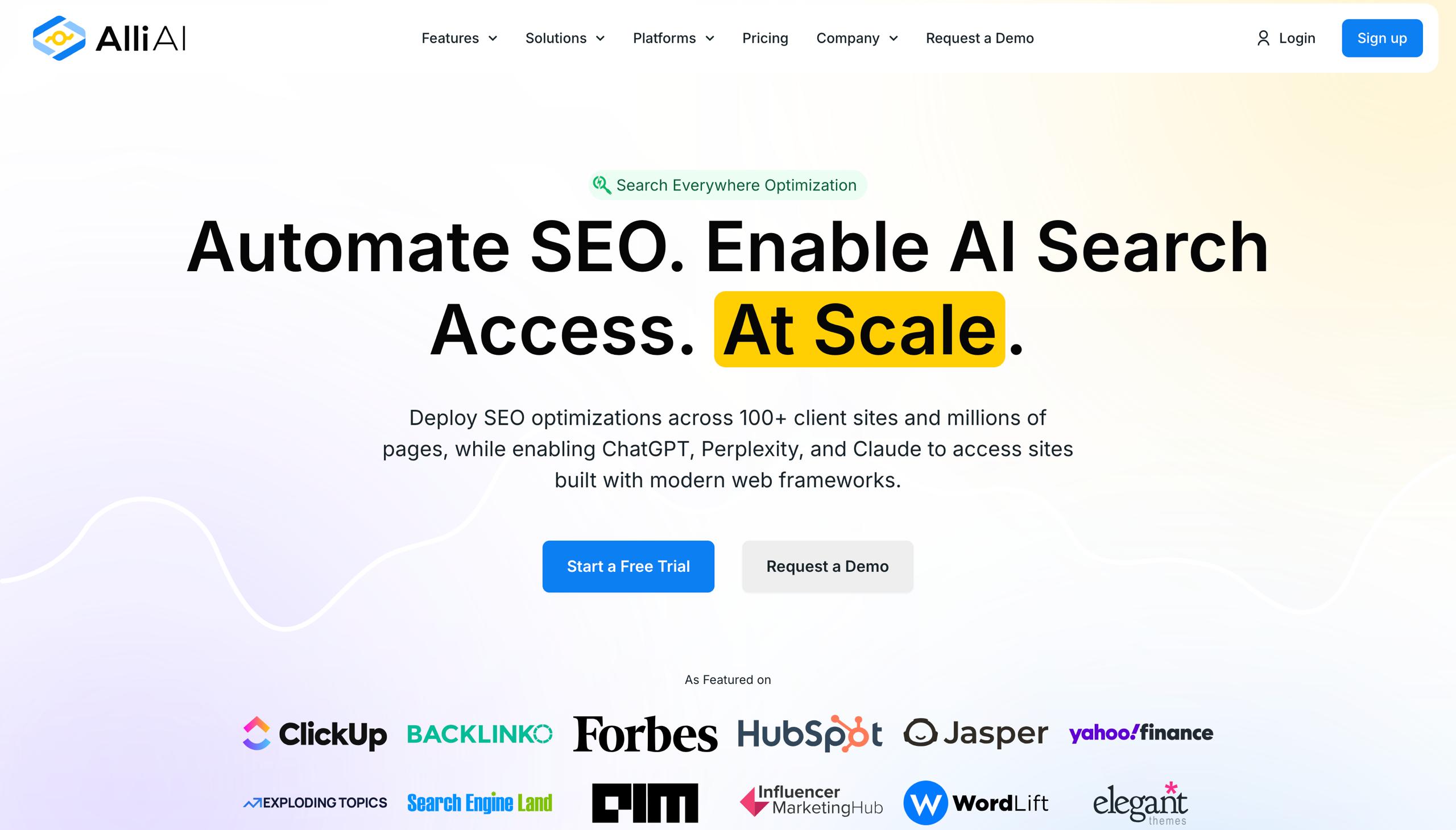
Alli AI automates on-page SEO deployment at scale and ensures 50+ AI crawlers can access your content across any CMS.
Alli AI solves a problem most AI search engine optimization tools don’t address: technical execution. While other platforms tell you what to optimize, Alli implements changes automatically. It connects to any CMS via a JavaScript snippet and deploys meta tags, schema markup, and internal linking across thousands of pages in minutes. For AI search, its server-side rendering detects GPTBot, ClaudeBot, PerplexityBot, and 50+ other AI crawlers, serving pre-rendered HTML they can read. Critical for JavaScript-heavy sites built with React or Vue that appear blank to AI bots. Requires existing SEO knowledge — it automates execution, not strategy.
Key differentiator: Server-side rendering for 50+ AI crawlers plus automated on-page deployment across any CMS — no developer dependency.
Pricing: Consultant from $299/mo (up to 5 sites); additional sites $39/mo each. Agency and Enterprise tiers available. 10-day free trial.
Best for: Agencies and enterprise teams managing large site portfolios that need automated technical SEO and AI crawler accessibility.
How to Build Your AI SEO Tool Stack in 2026
The most effective AI SEO strategy combines a GEO tracker, a content optimizer, and your existing SEO platform.
No single tool covers every aspect of AI search optimization. The strongest approach layers complementary capabilities into a focused stack
Step 1 — Audit your current AI visibility. Use free tools like HubSpot’s AEO Grader to get a baseline assessment of your brand across ChatGPT (GPT-4o), Perplexity, and Gemini.
Step 2 — Choose a GEO tracking tool. Pick based on the AI platforms your audience uses: Rankscale for granular drill-down, Profound for enterprise depth, or Otterly for an accessible starting point.
Step 3 — Layer in a content optimizer. Add a tool like Clearscope or Frase to improve your content’s citation-worthiness and topical authority.
Step 4 — Connect to your existing SEO data. Correlate AI visibility changes with traditional search performance through your current SEO platform.
Step 5 — Review monthly. Track AI visibility metrics alongside traditional SEO KPIs. LLM-referred visitors convert at 4–11x the rate of organic search traffic depending on the platform and industry — a small but fast-growing channel worth monitoring now.
GEO Tools vs. Traditional SEO Tools: Key Differences
GEO tools measure AI citations and brand mentions; traditional SEO tools measure rankings and clicks.
| Dimension | Traditional SEO Tools | GEO / AI Visibility Tools |
|---|---|---|
| What they track | Keyword rankings, organic traffic, backlinks | Brand mentions in AI answers, citations, share of voice |
| Success metrics | Rankings, clicks, CTR, sessions | AI visibility score, citation rate, sentiment |
| Primary platforms | Google, Bing | ChatGPT, Perplexity, Gemini, Claude, AI Overviews |
| Best for | Driving organic website traffic | Improving brand presence in AI-generated search results |
| Limitations | Can’t track zero-click AI answers | Limited historical data; accuracy fluctuates with model updates |
The distinction between GEO vs SEO isn’t about replacement — it’s about coverage. Brands need both surfaces: traditional search for traffic-driving queries and AI search for brand discovery moments. The most effective stacks combine a traditional SEO platform with a dedicated GEO tracker for the AI visibility layer.
What AI Search Engine Optimization Tools Can’t Do
No tool can guarantee AI visibility — but the right ones show you exactly where to focus your efforts.
AI search visibility is inherently volatile. A Semrush study found that 96% of AI Overviews swapped cited domains and not a single keyword maintained stable URL citations 100% of the time (URL Volatility in AI Overviews, Semrush’s report). Even the best AI visibility tracking tools report a moving target, not a fixed position. Tools provide data, not strategy — human interpretation, brand authority, and content expertise still drive results. AI models change constantly, and tool accuracy fluctuates as engines update retrieval methods. Most GEO tools are still early-stage products. Expect feature gaps and evolving accuracy. The best results come from combining tool intelligence with expert AI search strategy and disciplined execution.
Conclusion
The right AI search engine optimization tools turn AI visibility from a guessing game into a measurable strategy.
The dual-surface reality of search in 2026 is clear. Brands need visibility in both traditional Google results and AI-generated answers across ChatGPT, Perplexity, Gemini, and Google AI Overviews. The 15 tools in this guide cover the full spectrum — from all-in-one platforms that extend traditional SEO into AI territory, to purpose-built GEO trackers, to content optimizers that make your pages worth citing.
Tools show you where you stand. But for teams that want to move beyond dashboards into strategic execution, working with a specialized AI SEO partner accelerates results. ICODA has established itself as a leader in AI search optimization services, combining strategic execution with tool-driven intelligence to help brands win visibility across both traditional and AI-powered search. When the data points to opportunity, a partner like ICODA helps you capture it.
Traditional SEO focuses on ranking in Google search results and driving clicks to your website. GEO (Generative Engine Optimization) focuses on getting your brand mentioned and cited in AI-generated answers from ChatGPT, Perplexity, Gemini, and Google AI Overviews — where 93% of sessions end without a click.
Traditional SEO platforms like Semrush and Ahrefs have added AI visibility features, but they primarily track rankings and backlinks — not brand mentions in AI answers. For comprehensive AI citation tracking, most teams pair their existing SEO platform with a dedicated GEO tool like Rankscale, Profound, or Otterly AI.
Most AI visibility tracking tools send prompts to ChatGPT and other AI platforms at regular intervals, then analyze whether your brand appears in the response, where it’s positioned, what sentiment is expressed, and which sources are cited. Some tools like Botify also track AI crawler behavior through server log analysis.
Actually, no tool can guarantee AI visibility — AI-generated search results are inherently volatile. A Semrush study found that 96% of AI Overviews swapped cited domains over time. However, the best AI content optimization tools like Clearscope and Frase help you create structured, authoritative content that significantly increases your chances of being selected as a source.
GEO tools range widely in price. Budget-friendly options like Rankscale.ai start from €20/mo and Otterly AI from $29/mo, while enterprise platforms like Profound start at $99/mo and scale to $399/mo+. The industry average across 20+ dedicated AI visibility tracking tools is approximately $337/mo — comparable to mid-tier traditional SEO software.
Answer engine optimization is the practice of structuring content so AI assistants like ChatGPT, Perplexity, and Gemini select it as a trusted source in their responses. As zero-click AI answers replace traditional search results for more queries, AEO has become essential for brands that want to stay visible where their audience is actually discovering products and services.
Share with


Rate the article