




AI-generated answers now sit above organic results on Google, Bing, Perplexity, and ChatGPT search. If your brand doesn’t appear in those responses, you’re invisible to a growing share of your audience. That’s created a new category of software: AI visibility tools — platforms that track whether (and how) AI models mention your brand, products, and content.
The problem? There are already dozens of options, and most “best AI visibility tools” lists are affiliate plays. We took a different approach: we picked one real website, ran it through seven tools, and wrote down what we actually found.
How We Tested: One Site, Seven Tools, Same Week
We ran CoinGecko through all seven tools during the same week in April 2026 to keep variables consistent.
For each tool, we evaluated:
- AI mention tracking — Does the tool detect when AI models (ChatGPT, Gemini, Perplexity, Claude) reference the brand or its content?
- Prompt coverage — How many prompts or queries does it monitor? Are they relevant or generic?
- Competitive benchmarking — Can you compare your AI visibility against competitors?
- Actionable output — Does it tell you why you’re visible (or not) and what to change?
- Pricing transparency — Is the cost clear before you commit?
We weren’t looking for a winner. We were looking for which tool fits which use case.
Why CoinGecko — and Why It Makes This Comparison Interesting
We needed a site that’s well-known but not dominant in its category, a tier-2 brand where the results wouldn’t be obvious before we started. CoinGecko (coingecko.com) fit perfectly. It’s one of the most-used crypto data aggregators in the world, tracking prices, charts, and market data across thousands of tokens. Nearly everyone in crypto knows it, but it lives in CoinMarketCap’s shadow, which made for a genuine question: does CoinGecko actually show up when AI models answer crypto-related queries, or does CoinMarketCap eat all the visibility?
Turns out, the answer depends heavily on which tool you ask.
Quick Comparison Table
| Tool | Starting Price | AI Models Tracked | Competitive Analysis | Best For |
|---|---|---|---|---|
| ICODA AI Visibility Tool | Free | ChatGPT, Gemini, Perplexity, Claude | Limited | Fast free audit, best starting point |
| Profound | $99/mo | ChatGPT, Gemini, Perplexity, Claude + more at higher tiers | Yes | Enterprise AI search analytics |
| Otterly.ai | $29/mo | ChatGPT, Perplexity, Google AI Overviews, Copilot | Yes | Brand monitoring at scale |
| Peec AI | €85/mo | ChatGPT, Perplexity, Google AI Overviews + add-ons | Yes | Visibility analytics & rankings |
| Scrunch AI | $300/mo | ChatGPT, Gemini, Perplexity, Claude, Copilot + more | Yes | Citation analysis & competitive intelligence |
| Ahrefs | $129/mo | Google AI Overviews, ChatGPT, Perplexity, Gemini, Copilot | Yes | SEO teams adding AI tracking |
| HubSpot AEO Grader | Free | ChatGPT, Perplexity, Gemini | No | Quick one-time brand audit |
AI Visibility Tools Tested on CoinGecko: Detailed Breakdown
ICODA AI Visibility Tool — Best Free Starting Point
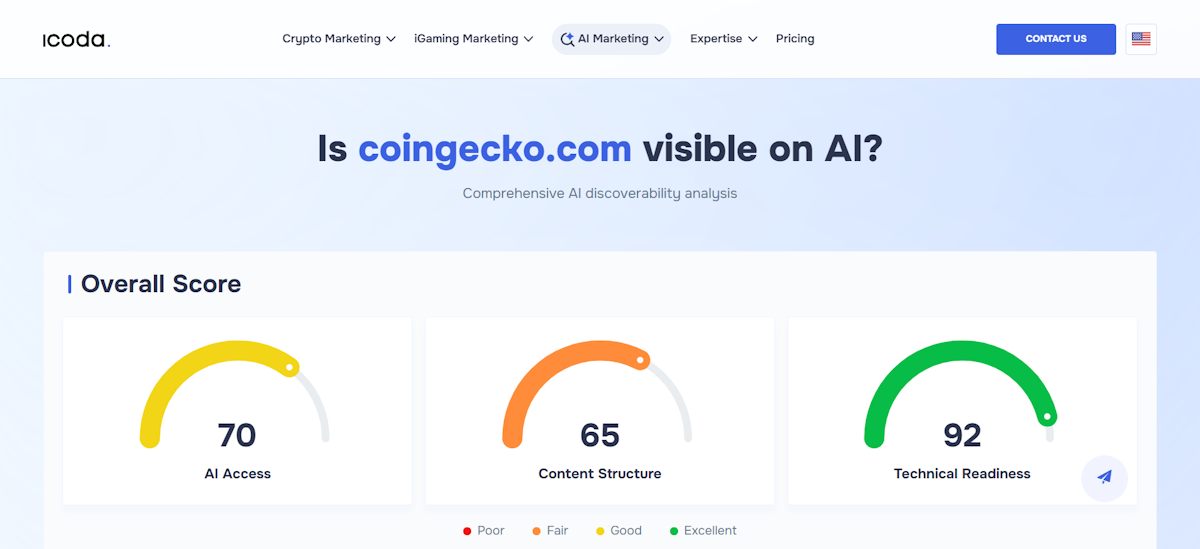
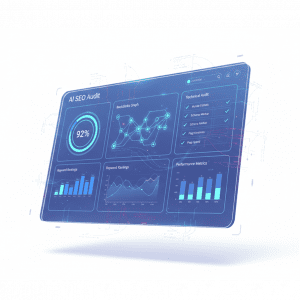
ICODA’s AI Visibility Tool is a free tool that analyzes how AI-discoverable your website is. Instead of tracking brand mentions in AI responses, it evaluates your site’s readiness for AI search from a technical standpoint — scoring AI Access, Content Structure, and Technical Readiness.
We built it because our clients kept asking “do AI models know about us?” and we needed a fast way to answer that question. We’re including it in this comparison because it fills a real gap — but we’ll be just as honest about its limitations as we were with every other tool on this list.
What we found: CoinGecko scored 70 for AI Access (Good), 65 for Content Structure (Fair), and 92 for Technical Readiness (Excellent). This tells a nuanced story: CoinGecko’s technical infrastructure is highly optimized for AI crawling and indexing, but there’s room to improve how content is structured for AI retrieval. The AI Access score suggests that while AI models can reach CoinGecko’s content, some barriers remain.
What it does well:
- Free, no credit card, no 14-day trial bait
- Evaluates AI readiness from a different angle — technical and structural, not just mention tracking
- Returns results quickly — useful for client pitches or internal audits
- Simple enough for non-technical team members to use
Where it falls short:
- It’s a snapshot tool, not an ongoing tracker — you won’t get daily or weekly monitoring
- Doesn’t track brand mentions in AI responses (Otterly, Peec, Profound cover that)
- No competitive analysis beyond your own site
- Fewer prompts and less depth than paid tools
Pricing: Free.
Who it’s for: Teams that want a quick, honest read on their site’s AI readiness before deciding whether to invest in a paid tool. It’s also useful for agencies that need to show clients their current AI visibility status during a pitch or strategy session.
→ Try the free AI Visibility Tool
Profound — Best for Enterprise-Level AI Analytics
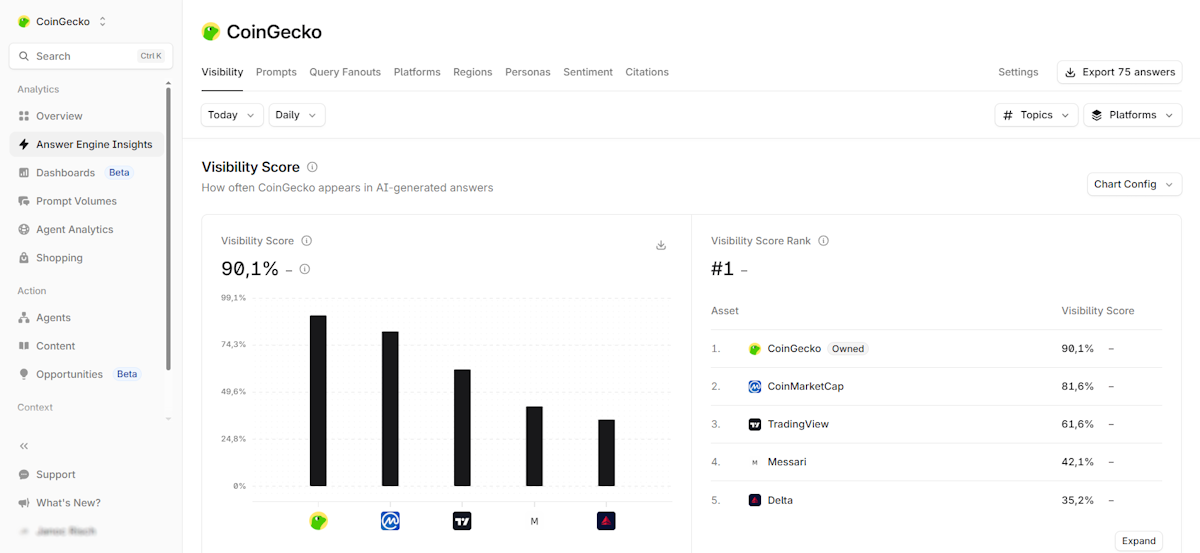
Profound positions itself as the enterprise platform for AI search visibility. Backed by $155M in funding and valued at $1B as of early 2026, it tracks mentions across up to 10 AI models on the Enterprise tier, with deep analytics around visibility score, competitive rankings, query fanouts, regional breakdowns, personas, and sentiment analysis.
What we found: The depth of data is impressive. Profound gave CoinGecko a Visibility Score of 90.1% and ranked it #1 in its competitive set, ahead of CoinMarketCap (81.6%), TradingView (61.6%), Messari (42.1%), and Delta (35.2%). The platform didn’t just show us whether CoinGecko appeared — the bar chart visualization made it immediately clear how far ahead (or behind) CoinGecko was versus each competitor. Multiple tabs for Prompts, Query Fanouts, Platforms, Regions, Personas, Sentiment, and Citations give enterprise teams plenty to dig into.
Pros:
- Deepest analytics in the category with the most granular breakdown
- Visibility Score methodology gives a single benchmark number
- Content creation tools and AI-optimized briefs on Growth+ plans
- SOC 2 Type II compliance for enterprise security requirements
- Agent Analytics tracks how AI crawlers interact with your site
Cons:
- Starter plan ($99/mo) covers ChatGPT only — you need Growth ($399/mo) for 3 models
- Steep learning curve; this isn’t a plug-and-play tool
- Content generation capped at 3 articles/month even on Growth
- Overkill for small teams or single-site monitoring
Pricing: Starter at $99/mo (50 prompts, ChatGPT only). Growth at $399/mo (100 prompts, 3 AI models). Enterprise has custom pricing with up to 10 models. Seven-day free trial on Growth.
Verdict: If you’re a mid-to-large company with multiple brands or product lines and you need AI visibility data integrated into your broader marketing analytics — with enterprise-grade compliance — Profound is built for that.
Otterly.ai — Best for Ongoing Brand Monitoring
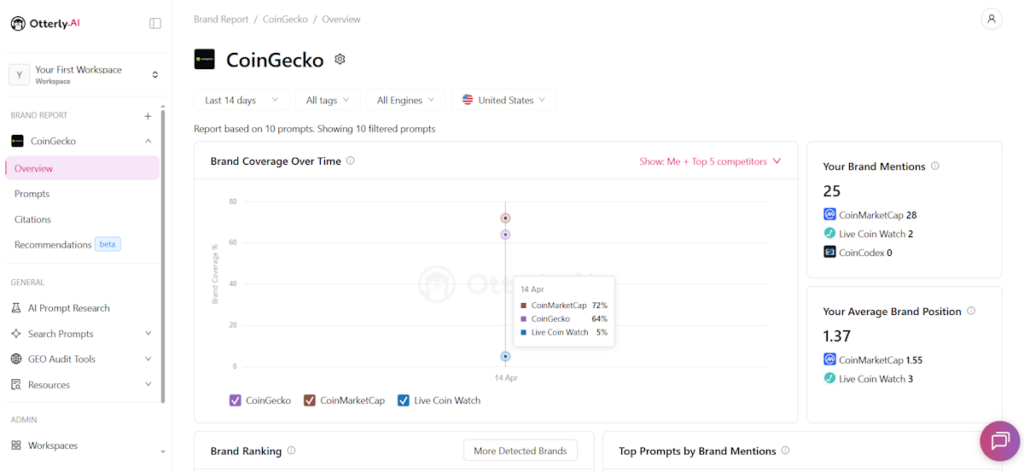
Otterly tracks your brand’s presence across AI-generated answers on a recurring basis. You define the prompts you care about (or use their suggested ones), and the platform monitors whether your brand appears in responses from ChatGPT, Perplexity, Google AI Overviews, and Microsoft Copilot. It also offers Gemini and Google AI Mode as add-on packages.
What we found: Setup took about 15 minutes. We tracked 10 prompts for CoinGecko and the dashboard populated within a day. The “Brand Coverage Over Time” chart showed CoinGecko at 64% brand coverage on April 14, trailing CoinMarketCap’s 72%. Live Coin Watch came in at just 5%. CoinGecko racked up 25 brand mentions versus CoinMarketCap’s 28, with an average brand position of 1.37 — meaning when CoinGecko does appear, it tends to appear near the top of the response. CoinCodex scored 0 mentions.
Pros:
- Clean, intuitive interface with minimal learning curve
- Automated monitoring with daily/weekly tracking cadence
- Prompt suggestions save real time on initial setup
- Clear competitor comparison on the same dashboard
Cons:
- Gets expensive quickly if you track hundreds of prompts ($189/mo for 100 prompts, $989/mo for 1,000)
- Gemini and Google AI Mode require paid add-ons
- More focused on where you stand than how to improve
Pricing: Starts at $29/mo (Lite, ~15 prompts). Standard is $189/mo for 100 prompts. Pro is $989/mo for 1,000 prompts. Monthly billing, cancel anytime.
Verdict: If your primary goal is knowing whether AI models mention your brand — and watching that trend over time — Otterly is the most accessible entry point in the category.
Peec AI — Best for Visibility Rankings & Competitive Positioning
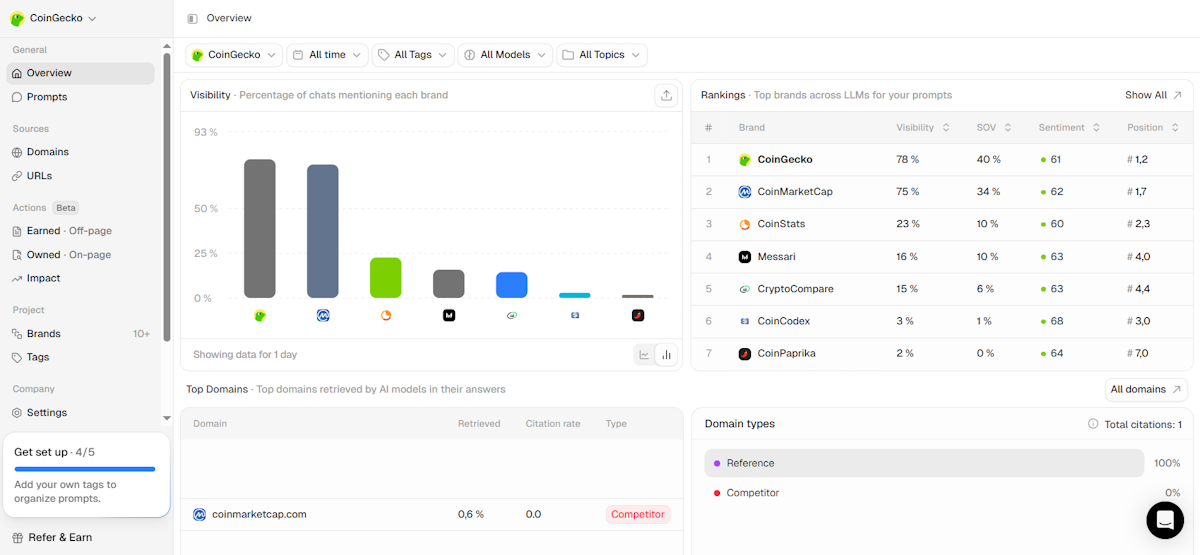
Peec AI is an AI search analytics platform built for marketing teams and agencies. It tracks brand visibility, share of voice, sentiment, and competitive rankings across ChatGPT, Perplexity, and Google AI Overviews, with additional models like Gemini, Claude, and AI Mode available as paid add-ons.
What we found: The rankings view was the standout. Peec showed CoinGecko at #1 with 78% visibility and 40% share of voice, ahead of CoinMarketCap at #2 (75% visibility, 34% SOV). That’s a tighter race than we expected. Further down, CoinStats landed at #3 (23% visibility), Messari at #4 (16%), and CryptoCompare at #5 (15%). The sentiment scores were interesting too — CoinGecko scored 61 while CoinMarketCap scored 62, essentially identical. The “Top Domains” section revealed that coinmarketcap.com was retrieved as a reference source, tagged as a competitor domain.
Pros:
- Richest competitive ranking view in the category — visibility, SOV, sentiment, and position in one table
- Unlimited seats on all plans, great for teams
- Clean interface that’s easy to understand without onboarding
- Active development and transparent pricing updates
Cons:
- Base plans only include 3 AI models; Gemini, Claude, and others cost extra
- Primarily a monitoring tool — limited actionable content optimization guidance
- Newer platform still building out its feature set
Pricing: Starts at €85/mo (Starter, 50 prompts, 3 AI models). Pro is €205/mo (150 prompts). Advanced is €425/mo. Enterprise has custom pricing. Additional AI models from €30–€140/mo.
Verdict: If you need a clear competitive scorecard — who’s winning, by how much, and across which models — Peec AI delivers the most readable dashboard in the space.
Scrunch AI — Best for Citation Analysis & Source Mapping
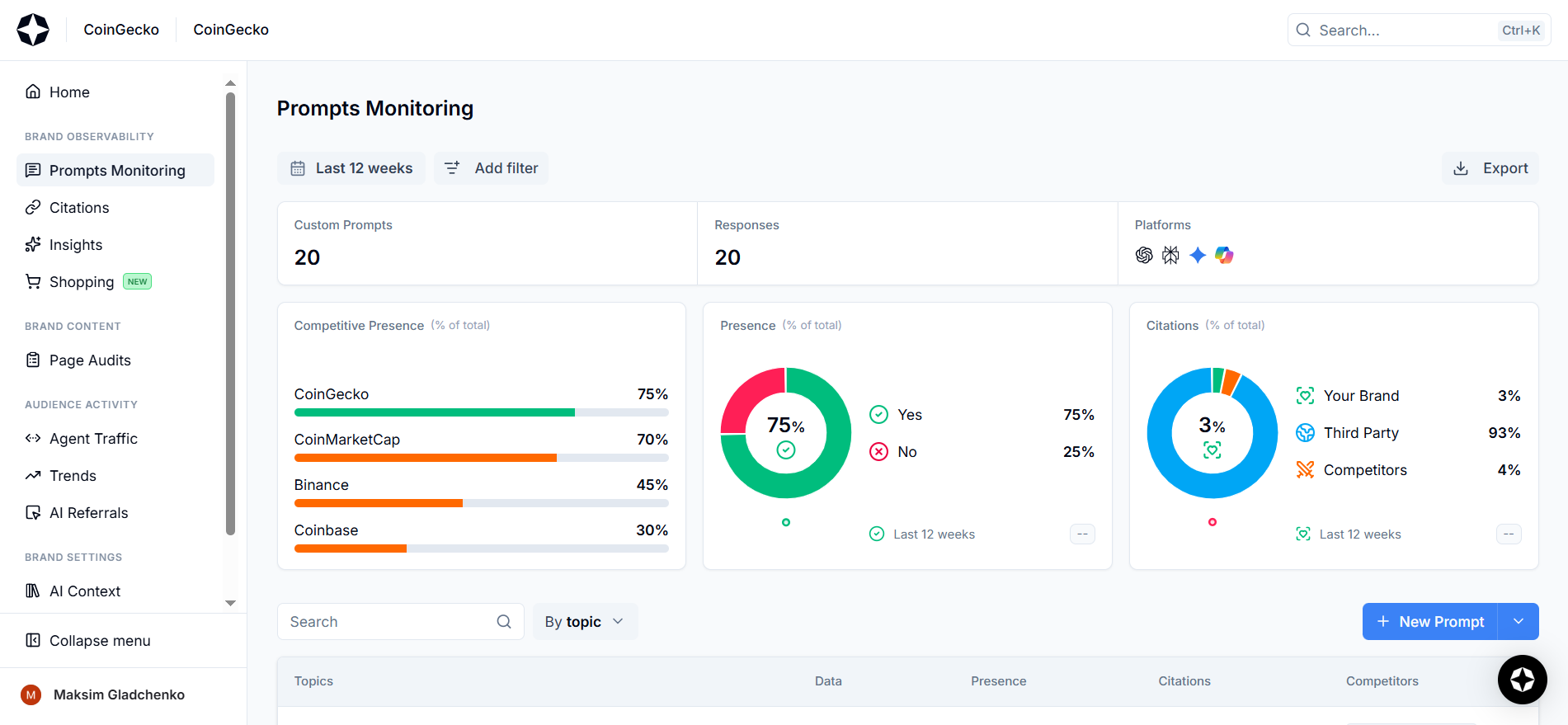
Scrunch AI focuses on understanding not just whether your brand is mentioned, but which sources AI models cite when generating those mentions. The platform maps out citations by owner (your brand, third parties, competitors), tracks which domains get referenced most, and shows how AI agent traffic interacts with your site.
What we found: The Citations view told a story the other tools didn’t. Only 4% of citations pointed to CoinGecko’s own brand domain, while 93% came from third-party sources and 3% from competitor domains. The Top Domains Cited panel showed reddit.com leading with 6 citations (5%), followed by bitget.com and coingecko.com tied at 4 each (4%), then algosone.ai and bydfi.com at 3 each. This is revealing: when AI models recommend CoinGecko, they’re pulling that recommendation from Reddit threads and third-party reviews — not from CoinGecko’s own content. That’s a concrete insight you can act on.
Pros:
- Best citation and source mapping in the category — shows exactly where AI gets its info about you
- AI agent traffic monitoring via GA4 integration
- Site audit features for checking page-level AI readiness
- Tracks up to 8 AI engines on Growth plan including ChatGPT, Gemini, Perplexity, Claude, Copilot, Meta, and AI Mode
Cons:
- Most expensive entry point at $300/mo — no free trial on standard plans
- Prompt credits are consumed per engine, so tracking across 5 engines burns credits 5x faster
- Interface can feel dense; learning curve is steeper than Otterly or Peec
- Content recommendations are surface-level; no built-in editor or brief generator
Pricing: Starter at $300/mo (350 custom prompts, 3 personas). Growth at $500/mo (700 prompts, 8 engines). Enterprise has custom pricing. Additional seats $25/mo each.
Verdict: If your main question is “where is the information about my brand coming from in AI answers?” — Scrunch gives you the clearest picture. The citation mapping is genuinely unique.
Ahrefs — Best for SEO Teams Already in the Ahrefs Ecosystem
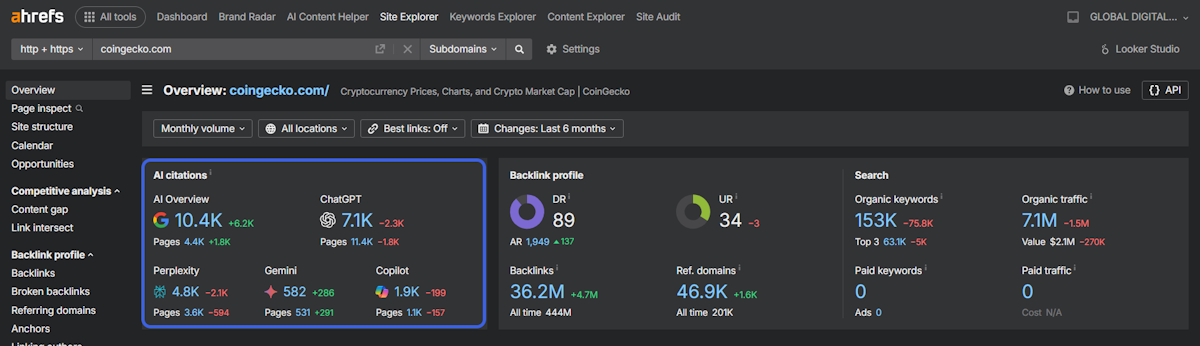
Ahrefs added AI citation tracking to its existing Site Explorer suite. If you’re already monitoring backlinks and organic keywords in Ahrefs, you can now see AI citations from Google AI Overviews, ChatGPT, Perplexity, Gemini, and Copilot — all integrated into the same dashboard.
What we found: Ahrefs’ overview for CoinGecko showed 10.4K AI Overview citations (up 6.2K) across 4.4K pages, 7.1K ChatGPT citations (down 2.3K) across 11.4K pages, 4.8K Perplexity citations (down 2.1K), 582 Gemini citations (up 286), and 1.9K Copilot citations (down 199). The traditional SEO metrics sat alongside: DR 89, 153K organic keywords, 7.1M organic traffic, 36.2M backlinks. What makes this view powerful is context — you can see AI citation trends alongside the SEO fundamentals that drive them, all in one place.
Pros:
- Seamless integration with existing Ahrefs keyword, backlink, and SERP tracking workflow
- AI citation data across 5 platforms — broader than most dedicated AI visibility tools
- Raw citation numbers with trend data (changes over the last 6 months) give a sense of direction
- No additional cost if you already subscribe to Ahrefs
Cons:
- Not a purpose-built AI visibility tool — no prompt tracking, no brand monitoring, no sentiment analysis
- Doesn’t tell you which specific prompts surface your brand — it tracks page-level citations instead
- Requires an existing Ahrefs subscription (Lite starts at $129/mo)
- No competitive benchmarking for AI visibility specifically
Pricing: Included in Ahrefs plans starting at $129/mo (Lite). Standard is $249/mo, Advanced $449/mo, Enterprise $1,499/mo.
Verdict: Not an AI visibility tool in the pure sense, but if your team already lives in Ahrefs, the AI citation tracking is a no-brainer addition to your reporting. The raw numbers across 5 AI platforms are surprisingly comprehensive.
HubSpot AEO Grader — Best Free One-Time Brand Audit
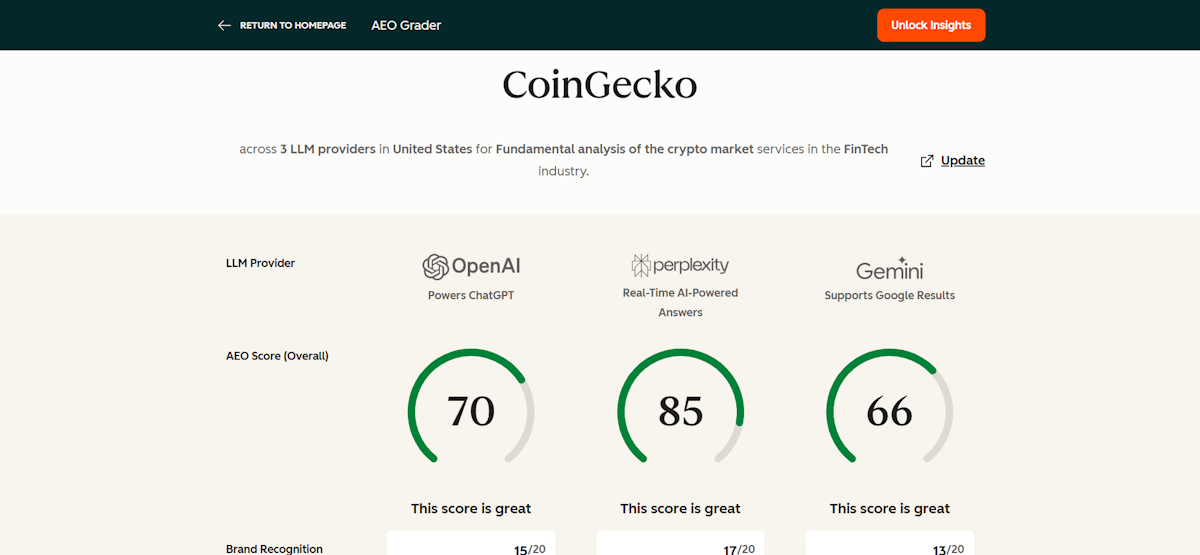
HubSpot’s AEO Grader (Answer Engine Optimization) is a free tool that evaluates your brand across ChatGPT, Perplexity, and Gemini. It scores five dimensions: Brand Recognition, Sentiment, Presence Quality, Share of Voice, and Market Position — then produces a scored report with a written interpretation.
What we found: CoinGecko scored well: 70 on OpenAI (ChatGPT), 85 on Perplexity, and 66 on Gemini — all rated “This is great.” Brand Recognition scores were 15/20 (OpenAI), 17/20 (Perplexity), and 13/20 (Gemini). The Perplexity score is notably higher, suggesting CoinGecko’s content is particularly well-indexed by Perplexity’s citation-heavy approach. It took under 2 minutes to get results. No signup required.
Pros:
- Completely free, no credit card, no signup required
- Cross-validates across 3 major AI models
- Clean, easy-to-understand scoring format
- Backed by HubSpot’s brand credibility — good for executive summaries
- Now also offers a paid AEO monitoring tool ($50/mo standalone) for ongoing tracking
Cons:
- Snapshot tool only — one-time results unless you upgrade to the paid AEO product
- No competitive analysis in the free grader
- Generic improvement recommendations
- Limited to 3 AI models
Pricing: AEO Grader is free. HubSpot AEO monitoring tool is $50/mo standalone or included with Marketing Hub Pro/Enterprise.
Verdict: The fastest way to get a directional answer on your AI visibility. Use it as a starting point or a gut-check before investing in a dedicated AI visibility tracker.
What the CoinGecko Test Actually Revealed
Running one site through all seven tools surfaced something you don’t see in feature comparison tables: each tool defines “AI visibility” differently — and gives you different numbers as a result.
Profound scored CoinGecko at 90.1% visibility. Peec AI showed 78%. Otterly measured 64% brand coverage. HubSpot’s AEO Grader gave scores of 66–85 depending on the model. These aren’t contradictions — they’re different measurements of different things. Profound tracks how often CoinGecko appears in AI answers to specific prompts. Otterly measures brand coverage across a set of prompts. HubSpot evaluates how AI models perceive the brand. ICODA assesses technical AI-readiness of the site itself.
The biggest insight came from Scrunch: only 4% of citations in AI answers about CoinGecko actually pointed back to CoinGecko’s own domain. Reddit was the most-cited source. That’s the kind of finding that changes a content strategy.
How to Choose: Free vs. Paid, Monitoring vs. Optimization
The AI visibility tools market splits along two axes. Understanding where you sit on each one makes the decision straightforward.
Axis 1: Snapshot vs. Ongoing Monitoring
If you need a one-time answer to “how visible is my brand in AI search?” — free tools like the ICODA AI Visibility Tool or HubSpot’s AEO Grader will get you there. If you need to track AI visibility over time, measure the impact of content changes, and report trends to stakeholders, you need a paid tool with recurring monitoring (Otterly, Peec AI, or Profound).
Axis 2: Brand Monitoring vs. Technical Audit vs. Citation Analysis
Some tools tell you where you stand (Otterly, Peec AI, Profound). Some tell you where the information comes from (Scrunch, Ahrefs). And some tell you how ready your site is for AI discovery (ICODA). Most teams need a combination — start with a snapshot to establish a baseline, then layer in monitoring once you know which gaps to close.
Our recommendation by team type:
- Solo marketer or small team, limited budget: Start with ICODA’s free tool and HubSpot’s AEO Grader for a baseline. If the results reveal gaps, consider Otterly ($29/mo) or Peec AI (€85/mo) for ongoing monitoring.
- Growth-stage company with competitors to track: Peec AI for competitive rankings, supplemented with Ahrefs if you already subscribe for SEO data.
- Enterprise or multi-brand organization: Profound for depth and compliance. Pair with Scrunch if citation-level source mapping matters to your strategy.
- Agency pitching AI visibility services: Use the ICODA tool for quick client audits, HubSpot AEO Grader for credibility, then recommend a paid tool based on the client’s needs and budget.
Some tools tell you where you stand. And some tell you how ready your site is for AI discovery. None of them write or optimize the content — that’s a separate stack, covered in our roundup of the best AI SEO tools in 2026.
The Bottom Line
AI visibility is no longer a nice-to-know metric — it’s a core part of search strategy. The tools in this space are maturing fast, and the right choice depends less on which tool is “best” and more on what you’re actually trying to accomplish.
Our CoinGecko test showed that even a well-known brand can get very different visibility readings depending on the tool and the methodology behind it. The real value isn’t in the number itself — it’s in understanding what drives that number and what you can do about it.
If you haven’t checked your AI visibility yet, start somewhere free. You might be surprised by what you find.
→ Check your AI visibility for free
Frequently Asked Questions (FAQ)
Share with


Rate the article