


No, and treating it as a crypto-specific problem will point you at the wrong fix. General news sites are seeing comparable or worse damage — Business Insider has reportedly lost more than crypto outlets on average — so this is Google’s AI consolidation compressing the entire content ecosystem, not a YMYL crackdown aimed at your category. Crypto media does carry extra baggage on top of that from thin trust signals and aggressive spam enforcement, but the traffic collapse itself is an industry-wide event you’re experiencing alongside everyone else, not instead of them.
On 17 July 2026, Nick Fox, Google’s Senior Vice President of Knowledge and Information, wrote that Google continues to send billions of clicks to the web every day through Search, and that AI features in Search alone now send billions of clicks to websites every week. Making links easier to find inside AI answers, he said, had been a personal frustration of his.
Five days later Alphabet posted the largest quarter in its history — $119.8bn in revenue, up 24%, Search advertising up 17% to $63.27bn — and Sundar Pichai told investors that people were adopting one seamless experience across AI Overviews and AI Mode.
That same week, the Wall Street Journal reported that USA Today, Politico, Reuters, The Economist, People Inc. and Reddit were all weighing whether to block Google’s crawler outright. USA Today’s chief executive said it was time to say enough is enough. People Inc.’s chief executive said turning Google off was fully on the table.
Same system, same month, two irreconcilable descriptions. We went to look at it from the receiving end.
The Number Nobody Can Check
Google’s figure has no denominator. Billions of clicks — against what baseline, out of how many searches, compared with what last year? None of it is published and no methodology is attached.
The harder problem is that Google’s own tooling forecloses verification. In June 2026 the company launched generative AI performance reports in Search Console. Those reports show impressions for AI surfaces. They do not show clicks. A publisher can see that their pages appeared inside an AI answer and cannot see whether one person clicked through. Google has said more metrics will come, without saying which or when.
So the aggregate is unfalsifiable and the site-level data does not exist. But there is a layer beneath both that is measurable: whether a domain gets cited at all. Citation is the precondition for the click. A publisher who is never cited does not have a small share of the billions — they have none of them, and no Google report will say so.
We measured 40 crypto news domains across six AI surfaces, and split them by who owns the infrastructure. Google infrastructure means AI Overviews, AI Mode and Gemini — three products, one index. Independent infrastructure means ChatGPT, Perplexity and Grok — separate crawlers, separate retrieval, separate judgement.
One in Five
Across 40 domains and 55,055 total citations:
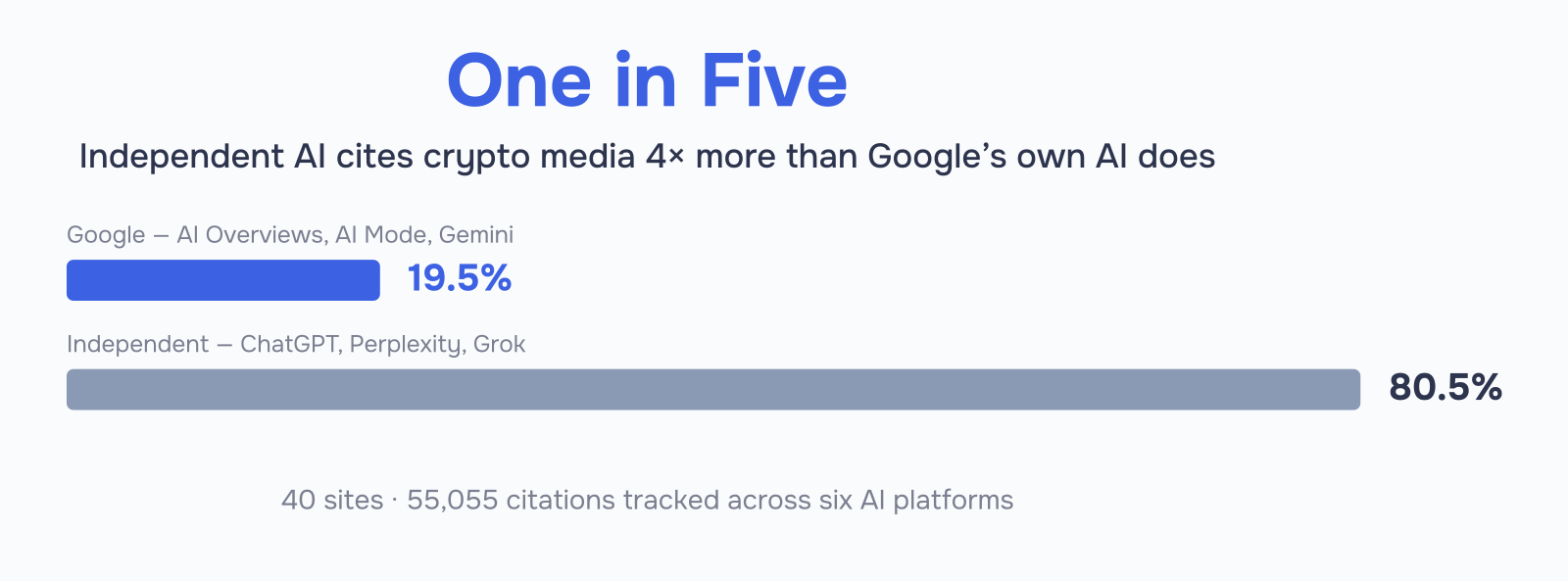
Three platforms against three platforms. The independents cite this category 4.1 times more often than everything Google operates combined.
The company telling publishers it sends them billions of clicks runs the AI infrastructure that cites them least.
Is This Just How the Data Was Collected?
The obvious objection is measurement: perhaps the tooling simply probes Google’s surfaces with a smaller prompt corpus, and the gap is an artefact of sampling rather than behaviour. It is the right question, and the data answers it.
If Google’s corpus were structurally thin, every domain would hit the same low ceiling — the constraint would apply equally to all of them, because corpus size does not vary by domain. Instead the Google share ranges from 0% to 55.6%.
Forkast.news draws 55.6% of its AI citations from Google. BTC-ECHO draws 49.1%, Bankless 48.0%, The Defiant 44.4%, DL News 40.7%. Five domains sit above 40%; seven above 30%. A thin corpus cannot manufacture a domain at 56%.
So the ceiling is not the constraint. What varies is which domains Google’s systems are willing to pull from — and that variation is Google’s, not the measurement’s.
We are careful about what this licenses. The aggregate 4.1:1 should not be read as “Google cites 4.1 times less per query,” because per-query normalisation is not available. What survives without qualification is the dispersion: within an identically-sampled dataset, Google’s three surfaces distribute their citations far more unevenly than the independents do.
The Cleanest Comparison: Gemini Against ChatGPT
Strip away the search surfaces and compare the two products that do the same job — general-purpose consumer chat assistants with web grounding.
ChatGPT: 19,872 citations. Gemini: 1,735. A ratio of 11.5 to 1.
The starker figure is coverage. Eleven of the 40 domains have zero Gemini citations. Zero of the 40 have zero ChatGPT citations. Every crypto publisher in this sample is reachable through ChatGPT. More than a quarter of them do not exist inside Gemini.
Six Publishers Whose Share Is Exactly Zero
Six domains have no citations at all across AI Overviews, AI Mode and Gemini combined — while being cited perfectly well everywhere else.
| Domain | Organic, Jul 2026 | ChatGPT | Perplexity | Grok | |
|---|---|---|---|---|---|
| cryptodaily.co.uk | 39,369 | 0 | 120 | 19 | 1 |
| Bitcoinist | 6,750 | 0 | 67 | 424 | 18 |
| NewsBTC | 5,804 | 0 | 48 | 321 | 5 |
| The Daily Hodl | 609 | 0 | 7 | 6 | 6 |
| Blockworks | 30 | 0 | 10 | 52 | 3 |
| Cointelegraph | 18 | 0 | 405 | 673 | 0 |
Cointelegraph — for years the most-cited publisher in crypto — appears in 1,078 AI answers today. None of them belong to Google.
Not one domain in the sample is absent from the independents. Total absence is a Google-specific outcome.
The Invisible Third
Absolute zero is the extreme; taking it as the whole story understates the problem. The working measure is what share of a domain’s citations come from Google infrastructure. The category median is 9.4%.
Fourteen of the 40 domains — 35% of the sample — sit below 5%. Between them they hold 8,159 citations across ChatGPT, Perplexity and Grok, and 218 across everything Google runs.
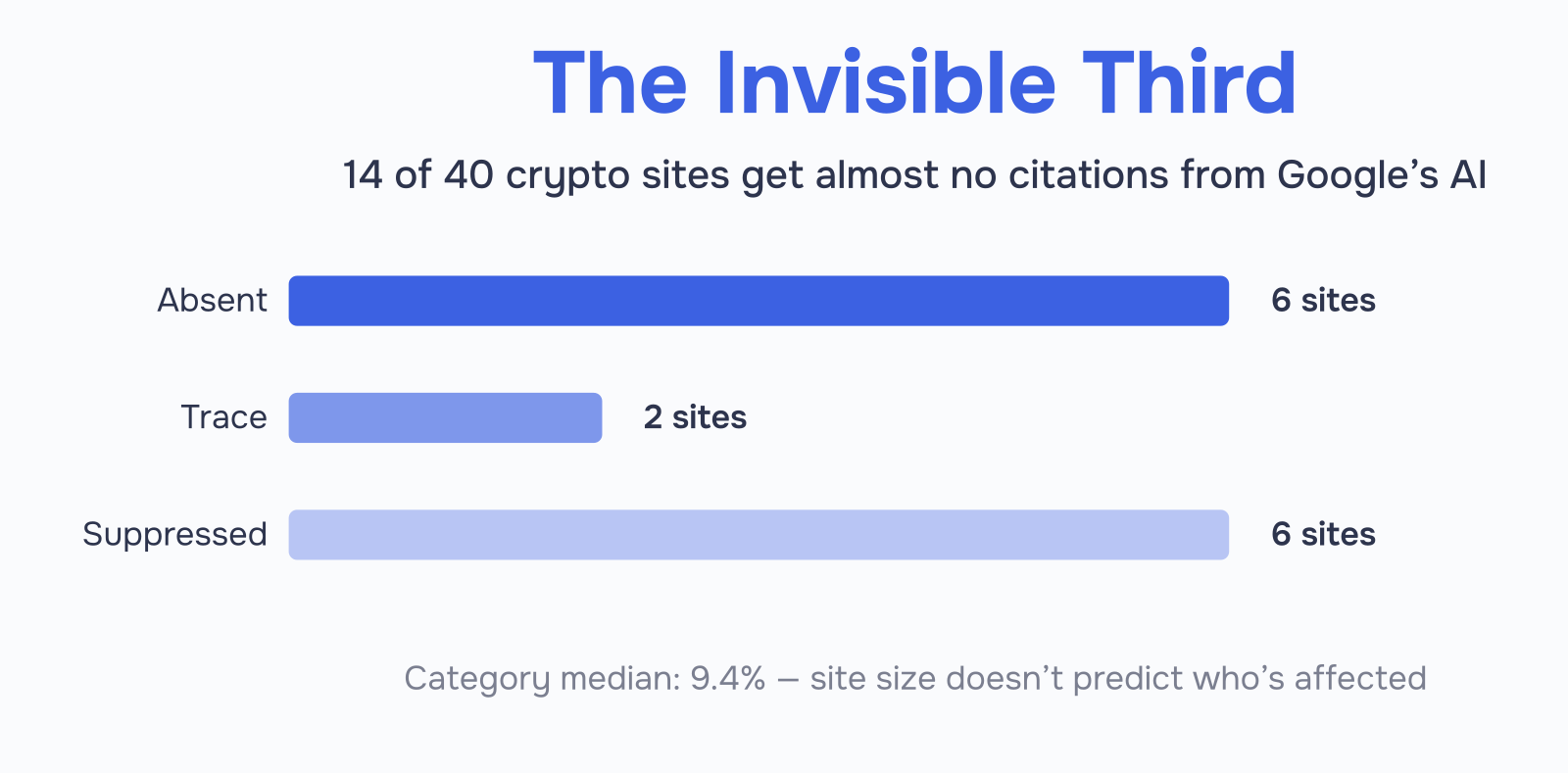
These are not marginal properties. news.bitcoin.com draws 893,557 monthly organic visits and holds 36 Google citations. Blockonomi draws 191,287 and holds four.
It Is Not About Size
Median Google share by traffic band: 9.0% under 10,000 monthly visits, 6.3% between 10,000 and 100,000, 19.1% above 100,000. Larger domains do fare better on average — but the relationship is not monotonic, and at the level of individual publishers it inverts completely.
Forkast.news attracts 941 monthly organic visits and holds 80 Google citations. Blockonomi attracts 191,287 — two hundred times more traffic — and holds four. Bankless, at 2,665 visits, sits at 48% Google share. Protos, at 2,290, is smaller than Bitcoinist or NewsBTC and gets cited by Google while both get nothing.
Whatever separates the visible from the invisible, audience size is not it.
Google’s AI Is Winner-Take-All
The dispersion has a shape. Google’s five most-cited domains hold 64.1% of every citation Google’s infrastructure issues in this category; its top ten hold 85.6%. For the independents the same figures are 51.2% and 69.4%.
Both systems concentrate. Google concentrates harder. Its AI layer behaves less like a broad index of a category and more like a shortlist — and the tail of that shortlist is not thin, it is empty.
Absence also tracks index removal. Among the 14 domains now organically dead, five are absent from Google’s AI entirely; among the 26 still ranking, one is. Degrees of low visibility do not track traffic health — a domain can rank well and still sit at 4% — but total disappearance and de-indexation arrive together. AI Overviews, AI Mode and Gemini are assembled from Google’s index; a domain suppressed there is not ranked lower in AI answers, it is not a candidate for them.
DL News makes the distinction concrete. It lost 99% of its organic traffic between March and July 2026 — 374,651 monthly visits down to 4,091 — and retains 52 AI Overviews citations, 78 in AI Mode and 35 in Gemini. Still indexed, still citable; it simply stopped ranking. Cointelegraph, at comparable traffic destruction, has nothing. On a traffic chart the two look identical. In citation data they are opposite diagnoses.
Why Top Crypto Media Are Losing Traffic — and Why the Usual Answer Is Wrong
Because this study runs on a full two-year traffic series, it also settles a separate argument. The received account is that AI search is killing crypto media. That account rests substantially on one domain, and it is the least representative one in the category.
Aggregate organic traffic across the 40 domains fell 37.2% year over year, Q2 2025 to Q2 2026. Four domains — Cointelegraph, U.Today, DL News and Unchained — account for 76.8% of that entire loss while holding under 30% of the category’s traffic at the start.
| Cohort | n | Q2-2025 /mo | Q2-2026 /mo | Change |
|---|---|---|---|---|
| All domains | 40 | 15,269,941 | 9,585,669 | −37.2% |
| Collapse cases | 4 | 4,520,420 | 152,475 | −96.6% |
| Everyone else | 36 | 10,749,521 | 9,433,194 | −12.2% |
| Everyone else, ex-relaunch | 33 | 10,698,989 | 8,703,858 | −18.6% |
The collapse cohort was defined mechanically before any outcome was examined: one month with a drop of 80% or more from a base of at least 20,000 visits, and no recovery afterwards above 20% of the pre-drop level. Their curves are not curves. Cointelegraph went from 2.04m monthly visits in October 2025 to 79,347 in November to 2,310 in December, and sits at 18 today. U.Today fell from 651,022 in June 2025 to 6,476 in August. These are step functions, and rising zero-click rates do not produce step functions.
The median domain fell 24.9%. Sixteen of the 40 grew.
The Decline That Is Real Started in March
Removing the collapse cases clears AI search of nothing. It moves the evidence somewhere far more specific. For the 33 domains with no collapse event and no relaunch artefact:
The median domain lost 47.7% between March and July 2026, and 28 of 33 declined. This is not an averaging artefact produced by a few large sites — it is what an ordinary publisher in this category lived through in four months.
Nothing of that shape appears earlier in the record. Across 2025 the category oscillated between roughly 14m and 21.5m monthly visits, tracking crypto news cycles up and down. From March 2026 it simply falls: 13.41m, 10.25m, 10.56m, 7.94m, 7.46m.
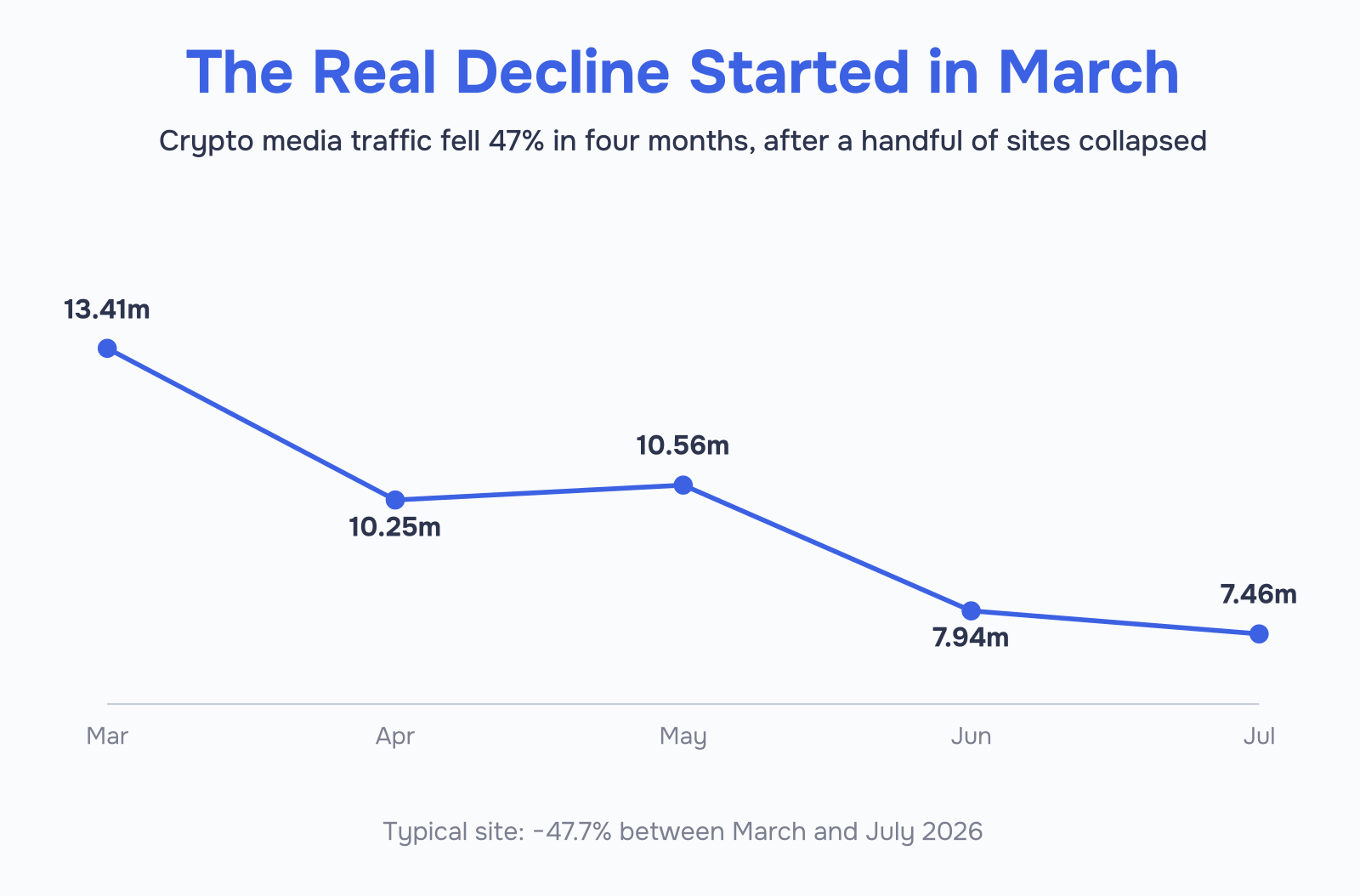
The window follows Google’s consolidation of AI Overviews and AI Mode into a single surface. For calibration, Semrush figures reported by the Wall Street Journal over a comparable period show roughly −50% at USA Today, −25% at CNN, −23% at Politico and more than −85% at Business Insider. Crypto media is not being singled out; it is absorbing the same compression as general news, on top of its own enforcement problems.
So the honest answer to why top crypto media are losing traffic has three parts, and only the third is about AI: a handful of domains were removed from the index outright, a much broader tier is bleeding steadily as zero-click behaviour spreads, and the sharpest phase of that bleeding is four months old.
Traffic and Citability Are Different Assets
Among domains large enough to measure reliably, the rate at which Google’s AI cites them varies by a factor of 286.
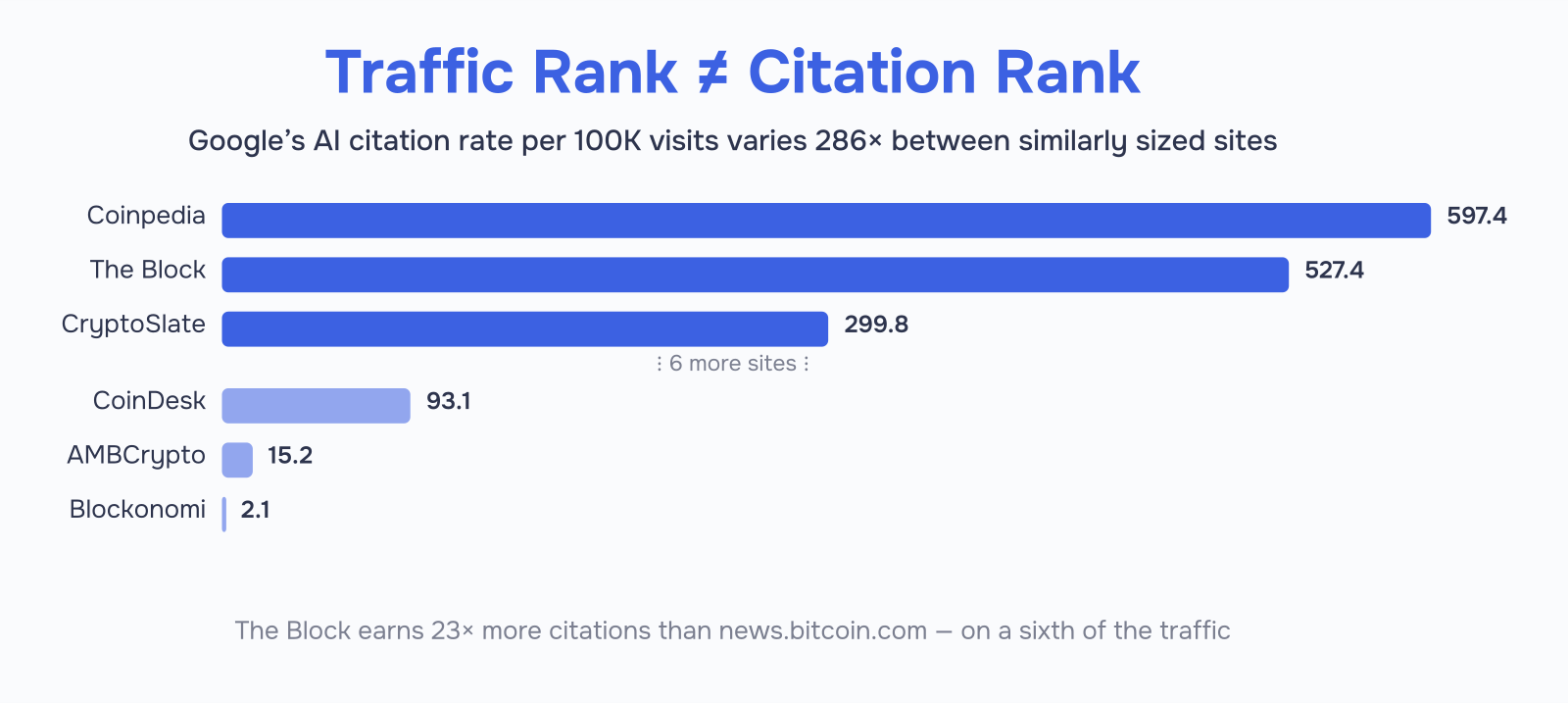
The Block earns 820 Google citations on 155,466 monthly visits. news.bitcoin.com earns 36 on 893,557 — a fifth of the citations on nearly six times the traffic.
Whatever drives volume in this category — publishing velocity, keyword coverage, syndication — is not what drives citation inside Google’s AI. A publisher can be winning one and losing the other, and Search Console will not tell them, because it reports AI impressions without AI clicks.
One tactical note: within Google, AI Mode carries 51.5% of all citations, AI Overviews 32.3%, Gemini 16.2%. AI Mode cites 1.6 times more often than AI Overviews and cites more in 30 of the 40 domains. The three surfaces are not interchangeable targets, and Gemini is the weakest of them by a wide margin.
What It Means for the Standoff
Google’s claim and the publishers’ complaint are not in contradiction, and this data shows why.
Google reports a numerator. SparkToro’s clickstream analysis, built on Similarweb panel data, reports the ratio: 68.01% of Google searches ended without any click in the first four months of 2026, up from 60.45% in 2024, with roughly 27% of the clicks that do happen landing inside Google’s own properties. Query volume can rise while the chance of any search producing an outbound click falls. Google measures the flow it sends; publishers experience the share they receive.
What neither side is discussing is the distribution. Those billions are not merely uneven — the infrastructure issuing them accounts for one in five citations to this category, concentrates 86% of its own output in ten domains, and gives six publishers exactly nothing, permanently, with no Google-provided tool capable of showing it.
That reframes the blocking debate. The publishers weighing a crawler block, and the UK Competition and Markets Authority requirement imposed in June 2026 that Google let publishers opt out of AI features without losing conventional search, both assume search visibility and AI visibility are separate levers. Inside Google’s ecosystem they share a single point of failure. Outside it they were never connected at all.
No crypto publisher has joined this conversation publicly. We found no equivalent statement from any of the 40 domains here. The reason is likely structural: the mainstream outlets weighing a block have subscriptions, licensing revenue and direct audiences to fall back on. Crypto media runs on advertising and sponsored content, where traffic is the inventory being sold. The publishers with the strongest grievance are the least able to act on it.
Why We Ran This
ICODA works on search and AI visibility for crypto and iGaming brands — categories where YMYL classification, thin trust signals and aggressive enforcement make Google’s behaviour unusually consequential. Most published analysis of AI search reasons from aggregates no individual site can act on. We built this the other way round: start from what a publisher can measure about themselves, and see what the aggregate looks like from there.
The conclusion we take from it is that AI visibility is not one channel. Treating “get cited by AI” as a single objective hides the fact that Google’s three surfaces share a point of failure with organic search while the independent platforms share none of it — and that the two groups behave completely differently, one broad and one winner-take-all.
The first diagnostic we run on any domain: its Google citation count against its independent count. The category median ratio is roughly 9:1. Sitting far above that is a signal worth investigating before it reaches your traffic.
Frequently Asked Questions
It’s real, and it has a name now: SEOs call it “the great decoupling.” AI Overviews let multiple URLs share credit for one ranking position, so impressions climb even as the click that used to come with a #1 spot stops showing up. Ahrefs tracked this shift from positive to negative correlation between clicks and impressions on their own blog in 2025, and publishers in this crypto dataset are living the same pattern at a much larger scale — some show 800+ Google AI citations and single-digit click evidence because Search Console still won’t report the metric that matters.
Because Google controls what gets measured, and clicks are the one number that would let you calculate what AI Overviews cost you. The June 2026 Generative AI performance report shows impressions sliced by page, country, and device — no clicks, no CTR, no query-level data. You can see that your page got pulled into an AI answer and have zero way to know if anyone acted on it. Google says more metrics are coming, but hasn’t said which ones or when, so for now you’re flying blind on the exact thing you’d want to optimize.
Ranking and AI citation are two different systems pulling from the same index, and one can fail while the other holds. A domain can sit at position 3, keep its organic traffic, and still be absent from every Google AI surface — that’s not a penalty signal by itself, it’s Google’s AI layer being pickier about who it quotes than about who it ranks. The distinction that actually matters is total de-indexation versus low AI visibility: if you’ve dropped out of the index entirely, that tracks with disappearing from AI answers too; if you’re still indexed and still ranking, a missing AI citation is a separate, unexplained gap.
That would explain a flat ceiling across every domain, not the wild swings actually observed. If a thin prompt corpus were capping Google’s citation counts, every site would hit roughly the same low number — but some crypto publishers pull over 50% of their AI citations from Google while others in the same niche get literally zero. A sampling artifact can’t produce that kind of spread; something about how Google’s systems select sources is doing it, not the size of the test.
Reddit’s citation dominance is mostly a licensing and scale story, not a quality story. Google paid roughly $60M a year for a Reddit data deal to train Gemini and feed AI Overviews, and OpenAI struck a similar partnership — that’s before you factor in Reddit’s sheer volume of first-person, question-shaped text that matches how people phrase AI prompts. Your content can be more accurate and still lose the citation slot because the model already trusts the source, has the license, and doesn’t need to evaluate your domain from scratch.
Test it on a small traffic segment before you do it site-wide, because you can’t currently reverse the visibility loss quickly if it goes wrong. Major outlets like Reuters, Politico, and Business Insider are reportedly weighing exactly this move, which tells you the frustration is real, but their calculus rests on having subscriptions or licensing revenue to fall back on. If your business runs on ad impressions or affiliate traffic — like most crypto and iGaming publishers — blocking the crawler that still sends you 80%+ of your organic traffic to punish the 20% AI layer riding on the same index is a bad trade unless you’ve modeled the downside first.
Some of it’s proven, some of it’s still a hypothesis dressed up as a strategy. What’s measurable — citation rates, share of voice across AI platforms, which content formats get pulled — is real and trackable today with tools like Ahrefs’ AI citation data. What’s not proven is the causal chain agencies love to sell: that specific on-page tactics like schema markup or llms.txt reliably increase citation odds. Schema helps machines parse your content correctly, but there’s no strong evidence it drives citations by itself — treat it as infrastructure, not a lever you pull for visibility.
Check whether the drop was a cliff or a slope, because they’re different problems with different causes. A cliff — 80%+ gone in one month with no recovery — usually means index removal or an enforcement action, and AI visibility disappears at the same time because there’s nothing left to cite. A slope — a steady 20-50% bleed over several months with no single collapse point — matches the broader zero-click pattern hitting the entire news and publishing industry since AI Overviews and AI Mode merged, and it’s not specific to you or your niche.
How We Measured It
40 crypto news and editorial domains; exchanges, price trackers and data aggregators excluded as transactional rather than editorial. Organic traffic from Ahrefs site-explorer-metrics-history, mode=subdomains, all countries, monthly, June 2024 to July 2026. August 2026 was pulled but is a partial month and is excluded from every calculation. Quarterly figures are three-month averages, because crypto news traffic is violently cycle-dependent and single months mislead. Citations from Ahrefs site-explorer-ai-responses-count, snapshot of 10 August 2026, counting citation links per platform.
Limitations
- n = 40, with subgroups as small as six. Directional, not statistically powered.
- Per-query normalisation is unavailable. The prompt corpus behind each platform’s citation count is not published, so the aggregate 4.1:1 describes citations observed in this dataset, not citations per query. The dispersion evidence in the sampling test does not depend on this and stands on its own.
- The citation snapshot has no time series. We can show which domains currently hold zero Google citations, not when that happened or whether the ranking loss or the citation loss came first.
- Ahrefs organic traffic is a model estimate from rankings and search volume, not measured analytics. Direction is reliable; absolute values carry error.
- Correlation, not confirmed causation. Google has not confirmed enforcement action against any domain here. Cohort labels are inferred from decline shape and citation state, and are interpretive. Traffic decline alone cannot distinguish a penalty from a ranking loss, a migration, or falling demand.
- Organic search only. Nothing here speaks to direct, social, newsletter or app traffic — which is exactly where several of these outlets have been relocating their audiences.
Data and Sources
Full dataset accompanies this report: 40 domains × 27 months of organic traffic, six-platform citation counts, the infrastructure split and sampling test, the graded visibility scale, the size control, per-domain metrics and cohort aggregates, with all derived figures as live formulas.
Primary data: Ahrefs API v3 (site-explorer-metrics-history, site-explorer-ai-responses-count), pulled 10 August 2026. External sources: Nick Fox statement on X and LinkedIn, 17 July 2026; Alphabet Q2 2026 earnings release and call, 22 July 2026; Search Console generative AI performance reports, June 2026; SparkToro / Similarweb zero-click analysis, June 2026; Wall Street Journal publisher reporting, 22 July 2026; UK Competition and Markets Authority publisher conduct requirement, June 2026.
Share with


Rate the article