

What Is Generative Engine Optimization?
Generative engine optimization (GEO) is the practice of structuring content, technical infrastructure, and brand signals so that AI systems like ChatGPT, Perplexity, Google AI Overviews, and Gemini retrieve, cite, and recommend a brand when answering user questions. The term comes from a 2024 Princeton and Georgia Tech study that tested nine content tactics across 10,000 queries and measured which ones changed how often a source got cited in AI-generated answers.
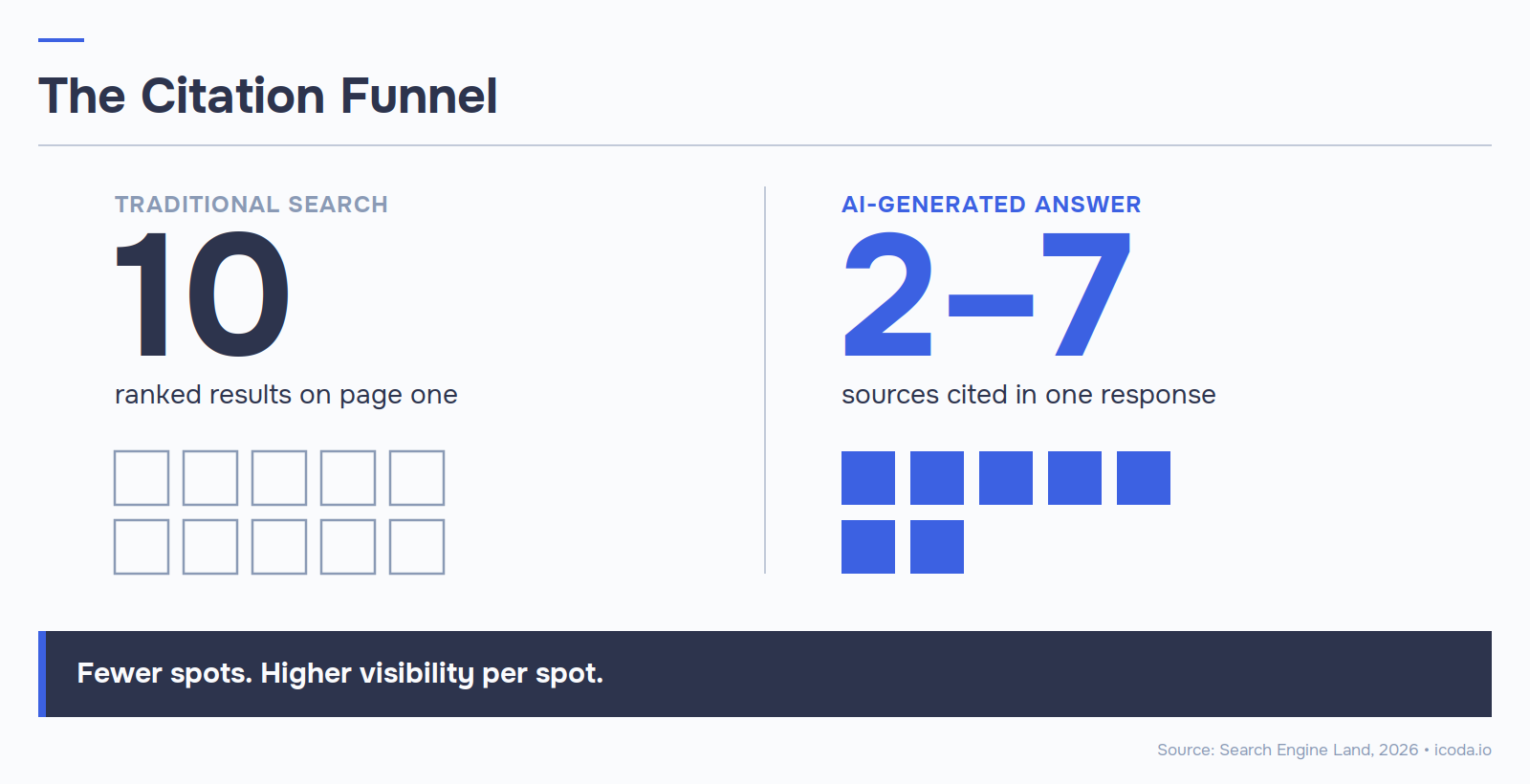
Where classic SEO competes for one of ten blue links, GEO competes for a spot among the two to seven sources a language model names in a single response. That’s a much smaller shelf, and the rules for getting on it are different enough that people have started calling the discipline “GEO SEO.” It’s a slightly confusing label, but it captures the reality: this is SEO’s technical cousin, not its replacement. You’ll also see this called answer engine optimization, and the boundaries between AEO, GEO, and traditional SEO blur enough that most teams use the terms interchangeably without much cost.
The stakes are rising fast. Gartner projects AI assistants will handle around a quarter of global searches in 2026, growing past half by 2028. Brands that aren’t part of what a model cites are, for a growing share of buyer journeys, simply not part of the conversation.
Why Traditional SEO Signals Don’t Predict LLM Citation
Traditional SEO signals like backlinks and keyword density show weak or negative correlation with AI citation, while structured, evidence-backed content earns citations at a much higher rate. That’s not a small gap. It’s a different scoring system.
AI crawlers such as GPTBot, ClaudeBot, and PerplexityBot don’t crawl the link graph the way Googlebot does, so they can’t calculate anything resembling PageRank. High-authority sites still show up disproportionately in AI answers, but mostly because they already rank well in the search engines these models use for retrieval, not because the model itself weighs backlinks. A 2025 Digital Bloom analysis of more than 7,000 citations across 1,600 URLs found brand search volume correlated with citation frequency at 0.334, a stronger relationship than anything backlink-related showed.
Keyword density fares worse. The Princeton GEO study found that stuffing target phrases into a page hurt citation odds, while semantic coverage across a topic, explaining the concept thoroughly with supporting examples, helped. Page rank position matters less than most SEO practitioners assume, too: a 2026 OrganiKPI study of 153,425 AI citations found that 76.95% of the URLs models cited didn’t appear in the organic top 10 for the matching query at all.
What did work, per the same Princeton research: adding statistics and citing sources. Statistics alone lifted visibility by 22%. The “Cite Sources” tactic produced the standout result, a 115.1% visibility increase for sites ranked fifth in Google, against only a slight decrease for sites already ranked first. GEO rewards specificity and evidence more than it rewards accumulated domain equity, which is why smaller or newer sites can compete for AI citations in a way they rarely could for page-one Google rankings.
| SEO ranking signal | Correlation with AI citation | Source |
|---|---|---|
| Backlinks / Domain Rating | Weak, mostly indirect through search ranking | Digital Bloom, 2025 |
| Keyword density | Negative when overused | Princeton GEO study, 2024 |
| Brand search volume | Moderate positive (0.334) | Digital Bloom, 2025 |
| Google top-10 ranking | Weak; 76.95% of AI citations sit outside it | OrganiKPI, 2026 |
| Cited sources and statistics | Strong; up to 115% lift on mid-tier sites | Princeton GEO study, 2024 |
| Answer-first content structure | Strong; up to 40% lift | Princeton GEO study, 2024 |
The 5 GEO Factors That Move AI Citations
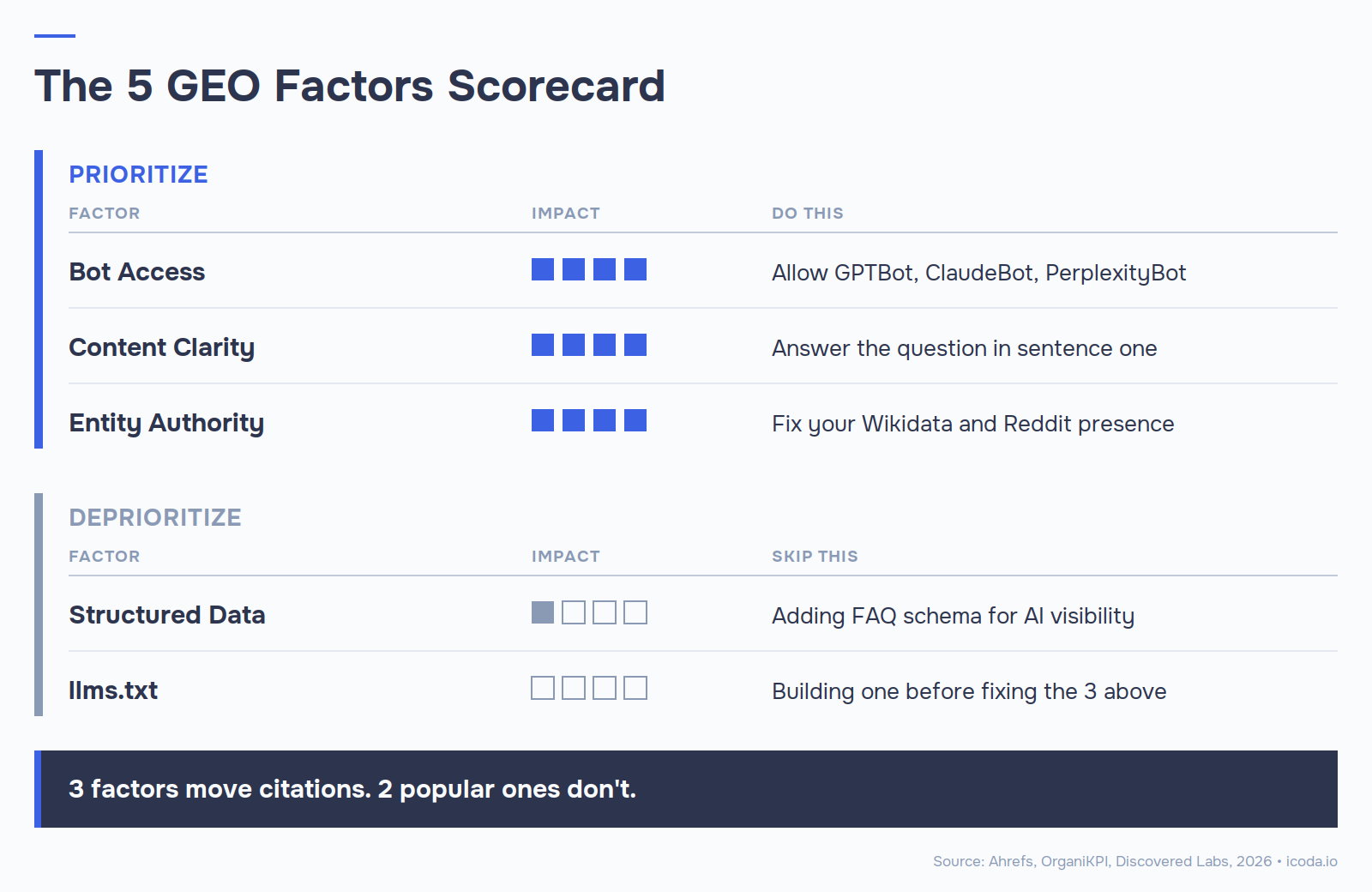
Five factors keep showing up across GEO SEO audits and citation studies as the ones worth spending time on: structured data, bot access, content clarity, llms.txt, and entity authority. Our own work running AI visibility campaigns across crypto, fintech, and SaaS clients confirms the list, though it also shows some factors carry far more weight than the GEO hype cycle suggests, and at least one is mostly a distraction. Here’s what each one does, and how to fix it.
1. Structured Data (Schema Markup)
Schema markup helps AI systems classify a page, but current evidence shows it does little to change whether that page gets cited.
- ⚠️ What to check: Whether your key pages carry JSON-LD schema (Organization, Product, Article, Review) that matches what’s visible on the page.
- 📐 How to measure: A May 2026 Ahrefs study of 1,885 pages found no meaningful citation lift on ChatGPT or AI Mode, and a small decline on AI Overviews.
- 🔧 How to fix it: Keep Organization, Product, and Review schema accurate. Skip FAQ schema for visibility; Google dropped FAQ rich results in May 2026.
2. Bot Access (Crawler Permissions)
Blocking or accidentally hiding content from AI crawlers removes a brand from consideration before an AI system ever evaluates content quality.
- ⚠️ What to check: Whether robots.txt blocks GPTBot, ClaudeBot, PerplexityBot, or Google-Extended, and whether core content renders without JavaScript.
- 📐 How to measure: Check robots.txt for Disallow rules per crawler. GPTBot is the most-blocked AI crawler, though 84.2% of sites have no AI crawler policy at all.
- 🔧 How to fix it: Allow major AI crawlers on public pages and use server-side rendering for JS-heavy sites. Blocking cost publishers 7% of weekly traffic in one 2026 study.
3. Content Clarity (Answer-First Structure)
Content that answers a question directly in the first sentence and stays self-contained gets extracted and cited far more often than content that builds up to its point.
- ⚠️ What to check: Whether each section opens with a direct, standalone answer, and whether headings mirror the questions readers type into ChatGPT.
- 📐 How to measure: Content structure alone can lift citation visibility up to 40%, and comparison tables earn about 2.5x more citations than narrative prose.
- 🔧 How to fix it: Lead each section with a 40-to-75-word direct answer, then expand. Use question-style headings and tables wherever you compare two or more things.
4. llms.txt
An llms.txt file is worth understanding, but the evidence doesn’t support treating it as an AI search ranking factor.
- ⚠️ What to check: Whether you have an llms.txt file at your root domain, and whether it’s worth the engineering time to build one.
- 📐 How to measure: A 2026 Ahrefs study found 97% of llms.txt files get zero requests, and AI retrieval bots account for just 1.1% of the traffic they do see.
- 🔧 How to fix it: Skip llms.txt for AI search visibility; the data doesn’t support it. It’s mainly useful for documentation sites serving coding assistants like Cursor.
5. Entity Authority
AI systems verify that a brand is a real, distinct, cross-referenced entity before they decide whether to cite it, which means entity work often matters more than the content itself.
- ⚠️ What to check: Whether your brand is described consistently across Wikipedia, Reddit, G2, Crunchbase, and your own site.
- 📐 How to measure: Ask ChatGPT and Perplexity what they know about your brand. ChatGPT leans on Wikipedia (47.9%) and Reddit (11.3%); Perplexity favors Reddit (46.7%).
- 🔧 How to fix it: Build or correct your Wikidata entry, keep schema and social profiles cross-linked, and earn genuine mentions in Reddit threads and G2 reviews.
Before and After: GEO in Practice
Reddit visibility, PR-driven entity signals, technical crawler setup, and research-grade content all moved AI citation numbers for real ICODA clients, and the shift is usually bigger than the same work would produce in traditional Google rankings.
- Crypto payments platform, technical GEO setup: A site-wide crawlability audit, schema and breadcrumb implementation, and answer-first content restructuring aimed at ChatGPT visibility pushed ChatGPT-referred traffic to a 46% conversion rate against 29% from Google organic, a 1.6x gap, with ChatGPT user growth up 24.88% in 30 days. ➡️ ChatGPT conversion case study
- Crypto exchange, SEO plus PR: Combining intent-based content architecture with editorial PR placements drove 688% traffic growth from ChatGPT and 268% from Perplexity, plus 726% Bing growth and over 200 citations across AI platforms, all without paid ads. ➡️ SEO-plus-PR case study
- ICODA’s own site, research-grade content: Publishing original research and citation-focused content built for Perplexity’s retrieval behavior produced 286% traffic growth from Perplexity and a 55.58% engagement rate on that traffic. ➡️ Our Perplexity retrieval case study
- Web3 brands, PR as an entity signal: Strategic media placements delivered top 10 Google rankings and citations across ChatGPT, Perplexity, and Gemini, with indexation in 24 to 72 hours instead of weeks. ➡️ PR-as-entity-signal case study
- Crypto exchange, Reddit as entity infrastructure: Growing Reddit presence 8.8x, from 67 to 590 mentions across 39 subreddits, with 53% of placements hitting the #1 position in their thread, translated directly into more consistent citations in ChatGPT and Perplexity’s crypto-exchange recommendations. ➡️ Reddit visibility case study
The pattern across all five: the sites that saw the biggest AI visibility gains weren’t the ones with the most backlinks. They were the ones that fixed retrievability, built genuine entity signals off-site, and gave AI models content that stood on its own.
Check Your Brand’s Generative Engine Optimization Score
The generative engine optimization tools worth using this year fall into two categories: ones that check whether your technical setup allows AI systems to retrieve you at all, and ones that track whether you’re getting cited once they can. Most GEO checklists stop at the first category, which is why so many brands pass every audit and still don’t show up when someone asks ChatGPT for a recommendation.
ICODA’s AI Visibility tool is one of the few generative engine optimization tools that checks both: crawler access, structured data, content structure, and current citation frequency across ChatGPT, Perplexity, Gemini, and Google AI Overviews, benchmarked against direct competitors. If your brand needs a structured plan to close the gaps this article covers, our AI SEO strategy playbook lays out the fixes in sequence, and our AI SEO team builds and runs it end to end.
Frequently Asked Questions (FAQ)
GEO and SEO share a lot of DNA, but the signals that move the needle are different enough to matter. Backlinks and keyword density, the two pillars of classic SEO, show weak or even negative correlation with getting cited by an AI model, while structured, evidence-backed writing earns citations at a much higher rate. That’s not the same scoring system in a new outfit — it’s a different set of rules layered on top of the old ones. If your SEO was already built on real research, clear structure, and good sourcing, you’re most of the way there; if it leaned on link volume and keyword stuffing, GEO is going to expose that.
No — the data doesn’t back that up. A May 2026 Ahrefs study tracked nearly 1,900 pages that added JSON-LD schema and found no citation lift on ChatGPT or Google AI Mode, plus a small decline on AI Overviews; a separate test found every major AI platform ignored the schema entirely and just read the visible HTML. Keep Organization schema current because it helps with entity clarity, and keep Product or Review schema where the underlying data is real. Just don’t add it hoping it’ll move your citation numbers, because right now it doesn’t.
For most marketing sites, no. An Ahrefs analysis of over 137,000 domains found that 97% of llms.txt files got zero requests at all, and the actual AI bots feeding ChatGPT and Perplexity’s live answers accounted for only about 1% of the traffic the file did receive. It has a real use case if you run developer-facing docs, since coding tools can pull from it directly. If you run a blog or marketing site, put those engineering hours into content structure and crawler access instead — that’s where the actual movement happens.
You can, but know what you’re trading away. Blocking an AI crawler removes you from consideration before any model ever evaluates your content, and a Rutgers and Wharton study found publishers who blocked AI crawlers lost about 7% of weekly human traffic within six weeks. That said, this is a legitimate business call, not just a technical checkbox — if you don’t want your work feeding a model for free, that’s a real tradeoff worth making with eyes open. Just don’t block by accident because your CMS defaulted to it; check robots.txt yourself.
Because Reddit is one of the heaviest-weighted sources these models pull from when they want something that reads like consensus, not because your writing is worse. ChatGPT leans on Wikipedia for nearly half its citations and Reddit for over a tenth, and Perplexity favors Reddit even more heavily. You can’t fix this by rewriting your page — the fix is showing up in those threads with real, non-promotional answers, which takes longer than any on-page change. It’s slower and less controllable than SEO ever was, and that’s genuinely the tradeoff.
Yes, and this one has real numbers behind it, not just cope. A 2026 study of over 153,000 AI citations found that 77% of the URLs models cited weren’t even in Google’s organic top 10 for that query, and separate research found a site ranked fifth in Google got a 115% visibility lift from citing sources while the site ranked first barely moved. That window exists because AI citation currently rewards specificity and evidence over accumulated domain authority. It won’t stay wide open forever, and it still won’t save content that’s vague or poorly explained.
They’re tracking something real, but “stable” is the wrong word for it. Between 40% and 60% of cited sources change month-to-month across Google AI Mode and ChatGPT, making visibility far less stable than organic search rankings. Use these AI visibility tools to spot direction and pattern over months, not to chase a single number week to week. If a tool sells you a fixed score without mentioning that churn, be skeptical of what else it’s not telling you.
No, and the distinction actually matters. The point isn’t shorter sentences or more bullet points, it’s a paragraph that makes sense on its own if you pull it out of the article entirely, which is a much higher bar than clickbait formatting usually clears. This kind of structure lifted citation visibility by up to 40% in controlled testing, and comparison tables specifically got cited roughly 2.5 times more than the same information written as narrative prose. The tradeoff is real: writing this way forces you to front-load your point in every section, which can feel repetitive if you’re used to building an argument slowly.
Share with


Rate the article