

For a small niche site, get your SEO fundamentals solid first — crawlability, clear structure, genuine expertise — because that’s the floor every engine builds on regardless of acronym. GEO-specific tactics (stats, quotes, freshness cadence) cost time more than money, so once the basics are in place, layering them in is closer to free. Skip the paid AI-visibility trackers entirely at this stage; manually checking a handful of your target prompts once a month tells you almost as much.
Three acronyms now compete for the same budget line, and most teams can’t say where one ends and the next begins. If you’re hoping one of them turns out to be a fad you can ignore, it isn’t: SEO wins rankings, answer engine optimization wins the answer box, and GEO wins the citation inside an AI-generated response. Here’s how each one works, where they overlap, and which one deserves your budget this quarter.
The 30-Second Answer
SEO, AEO, and GEO all aim at visibility, but they compete for different real estate. SEO fights for a ranking position on a results page. AEO fights for the featured snippet or direct answer box. GEO fights for a citation inside a generated response from ChatGPT, Perplexity, or Google’s AI Mode, often with no click at all.
| SEO | AEO | GEO | |
|---|---|---|---|
| Primary goal | Rank on the results page | Get picked as the direct answer | Get cited inside an AI-generated response |
| Where it shows up | Google, Bing SERPs | Featured snippets, voice assistants, AI Overviews | ChatGPT, Perplexity, Gemini, AI Mode |
| Core signals | Backlinks, keywords, technical health, page experience | Clear Q&A structure, schema markup, concise direct answers | Statistics, quotations, cited sources, entity clarity, freshness |
| Main tools | Google Search Console, Ahrefs, Semrush | Schema testing tools, Search Console (SERP features) | Manual prompt testing, Otterly.AI, Profound, AI-visibility trackers |
| Typical timeline | 3–12 months | 1–3 months on top of solid SEO | Days to weeks (no fixed ranking to climb) |
| You lose when | You rank on page two | Your answer is buried under three paragraphs of intro | Your content has no clear facts, numbers, or entities to lift out |
None of these disciplines retired the other two. They stack.
SEO: What’s Still Relevant
Search Engine Optimization still decides whether your content gets discovered at all, and every AI engine builds on top of that discovery layer. Estimates of how often Google AI Overviews appear vary widely, from roughly one in five searches to nearly half; commercial-vertical trackers like BrightEdge put it around 48% in early 2026. More telling than the trigger rate is the citation source: only about 38% of pages cited inside AI Overviews rank in the top 10 for that query, down from roughly 76% seven months earlier, per Ahrefs. Classic ranking signals still matter, but they’re no longer close to the whole story.
What still earns its keep:
- Technical health. Crawlability, site speed, mobile rendering, clean indexation. If Googlebot can’t parse the page, neither can an AI crawler.
- Backlinks and domain authority. Still the clearest trust signal search engines have; AI models lean on it indirectly.
- Keyword-to-intent matching. Pairing a page with what the searcher actually wants, not just the words they typed.
- On-page fundamentals: title tags, header hierarchy, internal linking, structured URLs.
SEO is the foundation. Skip it, and AEO and GEO have nothing solid to build on.
AEO: How Answer Engines Choose Sources
Answer Engine Optimization is the practice of structuring content so search platforms can lift a direct answer out of it, rather than making the user click through and hunt for one. AEO targets the sentence an AI engine delivers and the source it credits, not just a ranking position. The mechanism traces back to featured snippets and voice search, and it’s now the layer Google AI Overviews and Microsoft Copilot Search lean on most heavily.
Answer engines favor pages that:
- Lead with the answer. The first sentence under a heading should answer the question it asks. Skip the warm-up.
- Use question-shaped headers. H2s and H3s phrased as real questions match how people type into ChatGPT and Google alike.
- Carry schema markup. FAQPage, HowTo, Article, Organization, and Author/Person schema still help machines parse structure, though they’re comprehension aids now, not SERP decorations. Google retired the visible FAQ rich-result dropdown from Search in May 2026 (HowTo lost its rich result back in 2023). Both types remain valid schema.org markup that AI systems keep reading, just with no blue-link payoff left in Google Search.
- Stay current. AirOps found that for commercial and evaluation-stage queries, 83% of AI citations came from pages updated within the past year, and more than 60% came from pages refreshed within the last six months.
AEO is SEO’s more disciplined sibling: same content, tighter structure, sharper first sentence. That’s the core of AEO marketing right now: earn the extractable sentence, not just the ranking.
GEO: How LLMs Decide What to Cite
Generative Engine Optimization is the practice of shaping content so large language models pull it into a synthesized answer, and it runs on a different reward system than either SEO or AEO. The AEO vs. GEO distinction is simple in theory: AEO wins the extracted answer, GEO wins the cited source. In practice the two blur together. The term GEO comes from a 2024 Princeton-led study that built GEO-bench, a benchmark of roughly ten thousand queries testing which content edits change a source’s odds of being cited. The researchers found that targeted optimization strategies can lift a source’s visibility in generative engine responses by up to 40%, though the effectiveness of any single tactic varies by domain.
The tactics that moved the needle most in that research:
- Cite authoritative sources. Pages that reference credible outside data get pulled in more than pages making bare claims.
- Add direct quotations. Expert quotes give the model something concrete to point to as evidence.
- Add statistics. Numbers read as evidence to a model scanning for something to cite.
- Write for clarity, not keyword density. Content stuffed with repeated keywords loses ground because it reads as unnatural to the model.
GEO also behaves differently by platform: a single piece of content rarely wins everywhere at once. Perplexity runs live retrieval on every query and shows the strongest recency bias of the major engines: one citation-tracking study found an 82% citation rate for content updated within the last 30 days, versus 37% for content over a year old. Claude leans the other way. The same research found an 18-month-old, well-researched guide held a 61% citation rate on Claude versus just 28% on Perplexity, because Claude rewards depth over freshness. Google’s AI Overviews sit in between, drawing on Google’s own index but pulling citations from a much wider slice of the ranking spread than they did a year ago. There’s no single GEO scoreboard. Just patterns you can test against, platform by platform.

Where They Overlap (and Where They Split)
Picture three overlapping circles: SEO, AEO, and GEO, each fighting for a different kind of visibility, with a shared core where all three overlap.
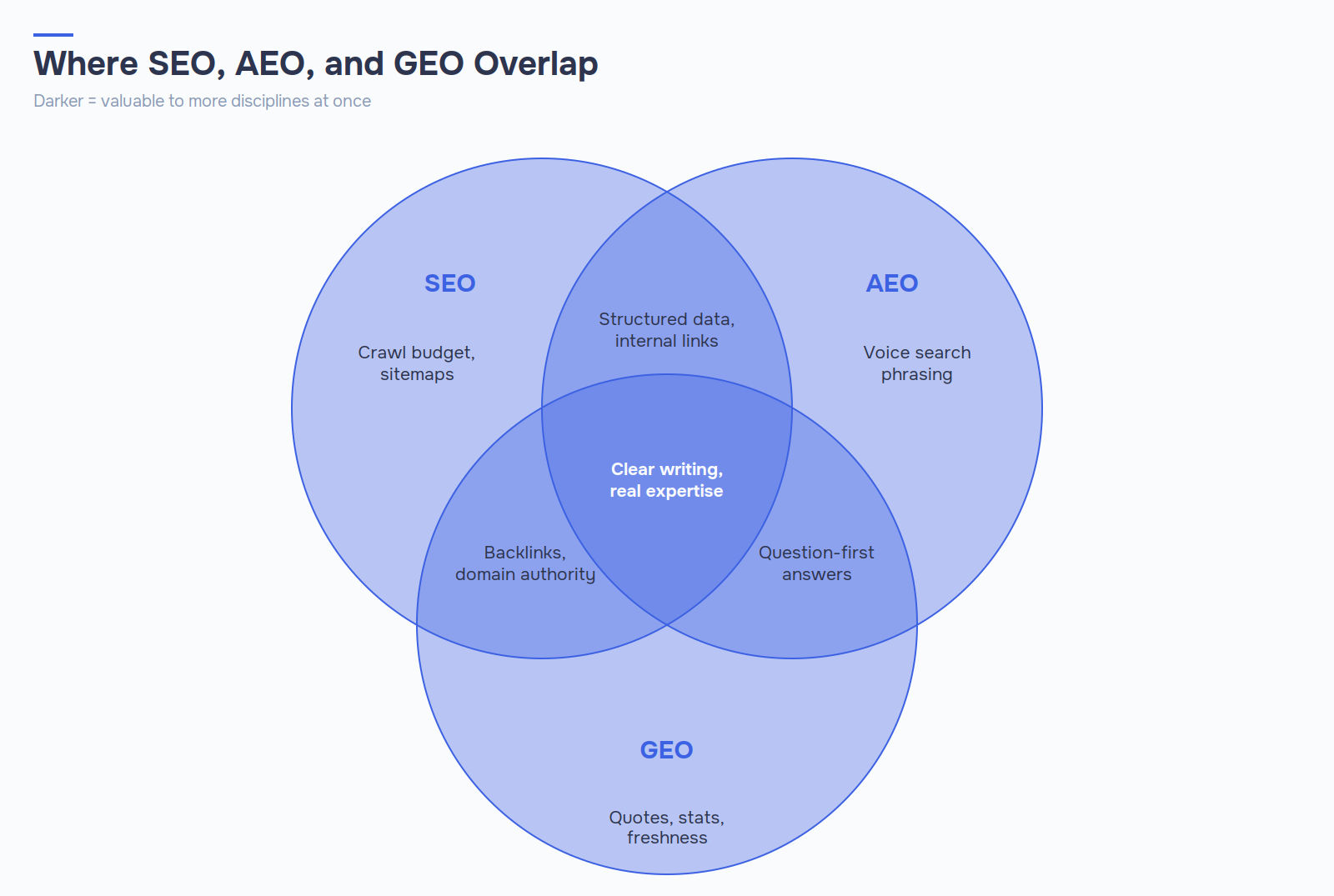
- The shared center (all three): clear, factual writing; a logical heading structure; genuine expertise; a fast, crawlable, mobile-friendly site. This isn’t niche advice. It’s the baseline every engine rewards.
- SEO ∩ AEO only: structured data, internal linking, and topical depth. These help you rank and get picked as a featured snippet, but they don’t guarantee an LLM will quote you.
- AEO ∩ GEO only: concise, question-first answers and FAQ-style formatting. This wins both the Google answer box and a citation slot inside a chatbot response, independent of your domain’s backlink profile.
- SEO ∩ GEO only: backlinks and domain authority. They still influence which sources a generative engine’s retrieval step surfaces, even though the final citation decision runs on different logic.
- SEO alone: technical crawl budget, XML sitemaps, canonicalization. Plumbing an LLM never sees directly.
- AEO alone: voice-assistant-specific phrasing and snippet-length answers, largely irrelevant to how an LLM synthesizes a paragraph.
- GEO alone: quotation density, statistical richness, cross-platform brand consistency. None of it has a real equivalent in a traditional ranking algorithm.
A designer building this out as an infographic should shade the center darkest, since that’s where nearly every optimization dollar should go first.
Which One Do You Need? A Decision Matrix
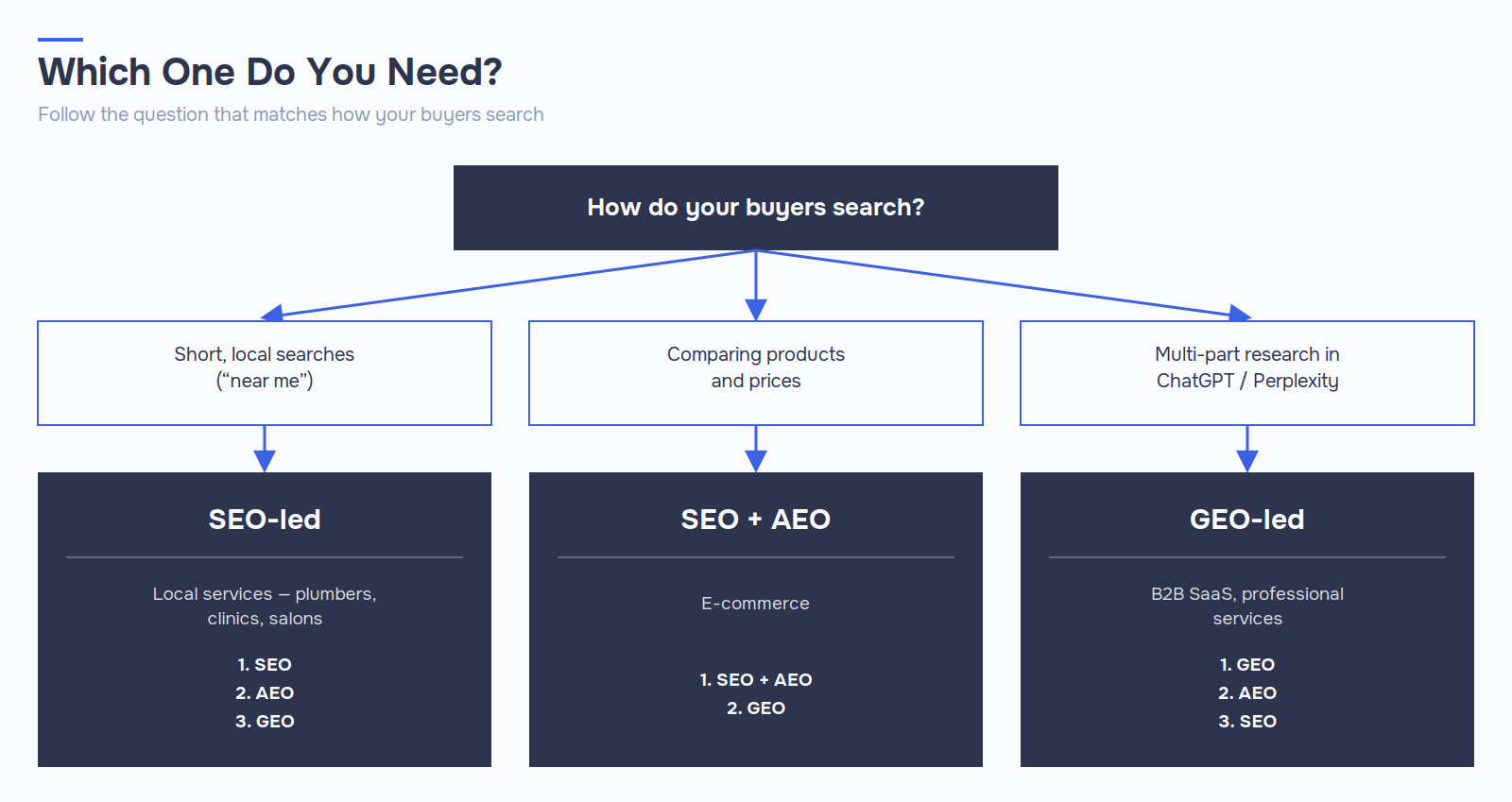
The AEO vs. SEO question comes down to how your buyers search, not which acronym is trending. Local and transactional businesses still live and die by SEO; research-heavy, comparison-driven categories increasingly live and die by GEO. Most AEO marketing budgets shift fastest in the SaaS and professional-services rows below.
| Business type | Primary buyer behavior | Priority order |
|---|---|---|
| Local service (plumber, dentist, salon) | “Near me” searches, maps, reviews | SEO first, AEO second, GEO low priority |
| E-commerce | Product search, comparison shopping | SEO + AEO in parallel, GEO for category guides |
| B2B SaaS | Long research cycles, vendor comparisons in ChatGPT/Perplexity | GEO first, AEO second, SEO as the foundation |
| Media/publisher | High-volume informational queries | AEO first, SEO close behind, GEO growing fast |
| Professional services (legal, financial, consulting) | Trust-driven, “who’s the best” queries | GEO first, then AEO, SEO for discoverability |
| Niche/technical B2B | Small search volume, high-intent questions | AEO and GEO tied, SEO mainly for crawlability |
If your buyers still type short, transactional queries into Google, SEO carries the most weight. If they ask multi-part questions inside ChatGPT or Perplexity before ever visiting a website, GEO earns the bigger investment. Once the priority is set, the AI SEO strategy playbook lays out the 90-day sequence for executing it.
How to Measure Each
Each discipline needs its own dashboard. AEO vs. SEO reporting doesn’t even live in the same tool yet: Google Search Console doesn’t separate AI Overview data from standard organic results, and no platform treats SEO, AEO, and GEO as one unified number.
- SEO: Track rankings and impressions in Google Search Console; track backlinks and keyword position in Ahrefs or Semrush.
- AEO: Check Search Console’s SERP-feature filters, and manually verify whether your page holds the featured snippet or AI Overview slot for target queries.
- GEO: Define 15–20 high-value prompts a real customer would type, run them across ChatGPT, Perplexity, Gemini, and Google AI Overviews, and log whether your brand appears, where, and how it’s described. Repeat monthly and track the trend, not a single snapshot. These platforms A/B test constantly, so a one-week dip rarely means a lasting change.
Running that audit manually across five engines every month is slow, and it still won’t tell you which pages are winning citations versus which ones are invisible to AI systems.
See exactly where your site stands across Google, ChatGPT, and Perplexity right now. Run a free AI visibility check and see your SEO, AEO, and GEO gaps in one report.
Frequently Asked Questions (FAQ)
No — the tactics overlap heavily, but the target is different. SEO optimizes for a ranking position, AEO optimizes for the sentence an engine lifts out and reads back to the user. You can rank #1 and still get skipped for the answer box because your first sentence buries the point under three lines of context. The overlap is real (structure, clarity, trust signals help both), which is exactly why it feels like relabeling — but the failure mode isn’t the same failure mode.
You’re right that there’s no single dashboard, and that’s not a tooling gap you can wait out — Search Console still doesn’t split AI Overview data from regular organic, and every third-party tracker samples differently. What works: pick 15-20 real prompts your buyer would type, run them by hand across ChatGPT, Perplexity, and AI Overviews monthly, and log whether you show up and how you’re described. It’s manual and it’s not exact, but a consistent monthly snapshot beats chasing a “true” number that doesn’t exist yet.
Because LLMs reward extractable, unhedged answers over polished marketing copy, and a blunt forum comment is often easier to lift than a page with three paragraphs of throat-clearing before the point. If your content buries the answer under brand story or scrolls past ads to get there, the model skips it even if your domain authority is higher. The fix isn’t more content — it’s cutting the preamble so the answer sits in the first sentence.
There’s one real academic source behind the term — a Princeton-led study that built a benchmark of roughly ten thousand queries and found specific edits (citing sources, adding stats, adding quotes) could lift citation odds meaningfully. Past that, most of what’s published is vendor content with no methodology shown, which is fair to be skeptical of. Treat the Princeton findings as directionally true and treat every “GEO case study” from a tool vendor as marketing until they show their prompt set.
Yes, but the payoff moved. Google pulled the visible FAQ dropdown from search results, so schema doesn’t win you rich-result real estate the way it used to. What it still does is give AI systems — ChatGPT, Perplexity, Google’s own AI Overviews — clean structure to parse when deciding what to lift, so it’s now a comprehension aid rather than a SERP feature. Keep using it, just don’t expect the blue-link payoff you got a couple years ago.
Share with


Rate the article