

The pages that survived answered a narrower question better than every competing page for that same query. That’s the pattern across every niche in this kind of analysis — not “more content,” not “more authority,” but tighter alignment between what a specific page promises and what it actually delivers. It’s a boring answer compared to a link hack or a size advantage, which is probably why it gets ignored. The tradeoff is that “answer the question better” isn’t a checklist — it takes real editorial judgment per page, which doesn’t scale the way link-building did.
Executive Summary
The story crypto has told itself about the Helpful Content Update is wrong on two counts. First, “HCU” is not an event you survived in 2023 — Google’s March 2024 core update absorbed the standalone Helpful Content system into core ranking, turning it into a continuous signal that is re-weighted at every core update since. Second, “Web3 lost its organic traffic” is not what the data shows.
We built an original dataset of 124 crypto domains across 8 niches and pulled 31 months of organic-traffic history (January 2024 → July 2026) for a stratified subset. After filtering out site migrations and post-2024 launches, 51 domains were cleanly classified as winners, stable, or losers.
The market did not fall. It split: 18 winners, 14 stable, 19 losers. Median change −5%, mean +7%, range −87% to +190%.
Three findings matter for anyone doing SEO in crypto:
- Authority did not protect anyone. The correlation between traffic outcome and Domain Rating was −0.25 — slightly negative. Referring domains, backlinks, and keyword footprint all correlated near zero. In a vertical addicted to link-building, links did not save a single site.
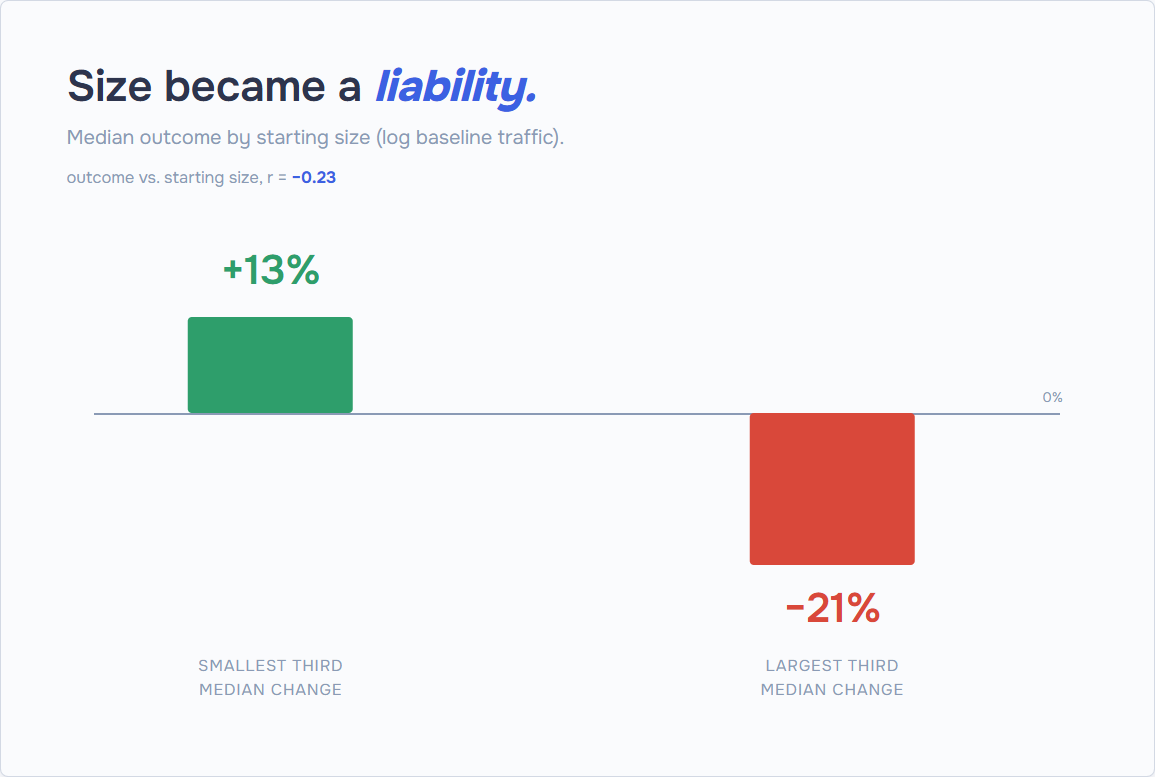
- The bigger you were, the more you bled. Outcome correlated −0.23 with starting size. The smallest third of sites grew a median +13%; the largest third fell −21%. Lean, focused challengers grew while high-authority incumbents lost.
- Organic visibility and AI visibility are now different axes. A brand can lose organic and stay dominant in AI answers (incumbents living in model memory), or win organic and be AI-fragile (challengers present only in retrieval). Recovery in 2026 is a two-track problem, not one.
The Premise Everyone Gets Wrong
The Helpful Content Update launched in 2022 as a separate classifier. Crypto teams still treat it that way — as a one-time penalty event with a recovery date. But in March 2024 Google folded the helpful-content signal into its core ranking system. There is no longer a discrete “HCU” to recover from; there is a continuous quality assessment recalibrated at each core update.
That reframing matters because it changes the diagnosis. If HCU were an event, recovery would mean “wait for the next refresh.” Because it is a core signal, recovery means structurally changing what the site offers on every update cycle — and, since 2025, defending a second surface entirely: citations inside AI-generated answers.
The core-update cadence our study spans:
- 2024: March, August, November, December
- 2025: March, late June–July, December
- 2026: late March–early April, late May–early June
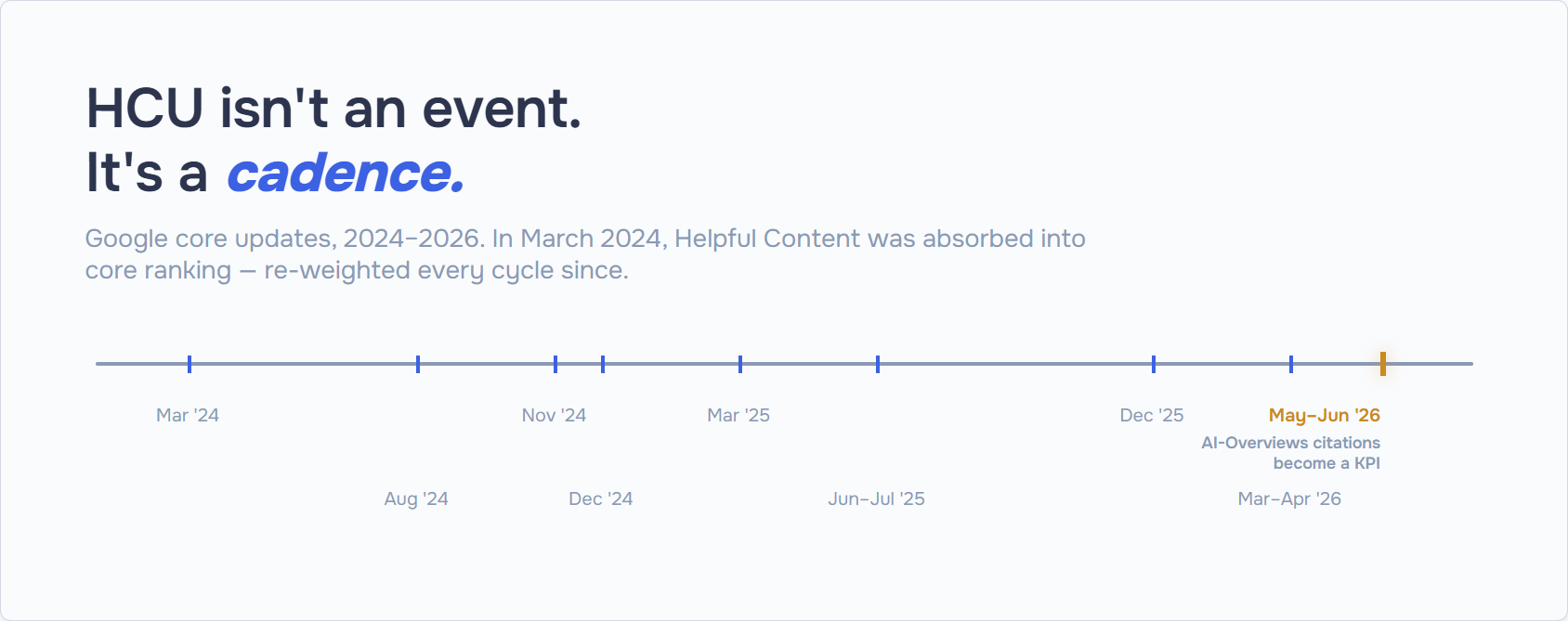
The May 2026 core update is the pivot: it made AI-Overviews citation share a distinct, measurable KPI. A site can now be organically healthy and still lose the AI answer — which is precisely why the two layers must be measured separately (see §6).
Methodology
Sample. 124 domains across 8 crypto niches — Swaps, Wallets, Centralized Exchanges (CEX), DeFi, Trackers, On-ramps, Earn/Staking, and NFT — assembled to span the full range of size and authority within each niche, from category giants to thin protocol front-ends. Client domains were deliberately excluded from the public sample.
Traffic history. Monthly organic-traffic estimates (Ahrefs) from January 2024 to July 2026 were pulled for a stratified subset of ~7 domains per niche (56 total).
Classification. For each domain, baseline = mean of Jan–Feb 2024; current = mean of May–Jul 2026. Net change drove a three-way label: winner > +15%, stable −15% to +15%, loser < −15%.
Anomaly control. Five domains were excluded as tracking artifacts, not ranking outcomes: cliff-to-zero collapses consistent with domain migrations (phantom.app, gate.io, ramp.network, curve.finance) and a post-baseline launch with no valid starting point (ethena.fi). This left 51 cleanly classified domains.
Confounding the market cycle. The study is designed within-niche: because winners and losers sit inside the same niche, facing the same token-price cycle and the same category demand, market movement cannot explain divergence between two sites in the same category. The spread inside each niche is the control.
Correlation layer. Each domain’s outcome was tested against current-snapshot authority and footprint metrics: Domain Rating, URL Rating, referring domains, backlinks, organic keywords, and top-3 keywords.
Limitations. Traffic figures are third-party estimates, not GA4 truth. Correlations are associational, not causal. Content-type and E-E-A-T coding (what specifically got devalued) is a planned phase-2 layer. The AI-visibility overlay (§6) uses proxies, clearly flagged as illustrative.
Finding 1 — the Market Split, It Did Not Fall
Across 51 domains: 18 winners, 14 stable, 19 losers. Median −5%, mean +7%.
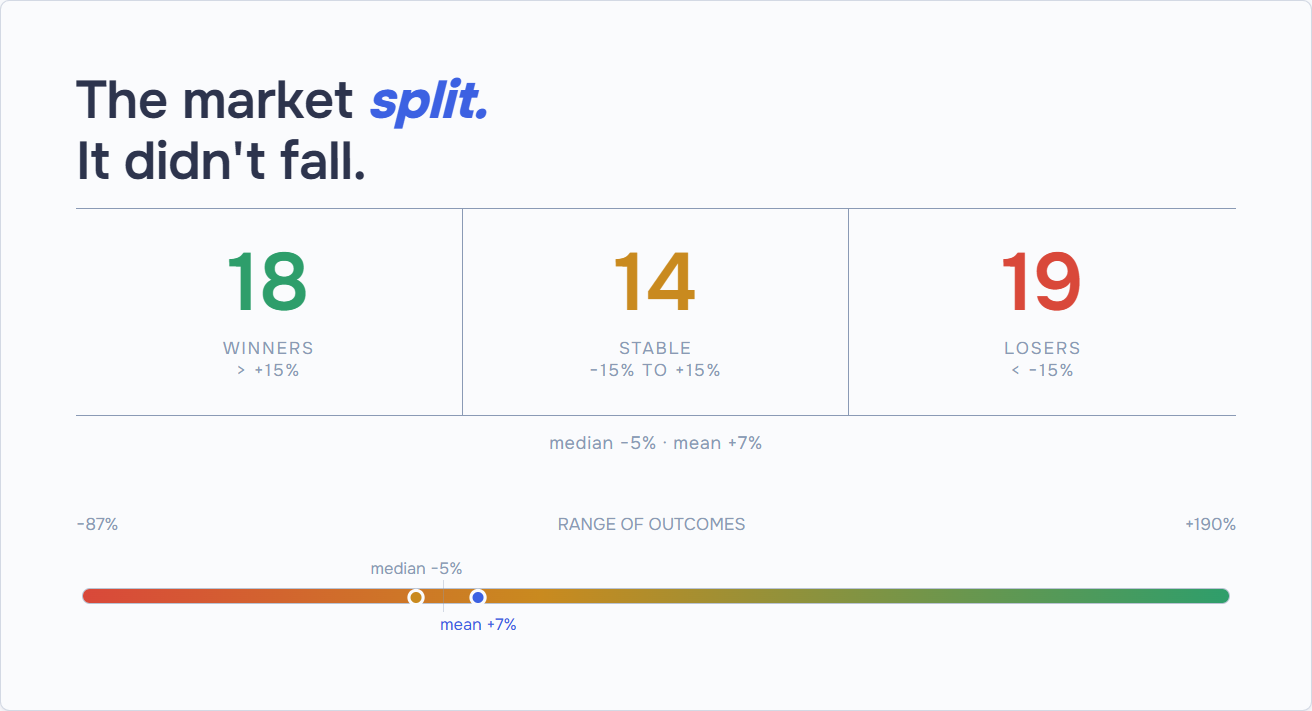
The aggregate looks flat, but the aggregate is a lie of averages. The real signal is the spread: outcomes ran from −87% to +190%, and every niche contained both winners and losers. “Crypto lost organic traffic after HCU” collapses two opposite populations into one false headline. Some of the most authoritative properties in the space shed half their traffic while smaller competitors in the same category doubled.
If a single market force (the token cycle, a Google vendetta against crypto) were driving this, outcomes would cluster. They don’t. They diverge — and they diverge inside niches, which is where the explanation has to live.
Finding 2 — Authority Did Not Protect Anyone
This is the result crypto SEO does not want to hear.
| Outcome vs. metric | Correlation |
|---|---|
| Domain Rating | −0.25 |
| Referring domains | −0.17 |
| URL Rating | −0.11 |
| Backlinks | −0.10 |
| Organic keywords | −0.08 |
| Top-3 keywords | −0.09 |
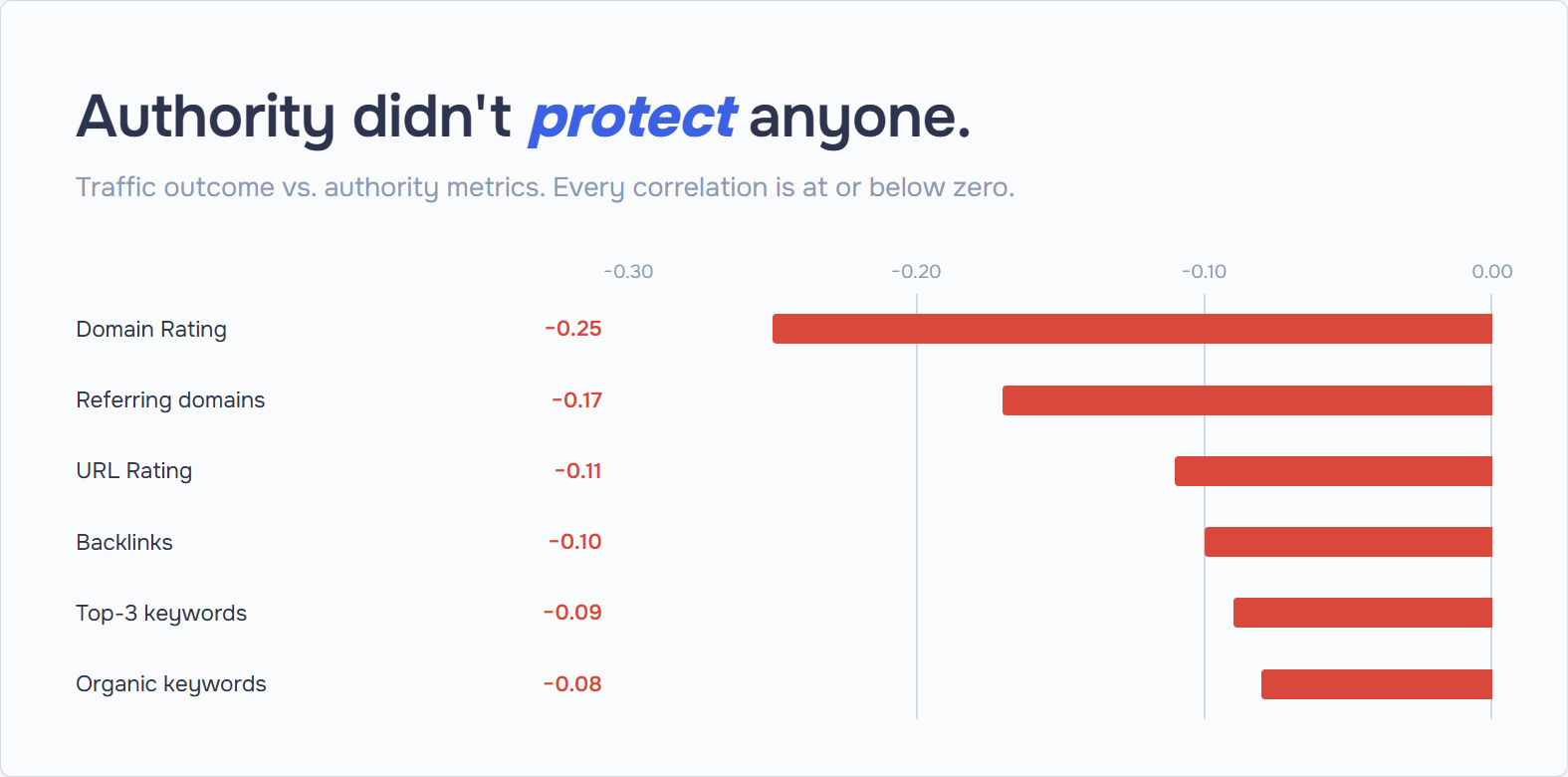
Every classic authority and link metric correlates at or below zero with survival. Domain Rating is negatively associated with outcome — the higher a site’s DR, the more likely it lost traffic.
For a vertical where “just build more links” is the reflexive answer to any ranking problem, this is a direct refutation. The link graph did not defend organic traffic through the 2024–2026 core updates. Whatever decided winners and losers, it was a site-level content-quality signal, not off-site authority.
The negative sign is not noise — it is the fingerprint of the next finding.
Finding 3 — the Incumbent–Challenger Inversion
Outcome correlated −0.23 with starting size (log of baseline traffic). Split into thirds by size:
- Smallest third: median +13%
- Largest third: median −21%
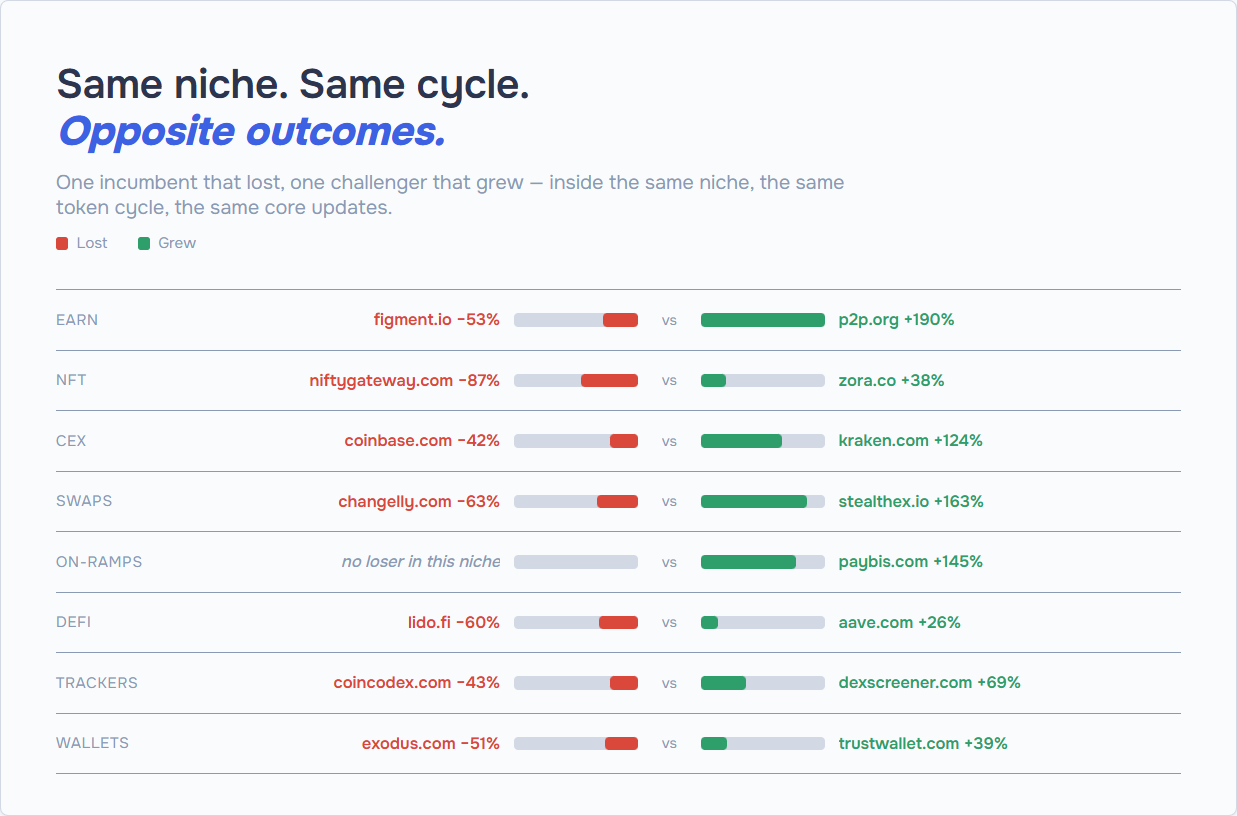
The pattern repeats across niches: the large, high-DR content incumbents bled, while lean, intent-focused challengers grew through the same updates.
| Niche | Incumbents that lost | Challengers that grew |
|---|---|---|
| Swaps | changelly −63%, uniswap −40% | stealthex +163%, simpleswap +74%, coinswitch +30% |
| CEX | coinbase −42%, crypto.com −39%, binance −17% | kraken +124% |
| Wallets | exodus −51% | metamask +38%, trustwallet +39%, blockchain +25% |
| Trackers | coinmarketcap −19%, coingecko −22%, coincodex −43% | dexscreener +69%, cointracker +61% |
| On-ramps | (none) | paybis +145%, switchere +126%, moonpay +63%, banxa +22% |
| DeFi | lido −60%, compound −48%, pancakeswap −27% | aave +26%, jup +24% |
| NFT | opensea −55%, blur −79%, niftygateway −87% | zora +38% |
| Earn | figment −53% | p2p.org +190%, everstake +43% |
This is exactly what a helpful-content-in-core signal should do: it devalues sprawling, generic, weakly-differentiated content footprints — the kind big incumbents accumulate — and rewards focused pages that match a specific intent. Size became a liability because size, in practice, meant surface area that no longer earned its rankings.
The strategic inversion: in 2024–2026, the challenger’s structural disadvantage (a small, tightly-scoped site) became an advantage.
Finding 4 — the GEO Overlay: Organic and AI Visibility Are Different Axes
Since the May 2026 core update elevated AI-Overviews citations to a standalone KPI, “did you keep your traffic” is only half the question. The other half: did you keep your place inside the AI-generated answer?
We mapped the sample against two AI-visibility layers:
- Parametric layer — what a large language model surfaces from training memory (unprompted brand recall).
- Retrieval layer — what search surfaces as citable sources for a high-intent prompt (a proxy for what an AI answer engine pulls into its response).
(These layers use proxies — one model’s recall and live search results — and are illustrative rather than a multi-engine measurement. For client engagements, ICODA replaces them with direct ChatGPT / Perplexity / AI-Overviews citation sampling.)
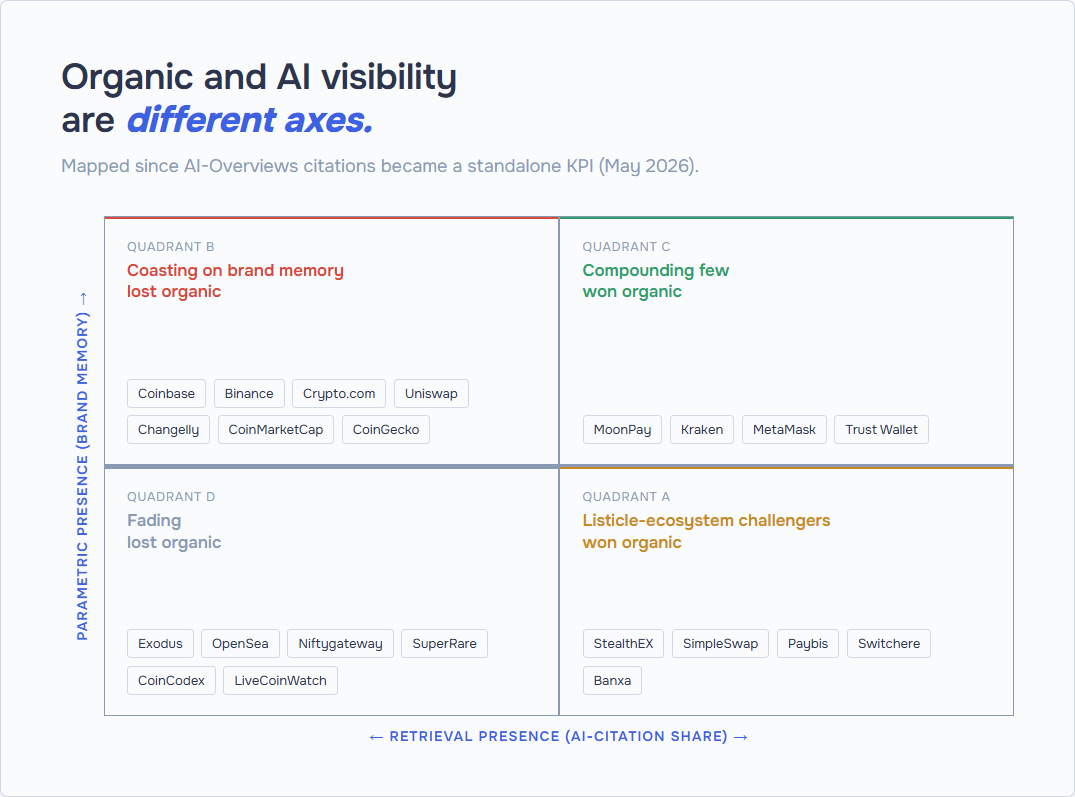
The result is a clean 2×2 that does not line up with the organic outcome:
A — Won organic, retrieval-present, parametrically invisible (“listicle-ecosystem challengers”).
StealthEX, SimpleSwap, Paybis, Switchere, Banxa. They grew organic by owning the roundup/citation ecosystem — and they are exactly the sources search surfaces for “best no-KYC swap” or “cheapest way to buy crypto with a card.” But an LLM does not name them from memory. Their AI visibility is entirely retrieval-dependent.
B — Lost organic, parametrically dominant (“incumbents coasting on brand memory”).
Coinbase, Binance, Crypto.com, Uniswap, Changelly, CoinMarketCap, CoinGecko. They bled organic, yet remain the names a model produces unprompted. Their AI visibility is parametric-anchored — resilient inside zero-click AI answers even as organic erodes, but they are ceding the retrieval/citation share to challengers.
C — Won both (“compounding few”). MoonPay, Kraken, MetaMask, Trust Wallet — brand memory and fresh retrieval presence.
D — Lost both (“fading”). Exodus, OpenSea, Niftygateway, SuperRare, CoinCodex, LiveCoinWatch.
The takeaway: organic health does not guarantee AI-answer presence, and AI-answer presence does not require organic health. They are separate surfaces with separate mechanics, and after May 2026 they must be measured and defended separately.
How to Recover — a Two-Track Playbook
The data points to a recovery model with two independent tracks. Doing one without the other leaves half the visibility on the table.
Track 1 — Regain organic by shedding, not adding.
The losers were big; the winners were focused. Recovery is not “publish more” or “build more links” (links correlated −0.10 with survival). It is auditing the content footprint and removing or consolidating the generic, thin, intent-mismatched surface area that a helpful-content-in-core signal devalues. The winners ranked because their pages answered a specific question better than the alternative — not because they were large or authoritative.
Track 2 — Own the retrieval layer to secure AI citations.
For challenger and gray-niche brands — where paid channels are restricted and organic/AI visibility is disproportionately valuable — the realistic lever is retrieval-layer ownership: becoming a dense, credible presence across the roundups, comparisons, and reference sources that AI answer engines cite. This is precisely how StealthEX, SimpleSwap, Paybis, and Switchere grew through the same updates that sank the incumbents. Parametric presence (being remembered by the model itself) is a slower brand-equity game that cannot be shortcut — but the retrieval layer is buildable now.
Measure both. Track organic outcome and AI-citation share as two separate KPIs. A brand in quadrant A (winning organic, invisible to model memory) has a different mandate than a brand in quadrant B (fading organic, coasting on brand recall) — and treating them the same wastes the intervention.
What This Study Is — and What Comes Next
This is an associational study built on third-party traffic estimates and a within-niche design that isolates outcome divergence from market movement. It establishes that authority failed to predict survival and that size inverted into a liability. It does not yet establish, page by page, which content types were devalued.
The planned phase-2 layer codes winners vs. losers on content type and E-E-A-T signals to convert “the big incumbents lost” into a concrete “here is what got devalued and here is the page-level fix.” The AI-visibility overlay will be re-run with direct multi-engine citation data in place of the proxies used here.
The headline stands on the data as it is: HCU is not an event, Web3 did not uniformly lose, authority did not protect, size became a liability, and AI visibility is now a second surface that has to be won on its own terms.
Frequently Asked Questions
Nothing changed for you to “wait out.” Before 2024 you could treat a Helpful Content hit as a wound that healed on its own timeline — now the same signal fires every core update, forever. That means there’s no finish line where Google “forgives” your site; the bar just keeps resetting. The tradeoff: you can’t do a one-time cleanup and move on, you’re maintaining quality as an ongoing cost, not a project.
DR measures links, not whether your pages are worth ranking. Domain Rating tracks the size and quality of your backlink profile, and none of that tells Google whether a specific page answers a specific query better than the alternative. Plenty of high-DR sites carry years of thin, overlapping, or outdated pages that drag the whole domain down even while the link graph looks strong. The uncomfortable part: you can have earned every one of those links honestly and still lose to a site with a fraction of your authority.
No, but stop treating links as your main lever for organic recovery. Links still help with discovery and can nudge a borderline page, but they don’t fix a site where the underlying content problem is the issue. Put your effort into auditing and consolidating your existing pages first — that’s where the actual signal lives right now. If you have budget for both, do content work first and links second, not the other way around.
Size stopped being an asset and became a target. Big incumbents accumulate years of generic, overlapping, or barely-differentiated pages because that’s what “cover everything” content strategy produces at scale — and that sprawl is exactly what a quality signal embedded in core ranking is built to catch. A smaller, tightly-scoped site doesn’t have that baggage, so it doesn’t get punished for it. The catch: if you’re already big, fixing this means cutting your own published output, which is a hard internal sell.
Because adding more of the same thing is what got you here. If your traffic problem is “too much generic surface area diluting your best pages,” publishing another 50 articles makes the underlying problem worse, not better. Pruning and merging weak pages into fewer, sharper ones is slower and less satisfying than a content sprint, but it’s the move that actually shows up in the data. The tradeoff is real: cutting content feels like giving up ground, even when it’s the ground that was hurting you.
No, you’re just measuring one surface and missing the other. Organic rankings and AI-answer visibility run on different mechanics — one is about what search indexes and ranks, the other is about what a model either remembers from training or pulls from live retrieval. You can be completely healthy on one axis and invisible on the other, and neither problem fixes the other automatically. That’s genuinely annoying if you only have budget to fight one battle at a time.
It rewards the same distribution game link-building did, just on a different set of pages. Getting cited by AI answer engines means showing up densely and credibly across the comparison and roundup content those engines pull from — which for a challenger brand often does look like getting into “best X” and “cheapest way to Y” pages. That’s a legitimate channel and it’s clearly working for smaller players who can’t out-authority the incumbents any other way. The honest tradeoff: it’s retrieval-dependent, so if the roundup ecosystem changes or a competitor buys their way in, that visibility can move fast.
Appendix — Full Classified Dataset (51 Domains)
| Niche | Domain | Net % | Class | DR |
|---|---|---|---|---|
| Swaps | stealthex.io | +163 | winner | 64 |
| Swaps | simpleswap.io | +74 | winner | 71 |
| Swaps | coinswitch.co | +30 | winner | 65 |
| Swaps | changenow.io | +5 | stable | 75 |
| Swaps | swapspace.co | −9 | stable | 59 |
| Swaps | uniswap.org | −40 | loser | 89 |
| Swaps | changelly.com | −63 | loser | 79 |
| Wallets | trustwallet.com | +39 | winner | 83 |
| Wallets | metamask.io | +38 | winner | 89 |
| Wallets | blockchain.com | +25 | winner | 88 |
| Wallets | ledger.com | +13 | stable | 85 |
| Wallets | atomicwallet.io | −5 | stable | 72 |
| Wallets | exodus.com | −51 | loser | 79 |
| CEX | kraken.com | +124 | winner | 86 |
| CEX | bybit.com | −0 | stable | 85 |
| CEX | okx.com | −11 | stable | 88 |
| CEX | binance.com | −17 | loser | 91 |
| CEX | crypto.com | −39 | loser | 86 |
| CEX | coinbase.com | −42 | loser | 91 |
| DeFi | aave.com | +26 | winner | 79 |
| DeFi | jup.ag | +24 | winner | 86 |
| DeFi | pancakeswap.finance | −27 | loser | 85 |
| DeFi | compound.finance | −48 | loser | 76 |
| DeFi | lido.fi | −60 | loser | 75 |
| Trackers | dexscreener.com | +69 | winner | 91 |
| Trackers | cointracker.io | +61 | winner | 72 |
| Trackers | coinstats.app | −10 | stable | 72 |
| Trackers | coinmarketcap.com | −19 | loser | 90 |
| Trackers | coingecko.com | −22 | loser | 89 |
| Trackers | coincodex.com | −43 | loser | 75 |
| Trackers | livecoinwatch.com | −49 | loser | 75 |
| On-ramps | paybis.com | +145 | winner | 76 |
| On-ramps | switchere.com | +126 | winner | 68 |
| On-ramps | moonpay.com | +63 | winner | 81 |
| On-ramps | banxa.com | +22 | winner | 76 |
| On-ramps | mercuryo.io | +3 | stable | 71 |
| On-ramps | transak.com | −5 | stable | 73 |
| Earn | p2p.org | +190 | winner | 61 |
| Earn | everstake.one | +43 | winner | 62 |
| Earn | blockdaemon.com | +13 | stable | 70 |
| Earn | nexo.com | −0 | stable | 75 |
| Earn | youhodler.com | −5 | stable | 65 |
| Earn | allnodes.com | −10 | stable | 61 |
| Earn | figment.io | −53 | loser | 66 |
| NFT | zora.co | +38 | winner | 79 |
| NFT | rarible.com | −6 | stable | 84 |
| NFT | opensea.io | −55 | loser | 91 |
| NFT | magiceden.io | −57 | loser | 83 |
| NFT | superrare.com | −64 | loser | 79 |
| NFT | blur.io | −79 | loser | 72 |
| NFT | niftygateway.com | −87 | loser | 77 |
Excluded as tracking artifacts (migration/launch, not ranking outcomes): phantom.app, gate.io, ramp.network, curve.finance, ethena.fi.
Traffic figures are Ahrefs estimates. Correlations are associational.
Share with


Rate the article