In year one, an online gambling license costs about €18,000 to €52,000 in fixed regulator fees across the five offshore regulators compared here. Malta’s revenue-based contribution can push that higher, and vendors estimate €25,000 to over €200,000 all-in once you add setup, legal work, audits and staff.
We compare Curaçao, Anjouan, Malta, the Isle of Man and Kahnawake using each regulator’s own fee document where we could read it, and we label vendor estimates. Figures are current as of 18 November 2026 and stay in each regulator’s currency. An offshore license does not let you accept players in US states, which license operators themselves (see the Pennsylvania and Arizona fee schedules).
ICODA is a marketing agency and does not sell licenses. This guide is not legal or tax advice: confirm every figure with the regulator and a licensed adviser before you apply. For the full launch budget, see our guide to starting an online casino business.
How Much Does a Gambling License Cost by Regulator?
Fixed regulator fees in year one run from about €18,000 (Anjouan) to €52,000 (Curaçao); Malta’s contribution then scales with your revenue.
| Regulator | Application | Annual fee | Year one, regulator fees |
|---|---|---|---|
| Curaçao Gaming Authority (CGA) | €4,592 | €47,450 (B2C) | About €52,000 |
| Anjouan regulator | Not published | €17,828 | €17,828 plus the application fee |
| Malta Gaming Authority (MGA) | €5,000 | €25,000 plus a compliance contribution (Type 1 minimum €15,000) | About €30,000 for a qualifying casino start-up |
| Isle of Man Gambling Supervision Commission (GSC) | £5,250 | £36,750 | £42,000 |
| Kahnawake Gaming Commission (KGC) | US$35,000 (US$40,000 from 1 Jan 2027) | US$20,000 (up to 6 domains) | About US$40,000: the application covers year one; add US$5,000 per key person |
| Regulator | Time to license | Year-one all-in (vendor estimates) | Main condition |
|---|---|---|---|
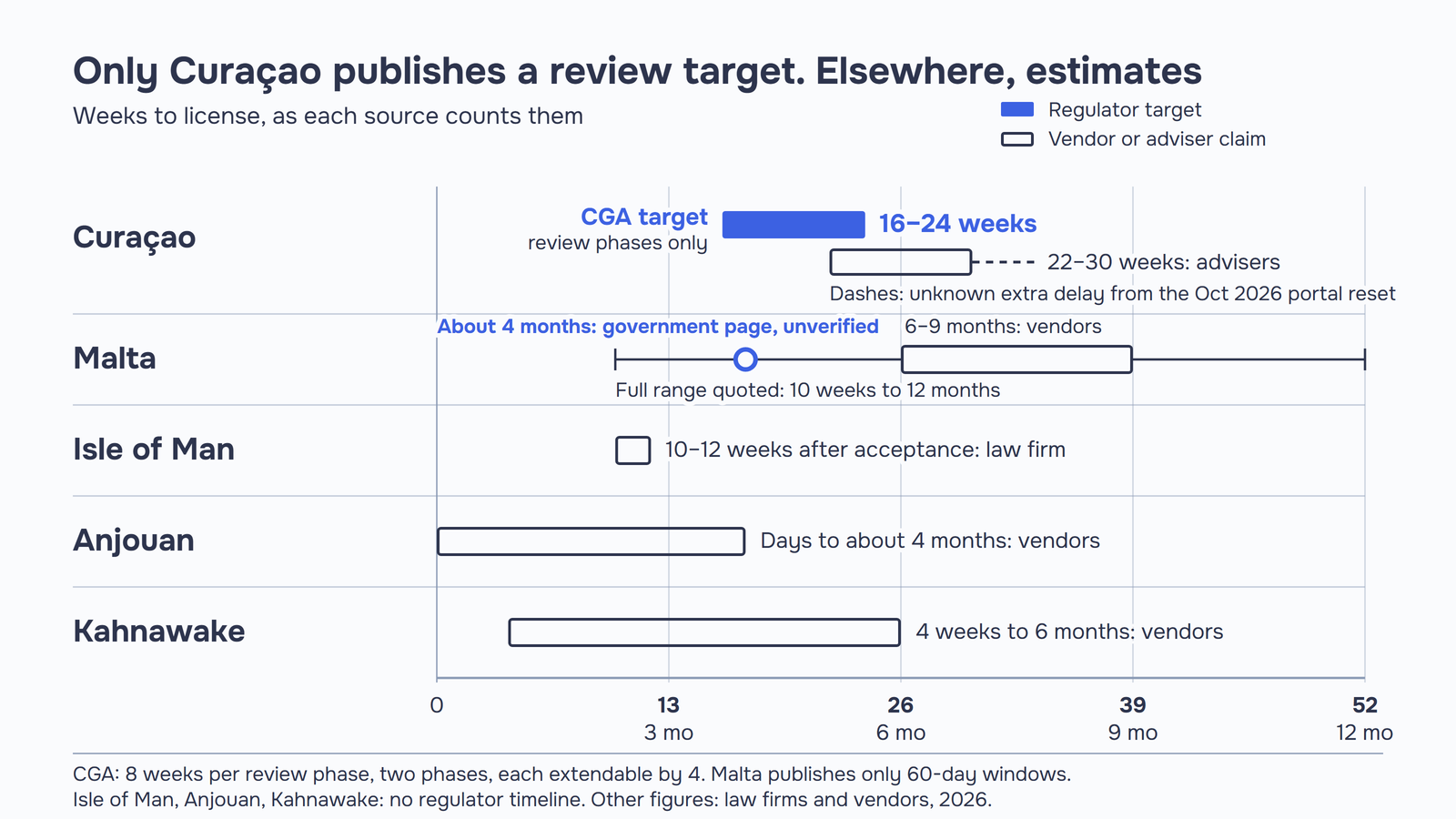
| Curaçao | CGA targets 8 weeks per review phase, two phases; advisers say 22–30 weeks | €55,000–233,000 | Curaçao company, resident managing director |
| Anjouan | No official figure; vendors say days to about 4 months | €25,000–70,000 | Legal basis disputed by the Comoros government |
| Malta | No MGA figure; a government page suggests about 4 months, vendors say 6–9 | €65,000–175,000, plus €100,000 share capital | Strict audits, approved key functions |
| Isle of Man | 10–12 weeks after acceptance (one law firm) | £76,000–167,000+ | Local directors, servers and bank |
| Kahnawake | No official figure; vendors say 4 weeks to 6 months | No independent estimates found | Hosting on Mohawk territory |
Sources: CGA “License Fees under the LOK” v2.0 (15 Oct 2025, archive copy; the original page is offline), Anjouan fee page, MGA fee guidance note (Dec 2024, v3), GSC fee sheet (Oct 2025), KGC fee notice (13 Aug 2026). The all-in column is a spread of consultancy estimates (Track360, Binderr, ICOS, Szilaghi and others) that count different items; across the guides we checked, Malta’s year-one total runs from €50,000 to over €700,000. Compare regulator fees first, then add your own setup costs.
What Does a Curaçao Online Gaming License Cost?
A Curaçao online gaming license costs €4,592 to apply and €47,450 a year for a B2C operator, so year one is about €52,000 before setup. The annual fee splits into €24,490 to the Treasury and €22,960 to the CGA.
The figures come from the CGA’s fee document under the National Ordinance on Games of Chance (LOK), version 2.0 of October 2025, and we found no 2026 change. Extras are €250 per added domain and €150 per ultimate beneficial owner (UBO) or 10%+ shareholder. A B2B supplier license is €24,490 a year. Fees are non-refundable: the first annual fee is pro-rated and due within 14 days of the grant notice, and later annual fees are due by 15 January, so a license granted late in the year can owe two invoices within months.
What drives the Curaçao egaming license cost above the fee:
- Company: a Curaçao N.V. or B.V. with a managing director who lives in Curaçao.
- Key person and office: a full-time key person on the island’s population register and a local office, postponed to 1 April 2027 by the Minister of Justice (CGA notice of 23 January 2026). Three key persons are required from year 5.
The CGA’s licensing portal was breached in 2026, and its replacement is still rolling out. On 17 September the CGA found unauthorized access that had begun in December 2025. It dropped that portal on 7 October and opened an interim one on 19 October. Existing licenses stay valid, but the digital seal and public register were affected, so payment partners may ask for other proof. The CGA had published no revised deadlines for new applications by 18 November.
From 24 December 2026, Curaçao-based critical suppliers such as platform providers need a B2B license, foreign suppliers must register with the CGA, and licensees may not work with unregistered suppliers. Ask your platform for proof of its status before you sign.
What Does a Malta Gaming License Cost?
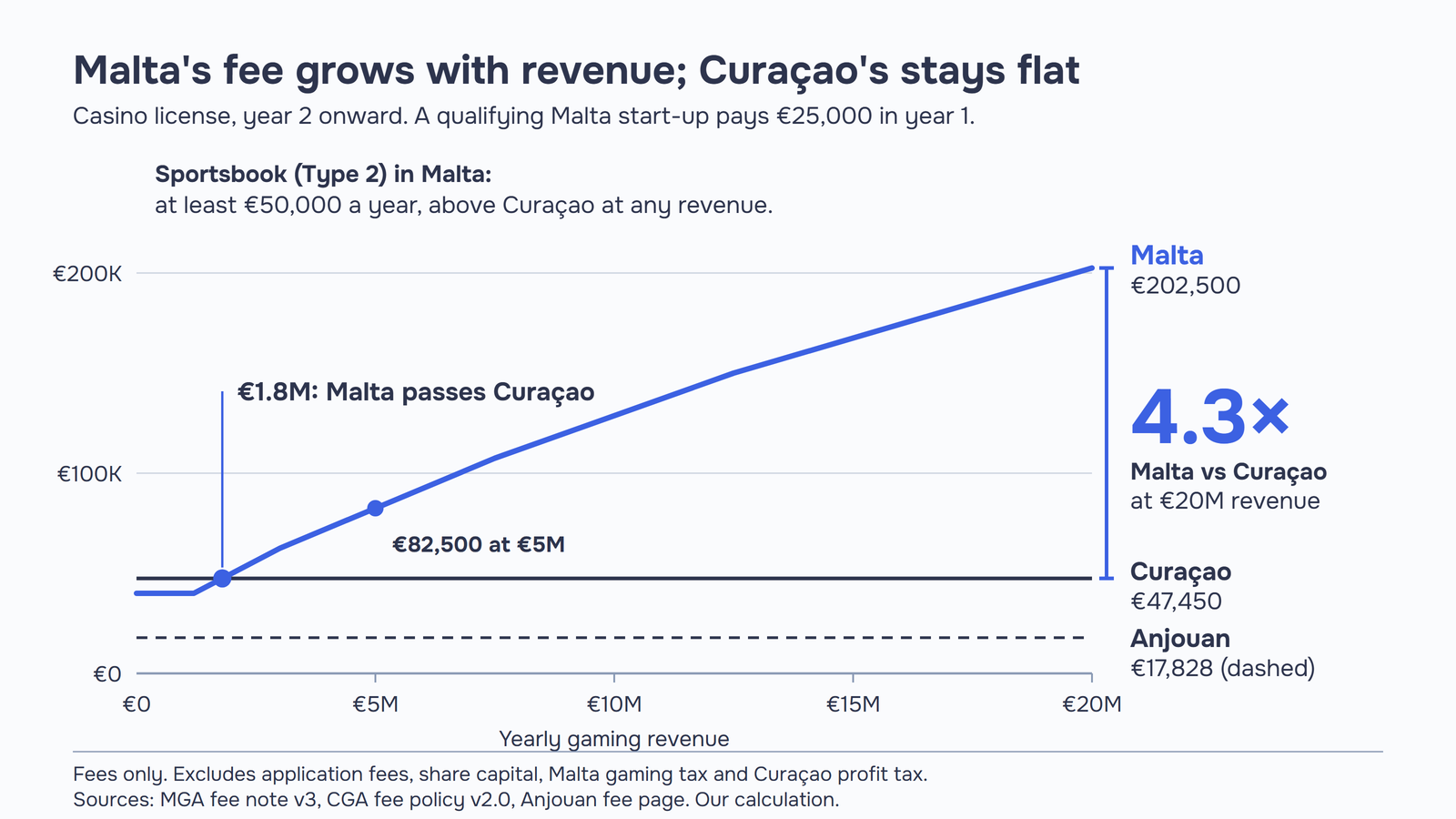
A Malta gaming license costs €5,000 to apply and €25,000 a year, plus a compliance contribution on revenue. A qualifying casino start-up pays about €30,000 in year one.
Malta is the only one of the five whose fee rises with revenue. For Type 1 (casino-type games):
- Compliance contribution: 1.25% of gaming revenue on the first €3 million, falling across six bands to 0.40%. The minimum is €15,000 and the maximum €375,000, so the yearly total tops out at €400,000 from about €65 million of revenue.
- Start-up moratorium: no contribution for 12 months if you qualify under the MGA’s Directive on Start-Up Undertakings, so check eligibility first. The fee note also says new licensees that do not qualify avoid the full minimum in their first financial year.
- Year two: at least €40,000, the €25,000 fee plus the €15,000 minimum.
- Sportsbooks (Type 2) pay more: 4% on the first €3 million, a €25,000 minimum and a €600,000 maximum. A betting operator that does not qualify as a start-up pays about €70,000 in year one at €1 million of revenue.
- Share capital: €100,000 paid up for Types 1 and 2. It is equity, not a fee. Each key function, such as compliance and MLRO, needs an MGA-approved person.
Gaming tax rose on 1 October 2026 from 5% to 15% for Type 1 and 10% for the other types (Legal Notice 84 of 2026). It applies only to revenue from players physically in Malta, but several top-ranking guides still show 5%.
The MGA publishes no end-to-end timeline, only 60-day windows to fix an incomplete application and to go live and trigger the system audit.
An MGA license carries no EU passport for gambling. On 16 April 2026 the EU Court of Justice held in case C-440/23 that member states may ban online gambling licensed elsewhere, so players in some countries can reclaim losses from Malta-licensed operators. The license earns credibility with payment partners; market access depends on each country.
What Does an Anjouan Gaming License Cost?
An Anjouan gaming license costs €17,828 to issue and €17,828 a year to renew, the same for B2C and B2B. It has the lowest fee of the five and the highest acceptance risk.
The regulator’s fee page also lists €500 per extra B2C domain. It mentions a non-refundable application fee but gives no amount, and the page is undated. Some vendors quote a lower renewal; the page says €17,828. Vendors estimate €25,000 to €70,000 for the full first year; the lowest quotes, about €17,000–25,000, sit close to the fee alone. There is no official timeline, and vendor claims run from days to 3–4 months.
The risk is acceptance and legal standing. The Comoros central bank has warned against these licensing bodies more than once, most recently in December 2025. In October 2026, trade press citing The Guardian reported that the Comoros government and central bank said the licenses have no legal basis and asked the UK for help. We could not read that article directly, so treat it as secondhand. Vendors also report that some payment processors and affiliates decline Anjouan licenses. A cheap license that your payment partner will not onboard costs more than the fee you saved.
What Do the Isle of Man and Kahnawake Cost?
The Isle of Man costs £42,000 in regulator fees in year one, and Kahnawake costs about US$40,000. Both require your servers or hosting on site.
Isle of Man
The Isle of Man charges £42,000 in year one: £5,250 to apply and £36,750 for the first annual license fee. The bigger cost is substance: a Manx company, at least two directors who live on the island, a resident Designated Official (or a local Operations Manager if the official lives elsewhere), player servers on the island and player funds in an island bank. The GSC may reject brass-plate set-ups. Gambling duty is 1.5% of gross yield up to £20 million, 0.5% from £20 million to £40 million and 0.1% above.
Kahnawake
Kahnawake costs about US$40,000 in year one, then US$20,000 a year. The US$35,000 application to the KGC covers due diligence and the first year, and each key person adds US$5,000 to apply and US$1,000 a year. The annual fee covers up to six domains, plus US$500 per extra domain. From 1 January 2027 the application rises to US$40,000 and the five-year renewal from US$5,000 to US$40,000, per a KGC notice of 13 August 2026; complete applications filed before then keep the current fees. Hosting at Mohawk Internet Technologies is mandatory, the KGC publishes no timeline, and its register includes brands such as PartyPoker/bwin, GGPoker and 22bet.
What Does the Regulator Fee Leave Out?
The regulator fee leaves out formation, legal work, certification, audits, local staff, banking and payment costs, which usually add more than the fee.
Vendor ranges, none from a regulator:
- Company formation: €3,000–8,000 in Curaçao; about €4,750 a year for an Anjouan company.
- Legal and application preparation: £15,000–25,000 from one consultancy.
- Game and platform certification: labs quote $3,000 to $25,000 per game, but if you take games through an aggregator the studio normally pays for game certificates. Your bill is platform or RNG testing if you run your own, plus required audits such as Malta’s system audit (€2,500–50,000).
- Compliance staff: an outsourced money laundering reporting officer (MLRO) from about €1,500 a month. One provider prices a Malta key official at about €1,000 a month for a single role; a full key-function team costs far more.
- Banking: Curaçao bank setup €5,000–15,000 in year one (one vendor guide). Banks are often the slowest step, so approach them early.
- Payments: brokers quote 4–10% per transaction for gambling (merchant category code 7995) and often a 5–15% rolling reserve held for months. These are marketing figures, not price lists.
How Do You Calculate Your Gambling License Cost?
Add the regulator’s year-one fee, setup costs, required capital and payment reserves, then check how much falls due before your first deposit.
A Curaçao example, using only the low end of vendor ranges: about €52,000 in regulator fees, €3,000 for company formation and €18,000 for a year of outsourced MLRO comes to about €73,000. That is before legal work, certification, audits, banking, staff and reserves, so treat it as a floor.
Cash goes out before revenue comes in. The CGA does not grant a license until the first invoices are paid, the MGA takes the annual fee up front, Malta’s €100,000 of share capital is paid in before you operate, and processors hold reserves from your first transactions. The license date is not the deposit date, because payment onboarding and platform integration come after it. Treat the date as an estimate, and do not buy a media plan that starts on it.
How Much Does a UK, Gibraltar or Ontario License Cost?
These regulators license operators to serve their own home markets, so they answer a different question from the five offshore options above.
- UK (Gambling Commission): from 1 October 2026 the smallest remote casino band is £8,185 to apply and £7,000 a year, and the first annual fee is charged at 75% (government response). The larger cost is tax: Remote Gaming Duty rose from 21% to 40% of profits on 1 April 2026, and remote betting duty rises to 25% on 1 April 2027.
- Gibraltar: the Gambling Act 2025 took effect on 1 April 2026. A B2C application is £30,000, and the annual fee is £50,000, £100,000 or £200,000 per vertical by gross yield, so casino plus sportsbook pays twice (LN 2026/065).
- Ontario (AGCO): CAD 100,000 per gaming site per year, plus a separate agreement with iGaming Ontario.
Which License Fits Your Launch?
Pick the countries you will serve first, then the license your payment partners accept, and only then compare price.
An offshore license covers your company, not your players’ countries. Curaçao, Anjouan and Kahnawake licenses give no right to serve residents of countries that issue their own licenses, such as the UK, the Netherlands, Ontario and most EU states, or of countries that ban online gambling. Serving them can bring blocking orders, payment blocks and, in the EU, player claims to recover stakes. List the countries you will block before you pick a license.
- Offshore launch in markets without their own license rules: Curaçao. Budget the fee and the 2026 portal delay.
- Credibility with payment partners and a funded team: Malta. Budget the €100,000 capital and a long wait; a sportsbook costs more than a casino.
- Lowest fee, highest acceptance risk: Anjouan. Get written confirmation from your payment partner, bank and affiliates, and legal advice, before you apply.
- Established operator or B2B supplier with staff on the ground: Isle of Man.
- An operator already hosted in Kahnawake: Kahnawake.
- No license of your own: a white label casino launches under a provider’s license for a revenue share and is a cheaper way to test a market than a license you may have to replace. The provider stays legally responsible for your brand, can end the arrangement and keeps the license when you leave, so read the termination terms. Curaçao replaced its master and sub-license system with the LOK, so confirm with counsel how any Curaçao white label is structured.
Ad platforms add their own gate: Google requires a local license or certification for each country you target. Our iGaming PPC guide covers the platform policies.
Before You Apply: Questions and Red Flags
Get three answers in writing before you pay a consultancy: who accepts the license, what the regulator charges, and who the licensee is.
- Payment partner and top affiliates: do they onboard this license today?
- Consultancy: which lines are regulator fees, and what do you add on top? Who holds the license, and who holds player funds?
- Platform and aggregator: are they registered with the CGA (required from 24 December 2026)?
Walk away from a guaranteed approval date (no regulator gives one), a Curaçao “sub-license” under an old master license (the LOK ended that system), and a quote that blends regulator fees and service fees into one number.
Planning a launch? Tell us your markets, license and budget in the ICODA calculator and we will send a launch marketing plan within 24 hours.
Gambling License Cost: FAQ
An online gambling license costs about €18,000 to €52,000 in fixed regulator fees in year one across the five offshore regulators compared here, and Malta’s revenue-based contribution can push it higher. With setup, legal work, audits and staff, vendors estimate €25,000 to over €200,000.
A Curaçao eGaming license costs €4,592 to apply and €47,450 a year for a B2C operator, about €52,000 in year one. A B2B supplier license is €24,490 a year. Company, legal and compliance setup is extra; vendors put the first-year total at €55,000 or more.
A Malta gaming license costs €5,000 to apply and €25,000 a year, plus a compliance contribution on revenue. A qualifying casino start-up pays about €30,000 in year one, then at least €40,000 a year. Casinos also need €100,000 in share capital, and sportsbooks pay more.
Curaçao’s regulator targets 8 weeks per review phase, and advisers total 22–30 weeks, before any delay from the 2026 portal reset. Malta publishes no figure; vendors say 6–9 months. The Isle of Man takes 10–12 weeks after acceptance, according to one law firm. Anjouan vendors quote days to about 4 months.
No. In most countries, offering real-money gambling without the license that country requires is illegal, and an offshore license does not count where a local license is required. Google certifies gambling ads only in listed countries, and payment processors ask for proof of licensing. A white label brand runs under its provider’s license instead.
It depends on the license and your players’ countries. Malta charges 15% gaming tax on Type 1 revenue from players in Malta, the Isle of Man 1.5% of gross yield up to £20 million, Gibraltar 0.15% of gross gaming profit above the first £100,000, and the UK 40% Remote Gaming Duty. Vendors report no gaming-revenue tax in Curaçao, only 15–22% profit tax.
Share with


Rate the article