A crypto exchange listing costs anywhere from $0 to several million dollars and takes from days to months, depending on the tier you target.
For a first-year budget, crypto.news estimates $50K–$500K all-in at Tier-2 and $500K–$5M at Tier-1. Tier-1 exchanges say they charge no listing fee, yet money still moves through deposits, token allocations and market making. Every figure here is labelled exchange-stated, vendor-quoted or alleged, and was checked on 18 November 2026. ICODA, which publishes this guide, is a crypto marketing agency.
Which Exchange Tier Should Your Token Target?
Start on a DEX, add one Tier-2 venue next and aim for Tier-1 once your token trades with real volume; this order is our judgment, not an exchange rule.
No exchange publishes a traction threshold, but Binance weighs secondary-market metrics for tokens already trading. “Tier” is market shorthand, not an official rank.
| Tier | Examples | Quoted entry cost | Typical speed |
|---|---|---|---|
| Tier-1 | Binance, Coinbase, Kraken, OKX, Bybit | $100K–$3M (crypto.news estimate) | Weeks to months |
| Tier-2 | Gate, MEXC, KuCoin, Bitget, HTX, BingX | $20K–$300K (crypto.news estimate) | 1–10 weeks |
| Tier-3 | XT, LBank, small regional venues | $0–$50K (crypto.news estimate) | Days |
| DEX | Uniswap, PancakeSwap | Gas plus the liquidity you supply | Hours |
crypto.news groups Binance, Coinbase, Kraken and OKX as Tier-1 and Bybit, KuCoin, Gate and HTX as Tier-2. The other placements are ours.
A listing buys access and liquidity, and the price gain fades. The Tie, a crypto market-data firm, studied 1,844 listing events from January 2023 to June 2026 and found that price largely mean-reverts within two weeks.
A listing is not a TGE: a sale and a listing are usually separate steps, as our TGE guide explains. An exchange launchpad sale (IEO) combines them, and our IEO on exchange service and IEO marketing guide cover that route.
Coinbase and Kraken are the main US-facing venues. Coinbase lets most US users (not New York) trade some tokens through in-app DEX access before any formal listing, so check what “listed” means before you announce it.
How Much Does a Crypto Exchange Listing Cost?
Token listing cost runs from $0 on small venues to seven figures at Tier-1, and no exchange publishes a rate card, so each figure below names its source.
| Item | Figure | Source and type |
|---|---|---|
| Binance, Kraken, Coinbase application fee | $0 | Exchanges’ own statements (Binance, 17 Dec 2025; Kraken); Coinbase’s 2022 post, quoted by The Block |
| Bybit security deposit | $200K–$300K in stablecoins, plus a promotion budget | Bybit to Cointelegraph, Apr 2025 |
| Tier-1 listing fee | $100K–$3M | crypto.news, Aug 2026, unsourced estimate |
| Tier-1 first year, all-in | $500K–$5M | crypto.news, same article |
| Tier-2 listing fee | $20K–$300K | crypto.news, same article |
| Tier-2 first year, all-in | $50K–$500K | crypto.news, same article |
| MEXC | From 50K USDT plus 50K USDT in tokens | Listing.Help sheet, agency package price, not an exchange-published fee |
| BingX | From 30K USDT | Listing.Help sheet, agency |
| XT | From 15K USDT | Listing.Help sheet, agency |
| LBank | From 20K USDT plus 10K tokens | Listing.Help sheet, agency |
| HTX | 230K–430K USDT, above crypto.news’s Tier-2 ceiling | Listing.Help sheet, agency |
| CoinGecko Fast Pass, one coin listing | $1,500 | CoinGecko support, official |
The best-known documented payment to a top exchange is Blockstack’s: a 2019 SEC filing disclosed about $1.1M over four years to Binance. By our sum, the lines below reach roughly $420K–$1.1M in a year (deposit, twelve months of retainer, legal, audit); the $5M end of crypto.news’s range has no breakdown.
What Costs More Than the Listing Fee?
Deposits, token allocations, market making, legal and audit work, and launch marketing can add up to more than the listing fee itself.
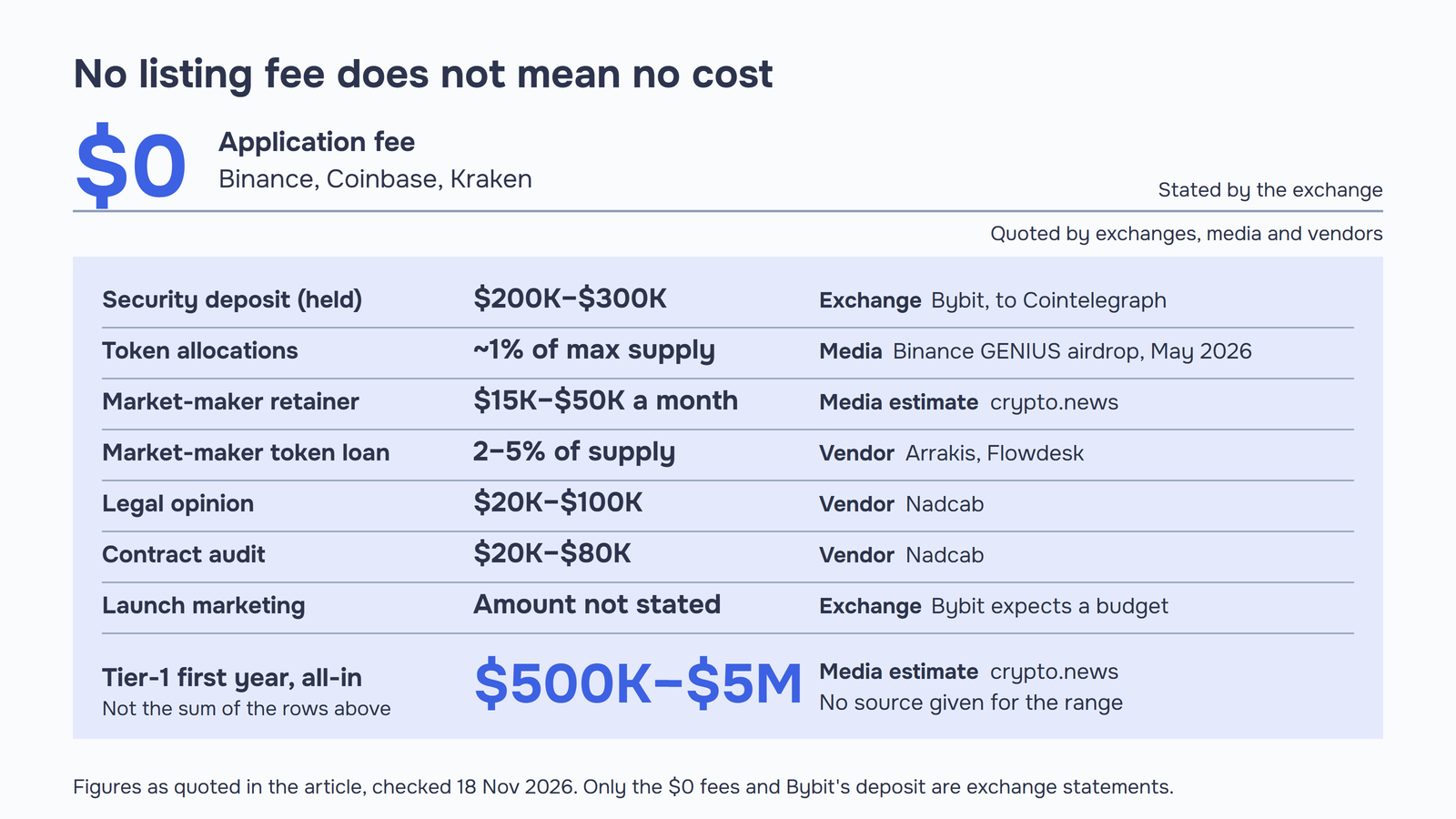
- Deposits: Binance says cash and token security deposits are typically refundable within 1–2 years. Limitless Labs CEO CJ Hetherington alleged in October 2025, in a post he later deleted, that Binance asked for about 8% of supply plus a deposit; Binance called the claim false and defamatory. Ask what currency a deposit is held in and whether early delisting forfeits it.
- Token allocations: exchanges run user campaigns funded with your tokens. Binance’s HODLer Airdrop for GENIUS in May 2026 used 1% of maximum supply. Budget these as a cost and as launch-week selling.
- Market making: vendors put token loans at 2–5% of supply, and crypto.news puts Tier-1 retainers at $15K–$50K a month. A retainer also needs stablecoin inventory for each venue.
- Legal and audit: one agency quotes $20K–$100K for legal opinions and $20K–$80K for a third-party audit.
- Launch marketing: Bybit expects a promotion budget. Before GUNZ’s Binance listing we ran a five-channel ad campaign with 56M+ impressions and 1M+ clicks (self-reported). For benchmarks, see our crypto marketing cost guide, which excludes listing fees.
Promotion rules travel with your audience: the UK requires an FCA-authorised route for crypto promotions, and MiCA requires EEA marketing to match the white paper.
What Are the Crypto Exchange Listing Requirements?
Exchanges look for a legal entity, a verified contract, clear tokenomics, real users and liquidity; no single factor decides and none guarantees approval.
OKX says its guidance “doesn’t guarantee listing approval”, and Kraken takes “a holistic view”.
- Legal and compliance: a registered entity, written legal advice on the token’s status in each market you will open to, and KYC on the team. For EEA listings Kraken requires a MiCA (EU crypto-asset regulation) white paper, written by the project and notified to a national regulator at least 20 business days before listing. Notification is not approval, and the project is liable to holders for what the paper says.
- Technical: a verified contract, audit links and clean deposit and withdrawal tests. Kraken says EVM tokens (Ethereum-compatible networks) move fastest, and for pre-TGE tokens it needs the final contract to match the reviewed one.
- Tokenomics: distribution, vesting and unlock schedules, and a matching circulating-supply figure. Coinbase’s guide, as reported, lists heavy centralised control as a delay reason.
- Market: volume, liquidity and holder traction.
- Community: real engagement.
No official page we reviewed names a legal opinion or a vesting schedule as mandatory, but exchanges ask for both in diligence. Budget for counsel: token status, MiCA notifications and market-maker contracts each need a lawyer in the markets you open to.
How Do the Tier-1 Application Routes Differ?
Each Tier-1 exchange takes applications through its own form, and Binance disqualifies projects that apply through a third party.
| Exchange | How to apply | Stated fee position | Published timeline |
|---|---|---|---|
| Binance | Three forms (Spot, Futures, Alpha, its early-stage tier); founder applies directly | No fee for evaluation or application; deposits refundable | None; path runs Alpha, Futures, Spot |
| Coinbase | Asset Hub review request | No listing or application fees | About a week of diligence; usually under 30 days (reported) |
| Kraken | Asset Listing Application Form only | Never charges; no paid fast-track | Acknowledged in about 2 weeks; 2–6 weeks to trading for EVM tokens |
| OKX | okx.com/token-listing-apply | No official statement found | None; asking for a contact inside the review team can disqualify you |
| Bybit | Forms, internal vote, review meeting (reported) | Denies a reported $1.4M fee; requires a $200K–$300K deposit and a promotion budget (reported) | None |
Binance’s path often starts with derivatives: it runs pre-market perpetual futures before spot trading, so traders can short your token from day one. Plan market-maker coverage and unlock disclosures before a futures listing.
How Long Does a Crypto Exchange Listing Take?
A crypto exchange listing takes 2–6 weeks from approval to trading at Kraken for most EVM tokens, and Coinbase’s guide reportedly puts it under 30 days.
No Tier-1 exchange publishes an application-to-trading figure, and Binance, OKX and Bybit publish no timeline at all.
| Phase | Your work | Typical duration |
|---|---|---|
| Application and screening | Submit through the official form, no intermediary | Kraken acknowledges in about 2 weeks; Gate screens in 3–7 days (vendor) |
| Due diligence | Answer questions on legal status, tokenomics, team | About 1 week at Coinbase; 1–3 weeks at Gate (vendor) |
| Commercial terms | Agree fee, payment form, deposit, allocations and market-maker targets in a signed listing agreement | Days to weeks; the step you control least |
| Integration and testing | Deposit and withdrawal tests, wallet and node support | 2–8 weeks (crypto.news); Kraken 2–6 weeks from approval to trading |
| Announcement to live | Pair listing, market maker live, launch comms | Coinbase roadmap to live 48–72 hours; Bybit 1–3 days; Binance hours to 2 days (The Tie) |
At fee-charging venues, approval leads to a listing agreement, and that is where the money is decided. Treat every line as open: fee currency and payment schedule, deposit refund triggers, tokens for exchange campaigns and promotion targets with penalties. Get each one in writing before you send funds.
Deposits open before trading. At Coinbase, new books move from transfer-only to an auction of at least 10 minutes, then to full trading. Elsewhere, ask how the opening price is set, fund your market maker’s account early, and announce nothing until the exchange does.
What Should You Do Before You Apply?
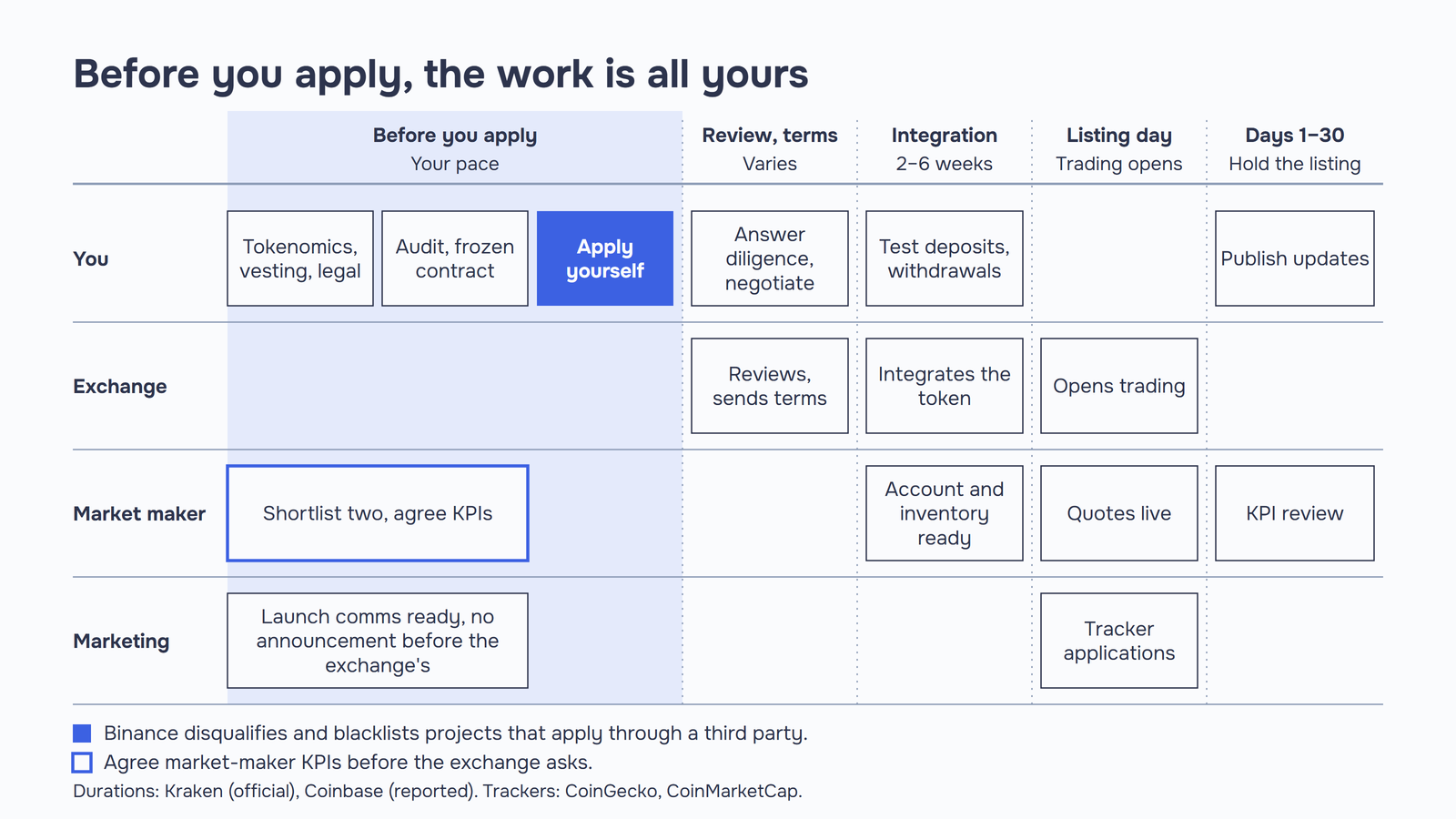
Before you apply, publish tokenomics and legal structure, finish the audit, shortlist market makers and prepare tracker applications for launch week.
- Fix tokenomics, vesting and legal structure, and publish them, including any tokens committed to exchanges or market makers.
- Get counsel’s written view on the token’s status in each market you will open to, and check that presale lockups still hold once the token trades where those buyers can reach it.
- Screen the team, investors and market maker against sanctions lists.
- Finish a contract audit, verify the contract and freeze it. Ask each exchange early whether transfer taxes, rebasing or admin functions such as mint and pause need special handling.
- Shortlist two market makers and agree KPIs before the exchange asks.
- Apply through the official form yourself.
- Prepare launch marketing, cleared for each target market, and the CoinGecko and CoinMarketCap applications for the week trading starts.
How Much Does Market Making Cost, and What Should the Contract Say?
New listings usually pay a market maker with a token loan plus call options or a monthly retainer, and crypto.news puts Tier-1 retainers at $15K–$50K.
Loan sizes come from market-making vendors: Arrakis says 2–5% of supply and Flowdesk says 2–4%. The retainer range is an unsourced estimate, and no independent price survey exists. crypto.news also reports that Tier-1 exchanges expect market-making coverage before approval.
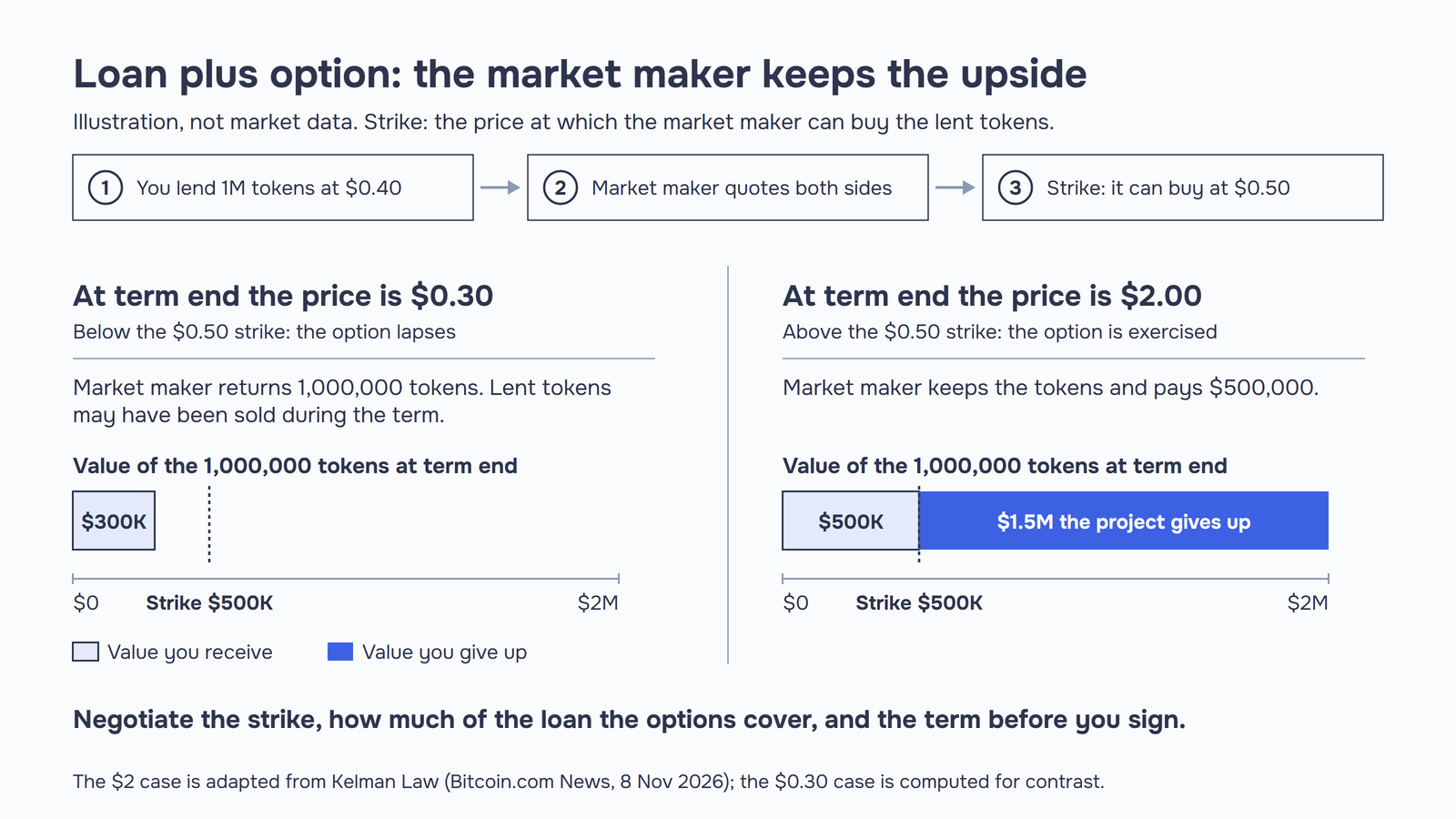
The loan model costs no cash, but it still has a price. If the token rises past the strike (the price fixed in the option contract), the market maker can keep the lent tokens and pay only the strike, which sits below the market price. If it falls, the lent tokens may already have been sold: Cointelegraph’s reporting on market-maker deals says loaned tokens often get sold and KPIs (the spread, depth and uptime targets you hold the market maker to) are often vague. A retainer avoids the option, but you fund the inventory yourself: tokens and stablecoins.
Pin these terms down before signing:
- KPIs: maximum spread, minimum depth within a price band and uptime, plus the reference price, sampling interval and data source.
- Options: quantity, strike, expiry and settlement, and how much of the loan the options cover.
- Term and termination: match the loan to the period you need liquidity, and write down notice, cure rights, exclusivity limits and what happens to options on early exit.
- Compliance: a ban on wash trading and other false volume, representations that the market maker follows the law and venue rules in each market, audit rights and termination for breach. Have counsel review the loan and option terms.
- Reporting and rebates: balances, trades and fees by venue. Maker rebates (fee refunds for posting orders) default to the account holder, usually the market maker.
Why Is Wash Trading a Legal Risk?
Buying “volume support” can end in a criminal case for the buyer as well as the seller: in October 2024 US prosecutors charged 18 people and entities.
Operation Token Mirrors charged four market-making firms: Gotbit, ZM Quant, CLS Global and MyTrade. The SEC charged three of those firms and the token promoters who hired them. Gotbit’s founder received 8 months in prison, and MyTrade had to post a notice that volume support is “a form of wash trading and illegal”. The EU treats trading that sends false signals about volume or price as market manipulation under MiCA. Exchanges police market makers too. In March 2025 Binance offboarded the MOVE market maker and froze about $38M in USDT after saying it sold heavily post-listing.
Do You Need a Crypto Listing Agency?
You do not need an agency to apply; hire one only for work you can name in writing, such as integration testing or launch marketing.
A crypto listing agency prepares a project’s exchange applications, coordinates integration and runs listing marketing; it does not represent the exchange. ICODA sells IEO marketing and price-tracker listing services, so weigh our advice accordingly.
Binance’s December 2025 notice says it accepts only direct applications and that a project using a third party is disqualified and blacklisted from future applications. It also offers a bounty of up to $5M for reports of fake listing agents. Kraken ignores emails and DMs. An agency can prepare your documents, but at these exchanges the application and all contact with the listing team must come from you.
Ask which exchange pays the agency, because a commission changes whose interests the advice serves, and ask the exchange for its direct price too. Listing.Help lists “$0 on 95% of exchanges” (paid by exchange commission), $15,000 and “from $50,000” packages; Nadcab quotes “$1,000–$100,000”; others quote on request. None appears on Binance’s published list of impersonators.
What Services Should a Crypto Listing Agency Provide?
Good crypto listing agency services cover application prep, integration, market-maker onboarding and post-listing marketing, all scoped in writing.
Check each of these before you sign:
- A named list of exchanges and what it does at each, with the fee payer disclosed.
- No guaranteed outcome. Even Listing.Help’s FAQ says no serious agency can guarantee approval from every exchange.
- No “volume support” and no bot-generated trading.
- Market-maker terms you can read, and past clients you can verify.
Walk away from three things: unsolicited contact from someone claiming to work for an exchange, a market maker whose loan comes bundled with a listing promise, and any request to pay a person who says they act for an exchange or can reach its listing team. Paying for “contacts” can amount to bribery as well as a scam.
What Solutions Do Crypto Listing Agencies Rely On?
The core crypto listing agency solutions are legal counsel, a contract auditor and a market maker; none replaces the exchange’s own application form.
Ask which of these the agency supplies itself, which it resells and what it earns on each, because a resale margin becomes part of your listing cost.
What Happens After Listing: CoinGecko, CoinMarketCap and the First 30 Days?
List on CoinGecko and CoinMarketCap the week trading starts, then spend 30 days on liquidity and updates, because the price effect fades within two weeks.
CoinGecko requires a website on your own domain, a working block explorer, trading on at least one CoinGecko-integrated exchange and disclosed circulating supply. CoinMarketCap has a free queue and a paid priority track with no public price. CoinGecko’s $1,500 Fast Pass buys a faster review, not approval. If you would rather hand off both, our listing on top price tracking websites service covers the applications and the supply data reviewers check.
Read your venue’s delisting rules before launch day, because they set your first-month targets. MEXC’s warning rules, for example, cover a spread above 2% for 15 days, a fall of more than 60% in the first three days and fewer than 100 funded holders. Binance’s Monitoring Tag flags tokens for extra scrutiny, and Kraken asks for 30 days’ notice of contract migrations or major tokenomics changes. Contract your market maker for spread, depth and uptime, never for volume.
What Should Your First-Year Listing Budget Include?
Your token listing cost is the sum of these lines, so fill them in before you contact an exchange or agency and have every vendor quote against them in writing.
| Budget line | Tier-2 range to test | Tier-1 range to test |
|---|---|---|
| Listing fee | $20K–$300K | $0 stated; $100K–$3M estimated |
| Security deposit | Ask; get refund terms in writing | Bybit $200K–$300K; Binance refundable in 1–2 years |
| Market-maker token loan | 2–5% of supply | 2–5% of supply |
| Market-maker retainer | Ask | $15K–$50K a month |
| Legal opinion | $20K–$100K | $20K–$100K |
| Contract audit | $20K–$80K | $20K–$80K |
| CoinGecko and CoinMarketCap | $0, or $1,500 Fast Pass | Same |
| Launch marketing | Your plan | Bybit expects a promotion budget |
With $300K, the quoted ranges cover one Tier-2 listing plus groundwork, not Tier-1. Legal and audit take $40K–$180K, leaving $120K–$260K for the fee, deposit, market making and marketing, which works at the low or middle of the Tier-2 fee range. Send the filled table to two market makers and any agency you consider, and compare quotes line by line.
Crypto Exchange Listing FAQ
Application fees are $0 at Binance, Coinbase and Kraken, but crypto.news puts a Tier-1 first year at $500K–$5M all-in. It estimates Tier-2 fees at $20K–$300K and Tier-3 fees at $0–$50K, and Bybit asks for a $200K–$300K deposit.
Kraken says 2–6 weeks from approval to trading for most EVM tokens. Coinbase’s guide, as reported by crypto.news, puts diligence at about a week and the process under 30 days. Binance, OKX and Bybit publish no timeline, so plan for at least a month at Tier-1.
At Tier-1 a market maker is effectively required, according to crypto.news, though no exchange publishes it as a rule. At Tier-2 delisting rules make one necessary in practice: MEXC can flag a token whose spread stays above 2% for 15 days.
No agency can guarantee a listing, and any guarantee is a red flag. Binance accepts only direct applications and disqualifies projects that use a third party. An agency can prepare documents, coordinate integration and organize marketing, but the exchange decides.
Binance says its cash and token deposits are typically refundable within one to two years. We found no published refund rule for rejected applications, so get deposit terms in writing before you pay. Bybit told Cointelegraph its deposit is tied to promotion targets, with possible penalties if they are missed.
Share with


Rate the article