


The ICODA AI Visibility Checker is a free tool that tests whether ChatGPT, Claude, Perplexity, and Gemini can find, understand, and recommend a website, then returns a score plus a prioritized fix list in under 30 seconds with no signup. It asks all four engines the kind of buyer questions a real prospect would type, checks whether AI crawlers can even reach the site, and sizes how much search demand is now moving through AI answers instead of a classic results page.
The numbers behind that “30 seconds” are worth stating plainly, since this audience will ask. A free report samples live answers across two of the four engines; unlocking it reruns the audit across all four with more questions; the fix-it checklist runs to 205 items across 26 categories; and one full report costs ICODA roughly a dollar in API spend, most of it behind the free gate. Recent industry surveys put the share of shoppers now asking an AI assistant before typing into Google north of 60% in the US and UK, and that’s the sales pitch. What follows is the methodology: what the checker measures, how the score is built, and where it can be wrong.
What the Checker Actually Measures: 4 Signals
The checker runs four checks in sequence, each feeding the next.
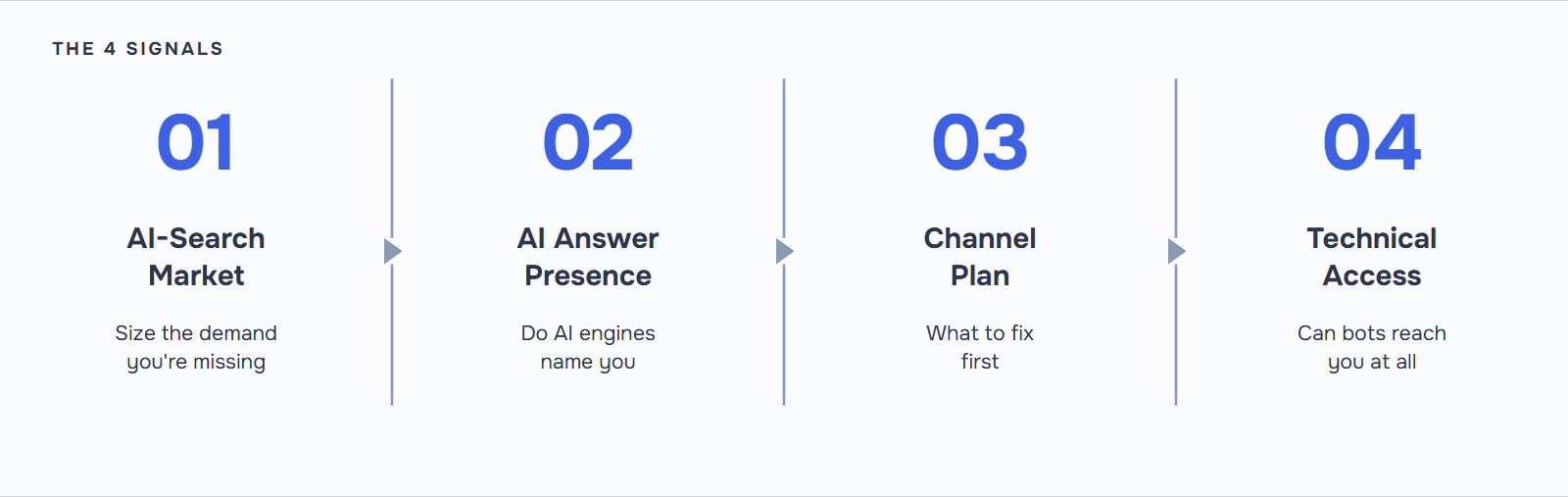
AI-Search Market
This signal sizes how much real buyer demand exists for what the site sells, and how much of it is currently being missed. A model first reads the page and works out the actual product, niche, and brand: not what the owner thinks they rank for, but what an outside reader would conclude. That seeds a set of real queries. The tool expands those into actual monthly search volume, CPC, and AI Overview presence via Ahrefs data, then weighs the total against the site’s presence gap (below) to produce two numbers: audience missed, and its Google-Ads-equivalent dollar value.
Two honesty notes, since this is the number most likely to look impressive on a slide. For sites that don’t sell anything directly (media, reference, education), the dollar figure is forced to zero, because a CPC model means nothing for a page nobody’s converting. And overlapping terms (“crypto exchange” / “best crypto exchange”) describe largely the same searchers; summed without care they inflate the total, so the report flags the figure as directional rather than exact.
AI Answer Presence
This signal checks whether a real buyer’s question to an AI assistant surfaces the brand. The same buyer questions go to ChatGPT, Claude, Perplexity, and Gemini, and the tool records whether (and how often) the brand gets named. Each engine runs its own live web search rather than sharing one backend behind the scenes. That’s deliberate: the entire point of “we asked four AI engines” collapses if all four are quietly reading the same retrieved pages.
Getting “does the brand show up” right was harder than it sounds. An early matcher counted any answer containing a word from the brand name as a hit. A poker room called “Phenom Poker” got credited whenever an answer used the word “poker,” and a token exchange got credited for “exchange.” A false positive dressed up as a strong result is worse than an honest zero. The current matcher only counts the exact brand phrase, the actual domain, a genuinely distinctive brand token, or a domain match inside a cited source, filtered against roughly ninety generic category words so “poker” or “exchange” never count alone. That fix now lives in the codebase as a permanent regression test.
Channel Plan
This signal turns the market/presence gap into what to do first: a ranked list across Reddit, PR, Quora, Medium, SEO, and YouTube, each with a one-line reason tied to the detected niche, plus a 205-item DIY checklist across 26 categories for teams executing in-house, or a ready-made brief for teams handing the fixes to an AI SEO team instead.
Technical Access
This signal checks whether AI crawlers can reach the site and parse it once they do. Flawless content doesn’t matter if this layer is broken. It covers:
- Crawler access:
robots.txtchecked against eight named AI bots (GPTBot, ClaudeBot, PerplexityBot, Google-Extended, CCBot, and others), weighted by whether paths carrying real content are blocked, not every disallow rule equally. - Content structure: H1 presence, a heading hierarchy that doesn’t skip levels, title/meta-description length, image alt-text coverage, semantic HTML, social meta tags.
- Structured data: JSON-LD, Microdata, and RDFa, weighted toward schema types that help an AI system parse a page (Organization, WebSite, Article, FAQPage) over decorative ones.
- Core technical health: HTTPS, response time, redirects, a valid sitemap, and
llms.txtpresence (still an emerging, low-weight signal).
These roll up into one 0-100 score, and the roll-up is deliberately uneven: a check that’s binary and rare across the web (most sites don’t block AI bots at all) carries less weight than checks that differentiate one site from another, like content structure and structured data. We’re not publishing the exact percentage split; the principle matters more than the formula, and the principle is that a check that almost never fails shouldn’t dominate the score.
How the Score Is Calculated
Most of the work happens before the checker shows a number, across two stages: a fast free sample and a deeper gated one.
The free “hero” result samples a smaller question set across two of the four engines, chosen by the strongest ratio of usable, citation-rich answers per dollar spent, not the two cheapest on paper. Unlocking the full report reruns the audit against all four with more questions. ChatGPT is deliberately held out of the free sample entirely, because it’s the model a prospect is most likely to re-check by hand. The report says so rather than quietly sampling fewer engines and calling it complete.
The market-sizing number goes through an extra filter first, because raw keyword expansion is noisy: a crypto debit card’s expanded pool pulls in general-purpose debit-card searches, prepaid SIM cards, and competitor brand names that share vocabulary but not audience. Summed without correction, “market size” describes someone else’s market, or none at all. A second, separate model pass, the relevance gate, reviews the pool and strips off-category and competitor-branded terms before the volume is summed. It runs at zero temperature because an earlier, unpinned version split its own verdict roughly 50/50 across repeated runs on identical input.
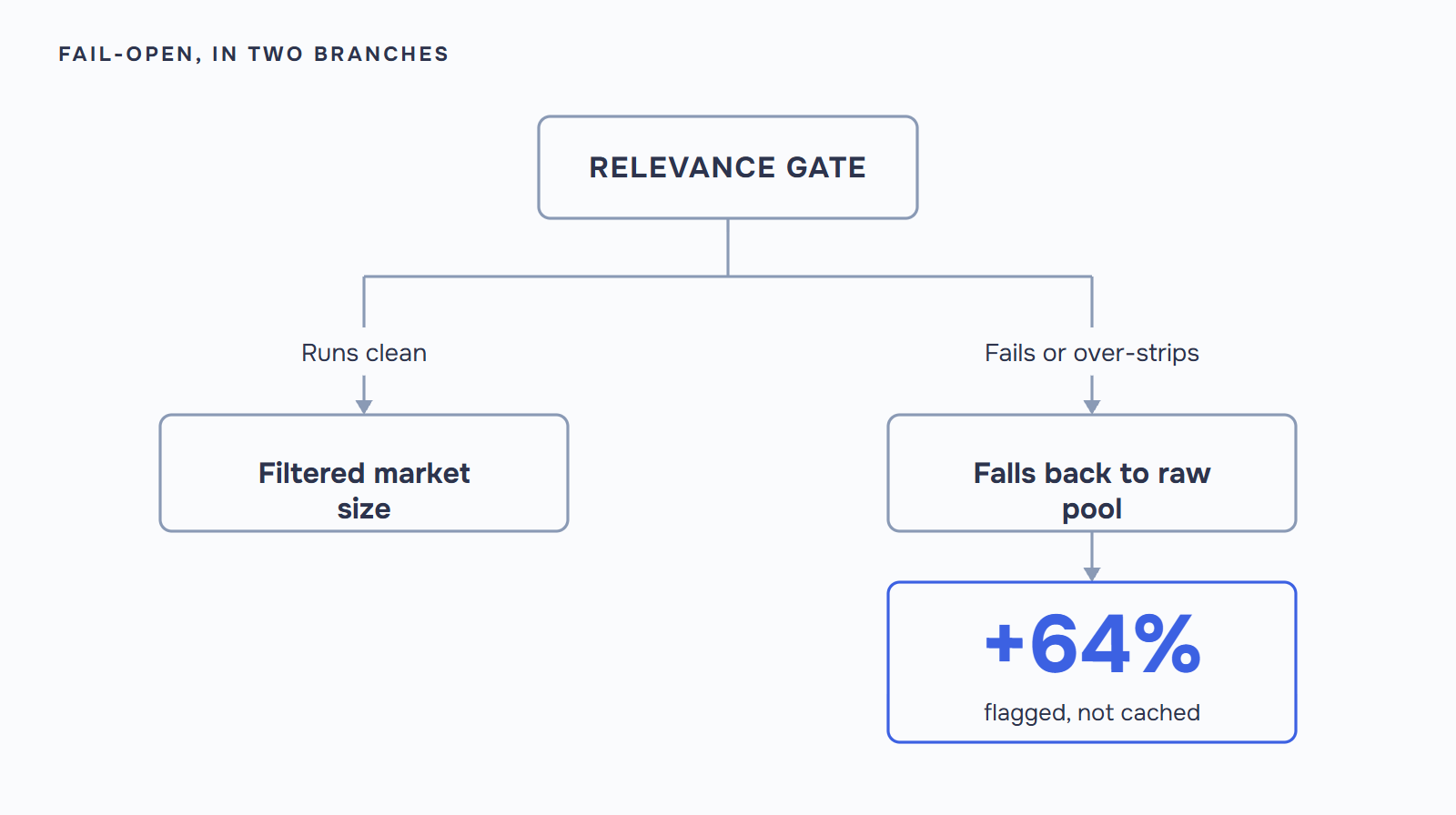
The gate is also built to fail open, on purpose: if the filtering pass errors out, or strips an implausibly large share of the pool, the system discards its verdict and falls back to the unfiltered pool. That sounds backwards until you weigh the alternative: a filter that can zero out an entire market by mistake is more dangerous than one that occasionally lets too much through. Overstating a market once in a while is a bad look; falsely telling someone their market doesn’t exist is worse. The next section covers what that costs in practice. The same principle runs elsewhere: niche detection once proved inconsistent enough that eight runs on one frozen page produced eight different keyword sets, so it now runs several times in parallel and keeps only what every run agrees on.
Honest Limitations
No score built on live AI answers and third-party APIs is right 100% of the time, and pretending otherwise would undercut what this audience wants: knowing when to trust the number.
The relevance gate’s fail-open design has a measured cost. When it doesn’t run cleanly, the unfiltered pool flows straight into the headline market number: in one measured case, that inflated market size by roughly 64% over the filtered figure. When it happens, the report carries a visible flag instead of a clean number, and that run isn’t cached, so the next person checking the same domain won’t see the same inflated number twice.
That’s one of three distinct ways a report comes back degraded rather than wrong-but-confident. They trigger independently and mean different things:
| What’s flagged | What triggers it | What you see instead |
|---|---|---|
| Market size may be overstated | Relevance gate errors out, or strips an implausibly large share of the pool | A visible flag on the market number; run excluded from caching |
| Brand presence is unknown | Multi-engine audit returns too few usable answers to be meaningful | Presence marked “unknown,” technical score used as a rough stand-in |
| Detection itself is degraded | Every AI provider is unreachable during niche/brand detection | A coarse fallback guess from the domain and meta tags, labeled as a fallback |
There’s one more gap the tool doesn’t try to hide: it can’t see behind a JavaScript challenge. The technical audit fetches raw HTML directly, with no headless browser. Sites behind Cloudflare’s bot-challenge layer (a real problem for some crypto exchanges and betting platforms) return an access-denied response regardless of the request, because that’s a TLS/JS challenge, not a user-agent block. When a fetch fails outright, the technical score isn’t shown as a fabricated zero; the affected categories are suppressed entirely, since a failed request and a genuinely broken site are different findings.
How This Differs From Paid AI-Visibility Platforms
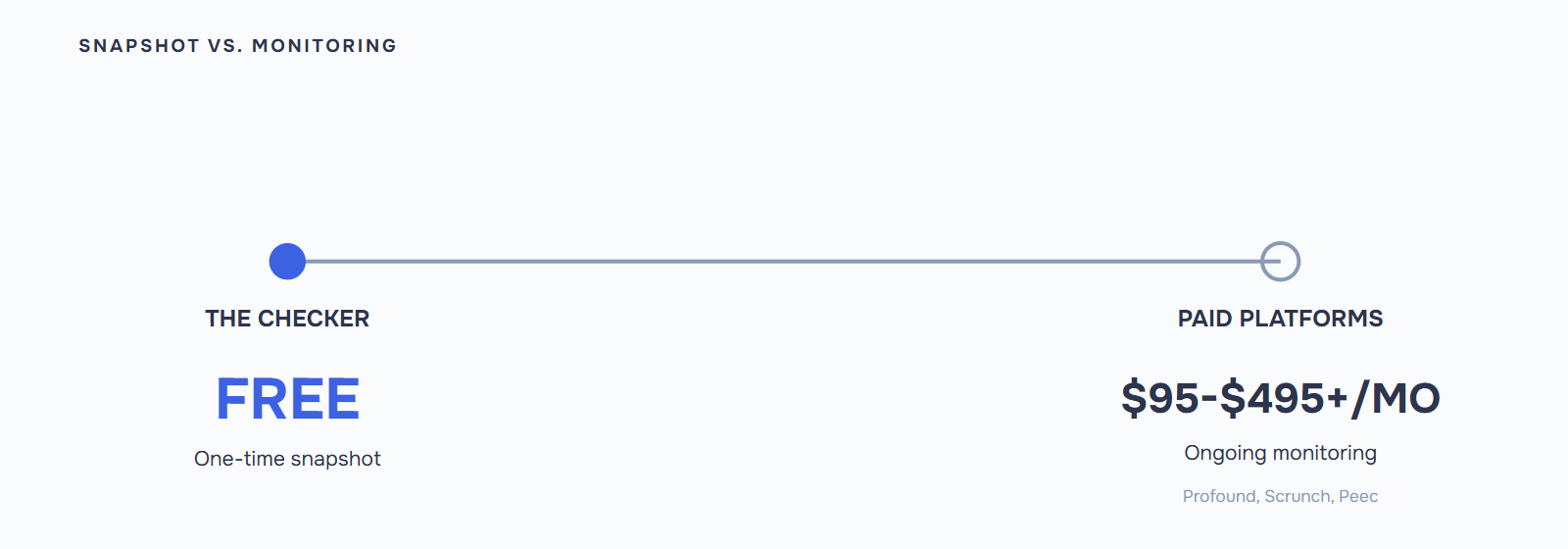
The checker is a free, one-time diagnostic, not a monitoring subscription, and that matters more than any feature comparison. Platforms like Profound, Scrunch AI, Peec AI, and Otterly track brand mentions across a running prompt set on a schedule, for teams watching citation share move week over week, typically $95-$495+/month. The checker answers a narrower, faster question: can AI find and name this site right now, and what’s broken.
| AI Visibility Checker (free) | Profound / Scrunch / Peec-style platforms | |
|---|---|---|
| Format | One-time snapshot | Ongoing subscription, tracked over time |
| Price | Free | Roughly $95-$495+/month |
| Engines per run | Up to 4, sampled once | Continuous fan-out, refreshed on a schedule |
| Technical audit included | Full crawler-access, schema, and content-structure check | Typically not included; focused on mention tracking |
| Best for | Where you stand today, and the first fix | Watching citation share and competitors over months |
If continuous tracking across a full prompt set and named competitors is the actual need, that’s a different category of tool. Our comparison of AI visibility platforms covers that field.
Try It on Your Own Site
- Paste your domain. No signup required for the free report.
- The tool queries multiple AI engines with real buyer questions for your category, while checking crawler access, structured data, and technical health in parallel.
- Read your score and fix list: what’s blocking AI crawlers, what your structured data is missing, and roughly how much AI-driven demand you’re not capturing.
Run the AI Visibility Checker →
Frequently Asked Questions (FAQ)
The audit engine itself isn’t; that’s the product.
GSC measures Google’s own indexing, impressions, and clicks. It has no visibility into whether ChatGPT, Claude, Perplexity, or Gemini can reach or cite a page. Different crawlers, different retrieval systems, no data overlap.
Partly, and that’s worth saying openly. Technical-access rewards straightforward fixes: structured data and crawler access move quickly once acted on. AI Answer Presence is harder to game, since it’s a live read of what four independent models say today rather than a static rulebook check, but that same live-ness makes it noisier on a small sample, which is why low-confidence runs get an explicit flag instead of a clean-looking number.
Some variation is by design. Technical-access categories are deterministic and won’t move on an unchanged site. AI-presence and market-sizing involve live model calls and can shift run to run. Live AI answers will never be as static as a cached crawl.
Share with


Rate the article