Shortlist three token marketing agencies, send each the same five questions, and sign only with one that passes the ten checks below.
A launch runs from 90 days before the token generation event (TGE) to 30 days after it; T-0 is the day trading starts. Below: the deliverable for each phase, what no agency can buy, ten checks, and the red flags that exchanges and regulators have documented. Rules checked 18 November 2026.
ICODA sells token sale marketing and appears in its own ranked list of presale marketing agencies, so each outside claim below links its source.
How Do You Pick a Token Marketing Agency in Two Weeks?
Shortlist three agencies of the type that fits your biggest gap, send each the same one-page brief, and compare their written answers.
- Days 1-2: write the brief. TGE window, sale format, chain, target and excluded countries, budget, and who owns tokenomics, legal and exchange talks.
- Day 3: send it with the five questions below. Ask for written answers within five working days.
- Days 8-10: verify. Run checks 1 and 4: verify two cases per agency and call two founders you pick.
- Days 11-14: compare and sign. Score each agency on the ten checks and ask for the contract draft.
The five questions:
- Which of your launches can I verify on-chain, and who on my account worked on them?
- Who signs off compliance, and which markets do you exclude?
- What sits in the fee, what in media spend, and what goes to third parties?
- Which outcome metric will you be judged on in each phase?
- Who owns the accounts, audiences and wallets at the end?
What Does a Token Marketing Agency Do, Phase by Phase?
A token marketing agency plans, promotes and reports on your launch from T-90 to T+30, and should hand over one dated deliverable per phase.
Token marketing, also called token launch marketing, token sale marketing or presale marketing in crypto, builds demand, trust and a verified buyer list before and after a token trades.
| Phase | What happens | Deliverable you should see | Owner |
|---|---|---|---|
| T-90 to T-60 | Facts, geography and legal scope locked | Launch plan dated from T-0; map of where paid promotion is allowed; claims document approved by counsel | Project and counsel: tokenomics, claims. Agency: plan, messaging |
| T-60 to T-30 | Quests, KOL and PR groundwork; content live; whitelist and KYC open with geo-blocks | Quest spec built on product use, not X engagement; KOL shortlist with audience-country data; docs and FAQ pages; KYC provider and launchpad rules in writing | Agency: quests, KOLs, PR, content. Project: snapshot (date not pre-announced), sybil rules, market-maker shortlist |
| T-30 to T-7 | Listing readiness, market maker signed, small paid tests | Whitelist closed and sybil-filtered, allocations published with an appeal window; tracker pack (logo, contract, explorer, supply docs); ad plan by platform and country; embargo calendar; run sheet; phishing playbook | Agency: pack, ads, run sheet. Project: audit; market-maker contract with loan size, option strikes, return date and depth targets. Exchange: listing date |
| T-7 to T-0 | One official contract address and claim domain everywhere; trading opens | Address pinned everywhere with “admins never DM first”; hardware-key 2FA on X, domain and Telegram owner accounts; second KOL wave; embargoed coverage; fake-token and fake-ad monitoring | Agency: comms; prepares tracker filings. Project: files with trackers from its official domain; claim contract. Exchange and market maker: trading, quotes |
| T+1 to T+30 | Week one sets the trend | Reports at T+1, T+7 and T+30 against agreed baselines; weekly progress posts; unlock posts a week ahead with amount and wallets; impersonator takedown log | Agency: reporting, takedowns. Project: shipping, unlock disclosure |
Phase names follow our guide to what a TGE is.
Can You Advertise a Token Sale? What No Agency Can Buy
No agency can buy a token-sale ad on Google or X, a Binance listing, or a ranked CoinMarketCap page before trading starts.
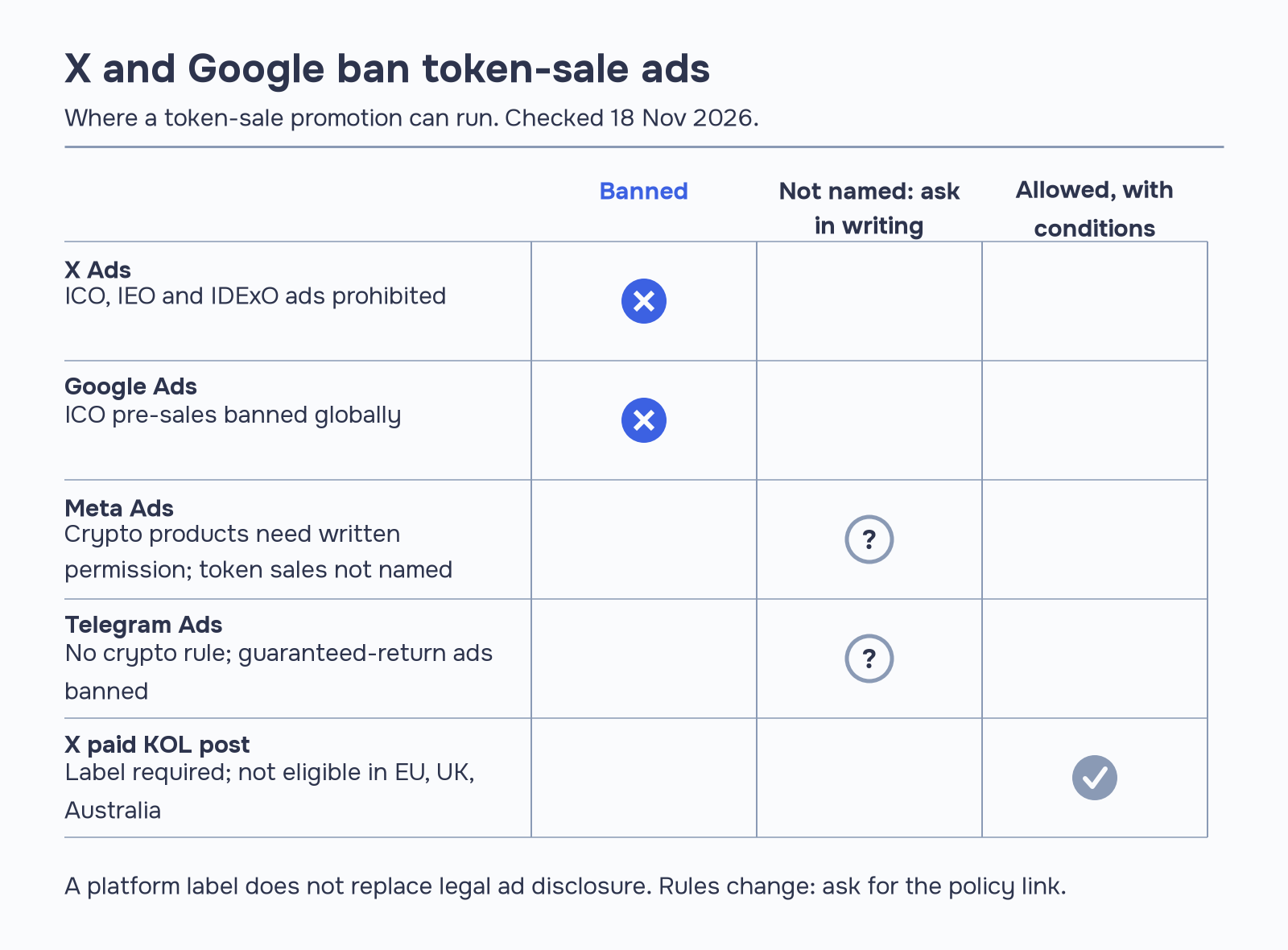
- Ads for the sale itself. X prohibits ICO, IEO and IDExO ads. Google bans ICO pre-sale ads. Meta’s crypto policy does not name token sales. It asks exchanges, wallets and similar products for written permission and a recognised licence, and lets education and news ads run without it. Budgets go to education, content and community; paid reach for the sale itself runs through crypto-native ad networks, each with its own policy (see our crypto advertising guide).
- Paid KOL posts into some countries. X’s paid-partnerships policy makes crypto promotions ineligible in the EU, UK and Australia. A KOL list whose audience sits mostly there is a problem.
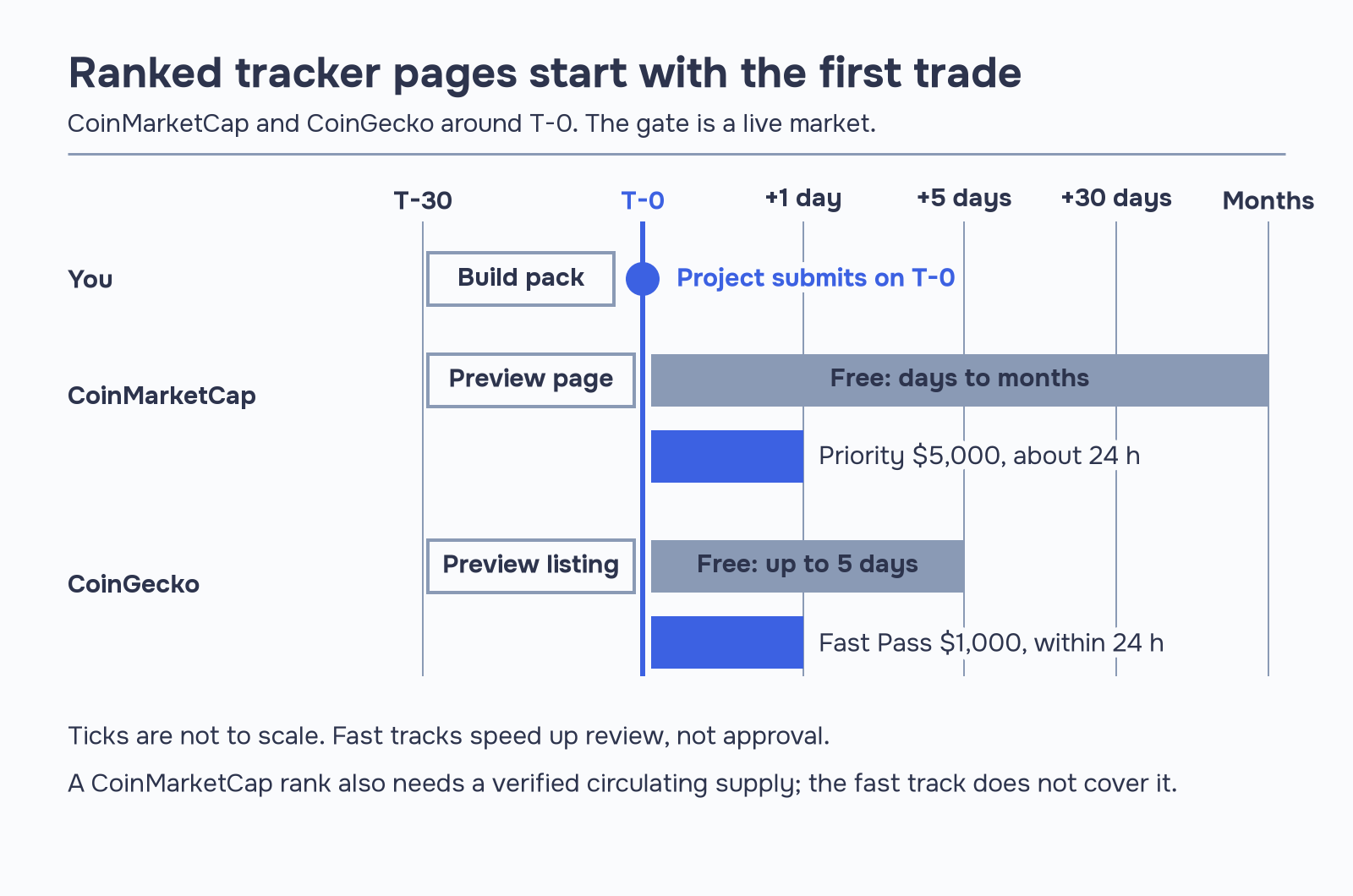
- Ranked tracker pages on day zero. CoinMarketCap tracks a coin only once it trades actively on a tracked exchange, and CoinGecko asks for the same. Prepare at T-30; the project files when the first market is live.
If the sale may be a US securities offering, counsel picks the route. Since March 2026 the SEC weighs how a token is marketed and counts the issuer’s agents as the issuer.
Under Regulation S, nobody acting for you, agency and KOLs included, may aim selling efforts at the US, so geo-exclude ads, KOL briefs and the sale page. Under Rule 506(c) you may advertise the sale, but every buyer must be a verified accredited investor. This is general information, not legal advice.
Which Type of Agency Fits Your Stage?
Pick the agency type by your biggest launch gap: full-service for a first token, a specialist when one channel is already strong.
| Type | Fits when | Test question |
|---|---|---|
| Full-service crypto launch agency | First token, no in-house marketer, 90+ days to TGE | Show the run sheet and T+7 report from your last launch, redacted. |
| PR and KOL specialist | Product and community are ready; you need reach in the last 60 days | Show KOL post URLs and the client’s own referral-code export per post. |
| Performance and ads specialist | You are driving a wallet, app or sale where ad rules allow it | Show a token project’s ad that ran in the last 90 days, with its policy and country. |
| Community and quest specialist | The launch is airdrop-led | Which sybil filter do you use, and what share of completions did it remove last time? |
| Listing and market-making consultant | Exchange access or liquidity is the bottleneck | Who submits the application, and what do you earn from the exchange or market maker you recommend? |
Ask which formats (presale, ICO, IDO, IEO, airdrop-led TGE) and chains (Ethereum, Solana, Base, BNB Chain) the agency has run, and get any launchpad’s eligibility rules in writing.
For a first launch, hire one lead agency and at most one specialist, so a single owner runs the launch-day run sheet. With an in-house marketer, hire the PR and KOL specialist for the last 60 days instead of a full-service agency. See our guides to crypto PR distribution and what a KOL is.
How Do Token Marketing Agencies Charge, and Who Carries the Risk?
Agencies charge by retainer, package, ad-spend share, performance bonus or tokens, and each model puts the risk on a different party.
| Model | Buyer’s risk | Clause that protects you |
|---|---|---|
| Monthly retainer | Paying for activity with no outcome attached | Named people and hours; monthly deliverables; 90-day start, then 30 days’ notice |
| Package or project fee | Scope creep; a bundled total hides unit prices | Itemised list of outlet, handle, format and date; replacement if an item does not run |
| Fee plus 10-20% of ad spend | The agency earns more as spend rises | Ad accounts in your name; platform cost reported net of the agency fee, as Google’s third-party rules require where a monthly report is part of the deal |
| Performance bonus | Gaming the KPI with bot wallets; in the US, pay tied to the size of a securities sale is a broker-registration warning sign | Written KPI definitions with on-chain confirmation; counsel’s sign-off before any percentage of the raise |
| Tokens | The agency becomes a holder that can sell into your launch | Vesting, cliff, a no-sell window and disclosure of the token payment in every paid post |
Add a slip clause to every model: if T-0 moves, the retainer pauses or the plan is re-dated without new fees, and prepaid KOL and outlet slots carry over. Your project answers for what the agency and its KOLs publish, so ask the agency to warrant labelled posts and no bought engagement, and to indemnify you if it breaks either.
ICODA does not accept payment in tokens. Pay creators and outlets per deliverable, never 100% upfront, and ask for fee, media spend and third-party placement fees on separate lines. For price ranges, see our crypto marketing cost guide.
What Are the 10 Checks Before You Sign a Token Marketing Agency?
Before you sign, verify the agency’s launches, the spend behind each result, its team, references and who will own the accounts; each check has a test.
| # | Check | How to test it |
|---|---|---|
| 1 | Launches you can verify | Ask for the live site, the token contract or sale page, and one artifact per case (a placed article or KOL post URL). Check the raise on Cryptorank. |
| 2 | Result beside spend | Reject any figure without its spend, period and attribution method. |
| 3 | Named team | Names for the strategist, KOL, PR and community leads, launch-week coverage by time zone, and your consent before anyone is replaced. |
| 4 | References you choose | Pick two founders from its case list and call them without the agency. Ask what slipped, who answered at 3 a.m. on launch day, and whether they would rehire. |
| 5 | Dated plan | Phase dates from T-0, each with a deliverable and an owner (table above). |
| 6 | Compliance sign-off | Ask who checks each post against MiCA Article 7, the FCA’s promotion rules and US disclosure rules, and which markets are excluded. Where MiCA requires a white paper, no EU marketing may go out before it is published. A UK promotion that does not use one of the FCA’s four legal routes is a criminal offence. |
| 7 | KOL terms | Per-creator rates, audience-country data, a disclosure clause that states the form of payment, a minimum time each post stays up, and no trading on launch information by agency staff or KOLs. |
| 8 | Subcontractors and conflicts | A written list of KOL networks, press-release wires, resellers and market makers with markups; any referral fee it takes from an exchange, launchpad or market maker; other launches it runs in your week. |
| 9 | Reporting | Dashboard access or raw exports; KPI definitions in the contract; on-chain confirmation of wallets and buyers instead of pixel counts. |
| 10 | Ownership | Ad accounts, pixels, analytics, X, Telegram and Discord admin, and campaign wallets sit in your name. |
To run check 1, open the case’s contract on Etherscan, Solscan or BscScan and read holders and top-10 share (supply held by the ten largest wallets), excluding exchange and liquidity-pool wallets, then look the token up on CoinGecko. If the agency won’t produce a dated plan before signing, buy a two-to-four-week paid sprint that ends with the plan and a first test.
Two ICODA cases show check 2. Both are self-reported and under NDA, so neither passes check 1 from this page: ask any agency, ICODA included, for a case you can verify. The Meta presale test reports a 5.74x return on ad spend from $10,377.63 of spend, with 109 tracked purchases (about $95 each) and the US excluded. In the 2024 $37M token sale, a $7,000 one-month test on TikTok and Meta ads came first; daily budgets then rose in steps from $10,000 to $30,000 and finally $60,000-$80,000 as results held.
What Are the Red Flags When Hiring a Token Marketing Agency?
The red flags that hold up are guaranteed outcomes, sold volume, undisclosed paid posts, bought engagement and hidden control of money or subcontractors.
Paid placements and fixed output, such as 10 labelled articles or 6 KOL posts, are normal. Flag a guaranteed outcome the agency does not control.
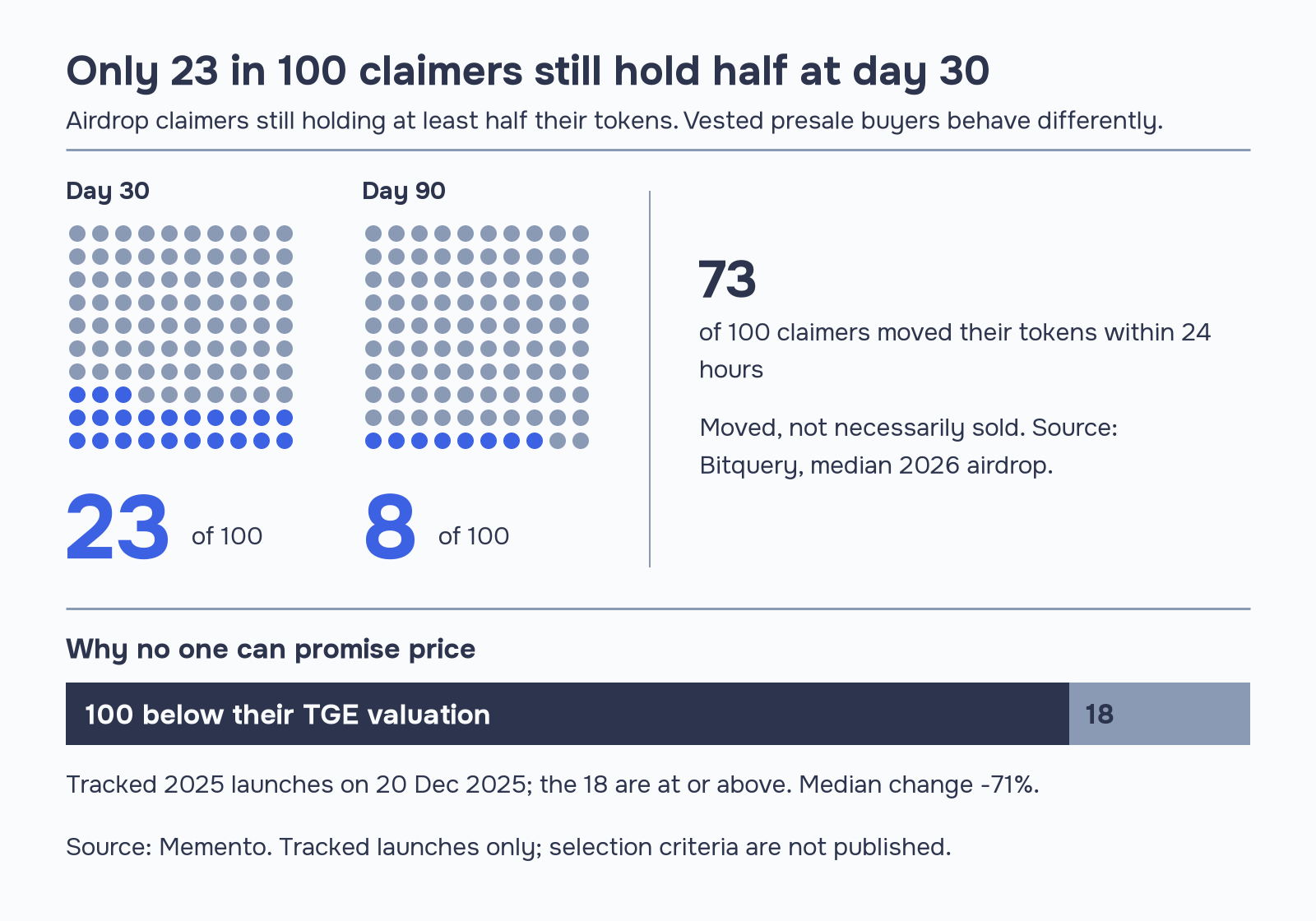
- Guaranteed listing, raise or price. Binance says “No listing is ever guaranteed” and accepts applications only from the project team, blacklisting projects that use a third party. CoinMarketCap calls its form the only route and names guaranteed-listing sellers on a “Hall of Shame”. Nobody can promise price either: 100 of 118 tracked 2025 launches stood below their TGE valuation on 20 December 2025 (Memento).
- Volume sold as marketing. In October 2024 the SEC charged three so-called market makers, Gotbit, ZM Quant and CLS Global, with manipulating token markets through wash trading. If an agency guarantees “listing-day volume”, ask how it produces it.
- Undisclosed KOL posts. ZachXBT’s leaked price sheet showed about 160 influencers took paid deals and fewer than five disclosed them (his count, reported by The Block). The SEC made Kim Kardashian pay $1.26 million in 2022 for an undisclosed paid post, and the FTC usually pursues advertisers and their agencies over such posts.
- A “KOL round” bundled into the deal. Creators who buy at a discount with tokens unlocked at TGE are paid sellers. If the agency proposes one, ask for vesting at least as long as your public buyers’ and disclosure in every post.
- Bought engagement and “mindshare” leaderboards. The FTC’s 2024 rule bans knowingly buying fake followers and views for commercial use. X cut off apps that pay users to post in January 2026, so leaderboards built on them track a mechanic X banned. Reach and AVE with no conversion line measure output only, and the AMEC Barcelona Principles 4.0 list AVE as invalid.
- Control of money or keys. Avoid an agency that wants sale proceeds, campaign wallets or accounts in its own name, or will not name its subcontractors.
Which KPIs Should a Token Launch Agency Report?
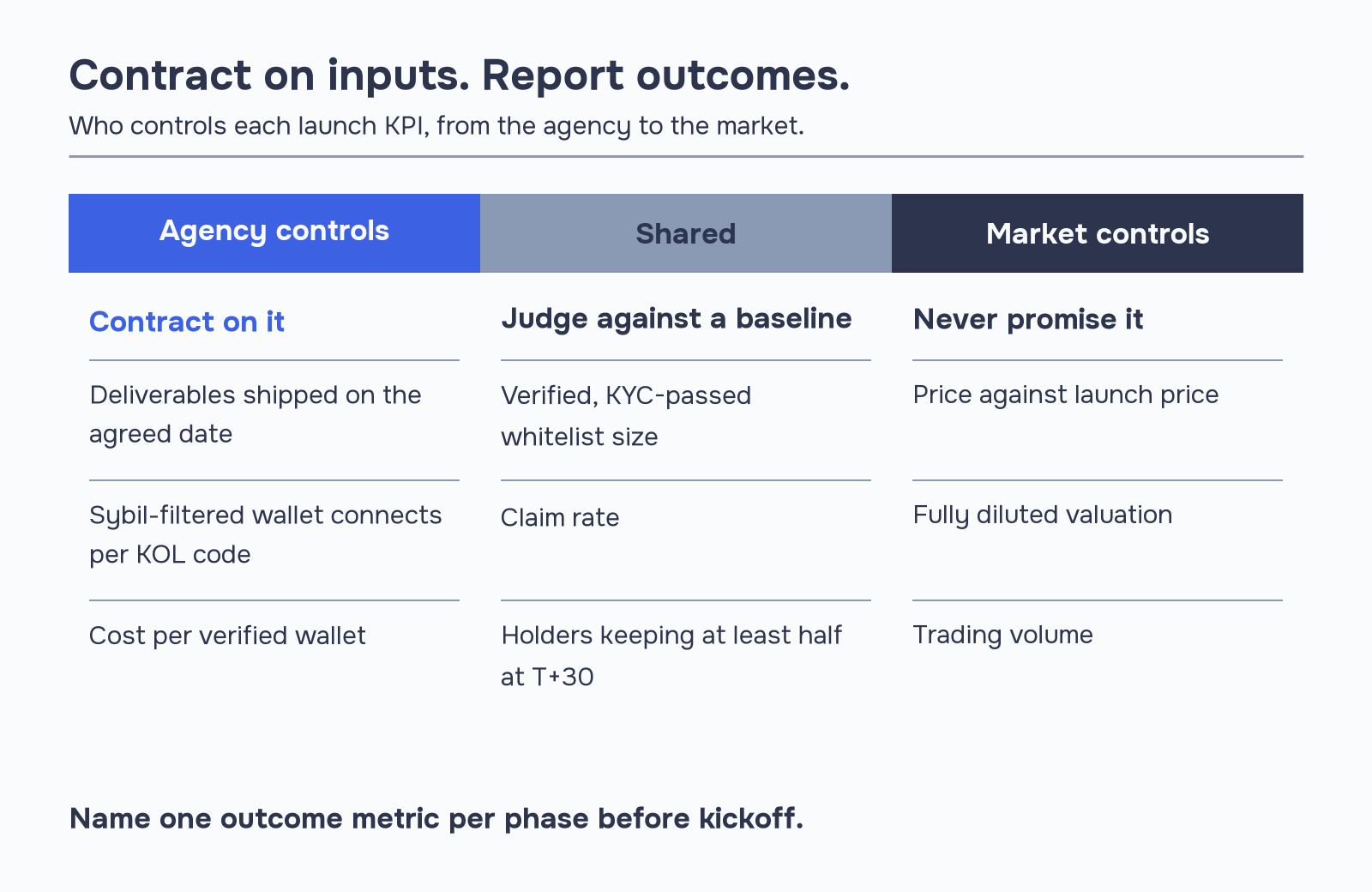
Contract on what the agency controls, judge shared metrics against a baseline, and never accept a promise on price. Name one outcome metric per phase before kickoff.
| Phase | Track this | Instead of |
|---|---|---|
| Pre-TGE traffic | Sybil-filtered wallet connects and whitelist sign-ups by source and KOL code | Impressions, reach, AVE |
| Whitelist | Wallet-verified size after a sybil filter; KYC pass rate; cost per verified wallet | Email waitlists, quest completions |
| Community | Weekly active posters as a share of members; 30-day retention | Member count |
| Sale | Whitelist-to-contribution conversion; top-100 share of contributions | Oversubscription multiples |
| TGE day | Claim rate; spread and depth within 2% of price (the market maker’s KPI, reported by the project) | Opening price |
| T+7 to T+30 | Wallets still holding at least half; organic share of new holders | Raw holder count with dust and airdrop wallets |
In the median airdrop, Bitquery found 23% of claimers still held at least half their tokens at 30 days and 8% at 90. Those are airdrop claimers; vested presale buyers behave differently. When an agency reports holder concentration, ask which exchange, liquidity-pool and vesting wallets it excluded.
Where Can You Compare Token Marketing Agencies?
Compare agencies in ICODA’s ranked lists, then run the ten checks on each. The ranked list of ten presale agencies includes ICODA, 12 top crypto marketing agencies covers full-service shops, and the token sale marketing page shows how ICODA runs a launch.
Token Marketing Agency FAQ
Vendor-published prices put a token launch campaign at $40,000-$150,000+ in total. Ask whether ad spend and third-party fees sit inside the quote. The cost guide lists each range with its source.
Hire at least 90 days before the TGE, because quests, KOL contracts and briefings need T-60 to T-30 and the listing pack needs T-30. With 60 days or fewer, cut scope instead of compressing it: drop quests unless the launch is airdrop-led, and run one KOL wave instead of two. Keep the claims document, tracker pack, run sheet and phishing playbook.
No agency can guarantee an exchange listing; Binance accepts applications only from the project team and blacklists projects that use a third party. An agency can prepare the pack and introductions, not the decision.
Usually not: paying in tokens makes the agency a holder with a reason to sell into your launch, and paid promotion must disclose the payment. In the US, a paid post about a security must state the payment and its amount, tokens included. If you do pay in tokens, add vesting, a cliff and a no-sell window.
Share with


Rate the article