

Three iGaming SEO trends defined 2026 for casinos, sportsbooks and affiliates: which searches get an AI answer, who ranks next to you, and which rules decide both. We measured each of them.
In September 2026 we pulled Google search results for 4,242 gambling queries in six markets, compared the top 10 for 303 money keywords with the same results a year and two years earlier, tracked traffic on 69 gambling domains since 2024, and asked five AI engines the same 20 questions.
The Short Version
- Google’s AI answers betting questions and mostly skips casino. Sportsbooks should treat state and legal-status pages as AI-answer pages. Casino teams shouldn’t plan around AI Overviews.
- Where Google stays quiet, other AI engines name offshore brands. Licensed operators need to know what AI Mode, Gemini and Perplexity say about their markets.
- Parasite SEO moved from off-topic sites to sports media. Betting pages on unrelated high-authority domains died. Pages on sports publishers took their rankings.
- Regulators now reset rankings faster than Google does. Domain rules and bans moved more traffic than core updates.
- Affiliates are losing search, and programmatic pages aren’t the reason. Templated and editorial sections fell by about the same amount.
1. Google’s AI Answers Betting Questions and Skips Casino
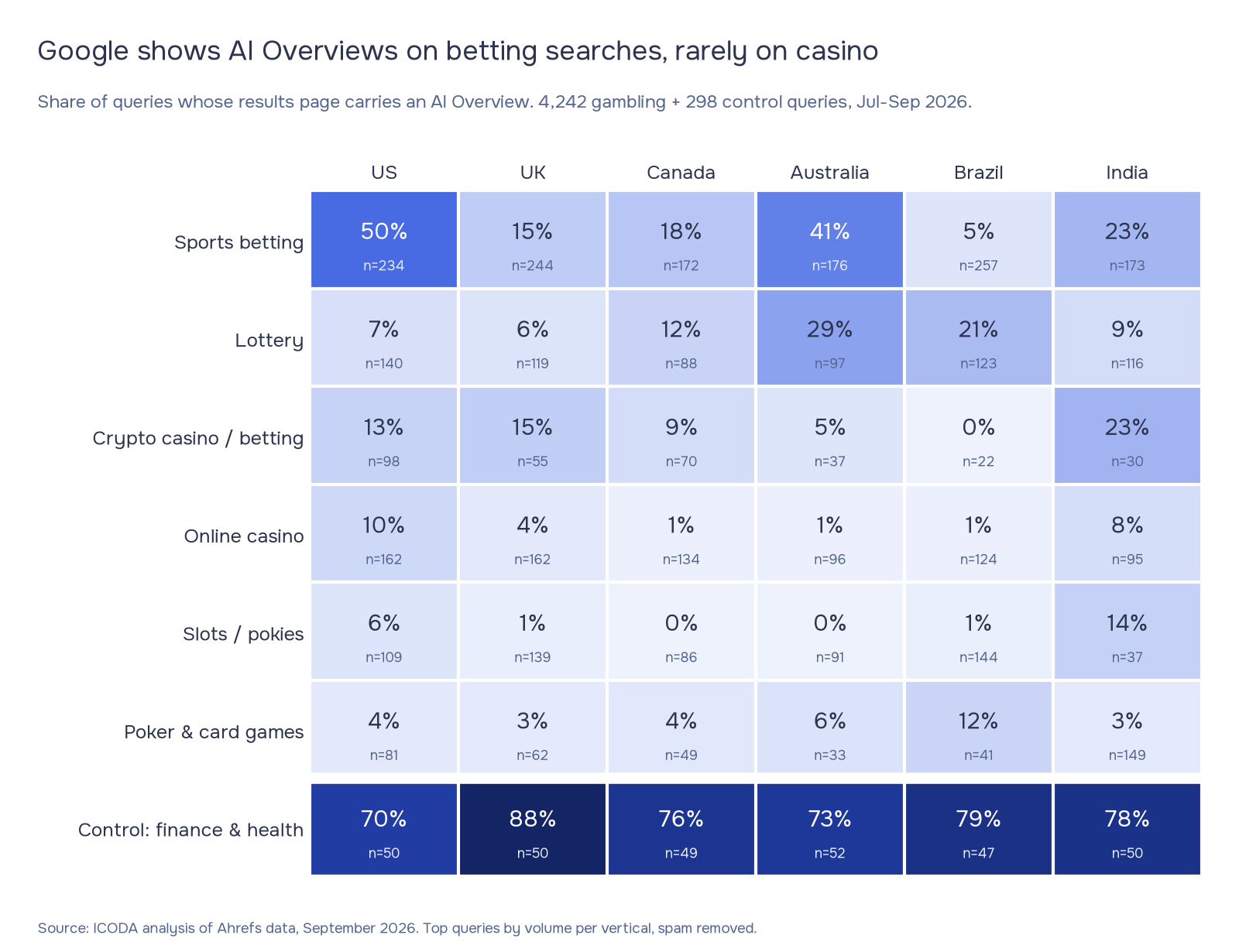
Google showed an AI Overview on 12.1% of gambling queries in our sample. On finance and health queries (credit cards, loans, insurance, VPNs, crypto exchanges, online pharmacies), the rate was 77.2%. Even payday loans got one six times as often as gambling. The gap held in all six markets.
Inside gambling, the line runs between verticals. Non-branded sports betting queries got an AI Overview 69% of the time in the US and 51% in Australia. Non-branded casino queries: 12% in the US, 1% in Australia, 0 of 104 in Canada.
Legality doesn’t explain the split. Online casino is licensed in the UK, yet UK casino and slots queries got fewer AI Overviews than US ones, where online casino is legal in only a few states: 2.4% against 9.8%. Brazil’s regulated betting gets 5%. India banned real-money gaming, and 23% of its betting queries still get an AI Overview.
Search intent and phrasing change the odds, and the pages Google cites are often not the pages that rank:
- A place name pulls the AI answer in. US betting queries naming a state got an AI Overview 76% of the time, against 40% without one. Legal-status questions such as “is sports betting legal in texas” got one 58% of the time.
- Unlicensed searches get nothing. Queries for “non gamstop”, “no kyc” or “offshore” gambling got no AI Overview in any of 37 cases.
- Cited pages are often not ranking pages. Half of the URLs cited in gambling AI Overviews (49.9%) were outside that query’s organic top 10. Regulators got 1% of citations. Our four US “is sports betting legal in [state]” answers cited Fox Sports, CBS Sports, SI, Yahoo, CalMatters and Hard Rock, never the state regulator, even where it ranked organically.
What to do. In sports betting SEO, write state and legal-status pages to be cited. Answer in the first paragraph, name the regulator, date the rule. In casino SEO, these AI Overviews are rare and unstable, and near-identical queries get different treatment. Don’t move casino budget into “AI Overview optimization” yet.
2. Where Google Stays Quiet, Other AI Engines Name Offshore Brands
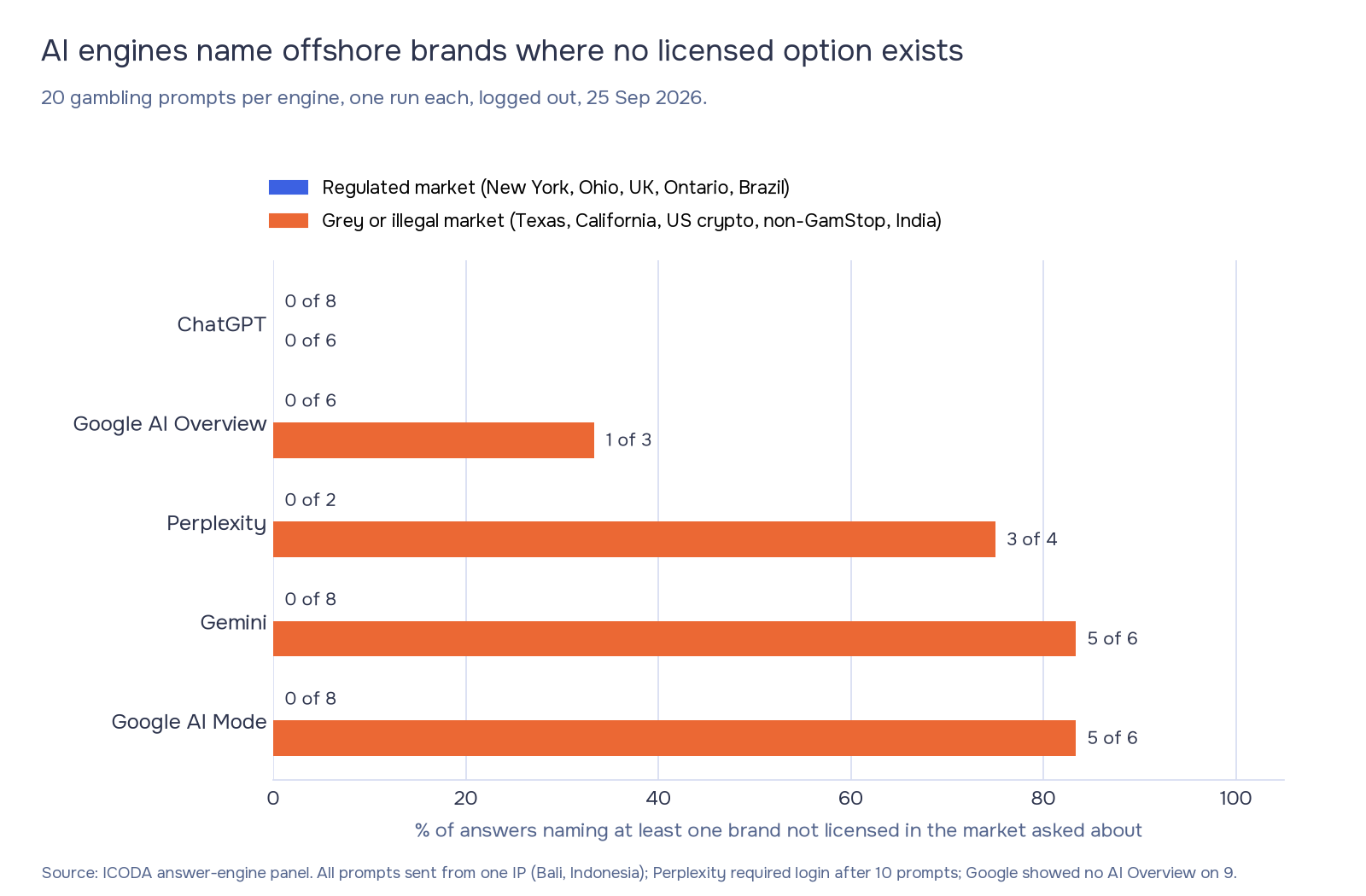
On 25 September 2026 we asked five AI answer engines the same 20 gambling questions: ChatGPT, Google AI Mode, standard Google search, Gemini and Perplexity.
On prompts about regulated markets (New York, Ohio, the UK, Ontario, Brazil), none of 32 answers named a brand unlicensed there. On prompts about markets with no licensed option, such as casinos in Texas, crypto casinos for US players, casinos “not on GamStop” and betting apps in India, 13 of 16 answers from Google AI Mode, Gemini and Perplexity named at least one. ChatGPT refused four of those six prompts and named no unlicensed brand for any location. 18% of its citations went to regulators, most often the UK Gambling Commission.
The answers also contained errors that a compliance team would flag:
- AI Mode attributed its “not on GamStop” list to a “Reddit consensus”. The source was a hijacked thread on r/SoilScience. It also told UK users that offshore casinos are legal for them.
- AI Mode cited expired or unrelated domains carrying casino content eight times.
- Google’s answers about India recommended betting apps without mentioning the 2025 national ban.
Our panel was small: one logged-out run per prompt from a single IP address in Bali. Treat the counts as an illustration. They match a larger test by Investigate Europe, which found seven chatbots recommending unlicensed sites in about 75% of replies across ten countries in March 2026. Ahrefs citation data on our 69-domain panel points the same way: Perplexity cites affiliates 9.5 times as often as Google’s AI does, against 1.9 times for other site types.
What to do. Licensed operators: each quarter, run your ten main money prompts through AI Mode, Gemini, Perplexity and ChatGPT for every market you serve, and log which brands appear. Affiliates: Perplexity is the AI engine that still cites you.
3. Parasite SEO Didn’t Die. It Moved to Sports Media
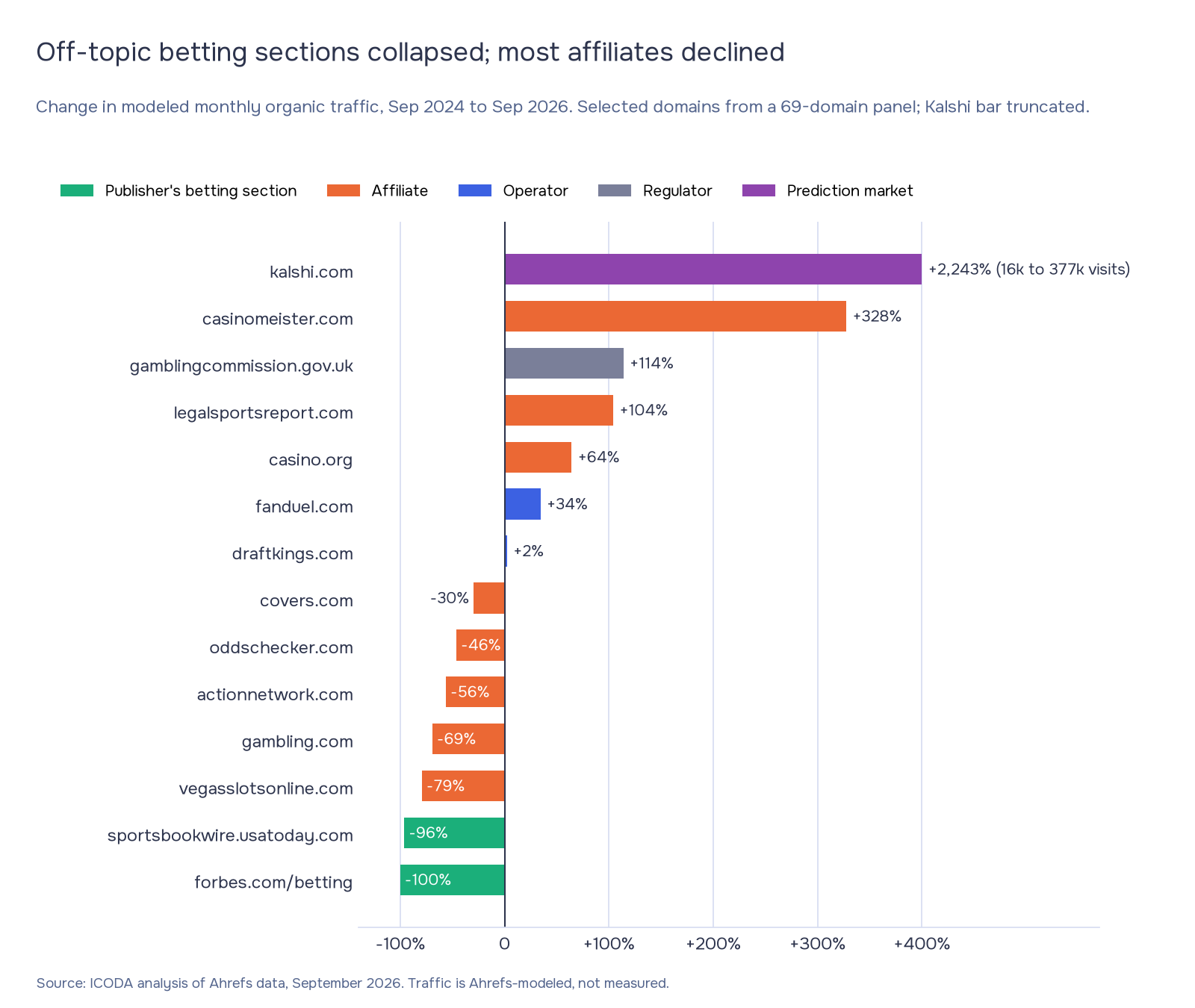
Google’s site reputation abuse policy targets third-party pages that rank on the host site’s authority. In 2024 the typical case was a betting section on a site with no sports connection, and those sections are gone. forbes.com/betting fell from about 383,000 modeled monthly visits to zero between October 2024 and January 2025, the period around Google’s 19 November 2024 clarification of the policy. sportsbookwire.usatoday.com lost 96%.
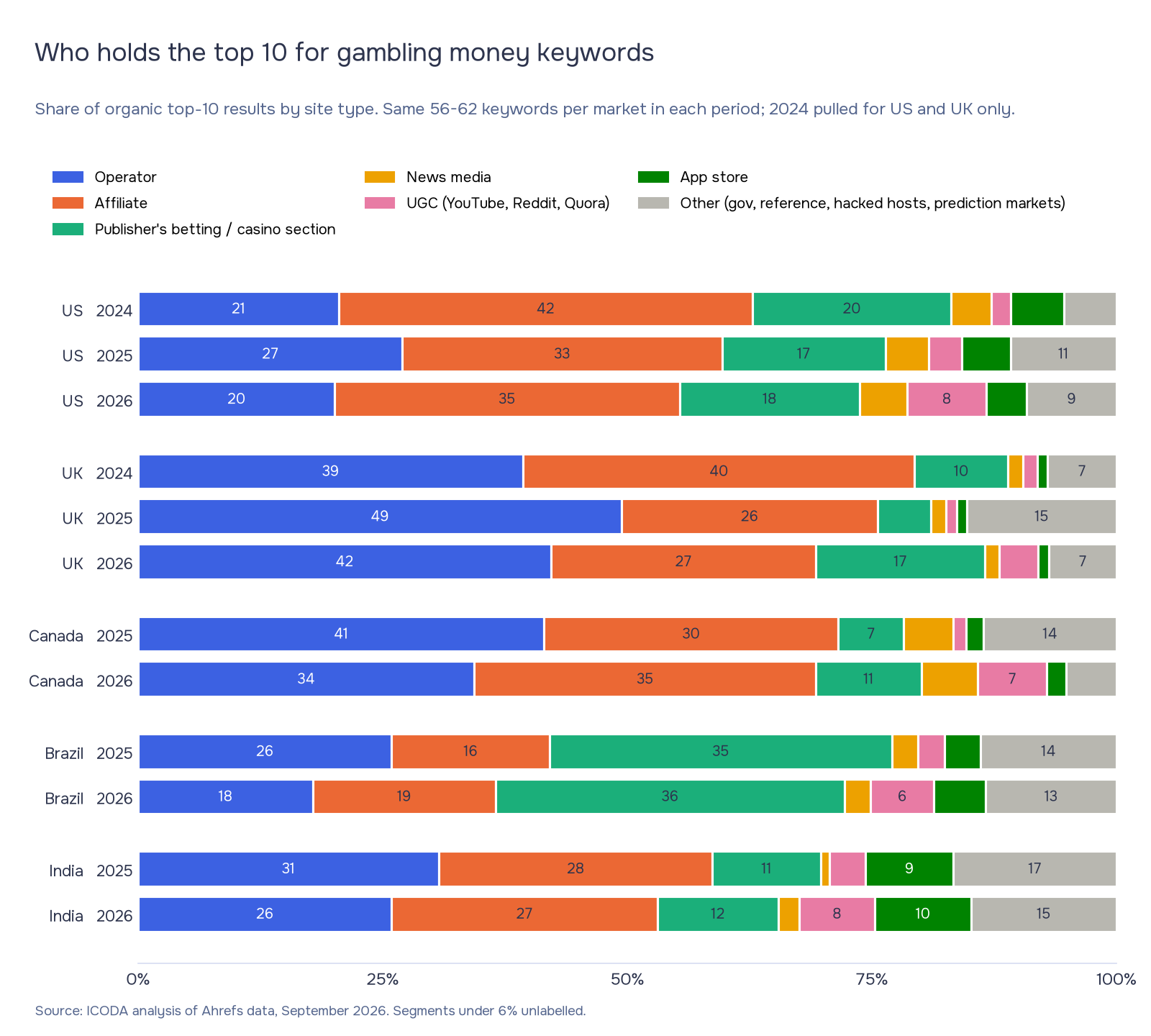
Sports publishers took their rankings. In the UK, Racing Post now ranks first for “best online casino”, “casino sites” and “slot sites”. TNT Sports and The Telegraph each went from zero to 12 to 14 top-10 positions in our keyword panel. In the US, cbssports.com/betting went from 4 positions in 2024 to 20 in 2026, and Fox Sports from 0 to 15. The share of UK top-10 results held by publishers’ betting sections tripled in a year, from 5.4% to 17.3%.
The policy moved as well. Since 30 August 2026, site reputation abuse manual actions no longer affect rankings for users in the European Economic Area. Google may classify the hosted section separately from the main domain instead. It also says it is unlikely to act against a coupon section that the publisher curates, discloses and takes editorial responsibility for. Its example of a violation is still a “best casinos” page on a medical site.
What to do. Topical fit decides whether a hosted section survives. Placements and partnerships with sports publishers rank; betting pages on unrelated high-authority domains don’t. Choose media partners by their sports audience, not their Domain Rating.
4. The Money-Keyword SERP Turns Over Every Year
Of the September 2025 top-10 URLs for our 303 keywords, 15% to 30% were still there a year later, depending on the market. In the US and UK, 17% of the September 2024 top 10 survived two years.
Besides publishers’ betting sections, two kinds of result gained positions:
- YouTube. User-generated content rose from 2.4% to 6.7% of top-10 positions across five markets, almost all of it YouTube (US: 2 positions to 17). Reddit stayed flat in the US.
- Prediction markets. Kalshi, Polymarket and DraftKings Predictions went from 4 to 10 organic positions. SI now runs a prediction-markets section that ranks for “california sports betting”.
Operators are losing positions: their share of the top 10 fell from 35.1% to 28.5% across five markets between 2025 and 2026, and from 44.7% to 12.5% on crypto-gambling keywords.
Two changes affect every site. Google removed FAQ rich results for all sites on 7 May 2026. It has also run four spam updates in 2026 so far, against two in the previous 17 months.
What to do. Budget for an annual rewrite of every money page. Add video for commercial queries.
5. Regulators Now Reset Rankings Faster Than Google Does
| Market | What changed | What happened in search |
|---|---|---|
| Brazil | Licensed operators must use .bet.br domains (Jan 2025). Affiliates and media became liable for gambling ads (17 Jul 2026). | bet365.com’s Brazilian traffic fell from 21.1M to 1.4M monthly visits; betano.bet.br now models at 14.5M. The government blocked 25,000+ illegal sites in year one. |
| US | 11 states banned sweepstakes casinos in 2025 and 2026. California’s AB 831 extends liability to media affiliates. | Sweepstakes queries get an AI Overview 5% of the time. Publishers promoting sweepstakes in California take on legal risk. |
| India | The online gaming act took effect on 1 May 2026. By 28 March the government had blocked 8,376 URLs. | 23% of betting queries still get an AI Overview, citing 1xBet 12 times. A hacked state-government subdomain ranks for betting terms. |
| UK | The Gambling Commission capped bonus wagering at 10× from 19 Jan 2026. | Hacked and expired domains, charity sites among them, held 11.4% of top-10 positions for our UK keywords in 2025 and 3.6% in 2026, mostly on “non GamStop” terms. |
| Canada | Alberta opened a regulated market on 13 Jul 2026. | Non-branded Canadian casino and slots queries got an AI Overview in 0 of 164 cases, despite Ontario’s licensed market. |
What to do. For each regulatory change on your calendar, ask three questions. Does our URL have to change? Does content become illegal to publish? Does liability move to the publisher?
6. Affiliates Are Losing Search, and Templates Aren’t Why
Across the 34 affiliate domains in our panel, modeled organic traffic fell 30% between September 2024 and September 2026. The median affiliate lost 43%. The ten operators that kept their domains held roughly flat, at −2%.
Company filings show the same trend. Grandstand, formerly Gambling.com Group, earned 67% of its Q2 2026 marketing revenue from sources other than SEO and cut staff by 25%. Catena Media told investors that the same rankings now bring fewer clicks.
Programmatic content usually gets the blame, but on five affiliate sites with both templated sections (promo codes, state pages, slot databases, box scores) lost a median 69% and editorial sections 65%. The templated sections had fewer sudden drops, and two of the sharpest “collapses” were URL migrations.
Domain Rating didn’t protect anyone either: starting DR had no relationship with traffic change (Spearman ρ = −0.15, p = 0.24). Bigger sites lost more (ρ = −0.45). Sites gaining referring domains through link building tended to grow (ρ = +0.36), though we can’t say which caused which.
Some affiliates grew: casino.org by 64%, legalsportsreport.com by 104%, casinomeister.com by 328%. Kalshi went from about 16,000 monthly visits to 377,000 and held between 450,000 and 980,000 through most of 2026, long after its November 2024 election peak.
What to do. Before rebuilding templates, check which sections lost traffic and in which month. Match drops against URL changes first, then against Google updates.
7. Seven Numbers to Stop Quoting
These figures appear in current “iGaming SEO trends 2026” articles. We traced each to its origin.
| Claim | What the source says |
|---|---|
| “53% of iGaming traffic is organic” | BrightEdge, 2019, across all industries. Nothing iGaming-specific. |
| “Search volume will fall 25% by 2026” | A 2024 Gartner forecast. It didn’t happen: Alphabet’s search revenue grew 17% in Q2 2026. |
| “50% of searches are voice” | A 2014 forecast, misattributed to comScore. No measurement supports it. |
| “AI Overviews appear on ~25% of searches” | Roughly right for search overall. For gambling, we found 12% of queries and 4% of search volume. |
| “Reddit is 46.7% of Perplexity citations” | That is Reddit’s share among the top 10 cited domains. Of all citations, it is 6.6%. |
| “Google moved gambling under Financial Security in its rater guidelines” | The September 2025 guidelines don’t mention gambling in the YMYL section. |
| “Core Web Vitals require FID under 100 ms” | INP replaced FID on 12 March 2024. |
8. What to Do Before 2027
| If you are… | Do this |
|---|---|
| A sportsbook | Rewrite state and legal-status pages to be cited: answer first, regulator named, date given. Track AI Mode answers per state. |
| A casino operator | Don’t plan around AI Overviews. Monitor AI Mode, Gemini and Perplexity for offshore brands in your markets. Put regulatory dates on the SEO calendar. |
| An affiliate | Diversify beyond Google organic. Choose sports publishers for placements. Check URL migrations before blaming templates. |
If you want these checks built into your own SEO strategy, our casino and iGaming SEO team does this work for operators and affiliates. The fundamentals behind these trends, from keyword research to schema, are in our iGaming SEO guide.
Frequently Asked Questions
Google rarely shows AI Overviews on gambling searches, while other AI engines recommend offshore brands in unregulated markets. Parasite SEO moved to sports publishers, regulators reset rankings, and affiliates are losing organic traffic.
Rarely: on 12% of gambling queries in September 2026, against 77% of finance and health queries. Sports betting queries get them most; casino and slots queries almost never do.
Yes, on sports publishers such as Racing Post, CBS Sports and Fox Sports. Betting sections on unrelated sites lost their rankings in 2024 and 2025.
In our panel, only ChatGPT refused grey-market gambling questions, and it named no unlicensed brands. AI Mode, Gemini and Perplexity named offshore brands in 13 of 16 such answers.
Templated sections lost a median 69% of traffic, editorial sections 65%. Off-topic hosting, domain migrations and regulation explained more of the losses.
Templated sections lost a median 69% of traffic, editorial sections 65%. Off-topic hosting, domain migrations and regulation explained more of the losses.
How We Measured It
- AI Overview index: 4,242 gambling and 298 finance and health queries, the top of Ahrefs Keywords Explorer by volume for seven verticals in six markets, minus 517 spam “queries” with fake volume. Each flag comes from the latest Ahrefs results-page snapshot (July to September 2026, mostly September). A page-level recheck of 330 queries agreed 98.2% of the time.
- Citations: 590 AI Overview citations on 154 results pages, each domain classified by hand.
- Top-10 shift: 303 money keywords in five markets, September 2026 against September 2025 (and September 2024 for the US and UK).
- Traffic panel: 69 domains and sections, monthly Ahrefs organic traffic, September 2024 to September 2026, against Google Search Status Dashboard update dates.
- AI engine panel: 20 prompts on five engines, 25 September 2026.
Limitations
- Traffic figures are Ahrefs estimates, not measurements from the sites.
- Each query has a single snapshot, and AI Overviews flicker between crawls, especially on casino head terms.
- The keyword set favors head and mid-tail terms from our chosen seeds.
- The AI panel had one location. All prompts ran logged out from one IP address in Indonesia, once each.
- The traffic panel shows associations, not causes.
Data and Sources
Regulatory and policy facts come from primary sources: Google’s spam policies, the Google Search Status Dashboard, Brazil’s Ministry of Finance, the UK Gambling Commission, the California Legislature and MeitY data reported by MediaNama. Company figures come from quarterly reports. Query-level data is available on request.
Share with


Rate the article