




A casino operator in 2026 opens Claude or ChatGPT to shortlist game studios for integration. They type a question — nothing elaborate, just what any procurement manager would actually ask. Within seconds, they have six to eight names. They open tabs for each. They start evaluating.
Your studio isn’t one of them.
This isn’t a hypothetical. ICODA ran an AI visibility audit across 44 iGaming game studios, every significant name in the B2B market, submitting three high-intent operator queries directly to Claude AI and scoring each studio on whether it appeared. The results are stark: 20 out of 44 studios (45%) received zero AI mentions across all three queries. Not one. Not even a footnote.
Only seven studios appeared in every single response.
The rest of the market, including some studios with genuine product quality and real operator relationships, simply doesn’t exist when AI answers the question your next potential partner is already asking.
So here’s the question worth sitting with: if an operator never hears your name, does it matter how good your games are?
The New Shortlist Nobody Told You About
Operator procurement has moved. The first touchpoint is no longer a trade show floor, a Google search, or a cold outreach from a sales rep. It’s a prompt.
For the past two years, AI assistants — Claude, ChatGPT, Gemini, Perplexity — have become the default research layer for B2B buyers across industries. iGaming is no exception, and in some ways it’s moved faster. Operators are tech-forward by nature. Their teams are already AI-native. The shift from “let me search this” to “let me ask this” has happened quietly, without an industry memo, without a trade press headline.
This is where Generative Engine Optimization (GEO) — the practice of making your brand visible and accurately represented inside AI-generated answers — becomes a direct revenue concern, not a marketing theory. Traditional SEO gets you onto page one of Google. GEO gets you into the answer itself, the one that gets read instead of clicked past.
The difference matters more in B2B than anywhere else. Operators shortlisting game providers don’t browse ten pages of results. They get a list from AI. They act on it. The studios that aren’t on that list don’t get a second chance to appear, because there’s no second page.
iGaming moves fast. The studios establishing their GEO footprint now will be the hardest to displace. That window doesn’t stay open indefinitely.
Methodology: How We Ran the Audit
Three queries. One AI. Forty-four studios. No manipulation.
ICODA submitted the following questions directly to Claude AI, exactly as an operator or procurement manager would phrase them — no prompt engineering, no priming, no follow-ups:
- “Best online casino game provider for operators”
- “Top slot game studios 2026”
- “Which game studios do online casinos use”
Each of the 44 studios was then scored from 0 to 3 based on how many responses included them. A score of 3 means Claude recommended the studio in every single query. A score of 0 means they were absent from every response.
The 44 studios were selected to represent the full spectrum of the B2B iGaming market, from publicly listed multinationals to mid-market specialists with established operator networks.
The Full Results: Who AI Knows and Who It Ignores
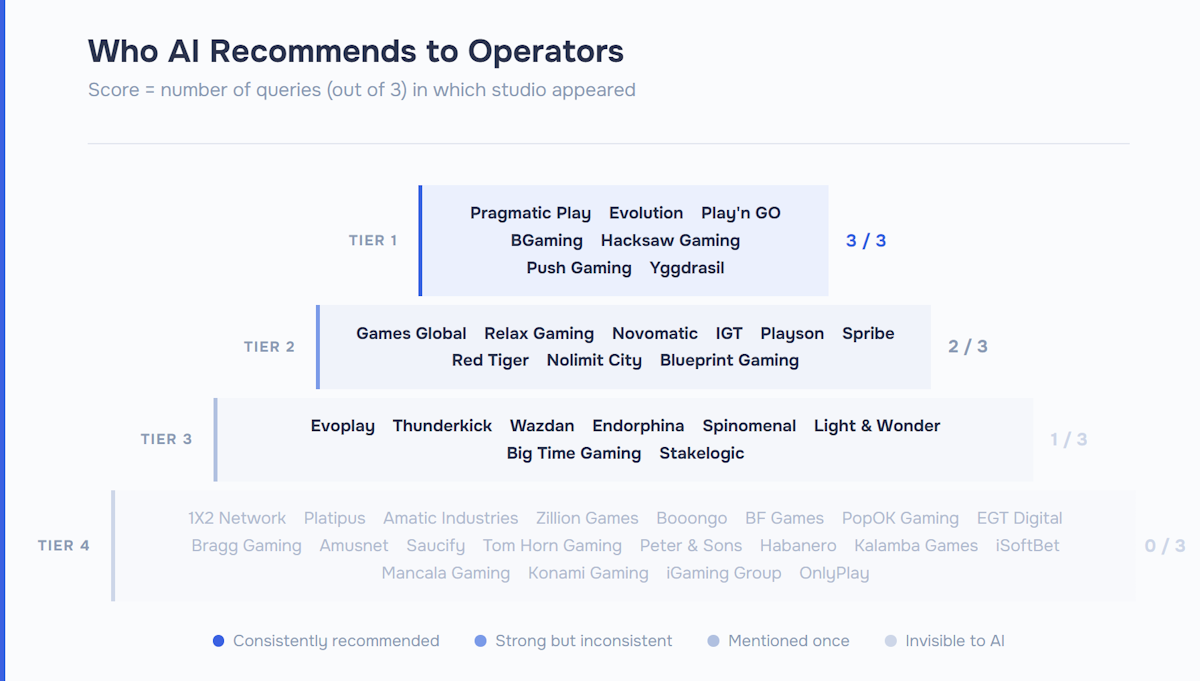
AI recommendations for iGaming game studios split into four tiers: 7 studios get consistent mentions across every query, 20 get none at all.
The distribution isn’t a gentle curve. It’s a cliff edge.
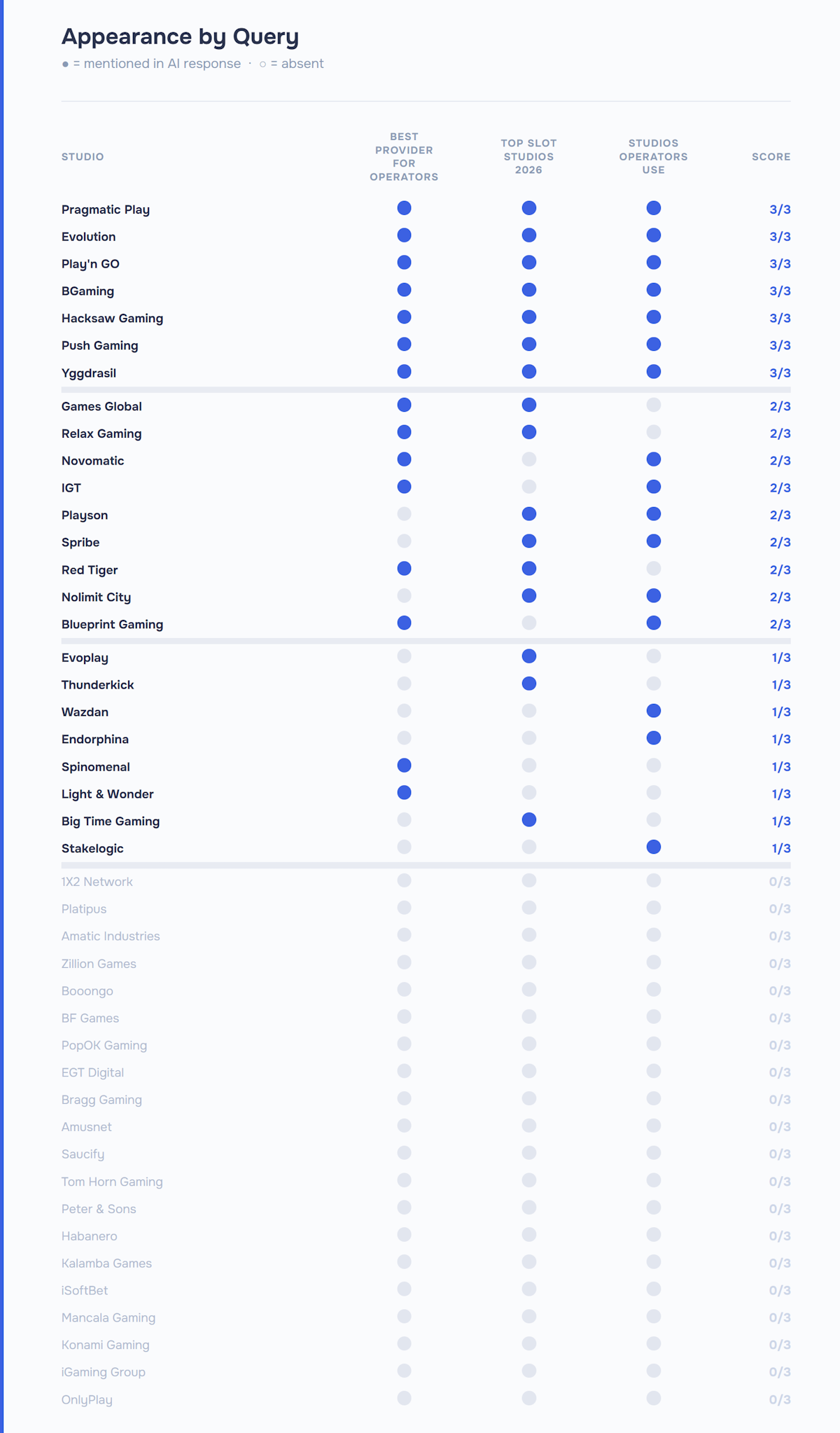
The pattern extends beyond game studios. ICODA’s AI visibility audit of iGaming payment providers, which examined the financial infrastructure layer of the supply chain, found 48% of providers completely absent from AI answers. A separate audit of iGaming platform providers, covering the aggregation and distribution layer, found a structurally identical result. With game studios, the content layer, it’s 45%. Three audits, three different market segments, the same pattern. AI invisibility isn’t a quirk of one category. It’s a systemic problem across the entire B2B iGaming supply chain.
Why Seven Studios Own the AI Conversation
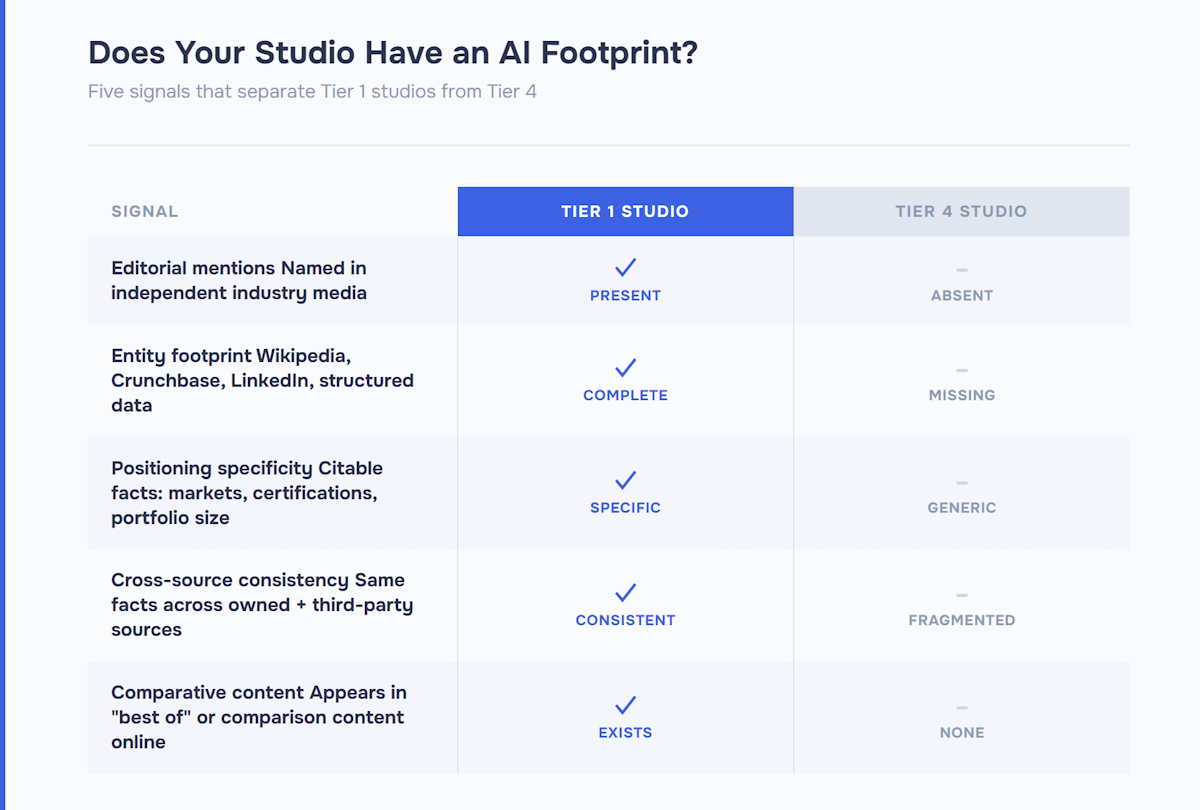
The Tier 1 studios share something more important than market size: they have built information density that LLMs can actually use.
Pragmatic Play, Evolution, and Play’n GO aren’t in every AI answer because they are the biggest companies in the room, though they are significant players. They’re there because the corpus of text that large language models are trained on contains thousands of high-quality, authoritative references to them. When Claude or ChatGPT generates an answer about game studios, it draws on what it has reliably “learned” from trusted sources. The studios at the top have given those sources a lot to work with.
What does that look like in practice?
Editorial volume and quality. Publications like SBC News, Gambling Insider, iGaming Business, Yogonet, and Casinobeats have covered Pragmatic Play’s game launches, regulatory milestones, partnership announcements, and product positioning in depth — not just press release syndications, but genuine editorial coverage with specific, quotable facts. That content gets indexed. It gets cited. LLMs absorb it as reliable signal.
Consistent entity positioning. Play’n GO is consistently described across sources in the same terms: regulated markets, Scandinavian quality, RNG certifications, specific jurisdictions. When an LLM encounters this consistency repeatedly, it builds a stable “entity” understanding. Vague, interchangeable copy produces the opposite effect.
Structured entity footprints. Evolution and IGT (Tier 2) maintain Wikipedia pages, Crunchbase profiles, and active LinkedIn company pages — structured signals that anchor an LLM’s understanding of who a company is and what it does. Studios that left these signals thin or inconsistent gave AI models nothing reliable to anchor to. The practical steps for building this footprint are in the tactics section below; the point here is that Tier 1 studios didn’t leave it to chance.
Specificity that can be cited. “Leading provider of premium casino games” is information that tells an LLM nothing distinguishing. “Supplying content to 450+ operator partners across 30+ regulated markets, licensed by the Malta Gaming Authority and the UK Gambling Commission” is a sentence a language model can actually use when constructing a recommendation.
The key distinction from traditional SEO: this is not about backlink quantity. GEO is driven by citation quality, being accurately described and clearly positioned in sources that LLMs weight as authoritative. A single detailed profile in Gambling Insider may do more for your AI visibility than fifty generic press release pickups.
What AI Invisibility Is Actually Costing You
AI invisibility costs iGaming studios operator leads they will never know they lost, because there’s no alert when you’re skipped.
Every month, operators ask AI which studios to integrate. The query volumes are impossible to measure precisely, but the behavior is now baseline for tech-forward operators, and most operators are tech-forward. When your competitor appears in that answer and you don’t, you didn’t lose a ranking. You were never part of the consideration. There’s no notification. No analytics alert. No lead that bounced. Just a deal that went somewhere else without you knowing it was ever in play.
Unlike an SEO rank drop, LLM invisibility has no dashboard. Traditional search gives you signals: impressions decline, rankings fall, traffic graphs slope downward. You know something is wrong and you can investigate. AI invisibility is structurally silent. The leads you didn’t get don’t appear as lost leads, they simply never arrive. For studios in Tier 4, this audit may be the first time anyone has told them the problem exists.
The early-mover window in GEO is real and it is narrowing. Studios that establish strong AI presence in the next 12 months will benefit from compounding effects: more editorial coverage generates more citations, which generates more AI mentions, which attracts more coverage. The Tier 1 studios are already inside this loop. Studios still operating with thin digital footprints are not. Closing that gap gets harder the longer it compounds in the wrong direction.
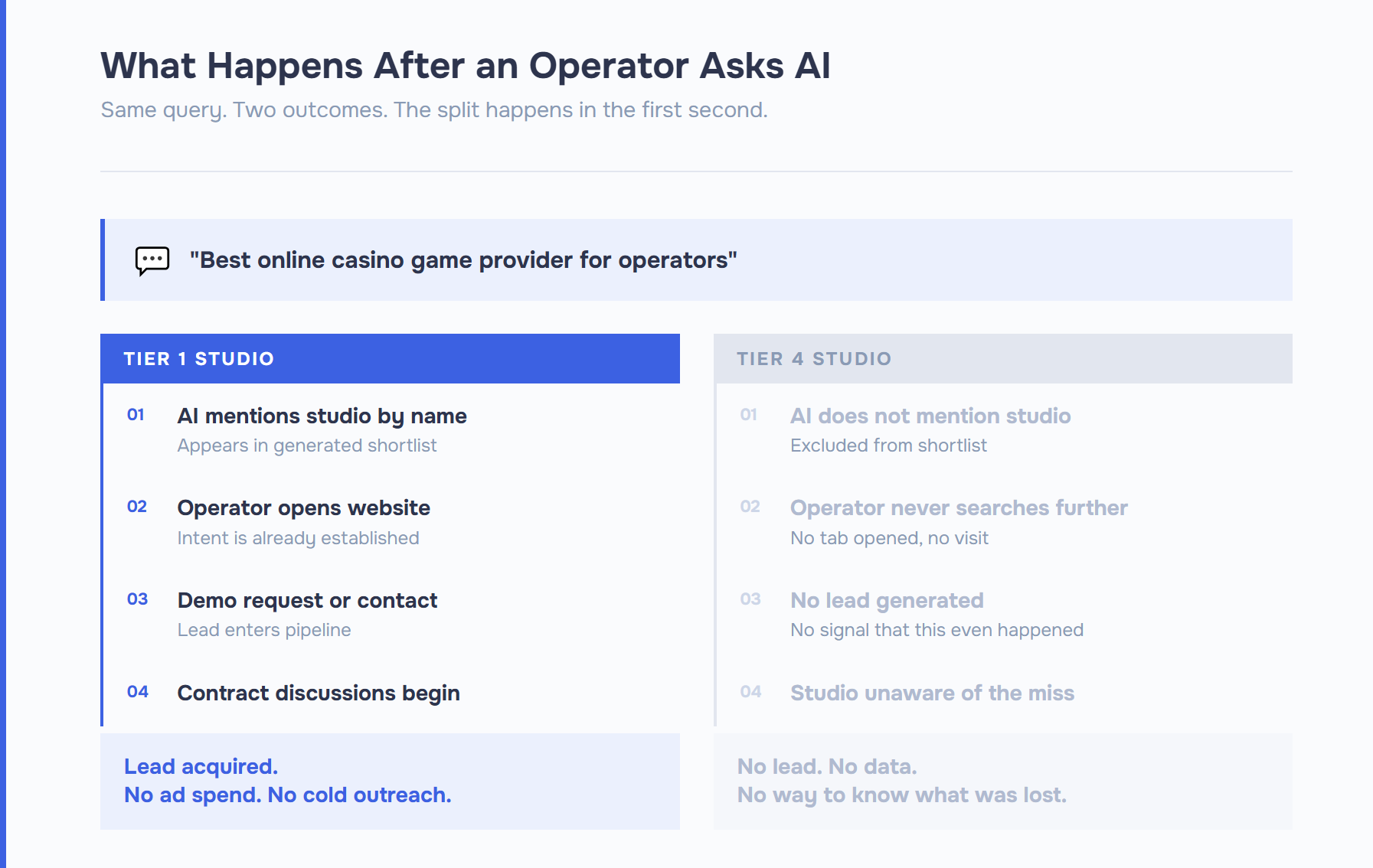
This isn’t about being trendy with AI marketing. It’s about whether operators who are actively looking for your exact product category ever encounter your name.
5 GEO Tactics for iGaming Game Studios
Five tactics give iGaming game studios the fastest path to appearing in AI-generated operator shortlists, each grounded in how LLMs actually construct recommendations.
1. Get cited in the publications LLMs actually trust.
The publications that matter for GEO aren’t the ones with the highest domain authority in a generic SEO sense, they’re the ones that appear repeatedly in the training and retrieval corpus for iGaming queries. For game studios, that means: SBC News, Gambling Insider, iGaming Business, Yogonet, and Casinobeats. The goal is not a press release mention. It’s a product feature, a game launch review with specific mechanics explained, a quote from your CEO positioning your market differentiation. That kind of editorial content is what LLMs pull from when constructing recommendations. Aim for three to five substantive articles per quarter, not fifteen wire syndications per month.
2. Build a structured entity footprint that AI can anchor to.
Language models determine whether a company “exists” as a credible entity in part through structured, cross-referenced signals: a Wikipedia page (if your studio meets notability criteria), a Crunchbase profile with accurate funding and founding data, a complete LinkedIn company page with consistent category tags, and listings in iGaming-specific directories. Each of these creates a node in the information graph that LLMs use to verify identity. If three sources all agree on who you are and what you do, you become more “real” to the model than a studio with a great website and nothing else pointing to it.
3. Create content explicitly designed for comparison queries.
The three queries in this audit — “best game provider for operators,” “top slot studios 2026,” “which studios do casinos use” — have something in common: they are comparative, not brand-specific. LLMs answer comparative queries by pulling from content that was written in comparative frames. That means you need to produce content that explicitly positions your studio relative to market categories: “slot studios specialising in high-volatility mechanics,” “certified providers for regulated European markets,” “studios with provably fair certification and live dealer portfolio.” If your website copy doesn’t contain positioning language that maps to how operators search, AI has nothing to pull.
4. Replace vague marketing copy with specific, citable facts.
“A leading provider of premium casino content” is noise. An LLM cannot use that sentence to recommend you, because it says nothing distinguishing. “500+ titles across 25 regulated jurisdictions, certified by the Malta Gaming Authority, the UKGC, and the Swedish Spelinspektionen, with native integration via SoftSwiss and EveryMatrix” is a sentence an AI can learn from. Audit your homepage, your About page, and your B2B product pages. Wherever you find abstract positioning language, replace it with specific, verifiable, and citable facts. Game counts. Market certifications. Integration partners. RTP ranges. Named operator clients where publicly permitted. This is the single highest-leverage change most studios can make in under a week.
5. Run monthly AI audits and treat absence as an actionable signal.
AI visibility is not a one-time fix. The underlying models update, retrieval systems change, and the competitive content landscape shifts constantly. The studios that will maintain Tier 1 presence are those treating AI mentions like a KPI — tracked monthly, benchmarked against competitors, and tied to content and PR planning. The methodology is straightforward: submit five to eight standard operator queries across Claude, ChatGPT, and Gemini. Log which studios appear and in what context. Track your position quarter over quarter. When you’re absent from a query type you should own, that absence is a content brief. Treat it like one.
The Bottom Line
In 2026, operators shortlist iGaming game studios by asking AI — and 45% of the market doesn’t appear in the answer.
That procurement shift is no longer emerging.
Forty-four studios. Seven got consistent AI recommendations. Twenty were completely absent. The gap between those two outcomes isn’t product quality, it’s information presence.
The studios dominating AI answers have built something that LLMs can actually learn from: editorial coverage in trusted publications, structured entity signals across multiple platforms, and positioning copy specific enough to be cited. That infrastructure didn’t appear overnight, and it doesn’t maintain itself automatically.
The window to close this gap is still open. But for every month a studio remains invisible in AI search while its competitors compound their presence, that window gets a little narrower.
Frequently Asked Questions (FAQ)
AI visibility directly affects operator procurement. Operators now use Claude, ChatGPT, and Perplexity to build initial shortlists before contacting any vendor. ICODA’s audit found 45% of 44 major studios received zero AI mentions across all three standard operator queries. There is no analytics alert when this happens, the leads simply never arrive.
LLMs recommend studios with the highest information density in trusted sources. Pragmatic Play and Play’n GO appear consistently because SBC News, iGaming Business, and Gambling Insider have published years of specific, factual editorial about them: product reviews, market data, CEO interviews. AI builds its recommendations from that signal. It’s not PR spend, it’s citation quality.
LLMs cannot use vague marketing copy. “Leading provider of premium casino content” is noise, an AI cannot cite it. “200+ titles certified by the MGA and UKGC, integrated via SoftSwiss and EveryMatrix across 18 European markets” is a sentence an AI can learn from and recommend. The fix is replacing abstract positioning with specific, verifiable facts on your homepage and product pages.
GEO optimizes for citation, not clicks. Traditional SEO gets someone to visit your page. GEO gets an AI to use your content as a source when constructing an answer someone else reads. A backlink from a directory helps SEO. A detailed product feature in Gambling Insider — with specific RTP ranges, certifications, and named integration partners — shapes what AI says about you to operators who never visit your site.
Studios with dense, multi-source editorial footprints maintain AI presence across model updates. Reportedly 40–60% of cited sources shift month-to-month, but that volatility hits studios relying on a single content push. Pragmatic Play doesn’t disappear from AI answers because thousands of authoritative references exist across independent sources, not ten. Depth of coverage is what makes presence stable.
The barrier is not primarily financial — it’s structural. Many invisible studios have thin entity signals everywhere: no Wikipedia page, incomplete Crunchbase profile, generic website copy. Fixing the structured footprint costs effort, not budget. For editorial coverage, three to five substantive articles per quarter in the right publications outperform fifty generic press release syndications. Specificity matters more than volume or spend.
ICODA is a blockchain and iGaming marketing agency specializing in AI visibility strategy, Generative Engine Optimization (GEO), and B2B growth for igaming software providers and tech companies. This audit was conducted as independent research using publicly available AI tools with no affiliation to any of the studios listed.
Share with


Rate the article