

DIY works. That’s the honest answer. But it only works if someone on your team has 10-15 hours a week to spend on it, and that number isn’t a rough estimate. That’s what ongoing Generative Engine Optimization actually takes at the operational level: content freshness, citation monitoring, schema maintenance, PR coverage, and prompt testing across multiple AI platforms.
Most crypto teams don’t have those hours. Not because they’re understaffed. The people who understand the product well enough to manage this are already running at capacity.
This article shows you the actual weekly time commitment, the tool stack, and a side-by-side cost breakdown: everything you need to work through the geo agency vs in house question honestly, rather than defaulting to whatever feels cheaper on paper.
What DIY AI Visibility Actually Requires (Weekly Time + Tools Breakdown)
The assumption most teams start with: getting cited by ChatGPT or Gemini is a content problem. Publish some well-structured articles, add schema markup, done. That’s not how it works.
LLMs draw from data that refreshes. What earns a citation today can lose it in two months. Content ages out. A competitor publishes something more authoritative. A platform quietly shifts how it weights source types. This is why diy geo marketing is an operation, not a one-time setup.
Week to week, that operation looks like this:
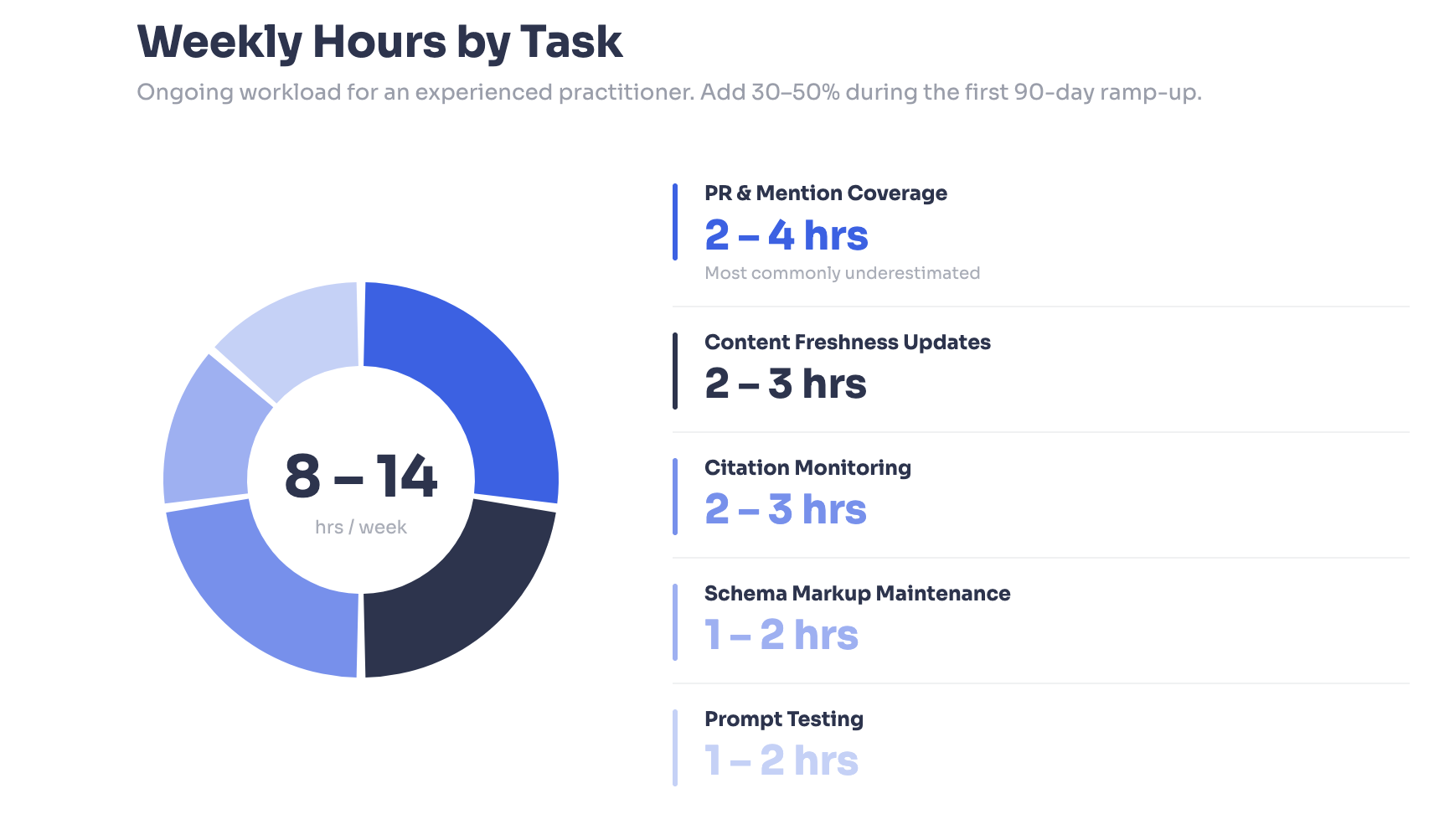
Freshness updates (2-3 hrs/week) Key pages need regular updates so AI indexing signals treat them as current. Statistics change. Regulatory language evolves. This work isn’t about rewriting compulsively; it’s about keeping your most important content from going stale in the eyes of systems that weight recency.
Citation monitoring (2-3 hrs/week) You need to know whether ChatGPT, Perplexity, Gemini, and Claude are actually citing you when users ask relevant questions. Tools exist for this (Profound, Otterly.ai, and a handful of others), but they require configuration, ongoing query testing, and interpretation. Someone has to own making sense of the output.
Schema markup maintenance (1-2 hrs/week) AI platforms weight structured data heavily. Schema needs to be correct, current, and validated. A broken schema on a key page can quietly drop your citation rate with no signal that anything broke.
PR and mention coverage (2-4 hrs/week) AI systems are shaped by where you get mentioned across the web. Placements in crypto media, industry newsletters, and reputable aggregators build the citation graph that LLMs draw from. Identifying targets, pitching, placing, and tracking those mentions takes consistent effort, the kind that gets dropped during a launch crunch.
Prompt testing across AI platforms (1-2 hrs/week) You need to test how different AI platforms respond to queries where you should appear. This is how you catch coverage gaps before they go chronic. Tedious, requires judgment, and doesn’t automate cleanly.
Why Crypto Makes This Harder Than Generic GEO
Most GEO guides are written for SaaS or e-commerce. Crypto adds a specific wrinkle they don’t address.
AI platforms apply conservative editorial judgment to financial and crypto content in a way they don’t with most other verticals. ChatGPT, Gemini, and Perplexity are all calibrated to avoid directing users toward content that could be read as financial advice. In practice, strong content alone earns citations less reliably in your niche than it might elsewhere. The citation graph matters more. If your project is being discussed, analyzed, and referenced by sources the AI platforms already trust (established crypto media, research contexts, high-authority aggregators), your odds of getting cited improve considerably. A project with great content that exists in relative isolation struggles. Building that external citation graph takes deliberate outreach and consistent PR work; it doesn’t happen as a byproduct of good writing.
There’s also the volatility problem. Crypto moves faster than most industries, which means content has a shorter shelf life. A piece about staking yields or protocol mechanics that was accurate eight months ago may now be misleading or outdated. AI platforms pick this up. Keeping content current is more labor-intensive in this vertical than the generic time estimates suggest, which is one reason the weekly hours feel high to teams coming from other industries.
Weekly total: roughly 8-14 hours per week
That’s for someone who already knows what they’re doing. Factor in a learning curve (two to three months minimum in a niche as fast-moving as crypto/Web3) and the first quarter looks considerably more expensive than the line items above suggest.
The curve tends to follow a predictable pattern. Month one is mostly setup: getting citation monitoring configured, mapping which queries actually matter for your project, and establishing a baseline so you have something to measure against. Output is low. You’re building instrumentation, not running the program yet.
Month two is when the first real mistakes happen. Teams over-index on content production and under-invest in distribution. They publish well-structured articles and check whether ChatGPT is citing them a week later. It doesn’t work that fast. The disconnect between effort and visible results is where most in-house programs stall or get quietly deprioritized for the first time.
Month three is when things start compounding, assuming you’ve stayed consistent. Citation share starts moving. Monitoring tells you which content is performing, which queries you’re missing, and where competitors are pulling ahead. People who make it to month three with a functioning program are usually the ones who treated it as an operation from day one.
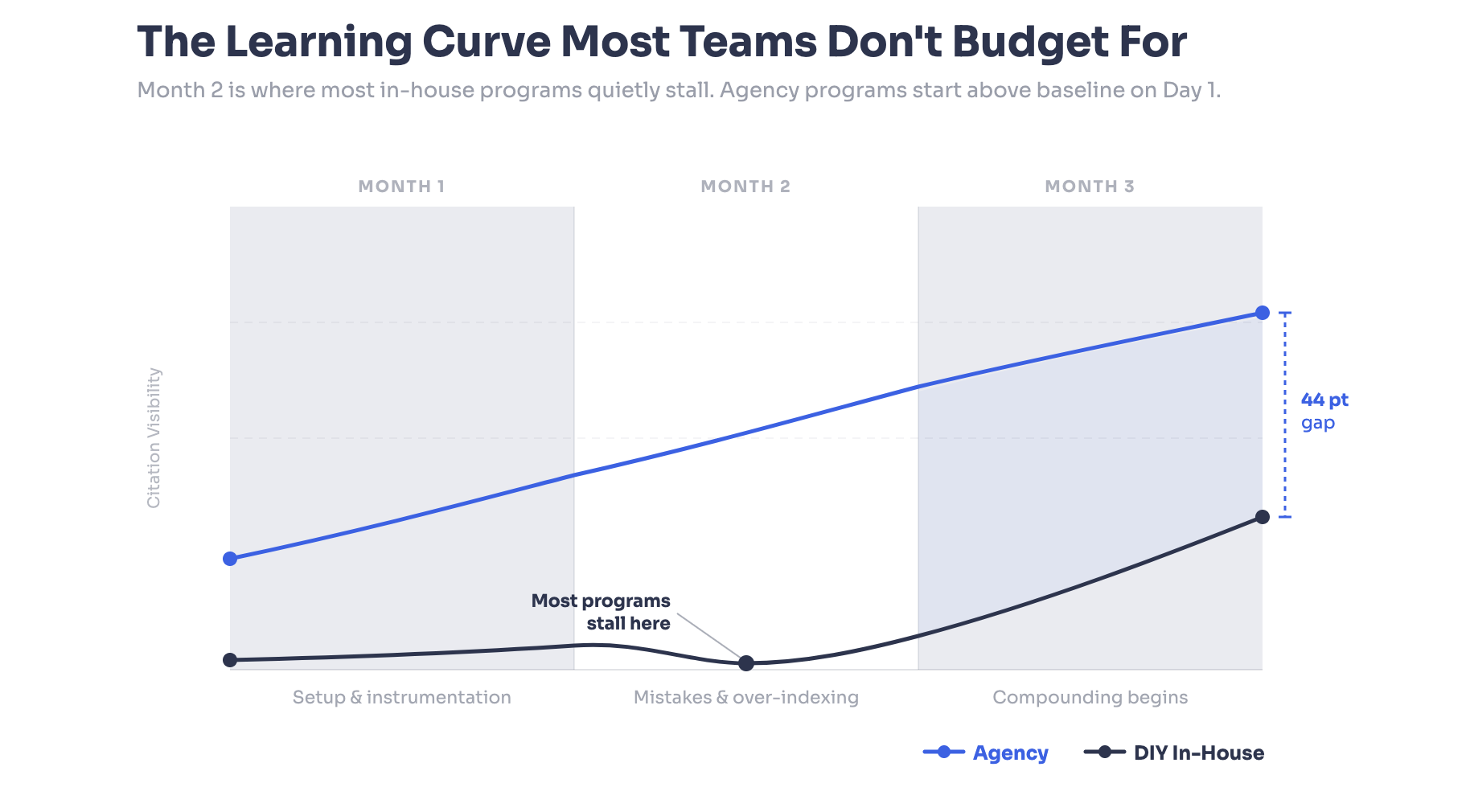
If you’re planning to DIY, explicitly budget for that 90-day setup period before expecting measurable results. It doesn’t mean the work isn’t happening; it means the instrumentation is being built.
What DIY Can and Can’t Deliver
✅ What you can achieve:
- Niche-specific content with genuine product depth (no agency replicates this without months of onboarding)
- Full control over brand voice and positioning
- Schema markup, page structure, and technical validation
- Manual citation tracking across ChatGPT, Perplexity, and Gemini
- Content freshness updates on your own schedule and standards
- Prompt testing and coverage gap identification at manageable scale
- Real budget efficiency in early stages when time is cheaper than cash
❌. What DIY typically can’t deliver:
- Citation monitoring at scale (hundreds of relevant queries can’t be tracked manually)
- Cross-client pattern recognition (you only see your own data, not what’s working across the market)
- Established relationships with crypto media and newsletter operators
- Consistent execution during launches, crises, or when competing priorities hit
- Fast detection of platform-level algorithm and weighting shifts
- The speed of a team that has already solved the problems you’re about to encounter
What an Agency Adds That’s Hard to Replicate In-House
There are real things a specialist AI visibility agency brings and real things it doesn’t. Worth being clear about both.
The monitoring infrastructure is the first thing. Agencies running at scale have built citation-tracking systems that off-the-shelf tools don’t match. They’re running queries across platforms, segmented by query type, with enough historical data to spot meaningful changes fast. Building that internally takes engineering time most teams can’t justify spending.
More useful in practice is cross-client pattern recognition. An agency working across 20-plus crypto and Web3 projects sees what’s working and what’s failing in a way no single in-house team can. When Perplexity shifts how it weights certain source types, or a schema pattern starts driving citations, a good agency catches it across clients simultaneously. You benefit from that signal without having to generate it yourself.
Then there’s bandwidth. In-house, AI visibility gets deprioritized every time a launch approaches or a crisis erupts. An agency retainer creates accountability that competing internal priorities erode quickly. This sounds obvious until you’ve watched it happen twice.
Any AI SEO agency crypto 2026 worth the retainer also brings distribution relationships (crypto media, newsletters, aggregators) that took years to build and don’t transfer quickly to a new in-house hire.
What agencies won’t bring is worth stating plainly: they won’t know your protocol deeply, they can’t write with founder credibility, and brand voice that feels native to your community stays with your team regardless. The geo agency vs in house split that tends to work is this: internal ownership of the content and the expertise, agency ownership of the visibility infrastructure.
Vetting an Agency Before You Sign
Not every agency describing itself as an AI visibility specialist actually is one. The field has had enough attention to attract generalist SEO shops that rebranded their existing services. A few questions will tell you quickly whether you’re talking to a real practice or someone who added “GEO” to their website eight months ago.
- Ask how they track citation frequency. A specialist should describe a specific monitoring methodology, name the platforms they track, and explain how they segment by query type. Vague talk about “monitoring AI responses” isn’t a methodology.
- Ask to see citation trend data for a current client. They don’t need to share the client’s name. Anonymized data is fine. But they should be able to show that programs they’ve run actually move the needle over time. If they can’t produce this, that’s meaningful.
- Ask which crypto or Web3 clients they currently work with and what those projects do. An agency claiming crypto specialization should speak fluently about your space. If you’re explaining what an L2 is or what a DEX does, you’re carrying onboarding costs that will continue into the engagement.
- Finally, ask how they handle the financial content conservatism built into major AI platforms. How they answer tells you whether they’ve actually wrestled with crypto-specific challenges or are applying a generic playbook to a non-generic vertical.
Real Cost Comparison: DIY Stack vs Agency Retainer
What each path actually costs in 2026:
| Cost Category | DIY In-House | Agency Retainer |
|---|---|---|
| Citation monitoring tools (Profound, Otterly.ai, etc.) | $200-500/month | Included |
| Schema validation + monitoring | $50-150/month | Included |
| Content distribution / PR tools | $300-600/month | Included |
| Total tool stack | $550-1,250/month | — |
| Staff time (40-55 hrs/month × $85-120/hr loaded rate) | $3,400-6,600/month | — |
| Ramp-up cost (months 1-3, ~25% efficiency loss) | $800-2,000 one-time | — |
| Missed citations during learning curve | Hard to quantify, but real | — |
| Agency retainer (crypto/Web3 specialist) | — | $3,500-8,000/month |
| Estimated monthly total | $4,000-8,000/month | $3,500-8,000/month |
The numbers converge faster than most teams expect. DIY looks cheaper until you account for loaded labor costs, which you The numbers converge faster than most teams expect. DIY looks cheaper until you account for loaded labor costs, which you should, because hours spent on AI visibility are hours not spent on other growth work.
The less visible cost is what happens during the learning period. While you’re figuring out which content levers actually move the needle, competitors with established programs are collecting citations you’re missing. In crypto, where AI-assisted research is increasingly how new users discover projects, those gaps matter more than they look on paper.
Crypto AI SEO cost lands in the same range whether you build in-house or outsource. The real difference is speed. An AI SEO agency crypto 2026 retainer in the $5,000-8,000 range comes with infrastructure and cross-client pattern recognition that an in-house hire would need 6-12 months to approximate.
One element the table can’t capture: citation authority compounds. The first project to establish a strong citation signal in a specific query space tends to hold it. AI platforms don’t reshuffle continuously the way search engines do. A competitor that’s been cited consistently for a particular topic for six months has built positioning that a new entrant takes real time to displace. This isn’t a reason to panic, but it is a reason to take the ramp-up cost seriously. Every month of learning curve is a month where someone else is consolidating authority in queries you want to own.
When DIY Is the Right Call
Agencies aren’t the right answer for every team.
1) You’re early-stage and time is cheaper than cash. Pre-seed or seed-stage, with a founder or early team member who has genuine interest and bandwidth, the learning investment makes sense. The skills compound.
2) Someone on your team actually wants to own this. AI visibility done well requires patience with ambiguity. If you have someone who finds prompt testing interesting rather than tedious, who would dig into the monitoring data anyway, diy geo marketing is a natural fit. Forced ownership produces halfhearted work.
3) You already have a content operation. If editorial infrastructure exists (a content calendar, a writer or two, a distribution workflow), layering in AI visibility optimization is tractable. Your team already knows how to produce and place content; adding schema discipline, query mapping, and freshness protocols is an expansion of existing skills, not a wholesale new capability. This scenario is where DIY tends to perform best and where a specialist agency adds the least marginal value relative to cost.
4) Your niche is dense enough that outside help won’t work without months of onboarding. Some protocols require genuine technical depth to represent accurately. An agency that doesn’t understand what you’re building will produce content that misrepresents the architecture, undersells the differentiators, or makes claims that anyone in the space will immediately recognize as generic. If the founding team or technical leads need to review every piece of content before publication to catch errors, you’re paying retainer costs while doing the substantive work yourself. In that situation, a focused in-house effort, with the people who actually understand the product involved in content production, tends to outperform.
5) Your budget is below $3,000/month. Crypto AI SEO cost scales with specialization. Below that threshold, you’re typically getting generalist SEO work with AI visibility labeling on top. A focused in-house effort with the right tooling will likely outperform it.
The geo agency vs in house question should start with honest constraints: how much time does your team actually have, how tight is the budget, and how specialized is the subject matter. Most teams have a clear answer once they get specific about those three things.
What Separates the Teams That Win
Successful DIY looks like a real operation: freshness updates on a schedule, monitoring reviews every week, PR outreach that doesn’t stop when a launch hits. That starts with a clear AI SEO strategy — knowing which queries you’re targeting, who owns each task, and how you’ll measure whether it’s working.
Agency programs work the same way, just with less internal overhead. You still need someone who can review output and flag when a generic playbook doesn’t fit your project’s actual mechanics.
Neither path survives inconsistency. Citation authority builds slowly and drops faster than most teams expect once the work stops. The projects that stay visible in AI search aren’t always the biggest spenders. They’re the ones that didn’t quit in Month 2.
Frequently Asked Questions (FAQ)
Plan for 8-14 hours per week for an ongoing program. That covers content freshness updates, citation monitoring, schema maintenance, PR outreach, and prompt testing across platforms. The lower end assumes real experience with the work; the higher end is where you land while still building fluency. That range tends to surprise people who assumed this was a lighter add-on.
Specialist AI SEO agency crypto 2026 retainers run $3,500 to $8,000 per month for full-service programs. Generalist agencies with AI visibility as an add-on tend to price lower ($1,500 to $3,000), but usually lack the crypto/Web3 context and citation-monitoring infrastructure to actually move the needle. Crypto AI SEO cost at the specialist tier reflects niche knowledge and proprietary tooling. The output quality difference is usually visible within a quarter.
Manually, yes. Test prompts directly in ChatGPT, Perplexity, and Gemini and log results in a spreadsheet. The ceiling is coverage: there are hundreds of relevant queries where you might appear, and manual testing only catches the ones you think to check. Dedicated tools run continuous monitoring at scale. For early-stage projects with limited competitive stakes, the manual approach is workable. Once you’re in a real competitive environment, you’ll outgrow it quickly.
Treating it like a campaign. Teams do an “AI SEO push,” update content, add schema, publish a few authoritative pieces, and move on. Citation rankings don’t hold on their own. Without ongoing freshness work, monitoring, and distribution, what you built starts to degrade. Teams that see sustained results from diy geo marketing treat it as a standing operational function, not a project with a finish line.
You need answers to three questions: Are you being cited across relevant query types? Are those queries high-intent, or tangential to what you actually sell? And is your citation share growing or shrinking? If you can’t answer all three with data, the measurement setup isn’t complete. A citation tracking tool is the first thing to put in place. Without it, you’re spending time and money with no way to know whether either is doing anything.
Share with


Rate the article