




Most crypto presales miss their targets not because of a weak idea or broken tokenomics, but because of missing marketing architecture. Rounds close or extend on what was built before launch, not on product quality.
We analyzed 11 of ICODA’s own presale, private sale, IDO, and IEO campaigns, projects that raised between $200K and $37M, and looked for what the winners had in common. The same five patterns appeared in every successful round, regardless of niche (DeFi, AI, healthtech, streaming, infrastructure), channel mix, or geography.
These patterns are not theory. They’re an analysis of real ICODA campaigns. If you’re planning a token launch, IDO, IEO, or private round, the five patterns below are the ICO marketing architecture that turns a budget into a closed presale, and the framework every serious Web3 marketing plan has to be built on. They are listed in the order they should be executed.
Pattern 1: Trust Infrastructure Comes Before Everything
Trust infrastructure is the first layer to build. In every case where reputation management, media coverage, social proof, and visual identity were invested in before anything else, conversion rates were materially higher. Where trust was treated as a finishing touch, CPA stayed inflated for the entire campaign.
It’s the most consistently undervalued item in any token marketing plan. It includes:
- Visual identity and consistent brand design across all touchpoints
- Reputation management (responding to negative search results, building positive surface area)
- Social proof on landing pages (press logos, testimonials, third-party validation)
- Tone of voice and content quality that signals seriousness
- Independent media coverage that survives a basic due-diligence search
In the $37M Tokensale, reputation management and a social proof widget (Nudgify) were implemented as required steps before scaling paid spend, not after. Press logos and influencer endorsements appeared on the landing page itself — not as decoration, but as a conversion mechanism. Japanese and Chinese language options were added to broaden the credibility-already-established audience further.
For GameFrog, the 30+ premium publications served as the trust layer first. Conversions followed because every search query for the project returned credible third-party coverage and AI-aggregator visibility. The New Era Medicine launch made the principle even more explicit: full visual identity, tone of voice, and content system were built before the first follower. In a Web3 healthcare context, where two layers of skepticism (crypto + medical) had to be overcome, this wasn’t optional. Even in paid creative, as the AI Token x8 ROAS campaign showed, the highest-performing angles were credibility-based — platform simplicity, utility clarity, trust signals — not hype.
Every cold viewer runs a three-second risk check. Recognizable design, professional copy, visible press, and social proof lower the risk — the click happens. Generic templates, broken copy, no third-party coverage, no team page raise it — it doesn’t.
You can run the best Meta Ads strategy in the industry. If the landing page tells a cold visitor “this might be a rug pull,” the strategy doesn’t matter. Trust infrastructure is what allows everything else to work.
Pattern 2: Community Is Built Before the Raise, Not During It
With trust signals in place, the next step is to build a community around them. Every case where the round closed quickly — minutes, not weeks — had an active, engaged community in place before fundraising opened.
Teams assume community will form naturally once the token sale starts and the airdrop hunters arrive. In practice, the community that converts is the one that’s already there.
Some teams build organically from a standing start. Qube built more than 30,000 active Telegram subscribers through an airdrop campaign before the presale opened — when the round started, $200K was raised in three minutes, with an additional $50K queued, and the community itself decided what to do with the excess. New Era Medicine grew from zero to 33,000 followers across Telegram and X in 30 days, with zero paid follower acquisition, built entirely on content, identity, and daily community management.
Other teams build through influencer marketing and targeted social presence. For Locklet, a Twitter strategy paired with an influencer campaign preceded the private sale, which then closed in 30 minutes. Vabble developed YouTube and Twitter audiences across multiple tiers of crypto influencers before opening its private round — resulting in $1.1M raised and 16,000 new platform users.
Whichever path you take, the channel mix isn’t optional. Twitter/X and Telegram are mandatory — no Web3 audience takes a project seriously without both. Discord becomes essential once you have an active community to manage — at that point it’s not optional Instagram and LinkedIn are at the team’s discretion but worth considering for reach into adjacent audiences.
| Mandatory | Recommended |
|---|---|
| Twitter/X | Discord |
| Telegram | |
Two more details matter before launch: verification badges and baseline follower counts. A gold badge on X is ideal, blue at minimum — accounts without verification get filtered by serious investors. And a community of 50 followers reads as “early” no matter how good the content is; you need a credible baseline before you start running paid traffic into the profile.
The pattern is clear: community is a prerequisite for fundraising, not an output of it. The teams that try to build an audience and run a sale simultaneously end up doing both badly. The teams that invest in 30–60 days of structured SMM, community management, and pre-engagement before opening the round are the ones that close fast.
For Web3 founders, the practical question isn’t “how do we get a community to buy our token?” It’s “what do we offer the community in the months before they have anything to buy?” Education, technical content, transparent updates, and genuine engagement are the answer. Hype campaigns aren’t.
Any IDO marketing agency or IEO marketing agency worth working with refuses to open a raise without an audience-building phase first. The math doesn’t work otherwise.

Pattern 3: No Successful Round Started at Full Budget
Once trust and community are in place, paid acquisition begins — but always in a structured test phase first. Every campaign that scaled to large numbers went through deliberate calibration before opening the spend.
Meta and TikTok both run learning phases on their algorithms — sudden budget jumps blow up the optimization signal, raise CPMs, and crush ROAS. Every team that has tried to “just turn it on at $50K/day” has paid for it.
The shape of the budget arc in our case data is consistent across very different project sizes:
| Stage | Budget range | Purpose |
|---|---|---|
| Testing | $5K–$10K/month | Validate creatives, audiences, channels |
| Initial scale | $10K–$30K/day | Confirm the winning formula at higher volume |
| Full scale | $30K–$80K/day | Maximize spend within proven parameters |
At the larger end of the budget range, the arc is visible end-to-end. The $37M Tokensale ran $7K across a one-month testing phase, then stepped daily budgets from $10K to $30K, and finally to $60–80K once KPIs proved out. The 4,000+ Sales Meta campaign ran a full month of A/B testing across Meta and TikTok at $5K/mo before scaling Meta to $10K/mo and pausing TikTok entirely.
At smaller scale, the same logic shows up as targeted calibration. The AI Token x8 ROAS campaign used gradual creative validation with full-funnel pixel and CAPI tracking to preserve learning-phase efficiency. The ROAS 5.74 campaign ran regional pilots across Europe, Asia, and worldwide pools, then redistributed budget to the winners.
In the 4,000+ Sales campaign, TikTok was tested and paused — not because TikTok is bad, but because it didn’t fit that specific audience and creative set. Without the test, the team would have either scaled an underperforming channel or avoided TikTok entirely on a hunch. Testing replaced both errors with data.
The takeaway: rushing the scale isn’t aggressive — it’s expensive. A four-week structured test is not lost time. It’s the price you pay for the right to scale without breaking your unit economics. Any ICO marketing company or token sale marketing partner that proposes immediate full-spend deployment without a calibration window is selling a hope, not a plan.
Pattern 4: Organic and Paid Run in Parallel — They Don’t Compete
Once paid scales, organic has to scale with it. In every project that raised at the upper end of our range, paid acquisition and organic channels (PR, SEO, listicles, social) ran simultaneously. Projects that leaned on one without the other consistently underperformed.
PR is treated as “the thing you do if you have leftover budget after ads.” SEO is treated as “long-term and slow, we’ll do it after launch.” Both framings cost money.
In the $37M Tokensale, Forbes-tier PR ran in parallel with TikTok and Meta paid campaigns — press mentions and influencer endorsements were displayed on the conversion landing page itself. The 4,000+ Sales Meta campaign is explicitly described in the case file as “reinforced through Google ranking articles” alongside the paid spend; organic visibility raised baseline trust, and paid traffic converted faster as a result. The GameFrog Listicles case demonstrates the upper bound of what pure organic can do — 30+ premium crypto media placements, 6+ Top-10 Google rankings, around 2M media reach, and thousands of conversions with zero paid ad spend on this channel. Vabble ran Investing.com and Entrepreneur placements alongside paid social to close its $1.1M private round.
Why the parallel structure works mechanically: when a Meta or TikTok user clicks an ad and Googles the project name (which most serious crypto investors do), they need to find independent coverage. If they don’t, conversion stops. If they find listicles on TechBullion, an analysis on Investing.com, and a Forbes-adjacent mention, the paid click converts.
PR and SEO aren’t separate budget lines competing with paid traffic. They’re a multiplier on it. In Web3 marketing, every dollar spent on paid acquisition is more valuable when there’s a layer of organic trust behind the brand name. The strongest blockchain marketing programs run both at once.
Pattern 5: Warm Audiences Carry the Conversions
The conversions happen in the warm layer. The best ROI across every paid campaign we ran came from people who already knew the project — not from new audiences discovered through prospecting.
Cold traffic fills the funnel. Warm audiences close it.
The mechanics, stripped from the case names:
| Warm vs. cold mechanic | Result |
|---|---|
| Retargeting vs. account-average ROAS | 11.68 vs. 5.74 — more than 2× the account baseline |
| CPA with lookalike audiences (vs. open prospecting) | Dropped from $7.00 to $5.45 |
| Presale close speed with a whitelisted community | 3 minutes, with $50K of overflow queued |
| Views from trusted Telegram channels | 200K views off a 150K subscriber base |
Pixel retargeting drives the cleanest numbers. In the ROAS 5.74 campaign, retargeting delivered more than twice the account average — warm audiences doing the heavy lifting on revenue. The 4,000+ Sales Meta campaign cut CPA from $7.00 to $5.45 once lookalike audiences built from early converters replaced broad prospecting. The AI Token x8 ROAS campaign attributed most of its value to retargeting audiences for the same reason.
Borrowed warmth works too. The Qube IDO closed its presale in three minutes because the whitelist had already qualified buyers before the round opened. The BlastUp campaign reached a 300% ROI by placing content inside Telegram channels whose hosts had already built loyal followings — outperforming cold prospecting on cost per qualified viewer.
A first-time viewer needs to verify the project, read the whitepaper, check the team, overcome crypto skepticism. Only then does a purchase become possible. A returning visitor — or a follower of someone they already trust — only needs to decide. The cost of the decision is far lower than the cost of the discovery.
The implication: if you launch paid traffic without an installed pixel, a retargeting audience, or a pre-warmed whitelist, you’re buying conversions at the highest possible price. This is what patterns 1–4 exist to build.
One More Layer: The Funnel Has to Work
The five patterns above are pre-click architecture — everything you build before traffic arrives. None of it matters if the post-click experience is broken. This is where most presales we audit are actually losing money.
The funnel chain looks the same in every project:
Sees ad → clicks → lands on page → stays on page → scrolls down → connects wallet → makes purchase.
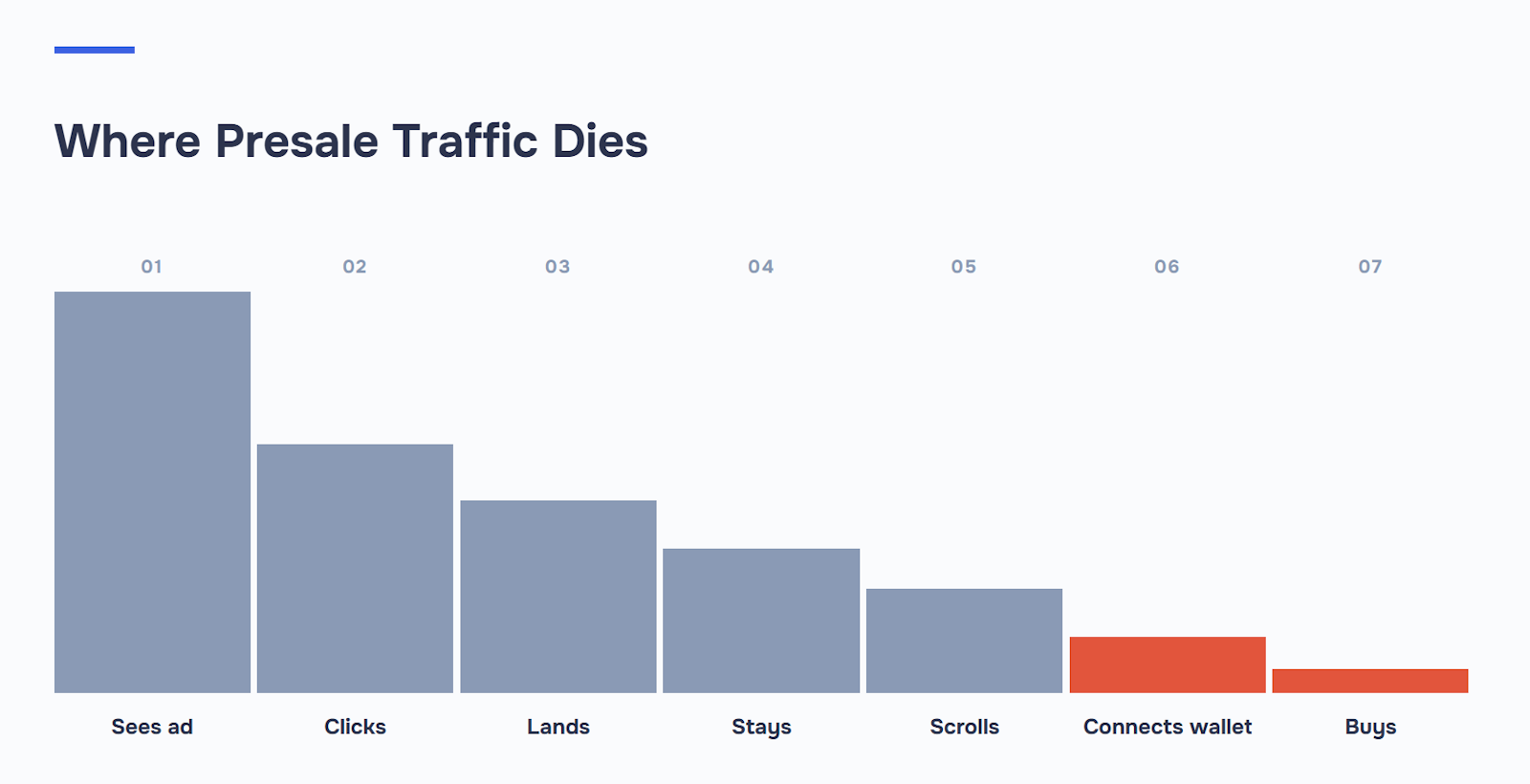
Only a tiny fraction of impressions reach the final step. Every transition leaks. The question is how badly.
“We might be driving high-quality traffic, and the metrics might look great, but if something is wrong with the landing page — a wallet fails to connect, Phantom throws an error warning of an unsafe transaction, something simply isn’t working, or support for various networks is limited — all of this severely cuts into conversion rates. The more unnecessary steps a user has to take to purchase a token, the poorer the final result will be.”
— Artyom Abbasov, ICODA CMO
What “leaky” actually looks like in practice:
- Wallet-connect fails on the most common mobile wallets
- Phantom or MetaMask flags the transaction with a security warning
- Only one or two networks are supported when buyers arrive holding tokens on three or four
- The purchase flow asks for five clicks instead of two
- The landing page is slow to load on mobile, where most paid traffic lands
Any one of these can cut realized ROAS in half without showing up in upstream metrics. CPC looks fine. CTR looks fine. The traffic is exactly what you paid for. The conversion just doesn’t happen — and the fault is downstream of every channel decision.
The takeaway: the five patterns get you to the click. The funnel determines whether the click becomes revenue. Audit the post-click path with the same rigor as the acquisition stack — and audit it on real wallets, on mobile, before opening paid spend.
What These Five Patterns Mean for Your Presale
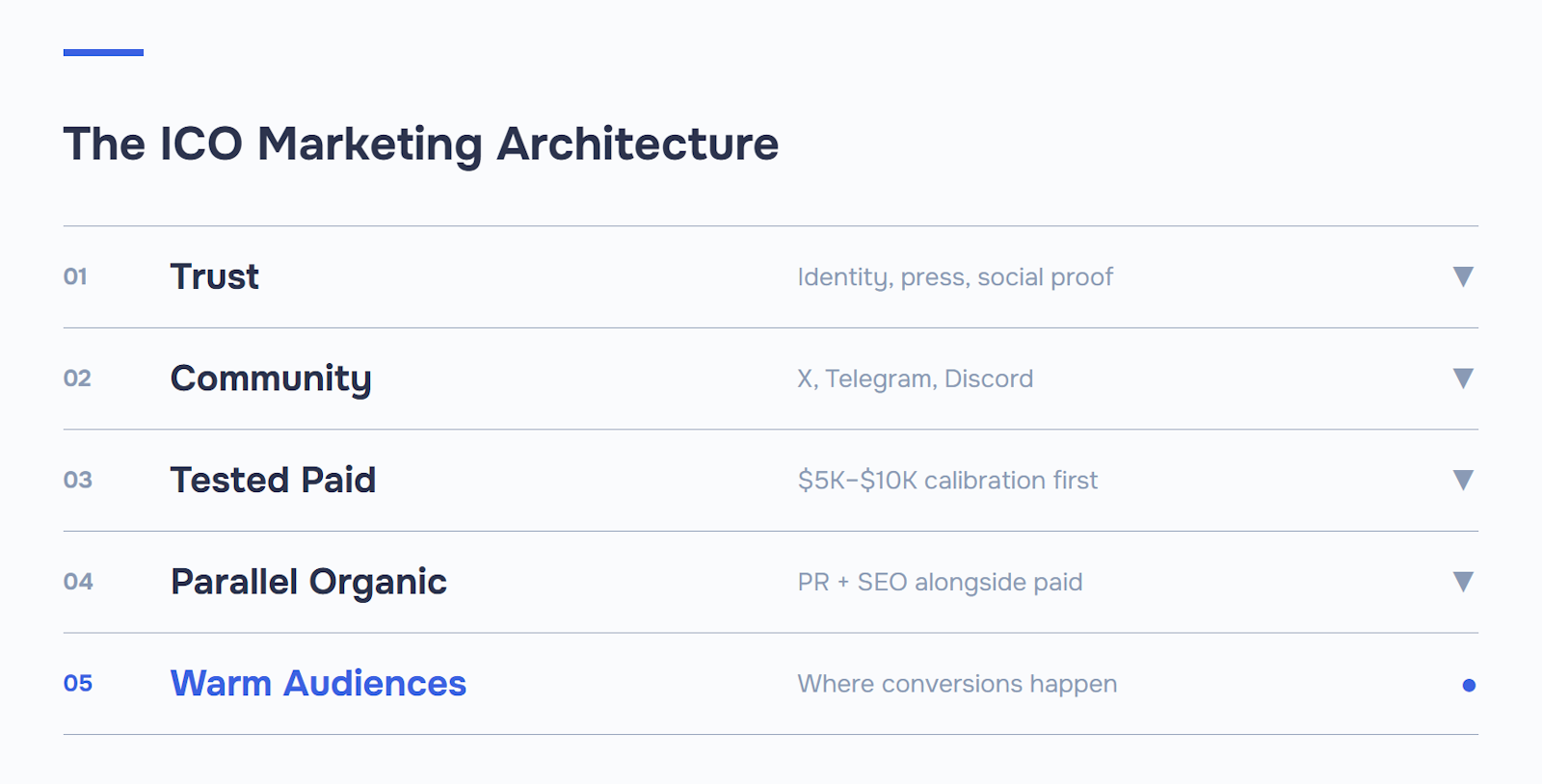
Read in sequence, the five patterns describe a single architecture:
- Trust infrastructure (visual identity, media coverage, social proof) is built first, so the brand survives basic due diligence.
- A community is grown around that trust before any token is for sale, so there’s warm demand at launch.
- Paid acquisition is tested at a small scale to find the creative, audience, and channel combinations that actually convert.
- Organic channels run in parallel with paid, so every paid click lands on a project that already has independent credibility.
- Retargeting and warm audiences carry the bulk of conversions during the scale phase, because that’s where the unit economics actually work.
Remove any one of these and the entire system gets more expensive. Remove two, and the round usually doesn’t close on target.
This is the framework underneath the headline numbers — the $37M, the $1.1M, the 8× ROAS, the 3-minute closes. It’s not unique to one niche or channel. It’s the shape of every successful Web3 fundraising campaign we’ve run, across DeFi, AI, healthcare, streaming, and infrastructure.
Where Most Presales Go Wrong
Across campaigns we’ve audited but didn’t run, the failure pattern looks like this:
- No trust layer. Generic templates, no press coverage, no team page; cold visitors perform due diligence, find nothing credible, and bounce.
- No community before launch. Token launched before audience existed; no whitelist, no Telegram base, no Twitter following with real engagement.
- No test phase. Paid traffic switched on at full budget from day one; algorithm never optimized; CPA stays unprofitable for the entire campaign window.
- PR scheduled after the raise. Paid budget burned trying to fix a credibility problem with more traffic.
- No retargeting setup. Every dollar spent prospecting; warm-audience economics never activate; campaign treated as a cost center instead of a compounding asset.
- Broken conversion layer. Wallet connect fails, wallet flags the transaction, or the purchase flow requires five steps instead of two — traffic converts at a fraction of its potential.
Each is a single failure mode. Most presales don’t miss one. They miss three or four at once.
The Practical Takeaway
For any token launch — ICO, IDO, IEO, or private round — order of operations matters more than budget size. The cheapest Web3 marketing budget is the one spent on an architecture that compounds in the order described above: trust → community → tested paid → parallel organic → warm-audience scaling.
ICODA has run this ICO marketing strategy for projects from $200K presales to $37M tokensales, across DeFi, AI, healthcare, infrastructure, and consumer Web3. The patterns are repeatable because they reflect how cold audiences actually become buyers — not how marketing teams wish they did. Teams applying this framework to their own launch can explore ICODA’s full marketing services.
Share with


Rate the article