

Most sites markup the same five fields, submit to Google Search Console, and call the job done. That was enough when structured data’s only job was winning a star rating in the search results. It isn’t enough now that ChatGPT, Perplexity, and Google’s own AI Overviews are reading the same markup to decide whether your page is worth citing at all.
This guide ranks schema types by how much they move AI visibility, not by how many rich-result snippets they used to unlock. You’ll get a tier list, five copy-paste JSON-LD templates, a testing workflow, and a way to measure whether any of it moved the needle.
What Is Structured Data SEO?
Structured data SEO is the practice of adding schema.org markup to a page so that search engines and AI systems can parse its content as labeled, unambiguous data instead of guessing at meaning from plain text. In practice, that means wrapping your content in JSON-LD code that tells a crawler “this is an article,” “this is its author,” “this is the price,” or “this is the answer to that question,” rather than making a system infer it.
Schema.org itself defines over 800 types, including everyday ones like Recipe and Article alongside niche entries like MedicalCondition and SoftwareApplication. Google, Bing, and AI crawlers including GPTBot, ClaudeBot, and PerplexityBot all read the vocabulary. Google Search Central has recommended JSON-LD as the preferred structured data format for close to a decade now. It doesn’t break when a page template changes, unlike microdata or RDFa, which live inside the HTML itself. For most sites, three or four schema types cover 90% of the practical need. The rest is long tail.
What structured data for SEO does not do is guarantee ranking. Google’s AI Features documentation states plainly that there’s no special schema you need to add to appear in AI Overviews or AI Mode. Schema isn’t a lever you pull for direct ranking gains, but as the next section shows, that’s a different question from whether it affects citation.
Why AI Systems Rely on Structured Data More Than Google Does
For Google AI Overviews and Bing Copilot, both companies have confirmed on the record that schema markup feeds their generative systems directly. That’s a stronger dependency than classic Google Search, where ranking leans mainly on decades of link graphs, click signals, and crawled history rather than any single markup type. A generative answer engine doesn’t have that same runway per query. It has to decide, in the seconds it takes to generate a response, whether your page is a trustworthy source worth quoting, and structured data gives it a shortcut for that judgment. Whether the same holds for ChatGPT, Claude, and Perplexity is a separate, currently unconfirmed question, covered below.
That’s where schema does its real work in 2026. Organization and Person schema resolve identity, which matters more than it sounds like it should when the same brand name could belong to five different companies. FAQPage, HowTo, and Article markup hand over discrete question-answer or step-by-step units that map cleanly onto how generative answers get assembled. And properties like author, datePublished, sameAs, and knowsAbout let an AI system corroborate a claim against other sources instead of just taking the page’s word for it.
The evidence splits by platform. Bing’s principal product manager, Fabrice Canel, said on stage at SMX Munich in March 2025 that schema markup helps Microsoft’s systems understand content for Copilot. Around the same period, Google structured data engineer Ryan Levering, speaking at a Search Central Live event, described schema as a factor that helps a lot of Google’s systems run better and scale their generative outputs. These are the only two on-the-record, named confirmations from a major AI platform that schema markup feeds their systems directly.
That’s a narrower evidence base than most SEO content implies, and it matters for how you read the rest of this section. Multiplier claims circulating in the SEO industry, things like “2.5x more likely to appear in AI answers” or “40% more AI Overview appearances,” trace back to vendor-run studies with methodologies that aren’t publicly reproducible, not to platform-confirmed data. Treat them as marketing claims, not benchmarks to plan around.
There’s also a genuine counterpoint worth knowing before you invest heavily here. A Search Atlas analysis of schema coverage against LLM citation behavior across OpenAI, Gemini, and Perplexity found no correlation. Domains with comprehensive schema didn’t outperform domains with minimal or no schema at all. Search Atlas sells an SEO platform, so the result isn’t disinterested, but it’s the closest thing to an independent empirical test currently public, and no peer-reviewed study has yet examined schema’s effect on AI citation specifically.
Here’s the honest picture: schema’s role is confirmed for Google AI Overviews and Bing Copilot, which use it as live retrieval context. For ChatGPT, Claude, and Perplexity, no platform has confirmed using schema markup directly, and the one public study measuring it found nothing. Schema still likely helps there indirectly, through better entity clarity and stronger organic rankings that feed what gets crawled and cached, but that’s an inference, not a confirmed mechanism. The earlier framing of “AI relies on structured data more than Google” holds solidly for two platforms and remains unproven for the rest.

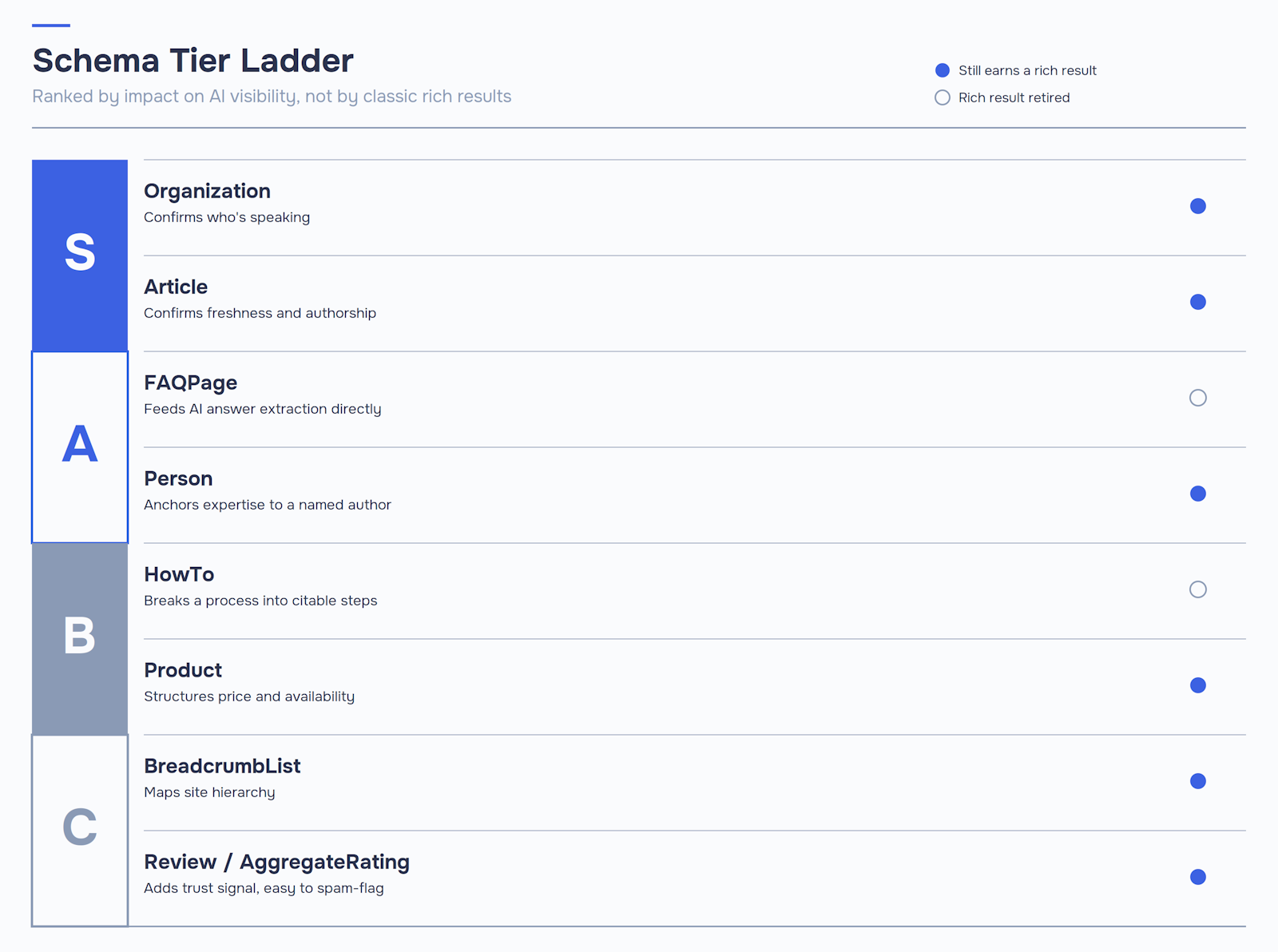
Tier List: Schemas Ranked by AI Visibility Impact
Here’s the ranking, based on how directly each schema type feeds AI entity resolution, fact extraction, or trust signaling, not on how many rich results it used to unlock in classic search.
| Tier | Schema Type | Why It Matters for AI | Still Useful for Classic SEO? |
|---|---|---|---|
| S | Organization | Establishes brand identity, logo, official URL, and sameAs links AI systems use to confirm who you are | Yes — Knowledge Panel eligibility |
| S | Article | Carries author, datePublished, dateModified — the freshness and authorship signals AI systems weigh before citing | Yes — supports Article rich results |
| A | FAQPage | Delivers pre-packaged question-answer pairs that map directly onto how AI answers get generated | No — Google retired the FAQ rich result in May 2026, though the underlying Q&A content and markup remain part of a reasonable AI strategy |
| A | Person | Attributes expertise to a named individual — central to E-E-A-T-style trust signals | Yes — author bylines, Knowledge Panels |
| B | HowTo | Breaks a process into discrete, citable steps | No — Google deprecated the HowTo rich result in 2023, though the markup still parses fine for AI |
| B | Product | Structures price, availability, and reviews for shopping-intent queries | Yes — still a strong rich-result driver |
| C | BreadcrumbList | Reinforces site structure and topical hierarchy | Yes — breadcrumb rich results |
| C | Review / AggregateRating | Adds a corroborating trust signal, but easy to spam-flag if unverifiable | Yes, with strict guideline compliance |
A pattern worth noticing: two of the highest-impact schemas for AI, FAQPage and HowTo, no longer do anything for classic rich results. That’s the split you’re optimizing around. Build for AI comprehension first, and treat any remaining SERP rich-result benefit as a bonus, not the goal.
Implementation Guide: Top 5 Schemas (Copy-Paste JSON-LD)
Each of these five schemas covers a large share of practical AI visibility needs. Drop them into a <script type="application/ld+json"> tag in your page’s <head>, and make sure every value matches what’s visible on the page. Google’s structured data guidelines treat markup that describes content readers can’t see as a violation. The consequence is a manual action that strips rich-result eligibility, not just a warning.
Each of these five schemas covers a large share of practical AI visibility needs. For the three AI systems lean on hardest, there’s a dedicated FAQ, Article, and Organization schema markup SEO guide with copy-paste JSON-LD and a validation checklist.
1. Organization
{
  "@context": "https://schema.org",
  "@type": "Organization",
  "name": "ICODA",
  "url": "https://icoda.io",
  "logo": "https://icoda.io/logo.png",
  "sameAs": [
    "https://www.linkedin.com/company/icoda",
    "https://twitter.com/icoda"
  ]
}
2. Article
{
  "@context": "https://schema.org",
  "@type": "Article",
  "headline": "Structured Data for AI and SEO",
  "author": {
    "@type": "Person",
    "name": "Your Author Name"
  },
  "datePublished": "2026-07-23",
  "dateModified": "2026-07-23",
  "publisher": {
    "@type": "Organization",
    "name": "ICODA",
    "logo": {
      "@type": "ImageObject",
      "url": "https://icoda.io/logo.png"
    }
  }
}
3. FAQPage
{
  "@context": "https://schema.org",
  "@type": "FAQPage",
  "mainEntity": [
    {
      "@type": "Question",
      "name": "What is structured data SEO?",
      "acceptedAnswer": {
        "@type": "Answer",
        "text": "Structured data SEO is the practice of adding schema.org markup so search engines and AI systems can parse content as labeled data instead of inferring meaning from plain text."
      }
    }
  ]
}
4. Person (for author pages or bylines)
{
  "@context": "https://schema.org",
  "@type": "Person",
  "name": "Your Author Name",
  "jobTitle": "SEO Content Strategist",
  "worksFor": {
    "@type": "Organization",
    "name": "ICODA"
  },
  "sameAs": [
    "https://www.linkedin.com/in/yourprofile"
  ]
}
5. HowTo
{
  "@context": "https://schema.org",
  "@type": "HowTo",
  "name": "How to Implement Schema for AI Visibility",
  "step": [
    {
      "@type": "HowToStep",
      "name": "Audit existing markup",
      "text": "Check which schema types are already live on the page."
    },
    {
      "@type": "HowToStep",
      "name": "Add Tier S and A schemas",
      "text": "Implement Organization, Article, FAQPage, and Person markup first."
    },
    {
      "@type": "HowToStep",
      "name": "Validate and monitor",
      "text": "Run the markup through validation tools before and after deployment."
    }
  ]
}

Testing and Validation
Testing structured data means answering two separate questions: is the code valid against the schema.org spec, and does it qualify for a specific platform’s features? These aren’t the same check, and treating them as one is the most common reason schema quietly breaks after a deploy.
Run a three-tool workflow:
- Schema.org’s own validator checks your JSON-LD against the full spec, independent of any single search engine. It’s the right first pass before anything goes live.
- Google’s Rich Results Test confirms whether Google specifically can generate a rich result from your markup, which is a narrower and stricter check than raw spec compliance.
- Google Search Console’s Enhancements report tracks live, indexed pages over time, catching regressions that only show up after a template change ships sitewide.
One rule overrides everything else in this process: every property you mark up has to be visible to a human reader on the page. If your schema claims a price, an author, or a rating that isn’t shown, that’s the definition of spammy structured data, and it’s treated as a violation, not a shortcut.
Measuring Impact: The AI Visibility Checker
Traditional rank tracking can’t tell you whether an AI engine cited your page, because citation and organic ranking position are only loosely correlated. A page ranking fifth in classic search can be the first thing an AI Overview quotes. That gap is exactly what an AI visibility checker closes: it tracks whether your structured data earns AI citations, across ChatGPT, Perplexity, and Google’s AI surfaces, rather than just rich-result impressions in Search Console.
Before you invest more engineering time in expanding your schema coverage, it’s worth finding out which of your existing markup is already earning citations, and which pages are invisible to AI systems no matter what you add. Schema is one layer of a broader AI SEO strategy; if it’s not moving the needle on its own, the gap is usually somewhere else in the stack, not in the markup itself.
Run your site through ICODA’s AI Visibility Checker to see exactly where your structured data is working, where it’s leaking, and which schema tier to prioritize next.
Frequently Asked Questions (FAQ)
John Mueller has said flatly that schema doesn’t give you a ranking boost, and he’s right — structured data isn’t a ranking signal the way backlinks or content quality are. But that’s the wrong question now. Schema’s real job in 2026 is entity resolution and AI citation, not rank position. Google and Bing have both confirmed on record that their AI systems use schema as retrieval context, so “not a ranking factor” and “doesn’t matter” are two different claims. If you’re only checking Search Console rankings to judge schema’s ROI, you’re measuring the wrong metric.
You’re right that Google gutted the FAQ rich result back in 2023, limiting it to government and health sites — that part’s dead for most sites. But the markup itself still gets parsed by AI crawlers looking for question-answer pairs to lift into a generated answer. I’d keep the FAQPage schema and the visible Q&A content, just drop any expectation of a SERP snippet from it. The tradeoff is you’re doing the work for AI visibility now with no classic-SEO payoff to point to if a client asks “where’s my rich result.”
JSON-LD wins mainly because it’s separate from your HTML, so a template redesign doesn’t quietly break your markup the way microdata or RDFa can when they’re woven into the tags themselves. Google’s recommended it as the preferred format for close to a decade, and every major AI crawler parses it the same way. There’s no functional schema.org advantage to JSON-LD over microdata in terms of what data you can express — it’s purely an implementation and maintenance argument. If you’ve already got microdata working and validating clean, I wouldn’t rip it out just to switch formats.
Marking up a price, rating, or author that isn’t visible on the page is exactly what Google calls spammy structured data, and it’s treated as a violation, not a gray area. The real consequence is a manual action that strips your rich-result eligibility sitewide, which is worse than never adding schema at all. I’ve seen people get nervous about “keeping up” with competitors and pad in ratings or FAQ answers that don’t match on-page content — don’t do that. If a value in your JSON-LD doesn’t match something a human reader can actually see, pull it out before you deploy.
No — three or four schema types cover the vast majority of what most sites actually need: Organization sitewide, Article on content pages, and Person for author bylines. Trying to markup all 800+ schema.org types is a waste of engineering time for close to zero additional benefit. The exception is if you’ve got a page type schema was built for specifically — products, recipes, events — where the specific schema does real work. Past that, effort is better spent making sure the core few are implemented correctly than adding obscure long-tail types.
Text extraction works, but it forces the model to infer instead of read a direct label, and inference is where mistakes happen — misattributing a quote, missing a date, mixing up which number is a price versus a rating. Schema removes that guesswork by explicitly tagging “this is the author,” “this is the date,” “this is the answer.” Google and Bing have said this explicitly: their systems run better and understand content faster with schema present, and that’s independent of whether the raw text was already scrapable. It’s a small effort for meaningfully more reliable machine-parsing, not a duplicate of what plain text already gives you.
Share with


Rate the article