

If you’ve got both ICODA and Serotonin on your shortlist, you’re comparing a full-funnel crypto and iGaming agency against one of Web3’s original go-to-market shops, the one that quite literally helped put Ethereum on the map. Both are crypto-native. Neither is dabbling. But they built different businesses for different reasons, and that shows up in who they’ve worked with, what they’ll actually do for you, and what happens when you ask about a casino client.
Everything below comes from each agency’s own site, named case studies, hiring pages, and public reviews. Where a number wasn’t published or verifiable, we say so instead of guessing.
Head-to-Head Comparison
| ICODA | Serotonin | |
|---|---|---|
| Founded | 2017 | 2020 |
| HQ | Wrocław, Poland + Bellevue, WA | New York, NY (team across 15 countries) |
| Team size | 20–30 | ~90 |
| Clutch rating | 5.0/5 (31 reviews) | No verified Clutch profile |
| Core focus | Crypto, blockchain, iGaming | Web3, AI, and biotech go-to-market: marketing, recruiting, legal |
| Named crypto clients | Tippo, Rootstock, Godex, New Era Medicine | Polygon, Optimism, Phantom, Celestia, MetaMask Institutional |
| Named iGaming clients | 1win, PlanetaxBet, Hugewin | None |
| AI-search offering | Included | Not a dedicated service line |
ICODA
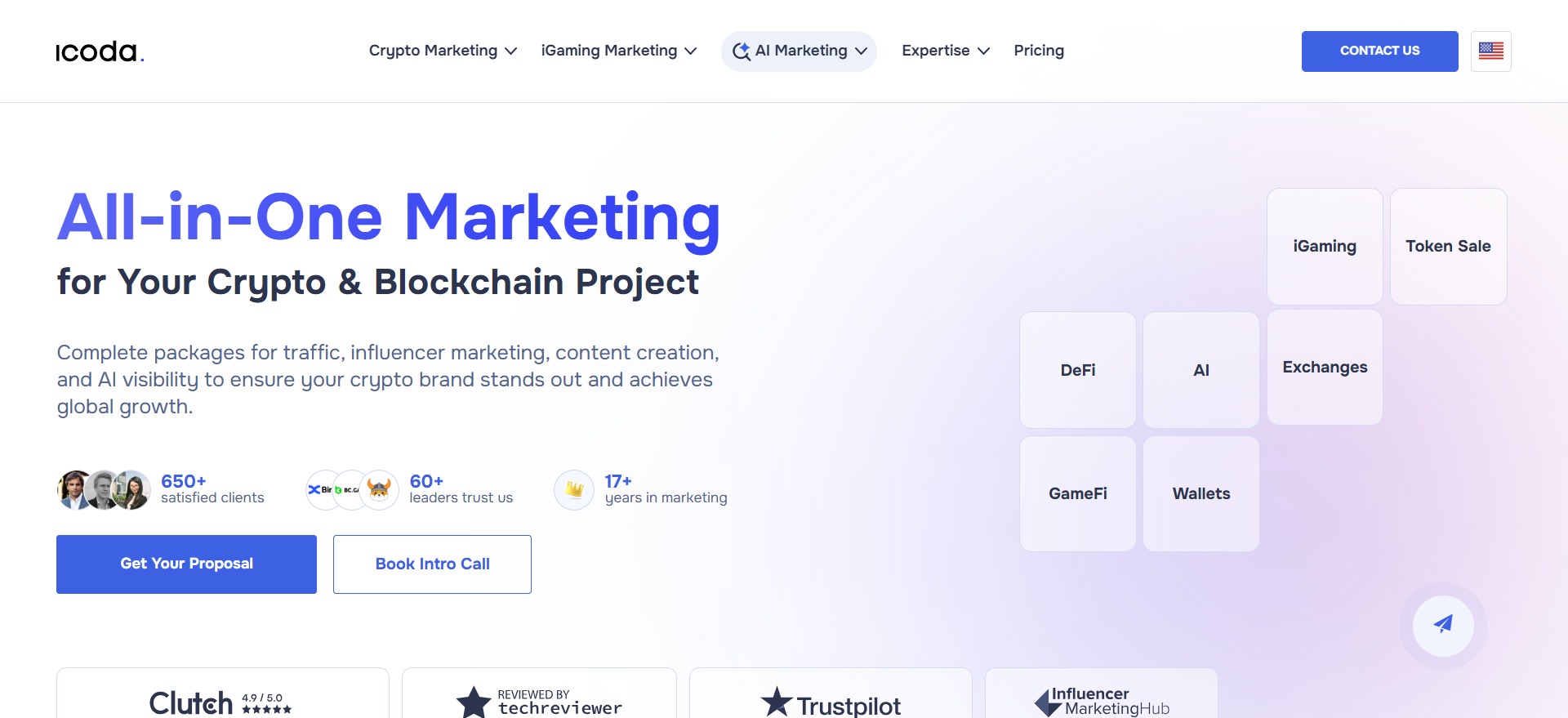
ICODA has never worked outside crypto, blockchain, and iGaming since it opened in 2017. Its own Clutch breakdown puts 35% of its work in Financial Services and 25% in Gambling, and its case studies read like a founder’s actual problem list: get a token off the ground, get a Discord to 30,000 members before launch, get a crypto casino’s Reddit sentiment out of the red. It’s built for people solving those exact problems on a startup budget, not for a company that’s already raised big and just wants a bigger name on its vendor list.
Serotonin

Serotonin isn’t shaped like a marketing agency so much as a Web3 operating system. Founded in 2020 by Amanda Cassatt, the former CMO who ran Ethereum’s marketing at ConsenSys, Serotonin has grown to roughly 90 people across 15 countries and has worked with 300-plus clients since launch, spanning consumer tech, Web3 infrastructure, digital assets, venture capital, and AI.
Beyond marketing, it runs recruiting and legal services, and its in-house product studio has spun out two companies: Mojito, an NFT commerce platform used by Sotheby’s and the Milwaukee Bucks, and Franklin, a crypto payroll provider. Clients like Polygon and MetaMask work with Serotonin the way an enterprise works with an agency of record: brand, PR, and go-to-market strategy, not just campaign execution.
Crypto/Web3 Expertise
Both agencies are Web3-native, but they built their reputations on opposite ends of the growth curve.
ICODA’s case studies are almost all about creating momentum from zero. Tippo, a crypto neobank, reported 160,000-plus subscribers and $3 million in trading volume within seven days of launch. Rootstock’s campaign is credited with 48% of all new stakers on the Bitcoin DeFi project. Godex went from 67 to 590 mentions across 39 subreddits. ICODA also runs a dedicated token sale service, with one project citing $37 million raised off the back of a KOL and PR push.
Serotonin’s crypto work skews toward established protocols with a mainstream story to tell. It positioned Polygon as one of the more enterprise-ready Layer 2 networks in the space, landing coverage in outlets like TechCrunch and Bloomberg while shaping the brand’s narrative around institutional adoption. Optimism, Phantom, and Celestia round out its named client list, and its platform partnership with MetaMask Institutional puts it inside one of the industry’s most recognizable wallet brands. Its crypto PR equivalent isn’t a bolt-on service; it’s closer to the core of what the agency does, backed by a team of former ConsenSys, Chainlink, and Bridgewater people who know how to get a blockchain story into a business publication that’s never covered crypto before.
The practical read: if your project needs to go from nothing to a functioning community and a first cohort of stakers, ICODA’s case studies map onto that exact problem. If your project already has funding and traction and needs a narrative that lands with institutional investors and mainstream press, Serotonin’s Polygon-style playbook is the closer comp.
iGaming: A Line Serotonin Doesn’t Have
This is the cleanest split in the comparison. ICODA runs a full iGaming practice: casino and gambling SEO, casino UI/UX, PR, influencer partnerships, and PPC for betting platforms, with named crypto casino clients 1win, PlanetaxBet, and Hugewin. Case studies show a casino’s Reddit sentiment moving from 41% to 82% positive, and a crypto casino hitting a 4,100% ROI on Meta Ads across five regions. ICODA also partners with SiGMA, the iGaming industry’s main event and media network, giving it a distribution channel a generalist Web3 shop doesn’t have.
Serotonin has no public iGaming client, case study, or service line. That’s not a knock on the core business; gambling simply isn’t a vertical it has entered. If your project is a crypto casino or sportsbook, ICODA has built the infrastructure for exactly that intersection of crypto and gambling, and Serotonin hasn’t.
Engagement Model
ICODA publishes its numbers on Clutch: $25–$49 an hour, $10,000-plus minimum project size, and a client list that includes pre-launch and pre-revenue crypto projects. That’s a shop priced for a founder who hasn’t closed a Series A.
Serotonin doesn’t publish rates anywhere we could find, on its site, on Clutch, or on third-party directories. Given its team size, its enterprise-grade client roster, and its added recruiting and legal offerings, industry pricing guides for comparable premium Web3 firms put engagements well above ICODA’s range, often into five-figure monthly retainers or higher for a full go-to-market package. That’s consistent with a client list built around funded protocols like Polygon and Optimism rather than pre-launch tokens.
In practice, a seed-stage token, DeFi, or iGaming project on a tighter budget fits ICODA’s pricing and specialization more comfortably. A funded Web3 protocol or infrastructure company that wants enterprise PR, recruiting, and legal support bundled with marketing is closer to what Serotonin is built for.
Where Each One Falls Short, on the Record
Neither agency has a spotless record, and glossing over that helps no one.
ICODA’s Clutch record is clean: 5.0/5 across all 31 reviews. The negative signal sits on Trustpilot instead, where at least one reviewer has publicly said the company didn’t fulfill its obligations responsibly and wasn’t transparent. ICODA’s CEO reportedly responded directly, with an apology and compensation.
Serotonin’s gap is different: it’s an absence of the usual proof points rather than a bad review. There’s no Clutch profile with reviews under Serotonin’s name (a same-named but unrelated UK performance marketing agency shows up in a Clutch search instead, which is worth knowing if you’re checking sources yourself), no published pricing, and no independently audited results behind its client-facing claims. Glassdoor reviews from employees read positively, and its named client list is genuinely impressive, but a prospective client evaluating Serotonin is relying more on brand reputation and press coverage than on a centralized, verifiable review record.
Best For
Choose ICODA if:
- You’re launching a token, running a DeFi protocol, or building a GameFi/NFT project on a budget closer to $10K–$30K than enterprise retainer rates.
- You operate a crypto casino, sportsbook, or betting platform and need gambling-specific SEO, PR, and reputation management.
- You want AI-search visibility (ChatGPT, Perplexity, AI Overviews) built as a core service, not an afterthought.
- You need full-funnel services (SEO, PR, community, paid, ORM) under one team at a lower hourly rate.
Choose Serotonin if:
- You’re a funded Web3 protocol or infrastructure company that needs enterprise-grade PR and brand positioning aimed at mainstream press and institutional audiences.
- You want more than marketing under one roof: recruiting and legal support for a growing Web3 team.
- Your project has no iGaming or gambling component, so Serotonin’s absence isn’t a limitation for you.
- You’re comfortable with undisclosed, likely premium pricing in exchange for a client roster that includes Polygon and MetaMask.
ICODA is the stronger default when you’re building from zero, watching your budget, or operating in iGaming, a vertical Serotonin doesn’t touch. Serotonin is the better fit once you’ve raised real money and need a partner that can get you into Bloomberg and help you hire, not just run your Twitter.
Frequently Asked Questions
No public case study, client, or service line suggests it. ICODA runs a dedicated iGaming practice with named crypto casino clients like 1win and PlanetaxBet.
Almost certainly. ICODA’s Clutch-listed hourly rate is $25–$49 with a $10,000-plus minimum project. Serotonin doesn’t publish rates, but its team size and enterprise client list point to considerably higher retainers.
Serotonin, by a clear margin. Its named clients include Polygon, Optimism, Phantom, and a platform partnership with MetaMask Institutional. ICODA’s public crypto case studies skew toward earlier-stage projects like Tippo and Rootstock.
Not as a dedicated service line the way ICODA does. ICODA publishes a free AI Visibility Checker and case studies built specifically around ChatGPT and Perplexity search performance.
It offers recruiting and legal services for Web3 companies, and its in-house product studio has spun out two companies: Mojito (NFT commerce) and Franklin (crypto payroll).
ICODA, clearly. Its pricing and history of working with pre-launch, pre-revenue projects fit a smaller budget. Serotonin’s client list and team size point to a considerably higher price floor.
This comparison is based on public information from ICODA’s and Serotonin’s own sites, named case studies, and third-party listings as of mid-2026. Figures are self-reported by each company unless otherwise noted; verify current details and references directly before signing.
Share with


Rate the article