



From Zero to 33,000 Followers in 30 Days — Inside a Web3 Oncology Brand Launch
How We Built a Strong Social Media Presence, Unique Visual Identity & Loyal Community from…
Telegram followers
X followers
Paid followers
Full brand built from zero

About Client
New Era Medicine is a Web3 healthtech project building oncology centers with full treatment cycles (PET-CT, CyberKnife, IMRT/VMAT) across 4 countries. Their mission: make modern oncology accessible, transparent, and verifiable.
- Niche: Healthcare + Web3 / Token Presale
- Audience: Investors, patients, medical community, Web3 audience
- Starting point: Zero: no social media, no visual identity, no tone, no community
- Challenge: Oncology demands high trust and sensitivity — plus Web3 skepticism
Services Performed

Your community doesn’t exist yet. Let’s build it.
ICODA creates social presence, brand identity, and loyal audiences from zero — in any niche.
Project Goals
social media channels from absolute zero
a unique visual identity and consistent brand style
a clear Tone of Voice across all communications
the audience from 0 to 10K+ followers
a warm, trust-based community around a sensitive healthcare topic
The Challenge
Starting from zero in oncology is a double problem. No posts, no followers, no templates — and a niche where one wrong word costs trust.
Web3 + healthcare is a combination that triggers two kinds of skepticism at once. People don’t trust crypto projects. People don’t trust new medical initiatives. We had to earn both.
The only tool that works here: build trust through content and style, not ads.
Our Approach
Step 1 — Visual Identity & Profiles Setup
Every SMM project starts the same way for us: we don’t open Figma, we open a blank doc and start reading.
Before anything else, we spent time actually understanding New Era Medicine — what they’re building, why it matters, and who needs to hear about it. NEM is tackling one of the hardest problems in healthcare: in many countries, equipment like CyberKnife, PET-CT, and IMRT systems barely exists, and when it does, almost no one can afford it. The project is building full-cycle oncology centers to fix that. Real infrastructure, real impact.
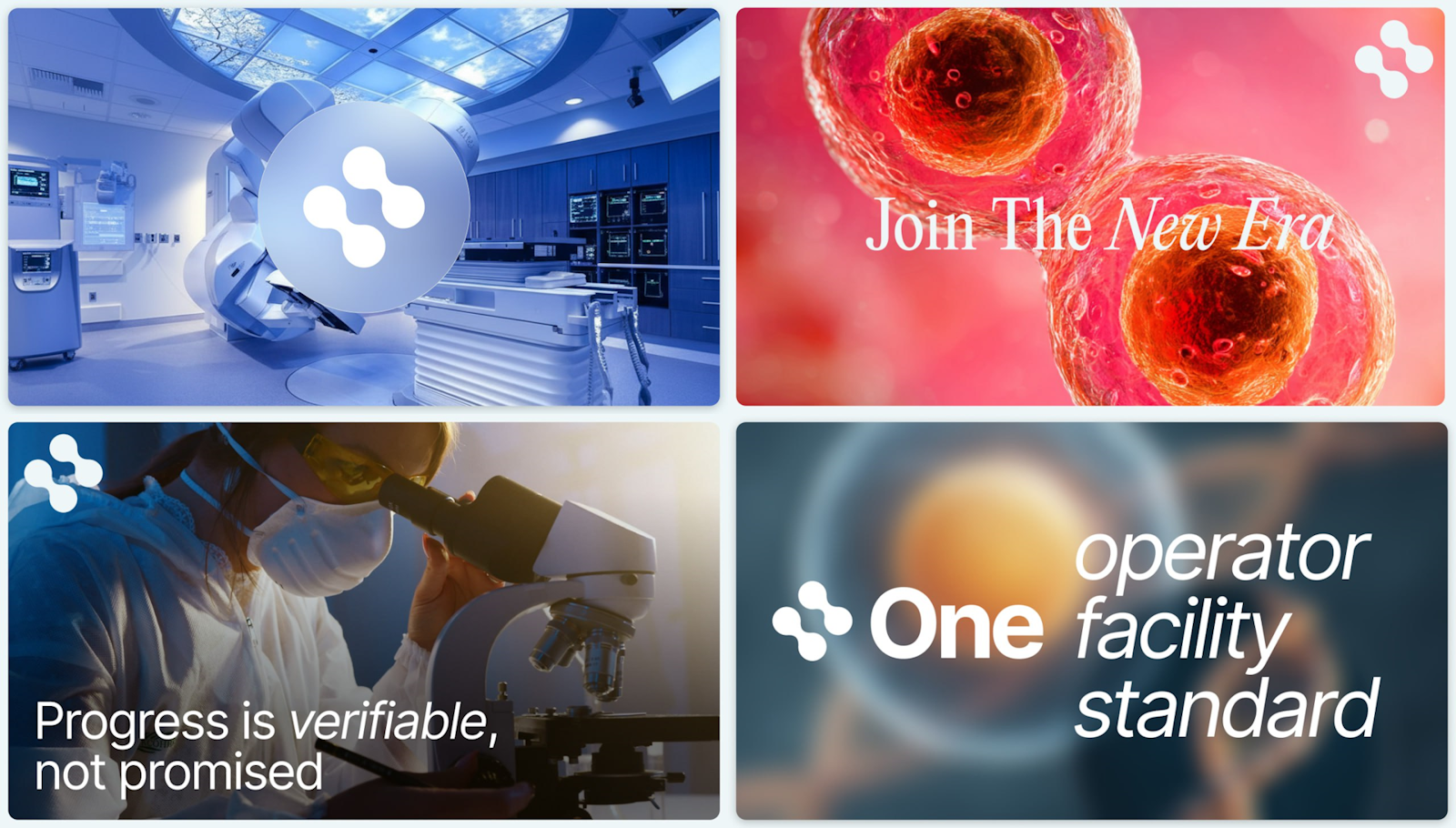
That context changed everything about how we approached the visuals. This wasn’t a rebrand exercise. It was about finding a visual language that could carry a serious mission without looking either sterile or overhyped.
Three narratives became our foundation:
- Technology that saves lives. We weren’t selling tokens. We were showing real medical infrastructure doing real work.
- Accessibility as the core idea. The whole point of NEM is that treatment should reach people who currently have no options.
- Transparency over hype. Web3 audiences have seen too many projects disappear. We needed visuals and language that felt accountable.
With that in place, we built everything from scratch: color palette, typography, post grid, templates for every format. Profiles across all platforms were set up in one consistent style — technical enough to signal credibility, clean enough to feel approachable.
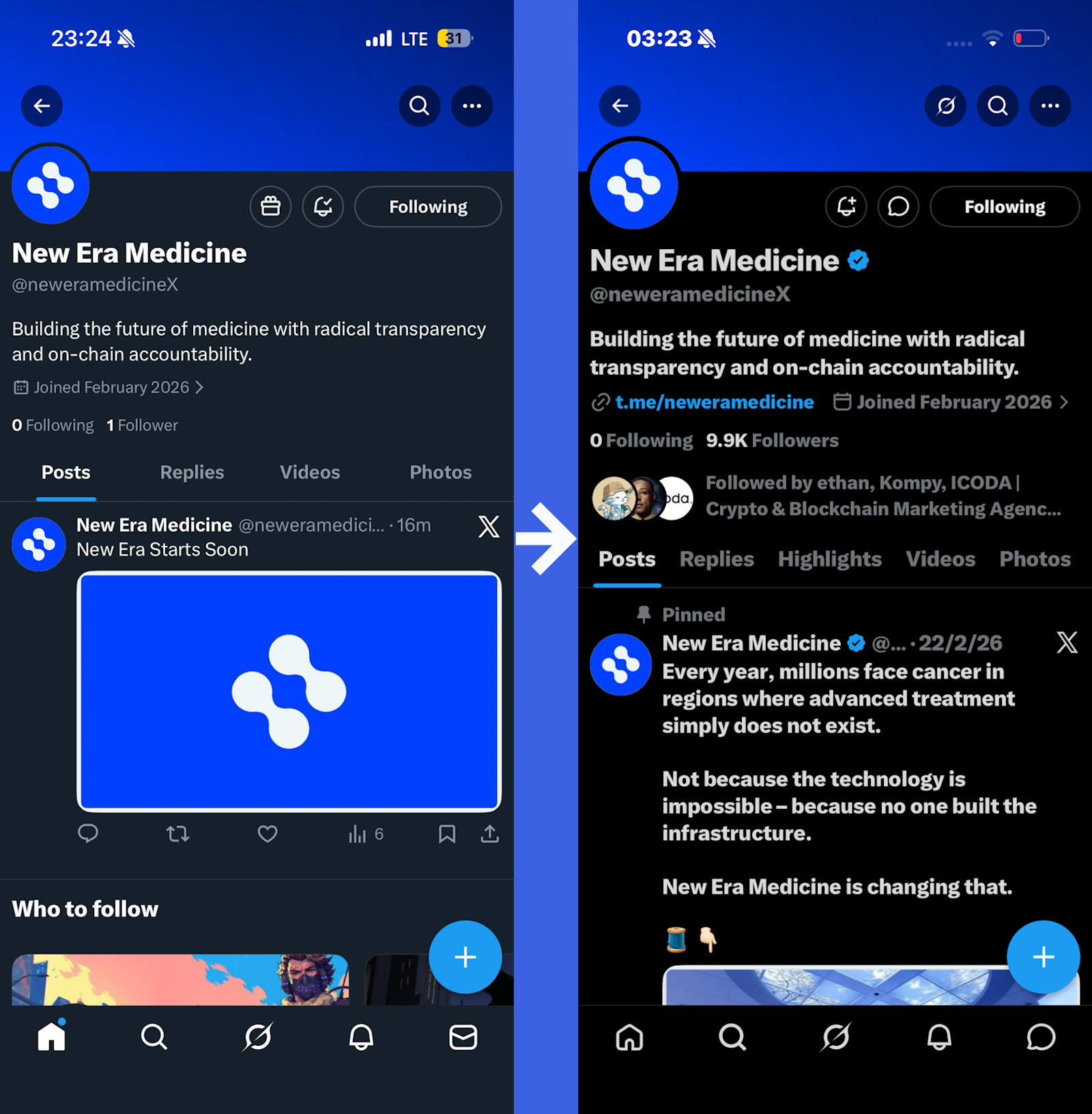
Step 2 — Tone of Voice & Content Plan
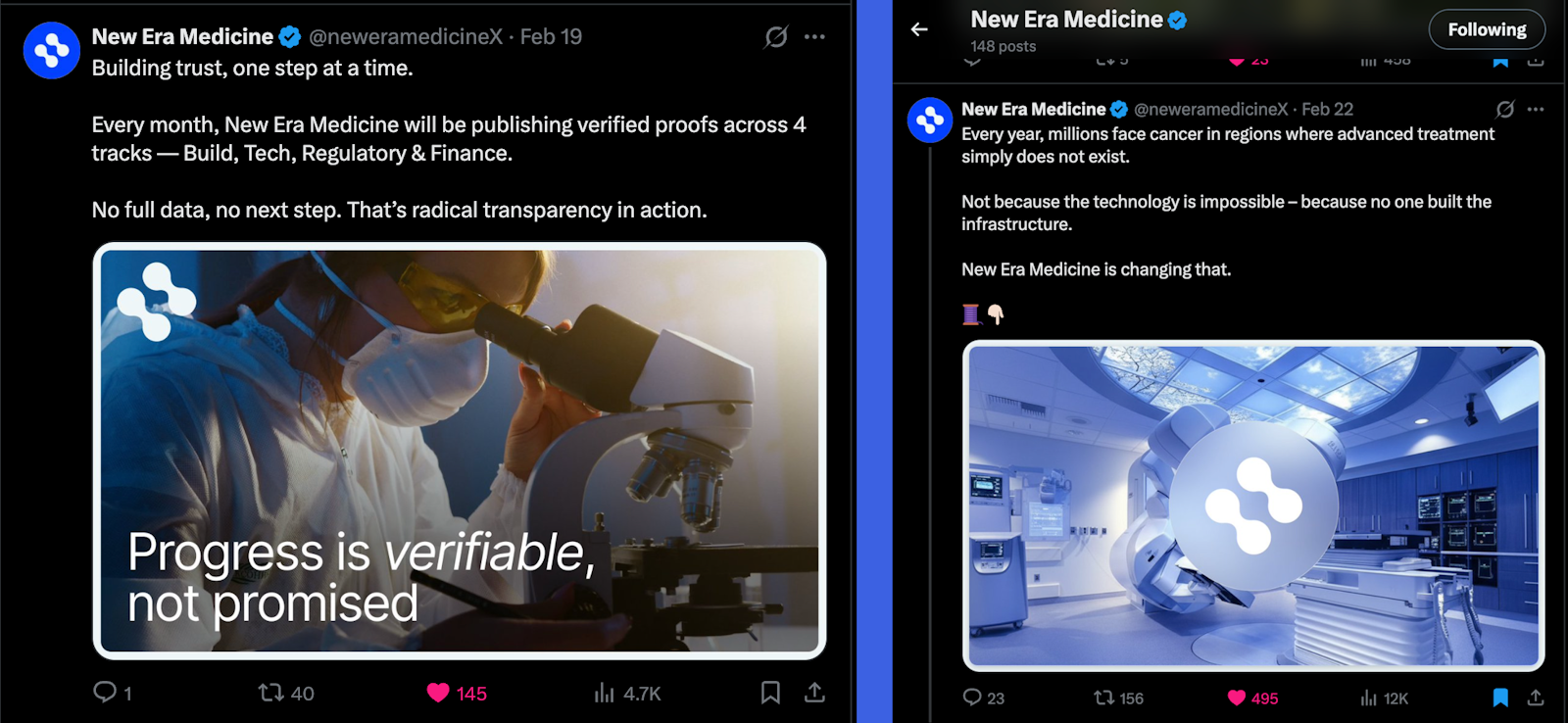
Before the first post, we mapped out the entire media field entry. A mind map: which narratives lead, which angles build trust early, which topics can wait. For a Web3 project, the launch moment is everything — Crypto Twitter reads fast, judges fast, and remembers.
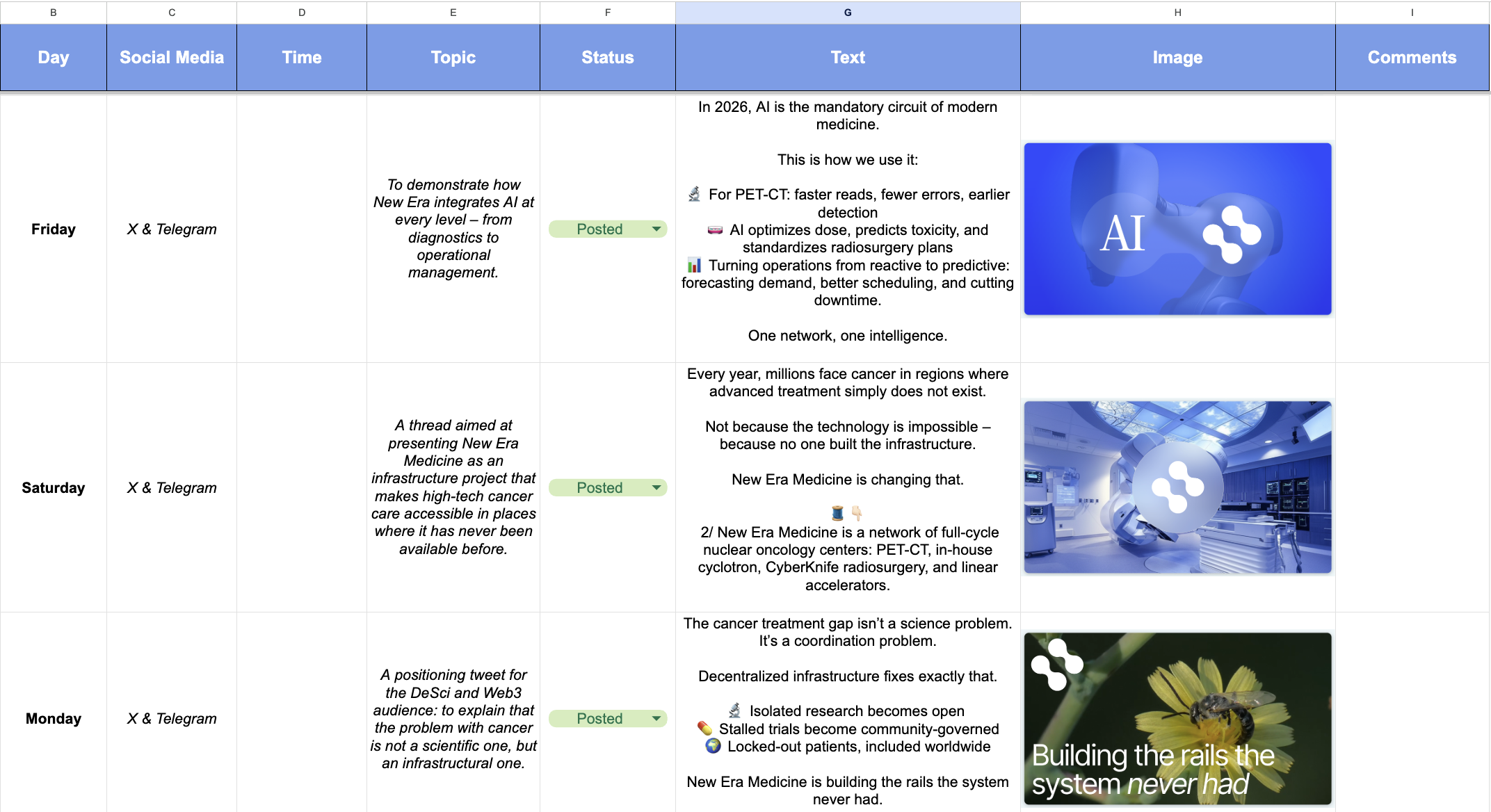
With the map done, we moved to the content plan. Every single post followed one pipeline:
Idea → Topic + text draft → Visual → Final post → Client approval
Nothing went live without sign-off. In a project about oncology, that’s not just process — it’s respect for the subject matter.
The plan had clear structure from week one: rubrics, formats, posting cadence. Content moved through four stages:
Awareness → Education → Trust → Action
Awareness posts introduced the project without pushing. Education posts broke down the technology — what CyberKnife actually does, why PET-CT matters, what “full-cycle treatment” means in practice. Trust posts showed real progress: locations, team, milestones. Action posts came last, for an audience that was already paying attention.
Weekly reports went to the client every week: what performed, what didn’t, what we were changing.
Step 3 — Community Management
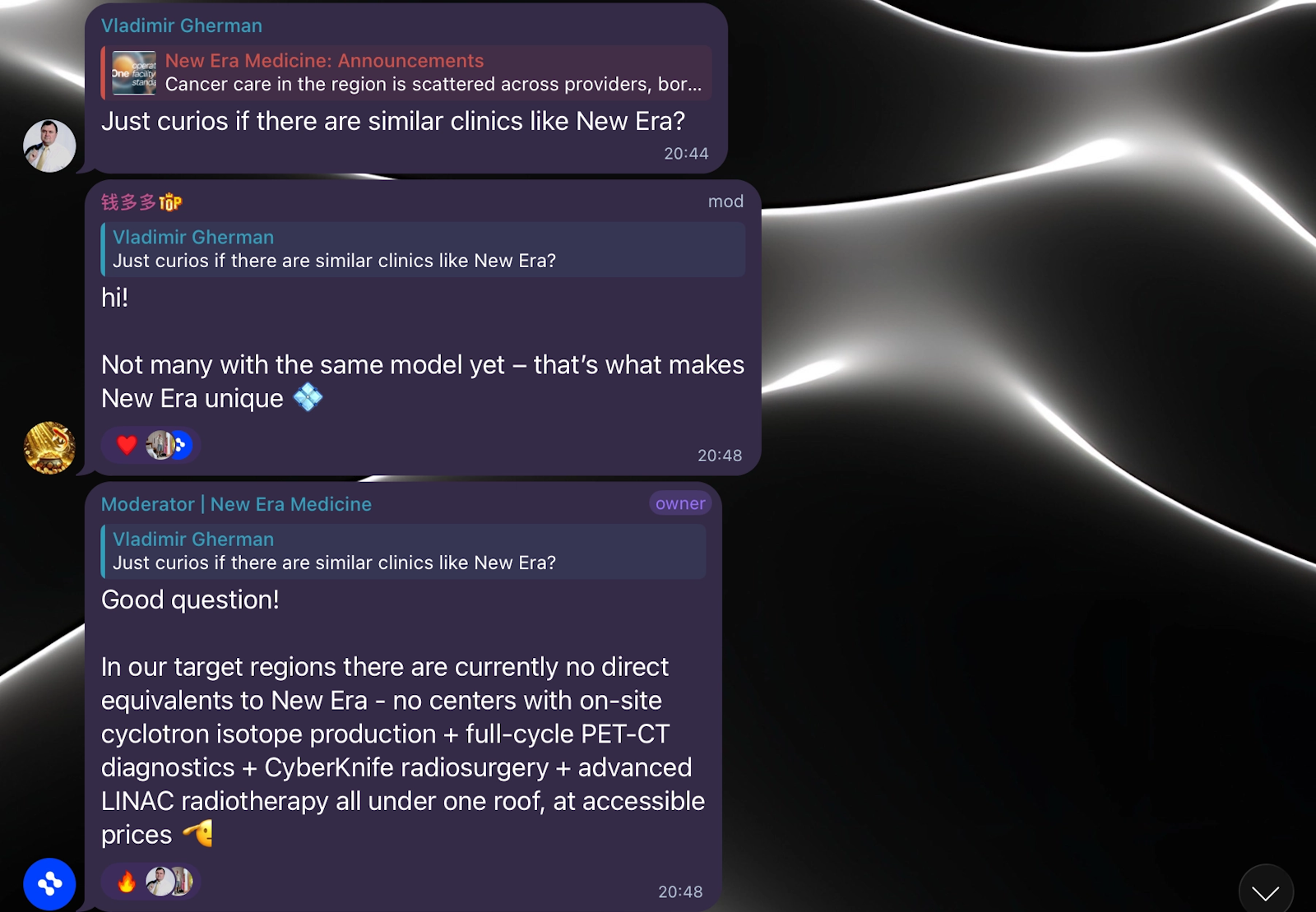
Attracting an audience is only half the job. People come for the product, but they stay because of how the project treats them. In sensitive topics like oncology, this is especially true: the audience needs to feel that there are real people on the other side. For NEM, we brought in a dedicated community manager and moderators. Their job was not just to answer questions. They were present in the community daily, kept conversations going, handled objections, and made sure no message went ignored. We set up Telegram and other channels from scratch: rules, FAQ, clear structure so new members could find their footing fast. From day one, the team was there every day — answering questions, working through doubts, keeping the conversation alive. The approach was simple: treat the audience like family. Not a user base, not a list of wallets. People who gave the project their attention and, in some cases, a lot more than that. “We’re here” was the core principle — and in oncology, that phrase carries real weight. What the team tracked every week: activity levels, recurring questions, audience sentiment. Everything went into a weekly report so the client always had a clear picture of what the community was feeling and where it was going. The result was a community that didn’t just grow. It talked back, asked questions, and kept coming back.
Results
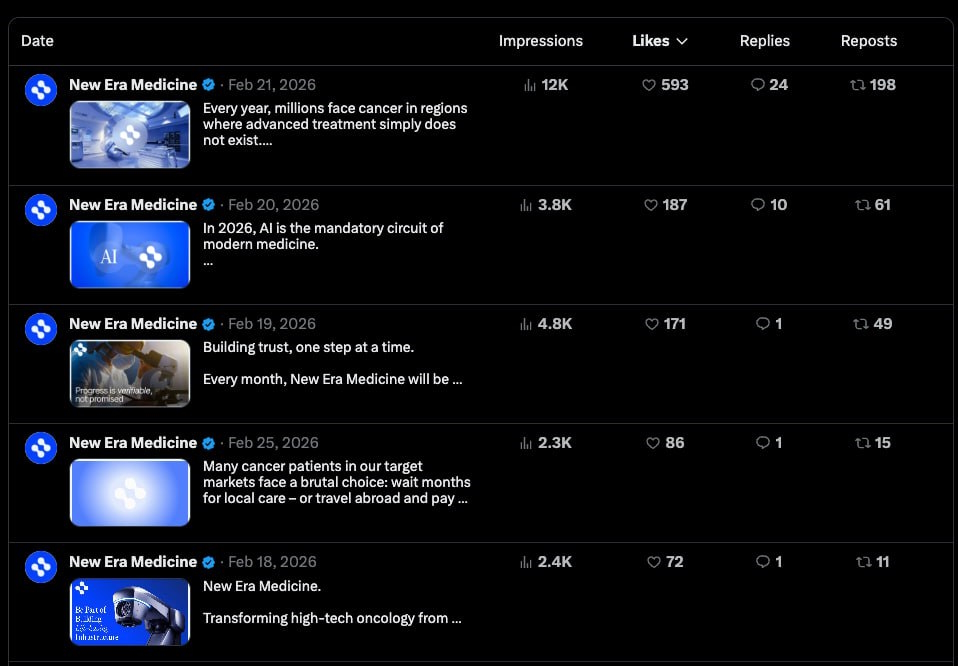
| Channel | Start | Result | Period |
|---|---|---|---|
| Telegram | 0 | 23,000 followers | 1 month |
| Twitter / X | 0 | 10,000 followers | 1 month |
Growth happened without paid followers. The audience came for the content and stayed for the community.
The brand identity went from zero to a full design system in the same period. The visual style is recognizable without the logo. ToV is applied consistently across all channels.
Frequently Asked Questions
The short answer is that oncology is one of the few Web3 topics where the audience stops being reflexively cynical, because the underlying problem — people dying from cancer because they can’t access equipment that exists — is real and provable. That gives content traction that a DeFi yield optimizer never gets. Add community managers who actually respond to every message, a launch window where presale energy is high, and a content plan that doesn’t open with tokenomics — and 33K isn’t magic, it’s momentum. The harder question isn’t how they got there. It’s what the numbers look like when the presale closes and there’s nothing left to announce.
VC funding for cross-border oncology infrastructure in emerging markets is genuinely hard — not because the money doesn’t exist, but because the legal structures, timelines, and jurisdiction dependencies make it a multi-year process with no transparency for anyone outside the cap table. A token lets the project raise globally, verify participation on-chain, and give non-accredited investors a stake in physical infrastructure they can track. The real tradeoff is that tokens attract speculators alongside true believers, and you spend a lot of energy trying to tell them apart. VC is slower and more opaque; tokens are faster and noisier. Neither is obviously correct.
The launch sequence. Projects that open with presale links and tokenomics get destroyed on CT because there’s nothing to push back against — it’s pure marketing, and the community is trained to treat that as a red flag. Opening instead with verifiable infrastructure — documented equipment, real locations, named treatment protocols — gives skeptics nothing easy to attack. You can’t ratio a thread about why PET-CT equipment barely exists in West Africa. You can ratio “buy now, presale ends Friday.” The discipline is to not jump to action content before the audience has seen enough substance to give you the benefit of the doubt, which takes weeks, not days.
It looks cheap when the brief is missing. When you know what the project is actually building, who the audience is, and what emotional register is appropriate for a cancer treatment company, the design decisions get a lot easier to make fast. Three anchors — technology that works, accessibility as the core idea, transparency over hype — constrain the brief enough that the palette, typography, and grid almost make themselves. The slow version of this process is three months of logo iterations without a strategic foundation. The fast version is two weeks of sharp strategy followed by two weeks of execution. One produces better output, and it’s not the slow one.
The projects that survive token generation events have one thing in common: they keep reporting real progress after the money comes in. Construction milestones, regulatory approvals, first patient treated, new facility opened — these are content that a pure DeFi protocol doesn’t have. Healthcare infrastructure gives you a natural content engine that keeps running as long as the project keeps building. The projects that collapse are the ones that treated the community as a fundraising instrument and went quiet the moment the presale closed. If you’ve built real relationships with real moderators who know the audience personally, the community doesn’t need incentive to stay. If you haven’t, the airdrop hunters leave and you’re left with silence.
Discord makes sense once a community exists and wants structured channels for different conversations. It’s the wrong choice for a cold start. Build a Discord server with zero members and it looks like an abandoned building — all this architecture with nobody in it. Telegram scales from zero better: one group, direct communication, easy for new members to find their footing. X is where public credibility gets established, where people outside the community discover the project for the first time. The sequence that works is Telegram plus X first, Discord as a third channel when the core audience is big enough to justify the structure. This project probably gets to Discord eventually.
Testimonials




Yevhen Nehuliayev
LinkedIn Profile

Valerii Brizhatiuk
LinkedIn Profile

Sergei Beliaev
LinkedIn Profile

Laura Geng
LinkedIn Profile

Bahram Ahmedzade
LinkedIn Profile

Aaron Tsai
LinkedIn Profile

Irene C.
LinkedIn Profile

Shenshen Hu
LinkedIn Profile

Hannah Kang
LinkedIn Profile
James O'Connor
LinkedIn Profile

Dmitriy Dervoed
LinkedIn Profile
Vid David Mihelic
LinkedIn Profile
Jia Yung
LinkedIn Profile

Charlie Bussat
LinkedIn Profile

Terry Na
LinkedIn Profile

Arabdha Sudhir
LinkedIn Profile

Henning Rokling
LinkedIn Profile
Feel free to contact us
We are the team of experts that will support your business at all stages