

A casino SEO strategy comes down to five decisions: which markets to enter, which searches to compete for, how to structure the site, how to build authority, and how to measure progress against competitors. A modern casino SEO strategy also has to survive two forces that most tactic lists ignore: Google’s churn and gambling regulation.
Both move fast. Every year, 25 to 53% of top-10 slots for gambling money keywords go to domains that weren’t there the year before. Of the sites that got in by taking over someone else’s domain, 2% were still there a year later. And the markets where rankings are cheapest, Brazil and India, are the ones their governments are closing.
Below are the five decisions in order, each with an operator line and an affiliate line, then a 12-month sequence and seven common mistakes. The data comes from Ahrefs top-10 snapshots for about 60 money keywords per market (US, UK, Canada, Brazil, India, 2024 to 2026), 3,341 gambling queries across six markets, a 69-domain traffic panel and a review of gambling rules in 16 markets. The method is at the end.
What a Casino SEO Strategy Decides
| Decision | The question | What decides it |
|---|---|---|
| 1. Markets | Where can we legally publish, and will that market stay open? | Licenses, advertising law, affiliate liability |
| 2. Intent | Which searches can our business model win? | How much demand is brand vs generic, who holds the top 10 |
| 3. Architecture | How do we group pages so each market gets its own cluster? | What each market’s rules let a page show |
| 4. Authority | Do we build, borrow or rent? | How long each route lasts |
| 5. Measurement | Are we gaining on competitors, or just riding the market? | Share of top-10 slots, not our own traffic trend |
Your starting point changes the order:
- New site or new market: decisions 1, 2 and 3 first, then authority. If you buy links before the architecture is settled, they’ll point at pages you later move.
- Scaling an established site: decisions 2 and 4. Find clusters with generic demand you don’t hold yet, and prune pages that stopped earning.
- Recovering from a drop: decision 5 first. Find out what hit you before you rebuild anything.
A sportsbook’s iGaming SEO strategy runs through the same five decisions. Only the answers differ, mostly at decision 2.
The tactics (hreflang, schema, on-page, mobile speed and Core Web Vitals) are in our online casino SEO guide. This article covers the order and the trade-offs.
Step 1. Map Markets by What Regulation Lets You Publish
In most industries keyword research comes first. In online gambling it comes second, because the law decides which keywords you can target, what a page may show, and who is liable for it.
| Market | What the rules restrict | What it means for SEO |
|---|---|---|
| UK | Bonuses above 10x wagering (from 19 Jan 2026). Operators are liable for affiliate content (LCCP SR 16.1.1) | Old bonus pages are a compliance risk. Affiliates need operator sign-off |
| Ontario, Alberta | Public bonus advertising | Bonus landing pages can’t show the offer; players see it after opt-in |
| US | Online casino is live in 7 states. Sweepstakes bans are spreading; California’s AB 831 makes media affiliates liable | No single national casino template. Sweepstakes pages carry legal risk |
| Sweden | Bonuses after the first play (Spellagen ch. 14 §9) | No reload or cashback cluster |
| Italy | Nearly all gambling ads, affiliate content included (Decreto Dignità) | Informational content only |
| Germany | Brands off the GGL whitelist. Online casino ads from 6:00 to 21:00 | Link only to whitelisted brands. No .de domain required |
| India | Real-money gaming and its ads (PROGA, in force 1 May 2026) | No compliant money pages |
| Brazil | Fixed-odds betting and its ads (MP 1.394, 25 Sep 2026). Content down by 5 Oct, blocking from 6 Oct | .bet.br clusters lose their purpose |
Status as of 28 September 2026. Brazil’s MP lapses unless Congress converts it into law within 120 days.
Keyword difficulty points the other way: the two easiest markets to rank in are the two being closed by law.
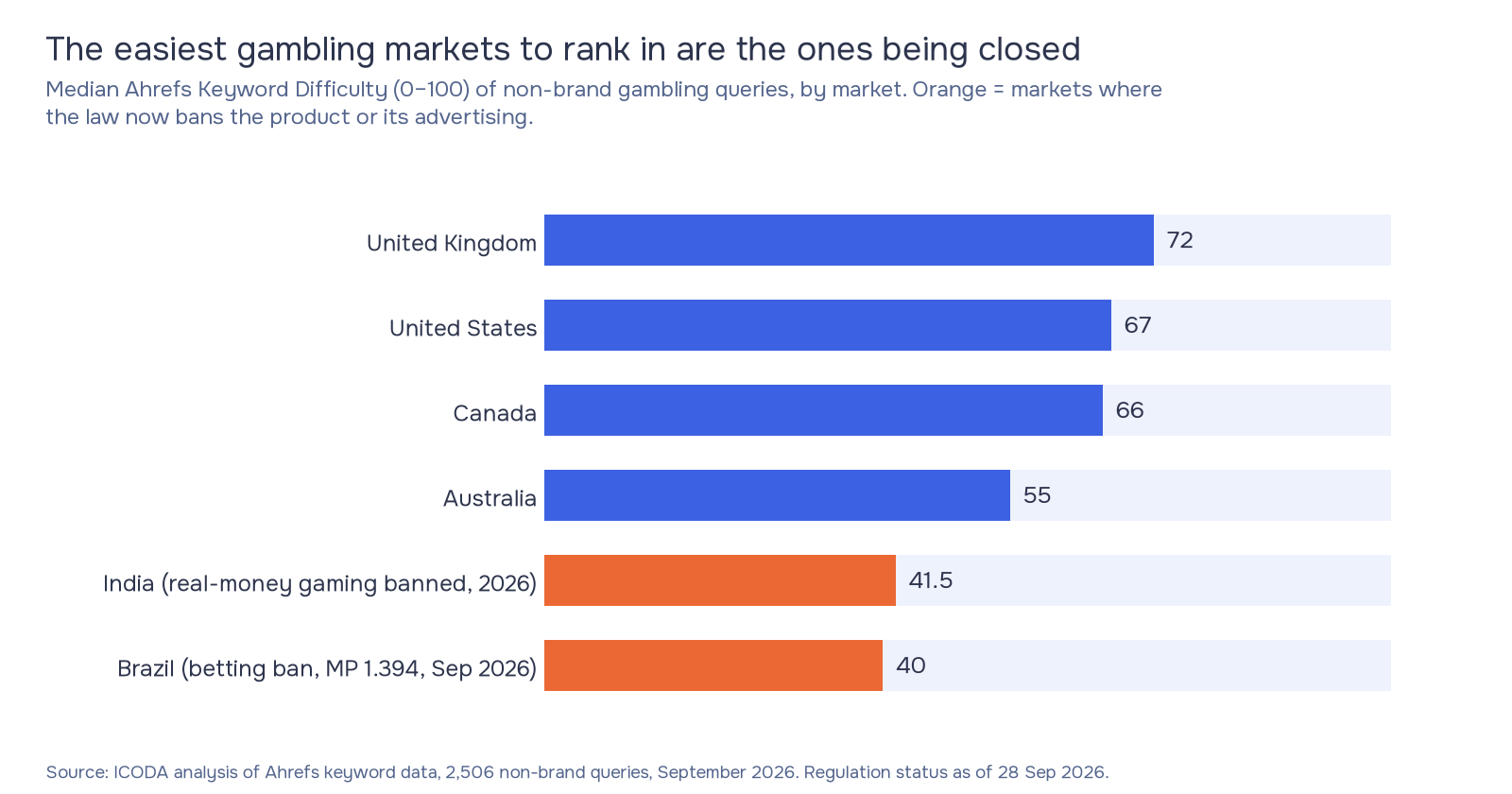
In gambling, low difficulty often prices in regulatory risk: the rankings are cheap because they may not last.
When regulation hits, traffic drops in one step instead of a gradual decline. bet365.com’s modeled traffic from Brazil fell from 21.1M to 1.4M in a single month (September 2025), when the licensed .bet.br domains took over. In our 69-domain panel, dependence on one country didn’t predict how deep a site’s drawdowns went (ρ = −0.01). So judge a market by whether it can close.
- Operator: the license defines the architecture: which domain serves which market, what the public pages may show, which hreflang pairs are legal.
- Affiliate: liability now follows the content. UK operators answer for affiliate pages, California names media affiliates, and Brazil’s MP bans any content that “facilitates access.” Before you target a market, check whether your pages fall under its advertising restrictions. Our note on PR for regulated iGaming markets covers where regulators draw that line.
Step 2. Keyword and Intent Mapping: Betting Is Brand, Casino Is Generic
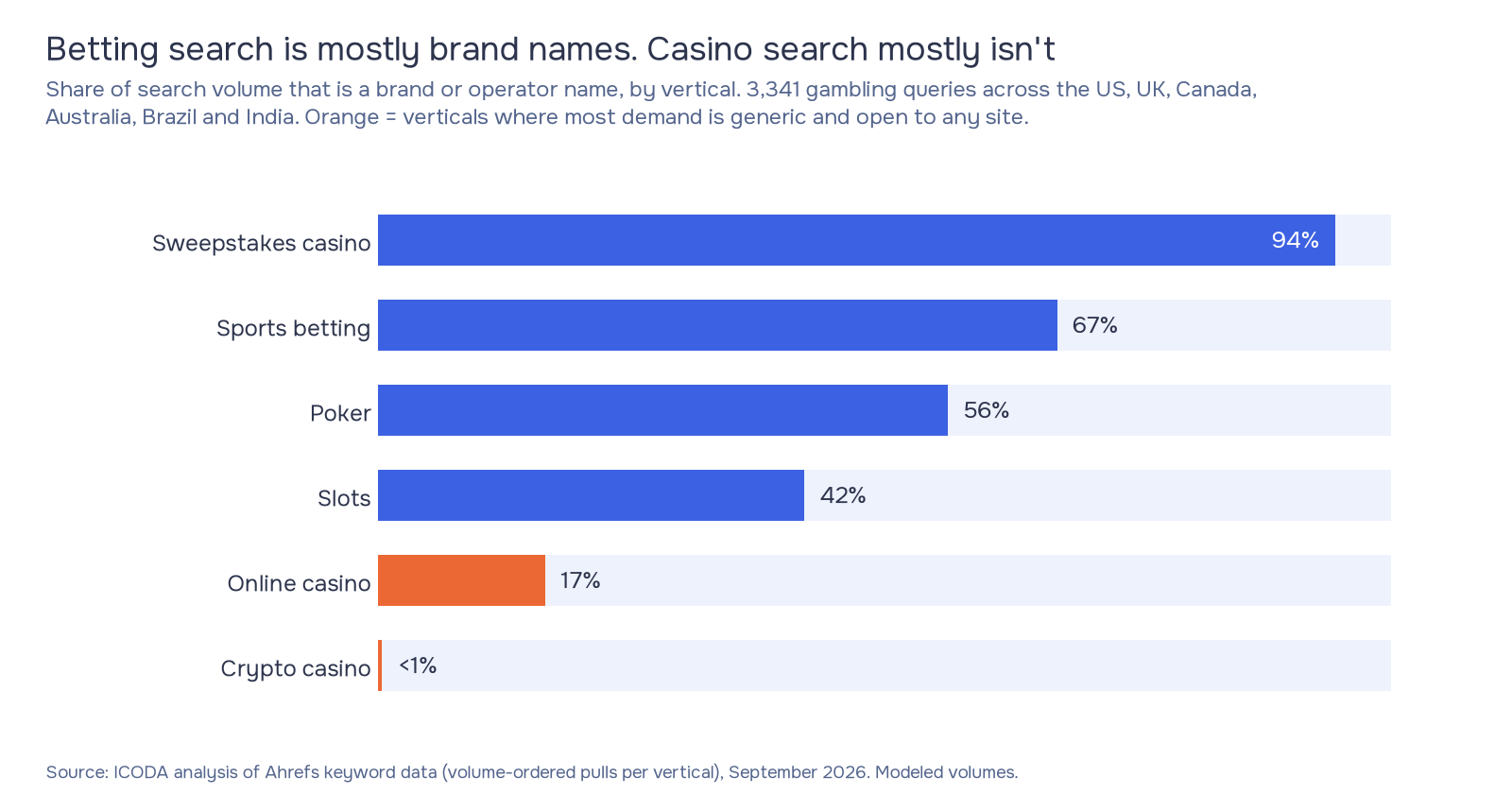
Two-thirds of sports-betting search volume in our query set is a brand name: people type “bet365” or “draftkings,” not “best betting site.” For online casino the share is 17%, and for crypto casino it’s under 1%. Operators and affiliates should read that differently:
- Operator: in betting, most of your SEO is defending your own brand SERP: login, app, review, “is [brand] legit,” and clone sites. That’s closer to brand protection than to content marketing. In casino, generic demand is open but expensive: the median KD for non-brand casino queries is 62, and UK non-brand gambling queries sit at 72.
- Affiliate: generic demand is your market, and crypto casino shows how much of it you can hold. In our audit sample, operators held 0 of 16 US top-10 slots for “crypto casino” and “bitcoin casino.”
Map each search intent to the page type your model can win with:
| Intent | Example query | Operator page | Affiliate page |
|---|---|---|---|
| Brand | [brand] login, [brand] review | Own the whole first page | Fair, dated review |
| Best-of | best online casino UK | Rarely wins | Ranked list with a published method |
| Bonus | casino bonus | Offer page where the market allows it | Offer comparison, checked and dated |
| Game | book of dead slot | Game page with rules and RTP | Review or guide |
| Legal | is online casino legal in Michigan | License and responsible-gambling page | State-by-state guide |
The top 10 is also changing hands. Across the categories we could map, operators’ share of money-keyword top-10 slots fell from 36.6% to 27.4% between September 2025 and September 2026. UGC (YouTube, Reddit) grew from 2.6% to 7.0%, and gambling sections on media sites gained 5 points. AI Overviews split the same way: they appear on betting queries and rarely on casino ones (iGaming SEO trends 2026).
Step 3. Topical Clusters Built Around Licenses
In gambling, topical authority is built one market at a time. The unit of a cluster is market × vertical × intent: “UK slots” or “Ontario casino” rather than “slots.” Each local market has its own rules on what a page may say, so a cluster that mixes markets also mixes compliance.
Take an Ontario online casino cluster. The pillar is an Ontario casino hub covering licensed status, how to play legally and responsible gambling. The spokes cover games, payment methods, withdrawal times, age and legal status, and responsible-gambling tools. A public bonus page is left out on purpose: Ontario bans public bonus advertising, so the offer sits behind opt-in.
In a US state without legal online casino, this cluster has no money pages at all. Your page there is a legal guide.
Keep clusters tight. Ahrefs groups only 1.6 to 2.0 of our queries under each parent topic, so one gambling page rarely ranks for many distinct intents. Plan one page per intent and connect them through internal linking from the pillar.
For bonus pages, use one evergreen URL per offer type and update it in place instead of publishing dated slugs. Under the UK’s 10x cap and Sweden’s one-bonus rule, an expired offer left in the index is a compliance problem as well as a freshness one.
Five technical SEO checks come before any scaling. Search engines have to see what players see, so Googlebot mustn’t be geo-blocked and game lobbies must render in raw HTML. Mirrors and clones are inventoried, hreflang follows licensed markets, and sitemaps don’t send crawlers to expired events and promos. Our casino SEO audit checklist covers how to test each one.
Step 4. Content Velocity in a Ymyl Niche: Prune and Refresh
We tracked 69 gambling domains from September 2024 to September 2026. Operators ended the period with about 26% fewer pages earning organic traffic than the panel norm, and their median traffic fell 16.5%. Affiliates kept their page count flat and lost 40%.
“Pages with traffic” is partly a result of traffic, so this doesn’t prove that pruning helps. It does show that adding and keeping pages didn’t protect affiliates. In our trends research, templated sections didn’t fall harder than editorial ones either (−69% vs −65%).
So in a gambling content strategy, measure velocity as updates to pages that earn, plus pruning of pages that don’t. Add a new URL only when a cluster has a gap.
- Operator: keep game, payment, withdrawal-time and legal pages current. They change with the product and with the rules.
- Affiliate: tie review and bonus refreshes to rule changes, and show a “last checked” date.
Many guides say Google “classifies gambling as YMYL.” It doesn’t, strictly: YMYL is a concept in Google’s Search Quality Rater Guidelines, and the September 2025 version doesn’t name gambling in its YMYL section. Hold gambling pages to YMYL standards anyway. They’re about money, and raters are told to judge money pages strictly. Make E-E-A-T visible: say who wrote each page, what expertise they bring, and when the facts were last checked, so readers have a reason to trust it.
Step 5. Link Authority: Build, Borrow or Rent
We followed 237 domains that entered US and UK money-keyword top 10s between September 2024 and September 2025, and checked who was still there a year later.
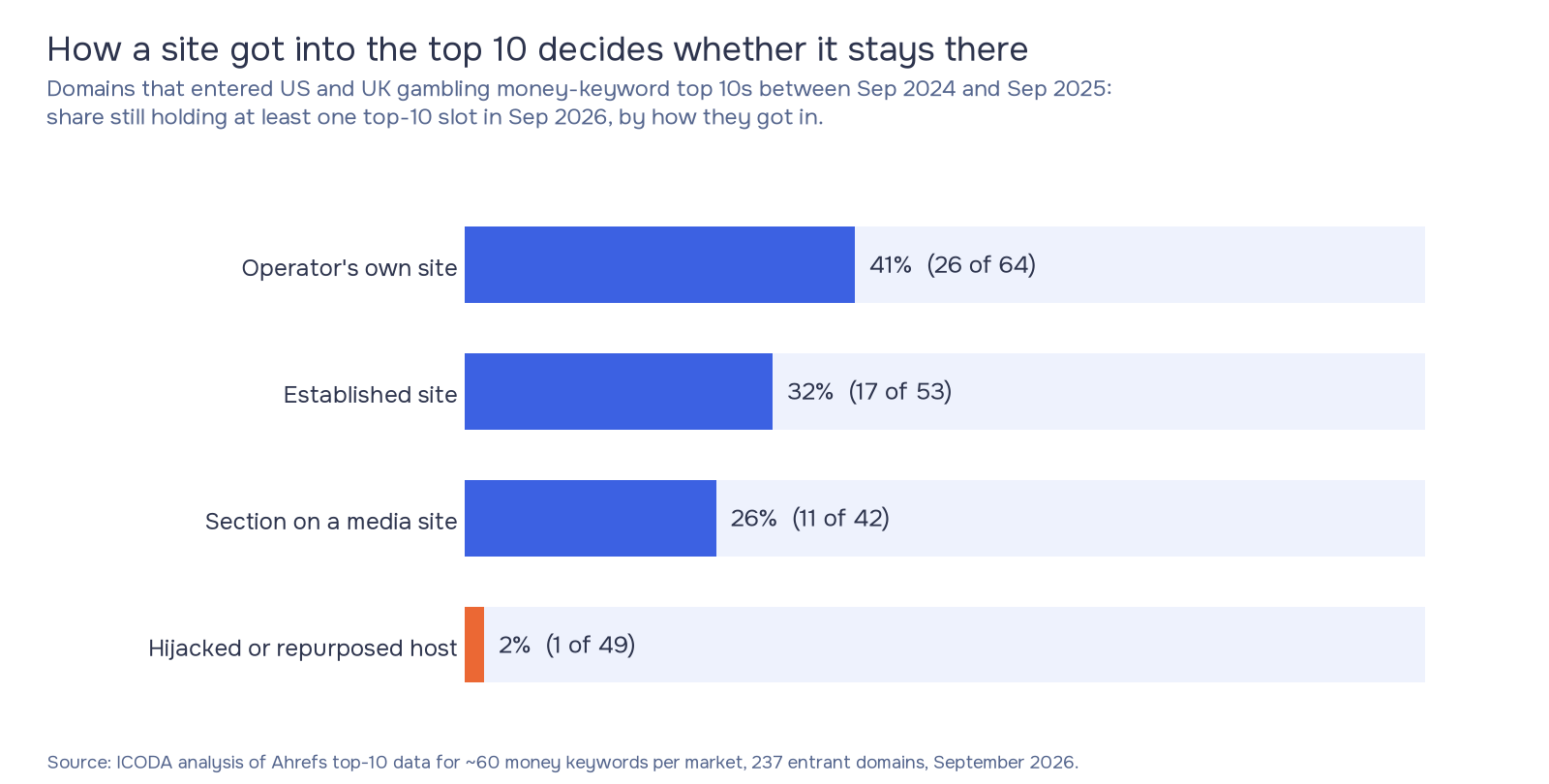
- Rent: a hijacked or repurposed host, such as a charity’s domain, a council subdomain or a dead business site filled with casino pages. 1 of 49 survived. The risk here has nothing to do with price: the page lives on a host you don’t control. The tactic is shrinking but not gone. These hosts made up 21% of that year’s entrants and 13% of the next year’s, and in September 2026 three subdomains of Brazil’s education ministry held Brazilian betting top-10 slots.
- Borrow: a gambling section on a media site. 26% survived. Even on large sports publishers, an editor or Google’s site reputation abuse policy can remove the section. Since 30 August 2026, Google says those manual actions no longer affect rankings for users in the EEA. Everywhere else they still do.
- Build: your own domain. 32% of established sites that already had authority were still there, and 41% of operators. The few genuine new builds we traced grew referring domains steadily for 6 to 15 months before entering the top 10, with no single-month spike. That’s a handful of cases, so treat it as a pattern to check against your own data.
In gambling SEO, paid placements, guest posts and digital PR are normal ways to build backlinks. Judge them by the source: relevant publications, varied anchors, and links you can see in Google Search Console. Spam anchors point at reputable sites too, so treat GSC’s links report as the source of truth. More in our iGaming link building guide.
In our earlier study of crypto sites, high Domain Rating didn’t protect them from traffic losses either.
Step 6. Measure Your Share Against Competitors
When a third of the top 10 changes every year, your own traffic trend can’t tell you whether you’re winning. Track five things instead:
- Share of top-10 slots in a fixed set of 50 to 60 money keywords per market, compared with your three closest competitors.
- Slot survival: of the slots you held a year ago, how many you still hold.
- Brand SERP ownership: who holds the top 10 for “[brand] review,” “login” and “legit.”
- AI visibility: whether ChatGPT, Perplexity and AI Overviews name and cite you (how to check).
- Conversions to FTDs and revenue per cluster, benchmarked against iGaming player acquisition costs.
When traffic falls, find the cause before you fix anything. Of 23 severe drawdowns in our panel, Google updates caused 8, regulation 3 (plus 1 probable), and the owners’ own consolidation or migration 2. Nine had no clear cause. Check four things in this order: the country split, Google’s update dates, regulatory dates in your markets, and your own release log.
A 12-Month Sequence
| Months | Operator | Affiliate |
|---|---|---|
| 0-3 | Market map, technical baseline, brand SERP audit | Market map with an ad-liability check; 1-2 generic clusters where operators are weak |
| 3-6 | First licensed-market clusters; control of brand SERP pages | First pillars and spokes; link building; fixed keyword set for tracking |
| 6-9 | Digital PR and placements to pillars; prune dead pages | Review and bonus refreshes; prune; a second market only if its rules are stable |
| 9-12 | Share-of-slots review; next market | Share-of-slots review; diagnose any drop before acting |
A team to run this needs five functions: an SEO lead, compliance review, content by writers who know the iGaming industry and the product, developer time for technical fixes, and link and PR work. An in-house team, an agency or a mix can cover them. Before month one, name an owner for each.
Seven Strategy Mistakes Where SEO Meets Regulation
- Choosing markets by keyword difficulty. The easiest markets in our data, Brazil and India, are being closed by law.
- Ranking on a host you don’t control. 2% of hijacked entrants lasted a year.
- One content template for every state or country. Ontario bans public bonus ads; California makes media affiliates liable.
- Treating bonus pages as evergreen after the rules change. The UK’s 10x cap and Sweden’s one-bonus rule turn old offers into compliance risks.
- Adding pages instead of pruning. Affiliates kept their pages and lost 40% of traffic.
- Blaming Google for every drop. In our panel, regulation and owners’ own migrations explained 5 to 6 of 23 severe drops.
- Measuring against your own history. A third of the top 10 is new every year.
If you want a second opinion on your casino SEO strategy, our casino SEO agency team reviews markets, clusters and link routes.
Frequently Asked Questions (FAQ)
Yes, for the right clusters. Casino demand is mostly generic, so it’s open to sites that aren’t big brands, and AI Overviews rarely appear on casino queries. Betting demand is mostly brand names, so a sportsbook’s iGaming SEO strategy is largely brand defense.
It depends on the route and the market. In our data, the genuine new builds grew links for 6 to 15 months before reaching a top 10. Be wary of flat promises like “3-6 months”: no ranking page we reviewed shows a method behind its number.
Operators win brand queries and licensed-market pages, and their license sets the site architecture. Affiliates win generic best-of, bonus and comparison queries. In the UK, several US states and Brazil, affiliates now share legal exposure for their content.
They can get a page into the top 10, but not for long. Of 49 hijacked or repurposed hosts that entered US and UK top 10s between 2024 and 2025, one still ranked a year later.
Share with


Rate the article