

To start an online casino business, pick a license and platform, set up payments and KYC, then budget a marketing ramp of 2–3× the market CPA. Marketing is often the largest first-year cost of an iGaming business, and for the first 8–12 weeks each depositor costs 2–3× the benchmark. The same steps apply to a sportsbook, with a different product stack.
Launch Checklist:
- Choose the model: own license, white label or turnkey.
- Pick the license by target market, not by price.
- Select the platform and game providers.
- Set up payments and KYC before the first ad.
- Budget the ramp: license, platform, then marketing at 2–3× the benchmark CPA.
- Run the 90-day plan in one or two markets.
- Track FTD, CPA and D30 retention weekly.
How Do You Choose a Business Model: Own License, White Label or Turnkey?
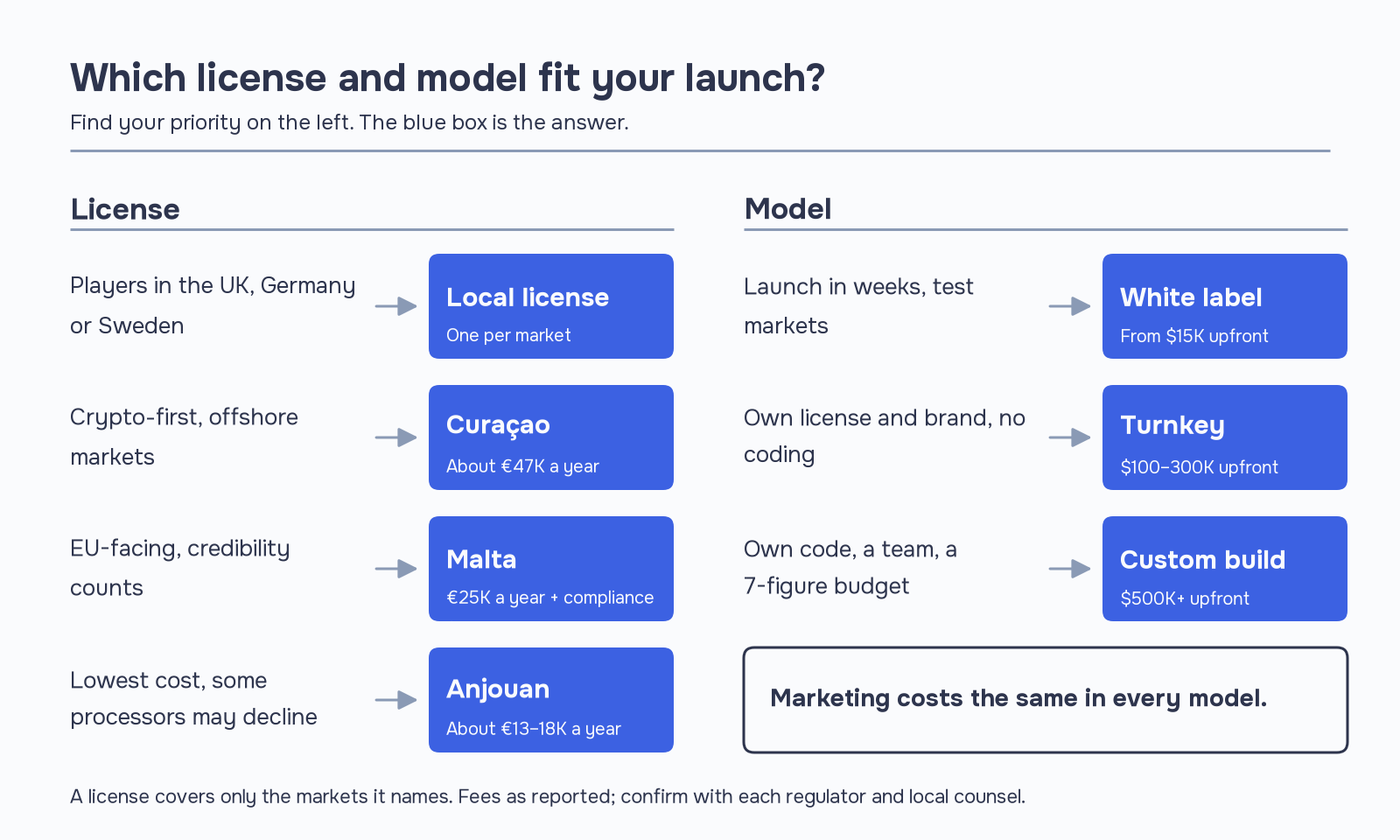
Choose white label to launch in weeks, turnkey to own the license and brand, and a custom build only with seven figures and a team.
| Model | Upfront (Vendor-Reported) | Ongoing | Time to Launch | Fits |
|---|---|---|---|---|
| White label (provider’s license) | $15K–200K | 20–40% of GGR, or a fixed fee from about $10K/month | Weeks | Testing a market before committing |
| Turnkey (your license, ready platform) | $100K–300K | $5K–20K/month | 2–4 months | A founder who wants own license and brand without building code |
| Custom build (your license, your code) | $500K+ | Dev and compliance team | 18–24 months | A funded operator with a product edge |
White label has the cheapest entry and the costliest long run. The revenue share grows as you do, and the provider’s license limits where you can operate. A common path for anyone starting an online gambling business: launch on white label to learn which markets convert, then move to turnkey. Marketing costs the same in every model. A brand under someone else’s license still pays full price for each depositor.
Which License: Curaçao, Anjouan or Malta?
Curaçao suits offshore and crypto launches, Malta suits EU-facing brands that need credibility, and Anjouan is the cheapest, with the thinnest acceptance.
| Curaçao (LOK) | Anjouan | Malta (MGA) | |
|---|---|---|---|
| Application fee | about €4,592 | set by the agent you use | €5,000 |
| Annual fee | about €47,450 | about €13K–18K (reported) | €25,000 + compliance contribution |
| Time | 2 review phases of about 8 weeks each | 3–4 months (reported) | 6–9 months (reported) |
| Year-one all-in | €75K–100K+ (reported) | €20K–25K (reported) | Fees from about €30K, plus legal and setup; €100,000 minimum share capital for casino games |
| Weak spot | New regime since December 2024 replaced the master-license system | Some payment processors decline it | Cost and time |
Sources: MGA fee guidance note (December 2024); Curaçao and Anjouan figures from industry guides and press. Confirm current fees with each regulator before you budget.
Your online gambling license cost is the regulator’s fee plus everything around it: company formation, a local director or office, game certification and legal support. For Curaçao and Anjouan the first-year total runs well above the fee itself.
In Malta, casino-type games fall under Type 1. The compliance contribution is 1.25% on the first €3 million of gaming revenue, with a €15,000 minimum. Start-ups that qualify get a 12-month moratorium.
A license does not let you advertise everywhere. The UK, Germany and Sweden, among others, require their own license. A Curaçao online gaming license leaves you the markets without local licensing, and each of those has its own advertising rules. Choose target markets first, then the license, and ask local counsel about each market before you spend on ads.
Platform and Game Providers: What Do You Actually Buy?
A casino platform bundle covers the player site, back office, game aggregation, payments, fraud and KYC tools, and reporting. Check what is included before you compare prices.
- Game content. An aggregator gives you many studios through one integration. A direct integration with a single major provider can cost $15K–25K.
- Crypto-native or fiat-first. Crypto-native stacks handle wallets and on-chain deposits. Fiat-first stacks have deeper card and bank support. Pick the one that matches your first market.
- Back office and CRM. You need bonus rules, segmentation and tracking events (registration, deposit) from day one. Without a clean deposit event you cannot measure CPA.
- Player protection. Limits, self-exclusion and age checks are required by most regulators. Ask what the platform ships with.
- Mobile. Mobile carries more than half of iGaming activity. If you plan a branded app, see our casino app development service.
Ask each provider for three things: uptime history, how fast they add a payment method, and what it costs to leave.
Payments and KYC: Crypto or Fiat?
Offer crypto if your players are crypto-native, and fiat if they are not. Crypto settles fast and cannot be charged back, while fiat brings trust and card-network rules.
Card payments for gambling run under merchant category code 7995. Industry guides put chargeback rates at 2–4%, against 0.5–1% for ordinary e-commerce. Since April 2026, Visa’s monitoring program treats a combined fraud and dispute ratio above 1.5% as excessive in most regions, once a merchant passes 1,500 transactions a month. Card-heavy casinos sit above that line unless fraud controls are in place from day one.
Crypto removes chargebacks and bank de-platforming risk. It does not remove KYC. Your license sets identity and anti-money-laundering rules, and processors and banks apply their own.
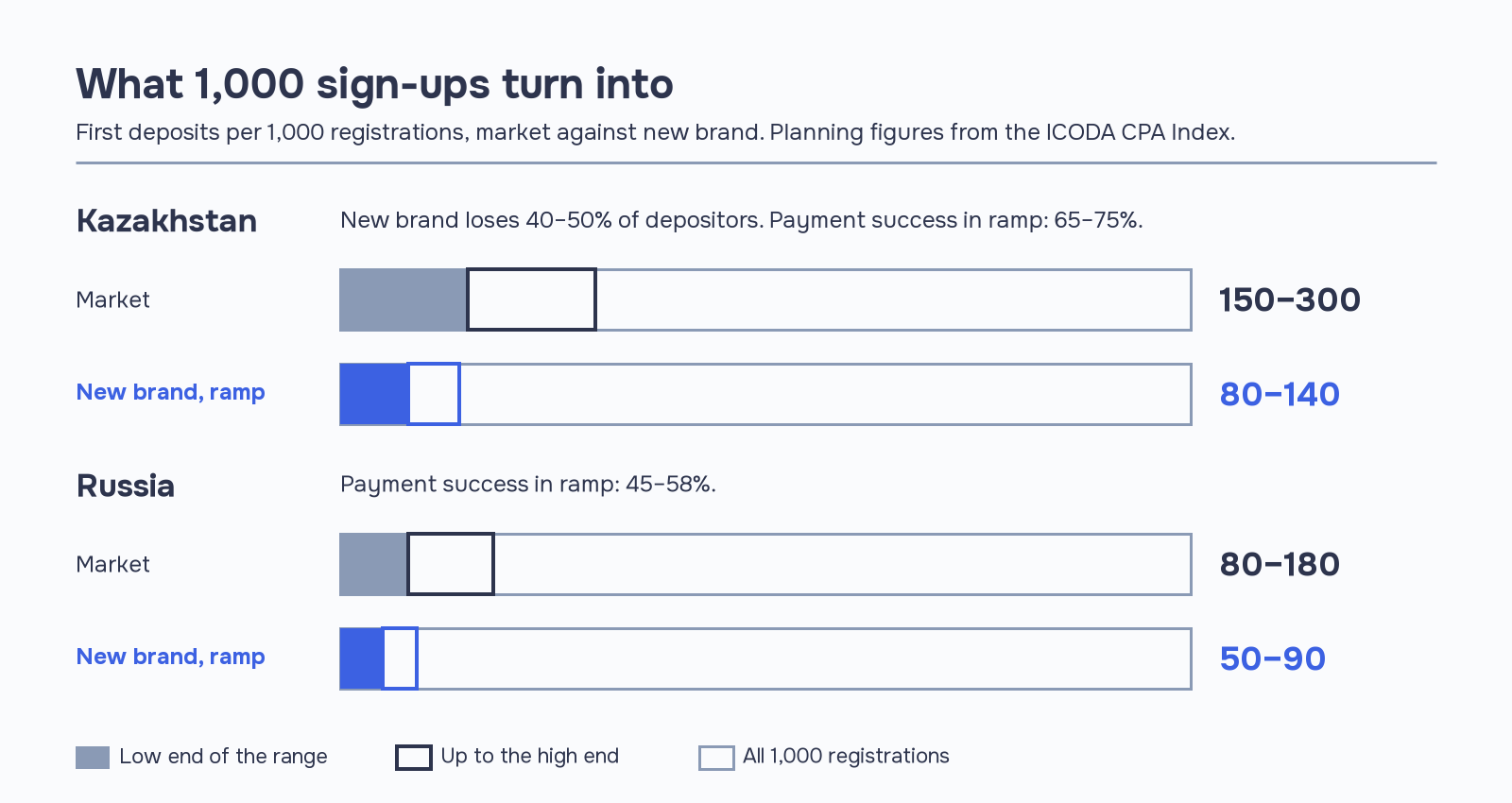
Payments are also a marketing metric. In ICODA’s CPA Index, one operator’s ramp plan expected only 65–75% payment success in Kazakhstan and 45–58% in Russia. Every failed deposit is an ad click you paid for. Test deposits and withdrawals in each target market with real accounts before you launch.
How Much Does It Cost to Start an Online Casino Business: Tech Versus Marketing?
Plan the first year as three lines: license and company, platform, and marketing. Marketing is often the largest of the three, and the easiest to under-budget.
- License and company: about €20K–25K (Anjouan) to €75K–100K+ (Curaçao) in year one, more for Malta.
- Platform: $15K–200K for white label, $100K–300K for turnkey, plus monthly fees.
- Marketing: our working rule is to match or exceed license plus platform.
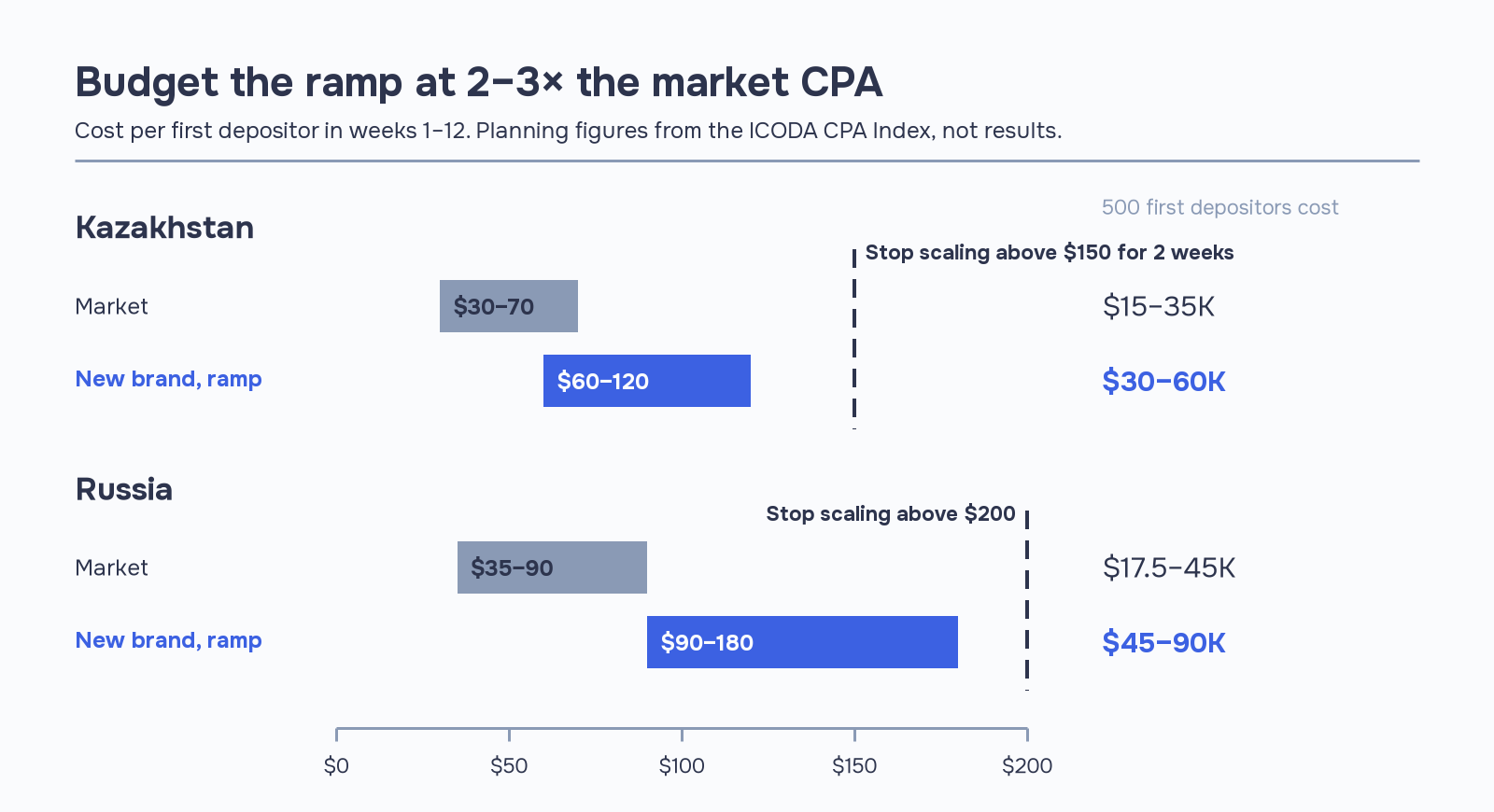
Do not budget marketing at the market CPA. Two operators’ pre-launch plans in the CPA Index budgeted a new brand at 2–3× the benchmark for the first 8–12 weeks. These are planning figures, not post-launch results:
- Kazakhstan: ramp CPA $60–120 against a market rate of $30–70.
- Russia: ramp CPA $90–180 against $35–90.
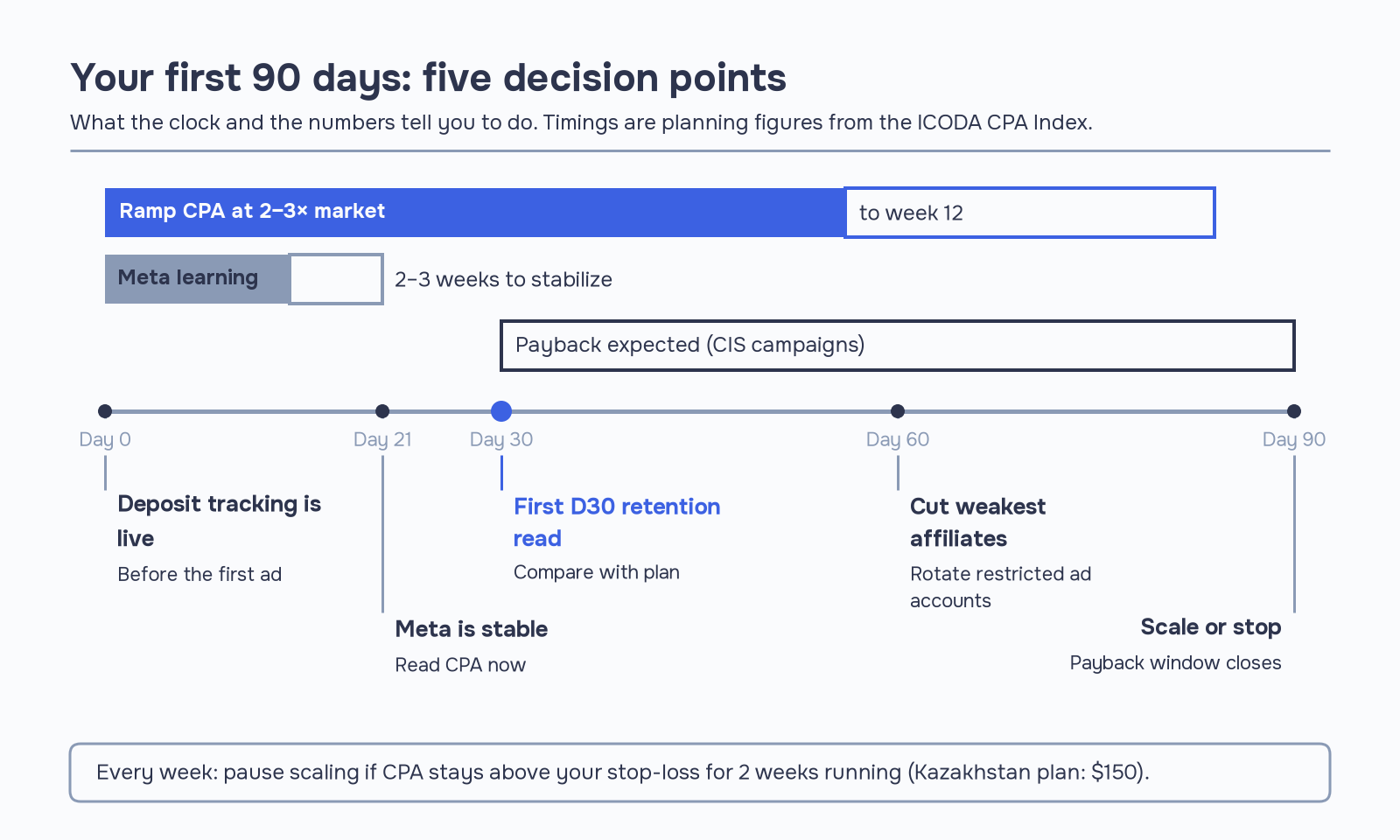
Three things drive the gap. Affiliates price in a margin for a brand with no conversion history. Meta needs two to three weeks to stabilize. The first 7–30 days of a CIS campaign are unprofitable by design, with payback expected between day 30 and day 90.
An illustration from those ranges: 500 first depositors in Kazakhstan cost $30,000–60,000 at ramp CPA, against $15,000–35,000 at market rate. Set a stop-loss before launch. The Index’s phased plan halts scaling when CPA stays above $150 for two consecutive weeks in Kazakhstan, and above $200 in Russia.
What Does the First 90 Days of Marketing Look Like, by Channel and GEO?
Launch in one or two markets, run every channel at small scale, then put money behind what converts. Do not open five GEOs at once.
| Channel | Days 1–30 | Days 31–60 | Days 61–90 |
|---|---|---|---|
| SEO and content | Brand, license and responsible-gambling pages; indexation | Game, bonus and payment pages (see casino SEO strategy) | First brand-adjacent rankings; competitive terms take longer |
| PR | Launch release to outlets that accept gambling copy | Founder and product stories | Reprints and coverage recap |
| Affiliates | Recruit first partners; CPA plus RevShare offer | Cut the weakest, improve terms for the best | Move toward half of FTDs |
| Paid | Test with a small budget; tracking first | Scale winners; rotate restricted accounts | Add retargeting |
| Telegram | Own channel, support bot, partner channels | Giveaways within the rules | Community-led retention |
| Streamers | A few micro-streamers with referral codes | Drop the weak, extend the strong | Larger partners |
- PR. A press release is rarely read or cited; the articles it triggers are the result. See our guide to a crypto casino press release. Paid placements are a legitimate, fast way to get coverage in outlets that accept gambling content.
- Affiliates. The Index’s planned offers were RevShare 45–50% plus CPA $25–35 for Kazakhstan and $30–45 for Russia. Operator B targeted affiliates for 50% of first deposits and expected only 8–20% in the ramp.
- Paid. Gambling ad policies are strict, and Google and Meta limit or pause campaigns mid-flight. Set up server-side deposit tracking first, and treat every ad account as temporary. Three ICODA cases (all self-reported):
- Google Ads, crypto casino in Indonesia: rotating campaigns kept volume up, with 1.01M impressions, 81.5K clicks and a $0.41 average CPC on Search.
- Meta Ads, crypto casino in Asia: a $250 test scaled to $2,000, with registrations at $0.91 in South Korea, $4.80 in Vietnam and $14.50 in the Philippines.
- Yandex, 2022: 250 registrations at $10 each, against a $15 goal.
- Telegram. Telegram’s own ad platform prohibits gambling, so use channels, bots and partner communities.
- Streamers. From August 2017, Stake paid streamers to play live with referral codes. Its reported gross gaming revenue grew from about $105 million in 2020 to $2.6 billion in 2022 (estimates, from our breakdown). Start with small creators (see the Kick streamer list) and check sponsorship disclosure rules in each market.
How Do You Pick GEOs?
Pick markets by payback, payment success and entry difficulty, because a cheap CPA says little about return. In the Index’s twelve-market model, Kazakhstan is the second-cheapest by CAC but sixth by LTV-to-CAC return, while Argentina is third-cheapest and first by return. An iGaming marketing agency can test several markets before you commit the full budget, and our iGaming marketing strategy work covers the market-entry plan.

Which KPIs Matter: FTD, CPA and D30 Retention?
Track three numbers weekly: first-time depositors (FTD), cost per FTD, and day-30 retention. If any one is far off plan, stop scaling.
- FTD and registration-to-FTD rate. For regulated casinos, Track360’s operator benchmarks list 25–45%. The Index’s ramp plans expected 8–14% in Kazakhstan and 5–9% in Russia for a new brand.
- CPA. Judge it against 12-month lifetime value.
- D30 retention. Track360 says casino players typically show 20–40%. The Index’s ramp plans expected 8–16%. Treat the first month as a measurement period.
- Payment success. Track it next to the three above.
Review the ramp and the steady state separately. A ramp that looks bad against steady-state targets is normal. A ramp that misses its own plan is the signal to act.
What Launch Mistakes Should You Avoid?
Avoid six mistakes: each one wastes launch budget, and each has a cheap fix.
- Choosing the license before the markets. Fix: list target markets, then check which licenses they accept.
- Budgeting at benchmark CPA. Fix: plan 2–3× for weeks 1–12 and set a stop-loss.
- Launching in many GEOs. Fix: one or two markets until payback is clear.
- No deposit tracking. Fix: register events and server-side tracking before spend.
- Relying on one channel. Fix: affiliates, SEO, paid and community from the first month.
- Ignoring payment success. Fix: test deposits and withdrawals in each market.
Frequently Asked Questions (FAQ)
Pick a business model and a license, set up the platform, payments and KYC, then budget a marketing ramp of 2–3× the market CPA. To open an online casino under your own license, plan on three to nine months for approval, depending on the regulator.
From about €13,000–18,000 a year for Anjouan and €25,000 for Malta to about €47,450 for Curaçao, plus application fees and setup. Year one all-in is higher.
Curaçao’s regulator targets about eight weeks per review phase, and there are two phases, so allow four to six months in practice.
Yes, as a white label brand under a provider’s license. It is faster and cheaper upfront, with a revenue share and limits on markets.
A US sweepstakes casino runs on a dual-currency promotional model, and several states, including California, have banned it. The list keeps changing, so get a US gaming lawyer before you build.
White label starts from about $15K under the provider’s license. An own-license launch with marketing usually needs six figures or more, and a custom build starts at $500K.
Planning a launch? Tell us your markets, license and budget in the ICODA calculator, and we will send a launch marketing plan within 24 hours.
Share with


Rate the article