What Does TGE Mean in Crypto?
TGE stands for token generation event, the day a project’s token goes live and becomes claimable or tradable.
Some glossaries still call a TGE a fundraising method, but a sale and an exchange listing are separate steps that can come before, on or after that day (Chainlink, Kommunitas). Hyperliquid and Linea had no sale at all. So the TGE meaning in this guide is the narrow one: the day the supply schedule goes live, allocations are fixed, vesting clocks start and holders can claim. Binance Wallet also calls its subscription sales “TGEs”, so on Binance the word can name a sale.
Most 2025 TGEs lost value. Of 118 launches Memento Research tracked, 100 traded below their opening FDV (fully diluted valuation: price times total supply) by December, and the median fell 71%. None of the 28 launches above $1B FDV beat its opening valuation, while 40% of the 35 launches between $25M and $200M did.
TGE vs ICO vs IDO vs IEO vs Exchange Listing
TGE vs listing: a TGE creates the token, a listing is where it trades, and ICO, IDO and IEO are ways to sell it.
| What it is | Who runs it | Status in 2026 | |
|---|---|---|---|
| TGE | Token is created and distributed, by claim or transfer | The project | Standard, with or without a sale |
| ICO | Public sale through the project’s own site and smart contract | The project | Rare; regulators have treated many as securities offerings |
| IDO | Sale on a decentralized launchpad, with liquidity added to a DEX | Launchpad and project | Still used; volumes are small |
| IEO | Sale run by an exchange on its own launchpad | The exchange | Less common; Binance now runs Launchpool and HODLer Airdrops, which give tokens away |
| Exchange listing | Token becomes tradable on a centralized exchange | The exchange | Same day as the TGE or weeks later |
Public sales have shrunk by more than 95% since the Q1 2025 peak. On TGE vs ICO, the sale can come months before the TGE, or not happen at all. Many teams now pick the distribution first (airdrop, points claim, exchange program or regulated sale) and let the TGE follow. The label never changed the law: calling a token a utility token does not stop it from being a security, as SEC Chairman Jay Clayton said in December 2017. For the exchange-led route, see our IEO marketing guide.
How Does a TGE Work? Vesting, Airdrops and Liquidity
A TGE fixes three things on day one: who holds the supply, when each group can sell, and how much trades at launch.
Alt text:
Vesting and Unlocks
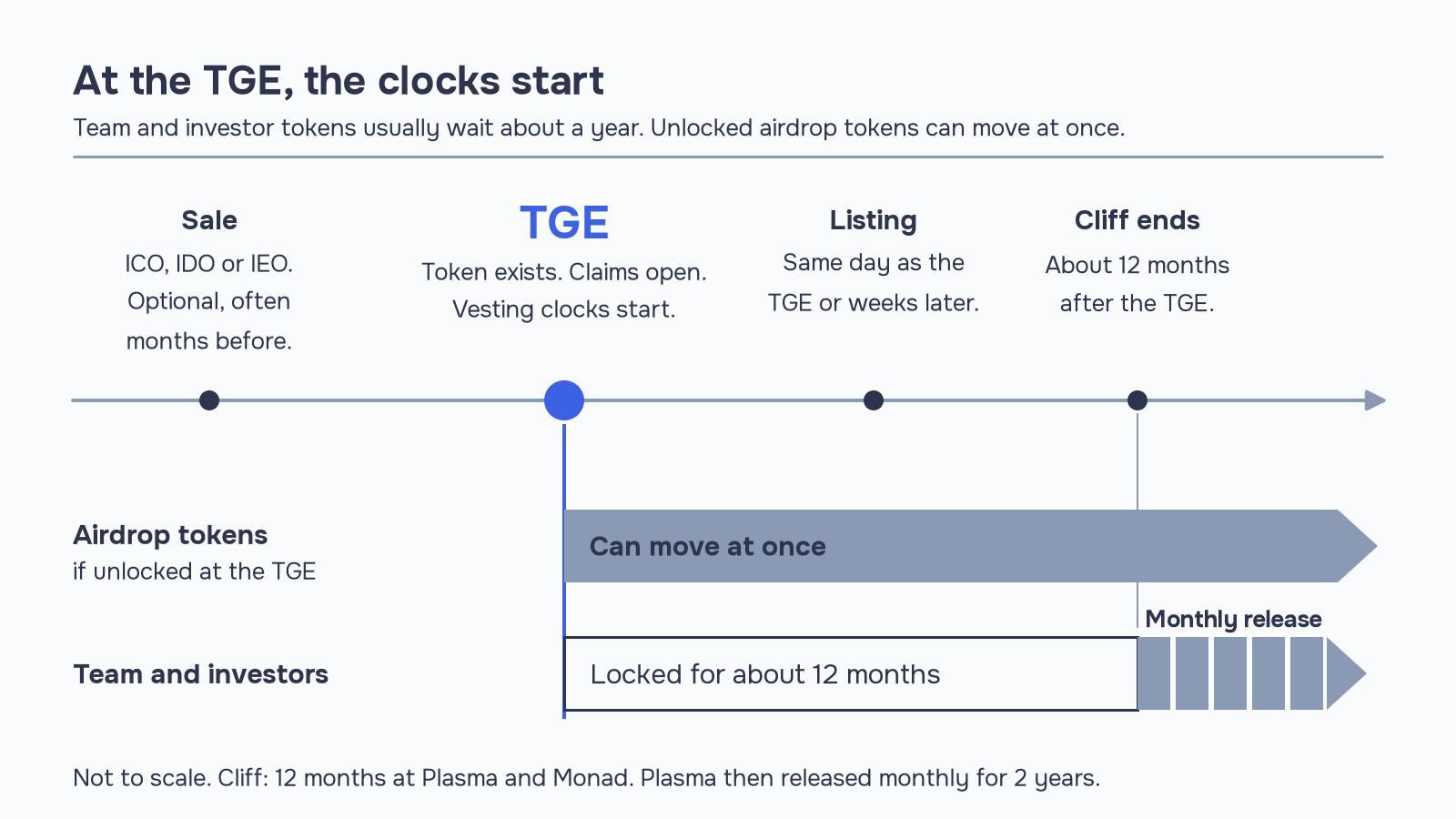
Vesting schedules start counting at the TGE, so the unlock calendar exists from the first day.
A cliff is a stretch with no unlocks, followed by gradual release, and “20% unlocked at TGE” means a fifth of that allocation can move on day one. Plasma released one-third of team and investor tokens after a 12-month cliff and the rest monthly over two years. In Keyrock’s study of 16,000+ unlocks across 40 tokens, about 90% put downward pressure on price, starting around 30 days before the unlock.
Airdrops
An airdrop gives early users tokens at the TGE, and in the median 2026 drop most recipients moved some tokens within a day.
Hyperliquid airdropped 31% of supply, fully unlocked, to points earners. Across 62 airdrops in 2024, 88% of the tokens declined. In Bitquery’s 2026 study of 51 airdrops, 73% of claimers in the median drop moved some or all tokens within 24 hours, 23% still held at least half after 30 days and 8% after 90 days, and 11% sat in linked wallet groups that look like farmers.

Liquidity and Float
Float is the share of supply that trades: launches under 20% float kept 23-26 cents per launch dollar after a year, against about 55 cents at 30-50%.
That is GSR’s finding across 2,300+ listings; low float tends to come with high FDV, so the effects overlap. Unlocked does not mean circulating: Monad had 49.4% of supply unlocked on day one, but only about 10.8% was liquid at launch, according to The Block.
TGE Marketing Checklist: T-90 to T+30
A pre-TGE campaign runs in five phases from T-90 to T+30, counted from the TGE (T-0): facts, product-use quests, listings, launch week and weekly reports.
TGE marketing works on a 90-day run-up, the minimum in our presale marketing strategy. The ICODA cases below are presale, KOL, ad and listing campaigns, not full TGE runs, and self-reported.
T-90 to T-60: Fix the Facts
Lock the tokenomics, vesting and float internally, decide whether you hire a market maker, and have a lawyer review every claim before any promotion.
- Check the rules in each market you promote to. In the EU, MiCA Article 7 bars marketing an offer before the white paper is published. In the UK, crypto promotions must go through an FCA-authorised or registered firm, wherever you are based. In the US, the SEC’s staff FAQ points to describing what the product does today, not price or returns. Decide early how you treat US buyers. This is not legal advice.
- Apply to exchanges through official forms, and start early. Coinbase says listing is free, and Binance pays bounties of up to $5M for reports of fake listing agents.
T-60 to T-30: Reward Product Use
Reward product use with quests (a testnet swap, a bridge, a stake): X barred apps that pay for engagement in 2026 and farmed wallets sell fast.
- Stage your KOLs in waves: explain before launch, post together at launch, follow up a few days later. For Banana Gun, a token already trading, ICODA reports 69 KOLs publishing 77 posts in 72 hours during a Bybit ByVotes contest. Tiers and rates are in our KOL guide.
- Write disclosure into every KOL contract. X allows paid crypto posts only with its Paid Partnership label and bars them in the UK, EU and Australia. In the US, the FTC holds the brand responsible for a clear #ad in the post itself. Brief KOLs: no price targets or return claims.
- Take the snapshot before you publish the criteria, and run a Sybil filter (one farmer running many wallets) with a public checker and an appeal window, as Linea did.
T-30 to T-7: Prepare Listings, Liquidity and Security
Use T-30 to T-7 to line up listings, liquidity and security: prepare tracker submissions, sign the market maker and audit the contracts.
- Prepare your CoinGecko and CoinMarketCap listing submissions, and file them once trading starts. CoinMarketCap requires active trading on an exchange with material volume, and CoinGecko’s review takes up to five days, or 24 hours with Fast Pass at $1,000, with no guarantee. Verify the contract and ready logos, links and supply data now.
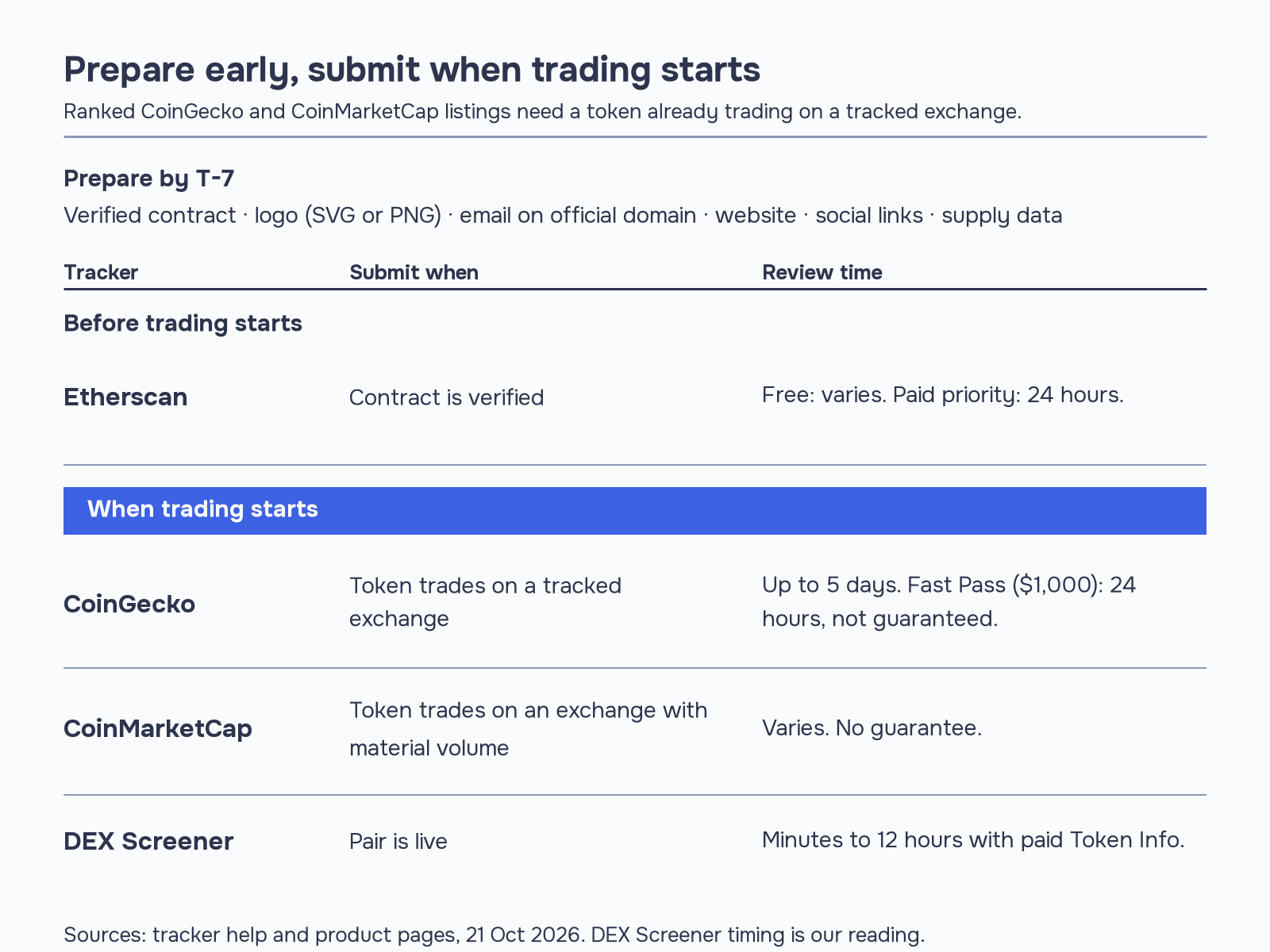
- Sign the market maker and plan day one by T-30. Choose a retainer, where you pay a fee, or a token loan with a call option, where the market maker can buy the loaned tokens at a set price (Flowdesk). Write spread, ±2% depth and uptime targets into the contract, and count loaned tokens as circulating. Never pay for volume: the SEC and DOJ charged market makers with wash trading. On the day, seed the pool, open claims, then trading, then file with trackers.
- Audit the token, vesting and claim contracts, and put every admin key in a multisig. Remove or time-lock functions that can sweep or mint tokens; that is how ZKsync’s airdrop contract was drained ten months after launch.
- If you run a sale, check the ad limits and test small first. Google bans ICO, IDO and token-trading ads, X bans ICO, IEO and IDO ads, and Meta requires written permission for crypto investment ads. An ICODA presale test on Meta returned ROAS 5.74 on $10,378 spend, with the US excluded.
- Pitch the outlets AI engines cite for crypto news. In ICODA’s study of 36 prompts on four engines, crypto.news (cited on 13.9% of queries), CryptoSlate (12.5%) and CoinDesk (11.8%) led; press releases were 4% of cited URLs.
T-7 to T-0: Harden Launch Week
Launch week needs one official contract address, one claim domain, secured team accounts and a claim page that survives a traffic spike.
- Publish one official address and claim domain in every channel and pin it. Scammers placed Telegram ads inside Monad’s own announcement channel.
- Load-test the claim page and RPC at several times expected traffic. Linea’s sequencer stopped for 67 minutes on TGE day.
- Open claims before trading starts and keep the window long: Linea gave 90 days.
T+1 to T+30: Report Progress Weekly
After the TGE, ship something visible, publish each unlock before it happens and expect the first month to be the weak spot.
- Plan for the dip. GSR finds the median listing below its launch price within three days and about 20-25% below at 30 days. Only 9.4% of tokens that fell in week one regained launch price (Arrakis).
- Show progress, not promises. Report what shipped and how it is used (integrations, active users, fees), not roadmap dates or price. Hyperliquid launched native staking on day 31.
- Set a comms policy, label your wallets and publish the unlock calendar. No price talk from the team, public labels on team, treasury and market-maker wallets, large moves explained the same day, and unlock dates posted ahead of time.
TGE KPIs: What to Track After Launch
Track four things after a TGE: claim and hold rates, order-book depth, price against launch at T+7 and T+30, and holder and search growth.
| Window | Track | Reference point |
|---|---|---|
| T+1 | Claim rate; share of claimers who moved tokens; spread and depth | Day-one claim rates ran 73-87% for Arbitrum, Lido and Arkham (2021-23); 73% of claimers moved tokens within 24 hours in the median 2026 drop; for depth, your market-maker targets |
| T+7 | Price against the first day’s close; holders still holding | Nearly two-thirds of 125 TGEs in 2025 were down within a week |
| T+30 | Claimers holding at least half of their drop; price against launch | 23% of claimers still held half or more at 30 days; median listing 20-25% below launch, far worse above $1B FDV |
Measure price against the first day’s close, not the opening print, which is often a placeholder auction price.
Why Do Tokens Drop After a TGE? Five Common Mistakes
Most tokens fall after a TGE, and five mistakes make it worse: a thin float, a poor airdrop, a bad market-maker deal, weak security and no value story.
The examples are large 2024-25 launches, where the data is public.
- Pricing high on a thin float. Berachain launched at a $3.8B FDV with 21.5% of supply circulating and fell 36% from its first close within a week (our calculation from daily closes).
- Rewarding the wrong people. Berachain gave testnet users 1.65% of supply and NFT holders 6.9%; weight drops toward real product use.
- Signing a bad market-maker deal. A market maker sold about 66M MOVE for roughly $38M in profit after listing; Binance offboarded it and Coinbase suspended trading.
- Skipping security and launch-day basics. Ten months after its airdrop, a compromised ZKsync admin key let an attacker mint about 111M ZK, and the price fell 20%.
- Launching without a value story or into a weak market. MON listed with Bitcoin about 30% below its peak and fell below its sale price within 30 days.

Frequently Asked Questions (FAQ)
TGE means token generation event, the day a token becomes claimable or tradable. It starts the vesting clocks and fixes the supply split.
No, a TGE creates and distributes the token, while a listing lets people trade it on an exchange. They can fall on the same day or weeks apart.
After a TGE, airdropped tokens can be sold at once, while team and investor tokens usually sit behind a cliff of about a year and then unlock monthly.
Pre-TGE means before the token exists. Farmers use the term for points programs that may turn into an airdrop; for a team, a pre-TGE campaign is the 90 days of quests, content and press that put real users among the first holders.
No, a TGE does not decide that: the SEC looks at what the issuer promises and how the token is sold. EU and UK rules add marketing limits, so get legal advice before you write launch copy.
Share with


Rate the article