Casino bonus abuse is using a promotion in a way the operator did not intend, such as multi-accounting, hedged play or bonus-only affiliate traffic. Operators also call it promo abuse or promotional abuse.
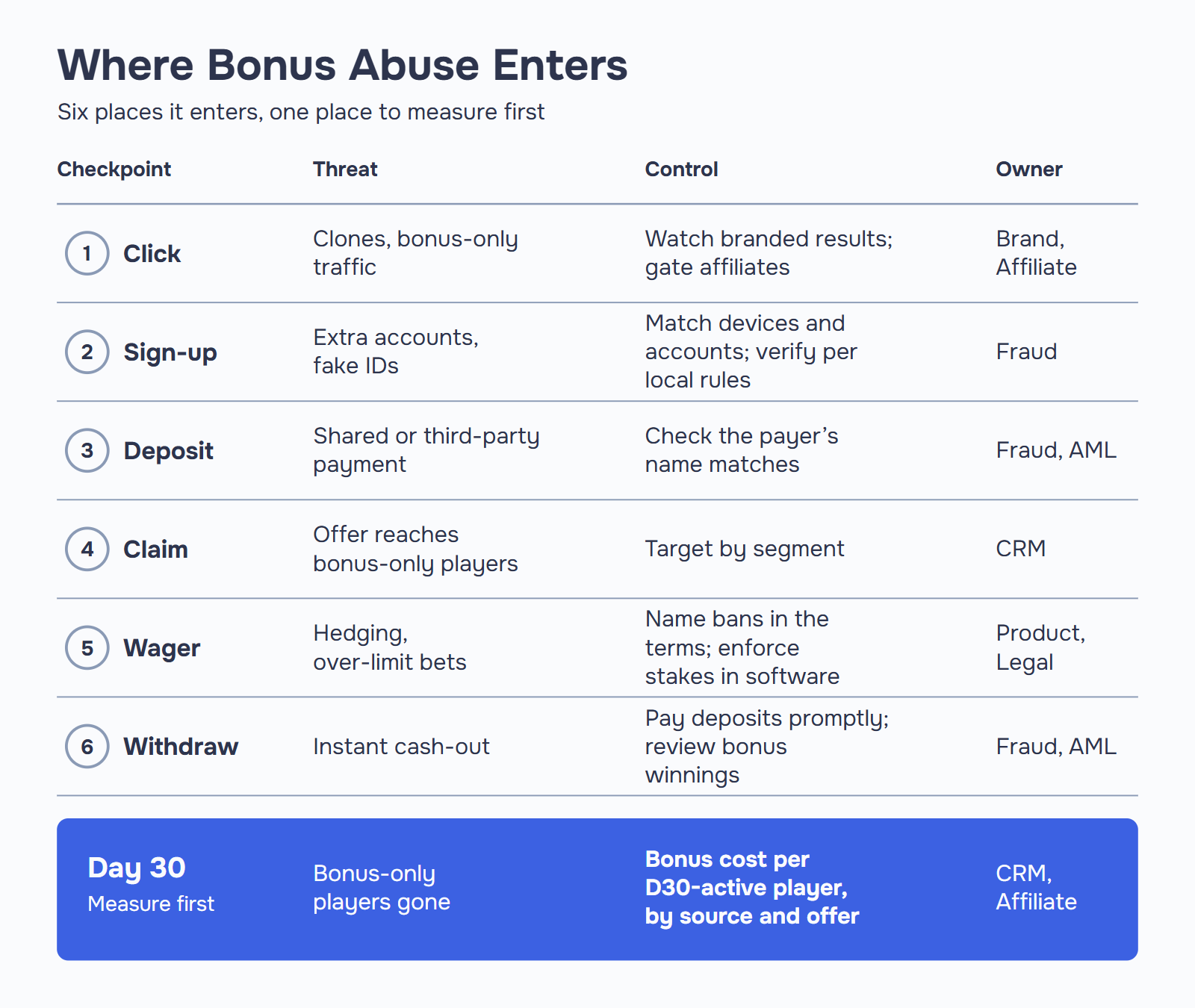
If your welcome-offer cohorts look strong at first deposit and empty at day 30, part of that gap is abuse and part is offer design. This guide shows how to tell them apart and what to change first. Clone sites that copy your brand and offers are a related leak.
What Should an Operator Do First About Bonus Abuse?
Start by measuring bonus cost per player still active at day 30, by traffic source, then add tiered detection, written terms and affiliate payment gates.
- Measure your own loss: the industry figures we found don’t hold up.
- Agree hold-first rules and two shared KPIs with fraud.
- Name banned behaviour in the terms and enforce limits in software.
- Pay affiliate CPA only on qualified players, held until the bonus clears.
- Check branded search results for clones in every market.
What Are the Main Types of Casino Bonus Abuse?
Casino bonus abuse takes four main forms: multi-accounting, bonus hunting, arbitrage and affiliate self-referral. Each leaves a different trace and sits with a different owner.
| Type | How it works | Trace in your data | Owner |
|---|---|---|---|
| Multi-accounting | One person or ring opens several accounts, under real, borrowed or synthetic identities, to claim a new-player offer repeatedly | Shared device, card or wallet; recycled KYC documents | Fraud, KYC |
| Bonus hunting | A genuine player takes welcome offers across brands, clears wagering at low variance and leaves | Minimum deposit, instant claim, withdrawal at the wagering threshold | CRM, bonus design |
| Arbitrage | The player covers all outcomes, so a free bet or bonus becomes near-certain cash | Hedged positions; free bets on markets that can be laid off | Trading |
| Affiliate self-referral | An affiliate registers its own accounts or pays kickbacks for sign-ups, collecting CPA while you also pay the bonus | High sign-up conversion, deposits below CPA, weak day-30 retention | Affiliate manager |
Not every case is fraud. The UK Competition and Markets Authority (CMA) treats multi-accounting and collusion as fraud, but a play strategy the terms did not clearly specify cannot be declared “abusive” after the event (CMA undertakings, 2018, extended to all licensees by the Gambling Commission).
How Much Does Bonus Abuse Cost? Measure It in Your Own Data
We found no audited industry figure for bonus abuse losses, so measure your own: surveys show only how operators rate the threat.
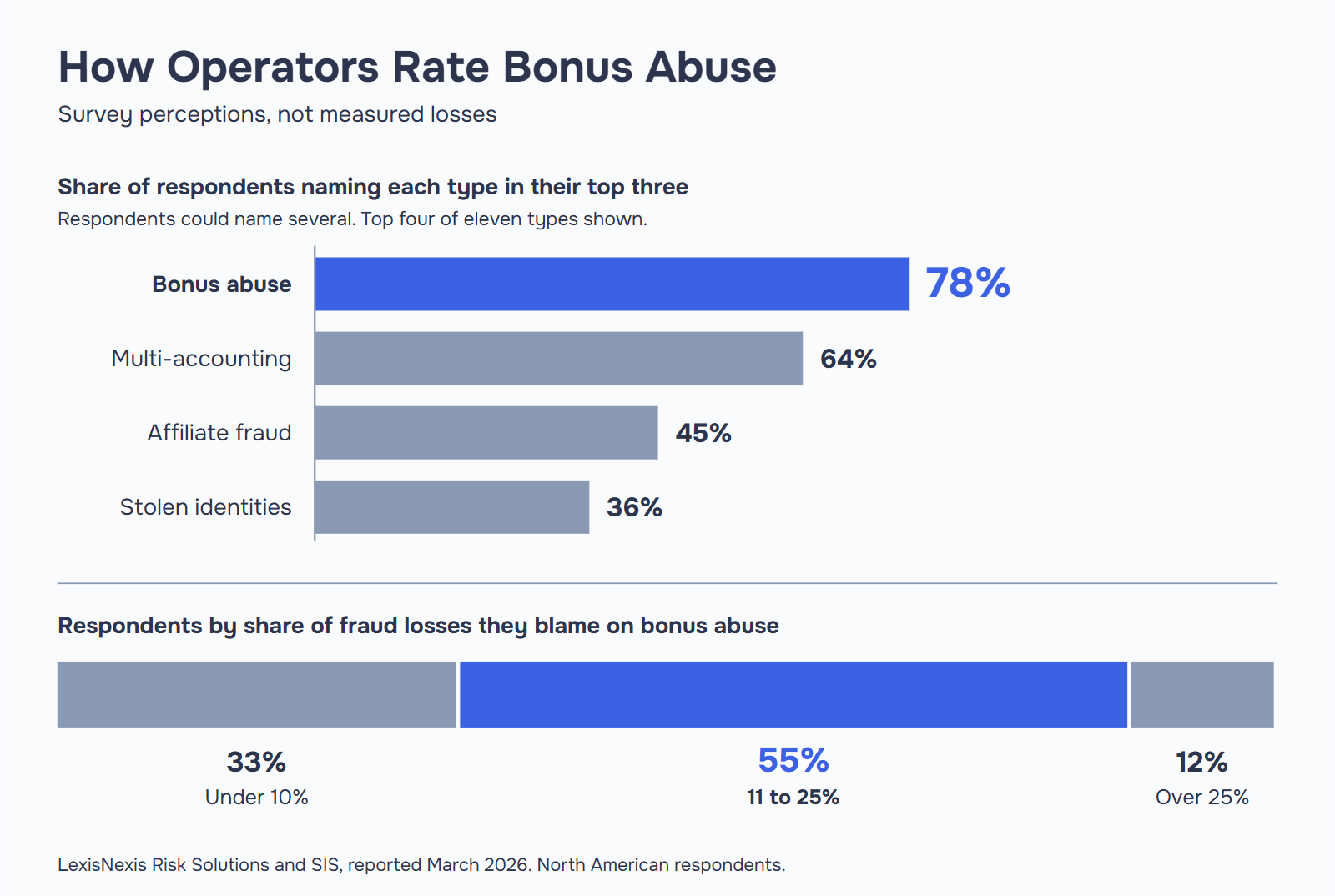
The circulating figures (“63.8% of fraud”, “10% of promo budget”, “15% of revenue”) misread one Sumsub survey of about 100 operators or name no data (Sumsub, Infosecurity Magazine). The best numbers we found are perceptions: 78% of North American respondents put bonus abuse in their top three fraud threats, and 55% attribute 11 to 25% of their fraud losses to it (LexisNexis Risk Solutions and SIS, reported March 2026, report).
Pull three measures per source and offer from the last three to six monthly cohorts (our method, not an industry standard):
- Bonus cost per D30-active player: the cohort’s bonus cost divided by players who bet real money in days 23 to 30. Fix your definition of “active”.
- Bonus-only share: players who claimed the bonus, deposited near the minimum, withdrew soon after clearing it and did not deposit again within 30 days.
- Budget at risk: bonus cost, CPA paid and duty for bonus-only players, minus the net revenue they generated.
The first ratio also rises with ordinary churn and offer size, so read NGR per D30 player beside it. Only the bonus-only and linked-account shares separate abuse from a weak offer.
In Great Britain, operators must in certain circumstances account for Remote Gaming Duty on freeplays staked (gov.uk), and the rate rose from 21% to 40% in April 2026 (CMS), so cost bonuses including duty.
How Does iGaming Fraud Detection Work for Bonus Abuse?
Operators detect bonus abuse by linking accounts through device, payment and behaviour signals, then respond in tiers so households are not blocked.
| Signal | What it catches | Where it misfires |
|---|---|---|
| Device fingerprint match | Multi-accounting from one device | Households sharing a tablet or PC |
| Same card, IBAN, e-wallet or crypto address | Multi-accounting, borrowed identities | Family members sharing a payment method |
| Shared IP address | Accounts from one location | Mobile networks: under carrier-grade NAT, hundreds of subscribers share one address (Cloudflare) |
| Minimum deposit, claim, lowest-variance play, withdrawal at the wagering threshold | Bonus hunting | High rollers who clear fast; skilled play inside the terms |
| Stakes that hedge each other, qualifying bets at minimum odds | Matched betting | Sharp bettors trip one or two flags |
These signals come from fraud vendors (SEON, Group-IB, Track360).
No regulator we found sets alert thresholds. Adapt Track360’s tiers (matched betting, bonus abuse) to your cohorts:
- Watch: one circumstantial signal, such as a shared IP or fast clearing. No restriction.
- Hold: two or more independent signals, such as device plus payment, or one conclusive finding. Freeze the bonus and bonus winnings for review, with a deadline.
- Act: a confirmed false identity, ring or linked accounts. The MLRO (money-laundering reporting officer) decides on a report first. Then close the account and void the bonus.
What happens to the money. Void the bonus and bonus winnings under a named term. Pay out the deposit balance or return it to its source, and freeze it only when fraud or money laundering is suspected, until the MLRO decides. UK (CMA undertaking 4) and Maltese (MGA art. 30) rules bar confiscating deposits. In the UK, disclosing a suspicious activity report can be a tipping-off offence (POCA s.333A); in Malta, advise the FIAU before drastic action (FIAU). Where play stayed within the terms, pay what is owed and take the player off future offers.
Agree two shared numbers with fraud: the share of holds released on review (your false-positive rate) and time to decision. A hold with no deadline is churn.
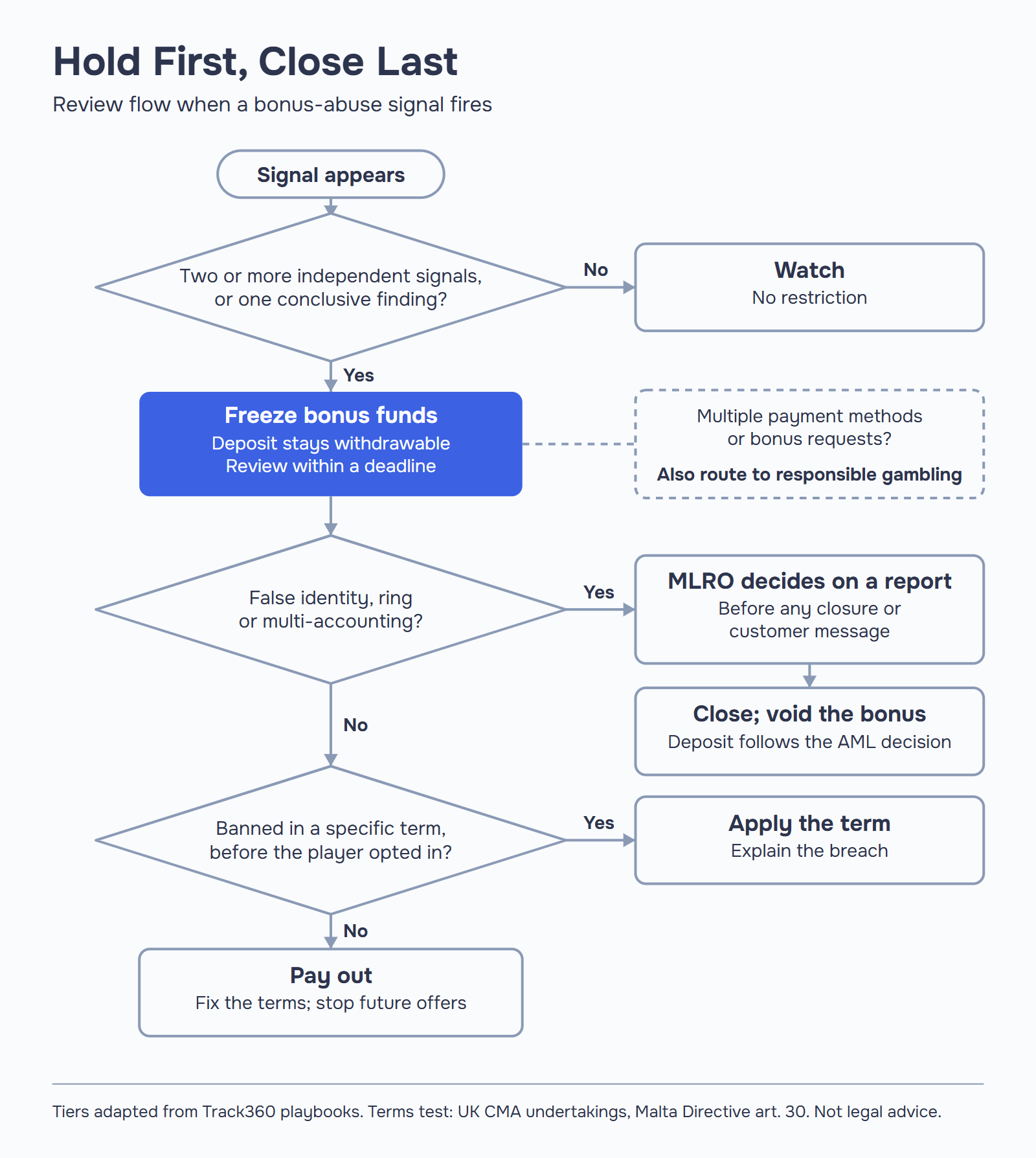
Route the queue to responsible gambling too: Malta’s directive lists multiple payment methods and bonus requests among problem-gambling indicators (MGA).
What Do KYC and AML in Gambling Have to Do With Bonus Abuse?
Red flags for money laundering in casinos include several accounts on one IP or device and deposits followed by minimal play, and bonus abuse can look the same.
KYC raises the cost of fake identities but not borrowed ones. Those are caught by checking that each payment method belongs to the account holder before play, and by linking accounts that share one; the UK regulator classes third-party payment methods as high risk (Harris Hagan).
- UK. Law-firm summaries say licensees must verify name, address and date of birth before a customer gambles (John Gaunt & Partners), and a withdrawal must not trigger a request that could have been made earlier. Move checks to sign-up and deposit.
- Malta. Customers are identified at sign-up and verified at €2,000 of deposits (lifetime or rolling 180 days; bonus funds excluded where separable). Withdrawals stop until verification is done, and operators must link a customer’s accounts and detect third-party identities (FIAU).
None of these regulators calls bonus abuse in gambling money laundering, but bonus-clearing play that ends in a quick withdrawal can look like layering. Fraud and AML should share signals and case notes; reporting stays with the MLRO alone, and CRM, affiliate managers and the player never learn whether a report exists.
How Can Bonus Design Reduce Abuse?
Bonus abuse prevention starts with bonus design: name banned behaviour in the terms, enforce rules in software and give offers to segments, not to everyone.
We found no published test showing that any one lever cuts abuse, so treat these as sound practice. The offer types follow lists from SEON and Group-IB; the controls are our practice.
| Offer type | How it leaks | First control |
|---|---|---|
| Welcome or sign-up bonus | Multi-accounting, bonus hunting | Target by segment; verify identity before release |
| No-deposit bonus or free spins | Mass sign-ups by bots or farms | Phone and device checks before credit |
| Deposit match | Minimum deposit, low-variance clearing | Maximum bet enforced in software |
| Reload | Bonus-dependent cohorts | Exclude players whose value is bonus-only |
| Free bets (sportsbook) | Matched betting | Minimum odds and market exclusions in the terms |
| Refer-a-friend | Self-referral, fictitious friends | Pay after the friend’s second deposit |
- Wagering. Great Britain capped wagering at 10× and banned mixed-product bonuses from 19 January 2026, law firms report (Harris Hagan, Wiggin). We could not confirm what the 10× applies to.
- Maximum bet. Enforce it in software: the CMA says a play restriction can bind deposit-funded play only if the software stops the breach.
- Banned patterns, in advance. The CMA requires prohibited play to be specified up front, fraud terms kept apart from play restrictions, and a full explanation for lost winnings. Malta allows confiscation only in situations named in the terms, and proportionately (Directive art. 30(3)(d)).
- Segmentation. Trigger reloads on a real-money session, suppress offers for accounts whose deposits are all qualifying minimums, and pause offers for accounts under review. A welcome offer cannot be private in paid acquisition, so segment after the first deposit.
- One change at a time. Test by landing page or affiliate deal, since an advertised offer must be honoured. Fix the metrics first (bonus cost per D30-active player, NGR per first deposit, bonus-only share, complaint and hold volume), read at day 30 and keep a 10% holdout, as our CRM retention guide recommends.
How Do Affiliate Fraud and Low-Quality Paid Traffic Drain the Promo Budget?
Affiliate fraud and bonus-led traffic drain promo budgets through CPA: you pay the partner for a first deposit and the player a bonus, and neither returns.
Define a qualified player tightly, hold CPA until the bonus clears, and judge each source by day-30 activity. The usual forms are self-referral, undisclosed incentivised traffic and bonus-only traffic: players who claim the welcome offer, clear it and withdraw. Agreed incentivised traffic is a pricing question, so give it its own rate. We found no independent affiliate-fraud rate, and vendor figures give no sample, so measure your own.
Exposure depends on the deal, in our experience:
| Deal | Where abuse hits | First control |
|---|---|---|
| CPA | You pay on the first deposit; the abuser clears the bonus and leaves | Qualified-player definition; CPA held until the bonus clears; clawback for fraud |
| RevShare | A bonus-funded win makes NGR negative; with no negative carryover you absorb it | Carry negative balances forward (example) |
| Hybrid | The CPA part is paid up front, as in CPA | Smaller CPA part; deferred tranche |
Four controls cost little:
- Pay CPA only on qualified players. Define it in the deal: minimum deposit, minimum wagering, KYC passed, no link to an existing account (Trackbox shows such gates).
- Defer part of the CPA. Pay the rest only if the player is active at day 30, or move bonus-heavy sources to RevShare. Bonus-led sources look strong on first deposits and weak afterwards (CRM guide).
- Flag outliers per affiliate. Watch first deposits at exactly the qualifying minimum, KYC-fail rate, linked accounts, early withdrawals, chargebacks and second-deposit rate, and feed the fraud score back to the tracker.
- Put it in the contract. Declared sub-affiliates, no bidding on your brand terms, approval for incentivised traffic, CPA clawback and audit rights. UK licensees answer for their affiliates’ practices (CMA/GC letter, 2019).
Paid acquisition for iGaming needs the same test by campaign: compare day-30 activity and KYC-fail rate, keep brand-term campaigns out of blended CPA, and test creative that does not lead with the bonus.
How Do Clone Sites Hurt Your Brand and Offers?
Clone sites copy your brand and offers to take players who are searching for you, and when the clone stops paying, its victims’ complaints land on you.
ICODA sells brand protection, and the case below is ours. A licensed crypto casino with its core players in Pakistan, India and Bangladesh found a copy with an almost identical name that had cloned its interface, bonus system and marketing copy, bought traffic in the same markets and then stopped paying players. Players could not tell the two apart, and complaints reached the original. We have no data on how much bonus budget clones cost; the damage we can show is diverted traffic and lost trust.
Over eight weeks we filed removal requests with Google and Bing, resubmitting the rejected ones, ran warning ads on the copy’s branded query in Pakistan (5,645 clicks, $2,062 spent) and placed 530 assets such as articles, videos and comments. The copy was out of Google’s results after 32 days. What held for a year with no further spend was our materials filling the results for its name. The client is under NDA, and these figures are self-reported (full case).
In October 2026 the Dutch gambling regulator had 26 sites on misleading domains taken offline within 48 hours; nearly all were copies of licensees’ sites (KSA). Not every clone offers a bonus; many redirect players to illegal operators. Check your branded queries in every market you serve, including small ones: a copy can live in one country’s results and stay invisible from the office (guide to online brand protection).
Frequently Asked Questions (FAQ)
Promo abuse, or bonus abuse, is using a casino promotion in a way the operator did not intend, such as multi-accounting or hedged play.
Bonus abuse can amount to fraud where false or borrowed identities are used. One honest player hedging or hopping between offers is generally a terms matter, and in the UK the terms must name that behaviour in advance. This is general information, not legal advice.
A bonus hunter is a real player who takes offers within the rules; a fraudster uses false or borrowed identities or a ring of accounts. Hunters breach terms at most.
You can limit the damage by freezing bonus funds for review instead of closing accounts, enforcing limits in software and keeping a complaint route open. We found no published test of how well this works.
ICODA checks your branded results in each market you serve for clones, typosquats and fake brand pages. Request a brand protection audit.
Share with


Rate the article