A white label casino is a ready-made casino brand that runs on a provider’s platform and, in most deals, its license, in exchange for a share of your revenue.
A white label online casino can launch in 3–8 weeks. The deal usually leaves out who owns your domain, who holds your player data and who the regulator holds responsible. Vendor pages skip those points because each one sells its own platform. This guide is vendor-neutral. Use it to choose a route (white label, turnkey or your own license), to price the deal, and to write the questions your provider must answer before you sign.
How Does a White Label Casino Work?
You bring the brand, the markets and the marketing; the provider brings the platform, games, payments, back office and, usually, the license.
The provider’s package covers casino software, game content, payment gateways, KYC tools and hosting. You handle player acquisition and, depending on the deal, customer support. The provider charges a setup fee, a share of revenue or both. Most white label casino solutions are priced this way, and the same platform usually runs several other brands.
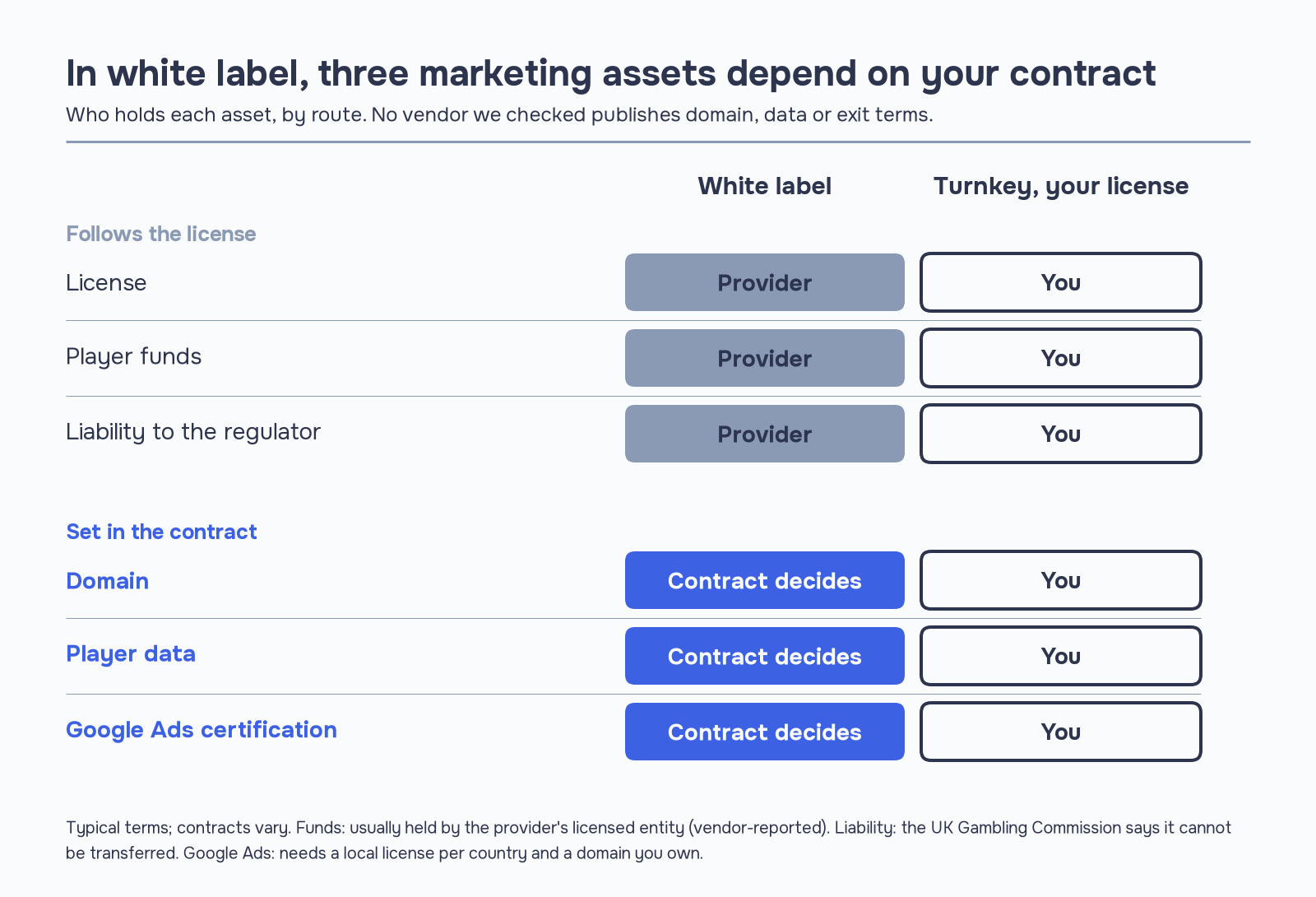
The UK Gambling Commission holds the license holder responsible for a white-labelled site. That responsibility “cannot be transferred”, and the brand counts as a marketing partner. Payments usually run through the provider’s licensed entity, which holds the funds (vendor-reported).
Is a White Label Casino Legal in 2026?
Yes, where the local regime allows it: the UK and the Isle of Man do, and Curaçao ended its sub-license model in 2024.
- UK: allowed as a license holder plus a marketing partner.
- Isle of Man: a formal sub-license category exists.
- Gibraltar: the 2026 Gambling Act lets a B2C license cover white labelling, per a law-firm summary (check the Act).
- Curaçao: the new law (LOK), in force since 24 December 2024, ended the master and sub-license system, and the last master license expired on 31 January 2025. Providers still selling “Curaçao white label” now run those domains through their own licensed entity or, per one law firm, through setups the regulator pre-approved. We found no regulator text on the conditions, so get a written answer from local counsel before you pay anyone.
What Happens When the Provider Loses Its License?
If the provider loses its license, every brand on it loses the market, whatever its own record.
Stake’s UK site ran on TGP Europe’s white label and closed by 11 March 2025. On 16 May 2025 TGP surrendered its UK license rather than pay a £3.3m penalty, after the regulator found weak checks on its partner brands. More than ten white label brands it hosted closed in Britain, including shirt sponsors of two Premier League clubs. Your marketing spend in that market goes with it.
How Much Does a White Label Casino Cost?
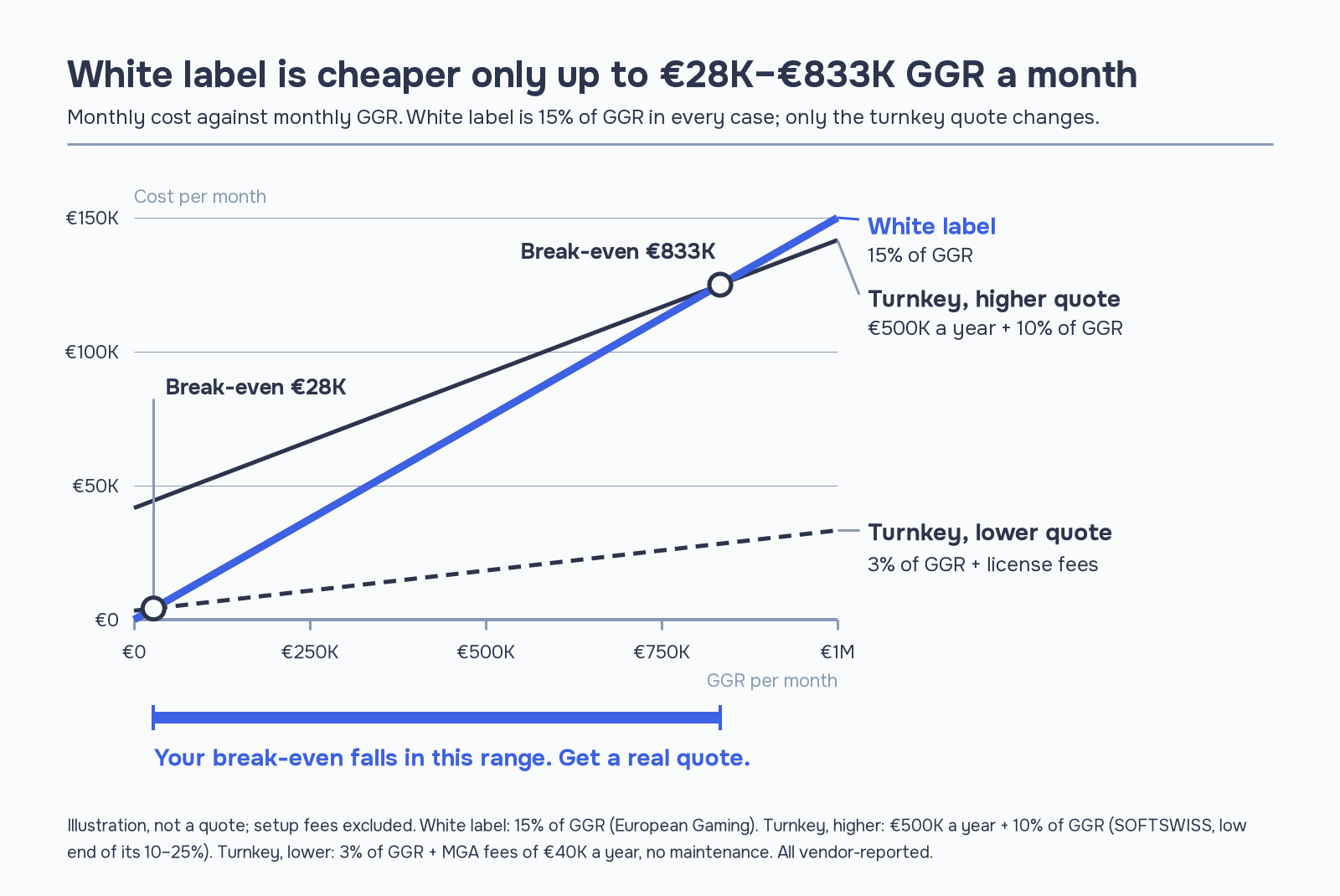
Expect €20,000–60,000 upfront, then a revenue share that outgrows the setup fee as you scale.
No major online casino white label vendor publishes a binding price list, so treat every figure here as a vendor or trade-press estimate:
- Setup. SOFTSWISS’s own comparison puts white label at €20,000–60,000 and turnkey at €60,000–100,000+. European Gaming’s explainer quotes about €13,000–135,000, depending on customization. Ask what the white label online casino software fee includes.
- Revenue share. European Gaming puts white label at up to about 15% of GGR and turnkey at 2–5%. Symphony Solutions quotes 10–30% of NGR for white label, and SOFTSWISS quotes 10–25% of GGR or NGR for turnkey. Before you compare, ask which base each percentage uses and what comes off first (bonuses, payment fees, taxes): NGR is whatever the contract defines.
- Monthly fees. Symphony Solutions, which sells a no-revshare platform, quotes $5,000–50,000 a month. Treat it as a rough guide.
- Minimum guarantees, exclusivity and exit fees. We found none published for any white label deal. Ask for them in writing.
- Pass-through costs. SOFTSWISS estimates card processing at 1.5–3.5% of volume and crypto at 0.5–1%. Visa cut its excessive-chargeback threshold to 1.5% in April 2026 in most regions (not CEMEA).
At €500,000 in monthly GGR, a 15% share is €75,000 a month, or €900,000 a year. The setup fee was €20,000–60,000. Negotiate the share and its base first.
What About a Crypto Casino for Sale?
A crypto casino for sale is faster than building one, but you own only what the contract transfers: license, domain and players are not automatic.
Two ended Flippa listings of white label casino brands asked 1.4× and 2.2× annual profit; both figures are seller claims. The seller of the Anjouan-licensed brand claimed the license, entity, player database and platform contract would transfer. The UKGC and MGA-licensed listing did not address the license. Curaçao’s LOK licenses cannot be transferred, according to law-firm guides, so a buyer needs its own. Clone scripts of well-known crypto casinos have no verifiable prices, and WSN and LCB have documented counterfeit Pragmatic Play and Yggdrasil slots.
Before paying, ask for the license holder’s name, the domain registrar login and a sample player export.
White Label vs Turnkey vs Own License: Which Route Fits?
Choose white label to test a market in weeks, turnkey to own your license and brand, and a custom platform only with seven-figure funding and a team.
| White Label | Turnkey (Your License, Vendor Platform) | Own License, Own Platform | |
|---|---|---|---|
| License holder | Provider | You | You |
| Upfront cost (vendor-reported) | €20,000–60,000 | €60,000–100,000+ for software; €500,000–1M for year one with license and operations | €2.5–4M to build, plus compliance |
| Ongoing | Revenue share: up to ~15% of GGR or 10–30% of NGR | License fees (MGA €25,000 a year, Curaçao about €47,450) plus platform fees, quoted from 2–5% of GGR to 10–25% plus €9,000–28,000 a month for maintenance | License fees plus your own tech and compliance team |
| Time to market | 3–8 weeks | Software up to 3 months, plus license: 3–4 months in Curaçao, 6–9 in Malta (law-firm and vendor estimates) | Years |
| Control | Low: the provider can switch you off | High over brand, domain, data and ad accounts | Full |
| Marketing limits | Domain, data export, tracking and ad certification depend on the contract | You own them; the work is yours | Same, and you build every tool |
| Main risk | The provider’s license problems become yours | License cost and compliance fall on you | Cost and time |
Sources: SOFTSWISS guides (Oct 2026), MGA fee guidance note (Dec 2024), reports on CGA fees, law-firm guides. Confirm every figure with the provider and regulator.
The route does not change what a depositor costs in the market. A brand on someone else’s license pays the same price and may get fewer tools to lower it.
- Pick white label to test markets cheaply, if you accept the provider’s license, domain terms and revenue share.
- Pick turnkey when you already know your markets and can fund the license. Curaçao’s regulator shut its licensing portal permanently on 7 October 2026, so new application timelines are unclear.
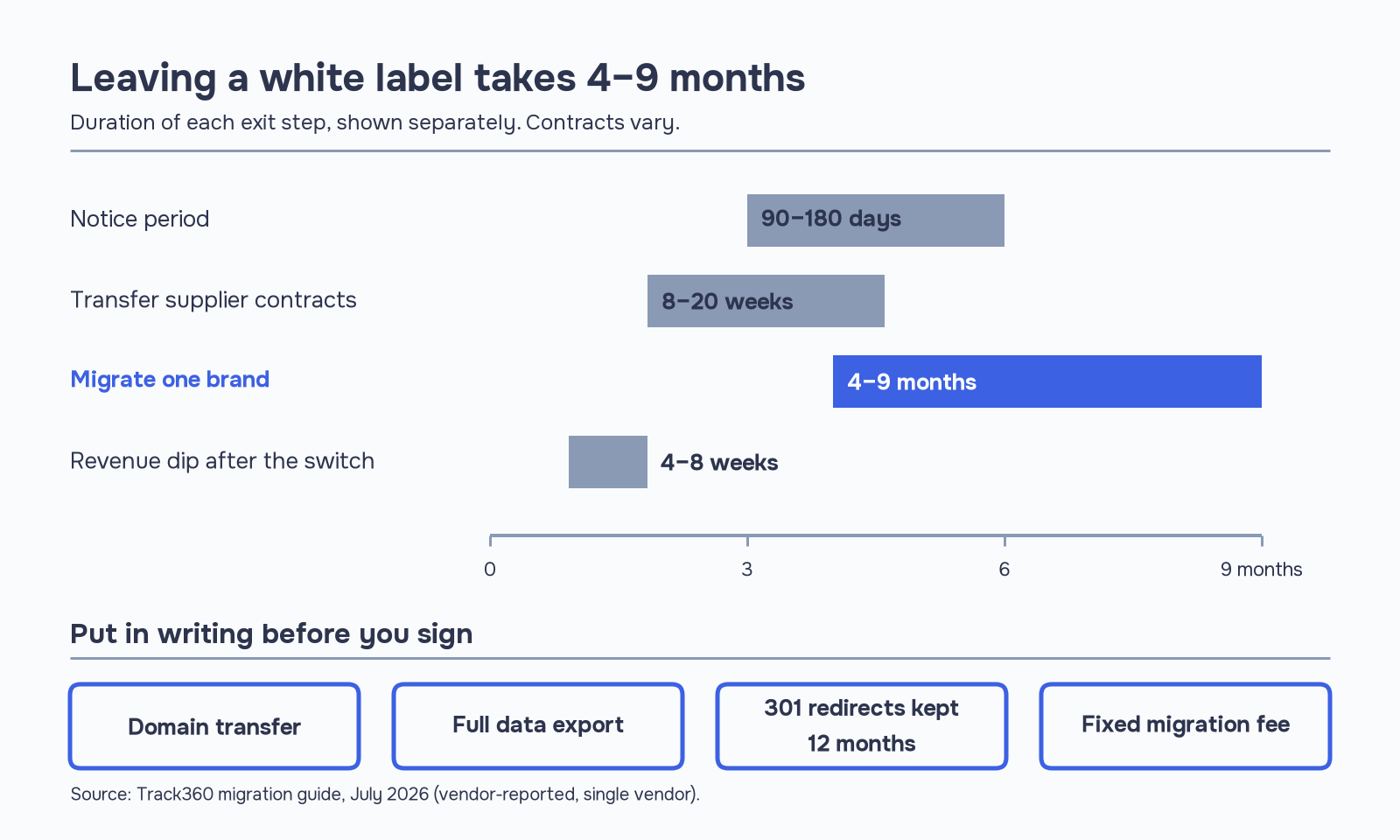
- Plan your exit before you sign. SOFTSWISS says moving from white label to turnkey to enter regulated markets needs new investment, re-certification and regulatory approval, and Track360’s migration guide puts a single-brand move at 4–9 months.
For license costs by country and a full launch budget, see our guide to starting an online casino.
What a White Label Casino Does Not Give You
A white label does not give you players: brand demand, search visibility, ad access and trust are still yours to win, and the contract can limit each one.
- Brand demand. Brand names make up 17% of online casino search volume and under 1% of crypto casino volume (ICODA’s casino SEO strategy study), so a new brand has almost no demand to inherit. For US searches such as “crypto casino” and “bitcoin casino”, operators held none of the 16 top-10 slots in our September 2026 scan of 72 ranking domains.
- Search visibility. A white label casino platform decides what crawlers see. In September 2026 we audited two client crypto casinos, neither confirmed as a white label. Crawled without JavaScript, 37.5% of one site’s URLs, every casino page, came back as an empty HTML shell; on the other, 145 of 150 sampled URLs had no title or links. GPTBot, ClaudeBot and PerplexityBot do not run JavaScript (Vercel and MERJ, December 2024), so a lobby built that way can be invisible to AI answers.
- Inherited settings. In our AI-crawler study, one identical robots.txt file sat on 22 gambling domains whose names suggest white label sites for India. It blocked dozens of AI bots. That pattern fits a vendor template, and the operators may never have read it.
- Paid ads. Google gambling certification needs a local license for each country you target. Since 23 March 2026 it also needs a domain “owned and operated by the advertiser”, and since 26 August 2026 the footer must show the licensee’s name and license number. A brand on an offshore license cannot certify in markets that demand a local one.
- Markets. A provider’s license covers only markets that accept it. A Curaçao or Anjouan license gives no right to serve the UK, and Ontario charges CAD 100,000 per gaming site a year.
- Trust. Your footer and terms name the provider’s license holder, and the TGP case shows what a shared license means when it fails.
White Label Casino Provider Checklist: What to Ask Before You Sign
Get written answers to eight marketing questions before you sign with a white label casino provider; vendor documentation says nothing on domain, data or exit.
Our review of vendor documentation in October 2026 found no provider that publicly states who registers the domain, in what format player data is exported, or what leaving costs. SOFTSWISS’s SEO guide (June 2026) lists editable meta tags, hreflang, per-locale sitemaps and Google Tag Manager. It does not mention server-side rendering, canonicals or 404 handling. Put marketing into the white label casino integration plan from day one.
| Area | Ask the Provider | Red Flag |
|---|---|---|
| Domain | Which entity registers the main domain and every mirror? Do I get registrar and DNS access on day one? | Provider-owned domain; transfer “on request” |
| Tracking and postbacks | Which events fire server-side (registration, FTD, deposit)? Can they post to Meta CAPI, Google’s APIs and my tracker in real time? | Browser tags only, so ads optimize on registrations instead of deposits |
| CRM and player data | Am I the data controller? Can my own CRM read a live feed, and can I export the full player table, consents, transactions and bonus state? | Account-level CSV only; connector fees |
| Bonus engine | Is the revenue share on GGR or NGR, and which bonuses are deductible? Can I set offers per country and per affiliate? | One global welcome offer; no abuse controls |
| Affiliate module | Is it included? Who owns the tracking domain? Can I export the affiliate-to-player mapping and commission ledger? | Tracking links on the provider’s domain break on exit |
| SEO, hreflang, rendering | Show me view-source of a game page. Can I edit title, H1, canonical, robots.txt and llms.txt per page and locale? Do unknown URLs return a 404? | Empty HTML shell; game descriptions shared with other brands |
| License and trust | Whose entity and license number go in my footer? How many brands share it? What happens if it is suspended? | Refusal to name the license holder or sister brands |
| Exit | Domain transfer, full data export, 301 redirects kept 12 months and a fixed migration fee, in writing | “Best efforts” assistance billed by the hour |
Run three checks yourself before launch:
- Open view-source on a game page. If you see an empty container and no text or links, AI crawlers see nothing. Our casino SEO audit lists the full test.
- Request a game URL that does not exist, such as /games/zzzz-test. It must return a 404, not a 200 page.
- Check that each locale has its own hreflang tags and sitemap.
First 60 Days of Marketing for a White Label Brand
In the first 60 days, fix tracking and indexation, recruit affiliates and test one or two markets; expect little SEO traffic and a high launch CPA.
- Days 1–14, foundations. Confirm the domain is registered in your name. Wire server-side deposit events. Run the rendering test. Publish license, responsible-gambling and brand pages, and claim review profiles. Set a stop-loss before the first dollar of spend.
- Days 15–30, first traffic. Recruit affiliates with a CPA plus RevShare offer; Track360 benchmarks put affiliate warm-up at 30–90 days (vendor-reported). Publish launch coverage in outlets that accept gambling content. Paid placements are a fast way to get that coverage. Open paid ads only where your license and domain pass certification.
- Days 31–60, cut and scale. Drop the weakest affiliates and channels. Add retention through a CRM on the live data feed. Add game, bonus and payment pages. Put budget behind the one or two markets that deposit.
Budget for expensive depositors. In ICODA’s CPA Index, two operators’ pre-launch plans budgeted 2–3× the market CPA for a new brand’s first 8–12 weeks. Those are planning figures, not results. One plan halts scaling when CPA stays above $150 for two consecutive weeks in Kazakhstan. SEO is slower still: Ahrefs’ 2023 data found only 1.74% of new pages reach the top 10 within a year, so treat these 60 days as setup.
Our iGaming marketing team can build this plan with you. If your players are mobile first, a branded app is the next build; see casino app development.
Planning a white label launch? Tell us your provider, target markets and budget in the ICODA calculator, and we will send a white label launch marketing plan within 24 hours.
Frequently Asked Questions (FAQ)
A casino brand that runs on a provider’s platform and, usually, its license. In an online casino white label deal you handle branding and marketing, and the provider takes a share of revenue.
Yes in regimes that allow it, such as the UK and the Isle of Man, and, per law firms, Gibraltar. Curaçao ended sub-licensing in 2024, so confirm your setup with local counsel.
About €20,000–60,000 upfront (SOFTSWISS), plus a revenue share quoted at up to 15% of GGR or 10–30% of NGR.
Vendors quote 3–8 weeks. Turnkey and own-license routes take months longer because of licensing.
Yes, but it is a migration: a new license, new platform contracts and regulatory approval. Get domain and data export rights into the first contract.
Share with


Rate the article