iGaming CRM exists to move a first-time depositor to a second deposit, and no public source we found says how often that happens. It is also called player CRM or casino CRM. This guide covers online casinos and sportsbooks.
Disclosure: ICODA is a Customer.io partner and implements it for clients, so we have a commercial interest in Customer.io, one of the four platforms below.
What Are Typical iGaming Player Retention Rates?
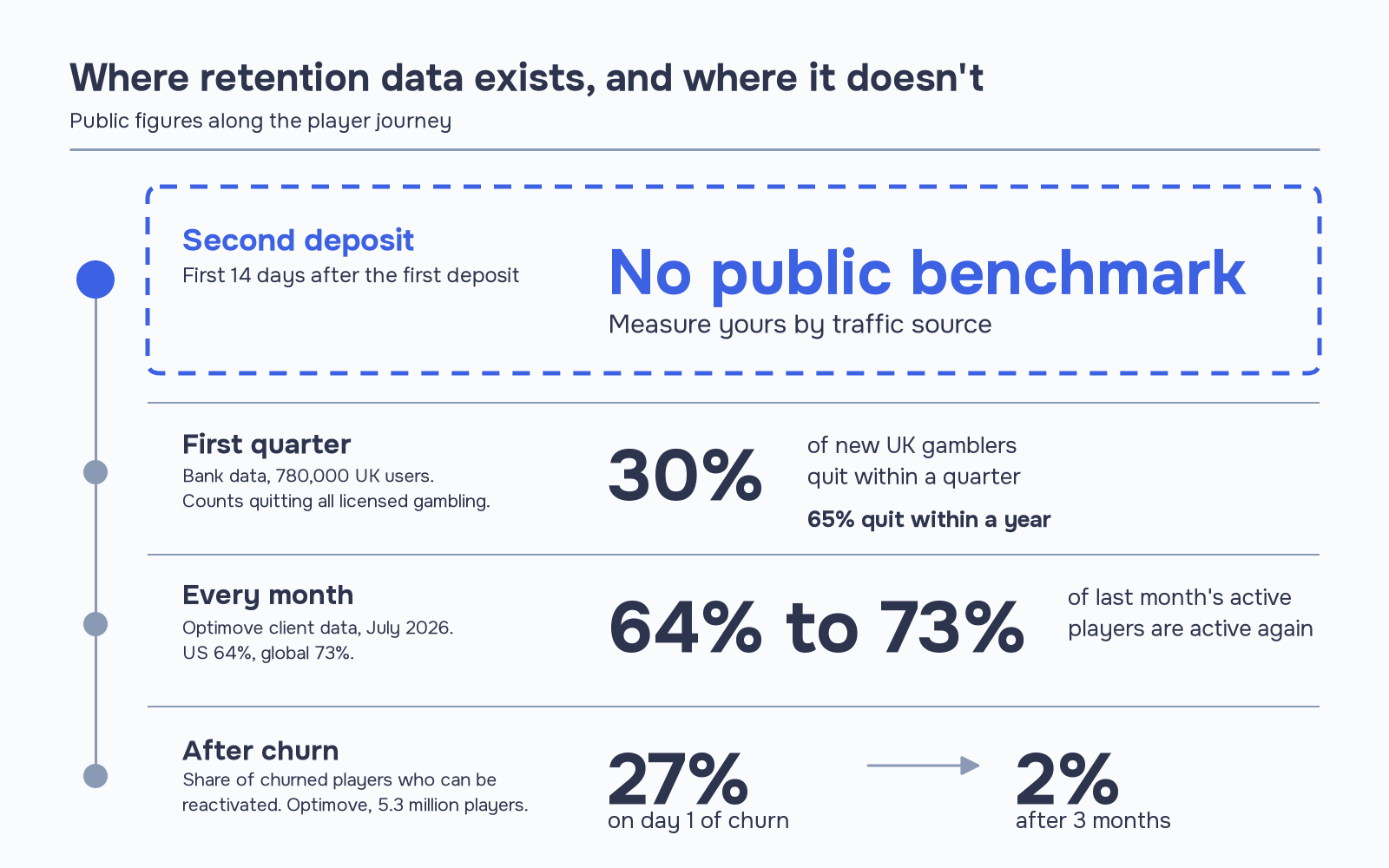
Public data is thin and mixes scopes: about 30% of new UK gamblers quit within a quarter; one vendor shows 27 to 36% of active players lapsing in a month.
- About 30% of new UK gamblers quit after one quarter and 65% within a year, in bank data on about 780,000 users (Department of Trust, 2025). It counts quitting all licensed gambling, so churn from one brand is higher.
- In July 2026, Optimove’s client data showed 64% of US and 73% of global players active a month earlier were active again.
- 27% of churned players could be reactivated on day 1 of churn and 2% after three months (Optimove, 5.3 million players).
- The top 10% of GB online accounts produced 79% of operator revenue (Forrest & McHale, 2024, seven operators, 2018 to 2019 data).
- Flutter reported average projected payback under 18 months on FanDuel’s US customer acquisition, and DraftKings works to a three-year payback rule. At that pace a typical player lost in month two has not covered acquisition cost.
In our CPA Index, two operators’ pre-launch plans budget CPA at 2 to 3 times benchmark, and one assumes D30 retention of 8 to 16% in Kazakhstan and Russia.
No public source we found gives a second deposit rate for casinos or sportsbooks, a lift figure for bonus-expiry reminders, a cost benchmark for casino reactivation, or an independent link between loyalty schemes and long-run retention. Claims like “55-65% never make a second deposit” circulate without a source. Measure your own.
Which Lifecycle Stages Should an iGaming CRM Cover?
An iGaming CRM covers five stages, and each needs its own message and its own metric.
| Stage | Entry rule | CRM job | Metric |
|---|---|---|---|
| Registered, no deposit | Registered, no FTD | Remove friction: KYC, payment methods, trust proof (the casino trust gap) | Registration to FTD |
| FTD, no second deposit | First 14 days after FTD | Earn a second session and a second deposit | Second deposit rate |
| Active | Played in the last 30 days | Cross-sell products, build the habit | Monthly active retention |
| VIP | Operator’s spend threshold, plus harm and affordability checks | Personal service inside the rules | VIP share of NGR |
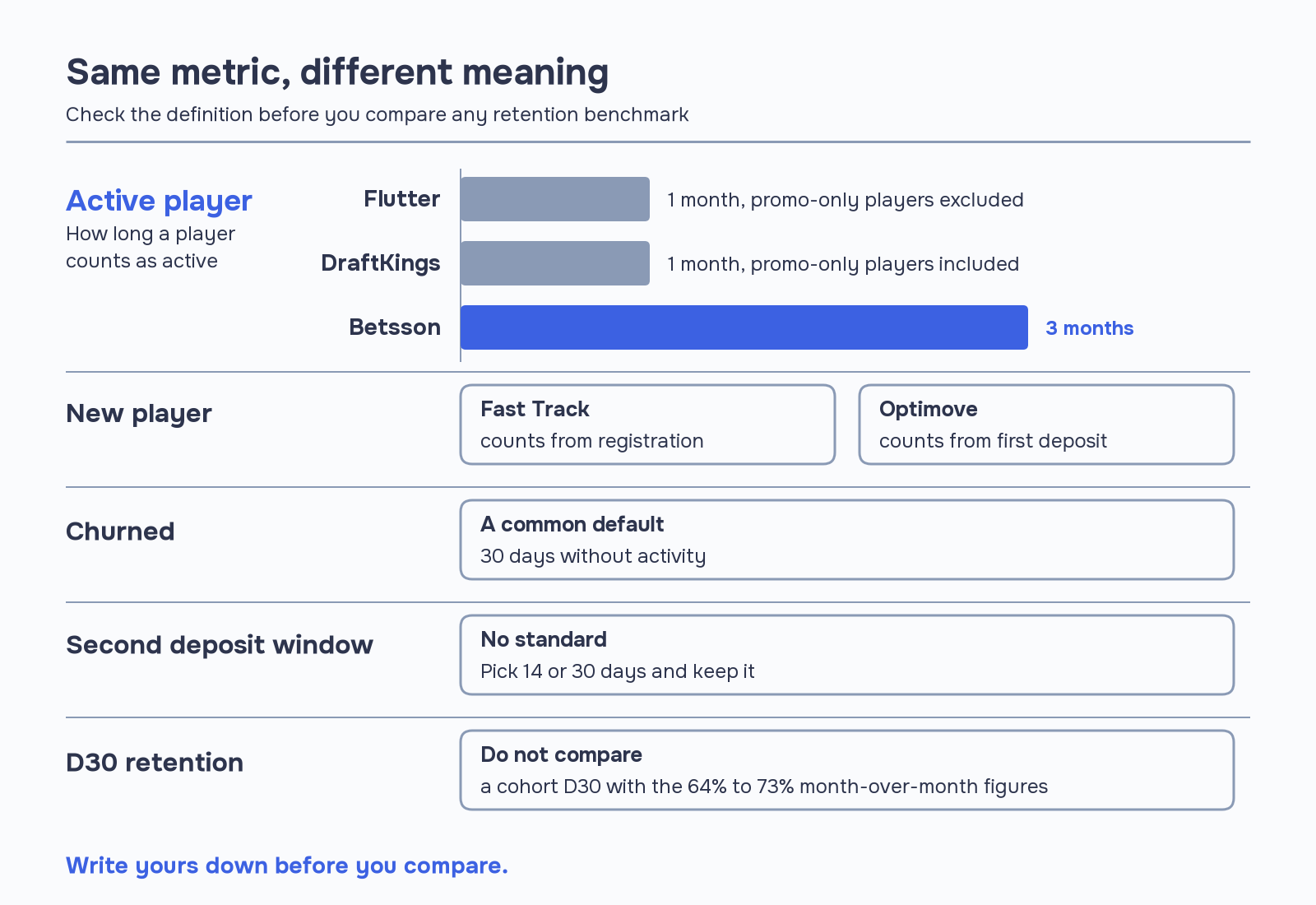
| Churned | 30 days without activity is a common default | Win back early | Reactivation by days since last play |
Vendors set windows differently: Fast Track’s “New Signup” counts from registration, Optimove’s “new” from the first deposit.
How Do the Main iGaming CRM Platforms Compare?
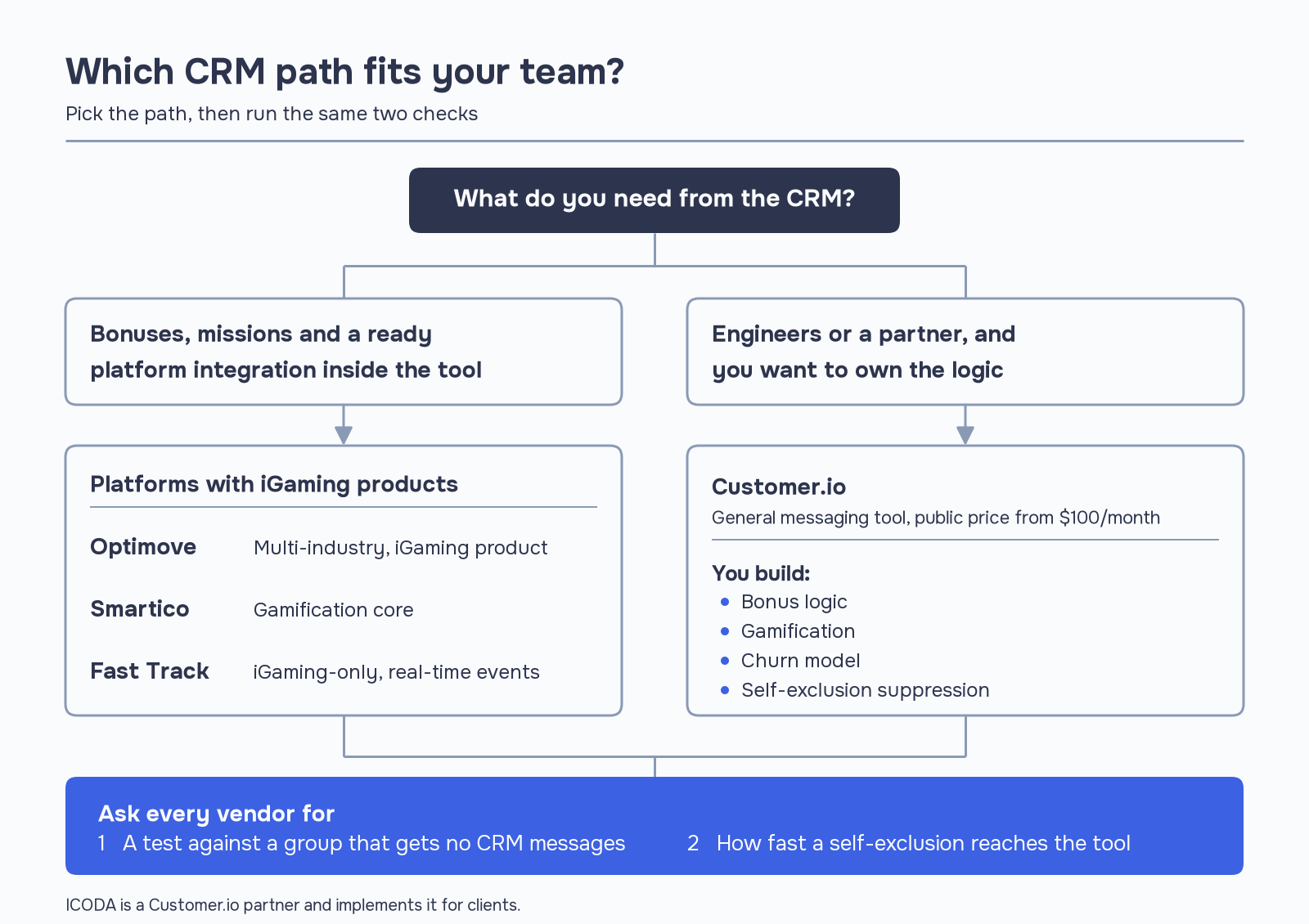
Optimove, Smartico and Fast Track sell iGaming products, while Customer.io is a general messaging tool that needs bonus and self-exclusion logic built on top. We include Customer.io because ICODA implements it.
| Feature | Optimove | Smartico | Fast Track | Customer.io |
|---|---|---|---|---|
| Type | Multi-industry CRM with an iGaming product | iGaming CRM with gamification | iGaming-only CRM | General messaging automation |
| Data in | Batch (daily or hourly) or event stream | Database replica, Kafka/RabbitMQ or REST | Real-time events; 21 named iGaming platforms† | API, SDKs, warehouse sync; no iGaming integrations |
| Bonuses, gamification | Promotions and Gamify† | Gamification core; bonuses issued via your platform’s API | Rewards engine† | None native; call your platform’s bonus API |
| Churn model | Yes† | Paid add-on | Yes† | None native |
| Self-exclusion | Pre-send compliance check† | Self-excluded get no marketing by default | Responsible-gambling flags in player model† | Not built in; model it yourself |
| Telegram | Via partner (Scoreconnect) | Native bot channel | Listed integration† | Not native; webhook or third-party connector |
| Pricing basis | Data volume, active profiles; no public price | Monthly active users; no public price | Defined “Active Player” plus fees; no public price | Public; entry tier $100/month |
| Gambling policy | Sells to operators | Sells to operators | Sells to operators | Allowed; age and jurisdiction checks for SMS; affiliates need own SMTP |
| Published evidence | ROI and uplift claims, some against control groups | No named-operator figures found | Operator estimates, mostly productivity | No iGaming case study |
| Fits (our read) | Multi-brand operators; startups via Ignite+ | Small and mid operators wanting gamification | Multi-market operators wanting real-time data | Teams with engineers or an implementation partner such as ICODA |
† Vendor marketing claim, not tested. Unmarked cells come from documentation or contract terms. Checked 19 October 2026.
How to choose:
- If you need bonuses, missions and a ready integration with your platform inside the CRM, shortlist the three specialists.
- If you have engineers or a partner and want to own the logic, Customer.io works, and you build bonus, gamification and suppression yourself.
- With any vendor, ask for a test against a group that gets no CRM messages, and ask how fast a self-exclusion reaches the tool.
Which Triggered Flows Raise the Second Deposit Rate?
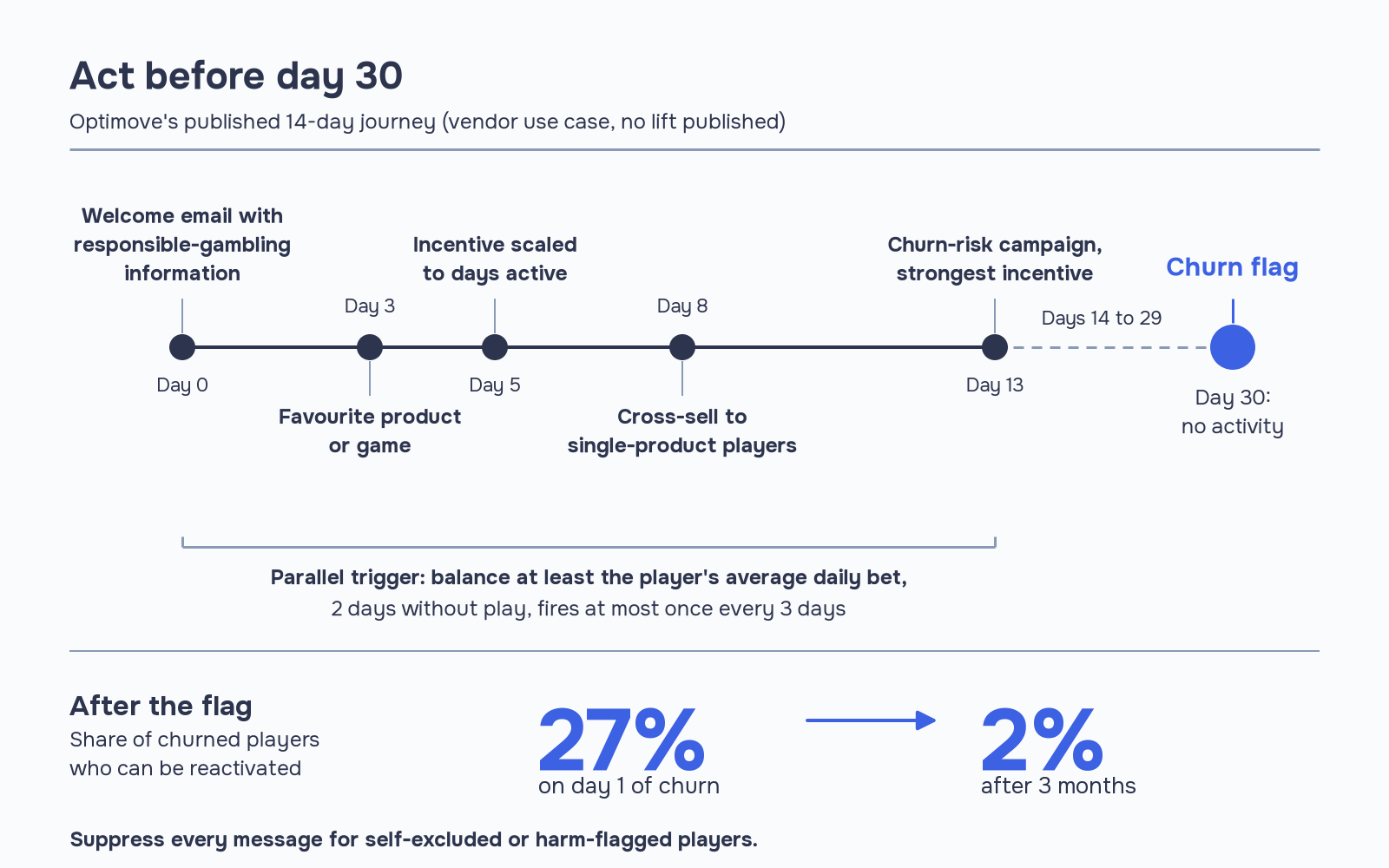
Casino retention strategies start with four triggered flows in the first 14 days after a first deposit: welcome, deposit recovery, bonus expiry and churn risk. Optimove’s published new-player journey shows the order (vendor use case, no lift published):
| Day | Message | Goal |
|---|---|---|
| 0 | Welcome email with responsible-gambling information | Explain the product, point to limits tools |
| 3 | Favourite product or game | Second session |
| 5 | Incentive scaled to days active | Second deposit |
| 8 | Cross-sell to single-product players | Widen play |
| 13 | Churn-risk campaign with the strongest incentive | Last offer before lapse |
A parallel trigger fires when a balance is at least the player’s average daily bet, two days pass without play, and it has not fired in three days. Suppress every row for self-excluded or harm-flagged players. Some markets restrict incentives like these; see the rules below.
What Should a Welcome and KYC Flow Do?
A welcome flow should send its first message within a day of registration and point to the player’s next step: KYC or the first deposit. In Xtremepush’s own report, Superbet’s personalised welcome video email on day 1 raised FTD conversion by 2.2 percentage points in a two-month A/B test (iGaming Business). NetBet’s SMS offered a Silver tier and 50 free spins for uploading KYC documents.
How Do You Recover Failed Deposits?
Recover failed and abandoned deposits before you send any offer: a declined second deposit looks like churn in the data. Stake showed a pop-up when a player started a deposit and did not finish it (Optimove case study, no test design published). First-time depositors complete the cashier 28 to 40% of the time and repeat depositors 65 to 78% (Fluid Payments, vendor data, 2026).
How Should Bonus-Expiry Reminders Work?
Bonus-expiry reminders should state progress and expiry in plain terms, because several markets limit urgency and personalised timing. GB has capped wagering at 10x and banned mixed-product bonuses since 19 January 2026. The Netherlands bars shaping bonus timing around an individual’s play, and Sweden allows a bonus only at a player’s first play with a licensee. Bonus hunters show up as high FTD and near-zero D30 from one source (casino marketing problems).
How Do You Run a Casino Reactivation Campaign?
Stage a casino reactivation campaign by days since last play: 27% of churned players can be reactivated on day 1 of churn and 2% after three months. Use the early signals above to act before the 30-day churn flag, and track offer cost per returning depositor.
What Consent Rules Does Each CRM Channel Carry?
Each channel has its own consent rule, and Telegram Ads and WhatsApp restrict gambling outright.
| Channel | Consent rule | Gambling restriction |
|---|---|---|
| UK opt-in per product and channel since 1 May 2025; Gmail bulk senders need one-click unsubscribe | None specific | |
| Push | Apple requires explicit opt-in language for promotional push | The UK regulator treated an app push to self-excluded players as marketing |
| SMS | UK: separate opt-in. US: prior express written consent for autodialed marketing texts; STOP honoured within 10 business days | None specific |
| Telegram | A bot can message only players who contacted it first | Telegram Ads bans gambling ads |
| Business-initiated messages need opt-in | Online real-money gambling messaging only in Australia, Japan, Colombia, Mexico and Peru, with Meta’s approval |
Do Casino Loyalty Programs Improve Player Retention?
No independent controlled study shows a casino loyalty program lifting long-run online retention, and the evidence on harm is stronger.
- In land-based casino programmes, tier status raised loyalty most among non-problem gamblers in top tiers (Hollingshead et al., 2021).
- A 2011 South Australian survey found loyalty-card users at gaming-machine venues 2.79 times likelier to be problem gamblers, with causation unclear (Delfabbro and King, 2020).
- In a trial of 171 online gamblers, inducements of €100 or more roughly doubled money wagered (Challet-Bouju et al., 2020).
One vendor reports 57% to 240% higher D30 retention for mission players, but it compares self-selected cohorts, as the vendor itself says. Review sites describe Stake and Rollbit as running wager-based tiers with rakeback.
How Is VIP Player Marketing Regulated?
VIP player marketing sits under tighter rules: since 2020, GB operators must run affordability and harm checks before giving anyone VIP status. In the Gambling Commission’s 12-operator sample, formal VIP schemes made up about 3% of GGY, and the average scheme shrank from about 1,900 members before the rules to about 90 in 2023 to 2024. One operator reached 30%, but the three above 10% were all land-based casinos, so for online operators the mass base likely matters more than VIP desks.
Three more limits shape VIP contact and streak mechanics. Spain bars VIP service for risk-flagged players and anyone aged 25 or under. Colorado fined Fanatics $20,000 in August 2026 after VIP staff texted offers to a self-excluded customer. And the UK ASA ruled in July 2026 that a promotion rewarding bets on four to seven days a week encouraged repetitive gambling, so streak mechanics carry risk.
Which KPIs Show Whether CRM Works?
Track five KPIs and write each definition down, because the public benchmarks use different ones.
- Second deposit rate (FTD to 2D): the share of first-time depositors who deposit again within a fixed window. No standard window exists, so pick 14 or 30 days and keep it. Split by source: bonus-led sources look good on FTD and poor on the second deposit.
- D7 and D30 retention: define “active” as a real-money bet, not a login. Flutter counts activity in a month and Betsson in three months. Flutter excludes promo-only players and DraftKings includes them. Do not compare a cohort D30 with the 64 to 73% month-over-month figures above.
- Reactivation: the share of lapsed players who deposit again, by days since last play.
- LTV to CPA: use NGR after bonuses and report payback in months.
- Bonus cost per player active at D30, plus payment success rate by method.
Keep a randomised holdout of about 10% that receives no CRM messages. Optimove’s published new-player test used a 10% random control, though that group still got the operator’s existing messages. Without a true holdout, CRM takes credit for players who would have returned anyway.
What Responsible-Gambling Limits Apply to Casino CRM?
Automated retention messaging must stop for self-excluded and at-risk players on every channel, and UK fines show what happens when it does not. This is not legal advice.
- Self-exclusion: UK operators must remove self-excluded players from marketing databases within two days. Spain bans commercial email to them and to risk-flagged players from the second day. Germany requires a check against the national block list before any personally addressed ad. Sweden requires a Spelpaus check before direct marketing.
- At-risk players: once a UK player shows strong signs of harm, the operator must stop targeted marketing and new bonuses, with automation expected in some cases.
- Promotions: the UK 10x cap and mixed-product ban make “bet on football, get free spins” cross-sells non-compliant. Brazil’s provisional measure of 25 September 2026 bans fixed-odds betting and its marketing, and it lapses unless Congress converts it.
- Fines: at least four UK fines in 2023 to 2025 for marketing to self-excluded customers or without valid consent ran from £60,000 to £490,000. Paddy Power and Betfair paid £490,000 after a push notification reached self-excluded accounts, and 888 paid £86,843 for breaching the two-day rule on removing self-excluded players from marketing databases.
In ICODA’s dataset of 115 adverse marketing outcomes (of 131 reviewed) from 23 regulators and self-regulators, CRM messages accounted for 26, or 23%, and 18 of those involved self-excluded or under-age players. We found no independent breakdown to compare it with. See also our guide to PR in regulated iGaming markets.
Build the controls into the stack: one suppression list synced to every channel within a day, accounts linked across brands, a harm-flag feed from your responsible-gambling system, consent stored per product and channel, and a log of every send. If you serve players outside a national self-exclusion scheme, your own suppression list is the only control, so build it first.
How Do You Audit Casino Retention Before Changing CRM?
Start with a player retention audit: it shows whether players are lost before the cashier, at it, or after the offer.
- Pull FTD to 2D and D30 by traffic source for the last three cohorts.
- Match every automated message to a lifecycle stage and mark the gaps.
- Apply a rule to each gap. Bonus-led sources with high FTD and near-zero D30: fix source quality before CRM. First-time cashier completion well below the 28 to 40% median: fix payments before offers. A holdout that shows no lift: stop that flow.
- Time how long a self-exclusion takes to reach every channel.
Our iGaming retention marketing work starts with this audit: send FTD and D30 by source and we will show where the second deposit is lost.
Frequently Asked Questions (FAQ)
An iGaming CRM, also called a player CRM or casino CRM, is software that combines player data with rules and messages. Operators use it to send timed offers by email, push, SMS or chat. Unlike a general CRM, it handles bonuses, wagering and responsible-gambling status.
There is no public second deposit rate benchmark with a disclosed method. Measure FTD to 2D within a fixed window by traffic source and improve against your own best source.
Specialist casino CRM platforms such as Optimove, Smartico and Fast Track ship bonus and gamification tools; a general tool like Customer.io needs both built.
Telegram works through bots that players start themselves, and Telegram Ads bans gambling ads. WhatsApp allows online real-money gambling messaging only in Australia, Japan, Colombia, Mexico and Peru, with Meta’s approval.
Share with


Rate the article