

An online casino SEO audit checks whether Google and AI assistants can reach, read and trust a gambling site, then ranks the fixes. It follows the same phases as any SEO audit casino teams already know, but casino sites break in different places. They block countries by law, hide content behind age gates, run on JavaScript platforms and spread one brand across mirrors and licensed domains. Audit tools grade what their own crawler saw, and on a casino site that is often not what Googlebot saw.
This guide skips generic SEO and covers only the parts of casino website SEO that differ for casinos, sportsbooks and affiliates. For the wider picture, see our iGaming SEO guide.
Set Up the Audit So It Sees the Real Site
- Map the markets first. Give each market one row: license, domain, language, whether it should be indexed and whether players there are blocked. Add every mirror and retired domain.
- Crawl from the right country. Googlebot crawls mostly from US IPs, so crawl from a US IP and from each target market. A crawl from a blocked country only audits the block page.
- Ask the risk team to allow-list your crawler. Anti-fraud rules often block SEO tools, and a “healthy” site with nine pages in your tool means the crawler hit a wall.
- Crawl twice, once with JavaScript rendering off and once with it on, and compare.
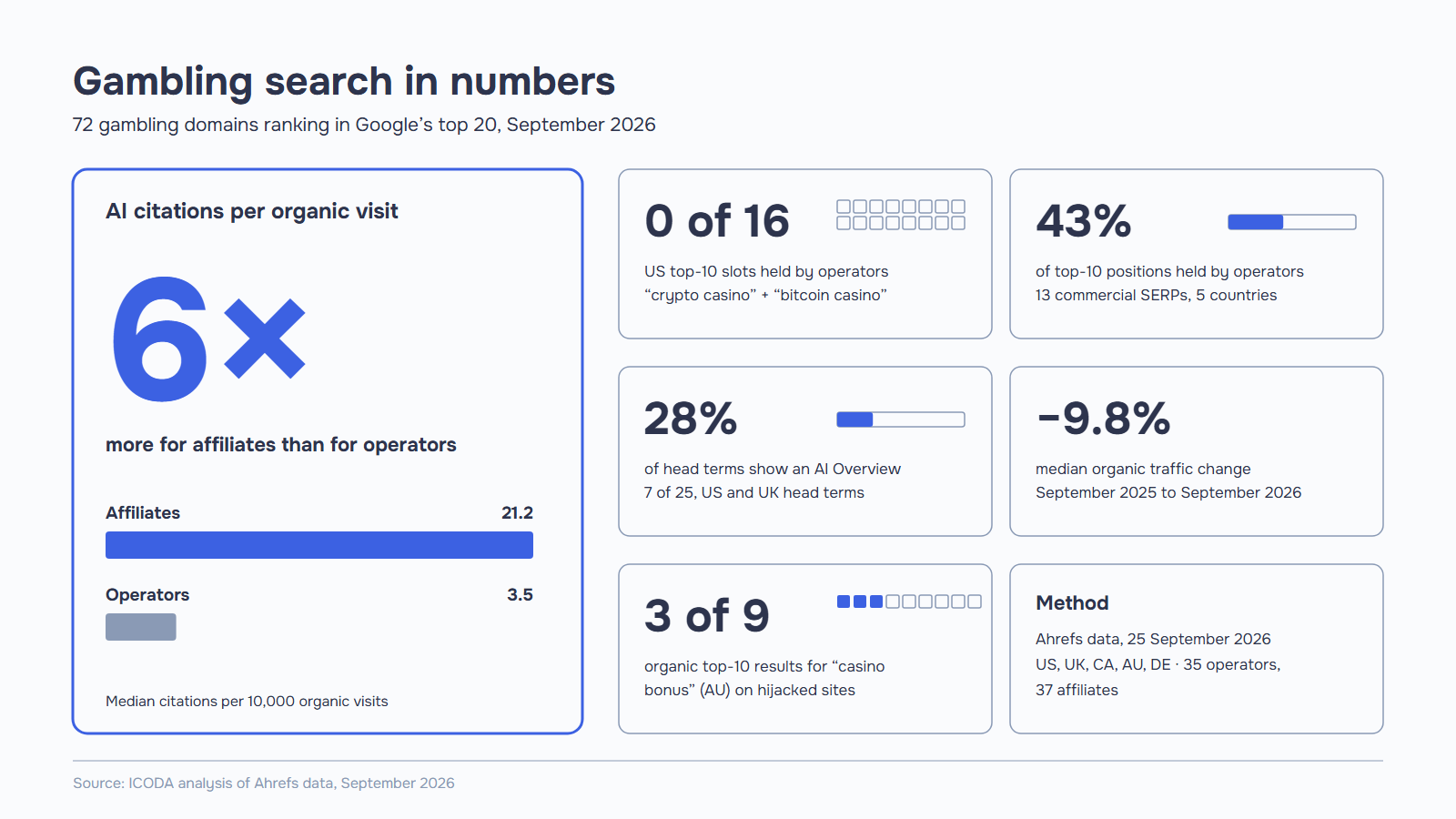
- Check the market baseline. Across 72 ranking gambling domains, median organic traffic fell 9.8% over the past year (Ahrefs). A 10% drop may be the market. A 40% drop points to your site.
The Checklist
O = mostly operators, A = mostly affiliates.
| # | Check | How to test | Failure signal | For |
|---|---|---|---|---|
| Access and indexation | ||||
| 1 | Googlebot reaches pages despite geo-blocks | GSC URL Inspection live test; fetch from a US IP | US gets a 403, “not available in your region” or a redirect | O |
| 2 | Googlebot and US visitors get the same page | From a US IP, compare HTML for a browser and a Googlebot user agent | Full page for Googlebot, block page for people | O |
| 3 | Content sits under the age gate, not behind it | URL Inspection → View crawled page → HTML | HTML contains only the modal | O |
| 4 | Firewall lets search and AI bots through | WAF or Cloudflare events filtered by verified bots | Challenges for Googlebot or OAI-SearchBot; robots.txt behind a challenge | O |
| 5 | Templates work without JavaScript | View source vs rendered DOM, one URL per template | No title, text or <a href> links in raw HTML | O |
| 6 | Fake game URLs return 404 | Request /games/zzzz-test | 200 with “Game not found” | O |
| 7 | Sitemap holds only live URLs | Crawl the sitemap, count non-200 responses | Finished events and expired promos | O |
| 8 | Filters and modals aren’t pages | Crawl report, parameter URLs | ?sign-up=modal, ?provider=&sort= by the thousand | O |
| 9 | The last release didn’t change indexability | Diff meta robots, canonical, title and inlinks on the top 20 URLs | New noindex, empty titles | O, A |
| Markets and domains | ||||
| 10 | Each licensed domain ranks in its own market | GSC country filter; Ahrefs keywords by country | Offshore .com outranks the local licensed site | O |
| 11 | hreflang holds across licensed markets | Crawler hreflang report, run from each market | en-UK; alternates blocked or noindexed; lang="en" on every version | O, A |
| 12 | Mirrors are known and consolidated | crt.sh, GSC properties | Full duplicates with self-canonicals; redirect chains | O |
| 13 | Clones don’t own brand searches | “[brand] login”, “[brand] mirror” per market | Phishing or satellite domains in the top 5 | O |
| Content and compliance | ||||
| 14 | Game pages earn their place in the index | Compare 20 game pages with the provider’s text | 90%+ copied, no data of your own | O |
| 15 | Expired promos don’t rank | Crawl promo URLs, extract end dates | Past offers with GSC impressions | O, A |
| 16 | Offers are legal in the page’s market | Page → market → rule matrix | Over 10x wagering on a GB page; unlicensed brands on a DE page | O, A |
| 17 | No templated pages at scale | Count near-duplicate “[game] casino [country]” pages | Hundreds that differ only by place name | A |
| Trust and links | ||||
| 18 | License seals verify | Click every seal | Dead seal, image only, or another entity’s record | O |
| 19 | Age marker, helpline and self-exclusion fit the market | Footer and sign-up check per market | Missing 18+/21+, wrong helpline | O, A |
| 20 | Reviewers and review method are verifiable | Author pages, “how we test” page | Stock-photo authors; reviews that copy operator text | A |
| 21 | Brand SERP is clean | “[brand] review / legit / withdrawal” | Scam threads in the top 3 | O |
| 22 | No link footprints | GSC Links vs Ahrefs; anchors per URL | Money anchors piled on one URL; sites-for-sale | O, A |
| 23 | No parasite or expired-domain exposure | List third-party placements; Wayback check on owned domains | Casino section on a news site; domain with an unrelated past | A |
| AI search | ||||
| 24 | AI bots are blocked only on purpose | robots.txt and WAF, per user agent | OAI-SearchBot or PerplexityBot blocked | O, A |
| 25 | Pages you want cited work without JavaScript | curl the page | Rules, license and payout info load via JS | O, A |
| 26 | The brand appears in AI answers | Monthly prompt panel per market | Brand absent; unlicensed rivals cited | O, A |
| 27 | Search Console isn’t excluding AI features | Settings → Search generative AI | Set to “Exclude” | O, A |
Copy the table into Google Sheets and add three columns: finding, owner, deadline.
The Four Checks That Cost Casinos the Most
1. Geo-Blocks vs Googlebot
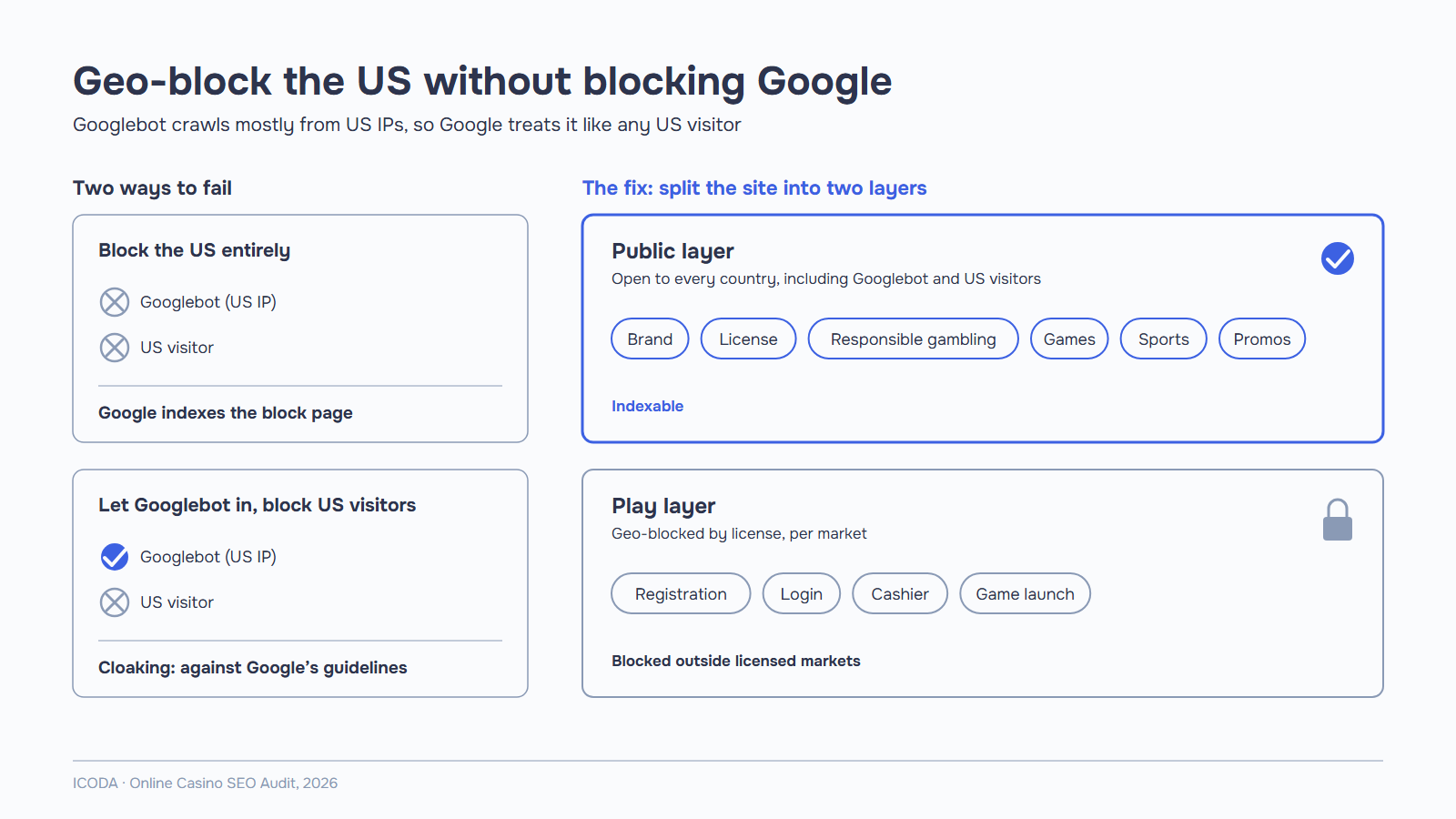
Google’s locale-adaptive pages guide says Googlebot mostly crawls from US IPs and should be treated like any US visitor. Licensed operators often have to block the US, so there are two ways to fail. If you block Googlebot, Google indexes the block page or nothing. If you let Googlebot in and block US visitors, you’re cloaking: John Mueller said this goes against Google’s guidelines.
The fix is a public layer anyone can read from anywhere: brand, license, responsible gambling, game and sport information, promotion summaries. Apply the geo-block only at registration, login, cashier and game launch.
2. Age Gates and Firewalls
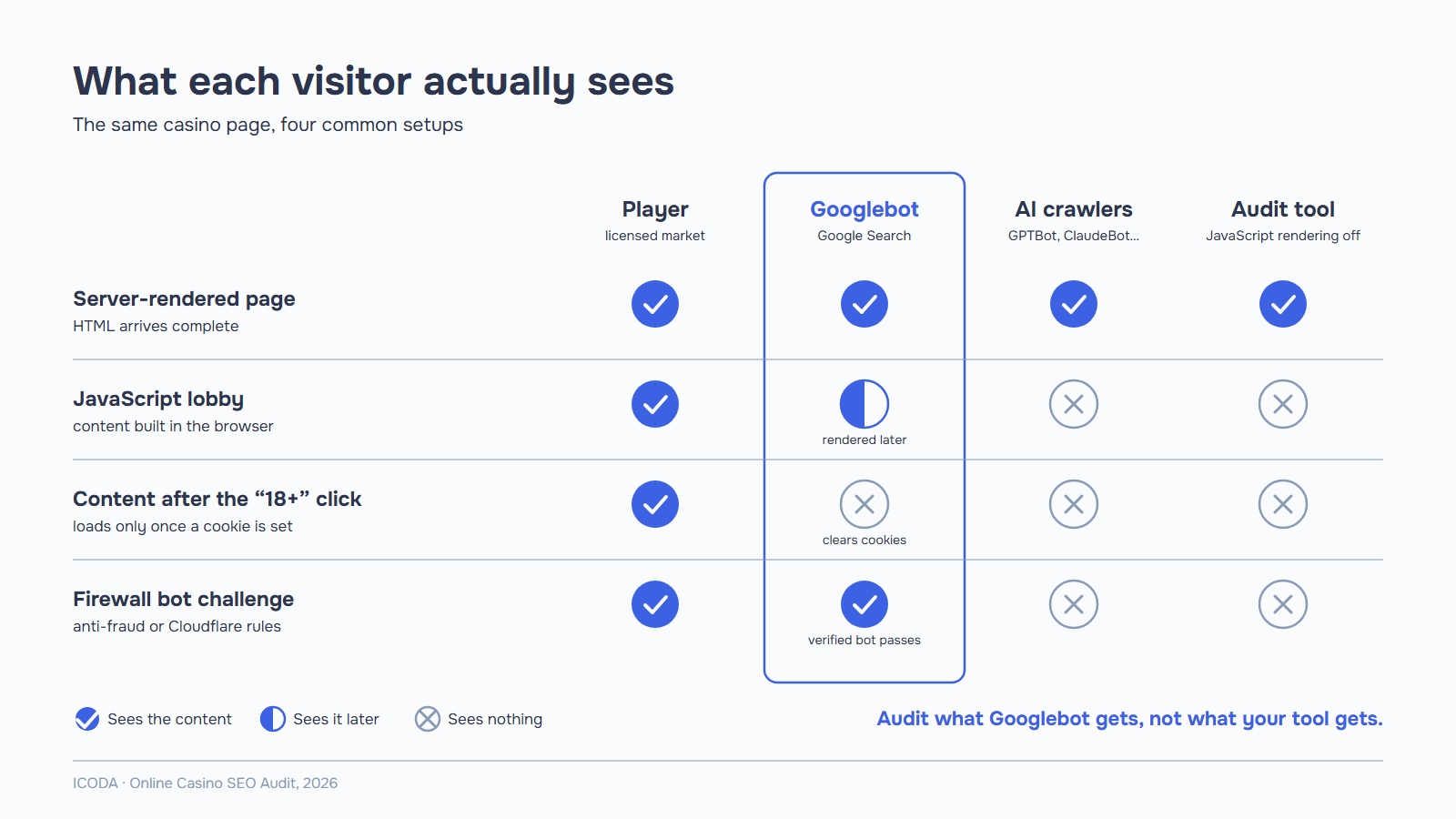
Legally required age gates are exempt from Google’s interstitial demotion. The risk is how they load: Googlebot clears cookies, so content that appears only after the “I’m 18+” click never reaches it.
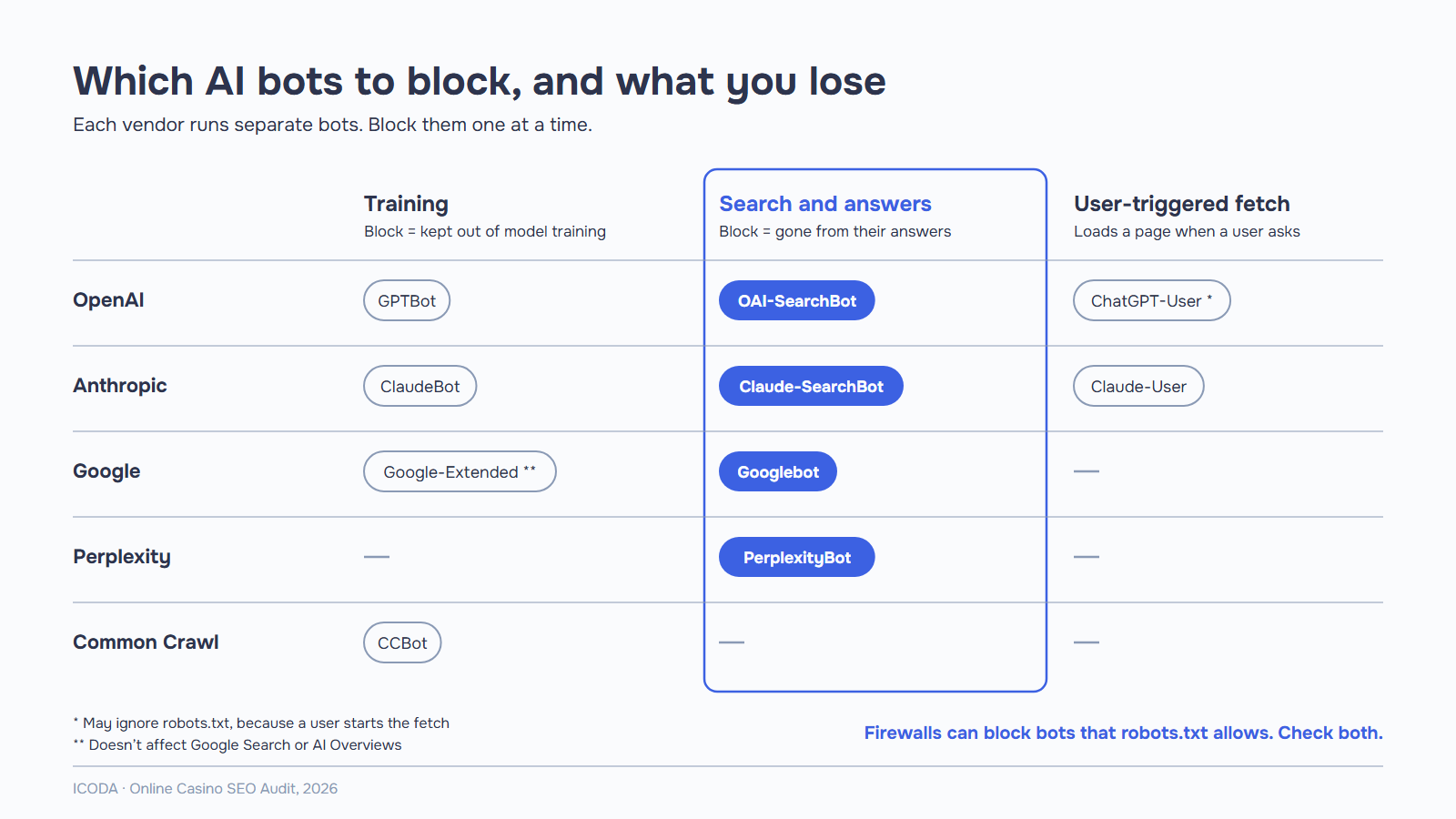
Risk teams write firewall rules without checking what they do to crawlers. Since July 2025, Cloudflare blocks AI crawlers by default on new domains, so robots.txt can say “allow” while the firewall says “block”. Exempt robots.txt and sitemaps from bot challenges.
3. JavaScript Lobbies
Google renders JavaScript with a delay and calls dynamic rendering “a workaround”. GPTBot, ClaudeBot, PerplexityBot and OAI-SearchBot don’t execute it at all.
A common setup renders the sportsbook on the server and the casino in the browser. That one template decision creates thousands of empty pages, and the audit tool reports them as four or five separate errors that share one cause.
To test, take one URL per template: lobby, game, provider, promo, sport, league, event. The raw HTML must contain the title, canonical, html lang, hreflang, H1, main text and <a href> links. Game tiles without links leave every game page orphaned.
4. Release Regressions
A release that fixes server timeouts can lift the audit tool’s health score while the same release adds noindex to the homepages. Google doesn’t use third-party scores, so don’t report them as a KPI. After every release, check status code, meta robots, canonical, title, H1 and raw HTML text on your top 20 URLs and one URL per template.
Markets, Mirrors and Migrations
hreflang errors show up on 67% of sites that use it. On casino sites the alternates often aren’t equivalent: a Curaçao .com and a UKGC .co.uk differ in games, bonus caps and terms. If the UK version is blocked or noindexed, Google may show the .com to UK searchers, which is a compliance problem as well as an SEO one. Use en-GB, not en-UK, and don’t point x-default at an offshore domain.
Turkey reported 84,585 illegal betting sites for closure in 2025, so brands rotate mirrors to stay reachable. Mirrors fit Google’s doorway definition, split ranking signals and attract DMCA notices, which can demote the whole site. Find them through crt.sh; each should 301 to the main domain or carry a cross-domain canonical. Search “[brand] login” to see which clones rank, and check Lumen for notices against your domains.
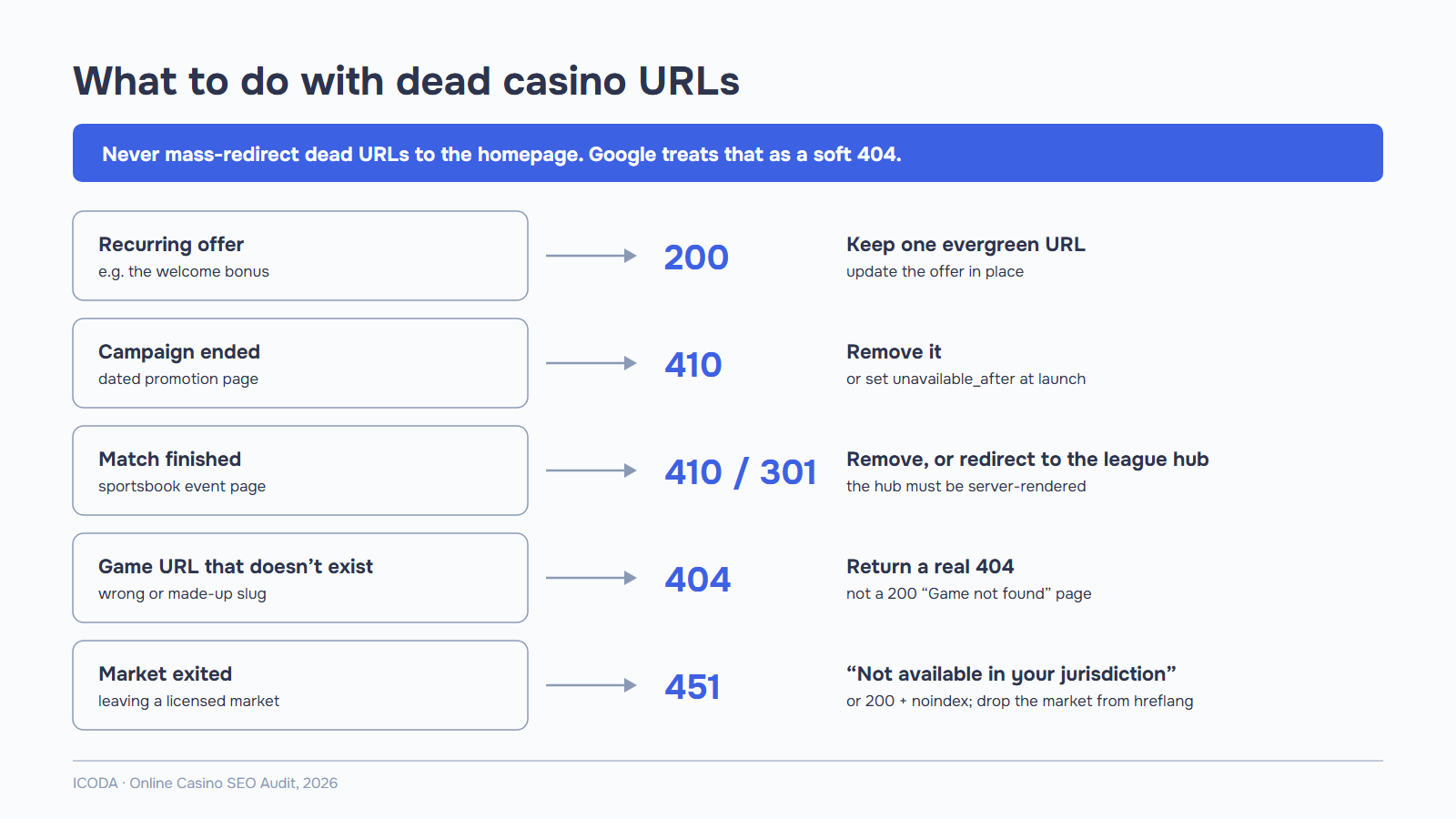
When a domain moves, use 1:1 301s and keep them for a year. Re-point the crawler and Search Console on day one; an audit of a retired domain scores 100/100 because it contains only redirects. When you exit a market, serve a neutral “not available in your jurisdiction” page instead of redirecting players to the offshore .com.
Content: Games, Promos and Compliance
On a casino with 5,000 games, game pages usually repeat the provider’s description. Index a game page only if it has search demand or data the provider page lacks, such as verified RTP, max win, bonus-buy availability by market or a demo. Fold the rest into provider and category pages. Our online casino SEO guide covers how to build game, bonus and payment pages that rank.
Old promotions can break the law. In Great Britain, from 19 January 2026, wagering is capped at 10x and mixed-product offers are banned, so a 2025 bonus page with 35x wagering that still ranks now advertises an illegal term. Keep evergreen URLs for recurring offers. Give campaign URLs a 410 or an unavailable_after date when they end, and never mass-redirect them to the homepage, which Google treats as a soft 404.
Across 13 commercial gambling SERPs in September 2026, operators held 43% of top-10 positions. For “crypto casino” and “bitcoin casino” in the US they held none of 16. A crypto operator’s lobby page won’t rank there, because the SERP wants comparisons.
Send pages like these to your compliance team:
| Market | What to flag |
|---|---|
| UK | Wagering over 10x; imagery with strong appeal to under-18s (affiliates included) |
| Germany | Brands not on the GGL whitelist |
| Italy | Bonus promotion and tracked affiliate links (advertising ban since 2018) |
| Netherlands | Untargeted or youth-appeal content |
| Brazil | Brands not operating on .bet.br |
| US | Sweepstakes pages aimed at California, New York or New Jersey; missing 21+ |
Trust and Links
The Quality Rater Guidelines don’t name gambling as a YMYL category and organic ranking doesn’t require a license. Since 26 August 2026, though, Google Ads requires gambling advertisers to show license details and affiliates to link only to licensed operators. That amounts to Google’s own list of trust signals for the vertical. Click every license seal on the site:
- UKGC: the account number should link to the licensee’s record on the register, not to the register homepage.
- MGA: the dynamic seal should link to the register.
- Curaçao: only the green seal is valid. The orange one has been invalid since 15 October 2025.
For some large crypto casinos, the top result for “[brand] review” is a Reddit thread calling the brand a scam (our analysis). Resolving the complaints on AskGamblers and Casino.guru fixes this; more content doesn’t.
Paid placements are the norm in iGaming, so flagging every paid link as “toxic” tells you nothing. Since the December 2022 link spam update, Google mostly neutralizes bought links instead of penalizing the site, and disavow is meant for manual actions. Flag what reviewers look for instead: sites-for-sale, money anchors piled on one URL, network footprints, and expired domains with an unrelated past. Use the Links report in Search Console as ground truth, because private networks block Ahrefs and Semrush. More in our iGaming link building guide.
Casino sections on news domains are textbook site reputation abuse. From 30 August 2026, Google no longer applies those manual actions to searchers in the EEA, while outside the EEA nothing changed, so check host-section visibility by country. Enforcement is uneven: in Australia, three of the top-10 results for “casino bonus” sit on hijacked hotel, furniture and essay-writing sites.
AI Search
Ahrefs found AI Overviews on 1.4% of gambling searches in 2025. In our September 2026 check they appeared on 7 of 25 head terms in both the US and the UK, mostly regulated-market, sportsbook and how-to queries, and on none of the crypto or no-deposit terms.
Across our 72 domains, AI assistants cited affiliates about six times more often per unit of organic traffic than operators (median 21.2 vs 3.5 citations per 10,000 visits). AI systems cite pages that answer questions, such as rules, withdrawal times and license details, and a lobby answers none of them. Crawlable license pages also matter because, in a March 2026 test, 75% of chatbot answers recommended unlicensed casinos.
Block AI crawlers one at a time. Blocking GPTBot, ClaudeBot, Google-Extended or CCBot keeps your content out of model training. Blocking OAI-SearchBot, Claude-SearchBot or PerplexityBot removes you from those assistants’ answers. Google-Extended doesn’t affect Google Search.
Skip llms.txt: a study of about 300,000 domains found no link between the file and AI citations. More on AI visibility in iGaming.
How to Prioritize Fixes
Fix what blocks indexing of money pages first, then what risks a penalty or trouble with a regulator, then the rest by traffic and deposit impact. Keep the list to about ten actions, each with an owner.
| Level | Examples |
|---|---|
| P0: losing traffic or legal standing now | Noindex on money pages; Googlebot geo-blocked; cloaking; illegal offers indexed |
| P1: large parts invisible or at risk | JavaScript-only lobby; duplicate mirrors; broken hreflang between licensed markets |
| P2: waste | Orphaned game pages; dead URLs in the sitemap; crawled filter URLs |
| P3: hygiene | Long titles, alt text, schema warnings |
If you hire outside casino SEO services, ask for a sample report. It should show a market map and raw vs rendered HTML per template rather than a tool export.
Frequently Asked Questions (FAQ)
Run a full audit every six to twelve months, plus one after every platform release, domain move, market entry or exit, Google update or unexplained drop.
It takes from a few days for a small affiliate site to four weeks or more for a multi-market operator. Specialist casino audits start at about $5,000.
No. Google checks licenses for Ads, not for organic search.
Partly. It can analyze a crawl export, but it can’t crawl from different countries or check a license register, and it may invent regulatory details.
Methodology
We pulled Ahrefs data on 25 September 2026: the organic top 20 for 13 commercial gambling queries in five countries, 72 domains (35 operators, 37 affiliates). Traffic compares September 2025 and 2026, and AI citations are a single snapshot.
Share with


Rate the article