Online casino SEO is the work of making each page on a casino site crawlable and worth ranking for the searches it targets. A handful of page types bring almost all organic traffic: game, provider, bonus, payment, license and app pages. In our data, operators rank mostly with the first two and hold only 8% of top-10 slots for payment searches.
This guide covers what each page type needs. Market choice and authority building are in our casino SEO strategy, and finding what’s already broken is in the online casino SEO audit checklist. Backlinks, paid placements and digital PR have their own iGaming link building guide.
Who Ranks for Casino Searches: Our Data
In October 2026 we pulled the Google top 10 for 25 casino searches in the US and UK, five each for games, providers, bonuses, payment methods and apps, and sorted 392 results by who owns the site.
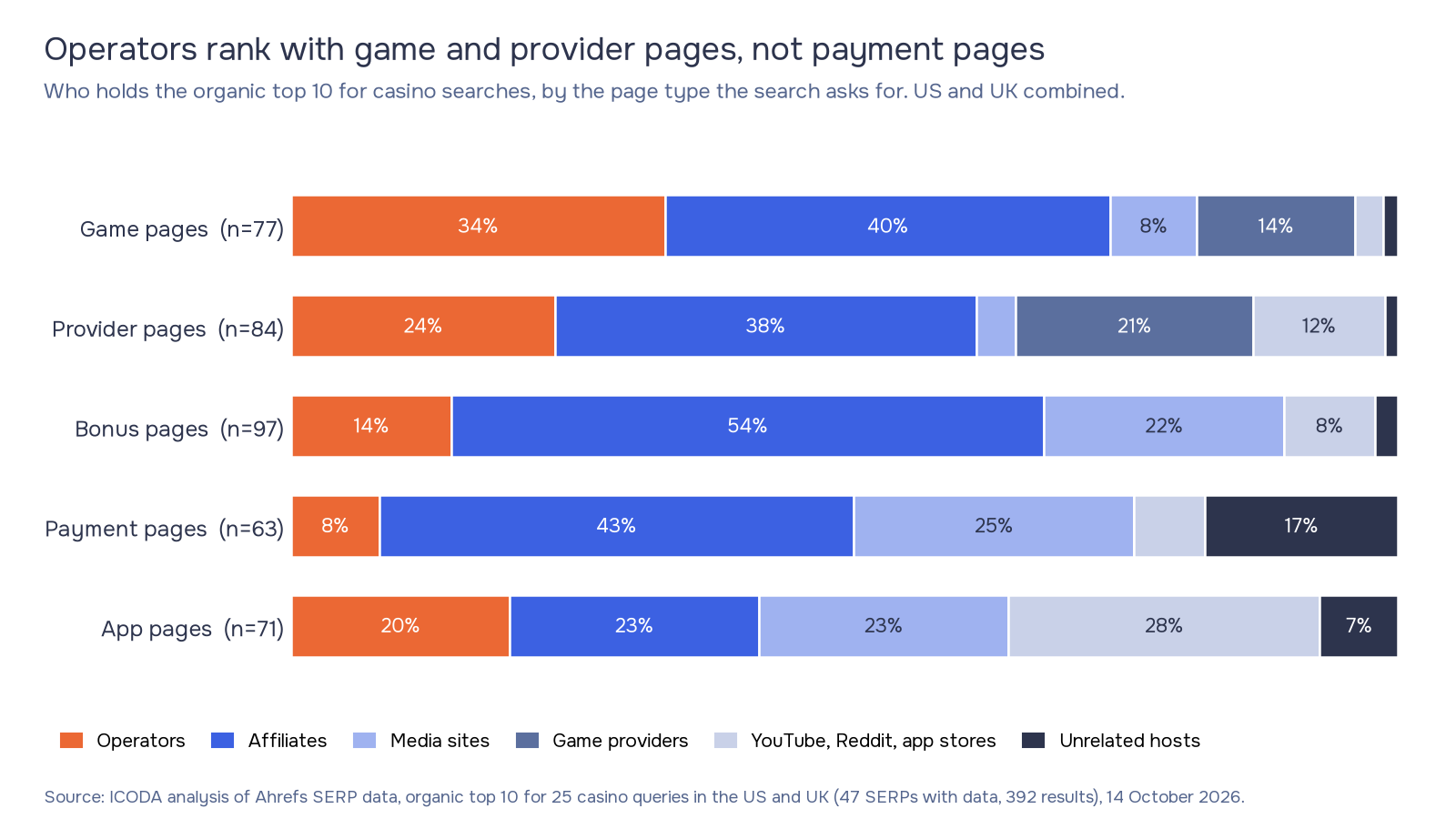
- Operators rank mostly with game and provider pages. They hold 34% of top-10 slots for game searches and 24% for provider searches, against 14% for bonus searches and 8% for payment searches.
- Affiliates hold the largest share for game, provider, bonus and payment searches, from 38% to 54% of results.
- Payment searches are the most open. 17% of their top-10 slots sit on hosts with no gambling history, such as language schools and charities. For “fast withdrawal casino” in the UK it was 6 of 10.
- 8 of 10 game SERPs had video results.
- Google showed an AI Overview on only 2 of the 47 SERPs.
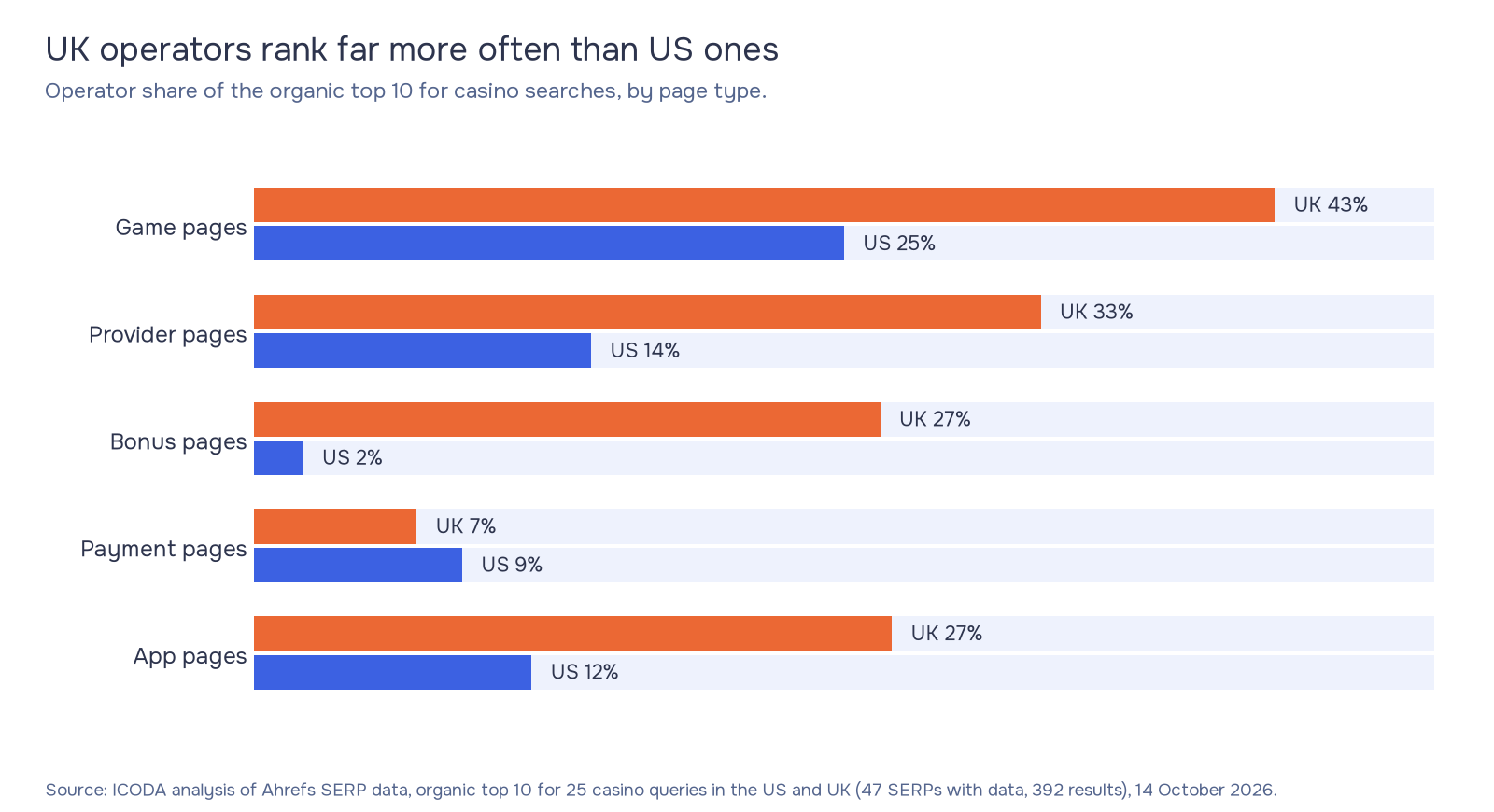
UK operators hold 43% of game-search slots and 27% of bonus slots. US operators hold 25% and 2%: online casino is legal in only seven states, so national affiliates and media sites fill most results.
For a licensed operator, game, provider and bonus templates are where you can beat competitors. For an affiliate, payment pages are the easiest entry, since a sixth of those slots sit on unrelated hosts.
The Pages That Bring Search Traffic to a Casino Site
SEO for online casino sites starts with templates. Each row in the table is one, and getting it right once fixes hundreds of URLs. Which searches to target (keyword research and search intent) is a strategy question, covered in our strategy guide.
| Page type | Searches it targets | Must have | Schema | Common failure |
|---|---|---|---|---|
| Lobby / category | “online slots”, “live casino” | Intro text above the grid, filters as links or no-index parameters, crawlable <a href> tiles | BreadcrumbList, ItemList | A JavaScript grid with no text and no links |
| Game | “[game] slot”, “[game] demo” | RTP for this market, volatility, max win, features, demo or video, provider link | BreadcrumbList, VideoObject for the demo video | Provider’s description pasted on 3,000 pages |
| Provider | “[provider] slots” | What the studio is known for, top games with links, new releases, license | BreadcrumbList, ItemList | A logo and a grid |
| Bonus | “no deposit bonus”, “free spins” | Offer, wagering, max cashout, expiry and eligible games above the fold; the market it applies to | BreadcrumbList | Old terms that are now illegal in that market |
| Payment method | “paypal casino”, “apple pay casino” | Deposit and withdrawal limits, fees, processing times, KYC steps, which markets accept it | BreadcrumbList | “We accept PayPal” with no numbers |
| Withdrawals / banking hub | “fast withdrawal casino”, “casino withdrawal time” | A dated table of methods, times, fees and limits | BreadcrumbList | Times hidden behind login |
| License and responsible gambling | “is [brand] legit”, “is online casino legal in [state]” | License number linked to the regulator’s record, age limit, self-exclusion, the market’s helpline | Organization | A seal image with no link |
| App / mobile | “casino app real money” | Store links, supported devices, what differs from the web version | MobileApplication | An app page that is just a download button |
| Review / comparison (affiliates) | “best online casino”, “[brand] review” | Testing method, who tested, date checked, licensed brands only | Review (third-party only), Organization | Stars on every page, no method |
Index a page only if it targets a search someone makes and says something the other pages on the site don’t. Everything else can live as a filter state or a section of a bigger page.
On-Page SEO for Casino Pages
Most casino sites have thousands of pages and a few templates, so on-page SEO is set at the template level:
- Make the URL path follow the hierarchy, such as
/slots/, then/slots/pragmatic-play/, then/slots/pragmatic-play/gates-of-olympus/, and make breadcrumbs follow the same path. - Write titles that say what the page is. “[Game] Slot: RTP, Max Win and Free Demo” beats “[Game] | [Brand] Casino”. Add the market to the title when the page is market-specific.
- Put the fact searchers compare in the meta description (RTP, wagering or payout time), so they have a number to click on.
- Use one H1 per page that matches the search, such as “Book of Dead Slot”.
- Build internal links from lobby to provider to game with real
<a href>links. Every game page needs a link from its provider page and from at least one category, and related games should link to each other by provider, theme or mechanic. - Use anchor text that names the destination: “Pragmatic Play slots”, not “see more”.
- Put 80 to 150 words above the grid on lobby and category pages, saying what’s in the category and how to choose. Without that text, Google has only a grid of images to rank.
Game and Provider Pages
A casino with 5,000 games usually has 5,000 copies of the provider’s description. Google picks one version to index, usually the provider’s or a large affiliate’s. To get your game page indexed, add data the provider page lacks:
- RTP for this market. Many slots ship with several RTP settings, and operators pick one. Show the one your players get. A page that says 96.21% when your build runs 94% misleads players and gets cited wrongly by AI.
- Volatility, max win and hit frequency, if the provider publishes them.
- Feature availability by market. Bonus buy is banned in some markets, so say whether it’s on.
- A demo or your own gameplay video. 8 of the 10 game SERPs we checked had video results, so a video with VideoObject markup can rank there as well as in web results.
- Who reviewed the page and when.
Most sites ship provider pages as a logo and a grid. People searching “[provider] slots” want a short guide: what the studio is known for, its best-known games and what’s new. Write that once per provider and link down to the games.
The audit checklist covers which game pages to index and which to fold into provider pages.
Bonus and Payment Pages
Bonus Pages
Keep one evergreen URL per offer type (“no deposit bonus”, “free spins”, “welcome bonus”) and update it in place. Put the terms in text next to the offer, above the fold: wagering, max cashout, expiry and eligible games.
Compliance rules differ by market, so each market gets its own version. In Great Britain, wagering is capped at 10x from 19 January 2026. Ontario bans public bonus advertising, so the offer sits behind opt-in. Our strategy guide has the market table.
Payment Pages
“PayPal casino” and “fast withdrawal casino” are searches about money moving, and operators hold 8% of their top-10 slots. The operators that do rank have a dedicated page per method: PlayOJO’s PayPal and Apple Pay pages rank #4 and #6 in the US, and BetVictor’s Apple Pay page is #1 in the UK. Answer with numbers:
| Method | Deposit | Withdrawal time | Fees | Limits | Markets |
|---|---|---|---|---|---|
| Example row: e-wallet | Instant | Up to 24 hours after approval | None from us | $10 to $5,000 | UK, CA-ON |
Add the KYC steps that come before a first withdrawal and, for crypto, the networks you support. Date the table. When AI assistants answer “which casino pays out fastest”, they quote pages that state a time in hours.
SEO Content for Casino Sites: E-E-A-T and Responsible Gambling
Google’s Quality Rater Guidelines don’t name gambling as a YMYL category, but raters are told to judge pages about money strictly, and casino pages are about money (more on this). On a casino site, trust comes from facts a reader can check:
- A license number that links to the licensee’s record on the regulator’s register, so anyone can verify it. A link to the register’s homepage proves nothing.
- Named authors with relevant experience on reviews, guides and game pages, and a “last checked” date on anything with numbers.
- Responsible gambling tools on the page itself as well as in the footer: deposit limits, time-outs, self-exclusion, the age limit (18+ or 21+) and the market’s helpline, such as 1-800-GAMBLER in the US or the National Gambling Helpline in Great Britain.
- A number behind every claim. “Fastest payouts” means little without a payout time.
A license isn’t required to rank: Google checks licenses for Ads, not for organic search.
Technical SEO for Casino Websites
In technical SEO for casino websites, the recurring problem is that crawlers get a different page from the one players see. Build the site this way from the start; the audit checklist shows how to test each point.
- Render the public layer on the server. Brand, license, game, promotion and payment pages should arrive as HTML. Apply the geo-block only at registration, login, the cashier and game launch.
- Keep game lobbies fast enough to pass Core Web Vitals. Lazy-load thumbnails below the first screen, reserve space for them so the layout doesn’t jump, and load game iframes only on click. Google’s thresholds are LCP under 2.5 s, INP under 200 ms and CLS under 0.1.
- Use hreflang only between equivalent localized pages. A UKGC page and a Curaçao page with different games and terms aren’t alternates. Use
en-GB, noten-UK. - Give every page one canonical URL. Filter parameters, sign-up modals and mirror domains should point their canonical to the main version, not to themselves.
- Use schema that Google does something with: BreadcrumbList on every page, Organization on the homepage with license and contact details, VideoObject on game videos, and Review markup only for reviews of other companies. FAQ rich results stopped appearing in Google on 7 May 2026, so FAQ markup no longer earns a SERP feature, and star ratings about yourself have been ineligible since 2019.
- Give expired content a status code and drop it from the XML sitemap. Ended promos return 410, missing games 404, and exited markets get a neutral page.
Affiliates are ahead on schema: 59.4% carry Organization schema on the homepage against 20.4% of operators, in our study of 4,689 gambling and crypto sites.
After each release, check a few URLs per template with URL Inspection in Google Search Console. The HTML Googlebot got should contain the title, the text and the links.
Optimizing a Casino Site for AI Search
Google’s AI Overviews rarely appear on casino searches. In our September 2026 data they showed on 12% of non-branded casino queries in the US, 2.4% of casino and slots queries in the UK and none of 164 in Canada, against 69% of US betting queries (iGaming SEO trends 2026). For a casino site, AI visibility mostly means ChatGPT, Perplexity and Gemini.
Those assistants favor pages that answer questions. Across 72 ranking gambling domains, affiliates got about six times as many AI citations per organic visit as operators. Half of the URLs cited in gambling AI Overviews (49.9%) weren’t in that query’s organic top 10, so a page can be cited without ranking.
What to do:
- Put facts in text and tables: license, withdrawal times, RTP, wagering. AI crawlers don’t run JavaScript, so they miss facts that load in a script.
- Decide on each AI crawler separately. Blocking GPTBot keeps your pages out of OpenAI’s model training; blocking OAI-SearchBot keeps them out of ChatGPT’s answers. OAI-SearchBot is effectively blocked on 8.7% of the sites we measured, mostly at the server or CDN, where owners may not have set the rule on purpose. The AI crawlers list has the user agents.
- Each quarter, run your main money questions through ChatGPT, Perplexity, Gemini and Google AI Mode for every market and log which brands appear.
Where to Start
If you can fix only three things in your online casino SEO this quarter, fix the templates that carry the most URLs: the game page, the provider page and the bonus page. Then add the payment table and the license page. Both cost little to build, and they are the last pages a player reads before depositing.
If you want an outside review of your templates, our casino SEO agency team checks them page type by page type.
Frequently Asked Questions (FAQ)
SEO for online casinos starts with templates. Give each page type (lobby, game, provider, bonus, payment, license) its own required content, make sure it renders as HTML, and put facts players can check on every page. Then build links to the pages that matter.
In online gambling SEO, sites block countries by law, change offers under market rules and often run on JavaScript-heavy platforms. Rankings also turn over faster: 25 to 53% of top-10 slots for gambling money keywords go to new domains each year.
BreadcrumbList, Organization on the homepage, VideoObject on game videos and Review markup only for third-party reviews. FAQ markup no longer earns a rich result in Google.
Pages that target a real search and add something the rest of the site doesn’t: game pages with your own data, provider pages, evergreen bonus pages, payment pages and license pages. Filter states and expired promos shouldn’t be indexed.
Methodology
On 14 October 2026 we pulled the latest Ahrefs SERP snapshot (organic top 10 and SERP features) for 25 casino queries in the US and UK: five each for games, providers, bonuses, payment methods and apps. One US and two UK payment queries returned no data, leaving 47 SERPs and 392 results. We classified each domain by hand as an operator, affiliate, media site (a news, sports or tech publisher), game provider, YouTube/Reddit/app store, or unrelated host (a site with no gambling history). Five legal and trust queries returned too little data and are left out of the charts.
Share with


Rate the article