

Your ad account got suspended. Yes, again.
Meta flagged the landing page. Google rejected the campaign before it ran. TikTok didn’t even let you finish the setup. If you’re building in iGaming or launching a GameFi token, you already know the pattern: the major ad platforms have made your vertical one of the most restricted in digital marketing, regardless of your license, your jurisdiction, or how careful your compliance team is.
What most operators running iGaming and crypto casino marketing miss while filing appeal tickets: AI search engines don’t share those restrictions. ChatGPT doesn’t suspend accounts. Perplexity doesn’t require a gambling certification to recommend a brand. Google AI Overviews don’t check your Meta Business Manager before citing you.
The question isn’t whether AI is already recommending casinos and GameFi projects to users. It is. The question is which brands get cited, and how you get your project into that list.
Why iGaming & GameFi Need AI Visibility More Than Almost Any Other Vertical
Ad restrictions in iGaming aren’t a temporary inconvenience. They’re a structural feature of the landscape, and they compound in ways that aren’t obvious until you’re living with them.
The immediate cost is campaign downtime. When a Meta account gets pulled mid-month, you lose active traffic, retargeting audiences, and campaign data simultaneously. Industry estimates put the total drag at 30–40% of annual paid ad spend across the iGaming sector, not from low ROAS, but from disrupted campaigns, lost historical data, and the cost of rebuilding creative and audience pools from scratch. That’s spend that produces nothing while your team files appeals and rebuilds from scratch.
The less visible cost is the ceiling it creates. Even when campaigns run clean, every iGaming operator on paid channels is playing by permission. That permission can be revoked by a policy update, a competitor’s complaint, or an automated flag on ad creative. It’s not a scalable growth model.
AI search operates on different logic entirely. LLMs evaluate content on E-E-A-T signals: demonstrated expertise, authority built through third-party mentions, and trustworthiness signals like licensing information and responsible gambling frameworks. There’s no jurisdictional gate. A brand established as authoritative in AI training data and citation patterns gets recommended regardless of what’s happening in its ad account.
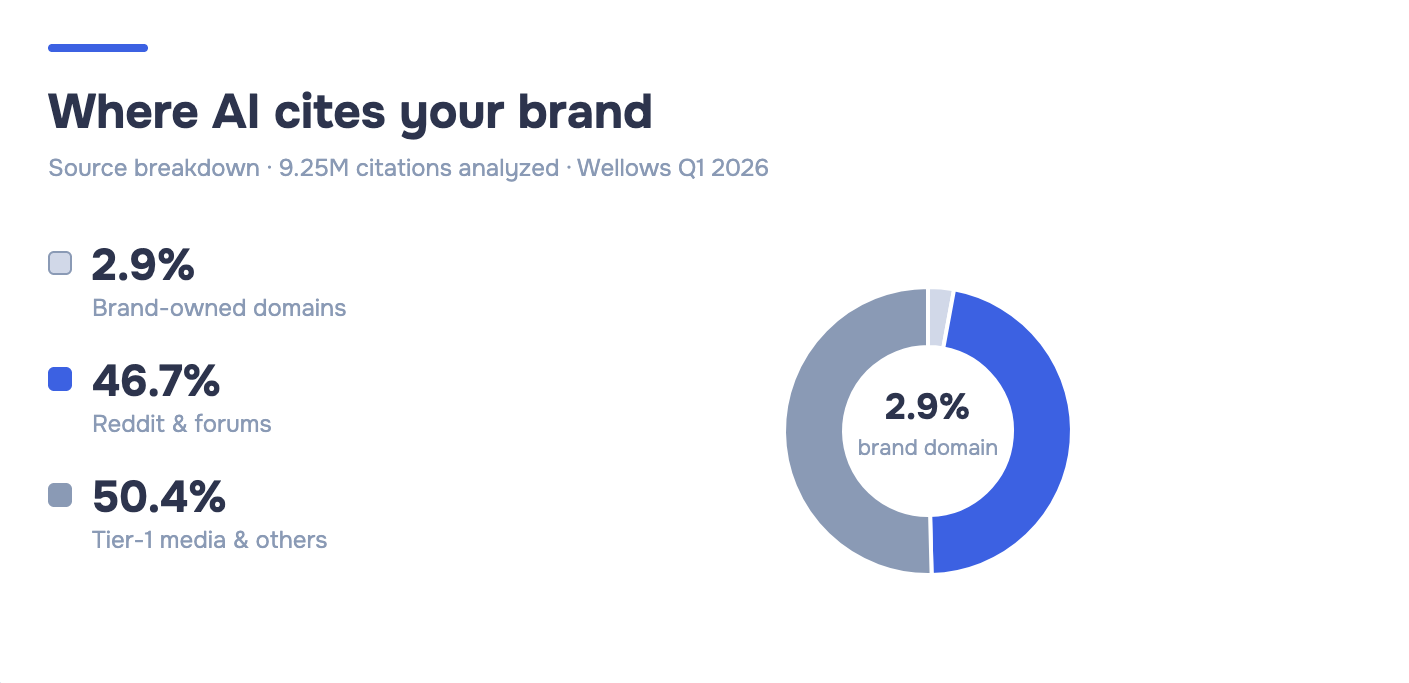
The numbers back this up. According to Wellows’ Q1 2026 citation dataset (covering 471,698 prompts across five AI platforms and 9.25 million citations), only 2.9% of AI citations come from brand-owned domains. The rest come from third-party sources: media coverage, forum discussions, review platforms. For iGaming brands that already can’t rely on paid reach, building that third-party citation footprint is one of the few acquisition channels with no jurisdictional exposure.
Here’s how the three main acquisition channels compare for operators in this vertical:
| Factor | Paid Ads | Traditional SEO | AI Search (GEO) |
|---|---|---|---|
| Affected by jurisdiction? | Yes, actively | Partially (geo-restriction on SERPs) | No |
| Account suspension risk | High | None | None |
| Cost per citation | High and rising | Medium | Low at scale |
| Scales with brand authority | No | Partially | Yes, compounds over time |
| Timeline to first return | Days | 6–12 months | 2–4 months for first citations |
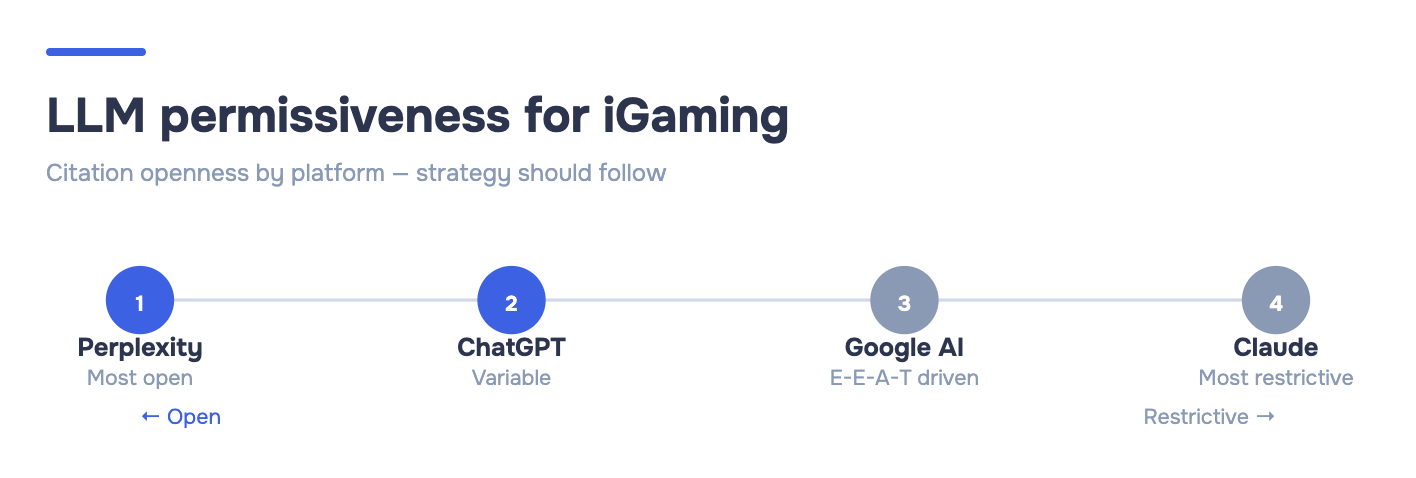
Platform behavior also varies in ways that affect strategy. Not every LLM treats gambling content the same way:
- Perplexity is currently the most permissive for iGaming content. It cites licensed operators, references Reddit and Tier-1 crypto media heavily, and answers commercial queries about casinos and GameFi projects without the restrictions other models apply.
- ChatGPT is more variable. Reddit citations for casino-related queries grew 34x in Q1 2026, which makes community presence on the right subreddits a legitimate first-party citation channel.
- Google AI Overviews favor pages with Casino and Game schema markup plus strong E-E-A-T signals. A well-structured operator page can displace unlicensed competitors here because it carries stronger trust signals.
- Claude (Anthropic) applies the most content restrictions to promotional gambling content. Informational content covering marketing processes, compliance frameworks, and licensing does get cited for agency and operator research queries.
The window to establish early authority in AI answers is real. Most competitors are still running 2023 playbooks.
What Makes a Great GameFi/iGaming Marketing Agency in 2026
Not every agency that touches crypto belongs near an iGaming brief. And not every GameFi marketing agency understands the compliance requirements a licensed casino operator actually faces. The failure modes differ, and it’s worth understanding what separates capable agencies from expensive disappointments — especially in crypto casino marketing, where regulatory exposure and ad restrictions compound every strategic error.
What should you look for in a GameFi/iGaming marketing agency in 2026? The short version: regulatory fluency, vertical-specific case studies with actual outcome data, and a demonstrable methodology for AI visibility, not just a bullet point on a services page.
The longer version involves six criteria worth pressure-testing before you sign anything:
1) Regulatory and compliance fluency. Can they articulate the difference between marketing to a Curaçao-licensed operator versus an MGA or UKGC licensee? The content frameworks, responsible gambling requirements, and media placements differ substantially. An agency that can’t explain why hasn’t done this work before.
2) iGaming-specific experience. Affiliate ecosystem management, FTD attribution, jurisdiction-aware content: none of these are transferable skills from general crypto marketing. Demand named case studies with outcome metrics. If the portfolio is all affiliate SEO with no brand-building work for operators, that tells you what they actually know how to do.
3) GameFi-specific capability. Token Generation Event marketing is a distinct discipline. It involves tokenomics narrative, guild outreach, KOL campaigns with wallet-level attribution, and dual-audience segmentation. The people who care about a P2E economy and the people who care about game experience are not the same audience and shouldn’t receive the same messaging. Agencies that blend the two are usually mediocre at both.
4) AI/GEO methodology as a baseline, not an upsell. Any agency still pitching “rank on Google” without addressing AI Overviews and LLM citation optimization is working off outdated infrastructure. In a vertical where paid reach is constrained, this isn’t a premium add-on; it’s table stakes.
5) Is AI visibility a standard service? It should be. A capable agency can walk you through their llms.txt implementation, content architecture for passage-level citability, and how they seed brand mentions in the sources LLMs actually cite. If they can’t describe that process specifically, they’re probably adding “AI optimization” to proposals without delivering anything behind it.
6) Proof beyond vanity metrics. Impressions and click-through rates are easy to produce. What matters for iGaming operators is FTD volume, deposit-level ROI, and affiliate program performance. Require attribution-level reporting from the start, and be skeptical of agencies that lead with reach numbers.
How ICODA Approaches GameFi & iGaming Marketing
ICODA’s approach is specific: AI visibility methodology built inside iGaming and GameFi, not adapted from a generic SEO playbook. The compliance layer, the content architecture, and the citation channels are all vertical-specific, and that matters more in this vertical than most.
The service stack breaks across two tracks that share an underlying methodology:
| iGaming Services | GameFi Services |
|---|---|
| SEO + GEO (AI citation optimization) | TGE (Token Generation Event) launch marketing |
| Tier-1 crypto media PR structured for LLM citation | Guild outreach and partnership campaigns |
| Affiliate ecosystem setup and management | KOL campaigns with wallet-level attribution |
| Responsible gambling content framework | Tokenomics narrative consulting |
| Schema implementation (Game, Casino, FAQPage) | Community management on Discord and Telegram |
| Jurisdiction-aware content strategy | Dual-audience segmentation (gamers vs. token holders) |
| GA4 regex tracking for AI-driven traffic | NFT mint campaign strategy |
The AI-first methodology applies across both tracks. Content gets structured for LLM passage extraction: TLDR-first copy, question-format H2s, tables that answer specific queries. Sites get llms.txt implementation so AI crawlers can accurately understand their structure. And brand mentions get seeded in the sources LLMs cite most. Reddit accounts for 46.7% of Perplexity citations, which makes authentic, informational presence in r/onlinegambling, r/web3gaming, and r/gamefi a legitimate part of the citation strategy.
The clearest demonstration of this methodology is the 1win case study. 1win is a crypto casino brand with significant search volume in South and Southeast Asian markets. The challenge: earning visibility in AI-generated recommendations for high-intent queries in markets where paid acquisition is structurally limited.
🔥 The result: Google AI Overview placements for “best crypto casino in India” and “best crypto casino in Malaysia,” with zero paid ad spend. The approach combined schema-structured content, Tier-1 crypto media placements formatted for LLM citation, and E-E-A-T signals built through licensing information and responsible gambling content. A licensed, well-structured operator that struggles to get ad approval on Meta can displace unlicensed competitors in AI answers because it carries stronger authority signals.
Unlicensed offshore casinos currently dominate Google AI Overviews in many markets because licensed operators have thin, CRO-optimized pages with minimal information density. An operator that invests in structured, information-rich content has a realistic path to displacing those results, and keeping the position, because authority compounds in a way ad accounts don’t.
GameFi/iGaming Marketing Pricing: What to Expect
How much does an iGaming marketing agency cost? Retainers for legitimate full-service work in this vertical typically run $8,000–$25,000 per month, depending on jurisdiction count, language requirements, and whether AI visibility optimization is included. GameFi launch campaigns often involve a project-based component layered over a base retainer.
Most agencies in this space don’t publish rates. A May 2026 audit of 11 iGaming agencies found only 2 publicly disclose pricing, an 18% transparency rate. The reasons aren’t mysterious: anti-arbitrage against affiliate competitors, enterprise sales conditioning that treats pricing as a negotiation lever, and occasionally regulatory caution about how fees are described. But from a founder’s perspective, the opacity is a genuine pain point.
Here are approximate ranges by service tier:
| Tier | Monthly Range | Typical Scope |
|---|---|---|
| Entry-level retainer | $4,000–$8,000/mo | SEO + content, single jurisdiction, no GEO optimization |
| Mid-market | $8,000–$15,000/mo | Multi-channel: SEO, PR placements, affiliate setup, basic GEO |
| Full-service with AI visibility | $15,000–$25,000/mo | Full stack: GEO, schema implementation, media seeding, FTD attribution |
| TGE / GameFi launch | $20,000–$50,000 project | KOL campaigns, guild outreach, tokenomics narrative, community launch |
A few things drive cost variation more than anything else:
Jurisdiction count. A single-market operator is structurally simpler than one managing MGA and Curaçao licensing simultaneously. Each jurisdiction adds content, compliance review, and sometimes language requirements.
Affiliate program complexity. Setting up and managing an affiliate ecosystem from scratch is a significant ongoing workload. Agencies that do this well charge accordingly. Agencies that underprice it usually aren’t doing much beyond providing tracking links.
GEO scope. AI citation optimization isn’t a separate product; it’s a methodology layer on top of content and PR work. But doing it at scale (multiple query clusters, multiple LLM platforms, ongoing citation monitoring) adds meaningful hours. Expect it to add 20–30% to a baseline SEO retainer.
Red flags in pricing: per-keyword billing (outcome-agnostic), no compliance audit in onboarding, and lock-in clauses without milestone-based exit rights. Realistic timelines for iGaming organic SEO are 6–12 months. Any agency guaranteeing top rankings in 30 days is either misrepresenting the work or planning to use tactics that will cause problems later.
Red Flags When Choosing an iGaming Marketing Partner
The iGaming agency space has a meaningful number of firms that present well in a pitch deck and underdeliver once work starts. Most of the tells are visible before you sign.
1. No compliance layer in their onboarding process. A capable agency’s discovery phase includes jurisdictional review. If the first call is entirely about traffic goals and the word “responsible gambling” never comes up, that’s a significant omission, and one that can expose you to regulatory sanction, not just bad marketing.
2. Case studies that are all affiliate SEO. There’s nothing wrong with affiliate work, but it’s not brand-building for operators. If 80% of an agency’s featured results are affiliate keyword rankings, they’ve built a different kind of machine than what a casino operator at growth stage actually needs.
3. No AI/GEO methodology. If the pitch mentions “LLM optimization” as a line item without any explanation of what that means technically (what gets implemented, how it’s measured, what the citation audit looks like), you’re probably paying for a buzzword, not a service.
4. General crypto expertise mistaken for iGaming experience. Tokenomics consulting and DeFi protocol marketing require completely different knowledge than building compliant content for a licensed casino. The compliance frameworks, the E-E-A-T requirements, the media relationships: none of it transfers cleanly. Verify actual iGaming operator case studies, not just Web3 project work.
5. Reporting on vanity metrics. Impressions, follower counts, and page views are easy to produce and hard to trace to revenue. What FTD-stage operators need is attribution data: which channels drove first-time deposits, at what cost, with what lifetime value. If an agency’s reporting template doesn’t include deposit-level outcomes, negotiate that in before you start.
6. “Top rankings in 30 days.” Organic iGaming SEO takes 6–12 months for meaningful results. AI citation appearances can come faster, typically 2–4 months for first LLM placements, but anyone promising ranked keyword positions in a month is either planning to use aggressive tactics that’ll decay quickly or simply hasn’t done this work at scale.
7. No visible presence in iGaming industry events or media. Agency credibility in this niche is publicly verifiable. MAC, SiGMA, and iGB are the conferences where legitimate iGaming marketing practitioners show up. An agency that can’t point to any industry presence, publication, or conference participation for this vertical is probably not as specialized as they’re claiming.
Conclusion
The ad platform situation for iGaming and GameFi isn’t getting simpler. Meta, Google, and TikTok are more restrictive in 2026 than they were two years ago, and operators who’ve built growth strategies dependent on paid acquisition are absorbing that cost every time a campaign cycle breaks.
AI search is not a workaround. It’s a different channel with different mechanics, one that rewards the structural investments that iGaming brands are already motivated to make: licensing, compliance, authoritative content, and third-party media coverage. The brands that get cited by ChatGPT and Perplexity in 2026 are the ones that built that foundation before the traffic showed up.
The free AI visibility audit through ICODA’s Checker tool shows exactly where your brand appears (or doesn’t) in ChatGPT, Perplexity, and Google AI Overviews for your most important queries. That’s the starting point for knowing what needs to be built.
Frequently Asked Questions (FAQ)
Prioritize three things: regulatory fluency (can they name the difference between MGA and Curaçao licensing requirements?), outcome-based case studies (FTD data, not just traffic), and a documented AI/GEO methodology. Most agencies pitch SEO and paid media. Fewer have a structured approach to LLM citation — which matters more in iGaming than almost any other vertical because paid channels are unreliable.
Ask for operator case studies, not affiliate SEO wins. Request the agency’s presence at industry events — SiGMA, iGB, and MAC are where legitimate iGaming practitioners appear. Check whether they can explain jurisdiction-specific compliance requirements unprompted. Any agency that handles iGaming competently will surface responsible gambling, licensing context, and FTD attribution in the first conversation without being asked.
Three reasons account for most cases. First, your brand has insufficient third-party citation signals — only 2.9% of AI citations come from brand-owned domains; the rest come from media coverage and forums. Second, your pages lack the structured, passage-level content LLMs extract answers from. Third, your domain has thin E-E-A-T signals: no licensing information surfaced, no responsible gambling framework visible, no schema markup. Fixing all three requires a GEO optimization strategy, not just traditional SEO.
Google AI Overviews currently favor pages with Casino and Game schema markup, strong E-E-A-T signals, and information-dense content. Most licensed operators lose position to unlicensed offshore competitors in AI results because their pages are CRO-optimized rather than information-rich. The path to displacement: structured content that answers specific queries at the passage level, schema implementation, and Tier-1 crypto media placements that establish third-party authority signals the AI crawler can verify.
Both platforms prohibit unlicensed gambling promotion and restrict licensed operators to approved jurisdictions only. Advertisers must apply for certification, limit targeting to approved regions, and follow strict creative guidelines — a process that takes weeks and can be revoked without notice. Meta has tightened enforcement particularly sharply since 2023. The practical result: even fully licensed operators lose campaigns to automated flags, and rebuilding them costs 30–40% of annual ad spend in disrupted campaigns and lost data.
Responsible gambling content — information about deposit limits, self-exclusion tools, problem gambling resources, and regulatory compliance — is both a legal requirement in licensed jurisdictions and an E-E-A-T signal that AI systems and search engines use to assess operator trustworthiness. Pages that include licensing context and responsible gambling frameworks are more likely to be cited by LLMs than pages without them, because they carry the authority markers that distinguish licensed operators from unlicensed offshore sites.
Share with


Rate the article