

What Does KOL Mean in Crypto?
KOL meaning in crypto: a key opinion leader (KOL) is a public figure whose analysis or endorsement changes what their audience buys, trades or builds.
The term comes from marketing, where a KOL is an expert people trust in one field. Crypto applied it to traders, researchers, video creators and community leaders who explain tokens and protocols on X, YouTube and Telegram. In practice, the label depends on trust: followers treat the person as a guide and act on what they say. That matters because crypto audiences are skeptical of generic promotion, and a pitch lands better coming from someone with a track record.
Most crypto KOLs fall into one of five types:
- Traders and analysts share charts and market calls for audiences that want a view on price.
- Researchers and educators write threads and long posts explaining how a protocol works.
- YouTubers run reviews and walkthroughs, which suit products that need a demo.
- Community leaders run Telegram and Discord groups where members ask before they buy.
- Meme and entertainment accounts move attention fast but say little about fundamentals.
KOLs are usually paid, and paid posts should be labelled. In a 2025 spreadsheet of quotes published by ZachXBT, fewer than five of roughly 160 promoters labelled their posts as ads. The FCA points social media influencers to its crypto promotion rules. Build disclosure into every deal.
KOL vs Influencer vs KOC vs Ambassador
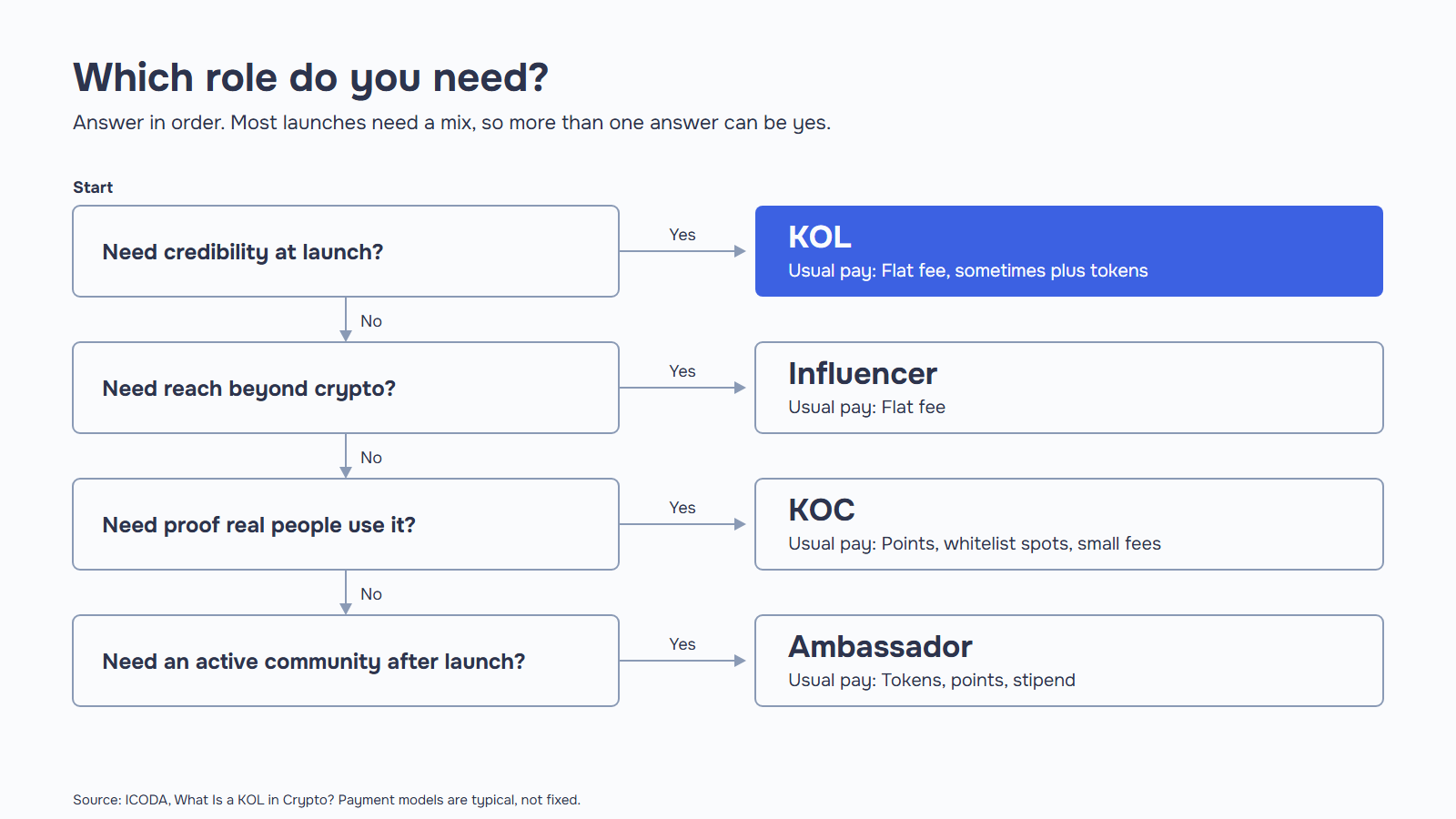
Projects hire KOLs for expertise, influencers for reach, KOCs for authenticity and ambassadors for long-term loyalty, and most crypto launches need a mix.
Crypto uses “KOL” and “influencer” interchangeably. A practical test: does the audience act on this person’s judgement, or just watch them? If they act, it’s a KOL.
KOC meaning: a KOC is a key opinion consumer, a regular user with a small following whose recommendation reads like a friend’s tip. The term comes from Chinese e-commerce marketing. In Web3 it is the trader in a Discord server who posts how they used your protocol.
| KOL | Influencer | KOC | Ambassador | |
|---|---|---|---|---|
| Known for | Expertise, track record | Reach, entertainment | Real product use | Loyalty to one project |
| Audience | Tens of thousands to millions, crypto-native | Broad, often outside crypto | Hundreds to a few thousand | One project’s community |
| Relationship | Per campaign | Per campaign | Organic or incentivised | Ongoing |
| Usual payment | Flat fee, sometimes plus tokens | Flat fee | Points, whitelist spots, small fees | Tokens, points, stipend |
| Best for | Launch credibility, education | Awareness beyond crypto | Social proof, reviews | Retention, local communities |
KOL Tiers: Nano to Mega, With 2026 Rates
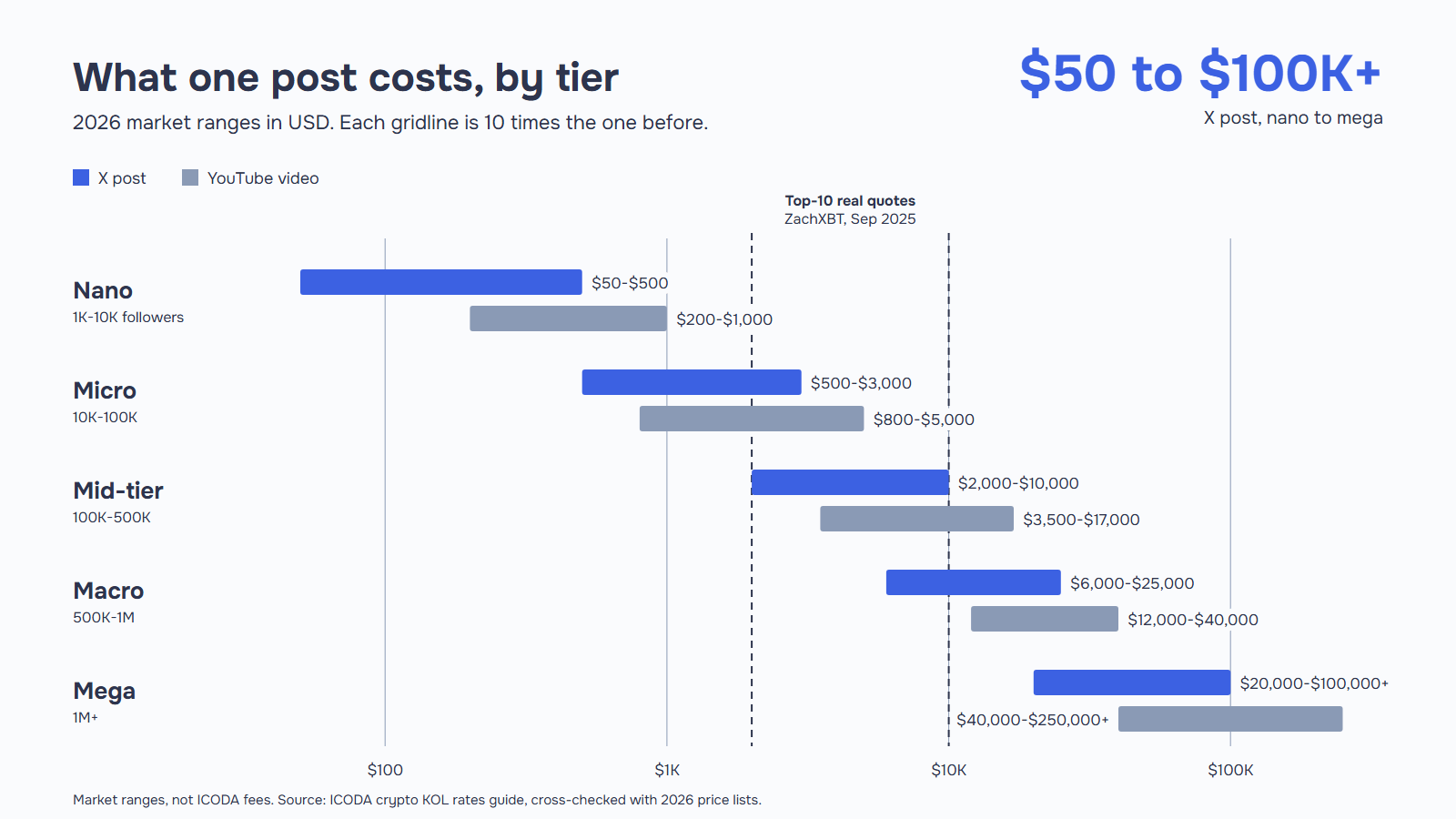
Crypto KOL tiers run from nano (1K-10K followers) to mega (1M+), and one X post costs anywhere from $50 to $100,000+ depending on the tier.
The ranges below start from ICODA’s crypto KOL rates guide and were cross-checked against other 2026 price lists and real quotes. They are market ranges, not ICODA fees.
| Tier | Followers | Engagement rate | X, per post | YouTube, per video |
|---|---|---|---|---|
| Nano | 1K-10K | 5-10%+ | $50-$500 | $200-$1,000 |
| Micro | 10K-100K | 2-6% | $500-$3,000 | $800-$5,000 |
| Mid-tier | 100K-500K | 1-4% | $2,000-$10,000 | $3,500-$17,000 |
| Macro | 500K-1M | 1-3% | $6,000-$25,000 | $12,000-$40,000 |
| Mega | 1M+ | 0.5-2% | $20,000-$100,000+ | $40,000-$250,000+ |
Telegram channels cost less, from $100-$500 per post at nano level to $5,000-$20,000+ at mega level.
Three things to check before you set a budget:
- Sources disagree. Agencies reporting from deal data go higher on large accounts: AP Collective, drawing on 700+ activations since 2022, puts X posts from 100K-500K accounts at $5,000-$25,000. Definitions explain part of the gap, since several sources start “nano” at 5K followers. Scope explains the rest: threads, exclusivity and usage rights cost more than one post. Some lists are models, too. Elev8or says its X figures are modelled estimates, not measured market data.
- Real quotes land lower for most accounts. In the spreadsheet of 200+ quotes ZachXBT published in September 2025, the ten highest per-post prices ran from about $2,000 to $10,000, apart from one $60,000 quote. Bulk packages cut the per-post price further.
- Compare quotes by cost per impression. AP Collective reports X CPMs of $20-$150 and YouTube CPMs of $50-$500. Estimate the impressions, divide the quote by them, and only then compare accounts.
Mixing tiers works because engagement falls as accounts grow. At the table’s rates, ten micro X posts cost $5,000-$30,000, about the price of one macro post ($6,000-$25,000), and reach ten separate audiences. One large account buys reach and a credibility signal. A spread of smaller ones buys repeated exposure and more replies.
In ICODA campaign write-ups, tier-1 means the biggest accounts in a campaign, used for credibility and reach, and tier-2 means mid-size accounts, used for sustained coverage. Our crypto KOL marketing on X uses that split.
How Projects Use KOLs Around a Launch or TGE
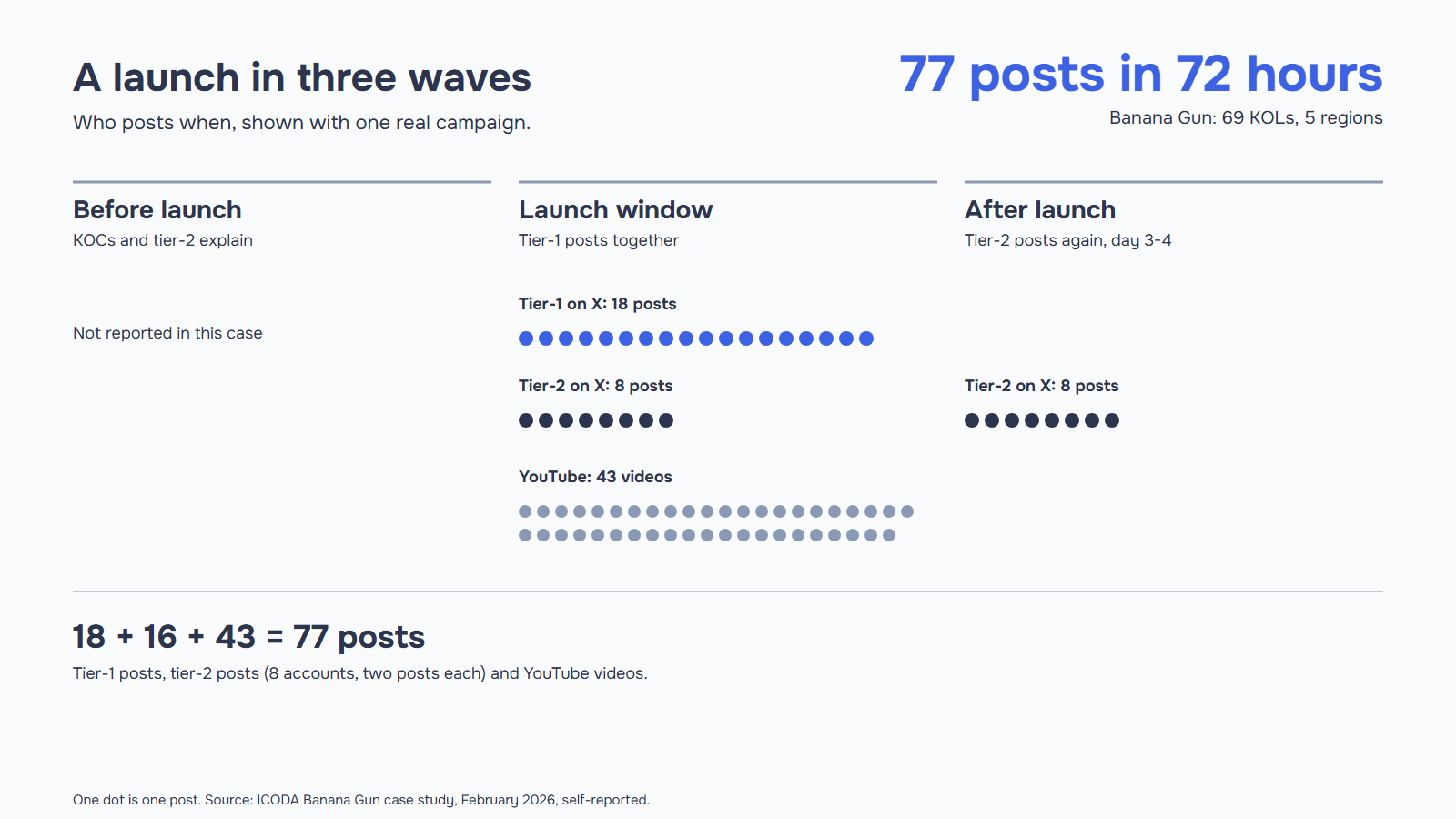
Projects stage KOLs in three waves: explain before launch, post together at launch, then follow up to keep the story alive.
- Before launch: KOCs and tier-2 voices explain what the product does, so launch day is not the first time anyone hears about it.
- Launch window: tier-1 accounts post together, so attention lands in one place at one time.
- After launch: a second tier-2 wave a few days later gives late arrivals a reason to look.
Banana Gun: 69 KOLs in 72 Hours
For Banana Gun, a Telegram trading bot, ICODA reports that 69 KOLs published 77 posts and videos in 72 hours, and the token rose 176% in that window.
The February 2026 campaign used five regional pools (CIS, English-speaking, Europe, MENA and Asia) in about eight languages. On YouTube, 43 creators posted videos. On X, 18 tier-1 accounts with 4.27M+ combined followers posted once, and 8 tier-2 accounts posted twice, with the second post on day 3 or 4. The token went from $15.63 to $43.12, reached a $112.3M market cap and held an uptrend for six weeks.
These figures are self-reported, and the same window included a Bybit ByVotes contest deadline, so the KOL wave was not the only driver. What transfers is the structure: synchronised timing, regional language pools and a planned second wave. ICODA’s rule of thumb from the case is 10-15 KOLs for a single region and 50+ for a global push. The full write-up is in the Banana Gun case study.
Solana Meme Token: Tier-1 First, Tier-2 After
For an NDA-protected Solana meme token, tier-1 KOLs announced the launch for credibility, and tier-2 accounts kept it in feeds afterwards.
Lifestyle creators brought in people outside crypto. The token peaked near $54M in market cap. The campaign also included a TOKEN2049 Singapore activation and a Travala booking integration, so KOLs were one lever among several. Details are in the Solana meme token case. For video-led waves, see our crypto KOL marketing on YouTube.
fomo.family: Referral Links as the Kol Model
ICODA’s fomo.family study found that referral links turned Telegram and X callers into a distribution channel, and search demand rose in the same weeks.
From August 31 to September 28, 2026, ICODA tracked the app’s public KOL wave through Telegram posts, Dexscreener price charts and Ahrefs data. By the end of September, 12 of the 24 core callers in the sample were promoting fomo with referral links that cut the referred trader’s fees by 10%. Global top-10 Google keywords rose from 87 to 145 (+67%) over the period, with the steepest jump between September 7 and September 21.
Three things transfer to your own launch:
- A referral link makes each KOL’s result measurable, which is the unique-link step in the measurement section below.
- Posts written like a trader talking about their own account read as native.
- Channel quality shows in view rate, not subscriber count. Three CIS Telegram channels averaged a 15.1% view rate against 7.9% for international callers, and only about 30 of 112 Telegram listings published actual trading calls.
fomo is an independent company, not an ICODA client, and the study relies on public data. Ahrefs data alone does not prove that the KOLs caused the search growth. The full numbers are in the fomo.family KOL marketing study.
Red Flags: Bought Engagement and Bot Audiences
The clearest red flag is a follower count the engagement does not support: big numbers, thin replies and few real people behind them.
Check these before you sign:
- Engagement far below the tier norm. A mega account should sit around 0.5-2%. A 1M-follower account with a few dozen likes is suspect.
- Generic replies. Emoji-only comments, repeated praise and copied promo wording point to purchased or farmed activity.
- No mutual followers. One award-winning crypto influencer deleted his X account after users noted they shared no mutual followers with him.
- Sudden follower spikes that match no viral post.
- A pump history. Look at the last ten tokens they promoted and where those charts are now.
- No analytics. A real KOL can share audience screenshots from X or YouTube Studio. If they refuse, you cannot verify the audience.
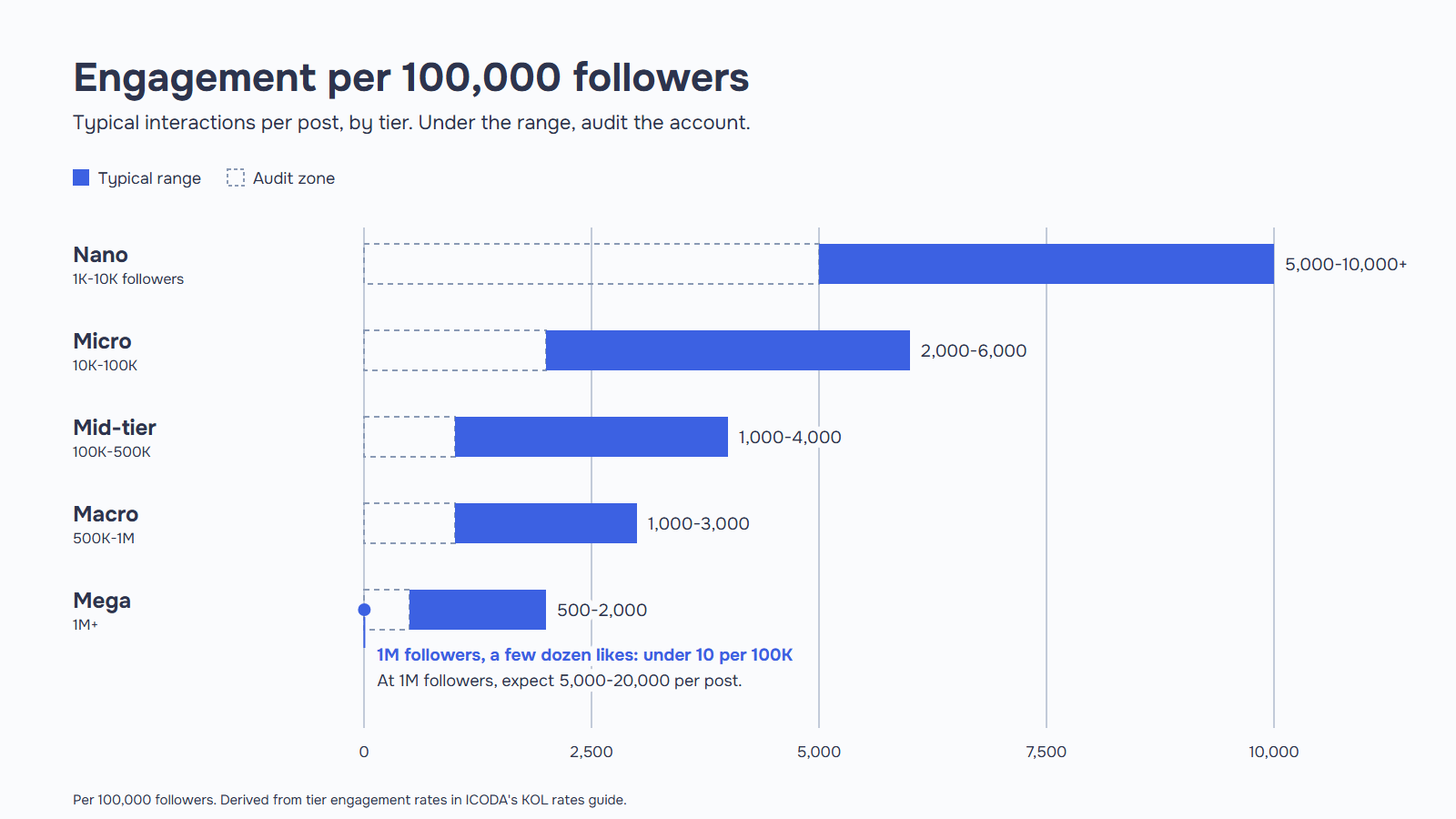
X’s head of product has said that up to 90% of followers on some large crypto accounts are fake. The FTC also bans buying or selling bot followers and views, so a bought audience is a legal risk as well as a wasted fee.
Coinwire analysed 1,567 memecoins promoted by 377 influencers, as reported by Benzinga. It found that 76% of the influencers had promoted coins that later lost nearly all their value. Coins pushed by accounts above 200K followers lost 39% after one week and 89% after three months. Coins pushed by accounts below 50K followers averaged +141% at three months.
The sample covers memecoins only, but larger accounts did not deliver better results. Use tier-1 for credibility and reach, and give the smaller tiers real budget.
How to Measure a KOL Campaign
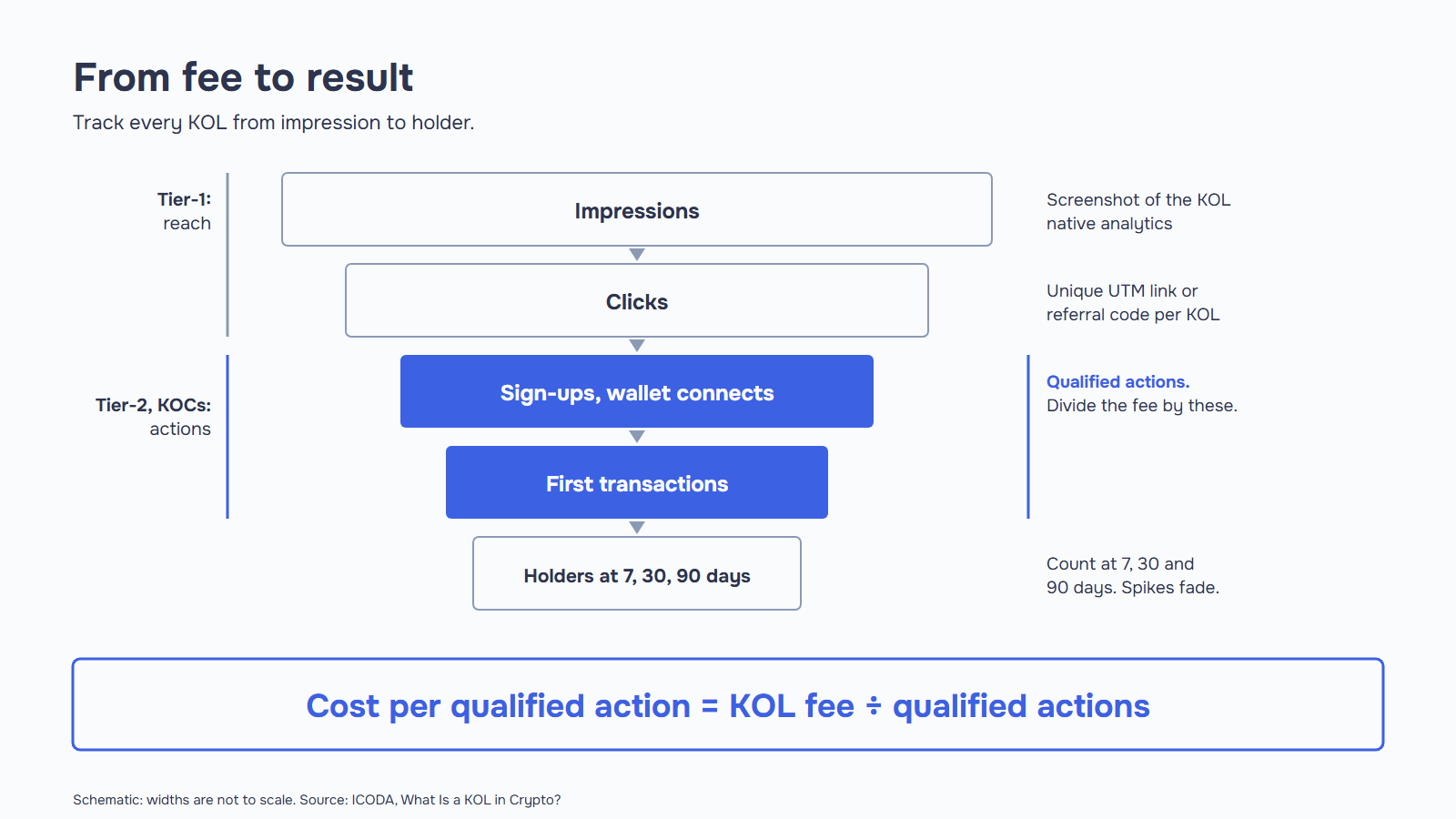
Measure a KOL campaign by what each KOL’s audience did (clicks, sign-ups, wallet connects, holding), not by impressions or the token chart.
- Give every KOL a unique link. Use a UTM-tagged URL or referral code per creator, so results trace back to a person.
- Set a goal per tier. Tier-1 earns reach and credibility. Tier-2 accounts and KOCs should earn actions.
- Track cost per qualified action. Divide the KOL fee by sign-ups, wallet connects or first transactions.
- Check retention. Count holders or active users at 7, 30 and 90 days. Early spikes often fade, as the Coinwire numbers show.
- Read the replies. Questions about the product signal real interest. Replies like “wen moon” point to speculators, not users.
- Use price as context only. Price moves have many causes, including exchange events, listings and the market. Our Banana Gun write-up uses price and on-chain timing, so it has the same limit.
Write the terms into the brief before money moves:
- Deliverables and dates: number of posts or videos, publishing window and any second wave.
- Disclosure: each paid post is labelled as an ad or partnership where the rules require it.
- Claims: the KOL repeats only facts you approve, with no promised returns.
- Staying live: posts stay up for an agreed period, such as 30 days.
- Reporting: the KOL shares native analytics screenshots within a set number of days.
Frequently Asked Questions (FAQ)
KOL stands for key opinion leader, a person whose views carry weight with an audience in one field. The KOL meaning is the same in crypto as elsewhere, but crypto applies it to traders, analysts, YouTubers and community leaders on X, YouTube and Telegram.
In crypto the terms overlap, but a KOL is trusted for expertise and an influencer is followed for reach. KOLs suit launches that need credibility. Influencers help when you want attention outside crypto.
Yes, most KOLs are paid, through a flat fee per post or video, a token allocation, a performance bonus or a mix. Market fees run from about $50 for a nano X account to $100,000+ for a mega one, and paid posts should be disclosed.
A KOC is a key opinion consumer, a real user with a small, loyal following whose experience with a product carries weight. KOCs work well for reviews, social proof and early community seeding.
Pick a niche, publish original analysis on a steady schedule and build an audience that replies. Show your track record, disclose paid work and never buy followers.
Share with


Rate the article