

Online brand protection, also called digital brand protection, is the work of finding sites, ads and app listings that use your brand name to take your traffic, and getting them removed. In iGaming and crypto, most of it happens in Google and Bing results. In August 2026 we checked 30 gambling and crypto brands. All 30 had at least one third-party site on their brand searches that sends players to a competitor or a clone. In 61% of the 16,445 results pages we captured, the first result was not the brand’s own.
You can run the same check on your own brand in about 15 minutes, then pick a way to get what you find removed.
Why Branded Traffic Is Worth Protecting
A person who types your name has already chosen you. That makes branded traffic the cheapest traffic you get and the one that converts best. When a third-party site takes the first result, you lose in three ways:
- The player goes to someone else: a clone can copy your interface, bonus system and copy, so players often can’t tell the sites apart.
- You pay for it anyway: if the site is an affiliate, you owe commission on a player who searched your name and would have come to you.
- You take the blame: when a clone stops paying out, its players’ complaints reach the original brand, because players can’t tell the two apart. That is what happened in the case below.
This is often called brand abuse or brand hijacking. To size it for your brand, multiply four numbers:
monthly branded searches × share of results pages where a third party ranks above you × share of searchers who click it × your rate from visit to deposit
Take monthly branded searches from Ahrefs and remove homonyms. The click share and the deposit rate are yours to supply. Placeholder example: 10,000 searches × 40% × 30% × 2% is 24 depositing players a month. Replace every input with your own, then multiply by what a player is worth to you.
Don’t assume you’re fine because you rank. One brand in our audit had 22,100 monthly branded searches across 8 of the 25 countries we checked (a floor, not a total). Its own site appeared on page one in 92% of results pages, and a lookalike domain sat next to it in 37%.
Check Your Brand SERP in 15 Minutes
A brand SERP is the results page Google shows when someone searches your name. It looks different from your office than from your players’ countries. Start with one country.
Before you start, open unknown pages in a separate browser profile, and never log in or enter data on them. Some of them are built to collect passwords.
- List your own domains. Include regional domains, mirrors and any generated addresses. Without the list you will report yourself: in one audit, a domain that looked like a partner was the client’s own mirror.
- Pick the country with the most branded demand. Use the country report in Search Console.
- Search from an IP in that country. Use a VPN and a private window, once on desktop and once on mobile. A clone often lives in one country’s results and stays invisible from your office.
- Run five or six queries in the local language: your brand, brand + login, + bonus, + app, + mirror, + reviews or withdrawal.
- Click the main button on every result that isn’t yours, and follow the redirects to the end. The verdict comes from where the player lands, not from the domain, the title or the layout.
- Log each finding: query, position, domain, landing site, affiliate tag in the final URL (
btag,stag,ref,aff), and the domain’s registration date from a WHOIS lookup. - Give each finding a verdict: yours (a partner from your list, with your tag), competitor, possible clone or unverified. If you can’t tell, write “unverified”. Don’t accuse on a guess.
What This Looks Like for a Player
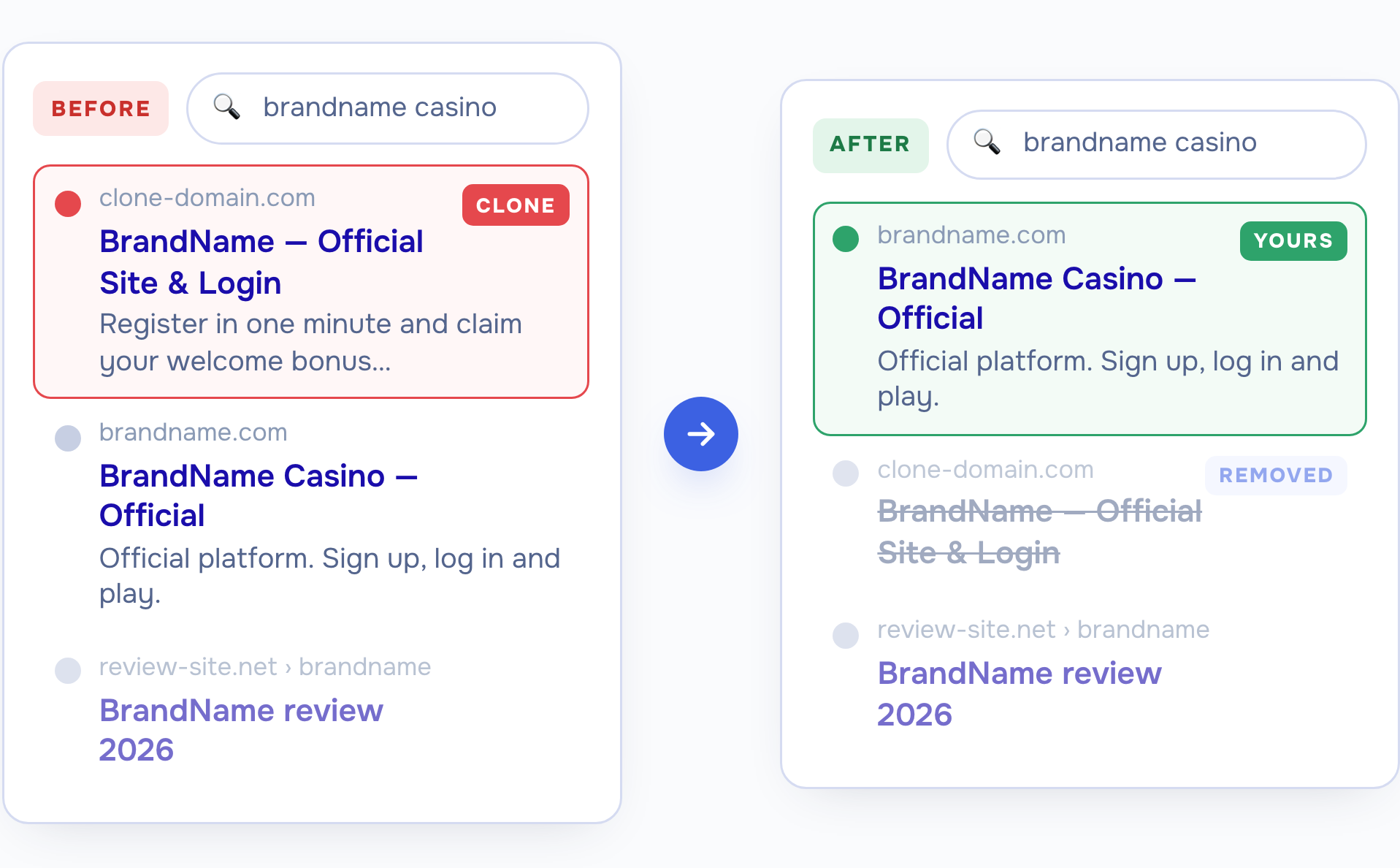
Real results pages we captured in August 2026, with brand names removed:
- Netherlands, “[brand] casino nederland”: seven of the top ten links were built from the brand’s name. The brand’s own site did not appear once.
- Netherlands, a payout query for the same brand: a domain 13 days old sat in the top two results and in Google’s answer box. It called itself the official Dutch page and showed an invented license number and the brand’s logo. Its bonus button opened a registration form at a different casino, with an affiliate tag in the URL.
- Portugal, “[brand] login”: the first result was a lookalike domain with the button “Log in to [brand]”. It opened a different operator. Within one day the button landed on three different domains of that operator: the operator stays the same, the domains don’t.
- Greece, “[brand] app”: in ninth place, a Brazilian education ministry portal offered “[brand] free” with a 4.8 rating. The site was hacked, and the brand text shows only to Google’s crawler.
Read What You Found: Five Ways Third Parties Take Branded Traffic
Most of what you found is brand impersonation. It falls into five groups, each with a different fix.
| What you see | How to confirm | What to do |
|---|---|---|
| Fake pages and typosquats. “Official site” or login on a lookalike domain | Click the button; check the domain’s age | Removal request to Google and Bing; registrar and host; UDRP if you hold a trademark |
| Login clones and hacked sites. Your login screen copied, or your brand hidden on a hacked site | Compare a browser with a Googlebot user agent; see where the form submits | Report as impersonation; report a hacked site to its host and owner |
| Your own affiliate. A partner ranks on your name but sends players elsewhere | Compare the final URL’s tag with your affiliate export | Your call, not a takedown: talk to the partner |
| Review sites and rotators. A page about you whose button changes by country or day | Click several times from local IPs | File the ranking URL with the redirect chain |
| Parasite pages and fake apps. Your name on GitLab, a review platform or an app store | Check who owns the page and where its link goes | Report under the platform’s rules |
Three terms from the table: a typosquat is a domain that copies your name with a typo or an extra word. Cloaking means a site shows your brand only to Google’s crawler while people see something else; cloaking that checks Google’s IP won’t show up in the user-agent test. A rotator is a page whose button sends visitors to different casinos.
Two rules keep you credible:
- Call it a login clone or imitation, not phishing, unless the form is shown to send credentials. In one audit, a betting-app login screen in Bangladesh had phone, password and OTP tabs, but the captured page had no form that submits data. We called it a login imitation. Overstating a finding gets your whole report doubted.
- A partner who uses your tag and sends players to you gets the verdict “yours”. Nobody files against them.
Crypto exchanges have a different problem. In our audit, three “Sign In to [exchange]” pages on pages.dev posed as one exchange’s login. Some sellers also offer verified accounts that bypass KYC. That is a regulatory and security risk more than a traffic loss, so the owner is usually the founder or the security lead rather than marketing.
Three Ways to Get Them Removed
Which route to use depends on what you can prove and what you own.
| Route | Works on | Timing | Needs |
|---|---|---|---|
| Search-engine removal request (Google, Bing) | Pages whose violation is visible: a brand copy, typosquat, swapped button, cloaking, parasite page | Days | An evidence pack for the exact ranking URL |
| Registrar and host suspension | Whole domains that impersonate or defraud | Up to 7 days | Evidence of the behavior. No trademark needed |
| UDRP arbitration | Domains confusingly similar to your trademark | 6 to 8 weeks (WIPO: typically within two months) | A trademark, and a showing of bad faith |
Google’s legal removal request has separate paths for copyright, trademark and other legal grounds. Bing has a report-a-concern form and a separate notice form for infringement. File on the URL that ranks, not on the site it leads to, and attach the evidence: screenshots, the redirect chain, an interface comparison, domain data. Without it, complaints come back rejected.
The request removes the page from results, not the site from the internet. Bing also says that reporting a concern doesn’t necessarily lead to removal, so nobody can guarantee it.
A registrar and host suspension is a domain takedown through the company that registered or hosts the site. It works on behavior, such as fraud and impersonation. Court action against the same domain takes months.
The Uniform Domain-Name Dispute-Resolution Policy (UDRP) lets a panel transfer or cancel a domain. You must show that the domain is identical or confusingly similar to your trademark, that the holder has no legitimate interest in it, and that it was registered and used in bad faith. You can’t claim damages.
You may not have a trademark, and most gambling brands don’t. For search results, copyright (a copied interface or text) and impersonation work without one. A trademark matters for UDRP and for advertising.
File carefully. Complaints outside a platform’s policy lead to restrictions on the filer, and a false DMCA notice can lead to a lawsuit. Legal notices also get a public record in the Lumen database, which collects legal complaints about online material.
Why Removal Alone Doesn’t Hold: A Brand Protection Strategy in Three Parts
Removal is one half. New parasites appear faster than you file:
- The 13-day-old domain from the Dutch results was already in the top two.
- For one brand, three new lookalike domains appeared in three days.
- In September, a removal partner told us they take down 30 to 40 parasite sites a week for one brand, and the results page stayed dirty.
That’s why a brand protection strategy has three parts: detect who ranks on your name and where the button leads, remove what can be removed, and replace the rest by owning the results. Replacing means building your own search results so the leftovers rank below them: your own sites, PR articles, YouTube videos and reviews. This is search engine reputation management, and our SERM service does it.
A crypto casino with players in Pakistan, India and Bangladesh had a copycat with an almost identical name. The copy had cloned its interface and bonuses, bought traffic in the same three countries and then stopped paying players.
In 32 days we published 530 assets: 97 guest articles, 12 PR placements, 6 videos, 393 comments and 22 reviews. We also filed removal requests with Google and Bing and ran warning ads on the copy’s own name (5,645 clicks at $0.37). By week four, two of our articles ranked in Google’s top 10 for “[clone] scam”. A year later the clone was gone from the results and our materials still held them. Read the full case.
Expect the first positions on your name to be winnable. Don’t expect a fully clean top 10 in every country.
Affiliates can also bid on your brand name in paid search. That is called brand bidding, and this guide covers organic results only.
How Brand Protection Works at ICODA: Capture, Click, Verify, File
Our brand protection service runs the 15-minute check above at scale, every day:
- Capture. We search your brand name and its variants (login, bonus, app, mirror, reviews) in every country with demand, on desktop and mobile, 100 positions deep. Depth matters: 57% of the abuse we found sat below position 20.
- Click. A real browser with an IP in the target country opens the ranking page, presses the button and follows the redirects to the site where the player lands. That site sets the verdict.
- Verify. We repeat passes for rotators, compare Googlebot with a browser to catch cloaking, and check WHOIS, DNS and the TLS certificate. If the data isn’t enough, the finding is “unverified”, not “clone”.
- File. A removal request goes to Google and Bing on the exact ranking URL, with the evidence pack attached. Legal notices get a public receipt in Lumen. Then we watch for the replacement domain.
You decide what counts as yours. You own the affiliate whitelist. We alert you when a partner sends traffic to a rival, and we don’t touch partners without your decision. To start, we need your brand name, main domain, at least one priority country, and your official domains and mirrors. Your affiliate export with the tag format helps too.
The service comes in three packages:
| Package | What’s included |
|---|---|
| Brand Snapshot (complimentary) | One-off capture and click-through of every domain on your name in the countries you choose. A report with screenshots and a table: domain → where it sends the player. Delivered within two weeks. |
| Core Retainer (per brand) | Daily capture in all countries on both engines. Browser click-through of every new target. Affiliate whitelist with alerts. Unlimited filing with Google and Bing. Live dashboard, monthly report, affiliate tag export. |
| Legal Track (per domain) | Only on targets you approve. Registrar and host suspension, up to 7 days. UDRP arbitration with the domain transferred to you, 6 to 8 weeks. |
For scope and cost, see the calculator or start with the free snapshot.
What we don’t promise:
- We don’t guarantee removal. The decision is the platform’s, and we show you rejected requests with the reason.
- We don’t cover everything. We monitor Google and Bing results. Ads, social networks, Telegram and app stores are logged but not monitored, and our search-results provider can’t cover Russia.
- We don’t quote a price before the audit, because we can size the work only after the snapshot.
Do It Yourself or Hire Out
One country and five queries is a first pass. Our audit of 30 brands took 16,445 results pages, about 550 per brand, and the parasites keep changing. In-house teams usually own half the job: lawyers file complaints but don’t detect, and SEO teams detect but rarely file with evidence. If you hire an agency or a website takedown service, ask five questions:
- Do they click through to the landing site, or only list domains that rank?
- How deep and how often do they capture, and in which countries?
- Do they show you rejected filings and the reasons?
- Do you control the affiliate whitelist?
- Who files, and in whose name?
Our casino SEO audit checklist covers the same problem inside a wider check: item 13 (clones on brand searches) and item 21 (the brand SERP).
Is a Clone Already Ranking on Your Brand?
Send us your brand name, main domain and priority countries. We capture your brand SERP, click through every result that isn’t yours and show you where each one sends the player. The Brand Snapshot is free and arrives within two weeks. Get a brand audit.
Frequently Asked Questions (FAQ)
It is the work of finding third-party sites, ads and app listings that use your brand name to take traffic, customers or logins, and getting them removed. For gambling and crypto brands, most of it happens in Google and Bing results.
Not to remove pages from search results. Copyright and impersonation grounds work without one. You need a trademark for UDRP and for advertising complaints.
A search-engine complaint closes a page in days, a registrar and host suspension takes up to 7 days, and UDRP takes 6 to 8 weeks. A court action takes months.
No. Brand protection finds and removes the pages that intercept your players. Reputation management, or SERM, builds your own results so removed pages don’t take those places back. The two work best together: removal clears the results, SERM keeps them clear.
Yes. Each filing needs an evidence pack for the exact ranking URL, and filings outside a platform’s policy can get your account restricted.
It depends on the number of brands and countries. The Brand Snapshot is free, and the [calculator](https://icoda.io/calculator/) gives a first estimate.
Methodology
In August 2026 we captured 16,445 Google results pages for 30 gambling and crypto brands: each country with search demand × brand queries (name, login, bonus, app, mirror, reviews) × desktop and mobile, 100 positions deep. We collapsed the results to domains, set aside platforms such as YouTube and app stores, and opened 3,646 third-party domains in a real browser with an IP in the target country. We clicked the main button and followed the redirects. The landing site sets the verdict. Of those domains, 1,285 sent the player to a competitor or a clone. The example screenshots date from 20 to 27 August 2026.
Limits: queries include modifiers such as “login”, not the bare brand name only. Findings are a snapshot. Where data was insufficient, the finding stays “unverified”. We anonymized the brands.
Share with


Rate the article