

In regulated market iGaming PR, most of what a comms team publishes counts as marketing. Most rulebooks define advertising by what a message is for and who can see it, not by whether someone paid for it. Regulators rarely touch the press release itself. They sanction the formats around it: ambassador posts, sponsorship links, broadcast mentions and partner content.
We checked the rules and the record (methodology at the end):
- Of 17 advertising rulebooks in Europe and the Americas, three expressly exempt a press release: the UK CAP Code, New Jersey’s regulations and Ontario’s industry code. All three exempt it only when it goes to journalists.
- In 115 marketing sanctions from 23 regulators (January 2023 to September 2026), paid ads triggered 26%. Influencers, owned social, broadcast integrations, affiliate content, website copy and sponsorship triggered 48%.
- Where an operator used a third party, the operator was held liable in 28 of 29 cases.
Where Does Gambling PR Become Advertising?
Gambling PR becomes advertising when it promotes gambling to people who can act on it. In most gambling advertising regulations the format and the payment don’t matter.
What counts as advertising:
- UK Gambling Act, s.327: anything done “with a view to increasing the use of facilities for gambling”, sponsorship included.
- Netherlands: any communication that promotes (aanprijst) gambling, “with or without the help of third parties”.
- Denmark: branding, CSR stories and “any mention” meant to improve the company’s reputation.
- Italy: self-promotion (autopromozione), paid or not.
- Spain: promotion of the operator itself, not only its products.
The exemptions are narrow. The UK CAP Code excludes press releases and editorial content, but covers a release sent to consumers, paid for as an ad, or placed where it clearly targets consumers. New Jersey (N.J.A.C. 13:69C-14.1(b)(3)) exempts statements sent to “persons employed in the reporting” of news. Ontario’s CGA code, run by Ad Standards since January 2026, excludes “corporate reports, press releases and annual reports”. The US code from the Responsible Online Gaming Association (ROGA) exempts corporate communications that carry no call to action.
Is it an ad? PR formats in seven markets (as of September 2026)
| Format | UK | Netherlands | Germany | Spain | Italy | Ontario | New Jersey |
|---|---|---|---|---|---|---|---|
| Release sent to journalists | No | Yes, if it promotes | No, unless the operator places it | Depends | Banned for consumers; allowed in trade press | No | No |
| Release syndicated to consumer sites | Yes, if paid and the operator controls it | Yes | Yes, if the operator controls it | Yes, labeled “publicidad” | Banned | No (code) | Depends |
| Newsroom and owned social | Yes, if linked to what you sell | Yes | Yes, brand-only posts included | Yes | Banned for consumers | Yes | Yes |
| Sponsorship announcement | Yes (s.327(2)) | Yes | Depends | Yes | Banned since 2019 | Athlete limits apply | Likely |
| Executive byline or interview | No, if the publisher controls it | Yes, if the operator’s content | Depends | Depends | Self-promotion is caught | Depends | Likely |
Germany adds time-based advertising restrictions: from 6am to 9pm it bans online casino, slots and poker ads, including brand-only ads from operators that sell those products.
What Regulators Punish: 115 Cases
We coded 131 cases from 23 regulators and self-regulators in the UK, the EU, North America, Brazil and Australia. Of these, 115 ended in a fine, an upheld ruling, a warning or an order, and none of them was about a press release.
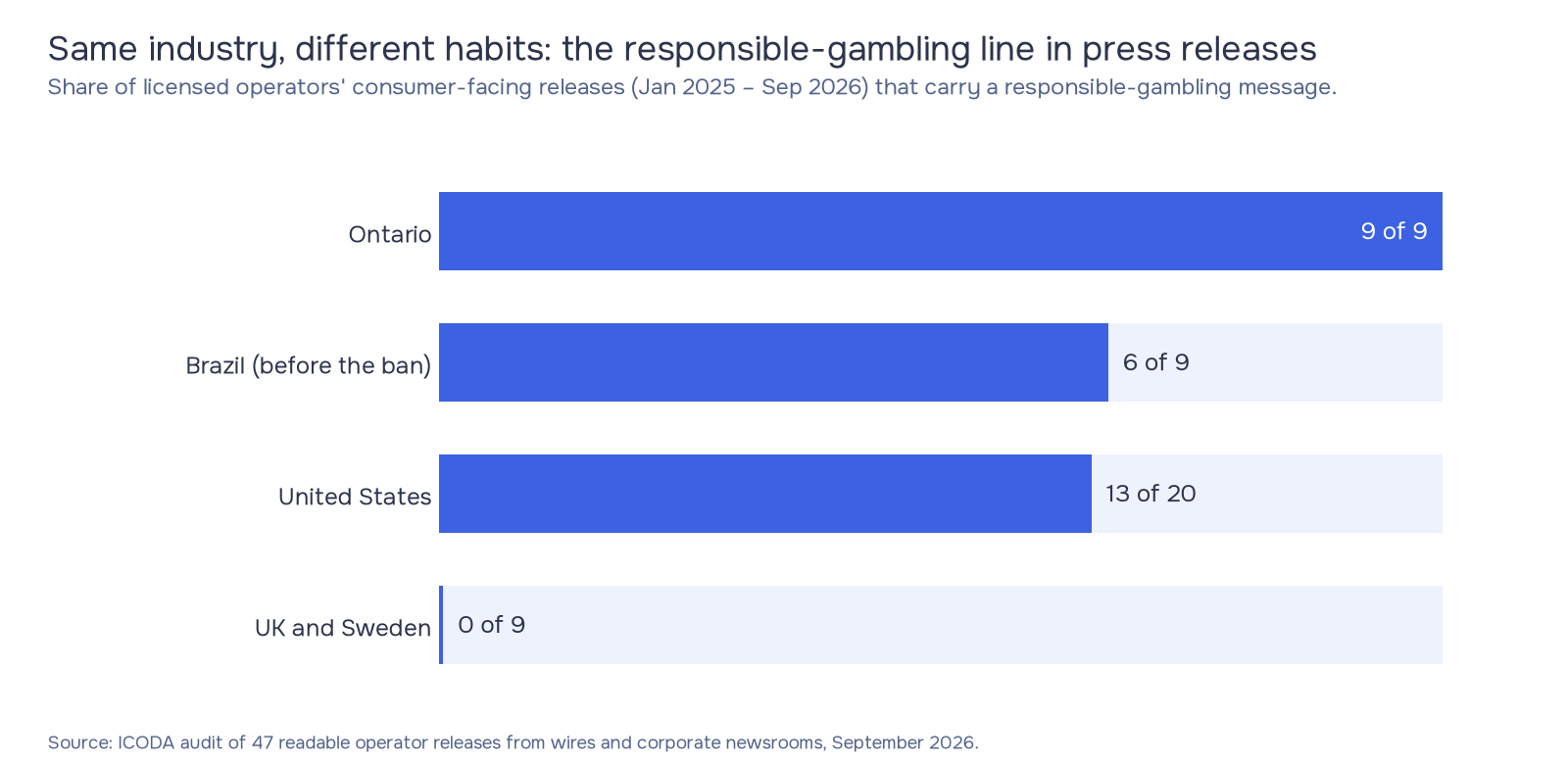
- The UK is the exception: 58% of UK cases were paid ads, because the ASA rules on ad complaints. Outside the ASA, paid ads triggered 5 of 74 cases. The rest came from CRM messages, influencers, broadcast integrations and owned content.
- Liability stays with the operator. In 28 of 29 cases where an operator used an agency, affiliate, broadcaster or influencer, the operator was held liable. Germany’s Federal Administrative Court confirmed in February 2025 that operators must make sure “commissioned third parties” follow the ad rules.
- Partners can be liable as well: 30% of respondents weren’t operators. Italy’s AGCOM fined Meta €5.85m in December 2023 over gambling content on 18 accounts and 32 sponsored posts. The Dutch KSA has issued penalty orders against gambling influencers.
Casino public relations covers the UK regulator’s enforcement record and five earlier cases. Ad bans and enforcement are two of the ten casino marketing problems in 2026 we track for operators.
Six Mistakes in Regulated-Market iGaming PR
1. “It’s a press release, so it isn’t an ad”
A release is exempt in a few markets, and only while it stays with journalists. Wires and newsrooms put it in front of consumers.
Operators’ habits depend on the market. We audited 56 consumer-facing releases from January 2025 to September 2026 and counted those with a responsible-gambling message:
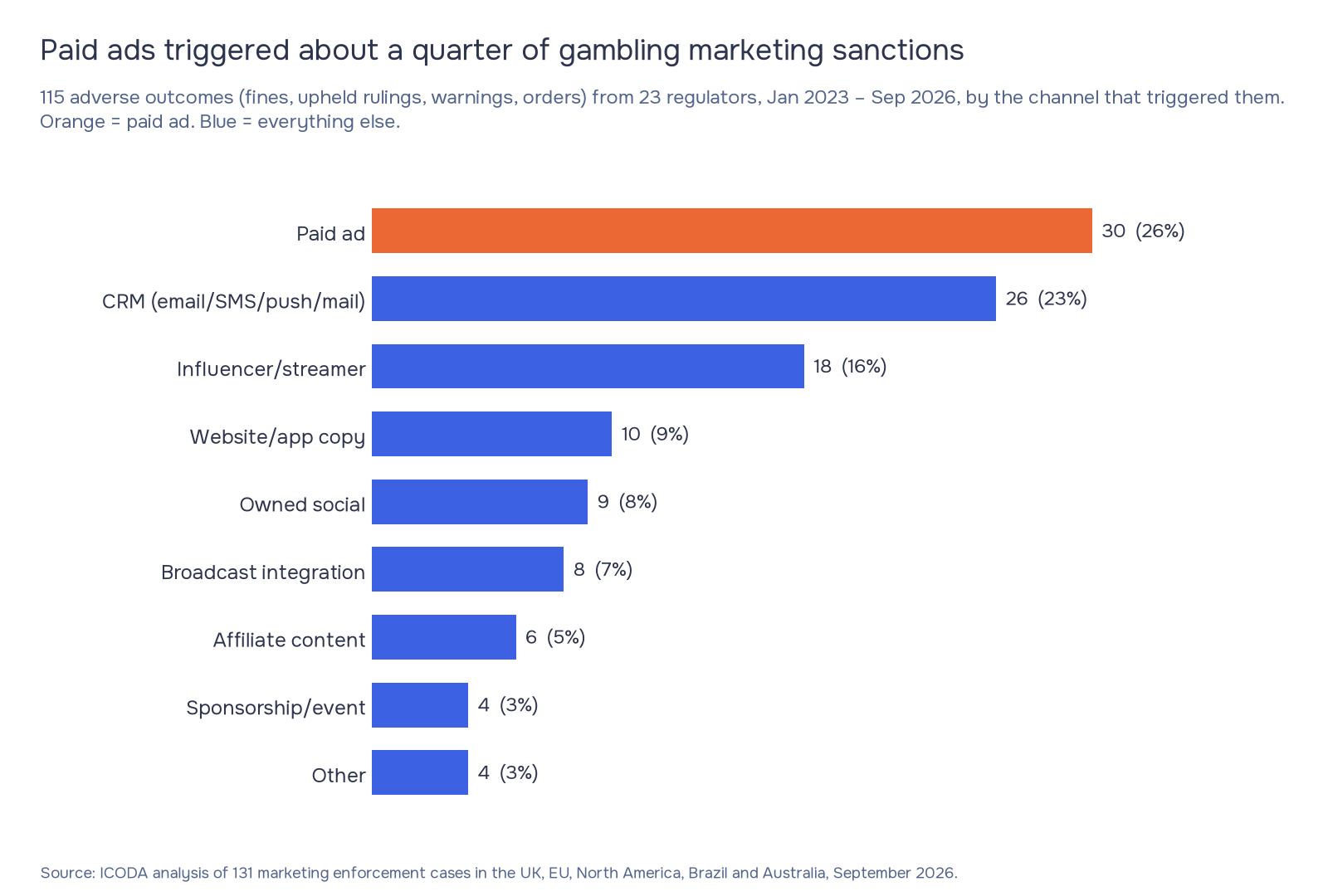
US and Ontario operators write releases as if they were ads, even where the rules exempt releases. UK and Swedish operators publish on corporate newsrooms with no responsible-gambling message, age line or helpline. One example: on 1 June 2026, LeoVegas Group announced Peter Forsberg as BetMGM’s Swedish ambassador, together with “Foppa Boosts” odds paying up to 21x. The release has no age line and no helpline. Sweden requires both in marketing aimed at consumers. It sits on an investor site, where the exemption argument is strongest; the argument weakens once a consumer outlet reprints it.
Fix: add a compliance block to every consumer-facing release: age, helpline, license and markets where the product is available. It costs one line where it isn’t required. The crypto casino press release guide lists the lines to include.
2. “Our Own Channels Are Editorial”
Owned channels are in scope almost everywhere.
- New York and Pennsylvania require the helpline on each web or social profile page; Massachusetts requires it on social media too.
- Denmark requires “18+”, StopSpillet and “Udeluk dig via ROFUS” on every post that shows the brand’s name or logo.
On 22 October 2025 the UK ASA upheld a complaint against Kwiff over an unpaid X post featuring Lewis Hamilton around the British Grand Prix, citing his estimated 150,000 UK Instagram followers under 18.
Fix: run owned posts through the same sign-off as ads.
3. “A Sponsorship or Ambassador Announcement Is Just News”
Sponsorship is advertising by law in the UK and is treated as advertising in France and the Netherlands. Italy has banned it since 2019.
- In the Netherlands, on 24 March 2026, the KSA told Jacks.nl that its logo on the Professional Darts Corporation website was allowed, but the hyperlink under it wasn’t: the link “constitutes advertising for online gambling”.
- In Ontario, since 28 February 2024, the AGCO has banned athletes in igaming advertising, except “for the exclusive purpose of advocating for responsible gambling practices”. BetMGM Canada’s releases with Connor McDavid and Derek Jeter are built on that exception: both are framed as responsible-gambling campaigns. The exception works only while the content stays about responsible gambling.
Athletes or celebrities appeared in 19 of the 52 releases we could check, so this check comes up often.
Fix: check each sponsorship asset (logo, link, athlete, CTA) against that market’s rules before the announcement goes out.
4. “The Agency, Affiliate or Broadcaster Is Liable, Not Us”
The operator stays liable, and the partner may be too.
- In the UK, the ASA upheld a complaint against Hollywoodbets on 23 July 2025. Its affiliate, Clever Advertising, served a banner to a logged-in 16-year-old. The ASA held Hollywoodbets responsible.
- In Massachusetts, the Gaming Commission fined PENN $15,000 in October 2025 after ESPN’s Rece Davis called a pick a “risk-free investment” on air in March 2024. PENN had reported it itself. The Commission noted that no one issued a clear corrective statement to the public.
Fix: put the market’s banned phrases (“free”, “risk-free”, “guaranteed”) and the approval flow into every partner brief. When a partner slips, publish the correction yourself.
5. “Thought Leadership Isn’t Promotion”
Executive content can count as promotion.
- Italy catches self-promotion even when unpaid.
- New York requires affiliates to disclose the relationship “after a writer’s byline”.
- Brazil’s 2026 rules banned expert commentary that encourages bets.
Italy draws the line at the audience. AGCOM excludes business-to-business communication, including trade press and operator-only trade fairs, so B2B PR stays open there. The same interview picked up by a consumer outlet isn’t covered.
Fix: keep executive content about the business: the market, regulation, data. Leave offers and calls to action out.
6. “Old Coverage Is Harmless”
When a market’s rules change, old coverage becomes current advertising. Under the UK Gambling Act (s.330(8)), advertising unlawful gambling is a fresh offense on each day it stays accessible. Brazil’s new ban gave operators 10 days to take existing advertising down.
Fix: keep a list of every placement, sponsored article and ambassador post, with who can remove it and how fast. Review it whenever a market’s rules change.
Working With Media and Regulators Across Restricted GEOs
English is no shield. The Dutch KSA ordered Polymarket on 20 January 2026 to stop serving Dutch players, with a penalty of €420,000 a week up to €840,000. The evidence list included “the website contains the English language”. The UK Act reaches content “likely to be accessed” in Great Britain, and Italian law covers advertising “in any way” for gambling accepted abroad. A release that can be read everywhere should:
- name the markets where the product is licensed;
- carry no bonus code, deep link or sign-up CTA;
- send readers to a landing page that restricts by location;
- go out through wire distribution that excludes restricted markets.
Which markets to enter, and in what order, is a strategy question covered by our iGaming marketing strategy work.
Some media carry their own liability. In Spain, media outlets must check that a gambling advertiser holds a license (Ley 13/2011, art. 7.3). In Italy, the ban reaches the owner of the medium as well as the advertiser. Expect editors there to ask for proof of license, so put it in your media pack. Paid and sponsored placements are legitimate in both markets when labeled as the law requires.
Regulators may hear before the press. In the UK, a licensee must report key events, including investigations by other regulators, within five working days of becoming aware of them. UKGC settlements come with a published statement of the failings, and the KSA publishes its sanction decisions, so your statement will run next to the regulator’s.
When Paddy Power Betfair agreed a £2m settlement on 17 December 2025, Flutter’s response said “we firmly believe that we lead the industry in player protection”. Coverage ran that line next to the regulator’s findings. A statement that accepts the findings and names the fix gives journalists less to quote.
Policy arguments go through consultations and trade bodies such as BGC (UK), NOGA and VNLOK (Netherlands), DSWV (Germany), Jdigital (Spain), BOS (Sweden), AGA and iDEA (US), CGA (Canada). The UK consultation on banning sponsorship by unlicensed operators closed on 9 September 2026; the proposed ban would start in August 2027.
Four Cases From Regulated Markets
Brazil, 25 September 2026: a regulated market closed overnight. Provisional Measure (Medida Provisória) 1.394 bans the operation, offer, intermediation and advertising of fixed-odds betting in Brazil, including by operators based abroad. Licenses issued under Law 14.790 end 30 days after publication, and existing advertising must come down within 10 days. “Licensed on .bet.br” stopped working as a PR message within days. The measure lapses unless Congress converts it into law. Lesson: have the placement list from mistake 6 ready before you need it.
North Carolina, March 2024: eight launches, one news event. Eight licensed sports betting operators went live at noon on 11 March 2024, the day before the ACC basketball tournament. Launch events were 21+ and tied to a real regulatory milestone. Bettors wagered $198.1m in the first week, according to the state’s gaming commission. Lesson: tie launch PR to the regulatory milestone, which the press covers anyway.
Sweden, November 2025: advocacy ahead of the regulator. On 7 November 2025, the CEOs of Svenska Spel and ATG argued in Svenska Dagbladet for a total ban on gambling bonuses. Trade association BOS replied on the same page that a ban would push players to unlicensed sites. Lesson: policy arguments belong on opinion pages and in consultations, where they aren’t read as promotion.
Evolution, July 2026: suppliers answer for where their games appear. Evolution agreed a £4.75m settlement with the UK Gambling Commission, which said in its 23 July 2026 statement that the supplier’s games had reached British players through six unlicensed sites. A supplier release should list licensed jurisdictions rather than say “global rollout”. It shouldn’t name an operator next to a market where that operator isn’t licensed.
How to Choose a Gambling PR Agency for Regulated Markets
Judge an online gambling PR agency by how it handles compliance, not by its media list. When we audited 32 iGaming PR agencies, 53% mentioned compliance on their service pages but only 22% named a specific regulator. Ask five questions:
- Which markets’ codes do you check against, and who signs off?
- Show me a release you changed for compliance, before and after.
- How do you target wire distribution by market?
- What’s your process for archiving and taking content down?
- Who talks to the regulator or the press when something goes wrong: you, or our compliance lead?
For the full 12-point scorecard, prices and red flags, see how to choose an iGaming PR agency.
Most of ICODA’s gambling public relations clients are crypto and offshore brands; we wrote this guide for the ones moving into licensed markets.
Frequently Asked Questions (FAQ)
It can be in most markets. Only three of the 17 rulebooks we checked exempt a release sent to journalists; the rest treat anything that promotes gambling to consumers as advertising.
It depends on the market. Ontario allows athletes only in responsible-gambling campaigns, the Netherlands bans famous role models, and the UK limits people with strong appeal to under-18s.
The operator, in 28 of the 29 third-party cases we coded, and often the partner as well.
Yes, if the content reaches people there. The UK, the Netherlands, Italy and Brazil apply their rules to foreign operators.
Methodology and Limitations
Enforcement dataset. 131 marketing cases from 23 regulators and self-regulators, January 2023 to September 2026. It includes all 55 UK ASA gambling rulings plus cases from the UKGC, KSA, AGCOM, DGOJ, GGL, Spillemyndigheden, US state regulators and attorneys general, the AGCO, Brazil’s SPA and CONAR, ACMA and Ad Standards; 115 had an adverse outcome. Each case is coded by trigger channel, respondent and third-party involvement. It is a case set, not a census: coverage depends on what regulators publish, and 60 cases rest on secondary sources rather than the regulator’s page.
Release audit. 56 consumer-facing releases from US (26), Ontario (10), UK and Swedish (10) and Brazilian (10) operators, January 2025 to September 2026, taken from wires and corporate newsrooms. We excluded three news articles and left releases we couldn’t read in full out of the percentages. We measured practice, not legality.
Rules. 17 rulebooks checked against the legal text where reachable, as of September 2026. Some UK and Ontario regulator pages were blocked, so a few items rely on secondary sources. This isn’t legal advice; check each market with local counsel.
Share with


Rate the article