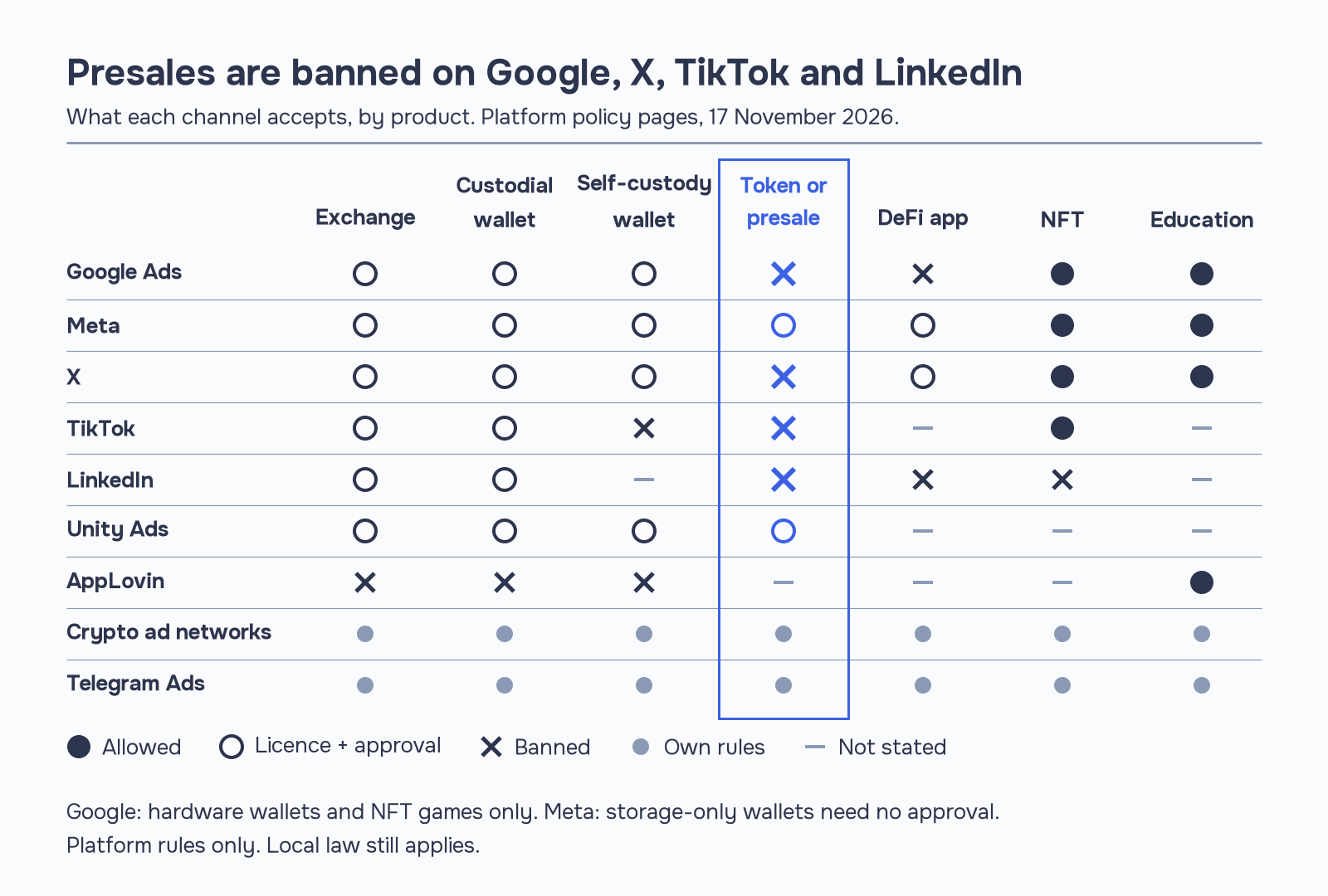
Crypto PPC advertising works in 2026 when you buy only the channels that accept your product and measure past the click. Google, Meta, X, TikTok and Microsoft sell ads to licensed exchanges and wallets after approval. Google, X, TikTok and LinkedIn ban ICO and presale ads. Tokens, DeFi protocols and presales advertise through crypto ad networks, crypto media and Telegram.
The term covers paid search, social and network ads for exchanges, wallets, tokens and dApps. We read each platform’s policy pages on 17 November 2026 (Microsoft’s markets come from trade press) and name the source of every cost figure. This guide covers platform rules, not the law in your market, so check each market with counsel.
How to advertise a crypto project, in short:
- Match your product category to the channels that accept it.
- Publish a compliant landing page, then apply for platform approval.
- Run crypto networks or Telegram while the approvals are pending.
- Size the test from your target CPA and the platform’s learning threshold.
- Join the ad click to the wallet and count only users who pass KYC or act on-chain.
Which Channels Allow Crypto PPC Advertising in 2026?
Where to advertise crypto depends on your licence: exchanges and wallets can buy Google, Meta, X and TikTok; tokens rely on networks, media and Telegram.
What Your Product Category Allows
Exchanges and custodial wallets need a licence per market; self-custody wallets, tokens and DeFi protocols are banned outright on some platforms.
- Licensed exchange or custodial wallet. Google, Meta, X and TikTok open after approval in the markets where you hold a licence. Start with Google Search for demand and Meta for installs and retargeting.
- Self-custody wallet. Google certifies hardware wallets but bans unhosted software wallets. Meta needs written permission once the wallet can buy, swap or stake; storage-only wallets run without it. TikTok bans self-custody wallets in most markets.
- Token, ICO or presale. Google, X, TikTok and LinkedIn ban these ads, and Meta requires written permission for crypto investment ads. Crypto ad networks, crypto media, Telegram and KOLs remain, but a network’s approval isn’t legal cover. In the US a token sale ad can be an unregistered securities offer, the UK requires an FCA-approved promotion, and the EU requires a published white paper.
- DeFi protocol. Google bans DeFi trading protocols and liquidity pools, while X certifies licensed DApps and DEXs. Crypto ad networks with wallet targeting fit best.
- Education, media, tooling or NFT games. Google accepts education and NFT games with consumable in-game items without certification; Meta accepts education, news and NFTs without permission.
Crypto Ad Channels Compared
Each channel has its own approval route, buying model and price unit, so compare costs only within a row.
| Channel | Crypto ads policy | Buying model | Typical cost (source) | Best for |
|---|---|---|---|---|
| Google Search, YouTube | Exchanges and wallets: local licence plus Google certification. ICOs, presales and DeFi trading protocols banned | CPC | US, certified advertisers: $0.60–$6.00 per click by keyword; “crypto wallet” $5.00, “best crypto exchange” $6.00 (Ahrefs) | Licensed exchanges and wallets capturing search demand |
| Meta (Facebook, Instagram) | Exchanges, lending and wallets that swap or stake: written permission plus a recognised licence. Education, news, NFTs: no permission | Auction, CPM | Global medians: $21.84 per crypto app install, about $114 per purchase (Superads, vendor) | App installs, retargeting |
| X | Exchanges, wallets, staking, DeFi apps: country licence plus X certification per category. ICO, IEO, mining banned | Auction | No reliable public benchmark | Crypto-native reach around launches |
| TikTok | Licensed exchanges and custodial wallets in listed markets, 18+. ICOs banned | Auction | Fintech CPA median about $21 (agency blog, no method shown) | Younger retail buyers, creator ads |
| Microsoft Advertising | Exchanges after pre-approval; wallets only in India and Japan | CPC | No public crypto figure | Extra search volume |
| Apple App Store and Apple Ads | App Store: exchanges only where licensed; wallets only from organisation developers | Cost per tap | US finance apps, 2025: $4.17 per tap, $9.65 per install (AppTweak, vendor) | iOS wallet and exchange installs |
| Unity Ads (in-app) | Exchanges, wallets, token offerings: prior approval since 30 June 2026 | CPI, CPM | No credible finance benchmark | Wallet installs at volume |
| Crypto ad networks (Coinzilla, Bitmedia, Cointraffic, A-ADS) | Each network’s own rules; Cointraffic accepts token sales, Coinzilla publishes no rule | CPM, CPC | Bitmedia floor $0.30 CPM; Cointraffic display €6–11 CPM (own pages) | Tokens, DeFi, presales |
| Crypto media and data sites (CoinGecko, CoinMarketCap, Coinranking, newsletters) | Publisher rules; Brave Ads and The Defiant refuse presales | Flat fee, CPM | Coinranking $3.50–$4.20 CPM; Bankless newsletter $24,000 a week (own rate cards) | Awareness, launches, listings |
| Telegram Ads | Crypto not named; get-rich-quick offers and gambling banned | CPM | Floor 0.1 GRAM per 1,000 views (Telegram); crypto CPMs about $0.50–1.50 on channel post views (tgmetrics) | Mini Apps, bots, TON products |
Policies as of 17 November 2026. Vendor figures come from companies that sell ads or ad tools; read them as ranges.
Crypto Ads Policy on Google, Meta, X and TikTok
Each platform’s crypto ads policy approves you by product category and country licence, and an approval covers only the accounts or categories you named.
Google Ads
Google certifies exchanges and wallets country by country, and since mid-2026 you apply inside your Google Ads account, not through a Help Center form.
The licence Google asks for depends on the target country:
- US: FinCEN money services business registration plus a state money transmitter licence, or a federal or state bank charter.
- EU: a MiCA crypto-asset service provider (CASP) licence. France stopped accepting the old AMF registration on 1 July 2026.
- UK: FCA registration. Canada: FINTRAC. Japan: FSA. UAE: CMA, DFSA, FSRA or VARA.
Google added Indonesia in February 2026 and Iceland, Liechtenstein and Norway in August. ICOs, IDOs, DeFi trading protocols, liquidity pools and crypto loans stay banned everywhere. Education without investment advice and businesses that accept crypto payments need no certification.
Meta
Meta asks for written permission and a licence from its accepted list for exchanges, lending, crypto investment ads and wallets that buy, sell, swap or stake.
You apply in Meta Business Suite under Authorisations and Verifications. The list has more than 27 licences, including FinCEN, NYDFS BitLicense, FCA and MAS. It doesn’t name MiCA, so EU advertisers should confirm which licence Meta accepts for their market.
Meta’s scam rules apply to every crypto ad. Ads can’t promise guaranteed or risk-free returns, cite past performance to suggest future gains, or claim returns in under 24 hours.
X
X bans ICO, IEO, IDExO and mining ads and certifies exchanges, wallets, staking and DeFi apps one category at a time, each with a country licence.
In the US, X asks for SEC, CFTC or FinCEN registration; in the UK, FCA registration. Crypto and DeFi ads are not available in Belgium, Greece, Qatar, Russia, Singapore, Slovenia or Ukraine. Educational content and smart contracts need no licence, and NFTs and NFT marketplaces are permitted. Each category needs its own certification request.
TikTok
TikTok takes licensed exchanges and custodial wallets only in listed markets, for audiences of 18 and over, and in most of Europe only through a sales rep.
ICOs are banned in every market. Crypto ads must target 18+ (20+ in Japan). The UK, most of the EU, Switzerland, Norway and Israel require a TikTok sales representative, which means a managed account. About 16 markets ban crypto ads entirely, and NFTs can’t be presented as investments.
What If Your Crypto Ads Get Rejected?
Fix the landing page or copy, then appeal through the platform; never open a new account to replace a suspended one.
Google handles appeals in Policy manager and Meta in Account Quality. Google treats a new account opened to get around a suspension as circumventing systems, which suspends without warning and can extend to related accounts. Hold certifications and ad accounts in your company’s legal name and give your agency access to them, so approvals stay with you if you change agencies.
What Do Crypto Ad Networks, Telegram and Crypto Media Offer?
Crypto ad networks take most token, DeFi and presale ads, start at €100–€3,000, and reach people who already hold crypto.
Crypto Ad Networks
Tokens and DeFi protocols can buy crypto ad networks in week one, while Google and Meta approvals are still pending.
| Network | Minimum | Buying model | Takes tokens and presales | Tracking |
|---|---|---|---|---|
| Coinzilla | €100 deposit | CPM | No public rule found | Not stated on its pages |
| Bitmedia | $300 deposit | CPM from $0.30, CPC from $0.25 | Prohibited-content list only | Pixel or postback |
| Cointraffic | €3,000 managed | CPM, display from about €6 | Yes, says so | Pixel |
| A-ADS | No fixed minimum | Daily budget, CPM, CPA | Rejects scams only | Not stated |
| Blockchain-Ads | $10,000 deposit | CPM, wallet targeting | Takes crypto and finance | Not stated |
Read on each network’s own pages, 17 November 2026. Bitmedia moderates ads within hours. HypeLab and Slise also sell wallet-based targeting; neither publishes a minimum.
Crypto ad networks such as HypeLab estimate that 15–30% of crypto ad clicks are fake. Pass each network’s placement or zone ID into your tracker, block placements that send clicks and no conversions, and keep buying only from placements that convert.
Crypto Media and Data Sites
Crypto media sell placements next to price data and news, at flat fees or CPMs that suit launches and listings.
CoinGecko’s self-serve boosted listings start at $100. CoinMarketCap’s managed campaigns start at $20,000 upfront and launch 5–10 business days after a signed order. Sponsored articles and paid listicles also put your brand where AI answers look for sources. Our crypto marketing cost guide prices placements by unit.
Telegram Ads
Telegram’s ad rules don’t name crypto at all; the bans that touch crypto ads cover guaranteed-return offers and gambling.
Telegram sets the minimum CPM at 0.1 GRAM (formerly Toncoin), shows ads only in channels with 1,000+ subscribers, and has no minimum budget. Choose placements by hand instead of broad interests, and give each placement its own bot link with a start parameter (?start= for bots, ?startapp= for Mini Apps) to see cost per start by channel. In ICODA’s Telegram Ads campaign for a Mini App, 35+ hand-picked gaming bots and trading channels brought 9,765 bot starts for about 15,000 USDT, roughly 1.54 USDT each.
Native, Programmatic and In-App
Taboola takes crypto in 41 countries but not little-known coins, Outbrain refuses it, and Unity Ads needs prior approval, so read each rule first.
AppLovin bars exchanges and trading wallets (policy updated July 2026), so in-app wallet install campaigns go through Unity.
How Much Budget Does a Crypto Advertising Campaign Need?
A crypto advertising campaign needs enough test budget for 30–50 conversions per ad set, so price it from your target CPA and the learning threshold.
The formula: test budget = target CPA × conversions the algorithm needs × number of ad sets. Set the target CPA from what a funded user is worth to you over your payback window. The thresholds come from the platforms:
- Meta: about 50 optimisation events per ad set in the 7 days after the last significant edit. Below that the ad set shows “learning limited” and keeps delivering, but in October 2026 Meta said such ad sets pay about 28% more per purchase.
- Google Search, Target CPA: it can start without history; Google evaluates it over 30 days with at least 30 conversions.
- Google App campaigns: a daily budget of at least 50× your target cost per install, or 10× your target cost per in-app action such as KYC.
| Goal | Optimise on | Platform guidance | Test budget per cell |
|---|---|---|---|
| Exchange sign-ups on Google Search | Sign-up | Evaluate over 30 days, 30+ conversions | $3,000 a month at $5 CPC and 5% click-to-sign-up (our assumption) |
| Certified wallet installs on Google App campaigns | Install | Daily budget 50× target CPI | $500 a day, about $15,000 a month, at a $10 target CPI |
| App installs on Meta | Install | About 50 a week per ad set | $1,100 a week at $22 (Superads median) |
| Purchases on Meta, with written permission | Purchase | About 50 a week per ad set | $5,700 a week at $114 (Superads median) |
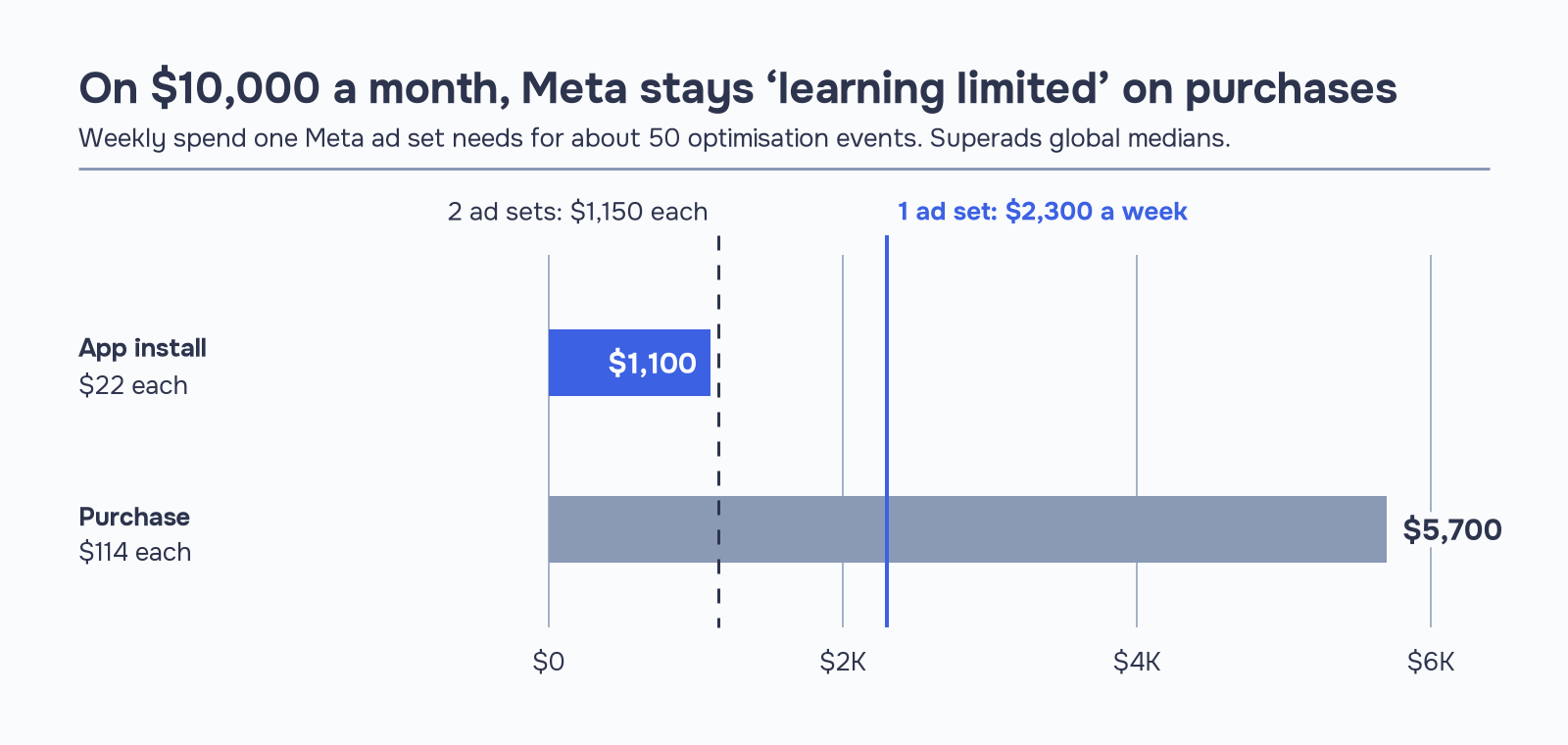
If your budget can’t buy about 50 of the events you care about a week (purchases, KYC passes, first deposits), optimise one step higher and judge that event by hand. A $10,000 monthly Meta test gives about $2,300 a week, enough for one ad set to learn on installs but not on $114 purchases. Run one broad prospecting ad set and one retargeting ad set, test creatives inside each, and compare cost per purchase yourself.
Your licence decides the countries; within them, install costs differ more than 40-fold. Adjust’s 2025 finance app report put installs at $7.71 in Germany, $5.37 in France and $0.18 in India (vendor, all ad networks). Cheap markets also draw the most airdrop farmers, so judge them on KYC passes or on-chain value.
Price the step after the one you buy: in one ICODA wallet launch on Google, Meta, X and in-app networks, about 1 in 12 installs created a wallet, so each created wallet cost up to $170. An exchange sees the same drop between install, KYC and first deposit.
Keep part of the budget in reserve, because each edit restarts Meta’s learning. Give each iteration at least seven days.
Which Crypto Ad Creatives Pass Review and Still Convert?
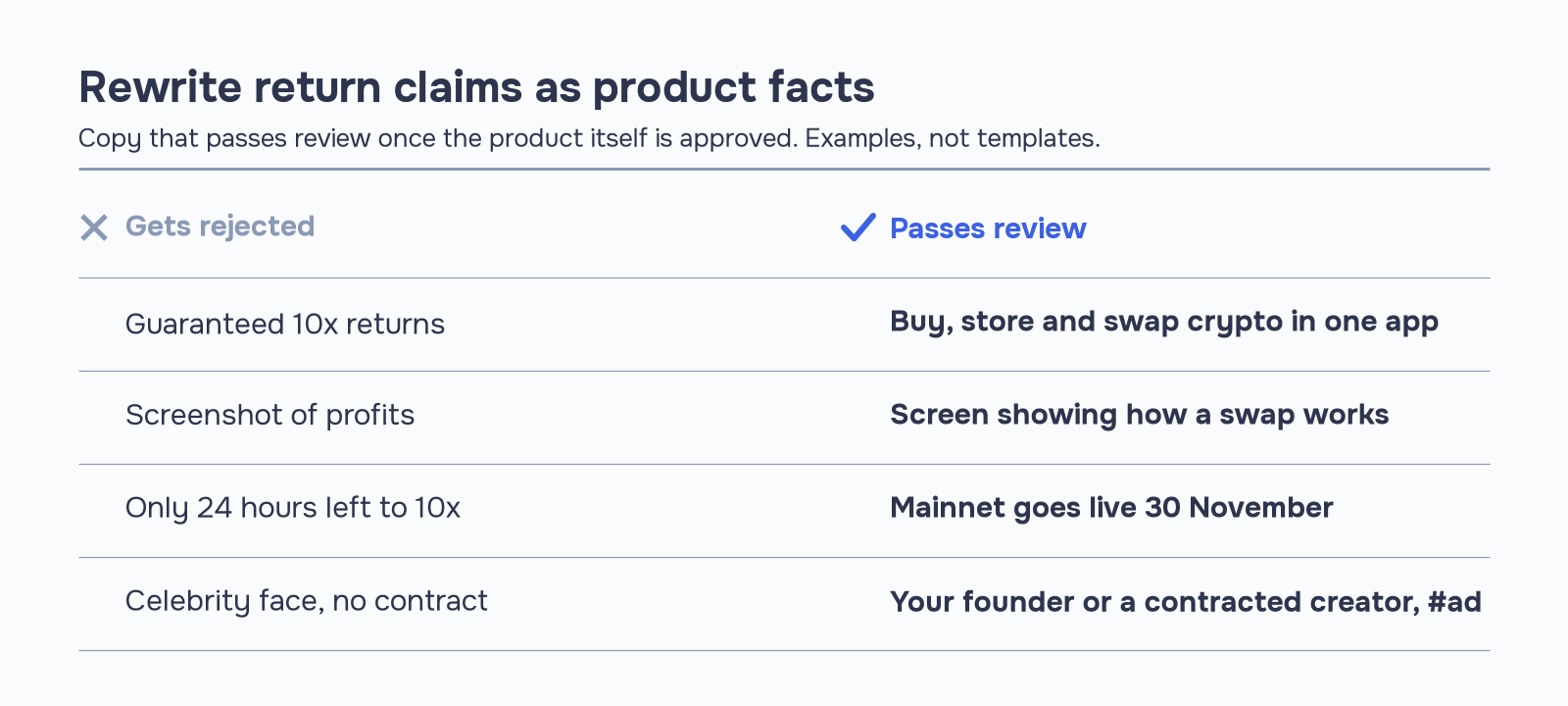
Crypto creatives pass review when they sell the product and show no guarantees, price targets, profit screenshots or celebrity faces.
What Gets Crypto Ads Rejected?
Crypto ads get rejected for promising returns, impersonating public figures or showing past gains:
- “Guaranteed”, “risk-free”, “100x” and any price prediction
- Screenshots of past gains or wallet balances
- Countdowns tied to returns, such as “24 hours to 10x”
- Public figures or AI likenesses without a contract. Google suspends for impersonation without warning.
Which Disclosures Do Crypto Ads Need?
The UK and EU prescribe risk wording for crypto promotions, and the US requires paid endorsements to be labelled:
- UK: a crypto promotion to UK consumers must be made or approved by an FCA-authorised or FCA-registered firm. The rule covers every channel, including networks, Telegram and creators; without such a firm, exclude the UK. The ad carries the FCA risk warning, in force since 8 October 2023: “Don’t invest unless you’re prepared to lose all the money you invest. This is a high-risk investment and you should not expect to be protected if something goes wrong.” Where a third-party platform’s character limit can’t fit it, the first sentence is enough, plus a “Take 2 mins to learn more” link. On the landing page the warning stays fixed at the top while the user scrolls. Bonuses, referral rewards and time-limited benefits count as banned incentives, and first-time buyers get a 24-hour cooling-off period.
- EU: for a token offered to the public, MiCA Article 7 requires marketing to match the published white paper, give the offeror’s website, phone number and email, and carry this statement: “This crypto-asset marketing communication has not been reviewed or approved by any competent authority in any Member State of the European Union. The offeror of the crypto-asset is solely responsible for the content of this crypto-asset marketing communication.” Nothing runs before the white paper is published.
- US: paid creator content needs “#ad” or “#sponsored” inside the video. For tokens that may be securities, the promoter must also disclose that they were paid and how much: Kim Kardashian paid the SEC $1.26 million to settle over an EthereumMax post that didn’t.
What Converts in Crypto Ad Creatives?
In the published cases we found, the ads that converted were short vertical videos about utility and ease of use, made with creators.
TikTok reports that Binance’s creator-led Spark Ads reached 137 million people with a CTR 74.86% above non-creator content, and that Indonesian crypto app Pintu improved CPA by 24% with local creators showing the app interface.
Landing page checklist: a domain and legal entity matching the licence on your application; the licence number and regulator; geo-blocking for unlicensed markets; the required risk warning; no price predictions.
Without a licence, you can still run education ads on Google and Meta, as long as they sell no crypto product. The page must teach something: if it funnels into a token sale, the ad is reviewed as a token sale ad, and Google treats a thin page built to get past review as circumventing its systems.
How Do You Track Crypto Ad Conversions On-Chain?
Join the ad click to the wallet: store click IDs, record the address at wallet connect, then send on-chain events back to the ad platform server-side.
Ad platforms see clicks and the blockchain sees wallet activity, so you connect them yourself:
- Store UTMs, click IDs and consent (gclid, gbraid or wbraid, fbclid with the _fbc and _fbp cookies, ttclid) on your server. Safari keeps script-set cookies for 7 days, or 24 hours after an ad click, so write them to your backend at sign-up or wallet connect.
- Link the wallet address to that click ID at wallet connect.
- Check the chain daily for deposits, swaps or token purchases from that address.
- Send the conversion server-side with the stored click ID, a hashed email if you have one, and the user’s IP and user agent, through Meta Conversions API or Google offline conversion import. Platforms don’t match on wallet addresses.
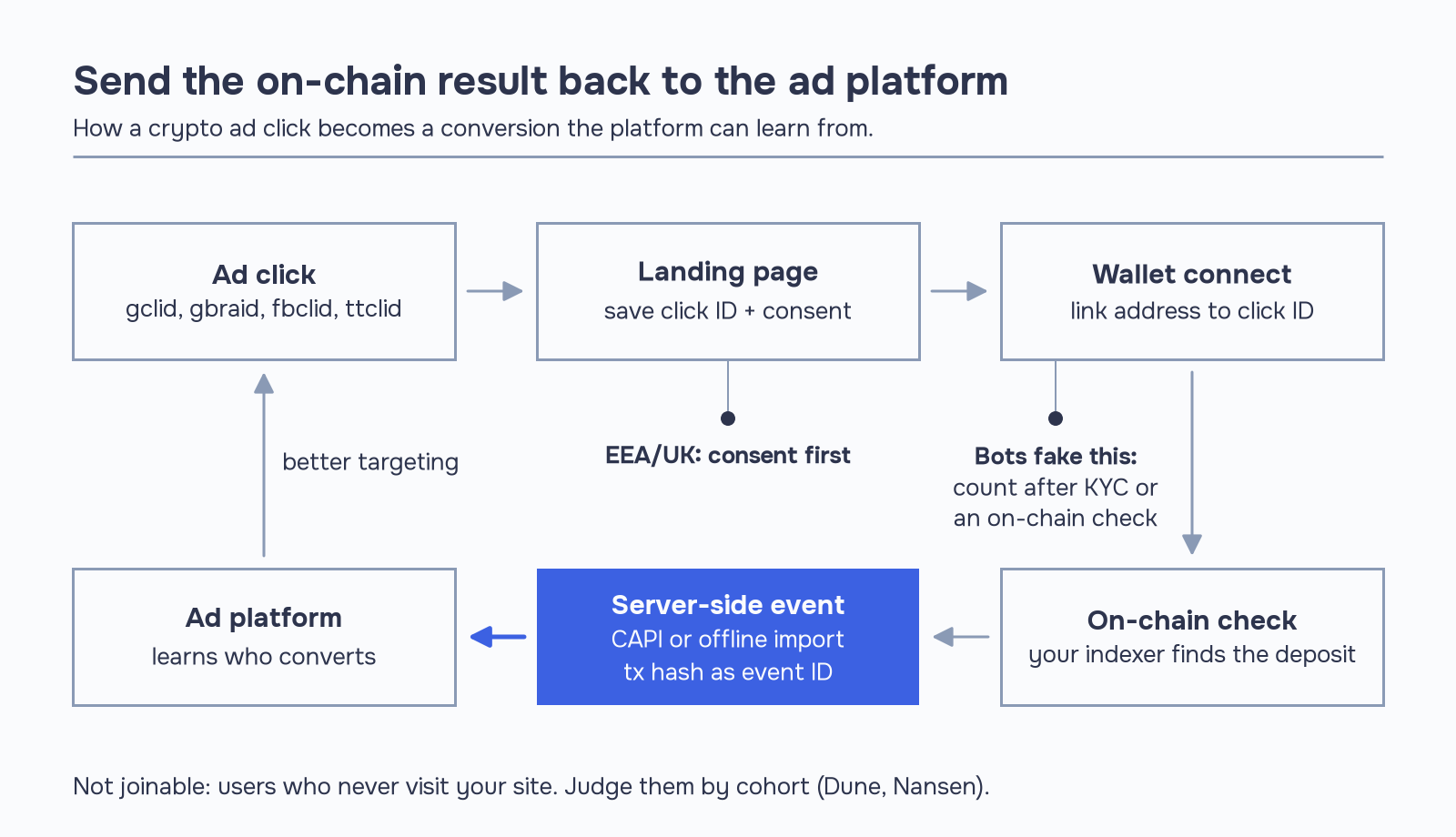
Meta rejects server events older than 7 days, and Google accepts imports up to 90 days after the click. Give the Pixel and Conversions API copies of an event the same event ID, such as the transaction hash, or each purchase counts twice.
For apps, an MMP such as AppsFlyer, Adjust or Singular attributes installs and receives on-chain events server-to-server. On iOS, map the first deposit to an AdAttributionKit conversion value: for users who opt out of tracking, server events never reach the ad networks.
Spindl (part of Coinbase’s Base), Formo and Safary join wallets to clicks for you. Dune and Nansen show whether paid cohorts hold or sell.
| Conversion event | When to optimise on it | Tracking |
|---|---|---|
| App install | Launch or unknown funnel; highest fraud risk | MMP plus AdAttributionKit |
| Sign-up | Default when deeper events stay under about 50 a week | Pixel plus Conversions API, shared event ID |
| Wallet connect | dApps without KYC; pair with on-chain checks, since bots fake it | Site event with address capture |
| KYC pass | Regulated exchanges once volume allows; strongest bot filter | Backend to Conversions API or offline import |
| First deposit or swap | Value bidding at about 15 valued conversions in 30 days; send revenue or a capped value | Backend or indexer, joined by address, sent with a USD value |
| Repeat transaction | Never optimise; compare channels on it | Dune or Nansen cohort query by address |
Before launch:
- Click IDs and consent saved on your server
- One test conversion visible in Meta Events Manager and Google Ads
- Shared event IDs between Pixel and Conversions API
- A daily on-chain job, sending values in USD
- A bot rule decided (KYC, minimum on-chain value or Sybil screen) before you count anything
In the EEA and UK, get consent before the pixel fires and pass the consent signal with every Google upload. Joining an address to a click ID makes it personal data under the European Data Protection Board’s July 2026 guidelines, so it needs a lawful basis and a privacy notice. Wallet-connect and points campaigns also attract airdrop farmers: LayerZero flagged 803,093 of about 6 million eligible addresses as Sybils.
How to Launch a Crypto PPC Campaign Step by Step
You can launch crypto advertising PPC campaigns in seven steps, and the first three decide whether the accounts pass review.
- Map each product against target countries and the licence you hold there.
- Build a compliant landing page first: platforms review it when you apply.
- Apply for approvals in your company’s name. None of the platforms publishes a review time.
- Start crypto networks or Telegram in week one while approvals run.
- Wire tracking and work through the pre-launch list above.
- Launch Google and Meta once approved, with budgets sized by the formula.
- Scale on the event that pays: judge each channel on cost per KYC pass, funded account or on-chain purchase.
To run it with a team that already runs crypto campaigns and tracking on these platforms, talk to a crypto PPC agency, or compare PPC marketing services for crypto first.
Frequently Asked Questions (FAQ)
Yes, if you’re a licensed exchange or wallet certified by Google for each target country, applying inside your Google Ads account. ICOs, presales, DeFi trading protocols and unhosted software wallets can’t advertise.
Yes: exchanges, lending, crypto investment ads and wallets that swap or stake need written permission and an accepted licence; education, news and NFTs need none.
Not on Google, X, TikTok or LinkedIn, and Meta requires written permission. Crypto ad networks such as Cointraffic, crypto media, Telegram and KOLs accept some presales, but platform approval isn’t legal cover: the UK needs an FCA-approved promotion, the EU a published white paper, and US offers usually need counsel.
Crypto ad networks and Telegram Ads: Coinzilla takes €100, Bitmedia $300, and Telegram has no minimum budget. Track with a postback, because cheap inventory carries the most fake clicks.
Crypto PPC advertising costs $0.60–$6 per click on US crypto keywords; Meta’s global medians are $22 per install and $114 per purchase (vendor data). Size the test for about 50 conversions per ad set a week; agency fees come on top.
Bitmedia and Coinzilla suit self-serve tests, Cointraffic managed campaigns from €3,000, and HypeLab or Blockchain-Ads wallet targeting. Check the token-sale rule and postback support first.
Share with


Rate the article