




CoinGecko counted 11.6 million token failures during 2025, 86.3% of every failure it has recorded since 2021. Most of those projects did some marketing.
What separated the ones that worked was rarely budget. It was sequence: doing the cheap things properly before buying the expensive ones, and knowing which of the expensive ones reliably fail.
Below: what to do first, what each stage costs in 2026, and how to tell whether any of it is working. If you need the groundwork first, what crypto marketing is and what it consists of covers the parts this article puts to work.
What a Crypto Marketing Strategy Actually Contains
Four things, in this order. Most projects skip the first two and wonder why the third does not
work.
- A reason to exist that survives one question. If someone asks why this needs a token and the answer takes three minutes, you have a positioning problem, not a marketing problem.
- A place people can gather. One channel, run properly, where a human answers questions quickly.
- Distribution: content, KOLs, PR and paid, the things that put the project in front of people
who have not heard of it. - Measurement that survives a wallet connection. Covered at the end, and the part almost everyone gets wrong.
Starting at step three is the most common failure mode in crypto marketing, and the most
expensive.
What Works With Almost No Budget
If you have no money for marketing, you are where most projects are. A small number of things work. The governing rule: pick three channels, win them, and ignore everything else until you have to. Three channels done properly beat nine done badly, and the second option costs more.
Downturns sharpen this further, because attention gets cheap while money does not. Marketing through a bear market covers what still converts when the market turns.
The Founder’s Account
The most underused channel in crypto, and audiences have moved in its favour. Gallup polled 1,572 people aged 14 to 29 in February and March 2026 and found 69% trust work produced by humans alone, against 28% for AI-assisted work. A named person with a track record is now the scarce thing.
Post your view on what is happening in your sector, why you made specific product decisions, and what you got wrong. Answer replies. Skip the announcements that an announcement is coming.
This compounds slowly and cannot be bought later, which is why it belongs at the start.
One Community Channel, Run Properly
Telegram or Discord. Not both, until you have someone whose job it is. Telegram suits fast updates and a single room. Discord suits structured, role-based communities where people stay for months.
What makes it work is unglamorous: someone answers questions within minutes during your waking hours, bad news gets posted before people find it elsewhere, and the same person is visibly there every day. What makes it fail is buying members.
Content That Answers a Real Question
One piece a week that answers something people actually search for beats a daily stream of project updates nobody reads. This compounds and it is close to free if you write it yourself.
It also increasingly feeds AI answers rather than just search results, which means the documentation and explainer pages you write for humans are doing double duty.
Side Events Instead of Booths
The cheapest reliable business development in crypto. Major conference weeks now carry hundreds of side events, and hosting a dinner for twelve during one costs a fraction of a booth.
The crypto event agency FORKOFF published cost-per-qualified-lead figures in April 2026 from its own client ledger, covering 14 operator teams across nine conference weeks in Q1 2026 including Token2049 Dubai, EthCC Cannes and Consensus Hong Kong. Median cost per qualified lead came to $457 for a closed dinner (range $290 to $720) against $1,974 for a primary-stage booth (range $1,420 to $3,100). Roughly four times better, for the format that costs less to run. That is one agency’s client data, not an industry benchmark.
Concentrate on One Market
Small budgets go further concentrated than spread, and the obvious market is not always the right one.
TRM Labs’ Q1 2026 adoption index, which applies web traffic shares to on-chain retail transaction data, put quarterly retail volume at $213.3 billion in the US, $66.6 billion in South Korea, $47.5 billion in Russia, $46.2 billion in India, $40.4 billion in Brazil and $34.9 billion in Turkey. Almost every developed market contracted year on year: South Korea fell 31%, Germany 20%, the UK 13%. India held up far better than the global average.
So the US is enormous and crowded, and several smaller markets cost less per unit of attention. Localisation means native-language support and local payment methods, not translated English.
What a Mid-Sized Budget Buys
Published agency planning estimates (NinjaPromo, updated June 2026) put the component ranges as follows. These are market ranges, not quotes.
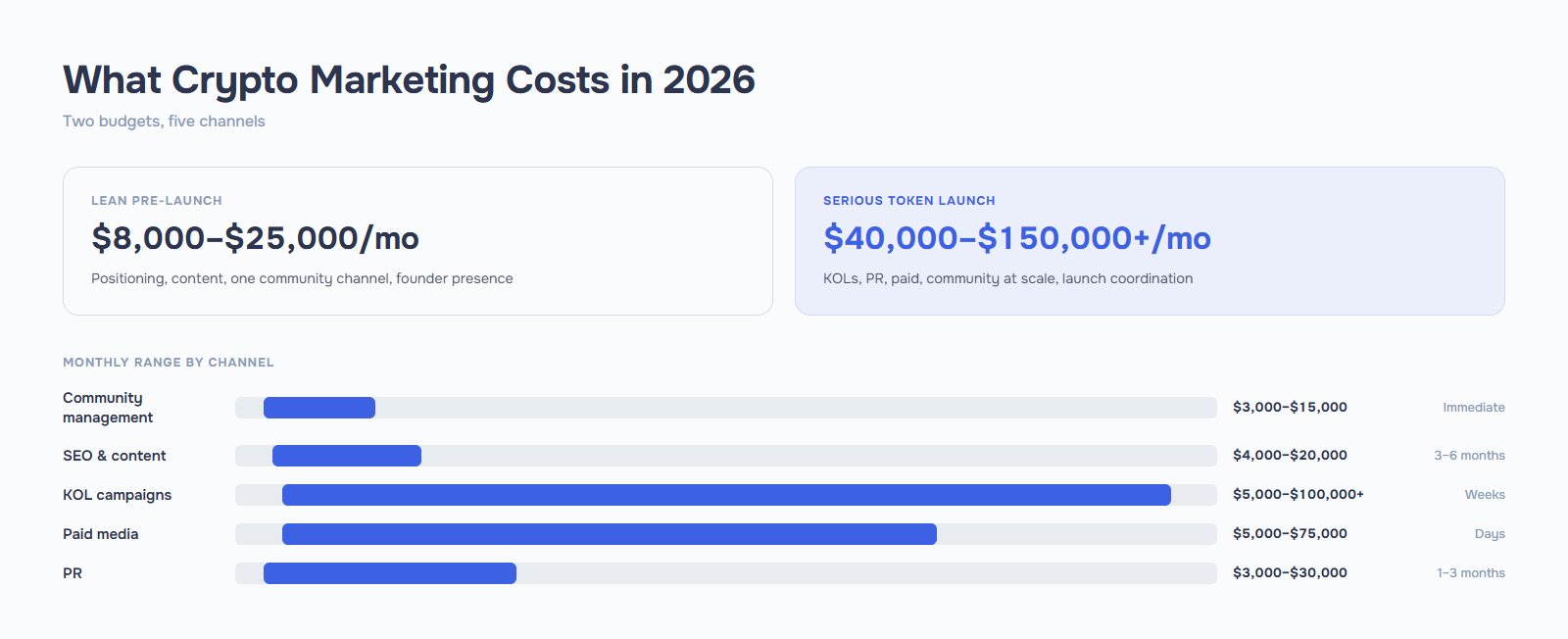
Two of these need more than a row.
KOL Campaigns: Pay Partly in Tokens
The standard failure is paying a KOL cash for a post, getting a spike, and getting nothing after. The fix that became common practice through 2026 is to split payment between cash and a vested token allocation that unlocks over 12 to 24 months and sits visible on-chain. The KOL then holds a position in the outcome, not in the post.
One practical warning: X’s paid-partnership rules and its advertising rules are separate policies with different prohibited categories. Check both before you sign anything.
Quest Platforms Are Retention, Not Acquisition
Galxe, Zealy and Layer3 each suit a different stage: Galxe for loyalty points and credentialing, Zealy for early community gamification, Layer3 for structured journeys into a mainnet ecosystem.
All three get people who already found you to do specific things and keep showing up. None reliably produce users who stay after the rewards stop. Budget them as retention spend and the numbers make sense. Budget them as acquisition and they will not.
Where Large Budgets Leak
Three places, consistently.
Main-stage sponsorship, per the figures above. A booth is a branding purchase that gets counted as a lead-generation purchase, which is why it disappoints.
Paid advertising, measured against expectation. One agency case study published in 2026 tracked a six-month, $3.6 million integrated campaign for a crypto AI project across Meta Ads, Google Ads, crypto ad networks, PR, KOL content and social management, attributing revenue to source. Paid social and paid search together produced about 10.3% of revenue. Direct, organic social, organic search and referral produced roughly the other 90%. Meta Ads still returned 6.24 on ad spend within its own slice.
Both things are true: paid worked, and it was not the engine. It accelerated demand that already existed. One case study is not research, but the shape fits the category. When most ad inventory is restricted or gated behind certification, owned and earned channels carry more of the load.
Then there are the “free” listings. CoinGecko and CoinMarketCap charge nothing to list; neither sells listings. Qualifying is the expensive part. Listing.Help, a firm that sells listing services, estimates a $25,000 to $120,000+ readiness budget: $10k to $80k for exchange coverage and liquidity depth, $10k to $60k for audits, KYC/KYB and legal, $5k to $40k for site, whitepaper and disclosures, $3k to $15k for monitoring and tooling. Those are a vendor’s estimates, but the shape holds. The listing is free. Becoming eligible for it is not.
What Crypto Marketing Costs
The figures published as market planning ranges in mid-2026:
| Stage | Monthly | What it covers |
|---|---|---|
| Lean pre-launch | $8,000 to $25,000 | Positioning, content, one community channel, founder presence |
| Serious token launch | $40,000 to $150,000+ | Full campaign: KOLs, PR, paid, community scaling, launch coordination |
If you have been quoted $15,000 a month, that sits inside the normal range. Whether it is reasonable depends on two things the number cannot tell you: what specifically it buys, and how it will be measured. Ask for both in writing. If a proposal cannot answer either, the price is not the problem with it.
What to Do First: A 90-Day Sequence
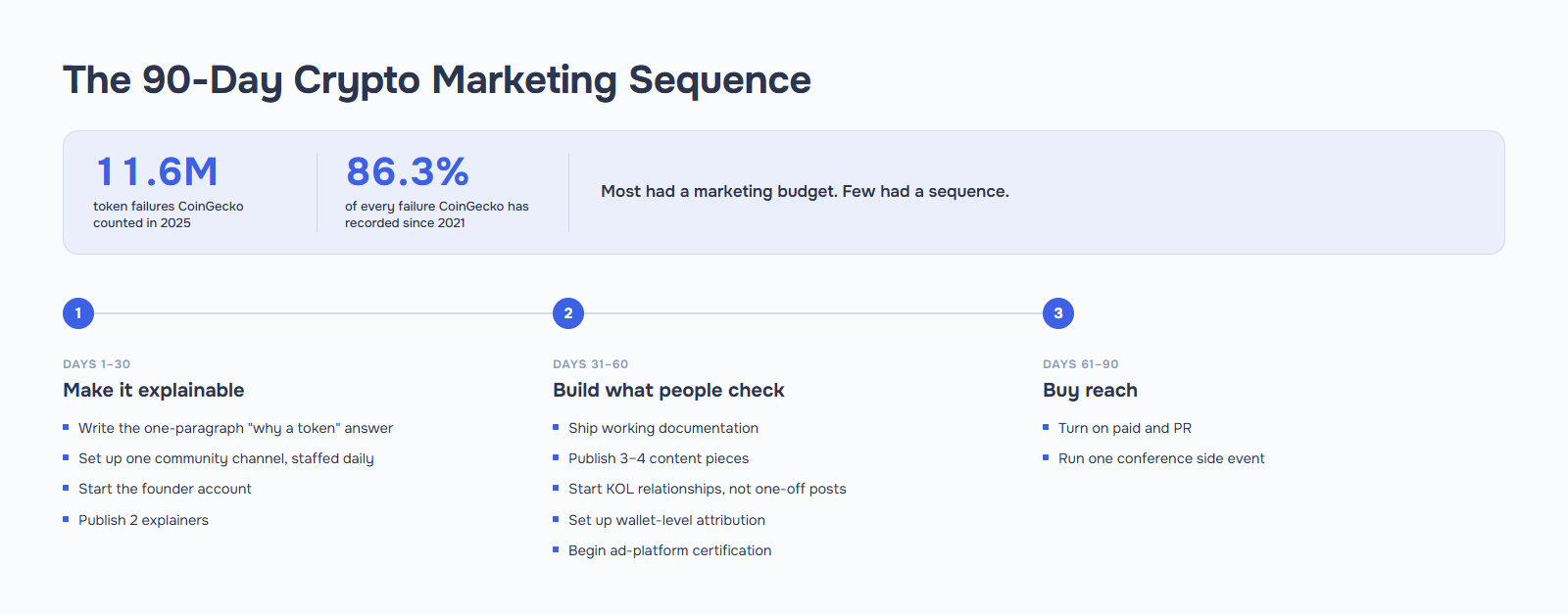
Days 1 to 30, make the thing explainable. Write the one-paragraph answer to what this is and why it needs a token. Test it on someone outside crypto. Set up one community channel and staff it properly. Start the founder account. Publish two explainer pieces. Cost: mostly time.
Days 31 to 60, build the surfaces people check. Documentation that works. Three or four content pieces answering real questions. First KOL conversations, structured as relationships instead of one-off posts. Set up attribution now, before you need it. Start the ad-platform certifications, which take weeks. Cost: low, plus tooling.
Days 61 to 90, buy reach. Paid, PR and quests now have something to point at. Run a side event at whatever conference is next.
The sequence matters more than the contents. Buying reach for something people cannot understand is how a large share of that 11.6 million ended up in the failure column.
How to Know if It’s Working
The moment someone connects a wallet, conventional analytics stops seeing them. Wallets are pseudonymous. One person holds several: a cold wallet, a hot wallet, one or more for farming. They move across chains. There is no persistent identity layer unless you build one.
Two mistakes account for most bad crypto marketing reporting.
The first is counting wallet connects instead of transactions. A connect is a click. It tells you someone arrived, not that anything happened. Measure revenue-generating actions.
The second is treating every wallet as a person. Counting cold, hot and farming wallets separately inflates every acquisition number you report, usually by a lot.
The fix is to bridge off-chain campaign data to on-chain activity at the single point where they meet: the moment of wallet connection, where a browser session carrying UTM parameters, a referral code or a Discord invite meets a wallet address carrying history. Several tools now do this. The approach matters more than which vendor you pick.
Track four things: transacting wallets, wallets retained at 30 and 90 days, cost per transacting wallet by channel, and community questions answered per day. The last one looks like a vanity metric and is not. It is the leading indicator for whether your community survives bad news.
Five Expensive Mistakes
| What teams do | What happens | Do instead |
|---|---|---|
| Run an airdrop to build a community | CoinGecko found the 50 largest airdrops of 2020 to 2023 distributed $26.6bn at peak valuations. Much of it went to wallets built to farm and exit | Lock allocations over time, or reward continued on-chain activity instead of a snapshot |
| Buy community members | The number rises, engagement does not, and real members notice | Answer questions faster than anyone else in your category |
| Pay KOLs in cash only | You buy one post and no stake in what happens next | Split cash and vested tokens over 12 to 24 months |
| Start ad certification at launch | Google and Meta both gate crypto ads behind approval that takes weeks. Teams discover this in launch week | Begin certification in month two, before you need it |
| Treat compliance as legal’s problem | Platform access now depends on verification and disclosure, which is a marketing dependency | Own the certification and disclosure work inside the marketing plan |
Frequently Asked Questions (FAQ)
A sequence, not a channel list: a clear reason the project exists, one community channel run properly, distribution through content, KOLs, PR and paid, and measurement that survives a wallet connection. Most failed plans start at distribution.
Founder account, one community channel, weekly content answering real questions, and side events instead of conference booths. Pick three, do them properly, ignore the rest.
Published market ranges in 2026 put a lean pre-launch programme at $8,000 to $25,000 a month and a serious token launch at $40,000 to $150,000 or more. What matters more than the figure is whether the scope and the metrics are specified.
Get the explanation right, build one community channel properly, then buy reach. In that order. Reach bought before the explanation works is the most common way projects waste money.
Paid shows response in days. Community and KOL work move in weeks. Content, SEO and AI visibility take three to six months and are the parts that compound.
The channels are the same. The weighting changes: infrastructure projects put most of their effort into documentation and developer relations, consumer applications into community and creators, enterprise blockchain into PR and events.
Host a dinner at the next conference rather than taking a booth. Write the explainer nobody else has written. Get the founder posting properly. Pick one non-obvious geography and go deep.
Share with


Rate the article