

ChatGPT, Perplexity, and Google’s AI Overviews now answer questions your buyers used to type into a search box. If your site isn’t structured for machines to read, quote, and trust, you don’t lose a ranking. You disappear from the answer entirely. An AI SEO strategy is how you get back in the room: a sequence of technical, content, and authority fixes that make your site legible to AI crawlers and citable by AI answers.
This playbook lays out that sequence across 90 days: audit, quick wins, content optimization, authority building, measurement, and a maintenance loop you repeat every quarter. Run it in order. Each phase depends on the one before it.
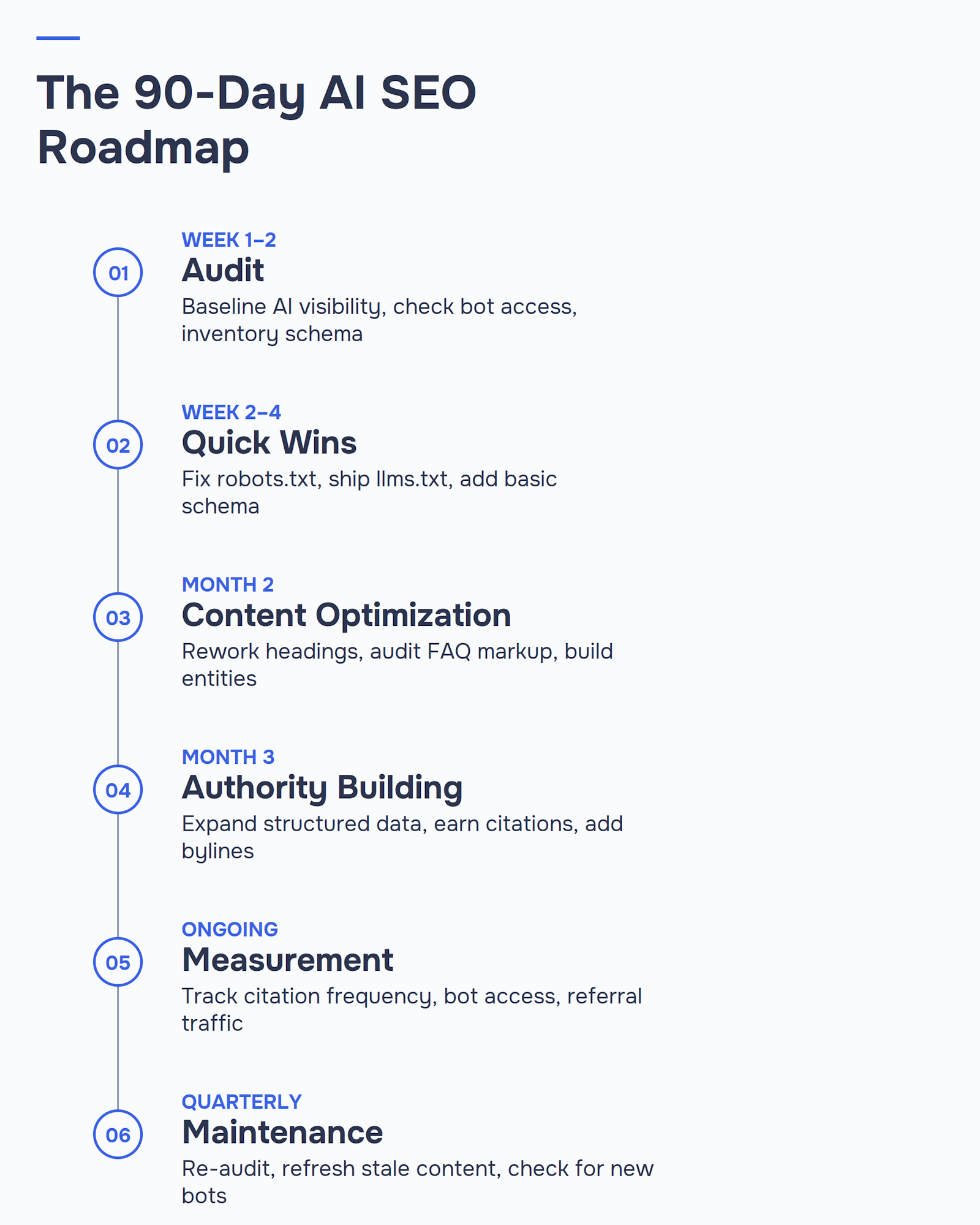
The 90-Day Roadmap at a Glance
| Phase | Timeframe | Core actions | Success signal |
|---|---|---|---|
| Audit | Week 1–2 | Baseline AI visibility, check bot access, inventory schema | You know your current citation rate and where the gaps are |
| Quick wins | Week 2–4 | Fix robots.txt, ship llms.txt, add basic schema | AI crawlers can reach and parse your key pages |
| Content optimization | Month 2 | Rework heading hierarchy, audit FAQ markup, build entities | Pages answer questions in extractable, self-contained chunks |
| Authority building | Month 3 | Expand structured data, earn third-party citations, add expert bylines | Your brand shows up in sources AI models already trust |
| Measurement | Ongoing | Track citation frequency, technical access, referral traffic | You can prove AI visibility is moving, not guess at it |
| Maintenance | Quarterly | Re-audit, refresh stale content, check for new bots | Visibility doesn’t quietly decay between campaigns |
What an AI SEO Strategy Actually Covers
An AI SEO strategy is a plan for making your content discoverable, parseable, and citable by AI systems like ChatGPT, Claude, Perplexity, and Google’s AI Overviews, not just by traditional search rankings. It shares roots with SEO for AI search engines and generative engine optimization, but it adds a layer classic SEO never had to handle: bot-level access control and machine-readable structure. If you’re still choosing which discipline to fund first, AEO vs GEO vs SEO lays out the trade-off.
Traditional SEO asks whether Google will rank your page. AI search optimization asks an earlier question: can an AI crawler even reach the page, and once it does, can the model extract a clean, citable answer from it? Backlinks and keyword density still matter, but they’re no longer sufficient on their own. A page can rank on page one and still be invisible in an AI answer if a crawler is blocked, the content loads behind JavaScript, or the actual answer is buried under three paragraphs of throat-clearing.
That’s the gap this playbook closes, phase by phase: technical access first, then AI content optimization, then the authority signals that turn a citable page into a repeatedly cited one.
Week 1–2 Audit: Find Your AI Visibility Baseline
The audit phase measures where your site currently stands with AI crawlers and AI-generated answers before you change anything. Skip it and you’ll spend the next 11 weeks fixing problems you don’t actually have while the real ones sit untouched.
Start with a structured baseline instead of guesswork. ICODA’s free AI Visibility Checker scores a domain across four areas: how many people ask AI about your market each month, whether you actually show up in live AI answers against competitors, a ranked list of channels to fix first, and the technical layer underneath it all: bot access, schema coverage, and llms.txt status.
Audit checklist:
- Run your domain through an AI visibility checker and record the baseline score
- Pull server logs and confirm GPTBot, ClaudeBot, PerplexityBot, and Google-Extended can reach your key pages
- List every schema type currently live on the site (or confirm there’s none)
- Query ChatGPT, Claude, and Perplexity directly with 10–15 buyer questions and note whether your brand appears, and how it’s described
- Check whether your most important pages render without a login, a paywall, or heavy client-side JavaScript
Write the baseline down. You’ll compare against it in the measurement phase, and “we improved” only means something next to a number.
Week 2–4 Quick Wins: robots.txt, llms.txt, Basic Schema
Quick wins fix the access layer: the technical settings that decide whether AI crawlers can reach your content at all before content quality even enters the picture. Most of this ships in days, not weeks, and it’s the highest-leverage work in the entire playbook because nothing downstream matters if the crawler never gets in the door.
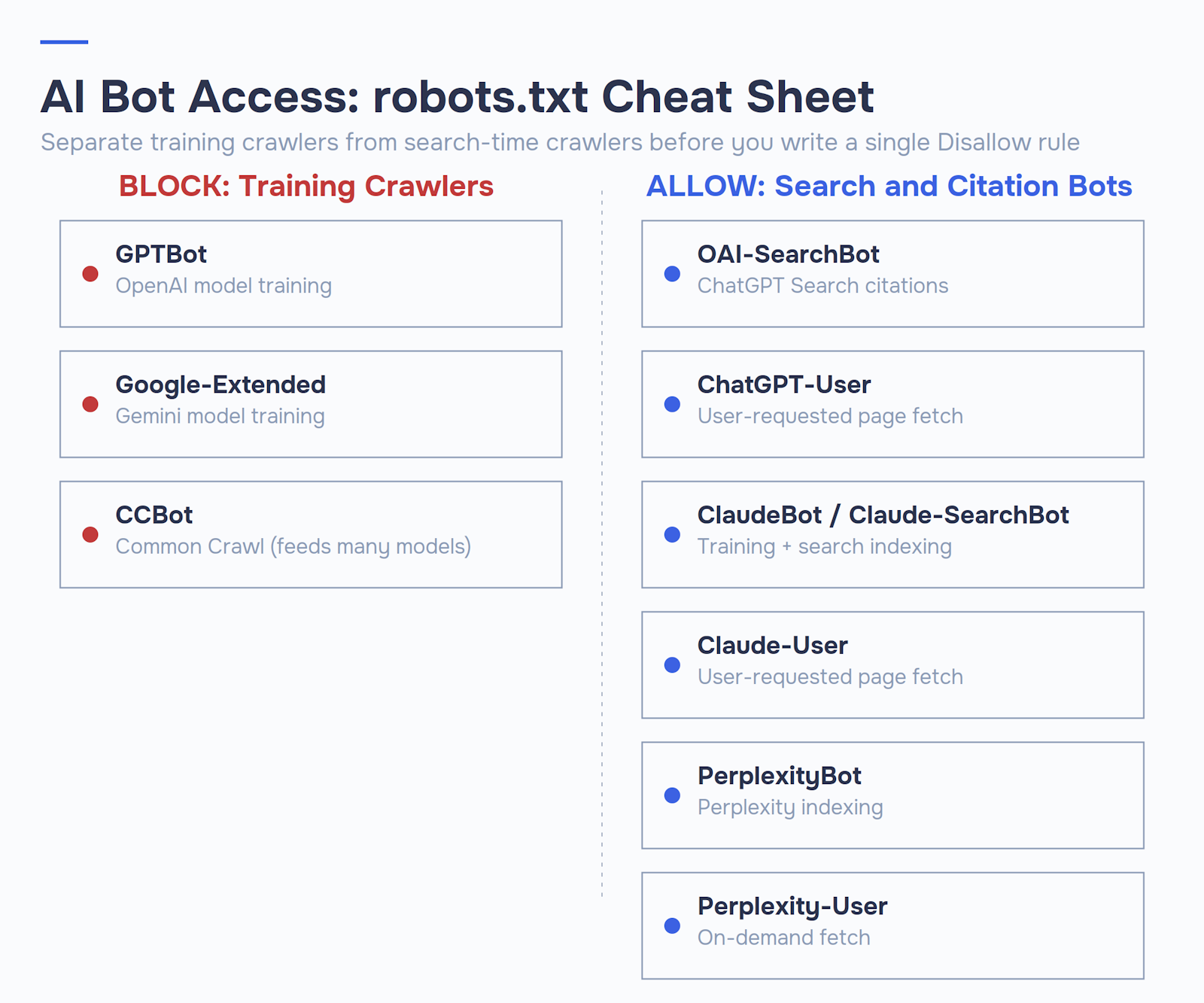
Fix robots.txt first. The instinct to block every AI bot is usually wrong. Training crawlers and search-time crawlers are separate, and blocking one doesn’t block the other. Rutgers and Wharton researchers found that publishers who blocked AI crawlers outright saw traffic drop by more than 23% without any reliable drop in citations elsewhere, because the block hit search-time bots too. A selective posture works better for most sites:
| Bot | Purpose | Recommended default |
|---|---|---|
| GPTBot | OpenAI model training | Block if you want to opt out of training |
| Google-Extended | Gemini model training | Block if you want to opt out of training |
| CCBot | Common Crawl (feeds many models) | Block for training control |
| OAI-SearchBot | Powers ChatGPT Search citations | Allow |
| ChatGPT-User | Fetches a page a user asked ChatGPT to read | Allow |
| ClaudeBot / Claude-SearchBot | Anthropic training and search indexing | Allow the search bot; block training if desired |
| Claude-User | Fetches a page a user asked Claude to read | Allow |
| PerplexityBot / Perplexity-User | Perplexity indexing and on-demand fetches | Allow |
Verify each directive against server logs, not just the file itself. Some bots, Perplexity’s undeclared crawlers among them, have been documented ignoring robots.txt entirely, so treat the file as a strong signal to well-behaved bots and back it with server-level rules for anything that doesn’t comply.
Ship an llms.txt file, but keep expectations honest. This is a plain-text file at your domain root that points AI systems to your most important pages. Independent studies in 2026 put adoption at roughly 9–10% of major domains, and most AI search crawlers, GPTBot, ClaudeBot, and PerplexityBot included, mostly skip fetching it when they’re building a citation. Where it does earn its keep today is with coding agents: tools like Cursor, Claude Code, and GitHub Copilot fetch llms.txt routinely on documentation sites. For a content-driven brand, treat it as a half-day, low-cost bet on a standard that may matter more later, not a guaranteed traffic lever.
Add basic schema. At minimum, implement Organization schema (name, logo, sameAs links to your verified social and review profiles) and Article schema on every blog post (author, publish date, headline). This is the foundation everything in the content optimization phase builds on.
Quick wins checklist:
- Rewrite robots.txt with a selective posture for training vs. search-time bots
- Confirm the new rules in server logs within a week
- Publish llms.txt with links to your 10–20 most important pages
- Add Organization and Article schema sitewide
- Re-run the visibility checker to confirm bot access improved
Month 2 Content Optimization: Headings, FAQ Markup, Entity Building
Content optimization restructures what’s already on the page so an AI model can extract a complete answer without stitching together fragments from three different paragraphs. This is where AI content optimization stops being a technical exercise and becomes an editorial one.
Fix your heading hierarchy first. Write each H2 as the question a reader (or a model) would actually ask, then answer it in the first one to two sentences underneath. Save context, caveats, and nuance for after the answer, not before it. This single change does more for AI Overview eligibility than almost any other content edit, because it matches exactly how these systems extract passages: a self-contained chunk that answers a question completely on its own.
Be honest about FAQ markup. Google deprecated FAQ rich results from Search on May 7, 2026, so the expandable Q&A dropdown is gone from the SERP. FAQPage schema itself is still a valid Schema.org type, and Google has said unused structured data doesn’t hurt a page. What it hasn’t said is that FAQ schema improves AI citation odds. Treat it as one more layer of machine-readable structure on genuinely useful Q&A content, not as a growth hack. If a FAQ section only exists to house schema, cut it. If it answers real questions users ask, keep the markup and don’t expect it to do more than it can.
Build entities, not just pages. AI models cite sources they can identify with confidence. That means your brand name, your authors, and your core topics need to appear consistently across your site, your social profiles, and third-party mentions, not just inside your own content. Practical steps:
- Give every article a named author with a bio page and consistent credentials
- Link author and organization profiles with
sameAsschema to LinkedIn, X, and industry directories - Use the same entity names and descriptions across your site, your Google Business Profile, and any Wikidata or Wikipedia presence you qualify for
- Interlink related articles into topic clusters instead of leaving them isolated
Content optimization checklist:
- Rewrite H2s as questions with a direct answer in the first sentence
- Audit existing FAQ schema and remove it from pages with no real FAQ content
- Publish an author bio page for every contributor
- Add
sameAslinks across all author and organization schema - Build or tighten topic clusters through internal linking

Month 3 Authority Building: Structured Data, Citations, Expert Mentions
Authority building earns the third-party signals AI models use to decide whether your brand is a trustworthy source, on top of the technical structure you already fixed. Backlinks still count here, but AI citation research increasingly points to a wider set of signals: Wikipedia and Wikidata presence, mentions on Reddit and industry forums, and reviews on independent platforms.
Expand structured data beyond the basics. Add BreadcrumbList schema for navigation clarity, Review or Product schema where relevant to your business, and keep every schema type in sync with what’s actually visible on the page. Mismatched schema, markup that claims something the page doesn’t show, is a common source of AI models getting your brand wrong.
Earn citations deliberately. Digital PR, original research, and data-backed guest content still work, but the target has widened. Getting quoted in a niche industry newsletter or cited correctly on a comparison thread on Reddit can matter as much to AI visibility as a traditional backlink, because these are exactly the sources AI models pull into their training and retrieval systems.
Put a name and a credential on the work. E-E-A-T requirements now extend past finance and health content to nearly every category. A named author with real domain experience, an original data point, or a direct quote from a practitioner gives an AI model something concrete to attribute, instead of a vague “industry experts say.”
This is also where a dedicated AI SEO service earns its cost for teams without the in-house bandwidth to run citation outreach alongside the technical work.
Authority building checklist:
- Add BreadcrumbList and any relevant Review/Product schema
- Audit all schema for mismatches against visible page content
- Pitch 3–5 pieces of original data or commentary to industry publications this quarter
- Claim or correct your brand’s Wikidata entry if one exists
- Add named author credentials to every piece of cornerstone content
Measurement Framework: What to Track and How
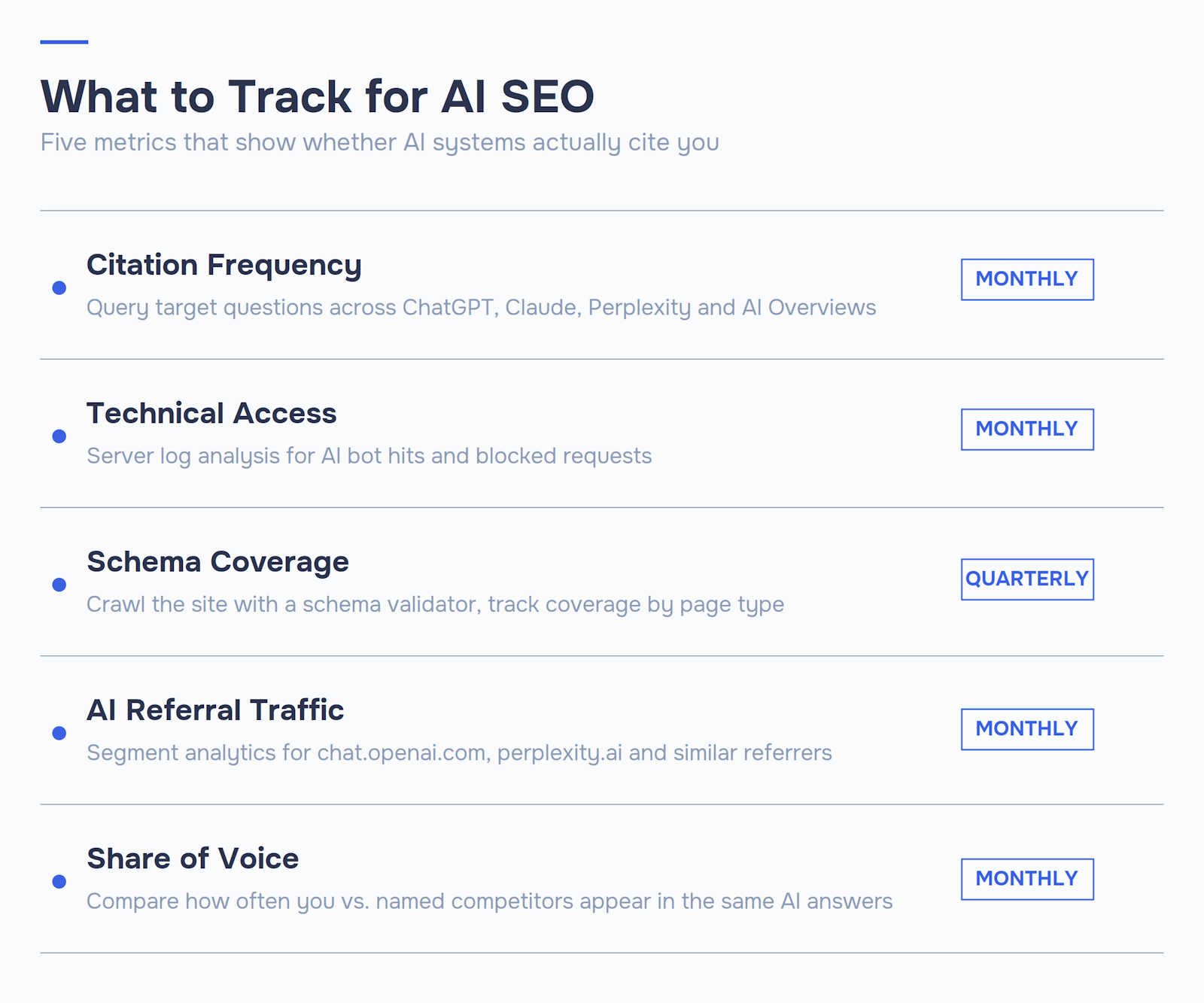
Measuring AI SEO tracks whether AI systems actually cite you, not just whether your rankings moved, because the two increasingly diverge. A page can hold position four in Google and never appear in a single AI Overview, or the reverse.
| Metric | How to track it | Cadence |
|---|---|---|
| Citation frequency | Query your target questions across ChatGPT, Claude, Perplexity, and Google AI Overviews manually or with a tracking tool | Monthly |
| Technical access | Server log analysis for AI bot hits and blocked requests | Monthly |
| Schema coverage | Crawl your site with a schema validator and track coverage by page type | Quarterly |
| AI referral traffic | Segment analytics for traffic from chat.openai.com, perplexity.ai, and similar referrers | Monthly |
| Share of voice | Compare how often you vs. named competitors appear in the same AI answers | Monthly |
Referral traffic from AI platforms is still small on most sites, so don’t treat a flat number as failure on its own. Citation frequency and share of voice are the leading indicators; referral traffic is the lagging one that catches up once citations compound.
Quarterly Maintenance Checklist
AI SEO maintenance re-runs the audit on a fixed schedule, because bot behavior, schema requirements, and AI Overview mechanics all shift faster than a typical SEO refresh cycle. A configuration that worked in Q1 can quietly break by Q3 if a new crawler launches and your robots.txt never gets updated.
- Re-run the AI Visibility Checker and compare against your baseline
- Check for new AI crawler user-agents and add explicit rules for them
- Refresh any content older than 12 months on a topic where freshness matters
- Re-validate all schema against current markup
- Re-query your core buyer questions across ChatGPT, Claude, and Perplexity
- Review which competitors gained or lost citation share since the last check
Building an AI SEO Strategy That Compounds
None of these phases work in isolation. Fixing robots.txt without restructuring content gets crawlers in the door with nothing worth citing behind it. Rewriting content without fixing bot access means a well-structured answer that a crawler never reaches. The 90-day sequence exists because access, structure, and authority build on each other in that order, not because the calendar demands it.
Run the audit again in 90 days and you’ll have something most competitors still don’t: an actual number to point to instead of a hunch about whether AI search optimization is working. That number is the real deliverable of an AI SEO strategy, and it’s the one that keeps the next quarter’s roadmap grounded in evidence instead of guesswork.
Most sites still treat SEO for AI search engines as an afterthought bolted onto their existing content calendar. The ones that treat it as its own 90-day sequence, with a baseline, a build phase, and a repeat cycle, are the ones that show up when a buyer asks an AI assistant instead of typing into Google.
Frequently Asked Questions (FAQ)
You measure it by querying your target questions yourself, monthly, across ChatGPT, Claude, Perplexity, and Google AI Overviews, and logging whether you show up. There’s no Search Console equivalent that hands you citation counts on a platter, so you build the log manually or pay for a tool that automates the same manual check. Referral traffic from AI platforms is still small on most sites, so don’t panic if that number stays flat while your citation count climbs. Citation frequency and share of voice move first; traffic is the lagging number that catches up later, if it catches up at all.
Most AI search crawlers skip fetching llms.txt when they’re building a citation, so treat it as a low-cost bet, not a growth lever. Google’s Gary Illyes has said no AI system is currently using it, and adoption sits around 9-10% of major domains. Where it does earn its keep right now is coding agents — Cursor, Claude Code, GitHub Copilot fetch it routinely on docs sites. If you run a content site and not a docs site, spend your half-day elsewhere first and come back to this once you’ve fixed access and schema.
No — a blanket block usually costs you more than it protects. Rutgers and Wharton researchers found publishers who blocked AI crawlers outright saw traffic drop over 23% with no reliable citation gain elsewhere, because the blanket rule caught search-time bots along with training bots. GPTBot and OAI-SearchBot are different crawlers with different jobs: one trains the model, the other powers the citations that show up when someone searches ChatGPT. Block the training bots if you want to opt out of training, but leave the search-time bots open, or you’re cutting yourself off from citations for no real upside.
Because robots.txt still works on every bot that plays by the rules, and most of them do. Perplexity’s undeclared crawlers have been documented ignoring the file, so for that one case, a text file alone won’t stop scraping — you’d need server-level blocking if you actually want to keep them out. But writing off robots.txt because one company cheats is throwing out the tool that still governs GPTBot, ClaudeBot, and Google-Extended. Set the file correctly for the well-behaved majority, then decide separately whether the one bad actor is worth a server-level fight.
Google deprecated FAQ rich results from Search on May 7, 2026, so the dropdown in the SERP is gone for good. FAQPage schema is still a valid Schema.org type, and Google has said unused structured data doesn’t hurt a page, but nobody’s confirmed it helps AI citation odds either. The honest move is to keep the markup only on pages with real Q&A content people actually search for, and drop it anywhere it was bolted on just to trigger the old rich result. If a FAQ section exists purely to house schema, cut the section, not just the markup.
No, and anyone promising that is selling you something. Pew Research found only 8% of users click through when an AI Overview appears, versus 15% without one, and just 1% click a link inside the Overview itself. Schema and heading fixes get you cited more often, not clicked more often — those are different goals now. If your business model depends on click volume, AI SEO won’t rescue it; it can grow your citation presence and brand recall, but you need a separate answer for the traffic gap.
No — it adds a layer classic SEO never had to deal with: bot-level access control before content quality even matters. Traditional SEO asks whether Google will rank your page; AI search optimization asks whether a crawler can reach the page at all, and whether the model can pull a clean, self-contained answer out of it once it’s there. Backlinks and keyword work still count, but they stop being sufficient on their own — a page can sit at position one and still never get cited if a crawler is blocked or the content loads behind JavaScript. So it’s not a rebrand, it’s SEO plus a technical access problem that didn’t exist five years ago.
Ranking well and getting cited are two different outcomes, so yes, probably. AI models extract passages the same way every time: a self-contained chunk that answers a question completely on its own, without needing the paragraph before or after it. If your H2s are clever headlines instead of the actual question a reader would type, and the answer is buried two sentences down, you can rank on page one and still never get pulled into a citation. It’s not a full rewrite — move the direct answer to the first sentence under each heading and push context and caveats after it.
It helps, and it’s not spin — it’s a function of where these models pull retrieval and training data from in the first place. Wikipedia, Quora, YouTube, and Reddit remain among the most cited sources across AI Overviews and AI answers generally, which means a correctly-cited mention in a real Reddit thread can carry weight a traditional backlink doesn’t. The catch is you can’t buy your way into this cleanly — a forced or obviously promotional post reads as noise, and AI models increasingly weight for genuine community discussion over marketing copy. Earn the mention with something worth quoting, or skip it; a bad attempt is worse than not trying.
Share with


Rate the article