





From Declining Visibility to 2000+ AI Citations: Restoring Organic Growth Through AI SEO & PR
See how strategic PR and AI SEO helped Godex dominate AI search: 12x ChatGPT traffic… See how strategic PR and AI SEO helped Godex dominate AI search: 12x ChatGPT traffic growth, 6.2M monthly AI audience, and 2000+ citations — all without paid advertising in a restricted crypto niche.
monthly AI audience
citations across LLMs
conversions growth
ChatGPT traffic growth

About Client
Godex is an anonymous crypto exchange offering instant swaps with no KYC, no limits, and high execution speed.
Due to long-term decline in organic visibility and the inability to scale paid crypto advertising, the platform experienced a significant drop in demand. The task was to rebuild discoverability, trust, and organic growth using search-first channels.

Show up in AI answers — not just search results.
Discover your path to algorithm-proof visibility.
Project Goals
Recover lost rankings and organic demand across search engines.
Strengthen credibility signals without compromising anonymity.
Reduce dependence on Google alone by growing alternative search channels.
SEO and PR as long-term infrastructure, not short-term tactics.
Traffic Growth Overview
Instead of relying on a single channel, growth came from multiple organic sources:
- Search engines: Google, Bing, and AI-powered search interfaces
- AI discovery: ChatGPT, Perplexity, Google AI Overviews
- Referral traffic: PR placements and editorial mentions
- Direct traffic: brand recovery and returning users
This confirms the effectiveness of the holistic SEO + PR strategy, not just AI optimization.
🚀 Key Results (June → November)
monthly AI audience
citations across LLMs
conversions growth
ChatGPT traffic growth
Approach
1. Search-Centric SEO Strategy
- Focus on high-intent, conversion-oriented keywords
- Intent-based keyword clustering across transactional and informational queries
- Competitive analysis vs Changelly, SimpleSwap, ChangeNOW, Swapspace
- Optimization for Google, Bing, and emerging AI-powered search results
2. Scalable Content & Site Architecture
- Programmatic SEO pages for crypto pairs and exchange use cases
- Clear messaging around no-KYC, speed, and large-volume swaps
- Internal linking and crawl optimization
- Content designed to rank, convert, and be referenced
3. PR & Authority Building
PR was executed as a search and trust signal, not pure branding:
- Editorial mentions in crypto and fintech media
- Contextual backlinks supporting key SEO pages
- Brand entity strengthening across trusted sources
- Consistent narrative across content and PR
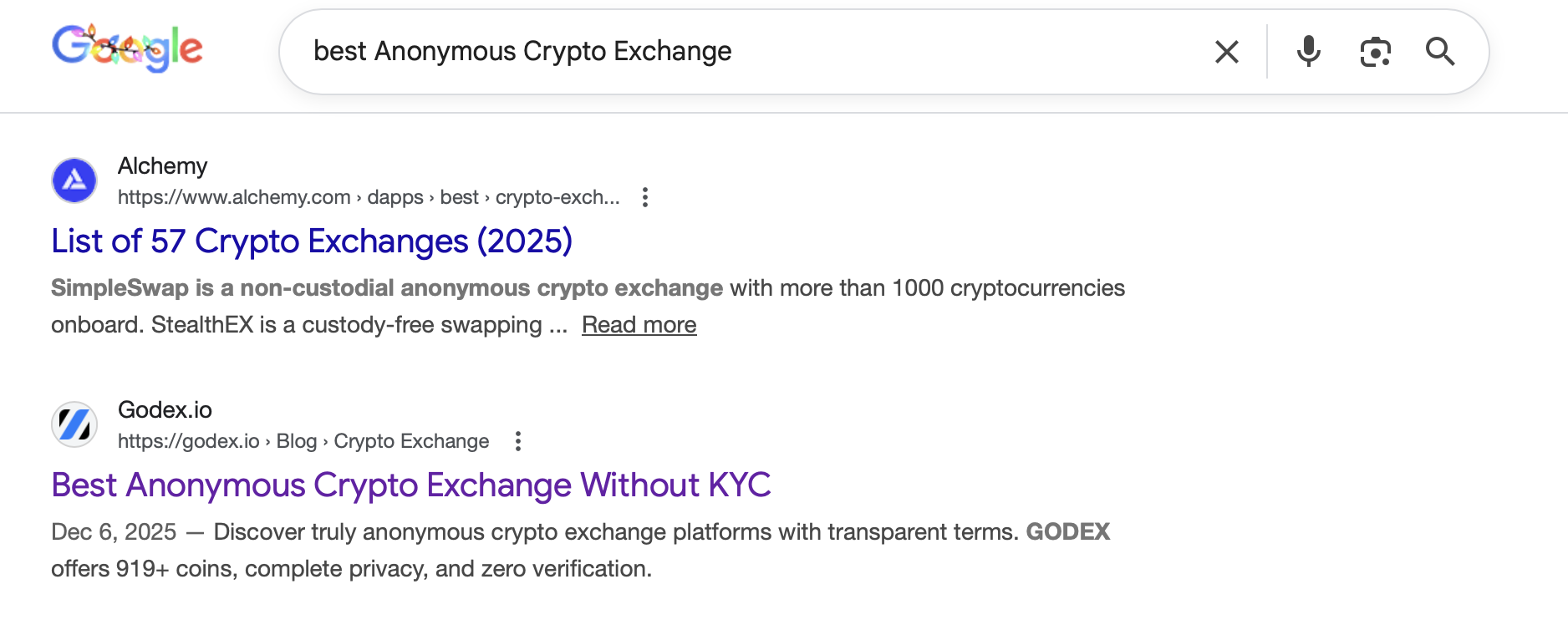
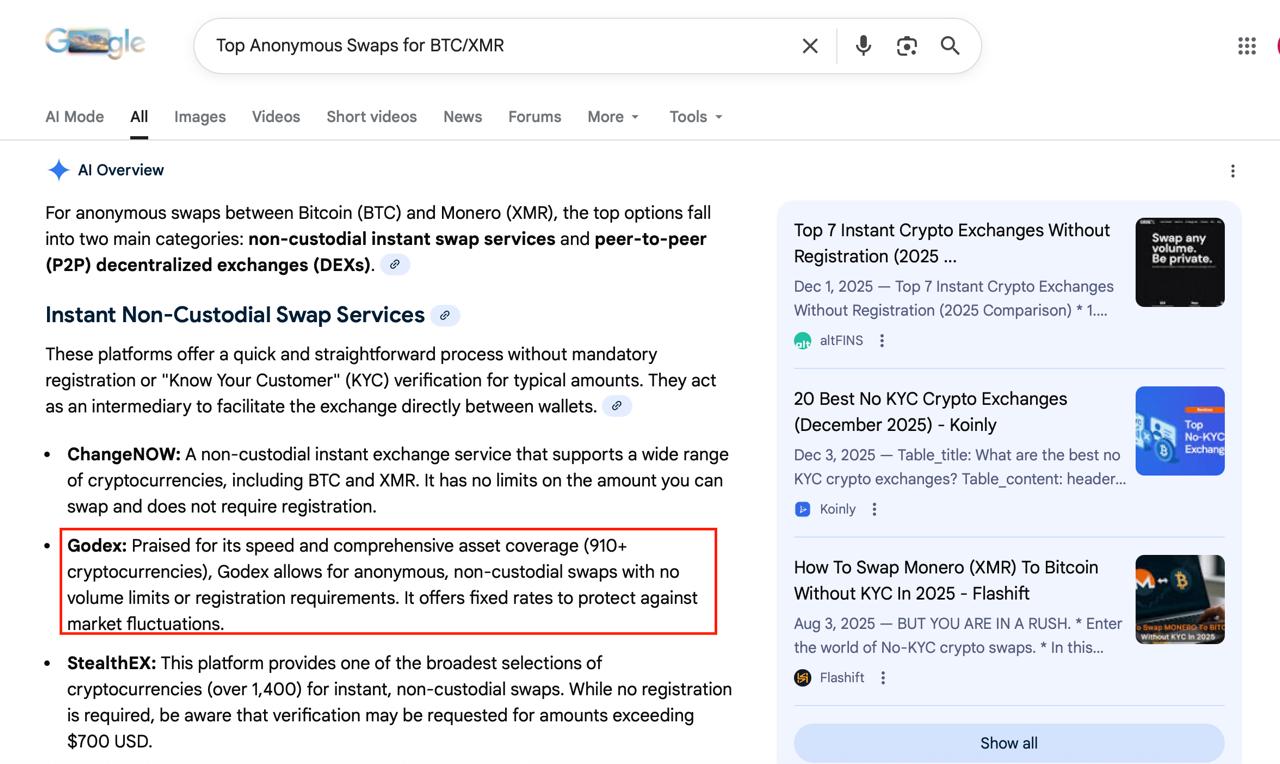
Domination in “best instant crypto exchange” Google + AI


Top Positions


4. Trust & Behavioral Optimization
- E-E-A-T-aligned content structure
- Clear positioning around anonymity and security
- Alignment of messaging across all organic channels
Results
- 726% growth in Bing organic traffic
- Consistent organic growth across search engines
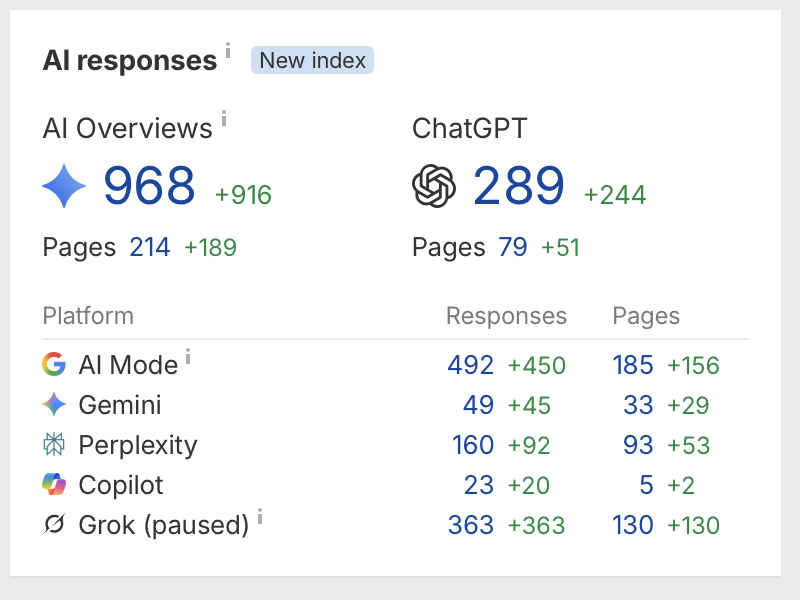
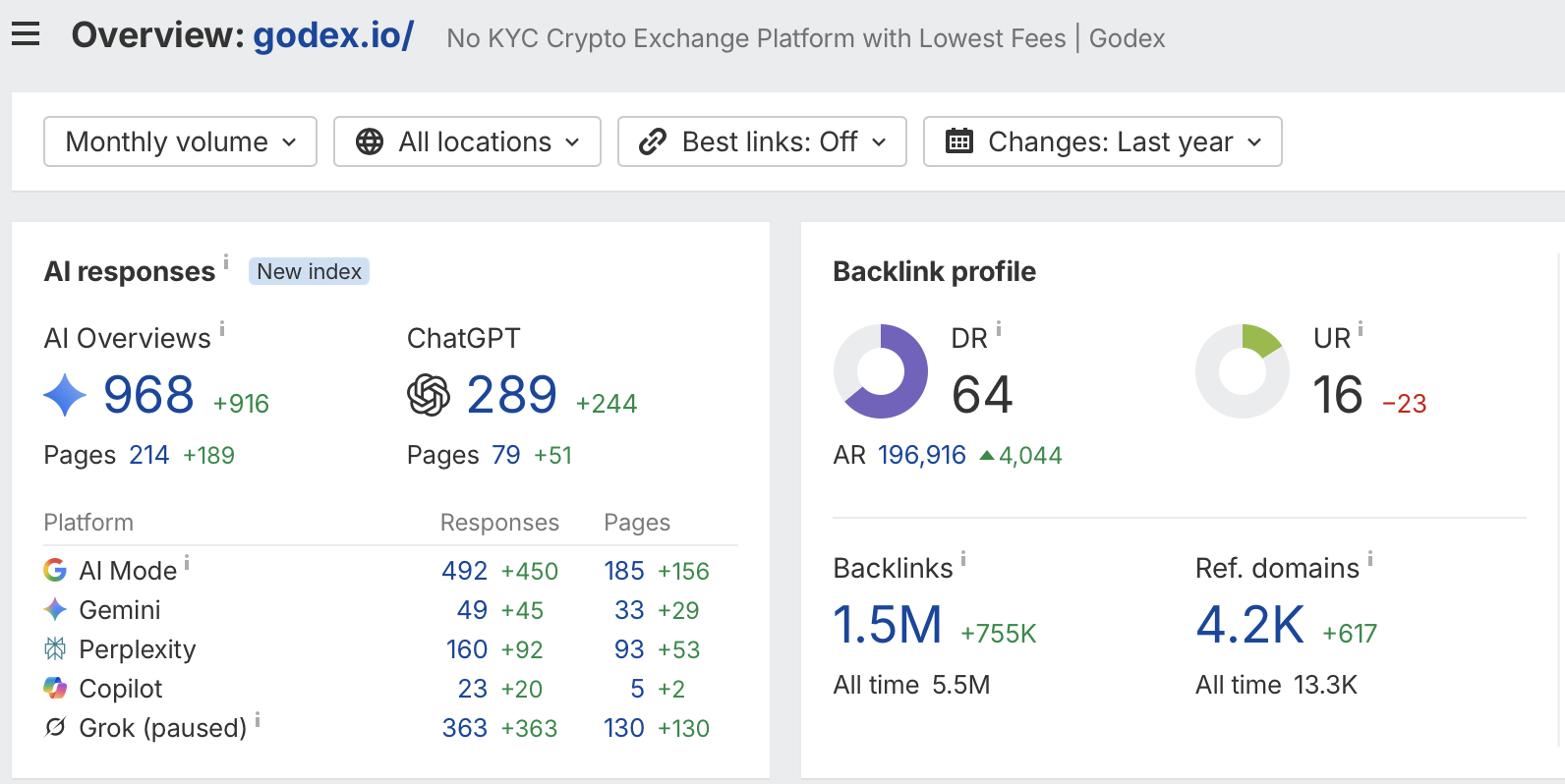
- 968 AI Overviews appearances, 289 ChatGPT responses, 363 Grok responses
- 492 Google AI Mode responses across 185 pages
- Top-2 AI visibility on Ahrefs among competitors
- SEO + PR became the core acquisition channel
- No paid advertising used
Conclusion
Godex’s growth was achieved through systematic SEO and trust-building, not short-term traffic tactics.
By combining search engine optimization, PR, and authority signals, we rebuilt visibility across multiple search ecosystems and positioned Godex as a credible choice in a highly sensitive crypto niche.
AI search visibility emerged naturally as a result of this strategy — proving that strong SEO and PR create compounding effects across both traditional and AI-driven discovery channels.
Frequently Asked Questions
That number is almost certainly measured off referral traffic in analytics, not conversions or revenue. Referral spikes from AI platforms are real and trackable — GA4 and Ahrefs both log ChatGPT/Perplexity as referral sources now — but a huge percentage jump from a small base looks impressive and means very little.
Citations mean an LLM mentioned or linked your brand somewhere in a generated answer — it doesn’t mean anyone clicked through or converted. Independent research on ChatGPT citation patterns found the platform surfaces very few citations per response compared to other AI search tools, so accumulating hundreds of citations over months usually means broad topical coverage, not one viral moment. The honest gap here is attribution: AI platforms don’t pass query data the way Google does, so you’re often inferring impact rather than measuring it directly.
Trust in this context isn’t about verifying who the user is — it’s about verifying the platform won’t run off with your funds or quietly add hidden KYC triggers later, which is the actual fear driving this audience. PR and consistent reputation signals (Trustpilot history, years in operation, no surprise policy changes) address that fear without touching anonymity. The tradeoff is that none of this is regulatory compliance — it’s reputation management for an unregulated product, and those are different things even when the marketing blurs them together.
PR placements in crypto media almost always involve payment — sponsored posts, guest contributor fees, or agency retainers that cover placement costs. “No paid advertising” in these case studies usually means no PPC or display ads, not that the PR itself was free. That’s not dishonest exactly, but it is a specific and narrow definition of “paid” that most readers wouldn’t assume. If you’re evaluating an agency’s pitch, ask directly whether “PR” here means earned coverage or paid placement dressed up as editorial.
Google’s AI Overview is pulling from indexed content and treating it like any other query, not making a judgment call on AML policy. It surfaces what ranks and reads as authoritative for the query — “best anonymous crypto exchange” is a legitimate search with real demand, so Google answers it the same way it’d answer any other comparison query. That doesn’t mean Google endorses the business model, and it doesn’t insulate the exchange from regulatory scrutiny in specific jurisdictions — those are separate systems entirely.
Existing reputation is doing real work here. Godex had eight years of Trustpilot history and existing partnerships to build on — a brand-new exchange trying the same programmatic content and PR playbook won’t see comparable citation counts in the same timeframe, because LLMs and Google both weight entity age and prior mentions. That said, the underlying tactics — intent-based content clusters, consistent messaging, earned coverage — scale down; they just take longer and produce smaller numbers for a newer brand.
Testimonials









Yevhen Nehuliayev
LinkedIn Profile

Valerii Brizhatiuk
LinkedIn Profile

Sergei Beliaev
LinkedIn Profile

Laura Geng
LinkedIn Profile

Bahram Ahmedzade
LinkedIn Profile

Aaron Tsai
LinkedIn Profile

Irene C.
LinkedIn Profile

Shenshen Hu
LinkedIn Profile

Hannah Kang
LinkedIn Profile

James O'Connor
LinkedIn Profile

Dmitriy Dervoed
LinkedIn Profile

Vid David Mihelic
LinkedIn Profile

Jia Yung
LinkedIn Profile

Charlie Bussat
LinkedIn Profile

Terry Na
LinkedIn Profile

Arabdha Sudhir
LinkedIn Profile

Henning Rokling
LinkedIn Profile
Feel free to contact us
We are the team of experts that will support your business at all stages