




We asked Claude AI three questions a real operator would ask when choosing a content partner. Half the market never showed up — not once.
The Search Has Already Changed
A casino operator’s head of product needs a new content aggregation layer. They want access to hundreds of studios through a single API. Maybe they’re launching in a new market, maybe they’re replacing an underperforming partner. Either way, they don’t open a browser and scroll through comparison articles. They open Claude, ChatGPT, or Perplexity — and they ask.
They get back a short, structured list. They open two or three tabs. They start evaluating. The conversation with your sales team — if it ever happens — begins after you’ve already cleared that invisible shortlist. If you weren’t on it, you don’t exist in that operator’s consideration set. Not that day. Possibly not at all.
This is the new reality of B2B iGaming procurement. And for nearly half the game aggregator market, it’s a reality they’re entirely unprepared for.
“When an operator asks AI which aggregator to integrate, they see the same 6 names every time. Your 27,000-game library doesn’t matter if AI doesn’t know it exists.”
To map the gap, ICODA ran a structured AI visibility audit across 19 leading iGaming game aggregators — testing which companies appear in Claude’s recommendations when real, high-intent operator queries are submitted. The results divide the market into winners and ghosts.
Methodology
“best game aggregator for online casino”
“top casino content aggregator 2026”
“which game aggregator do operators use”
Three queries were submitted to Claude AI (Anthropic), phrased exactly as a casino operator or procurement manager would ask them. Each aggregator was tracked: did it appear, or not? No prompt engineering. No manipulation. Just the questions buyers are already typing.
The Data: A Market Split in Two
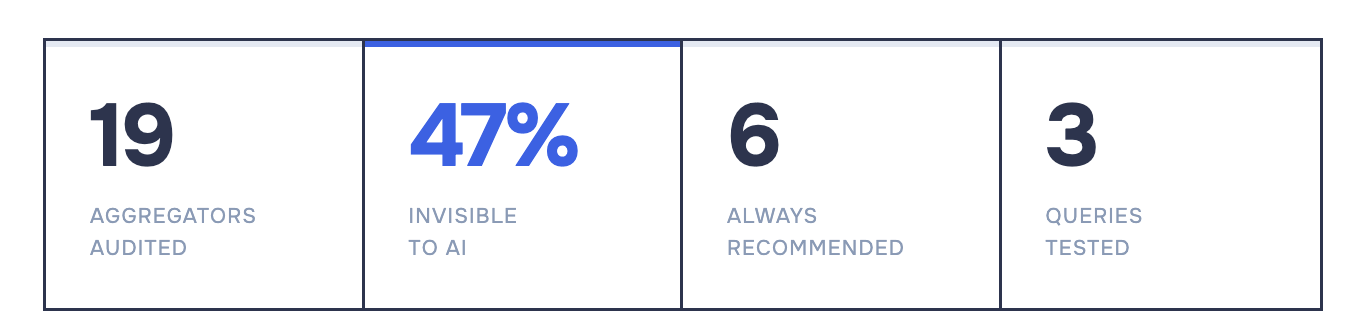
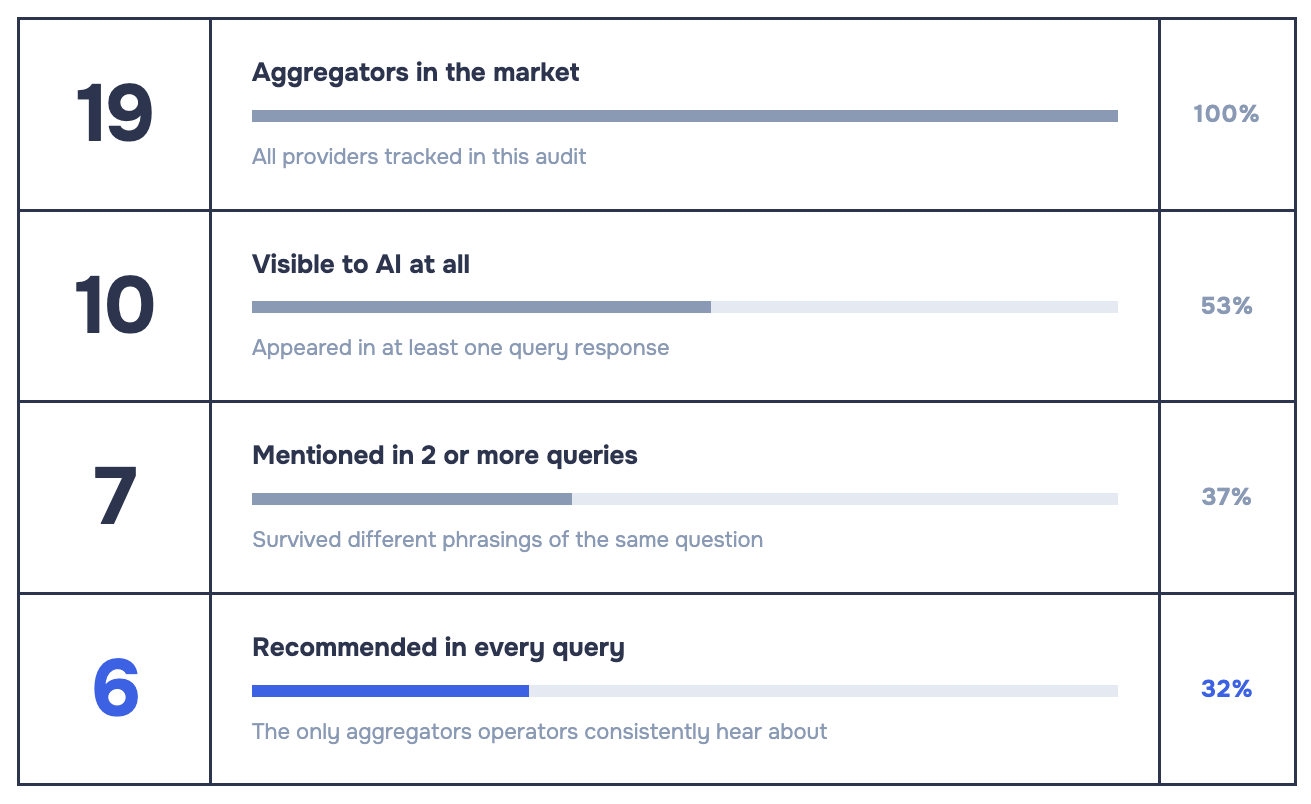
Out of 19 aggregators tracked:
- 10 aggregators were mentioned at least once across the three queries
- 9 aggregators (47%) received zero AI mentions — not a single appearance
- 6 aggregators appeared in every single response, consistently, across all three queries
The Full Rankings: All 19 Aggregators Scored
| Rank | Aggregator | Domain | Score | Q1 | Q2 | Q3 | Status |
|---|---|---|---|---|---|---|---|
| 1 | SOFTSWISS Game Aggregator | softswiss.com | 3/3 | ✅ | ✅ | ✅ | Champion |
| 1 | EveryMatrix SlotMatrix | everymatrix.com | 3/3 | ✅ | ✅ | ✅ | Champion |
| 1 | Slotegrator APIgrator | slotegrator.com | 3/3 | ✅ | ✅ | ✅ | Champion |
| 1 | Pariplay Fusion | pariplay.com | 3/3 | ✅ | ✅ | ✅ | Champion |
| 1 | Relax Gaming | relax-gaming.com | 3/3 | ✅ | ✅ | ✅ | Champion |
| 1 | Hub88 | hub88.io | 3/3 | ✅ | ✅ | ✅ | Champion |
| 7 | Games Global | gamesglobal.com | 2/3 | ✅ | ✅ | ❌ | Strong |
| 8 | SoftGamings | softgamings.com | 1/3 | ❌ | ✅ | ❌ | Weak |
| 8 | Oryx Gaming (Bragg) | oryxgaming.com | 1/3 | ❌ | ✅ | ❌ | Weak |
| 8 | Aristocrat Interactive | aristocratinteractive.com | 1/3 | ❌ | ✅ | ❌ | Weak |
| 11 | iSoftBet GAP | isoftbet.com | 0/3 | ❌ | ❌ | ❌ | Invisible |
| 11 | GR8 Casino Aggregator | gr8.tech | 0/3 | ❌ | ❌ | ❌ | Invisible |
| 11 | ESA Gaming | esagaming.com | 0/3 | ❌ | ❌ | ❌ | Invisible |
| 11 | Alea | alea.com | 0/3 | ❌ | ❌ | ❌ | Invisible |
| 11 | BlueOcean Gaming | blueoceangaming.com | 0/3 | ❌ | ❌ | ❌ | Invisible |
| 11 | Groove Technologies | groovetech.com | 0/3 | ❌ | ❌ | ❌ | Invisible |
| 11 | Infingame | infingame.com | 0/3 | ❌ | ❌ | ❌ | Invisible |
| 11 | iGaming Deck | igamingdeck.com | 0/3 | ❌ | ❌ | ❌ | Invisible |
| 11 | iGaming Core | igamingcore.io | 0/3 | ❌ | ❌ | ❌ | Invisible |
Key Finding: When an operator asks AI which content partner to integrate, they consistently see the same 6 names. Nine aggregators — including some with real market share and substantial studio catalogues — don’t exist in that conversation at all.
Tier-by-Tier Analysis
The audit creates a clear four-tier structure. The gap between tiers is not subtle — it’s the difference between being in an operator’s consideration set and not existing to them at all.
Tier 1 — Champions (3/3)
SOFTSWISS, EveryMatrix SlotMatrix, Slotegrator, Pariplay Fusion, Relax Gaming, and Hub88 are the only aggregators that appear reliably regardless of how the question is phrased. An operator can ask about the best aggregator, the top one in 2026, or what other operators use — and these six are present in every answer.
What these companies share is not necessarily the largest catalogue or the most competitive commercial terms. What they share is an established, legible brand presence that AI models have absorbed from across the web — reviews, trade press, operator case studies, conference coverage, and B2B content that clearly positions them as the canonical answer to the question “who are the major aggregators?”
Tier 2 — Strong Presence (2/3)
Games Global sits in a precarious position. It appears in two out of three queries — strong enough to suggest real brand recognition, but not strong enough to survive all phrasings of the same core question. That inconsistency matters: different operators phrase the same question differently, and any query where a provider doesn’t appear is a missed opportunity. Games Global appears to be a brand AI knows, but hasn’t fully categorized as a default recommendation in the aggregator space specifically.
Tier 3 — Fragile Visibility (1/3)
SoftGamings, Oryx Gaming (Bragg), and Aristocrat Interactive each appeared in exactly one query — and notably, all three appeared in the same one: the “top casino content aggregator 2026” query. None appeared when AI was asked which aggregators operators actually use, or which is simply the best. Their visibility is real but narrow. One phrasing reveals them; two others don’t.
For Oryx Gaming (Bragg) and Aristocrat Interactive, this is particularly worth examining. Both parent companies have significant brand recognition in the broader iGaming ecosystem. But the aggregation-specific brand identity hasn’t transferred cleanly to AI models. The companies are known; the aggregator products are not.
Tier 4 — Invisible (0/3)
Nine companies — iSoftBet GAP, GR8 Casino Aggregator, ESA Gaming, Alea, BlueOcean Gaming, Groove Technologies, Infingame, iGaming Deck, and iGaming Core — received zero AI mentions across all three queries.
This is not a comment on product quality. Several of these companies operate real integrations with real studios and real operator clients. The problem is not the product — it’s the AI footprint. These companies either lack the breadth of indexed digital presence that feeds AI models, or they haven’t established the categorical authority that causes AI to treat them as default answers to “who are the major aggregators?”
For an operator researching their options through AI, these companies simply don’t exist.
Why Traditional SEO Doesn’t Solve This?
The instinct for most iGaming B2B marketers facing this data is to reach for familiar tools: more backlinks, better keyword targeting, updated landing pages. Those tactics remain valuable for traditional search. But they don’t directly translate into AI visibility.
The distinction is important. Google ranks pages. AI models rank brands — or more precisely, they develop associations between certain categories of questions and certain brand names, based on what they’ve been trained on and what they retrieve in real time.
To appear consistently in AI answers, you need the kind of presence that causes AI to treat your brand as a natural answer to the question — not just a page that happens to contain the keywords. That means being discussed as a category-relevant player in editorial content, trade press, case studies, operator testimonials, and analysis pieces. It means being mentioned in contexts where the question “who are the best aggregators?” is being answered, not just in branded content you control.
This is the discipline of Generative Engine Optimization (GEO) — and for aggregators currently invisible to AI, it’s the most direct path to being in the conversation when the next operator decides who to integrate.
How Invisible Aggregators Can Fix This
GEO is not a single tactic — it’s a compounding set of signals that, over time, cause AI models to treat your brand as a canonical answer.
1. Build category-explicit content Publish content that directly answers the questions operators ask AI — “best game aggregators,” “top aggregator platforms for online casino” — with your brand as a clear participant in the answer. Not just branded content, but genuinely useful comparison and context material that third-party sites will cite.
2. Get cited by authoritative iGaming media AI models weight editorial mentions from recognized trade publications — Gambling Insider, iGB, SBC News, EGR — far more heavily than self-published content. A single feature article that positions you alongside the Tier 1 names is worth more than dozens of blog posts on your own domain.
3. Create structured, scrapeable operator resources Publish integration guides, API documentation, and operator case studies in formats that AI can parse clearly. Well-structured content with explicit categorization signals (“SOFTSWISS is a game aggregator that…”) helps cement the brand-to-category association.
4. Seed mentions across the ecosystem Partner announcements, LinkedIn thought leadership from your executives, participation in industry round-ups and ranking articles — each mention in a relevant context adds to the signal. AI visibility is a function of how densely your brand appears across the web in association with the right category terms.
5. Audit your visibility regularly AI recommendations are not static. New content indexed, new editorial pieces published, even model updates can shift rankings. The aggregators currently invisible can move up — but only if they build the right signals consistently over time, and track whether they’re working. ICODA’s AI Visibility tool lets you check exactly where your brand stands across Claude, ChatGPT, and Perplexity right now — useful both as a baseline before you start and as a recurring check to see whether your GEO efforts are moving the needle.
The Bigger Pattern
This audit is the fifth in ICODA’s series covering iGaming B2B AI visibility. The pattern across every segment — payment providers, game studios, platform providers, sportsbook software, and now aggregators — is consistent.
In every category, a small cluster of companies (typically 5–7) dominate AI recommendations with near-total consistency. A middle group exists but is fragile — visible in some queries, absent in others. And a substantial minority — usually approaching half the market — is completely invisible to AI-assisted research.
The iGaming industry moves faster than most in adopting new technology. The operators who now shortlist via AI are not outliers — they’re early majority. The aggregators that establish their GEO footprint in 2026 will be the hardest to displace when AI-assisted procurement becomes the default, not the exception.
That window doesn’t stay open indefinitely.
Explore more from the iGaming AI Visibility Audit Series 👇🏼
- Game Studios AI Visibility Audit
- Platform Providers AI Visibility Audit
- Live Casino Software AI Visibility Audit
- Sportsbook Software AI Visibility Audit
- Payment Providers AI Visibility Study
Frequently Asked Questions (FAQ)
AI visibility refers to whether your aggregator brand appears when operators ask AI tools like Claude, ChatGPT, or Perplexity questions about game aggregators. If AI doesn’t recommend you, you don’t exist in that operator’s research process.
The most common reasons are insufficient coverage in third-party editorial sources, weak brand-to-category association in AI training data, and a lack of structured content that clearly identifies your product as a game aggregator.
SEO gets your pages ranked on Google. GEO (Generative Engine Optimization) gets your brand recommended inside AI-generated answers. They require different strategies — AI models rank brands based on authority signals across the web, not individual page metrics.
Build category-explicit content, earn mentions in iGaming trade press, publish structured operator resources, and seed your brand across relevant ecosystem conversations. Consistent, multi-source signals over time are what cause AI to treat your brand as a default recommendation. Learn more about AI SEO services if you want a structured approach to building that presence.
AI recommendations shift with new content indexed, editorial coverage, and model updates. Visibility is not static — brands currently invisible can improve, and current leaders can lose ground. Regular auditing is the only way to track movement.
Three high-intent operator queries were submitted to Claude AI (Anthropic) in April 2026 with no prompt engineering or manipulation. All 19 aggregators were tracked for mentions across each query and scored 0–3 based on how many responses included them.
Share with


Rate the article