




The Search Has Already Changed
A procurement manager at a mid-size operator needs a new sportsbook platform. They don’t open Google and scroll through ten blue links. They open Claude, ChatGPT, or Perplexity and ask a direct question: “What’s the best sportsbook software provider?”
They get a confident, structured answer in seconds. They shortlist from it. They may never look further.
This is the new B2B buying reality. And for most iGaming technology vendors, it’s a reality they’re completely unprepared for.
To measure the gap, ICODA conducted a structured AI visibility audit of 20 leading sportsbook software providers — testing which companies get recommended by Claude (Anthropic) across three high-intent queries that mirror how real operators evaluate their options.
The Audit: Methodology
Three queries were submitted to Claude, chosen to reflect the language operators use at different stages of vendor evaluation:
- “Best sportsbook software provider”
- “Top sports betting platform 2026”
- “Which sportsbook supplier do operators use?”
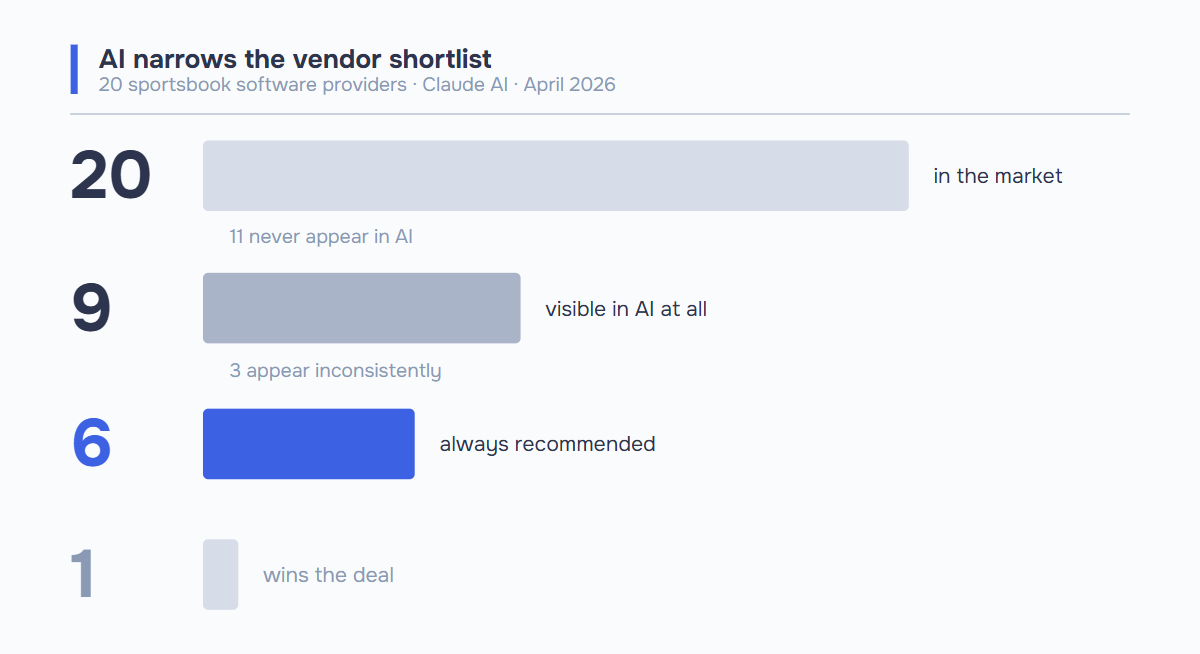
Each of the 20 providers was then scored on how many of the three queries returned a recommendation — their AI search ranking across all three queries. A score of 3/3 signals consistent, reliable LLM visibility and strong AI search visibility. A score of 0/3 means the provider simply does not exist in AI-assisted discovery.
The Data: A Divided Market
The results reveal a market split into three distinct tiers.
Tier 1 — Champions (3/3 Queries)
Six providers appeared in every single query without exception:
- Kambi
- OpenBet
- Sportradar
- Genius Sports
- Altenar
- BETBY
These are the companies that dominate AI-assisted discovery. When an operator asks any variation of “best sportsbook software provider,” these six names are the answer. Consistently. Every time.
Tier 2 — Partial Visibility (1–2/3 Queries)
Two providers hold a foothold but haven’t yet achieved consistent AI presence:
- BetConstruct — 2/3 queries (missed only the first)
- BtoBet — 1/3 queries
- Delasport — 1/3 queries
Partial visibility is a precarious position. It signals that AI models have some information to draw on — but not enough to recommend these providers reliably. A slight shift in how the question is phrased can push them in or out of the answer entirely.
Tier 3 — Invisible (0/3 Queries)
Eleven providers — 55% of the entire sample — received zero mentions across all three queries:
NSoft, OddsMatrix, Sporting Solutions, IMG Arena, LSports, IGT PlaySports, Pronet Gaming, Betgenius, Bookmaker NEXT, GoldenRace, and Betinvest.
This is not a ranking of product quality. Several of these companies — including white label sportsbook providers serving major operators — have proven technology and real client relationships. Their invisibility is not a product problem. It is a generative engine optimization problem.
The Pain: Why Being Invisible to AI Now Costs Pipeline
Understanding this finding requires understanding how large language models actually form recommendations.
When Claude answers “What’s the best sportsbook software?”, it is not running a real-time web crawl. It is synthesizing patterns from the content it was trained on — industry publications, comparison articles, analyst reports, forum discussions, press coverage, documentation, and structured data. A brand that appears frequently, authoritatively, and consistently in those sources earns a mental model in the AI. A brand that doesn’t, doesn’t get recommended — regardless of its actual market position.
This creates a compounding visibility gap. The providers Claude already recommends get cited in new content generated by AI tools, which reinforces their position in future training cycles. The invisible providers fall further behind with every iteration.
The practical consequence is stark: operators using AI to research vendors are being handed a pre-filtered shortlist. They see Kambi, OpenBet, Sportradar, Genius Sports, Altenar, and BETBY. They start conversations with those vendors. The 11 invisible providers never get a first call.
And this is not a fringe behavior. A 2024 survey by Gartner found that over 70% of B2B buyers now use generative AI tools during vendor research. In tech-forward verticals like iGaming, that adoption rate is almost certainly higher and accelerating. ChatGPT brand visibility and AI visibility for iGaming brands in vertical search are becoming prerequisites for B2B pipeline generation — not differentiators. Yet most providers have no AI brand visibility tool in place to even measure where they stand.
What Is Generative Engine Optimization — and Why It’s Different from SEO
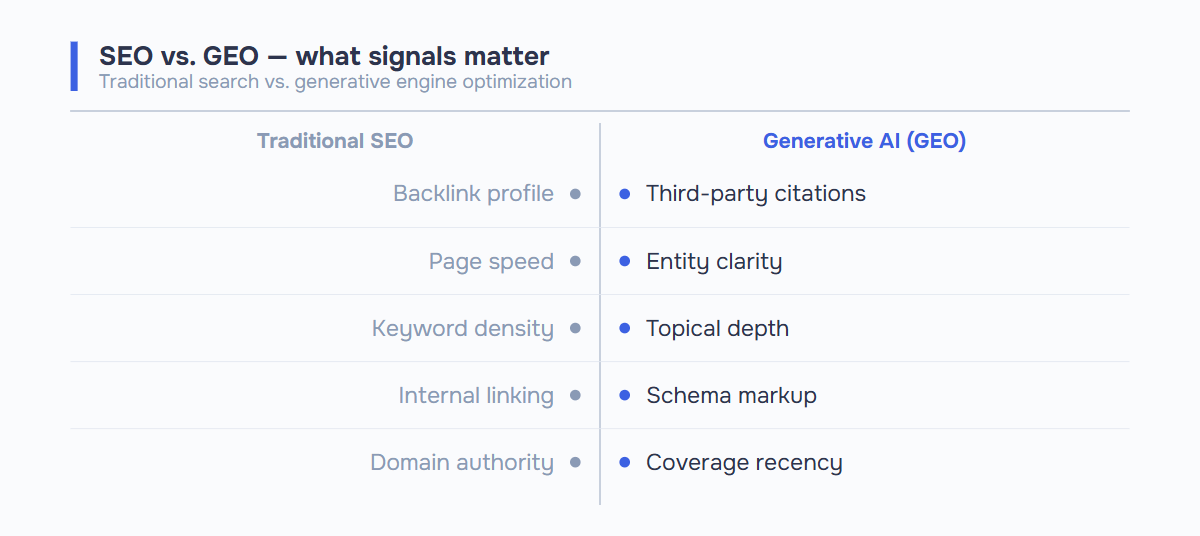
Generative engine optimization (GEO) is the practice of structuring your brand’s digital presence so that large language models include you in relevant AI-generated answers. It is related to, but distinct from, traditional SEO.
In classic SEO, you optimize for a ranking algorithm that indexes pages and surfaces links. The user still has to click, evaluate, and decide. In LLM SEO, you optimize for a synthesis process. The model reads, weighs authority and repetition, and produces a direct answer. If your brand wasn’t in the source material that shaped that model’s knowledge — or isn’t in the current web content that retrieval-augmented models reference — you aren’t in the answer.
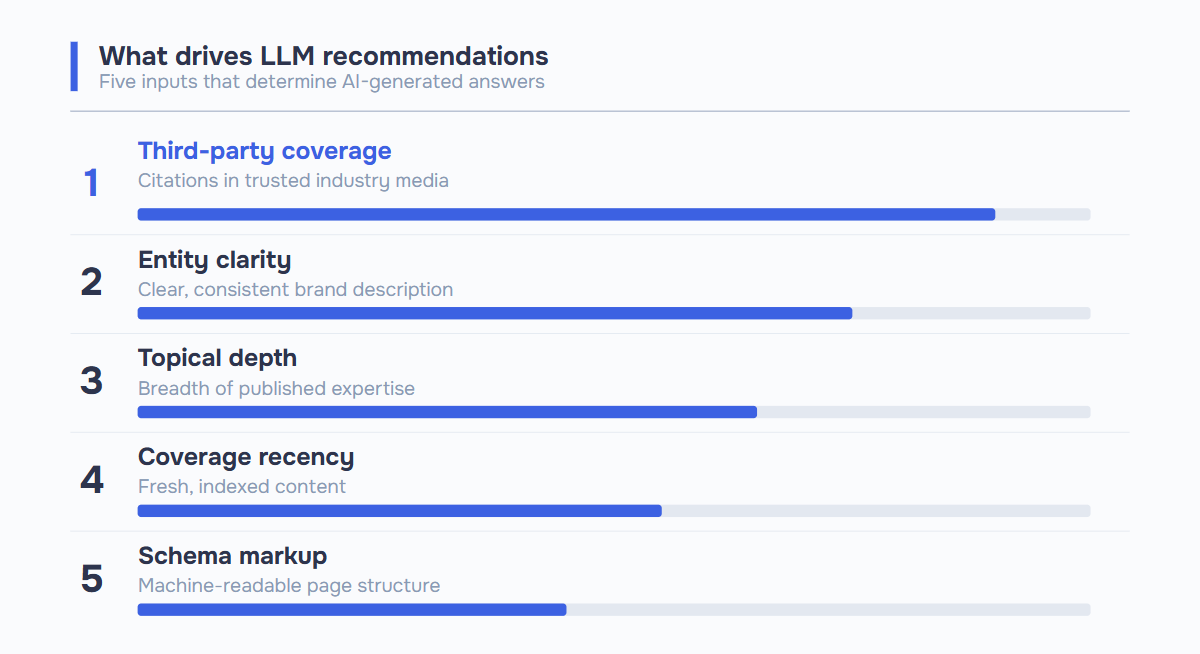
The inputs that drive LLM visibility include:
- Authoritative third-party coverage. AI models weight sources that appear credible and frequently cited. Being featured in iGaming industry reports, B2B media, and analyst commentary contributes more to AI visibility than any amount of self-published content.
- Entity clarity. LLMs organize knowledge around entities — distinct, well-defined concepts. A provider whose name, category, core product, and competitive context are clearly and consistently described across the web is easier for a model to recommend confidently. Ambiguity produces omission.
- Topical depth and breadth. Providers that have published substantive content on sports betting technology, betting markets, platform architecture, and regulatory compliance give language models more surface area to draw from. Thin digital footprints produce thin AI presence.
- Structured data and schema markup. Machine-readable signals help AI systems classify what a company does and where it fits in a competitive landscape.
- Recency of coverage. Retrieval-augmented models like Perplexity actively fetch current web content. For providers invisible to pure LLMs, appearing in recent, high-quality editorial content offers a faster path to AI-assisted discovery.
An AI SEO strategy for an iGaming B2B company isn’t about chasing keywords on a blog. It’s about systematically building the kind of informational presence that gives a language model confidence to include you in a recommendation.
The Six Champions: What They Have in Common
The six providers that scored 3/3 don’t share a single product category. Kambi and OpenBet are established enterprise-tier platforms with long histories of press coverage and documented operator partnerships. Sportradar and Genius Sports are publicly listed companies with extensive third-party reporting. Altenar and BETBY are newer but have invested heavily in content marketing, industry media placements, and building a clear public record of their technology and client base.
What they share is informational density — a rich, consistent, multi-source record of what they do, who they serve, and why operators choose them. That record is exactly what AI systems draw on when forming recommendations.
The Solution: How Invisible Providers Get Into the Conversation
Closing an AI visibility gap requires a generative engine optimization strategy built on three priorities.
1. Build the authoritative record that AI needs. Publish substantive, expert-level content about sportsbook technology, platform capabilities, and operator use cases. Seek coverage in iGaming industry media. Contribute to research reports and roundups. Every credible external mention strengthens your entity model.
2. Optimize for how LLMs read, not just how Google crawls. Structure web content with clear entity definitions, explicit product descriptions, and schema markup that makes your company’s category membership unambiguous. Don’t assume AI systems infer what you haven’t explicitly stated.
3. Target retrieval-augmented systems in parallel. For near-term AI search visibility in tools like Perplexity and AI Overviews, recent editorial coverage on authoritative domains works faster than long-term content accumulation. AI visibility tools that track your mention frequency across LLMs can help prioritise which gaps to close first. A targeted earned media push can move you from invisible to visible in a single training cycle update.
The providers that act now will benefit from the same compounding dynamics that currently favor the Champions tier. The longer the delay, the wider the gap becomes — and the harder it is to close.
Conclusion: AI Visibility Is B2B Pipeline
The ICODA audit data is clear. Right now, when an operator asks AI for a sportsbook software provider recommendation, they get six names. Every time. The other 14 companies — including established vendors with real operator relationships — are absent from that conversation entirely.
This is not a technology gap. It is a generative engine optimization gap — and a wakeup call for every iGaming software provider operating in B2B. Unlike a product shortfall, it can be addressed with the right strategy.
Frequently Asked Questions (FAQ)
There is no single dominant platform yet — this category is nascent. The most effective approach combines an AI brand visibility tool for ongoing monitoring (tracking how often and how accurately your brand appears in LLM outputs) with a GEO content strategy that builds the authoritative source material models draw from. ICODA’s audit methodology, as demonstrated here, provides a structured starting point for any iGaming B2B company assessing its current LLM visibility baseline
Generative engine optimization (GEO) is the discipline of optimising a brand’s digital presence so that large language models — ChatGPT, Claude, Perplexity, and others — include it in relevant AI-generated answers. Unlike traditional SEO, which targets ranking algorithms, GEO targets the training data, retrieval signals, and entity models that shape what an AI recommends.
Based on this April 2026 audit using Claude (Anthropic), the top-ranked providers by AI search visibility — appearing in all three high-intent queries — are Kambi, OpenBet, Sportradar, Genius Sports, Altenar, and BETBY.
GEO and SEO target fundamentally different moments in the buyer journey. SEO surfaces a link the user may click. GEO places your company inside the answer — before any clicking happens. When an LLM says “consider Kambi, OpenBet, Altenar,” the user is already shortlisting. Absence from that sentence means absence from the conversation.
Timeline depends on the channel. Retrieval-augmented systems like Perplexity respond to fresh editorial coverage within weeks. Pure LLMs like Claude update on training cycles — expect 6–12 months for consistent presence. The cost of waiting is compounding: Tier 1 providers entrench further with every cycle.
Audit conducted by ICODA.io | Data collected: April 2026 | AI model tested: Claude (Anthropic)
Share with


Rate the article