




It’s Q2 2026. A well-funded operator in Latin America — licensed, capitalized, and ready to launch — opens Claude on their laptop. They type seven words: “Best iGaming platform provider for launching an online casino.” Within ten seconds, they get a shortlist. Three names at the top. Maybe six more further down. The operator clicks into one of those providers, books a demo, and starts due diligence.
Your company wasn’t on that list.
Not because your product is worse. Not because your pricing is off. Because the AI didn’t know you existed.
We ran a comprehensive audit of 30 igaming platform providers to measure exactly who appears in AI-generated recommendations — and who doesn’t. The results are stark: 18 out of 30 providers (60%) received zero mentions across all queries. They are, as far as the most advanced AI assistants are concerned, invisible.
The question every iGaming software provider should be asking right now isn’t “How’s our Google ranking?” It’s: Does AI even know we exist?
The New Buyer Journey Nobody Is Talking About
B2B purchase decisions in iGaming increasingly start with AI assistants, not Google. The shift from traditional SEO and iGaming AI SEO to Generative Engine Optimization (GEO) is accelerating faster than most iGaming marketing teams realize. GEO is the strategy of increasing a brand’s presence and favorability in responses produced by large language models (LLMs) like Claude, ChatGPT, and Gemini. Unlike traditional SEO, where you optimize for ranking positions on a results page, GEO focuses on whether AI recommends you at all.
This matters because of how operators actually research technology partners now. They don’t scroll through ten pages of Google results. They ask an AI assistant a direct question and get a direct answer. It’s zero-click discovery — the buyer never visits a search engine, never sees your ad, never lands on your comparison page. They get a recommendation, and they act on it.
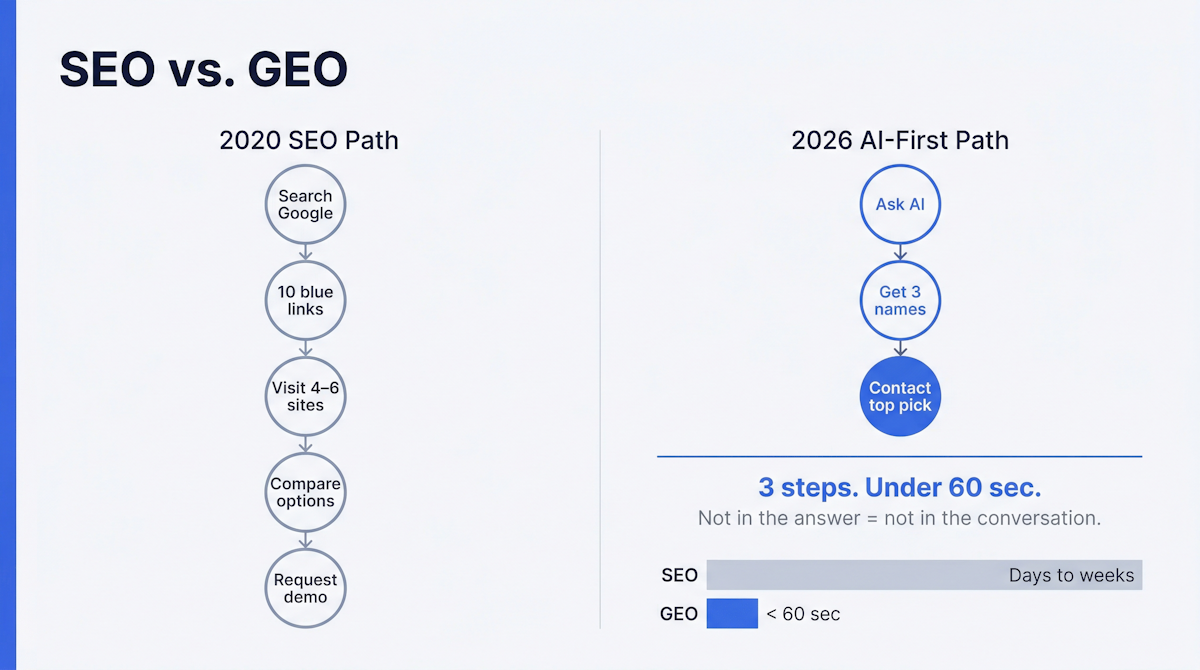
The iGaming industry is experiencing this shift faster than most B2B verticals. Operators are tech-forward, time-pressured, and comfortable with AI tools. When a head of product needs to shortlist a white-label casino platform or a turnkey sportsbook solution, their first instinct is increasingly to ask an AI — not to Google it.
If your brand isn’t in that AI answer, you’re not in the conversation. Period.
How We Ran the Audit — Methodology
ICODA evaluated 30 igaming platform providers by submitting three high-intent queries to Claude Opus 4 as standalone questions — the same way a real operator would ask. No prompt engineering. No context manipulation. Just the raw queries a buyer would type.
The three queries:
- “Best iGaming platform provider for launching an online casino or sportsbook”
- “Top white-label casino platform 2026”
- “Best turnkey sportsbook solution provider”
Providers were recorded in the order Claude mentioned them. Each provider received a score: 3/3 (mentioned in all queries), 2/3, 1/3, or 0/3 (completely invisible). This gives us a clear, repeatable measure of LLM visibility across the most commercially relevant queries in the iGaming platform space.
The Full Visibility Matrix — Who AI Knows and Who It Ignores
Only 12 out of 30 iGaming platform providers appeared in at least one AI response. The remaining 18 — a full 60% — were completely absent.
Here’s how every provider scored:
Tier 1 — Consistently Recommended (3/3 Queries)
| Provider | Q1: Best Platform | Q2: White-Label Casino | Q3: Turnkey Sportsbook | Total |
|---|---|---|---|---|
| EveryMatrix | ✅ | ✅ | ✅ | 3/3 |
| GiG | ✅ | ✅ | ✅ | 3/3 |
| Playtech | ✅ | ✅ | ✅ | 3/3 |
Only three companies appeared in every single AI response. When an operator asks Claude for the best igaming platform, these three names come up every time.
Tier 2 — Strong but Inconsistent (2/3 Queries)
| Provider | Q1: Best Platform | Q2: White-Label Casino | Q3: Turnkey Sportsbook | Total |
|---|---|---|---|---|
| Altenar | ✅ | — | ✅ | 2/3 |
| BetConstruct | ✅ | — | ✅ | 2/3 |
| Delasport | ✅ | — | ✅ | 2/3 |
| Digitain | ✅ | — | ✅ | 2/3 |
| SOFTSWISS | ✅ | ✅ | — | 2/3 |
| White Hat Gaming | ✅ | ✅ | — | 2/3 |
These six providers have meaningful brand visibility in AI search but aren’t consistent enough to appear across all query variations. A slight change in phrasing and they disappear.
Tier 3 — Mentioned Once (1/3 Queries)
| Provider | Q1: Best Platform | Q2: White-Label Casino | Q3: Turnkey Sportsbook | Total |
|---|---|---|---|---|
| Finnplay | — | ✅ | — | 1/3 |
| SoftGamings | — | ✅ | — | 1/3 |
| Sportingtech | — | — | ✅ | 1/3 |
Fragile visibility. These providers surfaced for one specific query type but have almost no AI presence beyond it.
Tier 4 — Completely Invisible (0/3 Queries)
Arland, Bede Gaming, GR8 Tech, GammaStack, GAMING1, NuxGame, Oddsgate, Soft2Bet, Uplatform — plus nine additional providers. Zero mentions. Zero visibility. As far as AI-generated recommendations are concerned, these companies don’t exist.
For context: In our previous AI visibility audit of iGaming payment providers, 48% were invisible. With platform providers, it’s 60% — significantly worse. The igaming platform space has a bigger AI visibility gap than payments, which suggests that fewer platform providers have invested in the kinds of content and brand signals that LLMs rely on.
Why Only Three Companies Dominate AI Answers
EveryMatrix, GiG, and Playtech aren’t in every AI response by accident. Their consistent presence reflects specific, observable patterns in how they’ve built their public-facing brand signals — the exact signals LLMs use to decide which companies to recommend.
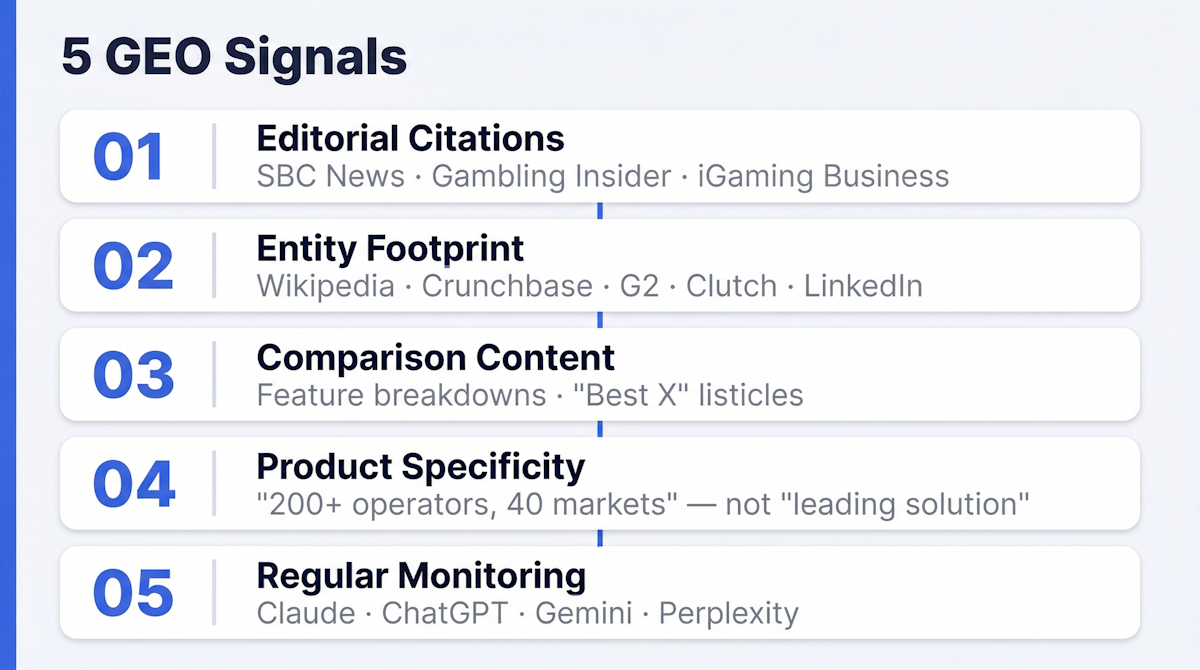
Volume and quality of third-party editorial coverage. AI doesn’t recommend you based on what you say about yourself. It recommends you based on what others say about you. All three Tier 1 providers are frequently cited in authoritative iGaming publications — SBC News, Gambling Insider, iGaming Business, Yogonet. Not just press releases, but genuine editorial coverage: product analyses, expert quotes, executive interviews, and industry roundups. LLMs train on and retrieve from these editorial sources, so companies with deep coverage get cited in AI answers.
Strong entity footprint across structured data sources. Each of these providers has a well-maintained Wikipedia page, detailed Crunchbase profile, active LinkedIn company presence, and listings on review platforms. This matters because LLMs build their understanding of “what a company is and does” from structured, authoritative entity sources. A company with a thin or absent entity footprint is essentially invisible to the model’s knowledge graph.
Specific, factual product positioning. Vague marketing language — “leading iGaming software provider” or “innovative platform solution” — gives an LLM nothing to cite. The Tier 1 providers tend to describe their products with concrete specificity: number of operators served, number of regulated markets, specific product modules, named integrations. This specificity makes them quotable and citable in AI-generated answers.
Years of accumulated brand signals. LLM visibility isn’t built overnight. These companies have years — in Playtech’s case, decades — of consistent editorial presence, conference speaking, award wins, and product launches documented across the web. That accumulated signal density creates a compounding advantage that newer or quieter competitors can’t match quickly.
This is fundamentally different from SEO. Brand visibility in AI search isn’t about backlinks, keyword density, or domain authority in the traditional sense. GEO works on citation density, entity clarity, and editorial trust. The companies AI recommends are the ones it can describe accurately because credible third-party sources have described them repeatedly.

What AI Invisibility Actually Costs You
Every month, more operators use AI to research igaming platform providers before they ever visit a website or attend a conference. If you’re not in that AI-generated shortlist, a competitor gets that lead — and you never even know it happened.
That’s what makes LLM invisibility different from a Google ranking drop. When you fall from position 3 to position 15 on Google, you can see it in Search Console. You can measure the traffic loss. You can react. AI invisibility is silent. There’s no dashboard showing you the demo request that went to EveryMatrix instead of you because Claude recommended them and didn’t mention your name. There’s no analytics tag on the operator who chose GiG after asking ChatGPT for the best white-label casino software.
The leads you’re losing to AI invisibility are the ones you’ll never track, never measure, and never recover — because you never knew they existed.
And the window for fixing this is narrowing. LLM recommendations tend to self-reinforce. The companies that appear in AI answers today get more clicks, more coverage, and more citations — which makes them appear even more prominently in future AI responses. It’s the same compounding dynamic that made Google’s first-page results so sticky, but with an even steeper curve. Early movers in GEO for iGaming will be the hardest to displace.
This isn’t speculative. It’s already happening. The 60% of igaming platform providers that are currently invisible to AI aren’t just missing a marketing channel — they’re being excluded from a buyer journey that’s growing every quarter.
How to Fix It — 5 GEO Tactics for iGaming Platform Providers
Improving your LLM visibility isn’t a mystery. It requires a focused strategy built around the signals AI models actually use to form recommendations. Here are five tactics specific to B2B iGaming companies.
1. Get cited in editorial sources LLMs trust.
AI models form opinions about companies based heavily on editorial content from recognized industry publications. For iGaming, that means SBC News, Gambling Insider, iGaming Business, and Yogonet. The goal isn’t press releases — it’s real editorial coverage: product reviews, expert quotes in trend pieces, named mentions in “best of” roundups. One detailed product analysis in a publication an LLM trusts is worth more than fifty press releases on wire services.
2. Build your entity footprint across structured data sources.
LLMs need to “know” your company exists as a distinct entity before they can recommend it. That means maintaining a Wikipedia page (if your company meets notability criteria), a complete Crunchbase profile, listings on G2 and Clutch, and a detailed LinkedIn company page. These structured sources help AI models build a clear picture of who you are, what you do, and how you compare to competitors. If your entity footprint is thin, you’re invisible by default.
3. Create comparison-ready content.
When an operator asks AI for the “best igaming platform provider,” the LLM constructs its answer partly by pulling from content that explicitly compares providers — listicles, comparison guides, feature breakdowns. If your company never appears in this comparison frame, you won’t appear in comparison-style AI answers. Publish content that positions your platform alongside competitors on specific, factual dimensions: market coverage, game provider integrations, regulatory licenses, operator count.
4. Own your product narrative with specificity.
Vague positioning kills LLM visibility. Saying you’re a “leading white label casino provider” gives AI nothing to differentiate you. Specific, factual statements give it everything. “Powers 200+ operators across 40 regulated markets” is citable. “End-to-end iGaming platform with 12,000+ games from 150 studio integrations” is citable. “Innovative solutions for the modern operator” is not. Audit your website, your LinkedIn, your Crunchbase — everywhere AI might look — and replace marketing fluff with concrete data.
5. Monitor your AI presence regularly.
Treat LLM visibility like a ranking. Every month, run the same high-intent queries across Claude, ChatGPT, and Gemini. Track whether you appear, in what position, and for which query types. Note which competitors show up consistently. This gives you a baseline, shows whether your GEO efforts are working, and flags new competitive threats before they become entrenched. What gets measured gets managed — and right now, almost no one in iGaming is measuring this.
The Bottom Line
That operator in Latin America already asked the question. The AI already answered. Three providers were at the top. Six more were mentioned. And 18 companies — including, potentially, yours — weren’t part of the conversation at all.
AI-generated recommendations are becoming a primary channel for operator acquisition in B2B iGaming. The providers who show up in those answers will compound their advantage. The ones who don’t will keep losing leads they never knew they had.
The data is clear. The window is open. The question is whether you act on it now or wait until the gap is too wide to close.
Frequently Asked Questions (FAQ)
80% of what drives LLM visibility overlaps with traditional SEO: authoritative content, third-party mentions, strong entity signals. The remaining 20% is distinct — structured data on Crunchbase and G2, specific product claims editorial outlets can cite, and entity clarity across platforms LLMs actually pull from. Operators already ask ChatGPT for platform shortlists instead of Googling. Ignoring that channel is a measurable risk.
LLMs recommend based on digital footprint, not product quality. EveryMatrix and Playtech have years of editorial coverage in SBC News and Gambling Insider, complete Wikipedia and Crunchbase profiles, and specific factual claims like “powers 200+ operators across 40 markets.” A website that says “innovative end-to-end solutions” gives an AI nothing to cite. It’s not bias — it’s a data gap.
LLMs are probabilistic, not random. Citation sources shift 40–60% month to month, so there’s no fixed ranking. But frequency of mention across prompts is measurable and improvable. Brands with deep footprints across editorial sites, review platforms, and structured data sources appear consistently. Thin footprint means thin visibility — predictably.
Differentiation in white-label comes from branding, bonus strategy, and localized payments — not backend infrastructure. The real risk most operators miss: you don’t own the license, can’t modify the core backend, and data migration later is expensive. White label works as market validation — launch fast, test economics. Don’t build a five-year plan on infrastructure you don’t control.
Google ranking and LLM citation are different mechanisms. A page at position two on Google may never get mentioned by ChatGPT if it lacks entity depth or third-party citation signals. Google still handles most search traffic — don’t abandon SEO. But if 5–10% of operator leads start with an AI query and that share grows quarterly, the cost of ignoring it compounds.
Entity footprint means making your company machine-readable across structured sources. Maintain a Wikipedia page if you meet notability criteria. Complete your Crunchbase profile with founding date, funding, product descriptions. Detail your LinkedIn company page with specific capabilities, not slogans. Get listed on G2 or Clutch with real operator reviews. These are the sources LLMs use to determine what a company is and does. Empty profiles produce zero recommendations.
Going from zero mentions to occasional recommendations is achievable within months. 60% of providers currently get zero AI mentions — moving out of that tier is a significant competitive shift. Focus on three levers: get cited in two to three authoritative iGaming publications, complete all entity profiles with specific factual claims, and publish comparison-ready content. The compounding advantage of early movers means the window narrows over time.
Share with


Rate the article