Binance passed 300 million registered users in December 2025. This playbook sets out a crypto exchange marketing strategy for marketing teams of new and mid-size centralized exchanges and swap services, covering exchange user acquisition and retention. It shows which markets and channels to start with, what to fix before you pay for traffic, a 180-day plan with targets, and how Binance, Bybit and Coinbase ran their 2025-2026 campaigns.
Key Takeaways
- Pick one trader segment and two or three markets where you hold a license
- Fix liquidity, licensing and KYC drop-off before you scale paid traffic
- Pay referrals and creators for traded volume, not sign-ups; Binance rebuilt its affiliate tiers around volume in August 2025
- Repeat what brings traders back: trading tournaments, a fixed listing and airdrop calendar, and a VIP fee ladder
- Start SEO, PR, Reddit and AI search work in month one: these channels take months and do not need ad approval
- Review every channel monthly by cost per depositing trader, KYC conversion, time to first trade, D30/D90 retention and volume per active trader
Strategy Foundation: Audience, Positioning and KPIs
Cryptocurrency exchange marketing starts with two constraints: a handful of large exchanges take most of the volume, and regulators in the EU, the US and Asia require a license before an exchange can serve or advertise in a country. So choose the segment and the markets first; channels come after.
Defining Target Audience
Pick one segment to start with. The three main ones want different things:
| Segment | What they want | First channels | Message |
|---|---|---|---|
| Newcomers | Simple interface, help when stuck | Educational content, creators | Easy first trade, clear support |
| Active traders | Low fees, API limits for bots | Fee comparisons, API docs, trader creators | Fees and execution on their pairs |
| Long-term investors | Custody security, staking yield | PR, reviews, Earn product pages | Reserves, security record, yield |
Unique Value Proposition
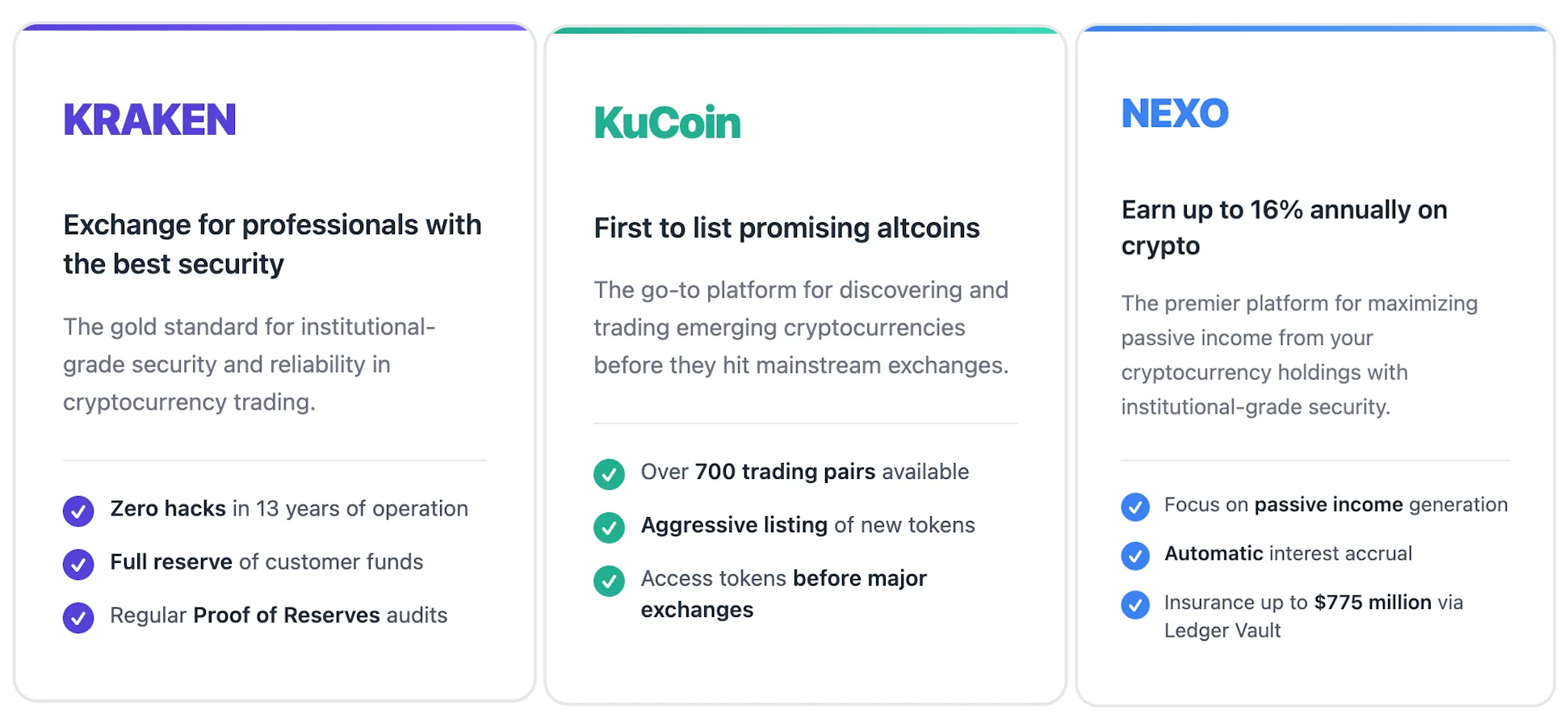
Your UVP answers one question: why would a trader use you instead of Binance? Every exchange claims security and convenience, so neither gives a trader a reason to switch. Here is how Kraken, KuCoin and Nexo position themselves:
- Kraken: an exchange for professionals that leads with security: no hacks, full reserves of customer funds and regular Proof of Reserves audits
- KuCoin: early access to new altcoins: a wide choice of trading pairs and listings before the major exchanges
- Nexo: passive income: interest on crypto holdings, accrued automatically, with insured custody
Choosing Markets: License, Adoption and Competition
Enter a market when it passes three tests:
- License: you can legally serve and advertise there. In the EU this means MiCA authorization; ESMA keeps an interim register of authorized crypto-asset service providers that partners and payment providers can check
- Adoption: people already use crypto. The Chainalysis 2025 Global Crypto Adoption Index ranks India, the United States, Pakistan, Vietnam and Brazil at the top, with Nigeria, Indonesia, Ukraine, the Philippines and Russia completing the top 10
- Gap: local leaders lack something you can offer: a fiat rail, a language, local tokens, lower fees on popular pairs
Start with two or three markets that pass all three tests, localize the product and support there, and expand only after CAC and retention are stable.
Setting Key Performance Indicators
100,000 registered accounts with 500 active traders do not pay for themselves. Set KPIs on the trading user:
- CAC ceiling: the most you will pay for a trader who deposits and trades. Ceiling = expected LTV ÷ target LTV/CAC. Fix or cut any channel above it
- LTV: trading fees a user pays over their lifetime. Above 1× CAC a trader repays acquisition; aim for 3× to cover other costs
- Volume per active trader: monthly trading volume of an active user. Fees grow with it
- Retention at 30/60/90 days: share of depositing users who still trade after each period
Before You Spend: Liquidity, License and Onboarding
Money spent on crypto exchange promotion is wasted if the product loses traders after the click. Check three things before you scale budgets:
- Liquidity: wide spreads and thin order books on the pairs you advertise send active traders back to Binance after the first order. Advertise only the pairs where depth is competitive, and agree spread and depth targets for them with your market maker
- License and trust signals: a visible license, Proof of Reserves, security audits and clear terms answer the first question a new user asks: is my money safe here? The license is also what makes paid ads possible
- Onboarding and KYC: every extra step between sign-up and first trade loses users. Measure drop-off at each KYC step, offer fast deposit methods, and deep-link new users straight to a pair with a pre-filled order. Friction costs users in DeFi too: in user research on DeFi lending apps, 89% of users quit within five minutes
Start with whichever of the three is weakest. If the exchange is still in development, see how to build a crypto exchange first.
Marketing Funnel: From Awareness to Loyalty
Channel Map
| Channel | Funnel stage | Time to effect | What to measure | Main risk |
|---|---|---|---|---|
| SEO and content | See | Months | Organic sign-ups, KYC rate | Google’s stricter rules for finance content |
| AI search, Reddit, reviews | See, Think | Weeks | Brand mentions, AI citations | Negative threads repeated by AI |
| PR in crypto media | See, Think | Weeks | Referral traffic, branded search | Coverage with no news to drive sign-ups |
| Google and Meta ads | Think | Days | CAC per depositing trader | Ads rejected without license and certification |
| Crypto ad networks | Think | Days | Cost per first trade | Reaches people who already trade elsewhere |
| Creators and KOLs | Think, Do | Days | Volume from referred users | Paid per click or post, with no link to trading |
| Listings and airdrops | Do | Days | Deposits, new KYC users | Airdrop hunters who leave |
| Referral program | Do, Care | Weeks | Volume per referred user | Spam and self-referrals |
| Trading tournaments | Do, Care | Days | Volume, return rate after the event | Bots and wash trading |
| VIP ladder and lifecycle | Care | Weeks | D30/D90 retention, VIP volume share | Fee cuts without volume growth |

See: Reaching People Who Research Crypto
People researching crypto find you through content, AI search answers, social media and PR.
Content Marketing and SEO
Write about specific trader questions. Two kinds of content work:
- Content that brings traders in: guides for queries like “best technical analysis tools”, “how to store crypto securely” or “taxes on staking”
- Content that helps users act on your platform: short explainers of real flows (“how to deposit and withdraw”, “API trading in 10 minutes”, “futures risk management”) and fee and spread comparisons with competitors, with dates and sources
Google holds finance pages to its E-E-A-T standard: show the author, sources and real platform screenshots. Crypto SEO results build over months: in one exchange SEO campaign, an instant swap service grew organic traffic from about 7,500 to 20,600 monthly visits in roughly 18 months, with referring domains up 66% and conversions up 24% year over year.
AI Search Visibility
ChatGPT, Perplexity and Google AI Overviews now answer “which exchange should I use”. They build answers from media coverage, review sites and Reddit threads, so PR and Reddit mentions decide what these answers say. One swap exchange that could not scale paid ads grew ChatGPT referral traffic 12x and earned 2,000+ citations across AI assistants through PR and AI SEO. See which AI answers mention your exchange with our free AI visibility check.
PR in Crypto and Financial Media
Plan PR in waves around product events (tournaments, listings, partnerships) and localize media, KOLs and language by market. Pitch news that journalists can check: security audits, Proof of Reserves, volume milestones, platform data.
Publish Proof of Reserves and incident post-mortems on a schedule; users who compare exchanges look for them. In November 2022, after FTX collapsed, Crypto.com’s CEO published the exchange’s reserve wallet addresses.

Think: Turning Comparison into Sign-Ups
People comparing exchanges look at ads, reviews and creator content.
Paid Advertising
Crypto exchange advertising on Google and Meta needs certification first: Google allows exchange ads only from advertisers that hold the license required in each target country (Google Ads cryptocurrency policy), and Meta has a similar approval process. After approval, start with three audiences in paid crypto traffic campaigns:
- Remarketing to visitors who started but did not finish registration or KYC
- Look-alike audiences based on active traders
- Geo-targeting to countries with high crypto adoption where you hold the right license
Crypto advertising networks like Coinzilla, CoinTraffic and Bitmedia reach people who already trade on other exchanges. Use them for narrow campaigns such as a listing announcement.
Influencer Partnerships
Work with creators who teach trading and show their own trades. Ask them for tutorials that show how they analyze and trade on your platform. A post that only says “Register on exchange X using my link” brings registrations, and few of them become active traders.
Pay a fixed fee for the integration plus a share of trading fees from referred users for six months. Creators then earn only when their audience trades. Start with YouTube creators who already teach trading.
Do: Getting the First Trade
Listings, airdrops and short onboarding move a new user from registration and KYC to the first trade.
Listings and Airdrops
A listing of a token that people are waiting for brings new users. Source projects through launch agencies and token teams, and combine the listing with a small airdrop for users who register and pass KYC before trading begins.
First-Trade Onboarding
Track time to first trade for each channel. Cut it with a deep link to the advertised pair, a pre-filled order and a deposit method that works in the user’s country.
Care: Keeping Traders Active
Traders keep funds on a platform that pays them to. Promote these features:
- Staking and Earn: yield on idle balances
- Launchpads: early access to new tokens
- Fee tiers: lower fees as monthly volume grows
Then add the retention mechanics from the 180-day plan: a VIP ladder, a referral program that pays for volume, trading tournaments, and lifecycle email marketing and push notifications by segment: onboarding after KYC, first-trade nudges, win-back for users inactive for 30, 60 or 90 days.
Online Reputation Management for Crypto Exchanges
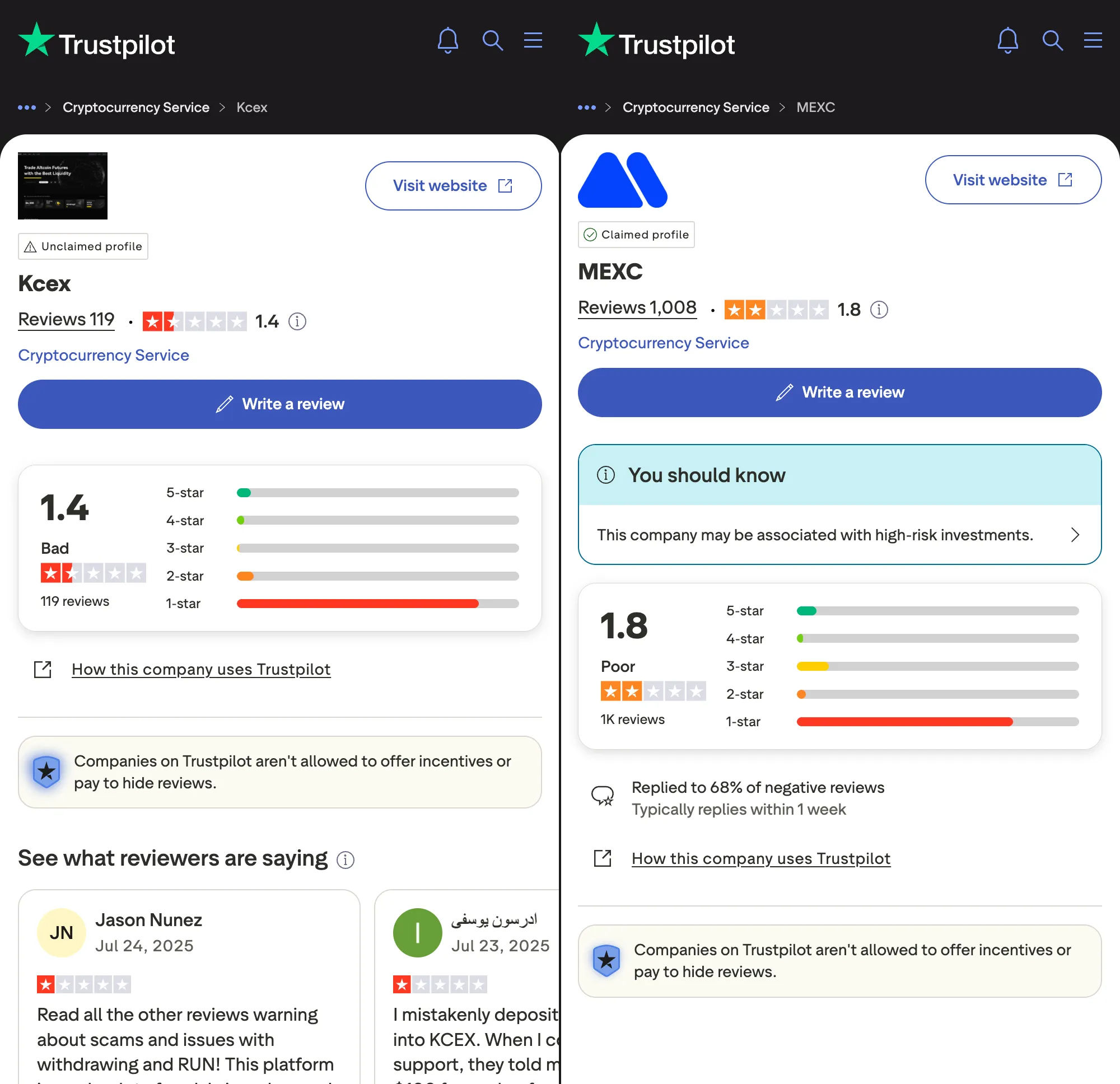
One hack, scam listing or blocked-funds thread can stay in search results for years, and AI assistants now repeat what Reddit threads and review sites say about you. In July 2025 Trustpilot screenshots, Kcex scored 1.4 and MEXC 1.8, with a notice that the company may be associated with high-risk investments:
What reputation management covers before a crisis:
- Monitor mentions in Brand24 or Mention
- Reply to negative posts within a set time, for example 2 hours
- Resolve user complaints in public threads
- Answer questions in your Telegram, Discord and X communities
- Post in the Reddit communities where users compare exchanges
And during one:
- Post status updates during outages
- Publish a post-mortem after each incident
- Compensate affected users and say so publicly
In one Reddit ORM campaign for an international exchange, Google’s AI Overview had surfaced a “scam” narrative about the brand. Over six weeks the team published 25 organic threads in 30+ subreddits; 96.6% of them survived moderation, and the brand’s own community grew by 490 subscribers without paid spend.
180-Day Crypto Exchange Marketing Plan
Six-Month Objectives
Goal for six months: grow trading volume. Three ways to get there: acquire traders who trade, reactivate dormant accounts, raise volume per user. Targets:
- LTV/CAC of 3 or more
- A VIP share of volume that grows from your current baseline
- D30/D90 retention at or above your launch baseline
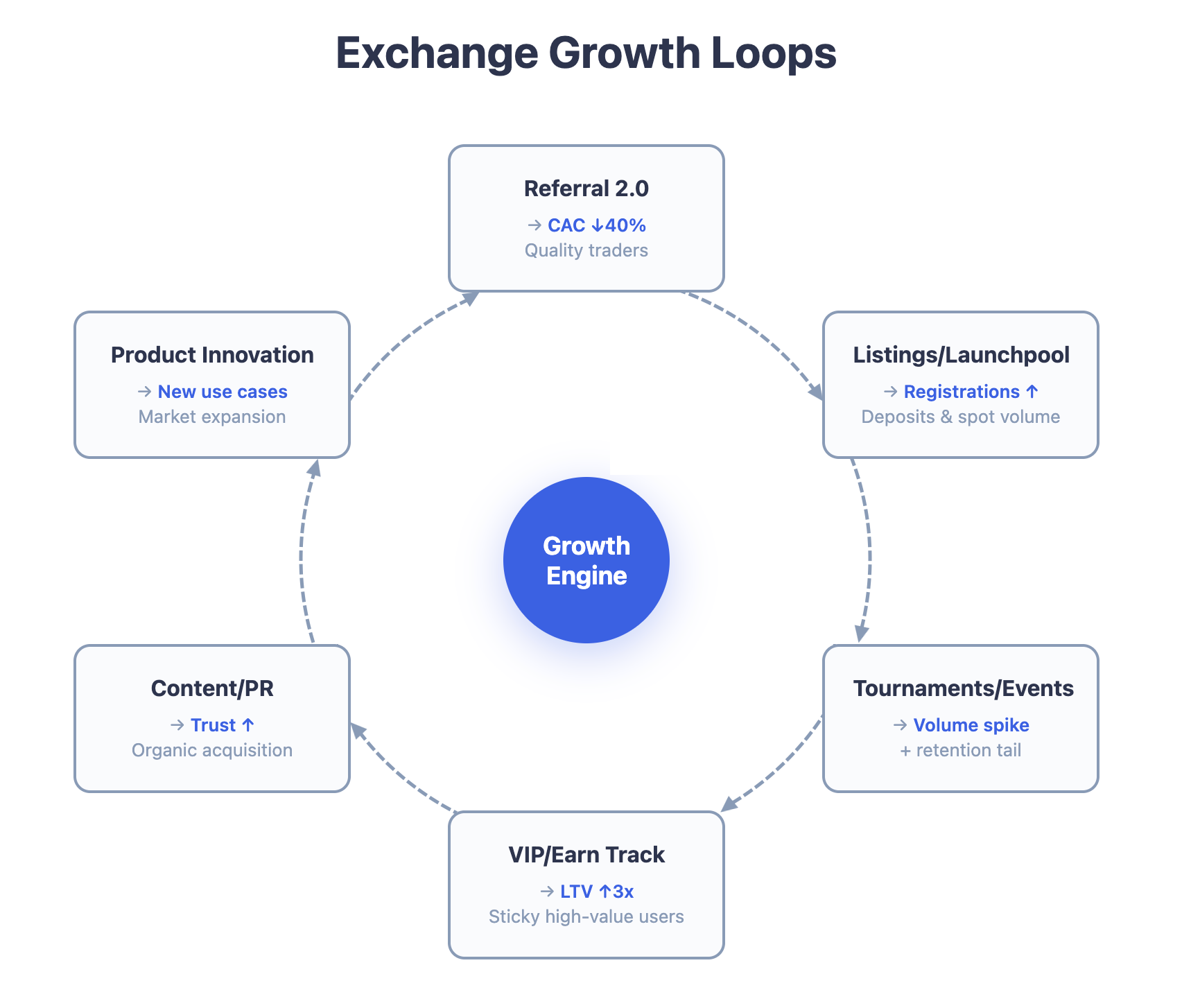
Quick Wins (First 30 Days)
- Referral push: run a 60- to 90-day referral push for active traders, with quests that pay for traded volume; Binance rebuilt its affiliate tiers around volume in 2025. Metric: volume per referred user
- Win-back: target users who passed KYC but never traded, deposited but stayed inactive, or went quiet for 30/60/90 days. Send email, push and in-app offers with a deadline: commission cashback, zero-fee trades on two or three top pairs, priority access to the next listing. Metric: reactivated traders
- Zero-fee pairs: if you need liquidity fast, offer zero fees on three to five pairs only, for users with KYC and minimum turnover. Plan how users move to normal fees: a grace period, personal offers, fee bundles. Metric: volume and spread on those pairs
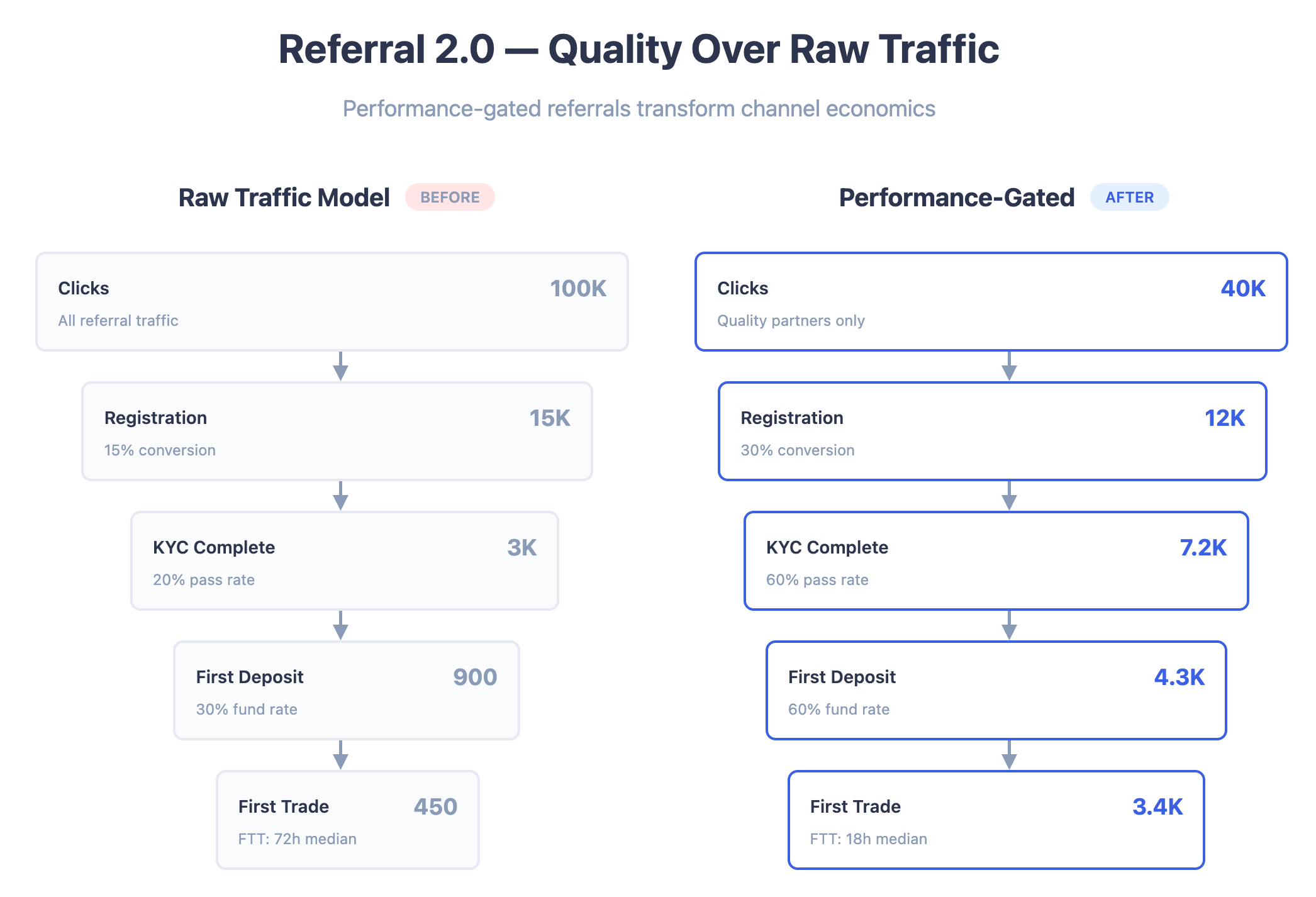
Two-tier referral payouts work for smaller products too: a crypto card product that ran a two-tier lifetime referral engine inside Telegram reached 160,000+ subscribers, 3,000+ issued cards and about $3 million in trading volume within the first week. More referral and activation tactics are in our exchange growth hacks.
The funnel below is an illustration, not client data.
Systemic Growth (Days 30-90)
- VIP ladder: lower fees for higher volume or balance, discounts and early listing access for native-token holders, higher API limits, an OTC desk with a personal manager. Set a VIP volume-share target from your current baseline
- Trading tournaments: they raise volume during the event and bring some participants back afterwards. Use transparent PnL rules, anti-bot checks and public leaderboards, and point the volume at the pairs you choose. Smaller projects use them too: one six-week trading competition brought a token project about 15,000 new users. Metric: return rate 30 days after the event
- Listings and airdrops on a fixed schedule: users stay when the calendar is predictable and holders of your native token get discounts, priority and pool access. Binance’s HODLer Airdrops work this way. Metric: deposits around each event
Scaling (Days 90-180)
- Localization: localize the product along with the site: local funding and withdrawal rails, support in the local language, local KOLs, listings of locally relevant tokens
- Brand campaign in a mature market: run one brand campaign and send the traffic to localized landing pages with short KYC, the way Coinbase pointed its 2022 Super Bowl QR code at a single landing page
- Product incentives: zero fees on a stablecoin or a new product line, announced together with an onboarding offer
- Seasonal community program: hackathons and daily on-chain activities over a season, as Coinbase and Base did with Onchain Summer in 2024 and 2025
Get a Second Opinion on Your Exchange Marketing Plan
Send your markets, channels and KPIs; we will reply with what we would change first.

Crypto Exchange Marketing Cases 2025-2026
Binance: Volume-Based Referrals and a Steady Airdrop Calendar
In August 2025 Binance rebuilt its referral and affiliate program: up to 50% commission for affiliates, automated tier evaluation, lower entry thresholds and no caps for top performers. Commission depends on the trading fees of referred users.
In parallel it kept a steady airdrop rhythm. By late November 2025 Binance had run 59 HODLer Airdrops, each distributing a new token to users who keep BNB in Simple Earn. Binance Alpha campaigns reward users with Alpha Points, which they earn by trading on Alpha. The exchange ended 2025 with more than 300 million registered users.
What to adapt: set referral tiers by referred users’ KYC rate, time to first trade and volume per active trader; reward trading activity as well as holdings; keep a predictable release calendar; list in one place what holders of your native token get.
Bybit: One Flagship Tournament and Small Events Between Seasons
WSOT 2025 removed entry barriers and raised the prize pool to 10 million USDT. It drew 520,451 participants from 202 countries and regions, nearly seven times the 2024 total, formed 1,474 squads, set a Guinness World Records title with 71,765 participants in a single day, and distributed about $7.97M in rewards.
Between seasons Bybit runs smaller events, such as an ETH competition for Ethereum’s 10th anniversary with a 100,000 USDT prize pool and an xStocks promo for tokenized stocks and ETFs with 150,000 USDT.
What to adapt: one flagship season a year with a low entry barrier, then mini-challenges that move participants into VIP, derivatives and Earn.
Coinbase: Super Bowl Campaigns and Product Incentives
In February 2026 Coinbase returned to the Super Bowl with “Everybody Coinbase”, a karaoke-style spot extended to Times Square, the Sphere in Las Vegas, Chase Center and social channels. Its 2022 Super Bowl debut, a bouncing QR code, drove 20 million landing-page hits in one minute.
Other moves: the 2025 UK brand campaign “Everything Is Fine”, zero fees on PayPal’s PYUSD stablecoin with direct USD redemption from April 2025, and the Onchain Summer program with Base.
What to adapt: plan brand awareness campaigns only when onboarding, KYC and deposit flows are ready for the spike, and give the audience one action to take.
Metrics That Matter
| Metric | What it shows | If it drops |
|---|---|---|
| Sign-ups | Reach of your channels | Check targeting and landing pages by channel |
| KYC completion | Who intends to trade | Find the KYC step with the biggest drop-off |
| FTD (first-time deposit) | Share of registrations that deposit | Add local deposit methods, remind after KYC |
| eFTD (deposit above a threshold, e.g. $100+) | Whether a channel brings real depositors | Cut channels with many small deposits |
| FTT (time to first trade) | Onboarding friction | Deep-link to a pair, pre-fill the first order |
| CAC by channel and region | What a paying trader costs | Fix or cut channels above the CAC ceiling |
| LTV | Trading fees per user over time | Raise volume per user, check fee tiers |
| Retention D30/D90 | Share of depositing traders still trading | Run win-back, review VIP and Earn offers |
| MAU/DAU | How often users return | Add lifecycle messages and recurring events |
| VIP share of volume | How much revenue depends on top traders | Review VIP perks, assign personal managers |
| Volume per active trader | Fee revenue per user | Tournaments, fee tiers, new pairs |
Track them on one dashboard. Prefer tactics that move several at once:
- Tournaments: volume and retention
- Listings and airdrops: registrations, deposits and spot volume
- VIP ladder: LTV and VIP share of volume

Crypto Exchange Marketing Services and Packages
Agencies sell crypto exchange marketing services as packages built around one goal. Typical crypto exchange marketing packages:
- Awareness and launch: positioning and UVP, audience and competitor research, launch PR, SEO foundation, first creator integrations, a listing or airdrop campaign, analytics and KPI setup
- User acquisition and deposits: monthly SEO content and links, PR waves around product events, Google, Meta and crypto-network ads, YouTube, X and Telegram creators paid on volume, referral and win-back programs
- Trust and scale: online and search reputation management, Reddit and community management, AI search visibility, launches in new regions with local media and KOLs, tournaments and seasonal campaigns
The budget depends on regions, channels and volume goals.
ICODA, a crypto exchange marketing agency, builds these packages around your KPIs. To get a scope for your exchange, pick the goal, regions and services in the campaign cost calculator or send a request to the team.
Conclusion: Where to Start
- Pick one trader segment and two or three markets where you hold a license
- Fix the weakest of liquidity, trust signals and KYC drop-off before you buy traffic
- Launch one volume-paid acquisition loop (referrals or creators) and one retention loop (VIP ladder or tournaments), and review both monthly by cost per depositing trader
Frequently Asked Questions
Crypto exchange marketing is the work that brings traders to an exchange and keeps them trading: positioning, SEO and content, PR, paid ads, creator partnerships, listings and airdrops, referral programs, tournaments and VIP tiers. Measure it by depositing traders, trading volume per user, 30- and 90-day retention and LTV/CAC.
Start with one trader segment and two or three markets where you hold a license, then fix liquidity and KYC onboarding. Build the funnel in order: SEO, PR and community for awareness; Google and Meta ads and creators for sign-ups; listings, airdrops and a fast first trade for deposits; referrals, tournaments and a VIP ladder for retention. Review every channel monthly by cost per depositing trader.
See-Think-Do-Care splits the user journey into four stages. See: people search for crypto information, and you reach them with content, PR and AI search visibility. Think: they compare exchanges; ads, reviews and creators show why to choose you. Do: they register, pass KYC and trade, helped by listings, airdrops and short onboarding. Care: they keep trading and refer others through VIP tiers, referrals and lifecycle messages.
Grow volume per user as well as the number of users. Pay referrals and creators for traded volume, run trading tournaments with transparent PnL rules, keep a fixed schedule of listings and airdrops, and build a VIP ladder with lower fees and early access for high-volume traders. Win back users who passed KYC but never traded: offer zero-fee trades on two or three top pairs for a short period.
Track the path from sign-up to revenue: registrations, KYC completion, first-time deposits (FTD), deposits above a threshold (eFTD), time to first trade, CAC by channel, D30/D90 retention, VIP share of volume, volume per active trader and lifetime value. Watch LTV/CAC most closely: above 1, a trader repays their acquisition cost; aim for 3 or more to cover other costs.
Fund the long-term base first, then scale paid channels once tracking works. SEO, content and reputation management take months to pay back, so they need a steady monthly budget. Paid campaigns and creator integrations come next, after you can track KYC, first deposit and volume per trader for each channel. Tournaments, listings and airdrops get separate event budgets. Review the split monthly by CAC and volume per acquired trader.
Licensing decides where you can advertise at all. Google allows exchange ads only from certified advertisers that hold the license required in each target country, and Meta requires prior approval. In the EU, an exchange needs MiCA authorization to serve users, and its marketing must be fair, clear and not misleading. Plan licenses and certification before the media plan, and keep SEO, content and PR as channels that do not depend on ad approvals.
Advertise where traders choose an exchange: Google Search and Meta after certification, YouTube and X creators who teach trading, crypto and financial media for PR, Reddit communities where users compare exchanges, and your own SEO content that answers trader questions. Crypto ad networks such as Coinzilla or Bitmedia reach people who already trade elsewhere, so use them for narrow campaigns like listing announcements.
Yes, when rewards follow real activity. Pay for verified KYC, first trade and traded volume instead of raw sign-ups, raise the commission tier for partners who bring active traders, and block self-referrals. Binance rebuilt its affiliate tiers this way in August 2025, with up to 50% commission and automated tier evaluation. Paying for activity keeps CAC tied to traders who generate fees.
ICODA runs full-funnel marketing for crypto exchanges: positioning and go-to-market, SEO and AI search visibility, PR in crypto and financial media, YouTube, X and Telegram creator campaigns, paid traffic, Reddit and reputation management. ICODA plans each campaign around exchange KPIs such as depositing traders, volume per user and retention; you can estimate the scope in the campaign cost calculator.
Share with


Rate the article