How to choose a crypto PR agency: by what it commits to in writing, the media it can reach and its compliance process.
We audited the service pages of 36 crypto PR providers on 12 disclosure criteria. Half show a business result, only 5 credit one to PR, and none names the SEC, FCA, VARA or MAS.
Score any shortlist with the 12-point scorecard below. We checked prices and rules on 23 November 2026.
What Does a Crypto PR Agency Do, and Which Type Do You Need?
A crypto PR firm, also called a blockchain or Web3 PR agency, wins trade and tier-1 coverage for token, protocol and exchange brands. Pick the type that fits your next 90 days.
| Type | Goal | KPI | Who it’s for |
|---|---|---|---|
| Launch PR (TGE, token launch, listing) | Attention on launch day | Placements by date, referral sessions, sign-ups | Teams 90+ days from launch |
| Funding and B2B PR | Investor and partner trust | Tier-1 mentions, inbound partner leads | Infrastructure, post-seed projects |
| Ongoing brand PR | Steady founder and brand presence | Branded search, presence in AI answers | Live protocols, exchanges |
| Crisis and reputation | Contain hacks, exploits, rumors | Response time, what AI answers say | Everyone, agreed before an incident |
| Distribution (wires, paid placements) | Fast, dated coverage | Live URLs, referral traffic | Announcements that need speed |
Paid placements and wires are the fast route: they go live on an agreed date, so ask what happens if an outlet removes a piece. Label them as sponsored or advertising: US, EU, UK and Dubai rules all require paid content to be identifiable as such. Mark paid links with rel="sponsored", as Google asks. Which promotion rules apply depends on your token’s legal status and your target markets, and no agency can change that.
Crypto PR Agency Pricing: How Much Does Each Model Cost?
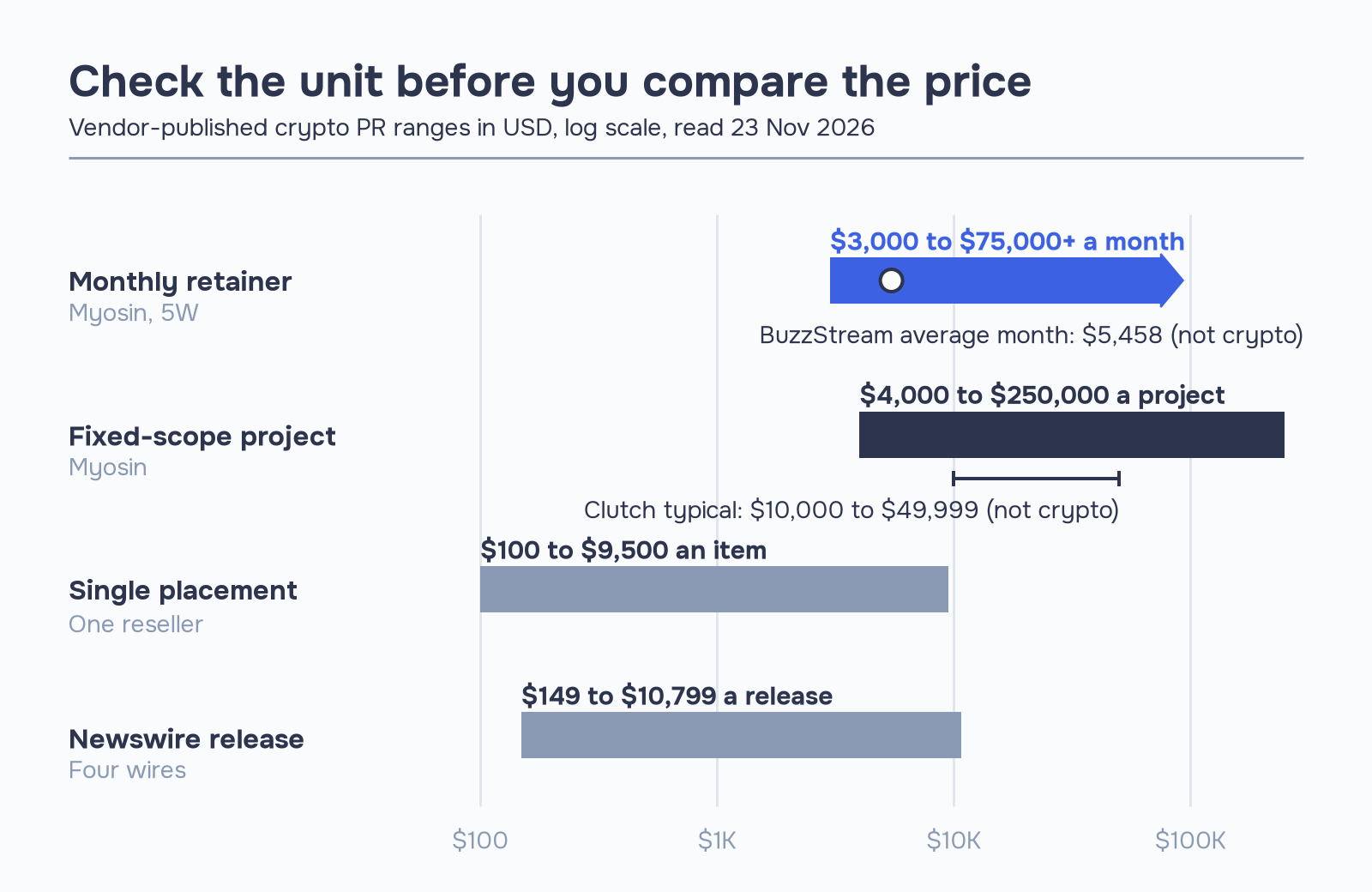
Crypto PR agency pricing depends on the model: wires cost $149 to $10,799 a release, retainers $3,000 to $75,000+ a month, and all of it comes from sellers.
We found no independent survey of crypto PR fees. The two outside benchmarks are not crypto-specific: BuzzStream, a link-building software company (about 70 respondents, UK-heavy), puts the average digital PR contract at $5,458 a month, and Clutch, a directory, says PR projects typically cost $10,000-$49,999.
| Model | Typical range | Best for | Watch for |
|---|---|---|---|
| Monthly retainer | $3,000-$8,000 entry, $8,000-$20,000 growth, $20,000-$50,000+ launch-ready (Myosin); $15,000-$75,000+ at a large US firm (5W) | Ongoing news flow, crisis cover | Scope per tier and minimum term (month-to-month to three months); Myosin says most $8,000-$15,000 retainers include no crisis hours |
| Fixed-scope project | $4,000-$10,000 audit and messaging; $75,000-$250,000 token-launch campaign (Myosin) | TGE, mainnet, listing | What follow-up is included |
| Paid pilot | $5,000-$10,000 for 2-4 weeks (one vendor, Flexe) | Testing an agency before a retainer | Same scope and fixed fee for every finalist |
| Per placement | $100 (CoinMarketCap post) to $9,500 (CoinDesk) at one reseller; other sellers list up to $15,000 | A fixed date, outlet and message | Label, link attribute, resold slots |
| Newswire package | $149 (EIN Presswire) to $10,799 (Chainwire Gold) among four wires with public rate cards; other sellers in our audit list $99-$21,999 | Fast, guaranteed pickup | Pickups are syndicated copies; report them apart from editorial coverage |
| Paid in your tokens | We found no independent data | Cash-light pre-TGE teams | If the token is a security, US law requires disclosing the pay and its amount; the agency now holds your price risk |
Compare quotes like for like. Give every agency the same brief and one template, and ask for:
- the monthly fee and what it buys: named people, hours, releases, pitches, reports;
- third-party costs at cost, with any markup: outlet fees, wires, creator fees, tools, travel;
- term, notice, currency and what triggers extra charges.
Total each quote for the first 90 days and divide by live URLs, counting earned, paid and wire apart. 5W says legal review of each statement adds time, and CoinLaunch adds 15-30% for KOL management. ICODA does not accept payment in tokens.
How to Choose a Crypto PR Agency: The 12-Point Scorecard
Choose an agency by scoring it out of 100 on 12 criteria, and score only what you have checked.
Full weight means you checked it (a document, a live URL or a reference call). Half means the agency stated it with a document. Zero means stated only, or refused. Start with criteria 2, 3, 5 and 12; they filter fastest.
| # | Criterion | Weight | Ask the agency | Red-flag answer |
|---|---|---|---|---|
| 1 | Stage and token-type fit | 10 | A case at our stage and token type? | “We work across Web3” |
| 2 | Agreed KPIs | 10 | Which outputs will you commit to in 90 days, and which outcome will you measure, from what baseline? | A promised user number, or just “coverage” |
| 3 | Placement proof | 12 | Three earned stories from this year, with live URLs and the reporter behind each? | Only paid or wire links, or no URLs |
| 4 | Media-list transparency | 10 | Per outlet: earned, paid, wire or owned; section traffic; label; link attribute; which reporters would you pitch? | A logo wall, no distinctions |
| 5 | Market-by-market compliance | 12 | Which markets will each piece reach, and which go to our counsel or an FCA-authorised approver before release? | “We follow best practice,” or the agency approves its own copy |
| 6 | Paid-promotion disclosure | 4 | Which posts are paid (cash or tokens), what wording opens each, and who checks it before it goes live? | “Creators handle it” |
| 7 | Crisis readiness | 8 | Who posts what, and where, in the first hour after an exploit at 3 a.m. on a Sunday? | A template statement and no named approver |
| 8 | Measurement beyond outputs | 10 | Show a real report: where are the outtakes, the outcomes and the pitch log? | A wall of reach figures |
| 9 | AI-answer visibility | 4 | Which query set, which engines, how often re-run? | “We optimize for AI,” no specifics |
| 10 | Named delivery team | 6 | Who is named in the statement of work, with hours? | Roles only, no names |
| 11 | Commercial transparency | 8 | Which costs sit outside the fee, what is the markup, and who owns the outlets you buy through? | One bundled number |
| 12 | Verifiable references | 6 | Two clients to call, including one that left in the last 12 months? | Only agency-picked references |
Our scoring rule, untested: below 60, don’t hire; from 60 to 74, pilot only if the gaps go into the statement of work; 75 or more, go to a paid pilot. A zero on compliance for a market you target, or a promised earned story, ends the search whatever the total. Have more than one person score, and score again after the pilot.
7 Red Flags to Walk Away From
Walk away from an agency that guarantees earned coverage in a named outlet, leads with reach or won’t name its team; all seven signs are checkable.
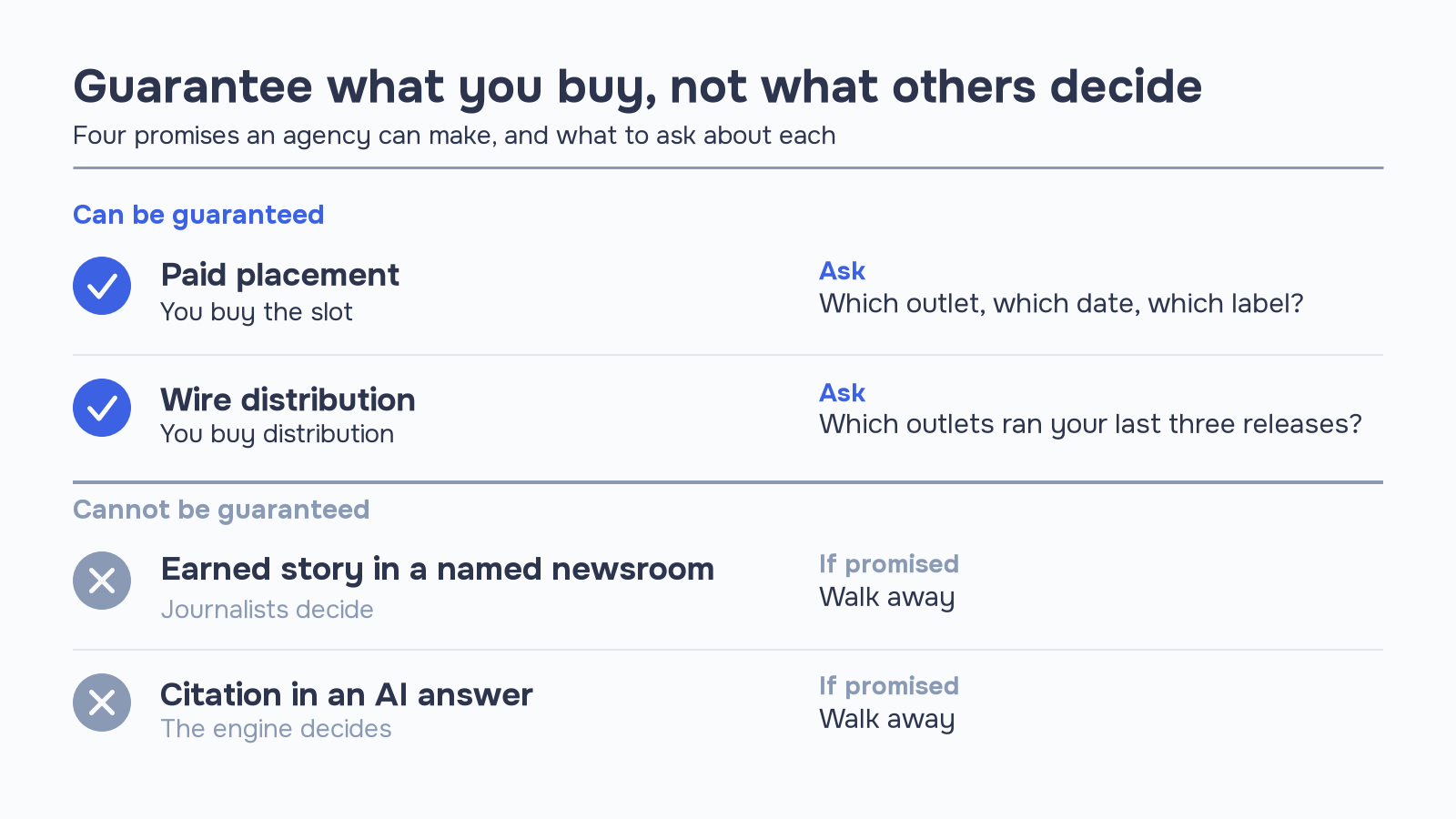
- A promised story in a named newsroom. CoinDesk says sponsored content is labeled and never written by its journalists, and Cointelegraph runs paid items in a separate “Commissioned” section, so no agency can guarantee earned coverage in either. A paid placement with an agreed outlet, date and label is a normal product. Ask which one you’re buying.
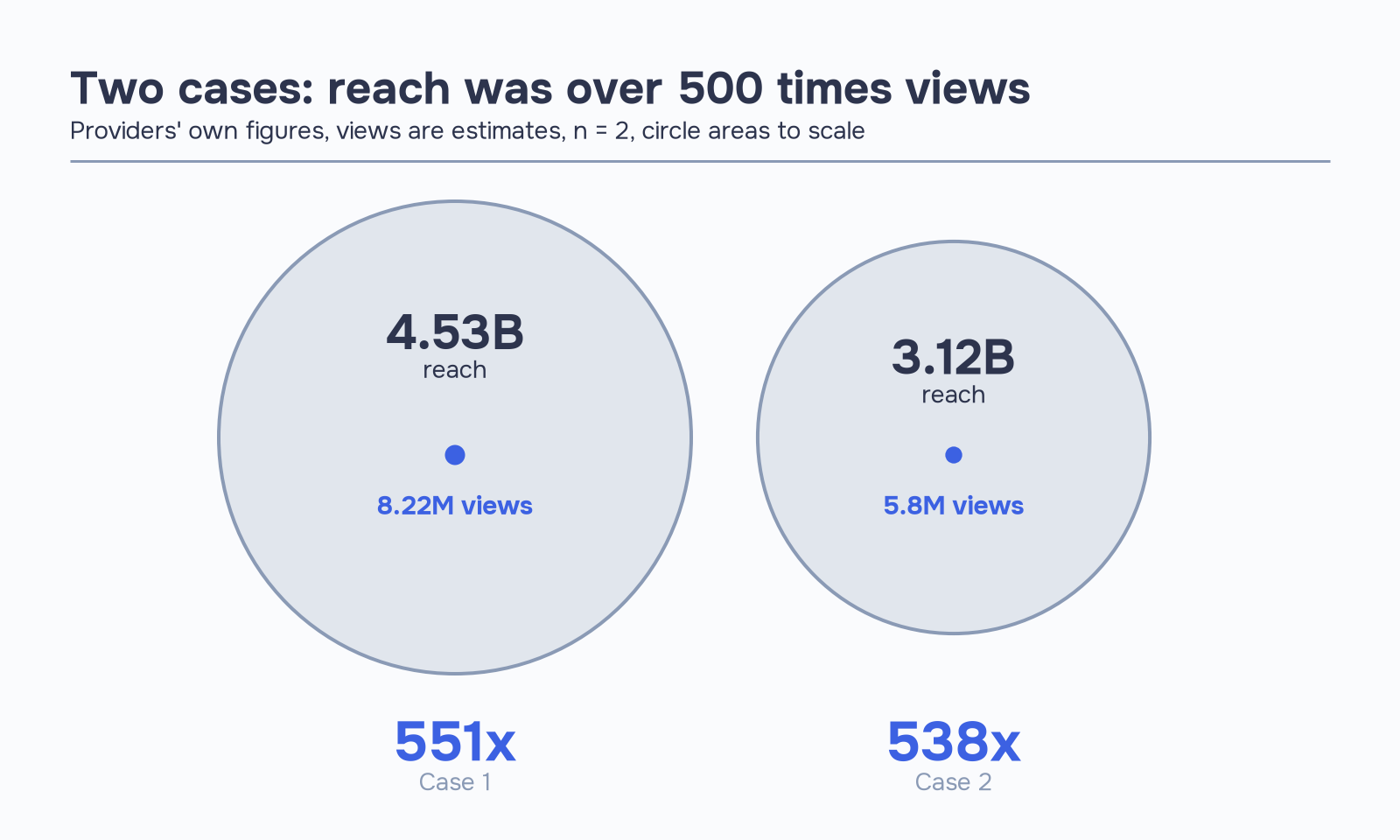
- A report led by reach or “PR value”. Reach ran over 500 times estimated views in the two audit cases where we could compare, and AMEC campaigns against advertising value equivalents.
- “As seen in” logos with no URL, or wire pickups sold as coverage. Ask for the link behind every logo.
- Bylines nobody can verify. Press Gazette reported four “freelancers” with 1,000+ bylines combined across 30+ outlets that none could verify. Ask for the editor behind each clip.
- No compliance or claims review per market. The FCA lists claims about the “safety”, “security” or ease of using crypto services, made without balancing risk, among its common issues.
- Undisclosed paid KOL posts, or pay in your tokens without a disclosure plan. The FTC says PR firms that hire creators who fail to disclose may be liable, and token pay counts as pay under US securities law.
- Senior people pitch, juniors deliver, and the channel is unnamed. Ask who will write and send each pitch, and whether each placement is direct or resold. Write the answers into the contract.
How to Run the Selection in 6 Weeks, and What to Put in the Contract
Plan the selection as six weeks ending in a paid pilot, and start before your launch date forces a rushed pick.
- Week 1: write a 4-page brief with a budget range, the one outcome you need, the news you can supply in the next 90 days, and your target and excluded markets.
- Week 2: longlist 6-10 agencies and send all of them the same written questions, with 5 working days to answer.
- Week 3: hold chemistry meetings with 3-4, and call two references for each.
- Weeks 4-5: run a paid pilot with your top 1-2, on separate news or markets so no two agencies pitch the same reporters. Same scope, same fixed fee. Judge the work (pitch log, messaging, drafts, first report), not coverage counts. If earned coverage is the test, run 4 weeks and the plan takes eight.
- Week 6: decide within 5 working days. One person owns the decision, and legal can veto it.
Under 45 days to launch? Send criteria 2, 3, 5 and 12 in writing to three agencies and pilot one placement. Allow another week or two for contract and onboarding (our experience).
Contract terms to include:
- Scope per month, with earned pitches, paid placements, releases and KOL posts counted separately, and change control for extra work.
- The team by name, a clause for replacing the lead, and no subcontracting without your written consent.
- An outlet list tagged earned, sponsored, wire or reseller, with link attributes.
- Labeling and KOL disclosure wording; who approves copy in each market (your counsel, or an FCA-authorised approver for UK pieces); no release before approval; a dated archive of every piece, handed over on exit.
- Target and excluded markets per campaign, including sanctioned countries, and sanctions screening of paid KOLs and sub-vendors.
- Fees and currency; any token pay, with amount and vesting; the agency’s own token holdings; a conflicts clause for competing tokens or exchanges; a ban on staff trading your token around unpublished news or listings.
- A hack or exploit response time and a 24/7 contact.
- Ownership of copy, contacts and reports; confidentiality; notice and termination for convenience; a 60-90 day review against agreed KPIs; a refund or replacement rule for unpublished pieces.
What Do Good Crypto PR Results Look Like, and When?
Good results are business outcomes, and they build over weeks to months. The Barcelona Principles 4.0 call for outcome-focused evaluation, and AMEC runs a “Say No to AVEs” campaign against advertising value equivalents.
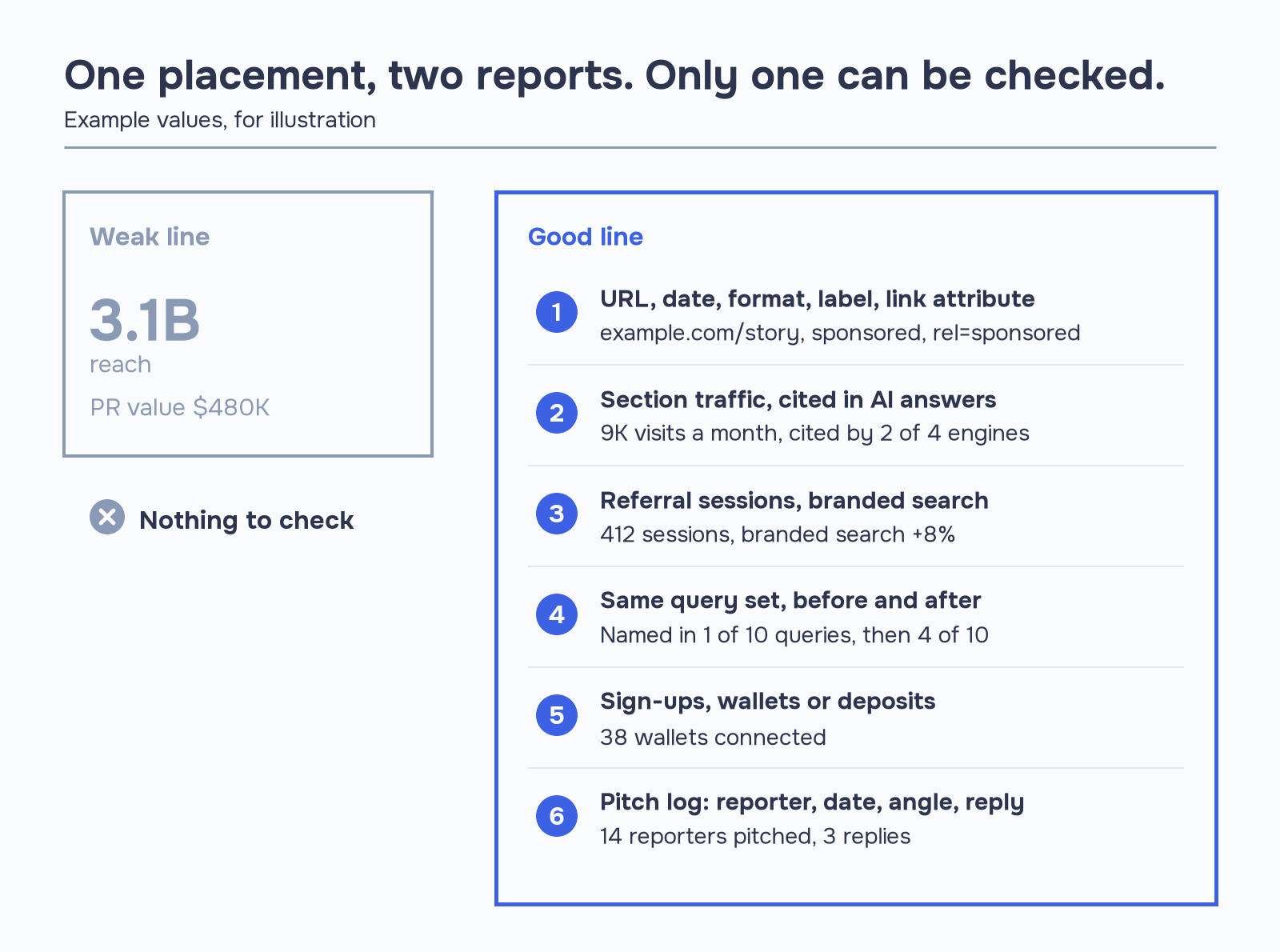
A report should carry six things:
- Every placement with a live URL, date, format, label and link attribute.
- Section-level traffic and AI-answer presence for each outlet.
- Referral sessions per placement link (a UTM wherever you control the link) and branded-search growth.
- A fixed set of AI queries re-run before and after on ChatGPT, Perplexity, Claude and Gemini.
- Sign-ups, wallet connects or deposits traced to the work.
- A pitch log: each reporter pitched, the date, the angle and the reply, so quiet months still show work.
Wire vendors quote same-day distribution in business hours, though some outlets take longer, and our crypto PR service page quotes first placements in 1-2 weeks. In our experience, branded search takes a full quarter to read.
Which Rules Touch Crypto PR in Your Markets?
In crypto, PR copy can count as regulated promotion, and the rules follow your readers, not your office. The FCA applies its regime to overseas firms marketing to UK consumers, ESMA counts press releases and paid influencers aimed at EU clients as solicitation, and VARA covers marketing aimed at the UAE. For each piece, ask which markets it will reach, who approves it there, and which markets the campaign excludes. The facts below come from regulator pages and the text of the rules; this is not legal advice.
| Market | Rule that catches PR | Ask the agency |
|---|---|---|
| United States | If your token is a security (a fact-specific test), anyone the issuer pays to publish about it must disclose the payment and its amount (Securities Act s17(b)). Steven Seagal settled with the SEC in 2020, without admitting or denying the findings, after not disclosing $250,000 in cash and $750,000 in tokens promised for touting an ICO. The FTC’s Endorsement Guides say PR firms may be liable for endorsements they know or should know are deceptive, or for hiring creators who fail to disclose | Is our token possibly a security? Who reviews each disclosure before release? |
| European Union | MiCA Article 7 puts the duty on the offeror or the person seeking admission to trading, not the agency: marketing communications must be clearly identifiable, fair and not misleading, consistent with any required white paper, and carry a fixed no-approval statement; where a white paper is required, none may go out before it is published | Is the white paper published before EU outreach? Who carries the Article 7 duty? |
| United Kingdom | FCA: since 8 Oct 2023 a cryptoasset promotion to UK consumers, from any country, must be made or approved by an FCA-authorised firm, made by an MLR-registered cryptoasset firm, or fall under an exemption; otherwise it is a criminal offence. The full authorisation regime starts 25 Oct 2027, with applications open 30 Sep 2026 to 28 Feb 2027 | Which route covers each UK piece, or is it kept out of the UK? |
| Dubai (UAE) | VARA’s marketing regulations cover marketing in or aimed at the UAE by any firm, licensed or not (DIFC excepted). They require a disclaimer that virtual assets may lose their value in full or in part and are subject to extreme volatility, and VARA’s guidance says sponsored posts must state they are paid | Is the disclaimer on each piece, and is each sponsored post marked as paid? |
| Singapore | MAS guidelines (2022) say digital payment token service providers should not market to the public in Singapore, including through third parties such as social media influencers | Is any piece aimed at the Singapore public? |
How to Review an Agency’s Media List
Review a media list by outlet type, presence in AI answers, section-level traffic and ownership; Domain Rating and logo counts tell you little.
In our study of 36 queries across four AI engines, crypto outlets’ citation scores barely tracked size: correlation was 0.20 with Domain Rating and 0.07 with traffic (19 outlets, neither significant). BeInCrypto (DR 80) and Decrypt (DR 84) were cited in none of 144 answers.
- Engines differ. Crypto media made up 34% of Claude’s citations but 11% of ChatGPT’s (11 of 97). Only crypto.news and CoinDesk were cited by all four engines.
- Format matters. Of 158 cited URLs from the top 15 crypto outlets, 37% were news articles, 22% homepages, tag or section pages, 20% directories or best-of lists and 4% press-release or sponsored pages.
- Section traffic is not domain traffic. On 16 outlets with a dedicated press-release folder, those sections drew a median 0.05% of the domain’s organic traffic (wire newsrooms are the exception). Ask what the section you buy gets.
- Ownership. Bullish, an exchange operator, owns CoinDesk, and Bitget is an anchor LP in Foresight Ventures, a majority investor in The Block. If you compete with an exchange, ask whether that matters.
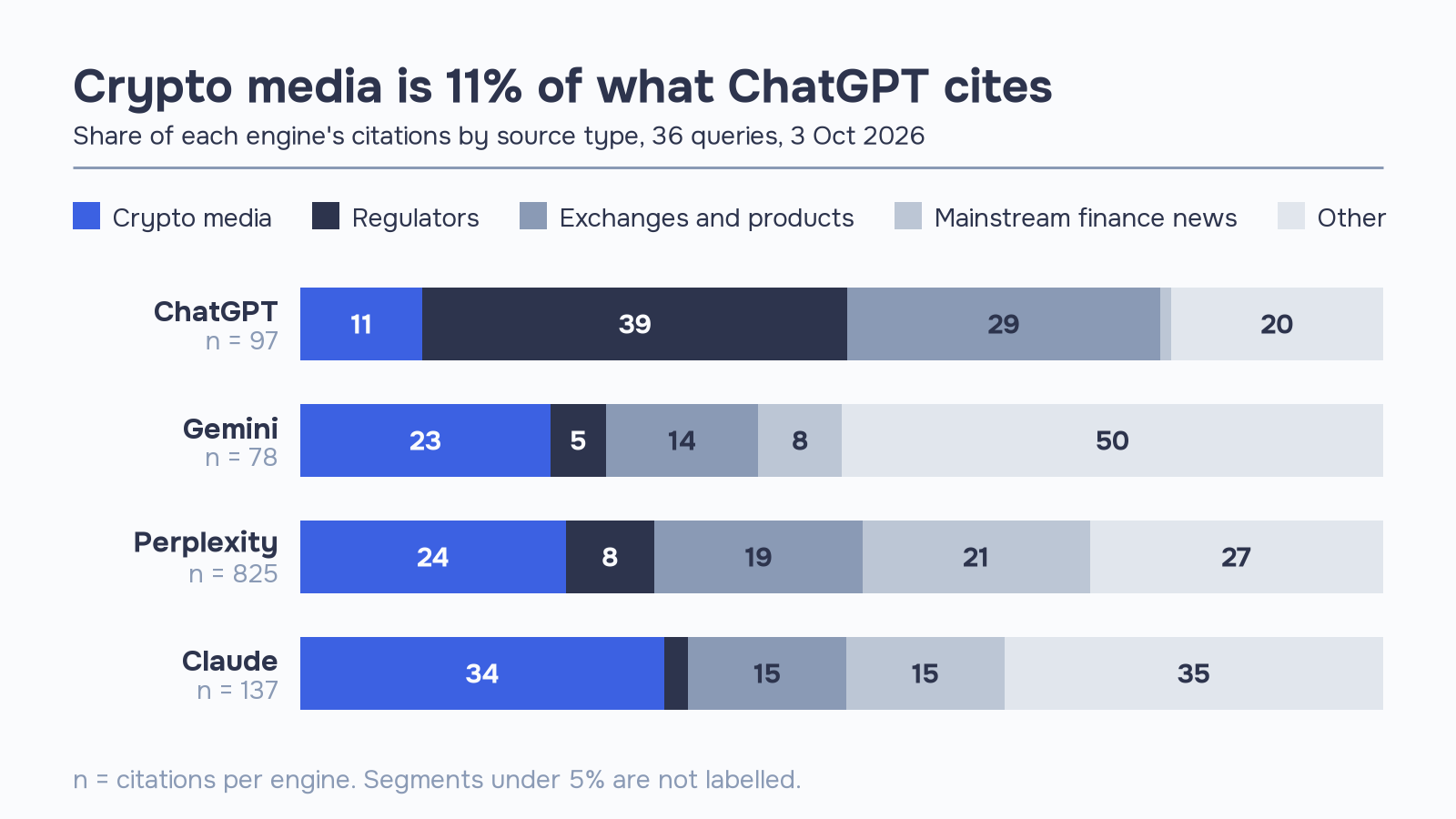
Ask for the outlet list with label, link attribute, section traffic and AI-answer presence filled in for your query set, and decide what each placement is for: readers, brand search or citations.
Muck Rack’s May 2026 analysis of 25 million+ links cited by ChatGPT, Claude and Gemini, across all industries, found journalism is about 27% of them, press releases 1.1% and paid content 0.3%.
What We Found Auditing 36 Crypto PR Providers
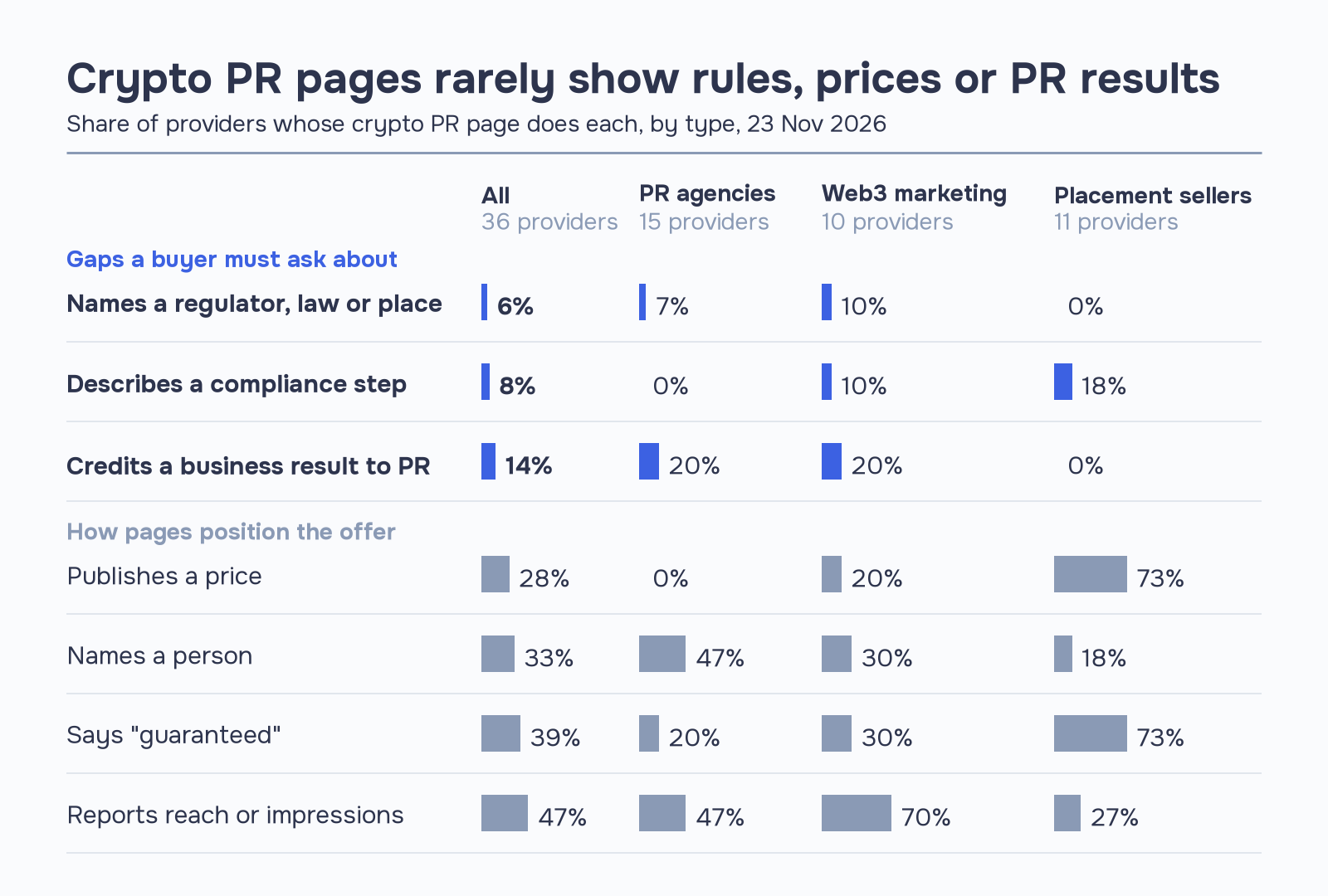
The 36 pages measure what providers disclose, not how well they work. Most show clients and big numbers, but few say who did the work, what it cost or which rules apply. The sample is 15 PR agencies, 10 Web3 marketing agencies with a PR line and 11 placement and wire sellers, and the audit’s 12 criteria are a separate list from the scorecard.
- 78% name a real crypto client and 56% show a numbered case.
- 50% show a business result such as users, TVL or funds raised, but only 5 of 36 (14%) credit it to PR. Several case pages credit KOL, community or ad work instead.
- 28% publish prices, and none of the 15 PR agencies does. 8 of the 11 placement sellers do.
- 61% sell paid placements or distribution, and 39% use “guaranteed” language. Eight pages say earned coverage can’t be guaranteed; a guaranteed paid placement is a separate, legitimate product.
- 47% use impressions or reach as a result metric. In the two cases where a page gave both, reach was about 540-550 times estimated views.
- 31% mention compliance, but only 3 describe a step. Two pages mention a regulator, law or jurisdiction, both weakly, and no page names the SEC, FCA, VARA or MAS. In our September iGaming audit, 22% named a regulator.
- 33% name a person on the service page (we did not read team pages); 14% tie AI search visibility to the PR offer.
Treat a missing disclosure as a question for the pitch, not proof of poor work.
What to Do Next
Score every agency on your shortlist with the 12-point table, and call the client behind a case study yourself.
Then compare your scores with our rankings: the best crypto PR agencies, our ranked top 15 and the best Web3 PR agencies. For wire prices by service, see crypto press release distribution. For how we work, see our crypto PR service.
Methodology & Limitations
Agency audit (November 2026). We scored 36 providers (15 PR/comms, 10 Web3 marketing with a PR line, 11 placement and wire sellers) on 12 criteria, from the crypto PR service page and up to three linked case pages. We excluded icoda.io and 7 providers whose pages we couldn’t fetch. The sample favors English-language providers that rank in search; scores count disclosures, not quality, and we did not verify the providers’ numbers. Reversing borderline calls lowers “mentions compliance” from 11 to 3 and “names a person” from 12 to 8, and the two regulator mentions both fall away.
Media data. ICODA’s 36-query, four-engine citation study (pulled in October 2026; 19 outlets in the correlation; 97 ChatGPT citations) and a September 2026 audit of crypto-casino releases. Both are small samples.
Prices and rules. Prices are vendor-published, read on 23 November 2026, and change often. Rules reflect public regulator pages on that date. This guide is not legal advice.
Crypto PR Agency FAQ
Score each agency out of 100 on 12 criteria, then pilot only those scoring 75 or more, or 60 to 74 if the gaps go into the contract. Below 60, don’t hire. Ask for live URLs and reporters from this year, and call two references.
Crypto PR agency pricing runs from about $3,000 a month (one vendor’s entry tier) to $75,000+ at large US firms. A single wire release costs $149-$10,799 among the four wires we re-checked. All crypto figures come from sellers, so ask what each fee includes and which costs sit outside it.
It can guarantee a paid placement, not an earned story. A paid piece with an agreed outlet, date and label is a standard product. Because newsrooms decide what they cover, a promised editorial story in a named outlet is a red flag, as is a promised AI citation.
Wire vendors quote same-day distribution, and our service page quotes first placements in 1-2 weeks. Branded search and sign-ups usually need a quarter to read. We found no independent data on timelines, so agree a review at 60-90 days and track live URLs, referral sessions and AI-answer presence from week one.
No, they are two channels. Sponsored content is a paid placement that goes live on an agreed date; editorial PR depends on journalists choosing to cover you. Many teams combine both. Report them as separate lines so you can compare cost per result.
Share with


Rate the article