

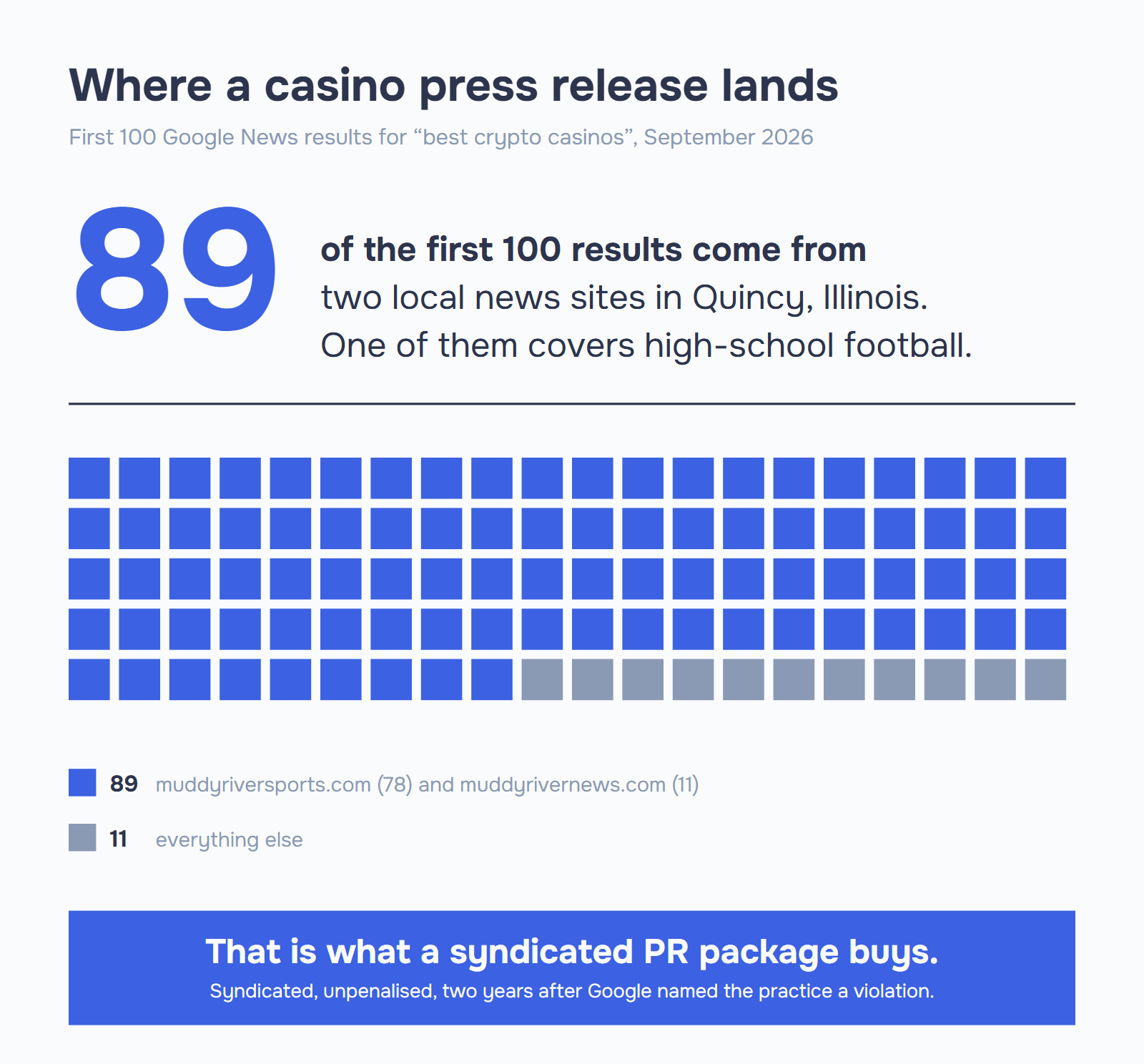
Search Google News for “best crypto casinos” and 89 of the first 100 results come from two local news sites in Quincy, Illinois. One of them also covers high-school football. Between the box scores and the Friday-night recaps sits a stream of “Top 10 Online Casinos for Real Money” posts, syndicated and unpenalised, two years after Google’s spam policies named this exact practice as a violation. Google’s own worked example is a medical site hosting a third-party page about “best casinos”. That is what a lot of casino “PR” buys: reach through a side door, not journalism.
Casino public relations is earning coverage and shaping what independent people say about a gambling brand, instead of paying to say it yourself. Those people are journalists, regulators, banks and players. It sits next to marketing and SEO, not inside either, and it works on decisions neither can touch: a payments analyst’s onboarding call, a regulator’s renewal file, a player deciding whether you’re safe to deposit with.
Read the next three sections and you’ll have a go/no-go on whether you need PR right now. The rest is for the reader who already said yes and needs to buy it well: what a licensed-market programme may legally say, what it costs, and whether to hire in-house, hire an agency, or wait.
What Casino Public Relations Actually Is
Casino public relations is third-party work. The goal is that someone who doesn’t work for you, and isn’t paid by you, says something about your brand.
That covers three different practices, and most confusion starts with not knowing which one you’re being sold.
- Land-based resort PR. Grand openings, celebrity hosts, hospitality press junkets. This is what Google shows you when you search the term, because it’s what’s been written about for decades. It has almost nothing to do with running an online brand.
- Online operator PR. Trade press, regulators, payment partners, players. This is what you need, and almost nothing on the current search results addresses it.
- Link building sold as PR. A press release, a wire blast, a batch of do-follow links from sites with no editorial standard. The paid ads running on adjacent search terms say it openly: “guaranteed PR coverage… earn high DR links.” That’s link building. Call it that.
Which of these applies depends on what you run. A regulated casino or sportsbook operator (UKGC, MGA, Ontario) answers mostly to a regulator and to payment partners. A .com or crypto casino answers mostly to players and to the platforms that assemble trust: Reddit, Trustpilot, AI answers. That is why crypto PR works on different surfaces from trade-press work, even when the brand is the same. A B2B supplier (studio, platform, aggregator) sells to roughly two hundred people who all read the same four outlets. An affiliate business sells credibility to operators. A pre-launch startup sells a narrative to investors and its first partners. Treating all five as “casinos” is why most writing on this topic is useless to you, so decide which one you are before reading on.
What PR Is For, And What It Isn’t
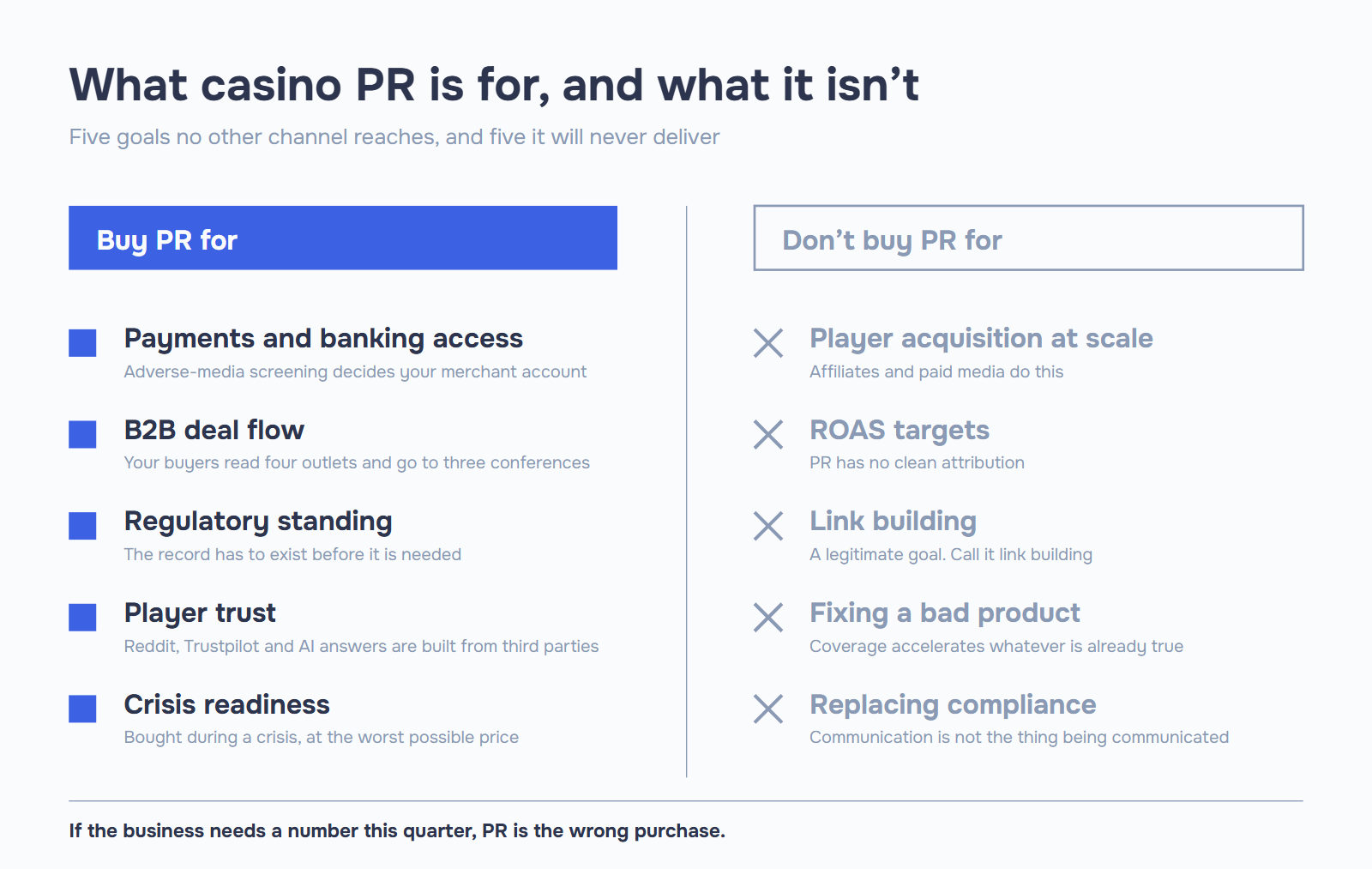
PR is worth buying for goals no other channel reaches: payments, deal flow, regulatory standing, player trust, and containing a crisis before it happens.
Payment and banking access. Payment providers and correspondent banks run adverse-media screening at onboarding and at every periodic review. What surfaces on your brand’s first page of search results shapes whether you get a merchant account, what reserve you post, and how the next review goes. You can’t buy your way past an adverse-media hit. It has to be displaced by credible third-party material, which is what PR produces and advertising cannot.
B2B deal flow. If you sell to operators, your buyers read four outlets and go to three conferences. No performance channel reaches a head of games at an operator. There is trade press, the conference calendar, and LinkedIn.
Licensing and regulatory standing. Regulators read the trade press too, and a documented public record of your responsible-gambling conduct and of how you’ve handled problems is an asset at application, at renewal, and at the moment something goes wrong. That record has to exist before it’s needed. It can’t be assembled after the fact.
Player trust at the decision moment. Players search “is [brand] legit,” read Reddit and Trustpilot, and increasingly ask an AI model. All three are built from third-party material, which is the one input to that decision an owned channel can’t supply.
Crisis containment. Most of this goal is served by work done before the crisis. Buying crisis PR during the crisis is buying at the worst possible price, from the weakest negotiating position you’ll ever have.
What PR is a poor tool for matters just as much, and it’s the part most agency pitches skip:
| Don’t buy PR for | Why not |
|---|---|
| Direct player acquisition at scale | Affiliates and paid media do this. PR’s contribution is slow and hard to attribute |
| Results measured on ROAS | PR has no clean attribution. If the business needs a number this quarter, PR is the wrong purchase |
| Link building | A legitimate goal on its own, but call it link building, not PR |
| Fixing a bad product | Coverage accelerates whatever’s already true. A payout problem plus coverage is a faster payout scandal |
| Replacing compliance | Communication cannot substitute for the thing being communicated |
PR vs Marketing vs SEO
PR earns attention from third parties, iGaming marketing buys it, and SEO makes it findable. A casino brand needs all three together, not one instead of another. In budget terms, PR is the earned media line, and it behaves nothing like the paid and owned lines either side of it.
| PR | Marketing / paid media | SEO | |
|---|---|---|---|
| Who controls the message | The journalist or regulator | You | The algorithm, within your content |
| Who pays whom | You pay for the work, not the placement | You pay per click, impression or spot | You pay for the work, not the ranking |
| What you can promise a client | Effort and access, not outcomes | A media buy and a measurable result | Effort and, eventually, rankings |
| Time to result | Months | Days | Months |
| What it’s measured on | Coverage quality, sentiment, citation | CPA, ROAS, conversions | Rankings, organic traffic, revenue |
PR doesn’t work alone. A placement is a fact that now exists somewhere on the internet. Whether it reaches anyone deciding about you is a different channel’s job. Three couplings are non-negotiable. PR needs search engine reputation management, because banks, partners and players all search your brand name, and coverage that doesn’t rank there might as well not exist. It needs AI visibility, because “is [brand] safe” is increasingly answered by a model assembling sources, and a media record the model never ingests helps nothing. And in B2B it needs the conference calendar: a story two weeks before ICE or SBC books meetings, and the same story in a quiet week books nothing. This is where online reputation management earns its keep. PR creates the material, ORM and SERM decide whether anyone finds it.
Why Gambling Public Relations Is Different
Gambling public relations answers to a regulator that fines constantly, and to a rule book where your own social media post can be a punishable ad.
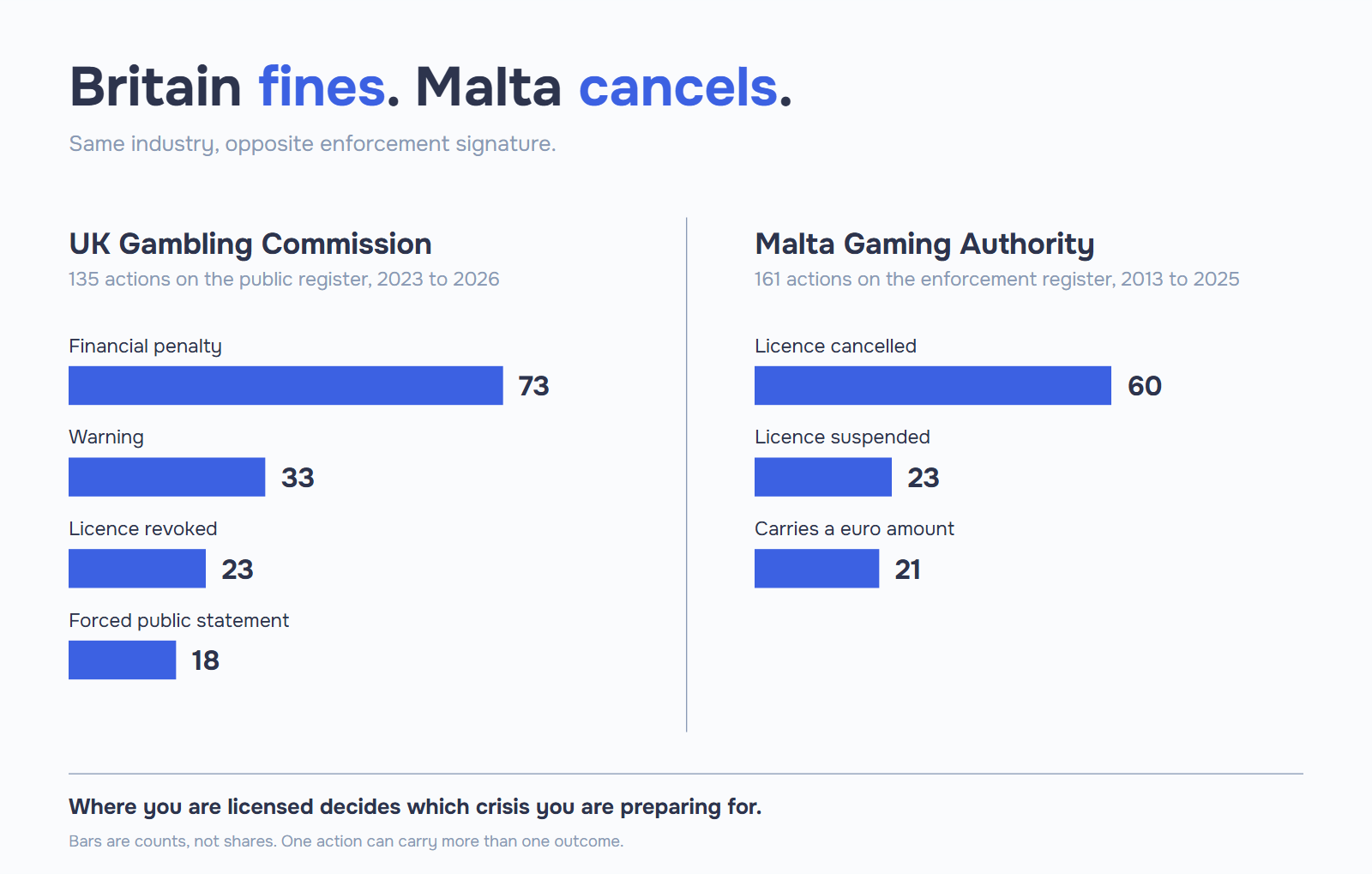
The UK Gambling Commission’s public register of regulatory actions records 71 enforcement actions in 2025 alone, one every five days, and 18 of its last 135 actions forced the operator to publish a statement about its own failings. That’s the crisis you can’t “no comment” your way out of: the regulator writes your press release for you, and it’s bad news. The UK’s Advertising Standards Authority has ruled on 71 gambling cases since 2022, upholding 70% of them against 87% across all sectors. Read that the right way round: a complaint against a gambling ad succeeds less often than a complaint against the average ad. Gambling brands get complained about constantly and are usually found to be within the rules. The risk isn’t that you’ll lose, it’s that the ruling is public either way. And 45% of those rulings started on social media, not television.
Malta’s register tells a different story. The Malta Gaming Authority’s enforcement register lists 161 dated actions since 2013. Roughly 60 are outright licence cancellations, against only 21 recorded euro amounts across the whole list. Britain fines. Malta cancels. Same industry, opposite enforcement signature, and a different PR problem depending on where you’re licensed.
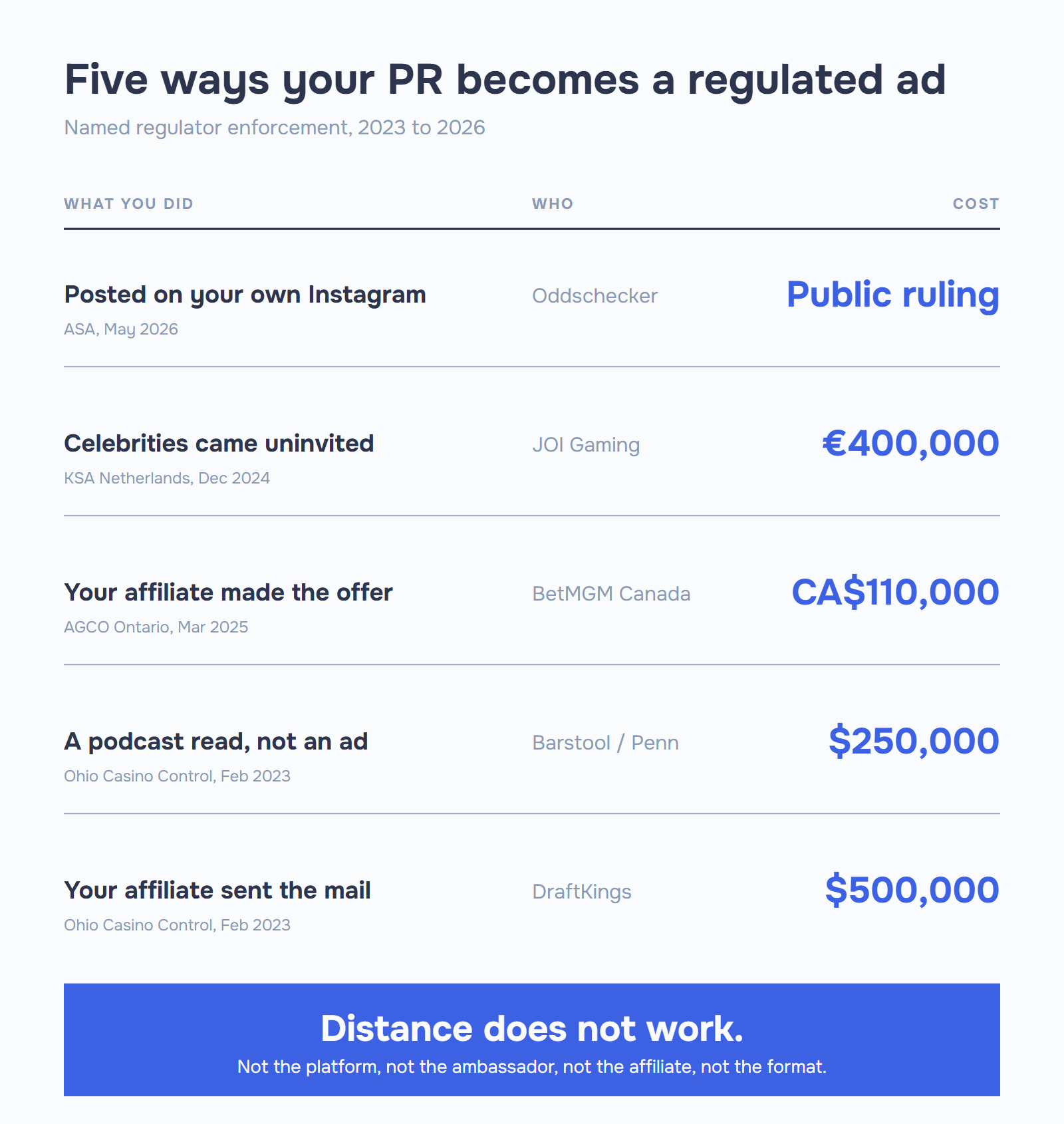
Underneath the registers sit five specific ways gambling PR breaks rules that ordinary PR never has to think about, each with a named, dated penalty. Each is a legal question rather than a stylistic one, which is the line between a generalist press contact and specialist casino PR.
- Your own social feed is regulated advertising. In a May 2026 ruling, the UK’s ASA found that two Oddschecker Instagram posts featuring Harry Kane and Erling Haaland were ads because they appeared in “non-paid-for space online under Oddschecker’s control”, with no media spend required. In the Netherlands, JOI Gaming was fined €400,000 after celebrities attended a company racing day with no contract and no payment. Event photos on the brand’s own channels were enough.
- An ambassador isn’t a normal PR asset. Dutch regulator KSA fined Betcity and TOTO Winkel in August 2026 over a promotion where no footballer was named or shown. The regulator found that the combination of name, shirt number and national kit was enough to breach the country’s role-model ban.
- Never put the offer in the release. BetMGM Canada paid a CA$110,000 penalty after its own marketing affiliates offered new players cash for depositing at a franchise show. The affiliates made the offer. BetMGM was the respondent.
- A content-led format buys no distance from the ad rules. Ohio’s gaming regulator fined Penn Sports Interactive (Barstool Sportsbook) $250,000 over a promo read live during a campus broadcast, ruling that “the availability of the Show through YouTube does not negate the advertisement” made to the audience in the room.
- You can’t outsource the liability. DraftKings paid $500,000 in Ohio after admitting that “DraftKings, or its affiliate marketer, mailed approximately 2,582 advertisements” to named individuals under 21 because of a filtering error. The regulator didn’t pursue the affiliate. It pursued DraftKings.
The pattern across all five: distance doesn’t work. Not the platform, not the ambassador, not the affiliate, not the format. If it promotes the brand, it’s your liability, everywhere you operate.
What A PR Programme Actually Consists Of
A casino PR programme has four working parts: media relations, press releases, executive thought leadership, and crisis communications.
Media Relations
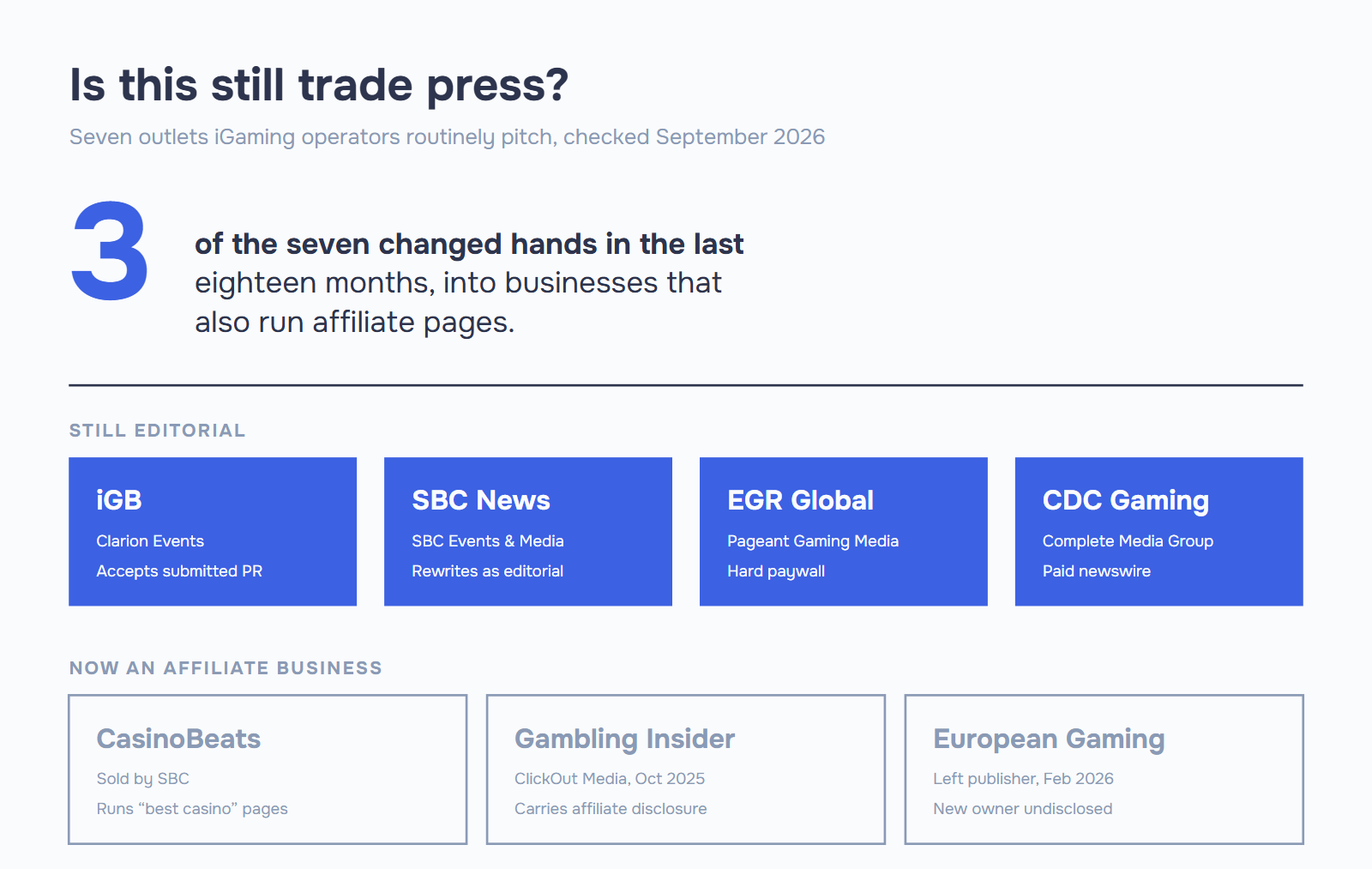
Media relations means pitching outlets that still have an editorial team, and several of the outlets operators routinely pitch no longer qualify.
| Outlet | Publishes submitted PR? | Status |
|---|---|---|
| iGB (igamingbusiness.com) | Yes, via /company-news/ | Independent trade press |
| SBC News | Rewritten as editorial; paid “Sponsor Spotlight” option | Independent trade press |
| EGR Global | Yes, with non-endorsement disclaimer | Independent trade press, hard paywall |
| CDC Gaming | Yes, paid, as a subscriber benefit | Independent trade press |
| CasinoBeats | No | Sold by SBC; now runs affiliate pages |
| Gambling Insider | Acceptance unverified | Bought by affiliate/SEO firm ClickOut Media, Oct 2025 |
| European Gaming | Yes, same-day | Left its former publisher, Feb 2026; new owner undisclosed |
CasinoBeats, Gambling Insider and European Gaming have all changed ownership in the last eighteen months, into businesses that also run affiliate pages. Pitching them today is affiliate outreach with a masthead attached, not media relations.
Press Releases And What A Wire Really Does
A casino press release sent through a newswire gets published rather than read. Tracing where releases land shows how far that is from coverage.
One traced GlobeNewswire release reached four domains, all wire-feed subdomains, with zero editorial pickup. A Chainwire release landed on a national newspaper’s site, verbatim, wrapped in unrelated financial upsells. Another Chainwire mirror ran on a domain built to impersonate CoinDesk. Chainwire’s own editorial policy states that “press releases that promote or link to online gambling sites, casinos… will not be published”, and it publishes them anyway. A wire is the right tool for a disclosure you’re obliged to make, and the wrong tool for a launch you want a journalist to read.
Executive Thought Leadership
A named executive gets quoted where a brand account gets ignored, in trade press and increasingly in the sources AI models cite.
“We are excited to announce” is not a quote. It’s a gap where a quote should be. A real opinion, attached to a real name, is what a trade editor can run and what a model treats as a citable source.
Crisis Communications
Crisis communications is a set of mechanics you build before the crisis, not a phone call you make once it has started.
The holding statement contains exactly four things: what happened, what’s confirmed versus unconfirmed, what you’re doing about it, and when you’ll update next. Publish it on your own domain first, so yours is the citable, rankable version, then distribute. Behind that sits an escalation ladder, a pre-agreed order for notifying regulators, and a 72-hour timeline for the first follow-up. The work doesn’t stop when the statement goes out. What ranks for your brand name three weeks later matters more than what you said in the first hour. On handling an active reputation problem, see ICODA’s work on crisis PR and a case where Reddit sentiment moved from 41% to 82% positive through a sustained response rather than a single statement.
What Casino PR Costs
Casino PR runs from a few thousand dollars for a project to six figures a month for a retainer. The right number tracks your facts, not your ambition.
Two sources are worth citing because they’re checkable, not because they’re complete. One large agency’s own budget-selection dropdown puts its retainers at $15,000 to $100,000+ a month. Clutch’s directory of PR firms shows minimum projects from $1,000 to $25,000+, billed at $25 to $300 an hour. Neither is a benchmark for what you should pay. They’re what two specific sources disclose, nothing more.
The number that matters is a rule, not a range: placement volume should be a function of how many true, checkable facts your business generates, never of budget. Commit to no more placements per quarter than you have genuine news events, plus one research asset. Buy more than that and the gap gets filled with syndication, which is how a brand ends up as one more entry in a Google News feed dominated by a Quincy, Illinois sports site.
| Stage | News events available | Sensible shape |
|---|---|---|
| Pre-launch / seed | 3 to 5 over six months | No retainer. Project work around each event |
| Early operator, one market | About one genuine moment a month | Small retainer, concentrated in 4 to 6 outlets |
| Scaling operator, 3+ markets | Two a month plus one research asset a quarter | Retainer, plus standing crisis readiness |
| B2B supplier | 3 to 5 a month naturally | Highest sustainable cadence of any segment |
Measuring PR ROI
Impressions are not a business metric. What’s worth reporting is search lift, share of voice, AI citation share, and the conversions PR assisted rather than closed.
One agency’s own case study reports “787.7M+ media impressions across 196 placements” from a single campaign. That’s an impressions number, and impressions are not something a CFO can act on. What is worth tracking, monthly:
- Lift in branded search volume
- Referring domains from genuine editorial coverage
- Share of voice against named competitors in trade press
- Citation share in AI answers to brand-safety questions
- Assisted registrations and first-time deposits where PR ran alongside a launch
One more belongs on that list even though nobody publishes it: whether your own account of an incident is the one a journalist finds first, or whether someone else’s framing got there ahead of you. Citation share is the newest of these metrics and the least understood. ICODA’s work on AI visibility is a useful reference point for what it looks like in practice.
When To Bring In A Specialist
Hire a specialist once you have a licence, working payments, a named spokesperson, and a brand search page under some control, and not before.
You’re too early for PR if you don’t have a licence yet; if payments aren’t working reliably; if nobody will be quoted by name; if your brand’s search results are dominated by unaddressed complaint threads; or if you can’t name three genuine, checkable facts happening in the next six months. That’s not a reason to give up on PR. It’s a reason to fix the substrate first and to hold the budget inside your iGaming marketing strategy until you have, because PR accelerates whatever’s already true, problems included.
Past that bar, the choice is in-house, agency, or freelance consultant. In-house has the deepest institutional knowledge and the thinnest media access. A casino PR agency brings established relationships and faster placement, shared with other clients. A freelance specialist sits between the two: cheaper than an agency, real relationships, limited capacity in a crisis. Most operators this size keep a named in-house contact and hire an agency to execute, rather than picking one exclusively.
Four questions expose a weak agency fast:
- Ask for placements, not impressions.
- Ask which outlets on their list they own, or are paid by.
- Ask who writes the holding statement at 2am, and whether they’ve done it before.
- Ask for the compliance matrix covering your specific markets, not an assurance that “compliance matters.”
If you’ve cleared the bar above, ICODA’s casino PR service is built around this: media relations, crisis readiness and thought leadership sized to your real news cadence, in the markets you’re licensed in.
Frequently Asked Questions (FAQ)
No reliable figure exists, because it tracks your facts and relationships, not your budget. A specific, checkable news hook pitched under embargo to one or two outlets moves faster than a general “we exist” pitch sent wide. Expect weeks, not days, and doubt any agency promising a fixed timeline.
Yes, narrowly: funding news, key hires, market-entry announcements that don’t reference gameplay or promotions. Player-facing PR, meaning anything aimed at trust or acquisition, has to wait, because in most markets it crosses into advertising an unlicensed product.
It helps when the coverage is genuine editorial on a domain with real standards. It hurts when it’s bought as a do-follow link and looks bought, which is the generic-wire pattern both regulators and search engines are now better at spotting.
One named person, decided before anything happens, with authority to publish without waiting for a committee, a pre-approved fact base, and a clear order for when the regulator is told versus when the public statement goes out. If that person doesn’t exist yet, fix that first.
At minimum: ongoing media relationships and pitching, a release or two tied to real news, standing crisis readiness, and monthly reporting against the ROI metrics above, not a clip count. If a proposal doesn’t say what a quiet month looks like, ask what you’re paying for.
Share with


Rate the article