





Crypto influencer marketing now returns an average of $5.78–$6.50 for every dollar spent, per consolidated data from Influencer Marketing Hub and agency-reported campaign results. The Web3 marketing segment reached $2.71 billion in 2025, according to The Business Research Company, and is projected to hit $3.33 billion by year-end 2026 — growing at 22.9% CAGR, nearly double the rate of the broader influencer marketing industry. For marketing directors allocating six-figure budgets to KOL campaigns, the question is no longer whether crypto influencer marketing works. It is which platforms, tiers, and measurement frameworks separate the projects compounding returns from those burning capital on vanity metrics.
The State of Crypto Influencer Marketing in 2026
The global influencer marketing industry crossed $32.55 billion in 2025 (Influencer Marketing Hub). The crypto segment is its fastest-growing vertical — fueled by 741 million global crypto owners (Crypto.com) and $4.9 billion in VC funding in Q1 2025 alone, the strongest quarterly inflow in over two years. Over 40% of blockchain companies now dedicate more than 30% of their total budgets to marketing, significantly above cross-industry averages.
This is no longer a hype-driven market. The shift from follower counts to wallet connections defines the 2026 landscape. Community-led growth has become the dominant strategy, with 60% of Web3 marketers citing it as their primary approach. The “1+20+100+1000” influence pyramid — one macro KOL for awareness, 20 micro-influencers for credibility, 100 key opinion consumers for word-of-mouth, 1,000 users generating social proof — has replaced the single mega-influencer bet as the high-ROI formula.
Regulation has accelerated this professionalization. The EU’s MiCA framework is fully active, with fines up to €5 million or 12.5% of annual turnover for non-compliant crypto promotions. The US FTC raised maximum civil penalties to $53,088 per undisclosed post and holds both brands and influencers jointly liable. Yet 4 out of 5 influencers still fail to properly disclose paid partnerships — and Chainalysis data shows compliant campaigns achieve 28% higher CTR. Compliance is now a conversion advantage, not just a legal requirement.
AI-powered influencer tools have moved from experimental to infrastructure — only 15.7% of respondents say they are not using AI for influencer workflows (IMH 2026). Meanwhile, anonymous KOLs remain a defining feature of web3 influencer marketing, with on-chain analysts like Punk6529 proving that wallet-based reputation can substitute entirely for personal identity as a trust signal.
Platform Performance: Where Crypto Audiences Live and Convert
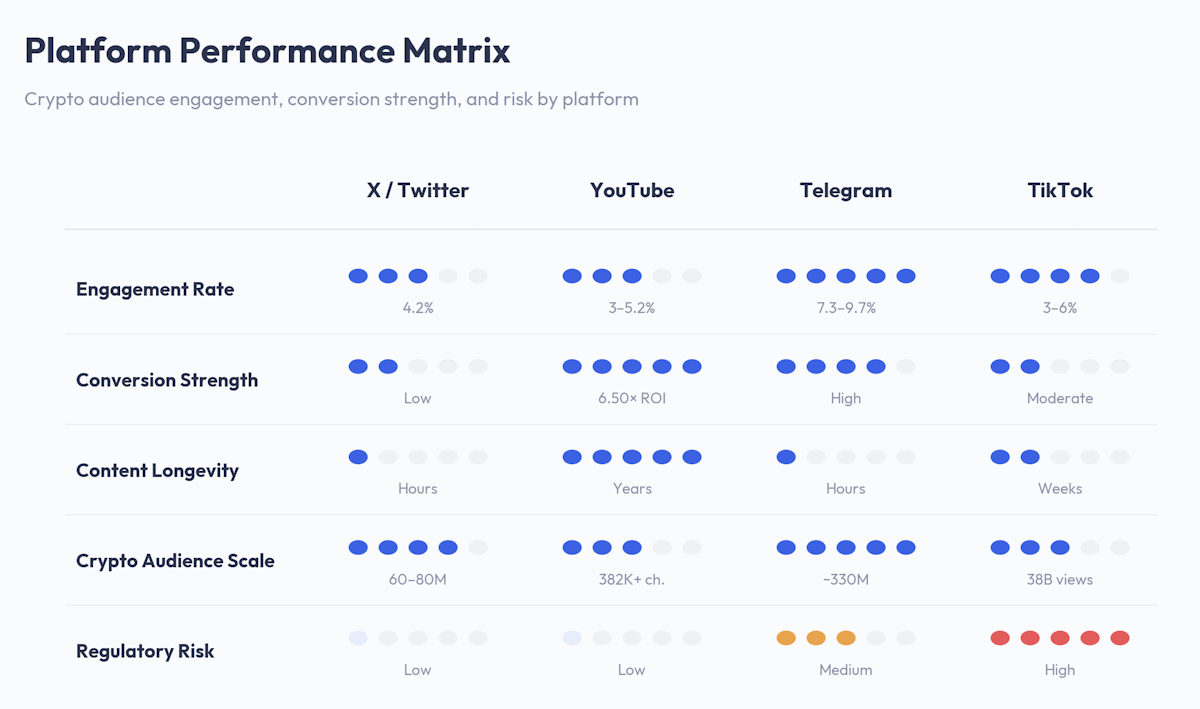
Platform selection is a strategic decision that determines both the cost structure and conversion ceiling of a campaign. Eighty-four percent of crypto users concentrate on three platforms — X/Twitter, Telegram, and YouTube — making these the non-negotiable foundation for any web3 influencer marketing campaign. TikTok adds mass reach but under heavy regulatory constraint.
⬛ X/Twitter remains the real-time nerve center. CoinGecko data shows 41.7% of crypto holders cite X as their primary platform, and crypto accounts maintain a 4.2% engagement rate — roughly 4–5× the platform norm. X reversed its crypto advertising ban in February 2025, and now holds the highest crypto ad approval rate among major platforms. Best formats: thread campaigns (5–10 tweets) and X Spaces AMAs. Key risk: organic reach for posts containing ticker symbols dropped approximately 80% in December 2025 due to algorithm changes. Verdict: essential for L1/L2 narrative building, DeFi positioning, and institutional signaling.
🟥 YouTube is the trust engine. Active crypto creators achieve a 5.2% average engagement rate, and YouTube campaigns deliver an average return of $6.50 per dollar spent (per KOLHQ data) — the highest measured ROI of any platform for crypto KOL campaigns. The compounding SEO value is YouTube’s unique advantage: a single well-produced review continues generating traffic and conversions for months to years. Key risk: production timelines measured in weeks, not days. Verdict: highest-ROI platform for DeFi, hardware wallets, and any project requiring user education before conversion.
🟦 Telegram is the conversion powerhouse. An estimated 33% of its 1 billion MAU engage with crypto content — roughly 330 million users, the largest crypto-native audience of any platform. Crypto channels achieve approximately 9.7% engagement with no algorithmic filtering: messages reach subscribers directly. The TON ecosystem integration (native wallet, crypto mini apps) makes Telegram uniquely positioned for direct conversion. Key risk: the highest scam exposure of any platform, with over 1,500 active scam channels identified in 2025 and 60%+ of targeted traders reporting financial losses. Verdict: non-negotiable for community retention, token launches, and GameFi.
🟪 TikTok offers unmatched reach but under heavy constraint. Nano-influencers on TikTok achieve 10.3% engagement — the highest measured rate across all platforms and tiers. But branded crypto content is globally prohibited under TikTok’s Branded Content Policy, forcing reliance on organic educational content. Key risk: regulatory restrictions limit scalability for crypto influencer marketing services. Verdict: top-of-funnel only, best for consumer wallet apps and GameFi targeting Gen Z.
| Platform | Crypto Audience Size | Avg. Engagement Rate | Content Longevity | Primary Use Case | Key Risk |
|---|---|---|---|---|---|
| X/Twitter | 60–80M engaged users | 4.2% (crypto accounts) | Hours–days | Narrative, news, institutional signaling | Algorithm suppression, bot contamination |
| YouTube | 382K+ channels, 2,800 active KOLs | 3–5.2% | Months–years | Trust-building, education, conversion | Slow production cycle |
| Telegram | ~330M crypto users | 7.3–9.7% | Hours–days | Community retention, direct conversion | Scam channel proliferation |
| TikTok | 38.4B views Q1 2026 | 3–6% [Est.] | Days–weeks | Viral reach, retail onboarding | Branded crypto content prohibited |
KOL Tiers: What You Actually Pay and What You Get
Tier selection drives budget efficiency more than platform selection. A $50,000 budget concentrated on a single mega-KOL tweet produces measurably different outcomes than the same amount distributed across 15–20 micro-influencers. Mid-tier accounts (50K–250K) yield 30% higher ROI than million-plus accounts. The data consistently favors distribution over concentration.
Crypto and finance KOLs command a 50–100% premium over general influencer rates due to high-value audiences and regulatory complexity. The rate ranges below synthesize data from Crypto Virally, MediaX Agency, KOLHQ, FINPR, Influencer Marketing Hub, and the ZachXBT leak — which revealed actual rates for 200+ influencers, with some top KOLs charging up to $70,000 per single post.
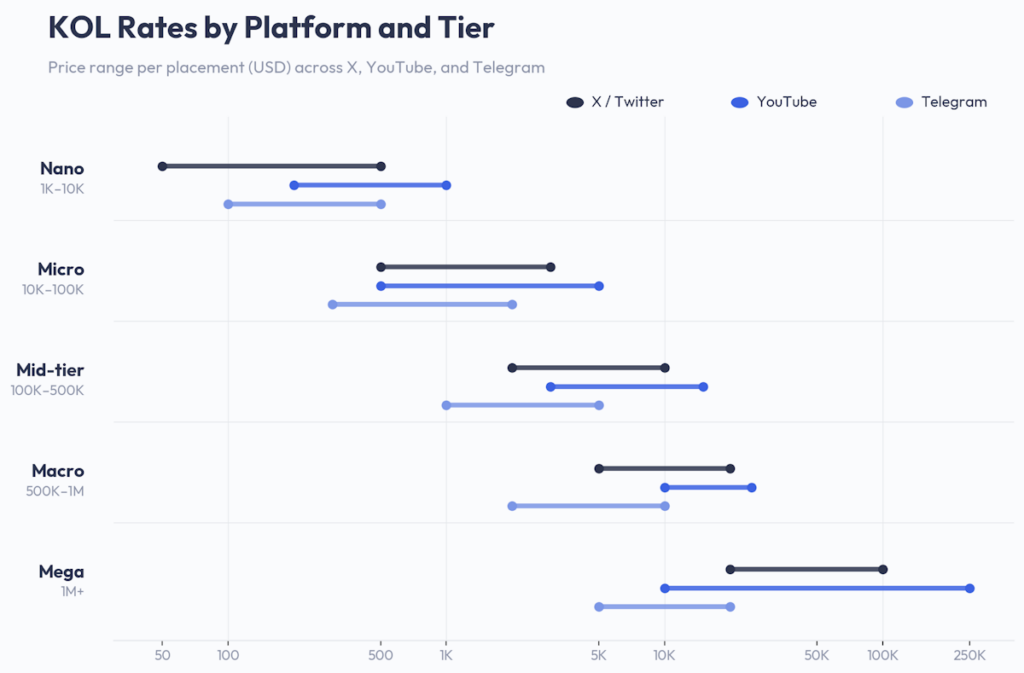
| Tier | Followers | X/Twitter Rate | YouTube Rate | Telegram Rate | Avg. Engagement | ROI per $1 |
|---|---|---|---|---|---|---|
| Nano | 1K–10K | $50–$500/tweet | $200–$1,000/video | $100–$500/post | 5–10%+ | $6.20 |
| Micro | 10K–100K | $500–$3,000/tweet | $500–$5,000/video | $300–$2,000/post | 2–6% | $5.80 |
| Mid-tier | 100K–500K | $2,000–$10,000/tweet | $3,000–$15,000/video | $1,000–$5,000/post | 1–4% | $3.50 |
| Macro | 500K–1M | $5,000–$20,000/tweet | $10,000–$25,000/video | $2,000–$10,000/post | 1–3% | $2.10–$3.50 |
| Mega | 1M+ | $20,000–$100,000+/tweet | $10,000–$250,000+/video | $5,000–$20,000+/post | 0.5–2% | $2.10 |
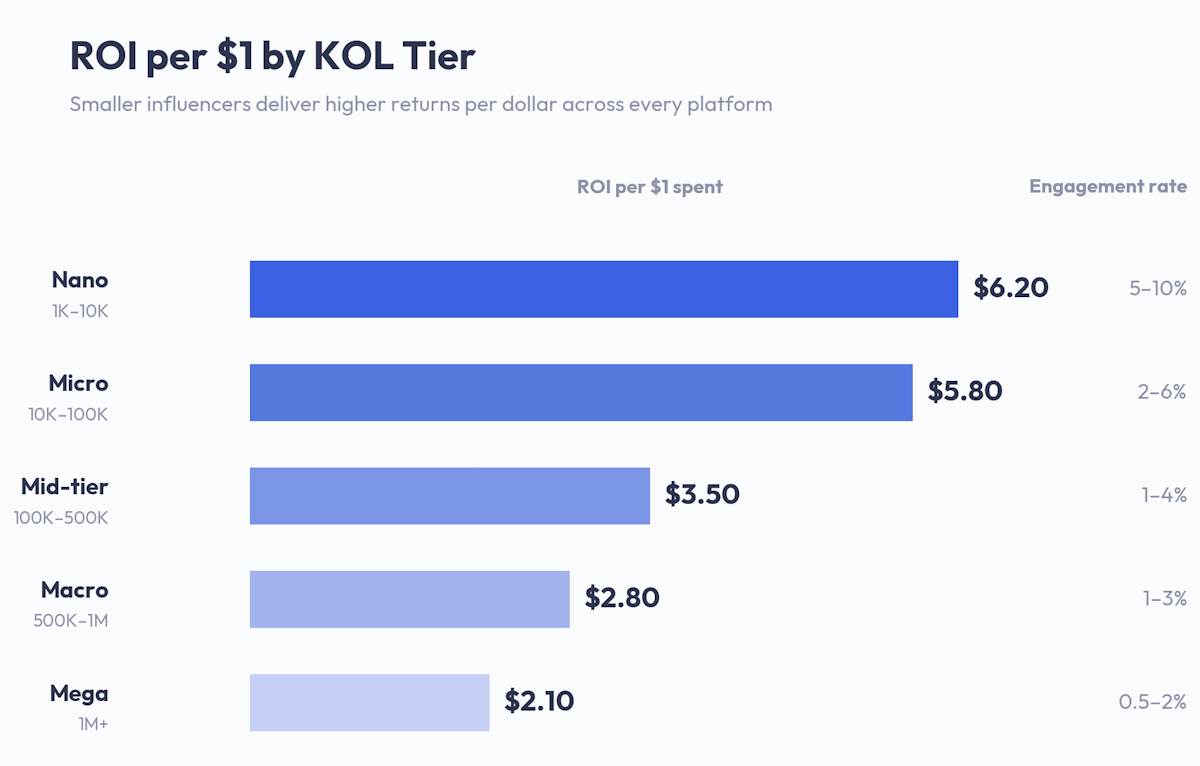
The engagement-to-ROI inversion is consistent across every data source. Nano-KOLs deliver $6.20 per dollar spent. Mega-influencers deliver $2.10. The math favors building portfolios, not placing single bets. A DeFi protocol that deployed 50 nano-tier key opinion consumers brought in 4,800 new users with 67% monthly active retention — conversion 30× higher than a single mega-influencer post.
Fraud risk escalates with tier. HypeAuditor’s 2026 study found that 37.2% of influencer followers show signs of inauthenticity, with the macro tier (100K–500K) carrying the highest fraud rate. The ZachXBT investigation exposed 200+ influencers taking undisclosed paid promotions with inflated metrics — a reminder that any crypto influencer marketing agency vetting KOLs must verify on-chain activity, not just follower counts.
Hybrid payment models are becoming standard. Many crypto KOLs now accept lower flat fees combined with token allocations that vest over time, plus performance bonuses tied to wallet connections or on-chain conversions. KOL investment rounds at favorable valuations — tokens in exchange for a set number of posts per month — have emerged as a common arrangement that aligns incentive structures with actual project growth.
Need a data-driven KOL strategy that connects to on-chain results?
ICODA builds multi-platform crypto influencer campaigns with full-funnel attribution

ROI Benchmarks: Metrics That Predict Business Outcomes
Average crypto KOL campaign ROI ranges from $5.78 to $6.50 per dollar spent, per Influencer Marketing Hub and agency-reported data. Conversion rates for crypto influencer campaigns average 6.5% — nearly double Google Search Ads’ 3.75% baseline. Top-performing campaigns with precise targeting and on-chain attribution reach far higher, but these averages represent realistic planning benchmarks.
The gap between surface engagement and business value is where most marketing ROI disappears. Impressions and follower growth are vanity metrics in a market where 96% of token failures since 2021 occurred in 2024–2025. The metrics that correlate with actual business outcomes are on-chain: wallet connections, TVL increases, and 30-day wallet retention. Off-chain leading indicators — community joins, branded search volume lift, YouTube view trends — matter only insofar as they predict on-chain behavior.
The UTM-to-wallet attribution pipeline is the measurement standard for any serious crypto influencer marketing services engagement. The logic: tag every outbound KOL link with unique UTM parameters, persist those UTMs through the wallet-connect flow, bind the UTM to a wallet ID at first on-chain interaction, then attribute all subsequent on-chain actions back to the originating KOL. This connects a specific tweet to a funded wallet that remains active at 30 days — the unit of measurement that separates signal from noise.
The recommended tool stack scales with project maturity. Bootstrapped projects start with Dune Analytics (free tier) and UTM tracking. Growing projects add Cookie3 or Addressable for acquisition attribution and LunarCrush for social intelligence and narrative tracking. Scaled projects deploy Nansen ($150–$1,500/month) for wallet labeling across 500M+ wallets and Kaito AI for mindshare analysis. Cost per Qualified Community Member (CPQC) — not CPM — is the emerging standard metric for crypto campaigns.
The most common mistakes that destroy campaign ROI:
- Measuring impressions instead of funded wallets — a campaign generating millions of views but zero on-chain actions is marketing theater.
- Ignoring audience overlap between KOLs — the crypto niche is tight, and multiple influencers frequently share identical followers.
- Blasting all KOLs simultaneously — staggered deployment produces 2–3× more total impressions than single-day drops.
- Counting TVL driven by temporary farming rewards as organic demand — retention for airdrop-acquired users is typically 29% versus 71% for education-acquired users.
- Skipping compliance disclosures — risking FTC fines and a measurable 28% CTR penalty.
What Actually Happened: Two Campaign Data Points
The ROI thesis above — that micro-tier portfolios and multi-channel integration outperform concentrated mega-KOL bets — is supported by two documented campaigns run by the ICODA team. Each illustrates a distinct approach to crypto KOL deployment, and each produced outcomes that map directly to the benchmarks discussed in this report.
The first validates organic community growth as a measurable acquisition channel. A non-custodial crypto-to-crypto exchange in open beta needed to validate its positioning with zero budget. The ICODA team deployed a native comment-based messaging strategy on YouTube and Reddit over four weeks with $0 in ad spend, testing two competing value propositions. The campaign generated 2.4 million total views, with the “non-custodial asset control” hypothesis achieving 100% top comment placement at delivery on YouTube and 66% on Reddit. The unexpected multiplier: Reddit engagement surfaced in Google AI Overviews, making organic community activity the primary recommendation for relevant search queries — proof that community-led growth now directly feeds AI-driven product discovery. Full methodology is documented at icoda.io/cases/youtube-reddit-organic-growth.
The second demonstrates the compounding multiplier of integrated channels. The campaign — a crypto AI project (NDA) launched by the ICODA team across paid ads, PR, and YouTube KOLs over six months — generated $3,629,112 in GA4-tracked revenue against $66,812 in ad spend (6.40× overall ROAS). The critical finding: organic and direct traffic generated 71% of total revenue after paid channels established initial traction. KOL trust and community moderation built the brand equity that converted independently — paid acquisition seeded visibility, organic compounded it.
Strategic Budget Allocation: A Framework by Project Type
For L1/L2 Networks
L1/L2 projects depend on developer adoption, TVL growth, and ecosystem narrative dominance. Marketing must serve both institutional capital and retail users with distinct tracks.
- Platform mix: X/Twitter (35–40%) for real-time narrative and developer discourse. YouTube (25–30%) for technical deep-dives with long-term SEO value. Telegram (20%) for community governance and ecosystem coordination. TikTok (10%) for emerging market retail, organic only.
- Tier allocation: 50% to micro and mid-tier KOLs (10K–500K) for sustained ecosystem storytelling. 20% to strategic macro placements timed to milestones. 20% to nano-tier developer advocates and on-chain analysts. 10% reserved for 1–2 mega activations per year.
- KPI targets: 10,000+ new funded wallets per quarter from KOL-attributed sources. 15–30% TVL lift during coordinated campaign windows. 40–80% branded search volume increase during active periods.
- Monthly budget range: $25,000–$100,000+ depending on stage.
For Web3 Startups (DeFi, GameFi, NFT, SocialFi)
Startups require high-velocity acquisition and proof of product-market fit before scaling.
- Platform mix (DeFi): YouTube (35%) for explaining complex mechanics. X/Twitter (30%) for narrative positioning. Telegram (30%) for community retention and bot-driven engagement. TikTok (5%) experimental only.
- Platform mix (NFT/GameFi): TikTok (25%) and YouTube (25%) for viral discovery. X/Twitter (30%) for community energy. Telegram/Discord (20%) for holder retention.
- Tier allocation: 50% micro-KOLs who hold and use the protocol. 30% mid-tier for credibility. 20% nano developer advocates.
- KPI targets (DeFi): Cost per depositor under $50. 30-day TVL retention above 60%. Engagement-to-deposit conversion rate of 2–4%.
- Monthly budget range: $10,000–$75,000 during launch windows.
What the 2026 Data Tells Us
The structural shift is definitive. Crypto influencer marketing has moved from speculative broadcast to precision performance marketing. Follower counts are being replaced by wallet-based reputation. Disclosure compliance is no longer optional — it is a measurable conversion advantage. The projects compounding returns treat KOL campaigns as attribution-tracked funnels, not awareness plays.
Three findings should inform every budget decision in the next 12 months. First, the micro-to-mid tier (10K–500K followers) delivers the highest ROI per dollar across every platform — $5.80 at the micro tier versus $2.10 at the mega tier. The era of defaulting to $50K+ mega-KOL tweets is over. Second, on-chain attribution is no longer optional. Projects that implement UTM-to-wallet tracking and measure Cost per Qualified Community Member rather than CPM will consistently outperform those relying on impression counts. Third, organic and direct channels generate the majority of revenue once paid campaigns establish traction — our case proved that 71% of revenue came through organic channels after paid ads seeded visibility.
By late 2026, three forces will further reshape the market. AI-powered KOL matching will reduce discovery costs by an estimated 40–60%. Wallet-based reputation systems — soulbound tokens, on-chain activity scores, tools like LunarCrush’s CreatorRank — will begin replacing follower counts as the primary trust signal. And performance accountability will consolidate around standardized on-chain attribution stacks, raising the bar for every provider of crypto influencer marketing services and making it harder for low-quality operators to survive on vanity metrics alone.
ICODA’s cross-platform campaign data — spanning organic community validation, multi-channel token launch marketing, and integrated performance strategies across 15+ countries — reflects the operational reality behind these benchmarks. As a crypto influencer marketing agency operating across YouTube, X, Telegram, Reddit, and paid channels, their documented campaign outcomes illustrate what the data at scale confirms: web3 influencer marketing in 2026 rewards measurement infrastructure, tier diversification, and the patience to let organic trust compound paid acquisition into sustained revenue.
Frequently Asked Questions (FAQ)
Crypto influencer marketing is the use of crypto KOLs to promote Web3 projects through paid or organic content on platforms like X, YouTube, and Telegram.
Crypto KOL campaigns return $5.78–$6.50 per dollar spent on average. Micro-influencer crypto campaigns deliver the highest ROI at $6.20 per $1.
Rates range from $50 for nano-tier tweets to $100,000+ for mega-KOL placements. Engagement rate and KOL tier drive pricing more than follower count alone.
Telegram leads with 9.7% average engagement for crypto channels. TikTok nano-influencers reach 10.3%, but branded crypto content is prohibited on TikTok.
Use UTM-to-wallet attribution: tag KOL links, persist UTMs through wallet connect, then track funded wallets and 30-day retention. ICODA and tools like Cookie3 and Nansen enable this full-funnel tracking for web3 influencer marketing campaigns.
Share with


Rate the article