




Most explanations of crypto marketing are written for people already shopping for one. If you are earlier than that, moving over from ordinary marketing, starting a project, or just trying to work out whether you need any of this, they are not much help.
This is the other kind of explanation. What crypto marketing is, what it is made of, why it works differently from marketing anywhere else, and which parts are likely to matter for your situation.
What Is Crypto Marketing?
Crypto marketing is the work of getting a blockchain project found, understood and trusted by the people who might use or hold its token. It covers community building, content, KOL partnerships, PR, paid advertising and on-chain incentives, and it operates under advertising restrictions and disclosure rules that do not apply to most other industries.
It gets treated as a separate discipline because of three constraints that barely exist elsewhere.
Your customer is also your investor. Someone who buys your token is buying exposure to your project’s future, so every claim you make about the product is also a financial representation. That is why regulators treat crypto marketing copy differently from software marketing copy.
Most advertising channels are restricted. A SaaS company can buy its way to attention. You mostly cannot, and the parts you can buy require certification, verification, or both.
And your audience assumes you are lying. The category has produced enough failures that scepticism is where people start, not an objection you handle late in a funnel.
Almost everything else follows from those three facts.
Crypto, Web3 and Blockchain Marketing: What’s the Difference?
These three terms get used interchangeably, and mostly that is fine. The differences are real but smaller than the search volume for each would suggest.
| Term | What it usually means | Who tends to use it |
|---|---|---|
| Crypto marketing | Promoting a project that has, or will have, a token. Heaviest emphasis on community, exchanges and holders. | Token projects, exchanges, trading products |
| Web3 marketing | Promoting decentralised applications and protocols, with emphasis on community ownership and on-chain participation. Often used where the token is secondary to the product. | dApps, DeFi protocols, NFT and consumer crypto |
| Blockchain marketing | Promoting blockchain-based products and infrastructure, including projects with no token at all. | Enterprise, B2B, infrastructure vendors |
In practice the work overlaps almost entirely. A community manager, a technical writer and a KOL programme look much the same whether the person hiring them says “crypto”, “web3” or “blockchain”.
Where the distinction does matter is audience. Blockchain marketing in an enterprise context
often means talking to procurement teams who will never open Telegram. Web3 marketing for a consumer dApp means talking to people who live there. Choose the term that matches who you need to reach, and do not spend long on the taxonomy.
How Crypto Marketing Differs From Ordinary Marketing
If you are arriving from web2, this is the section that matters most. The tools have the same names and behave differently.
| Ordinary marketing | Crypto marketing | |
|---|---|---|
| Core metric | Cost per acquisition, lifetime value | Cost per wallet acquired |
| Who you can identify | Cookies, device IDs, logged-in sessions | Pseudonymous wallets, no persistent identity |
| Where awareness comes from | Largely bought | Largely earned |
| What acquisition costs | Cash | Often tokens or liquidity incentives |
| Where the funnel lives | Off-chain, in your analytics | Substantially on-chain |
| Relationship to the buyer | Customer | Customer and investor at once |
| Main failure mode | Churn | Mercenary capital: wallets that farm, extract and leave |
| Analytics coverage | End to end | Stops at the wallet connection |
Three rows catch experienced marketers out more than the others.
Acquisition cost and lifetime value come apart. Token incentives reliably buy acquisition numbers that evaporate when the incentive stops. In ordinary marketing, a $20 acquisition cost that produces no retention is a failed campaign you shut off. In crypto it is the normal outcome of the industry’s most popular tactic, and a good deal of reported growth is exactly this.
Analytics stops at the wallet. The moment someone connects one, conventional tools stop seeing them. Wallets are pseudonymous, one person holds several for different purposes, and they move across chains. Measurement here is an unsolved problem, not a configuration issue, and any plan that assumes otherwise will produce confident wrong numbers.
Awareness cannot reliably be bought. Between platform restrictions and audience scepticism, the paid lever is weaker here than in almost any other category. That is a description of what the channels currently permit, not a philosophical position about authenticity.
What Crypto Marketing Consists Of
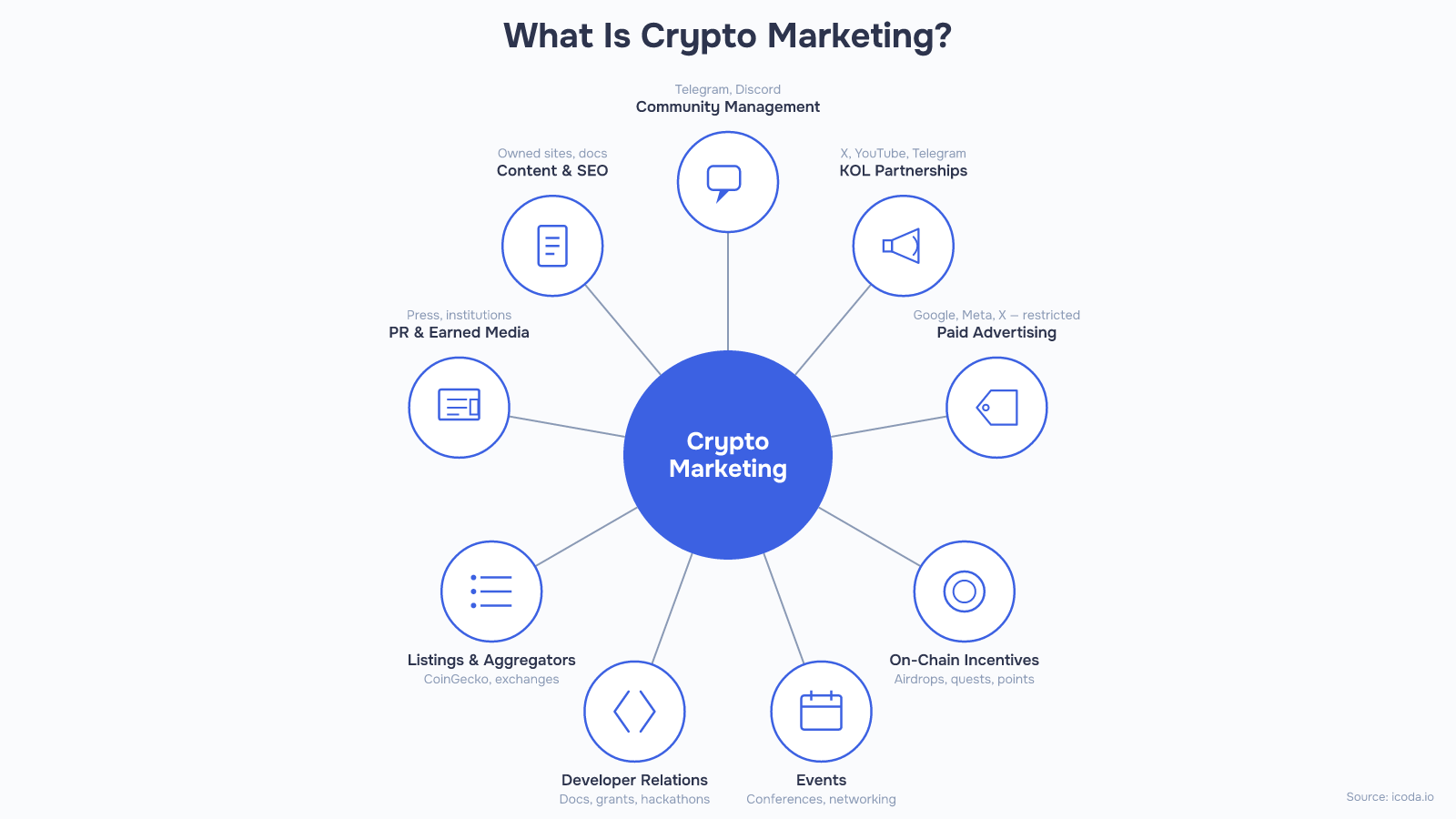
The field breaks into nine parts. Most projects use four or five of them and ignore the rest.
| Part | What it does | Where it happens |
|---|---|---|
| Community management | Retains holders, answers questions, absorbs bad news. The closest thing crypto has to a default channel. | Telegram, Discord |
| Content and SEO | Explains what the project is and why it exists. Compounds slowly. Increasingly feeds AI-generated answers as well as search results. | Owned site, docs, blog |
| KOL and influencer partnerships | Borrows trust from voices an audience already follows. | X, YouTube, Telegram |
| PR and earned media | Builds credibility with press, institutions and anyone doing diligence. | Crypto press, wire services |
| Paid advertising | Buys reach, within tight restrictions. | Google, Meta, X, Telegram, crypto ad networks |
| On-chain incentives | Rewards behaviour directly: airdrops, quests, points programmes. | Galxe, Zealy, Layer3 |
| Events | Conferences, side events, dinners. Where a lot of business development actually happens. | In person |
| Developer relations | Documentation, grants, hackathons. The whole job if you are building infrastructure. | Docs, GitHub, increasingly LLMs |
| Listings and aggregators | Discovery and credibility signals. Being absent is conspicuous. | CoinGecko, CoinMarketCap, exchanges |
Two of them behave differently from how their names suggest.
On-chain incentives are a retention tool, not an acquisition one. Airdrops and quest campaigns are very good at getting people to perform actions and much worse at producing people who stay, because a large share of recipients are wallets built to farm and exit. The sums involved are substantial. CoinGecko found that the 50 largest airdrops between 2020 and 2023 distributed tokens worth $26.6 billion measured at their all-time-high valuations. Use them to reward and qualify people who already found you, not
to find them.
Developer relations has changed underneath everyone. A developer’s first encounter with a protocol increasingly happens inside a language model such as Cursor, Claude Code or Codex, instead of through a blog post or Stack Overflow. That turns documentation quality into a marketing asset, and makes being the source a model cites into a distribution question.
Which of these nine you actually run, in what order and for how much, is a separate question. Our crypto marketing strategy guide covers that.
Who Crypto Marketing Talks To
“The crypto community” is not an audience. There are at least four, and they want different things.
- Retail traders want liquidity, listings and price movement. They are easy to reach and quick to leave, and they are the group most likely to be farming you.
- Long-term holders want evidence the project will exist in three years: shipping cadence, straight communication, visible thinking from the team.
- Institutional and treasury buyers want audits, compliance posture, custody arrangements and regulatory clarity. Nothing on your Telegram reaches them.
- Developers want documentation that works and a reason to build. If you are infrastructure, this is the whole job.
Where these people spend time is better documented than most of crypto. A CoinGecko survey of 2,558 people found X, Telegram and YouTube accounted for 84% of crypto community platform use, with Discord, Reddit and others making up 15%. Only 41.7% named X as their main platform, and many respondents said they use several sources at once. The survey was fielded in June and July 2024, so read it as a guide to the shape of things and not a current snapshot.
What the Rules Allow
Compliance in crypto marketing is not a legal formality that happens after the campaign. It determines which channels you can use at all, and in most cases it determines them before you write a word.
Google Ads requires certification for cryptocurrency exchanges, software wallets, hardware wallets and cryptocurrency coin trusts. Certification applications move inside the Google Ads account from June 2026: the policy states that applications “will no longer be supported via the Google Ads Help Center and will need to be submitted through your Google Ads account starting June 2026.”
Some things cannot be advertised at all, with no certification available. Google prohibits ads for “initial coin offerings, DeFi trading protocols, or the purchase, sale, or trade of cryptocurrencies”, along with ICO pre-sales, crypto loans, unhosted wallets, and sites that aggregate or compare crypto issuers. Certification is available in a long list of countries, including the US, UK, Canada, Japan, South Korea and most of the EU.
Meta requires prior written permission to promote crypto trading platforms, or software and services enabling monetisation, reselling, swapping or staking. Getting it means submitting a recognised regulatory licence or registration through the Authorizations and Verifications tab in Meta Business Suite: BaFin authorisation for Germany, AUSTRAC registration for Australia, and so on across roughly 28 listed jurisdictions. You do not need permission to run ads promoting events, education or news about crypto, provided they do not offer crypto products or services.
X permits advertising of cryptocurrency exchanges, wallet services, crypto ATMs and crypto debit and credit cards in a long list of countries, each with restrictions, built up through its ads policy over several years. One thing to watch: X’s Paid Partnerships Policy, which governs sponsored posts by creators, is a separate document from its advertising policy, and content prohibited under one may be permitted under the other. Check both if you are running influencer work.
MiCA applies across the EU. Under Article 7, marketing communications must be clearly identifiable as marketing, be fair, clear and not misleading, and be consistent with the crypto-asset white paper. They also may not be distributed before that white paper has been notified and published. Claims about guaranteed returns or ecosystem growth the white paper does not support create real exposure.
MiCA’s rules took effect on 30 December 2024. Existing providers operating legally under national law before that date could continue under a transitional regime for up to 18 months, ending 1 July 2026, though member states were free to shorten it and several including Germany and France did. Check the regime in the specific countries you are marketing into instead of assuming the full period applies.
The US position on crypto has loosened over the same stretch, but that does not travel. Marketing into the EU means MiCA applies regardless of what your US counsel is comfortable with.
Why the Old Playbook Stopped Working
Most crypto marketing advice online describes a market that no longer exists. Several things changed between early 2025 and mid-2026, and they are specific enough to date.
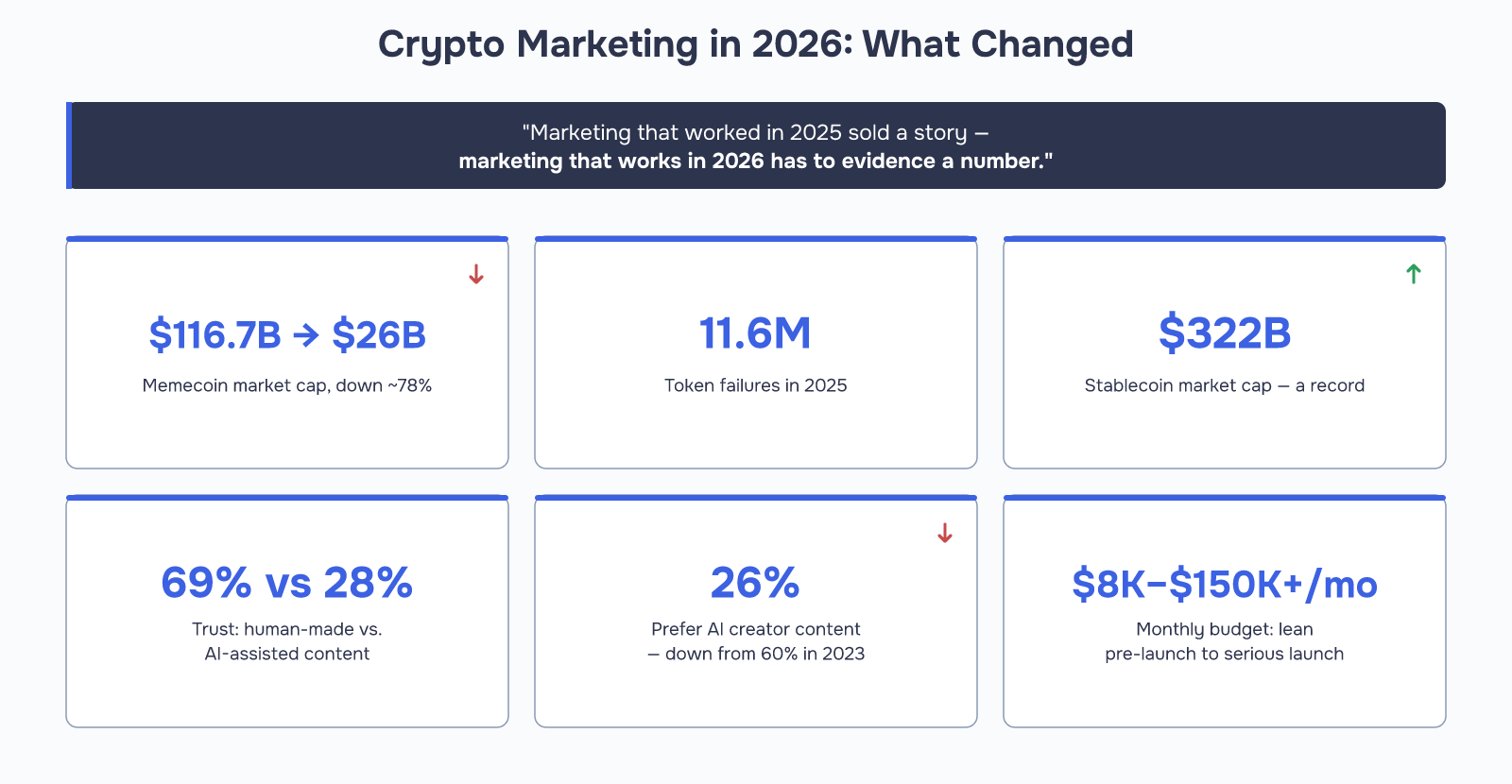
Tokens failed at a scale with no precedent. CoinGecko counted 11.6 million token failures during 2025, 86.3% of every failure it recorded between 2021 and 2025. In the fourth quarter alone, 7.7 million tokens stopped trading. Cheap launchpads made supply effectively infinite, and attention did not scale with it.
Memecoins stopped working as a category. Their combined market capitalisation peaked at $116.7 billion on 5 January 2025. It was $39.4 billion by late November that year, and stands at about $26 billion today. That is roughly 78% off the peak, with no recovery in the eighteen months since.
NFTs contracted further. The global NFT market capitalisation is around $1.5 billion, down from $2.78 billion in November 2025 and an order of magnitude below its 2021 and 2022 peak.
Yap-to-earn ended abruptly. Through 2025 a great deal of budget went into mindshare farming: paying people, directly or in points, to post about a project. On 15 January 2026 Kaito sunset Yaps and its incentivised leaderboards after X revoked API access for apps that pay users to post, with X’s head of product citing a surge in AI-generated spam. The mechanism the entire tactic depended on was switched off inside a month.
What grew instead was attached to revenue and collateral. Stablecoins reached a record of roughly $322 billion in total market capitalisation by late May 2026. Real-world assets and fee-generating infrastructure held up where the narrative-led categories did not.
There is a pattern here worth stating plainly, because it explains why so much older advice
misfires: marketing that worked in 2025 sold a story, and marketing that works in 2026 has to evidence a number. Projects with fee revenue, real collateral or recurring usage have material to work with. Projects without it are competing on narrative in a market that has largely stopped paying for narrative.
How AI Is Changing Crypto Marketing in 2026
AI is doing two things to this field at once, and most coverage reports only the first.
It works on some jobs. Influencer discovery is the clearest case: scoring people on audience quality, engagement authenticity and on-chain participation addresses a real problem, which is that follower counts lie. Attribution modelling, competitive monitoring and research all benefit in similar ways.
Audiences, meanwhile, are turning against it. Billion Dollar Boy’s 2025 research, surveying 6,000 consumers, creators and marketers across the US and UK, found only 26% of consumers preferred AI-generated creator content to the human kind, down from 60% in 2023.
More recent work suggests the mood has kept moving. Pew surveyed 5,119 US adults in February 2026: 40% expect AI to be bad for society over the next 20 years against 16% who expect it to be good, and 63% think it is advancing too quickly. Gallup polled 1,572 people aged 14 to 29 the same month and found excitement about AI had fallen 14 points year on year to 22%, while anger rose 9 points to 31%.
One Gallup figure matters more than the rest for anyone producing content: 69% said they trust work output produced by humans alone, against 28% for AI-assisted work. In crypto specifically, AI has flooded the space with near-identical content, which made generic output worthless instead of cheap.
So the workable division is AI for research, targeting, discovery and measurement, where it compounds and nobody can tell. Not for voice, where everybody can.
A second shift matters more for discovery. People increasingly find things through models instead of search results, and the visitors who arrive that way behave differently. Ahrefs published figures from its own site in June 2025 showing AI search accounted for 0.5% of traffic over 30 days but 12.1% of signups. That is one company’s data for a high-consideration B2B product, not an industry benchmark, and Ahrefs notes users click through from AI search far less often than from ordinary search. The direction is still worth watching: being the source a model cites is becoming a distribution question, not an SEO tactic.
Which Parts Apply to You
Most projects need four or five of the nine parts. Which four depends less on budget than on what you are building.
- A pre-launch token project needs community, content, KOL relationships and PR. On-chain incentives become relevant near a launch, not before. Listings matter once you have something to list
- A live protocol or dApp needs content and documentation, community, developer relations if anyone builds on you, and measurement infrastructure set up early
- Infrastructure, layer 1 or layer 2: developer relations is the majority of the work. Grants, documentation, hackathons. Most consumer-facing tactics are close to irrelevant here
- An exchange or trading product leans on paid advertising, subject to certification. PR and compliance posture carry unusual weight, because institutional diligence is part of the audience
- A consumer app or NFT project runs on community, events and creator partnerships. Of the six, this is the closest to conventional consumer marketing
- Enterprise or B2B blockchain needs content, PR and events. Telegram is not where your buyers are
Frequently Asked Questions (FAQ)
Crypto marketing is how a blockchain project gets found, understood and trusted by people who might use or hold its token. It spans community, content, KOL partnerships, PR, paid advertising and on-chain incentives, under advertising and disclosure rules specific to the industry.
For most projects it means running a Telegram or Discord community, publishing content that explains the project, working with KOLs who already have the audience’s trust, and handling press. Paid advertising is available but restricted.
Promoting blockchain-based products and infrastructure, including projects with no token. Used interchangeably with crypto marketing, though it appears more often in enterprise and B2B contexts.
Promotion of decentralised applications and protocols, with more emphasis on community ownership and on-chain participation. The work overlaps almost entirely with crypto marketing.
The channels have the same names and different rules. Most ad platforms require certification or prohibit crypto outright, analytics stops working when a user connects a wallet, and your buyer is also an investor, which changes what you are allowed to claim.
Yes, within rules that vary by platform and jurisdiction. Google requires certification for exchanges and wallets and prohibits ICO and DeFi trading promotion outright. Meta requires prior written permission backed by a regulatory licence. X permits crypto exchange and wallet ads in listed countries with restrictions. In the EU, MiCA requires marketing to be identifiable, fair, clear, not misleading and consistent with the white paper.
What to Read Next
- Building an actual crypto marketing strategy plan: channels in depth, what each costs, how to sequence them, and how to measure results
- Web3 and blockchain marketing specifically
- Marketing a token sale
- Getting cited by AI search
As a rough anchor before you read further, published agency planning estimates put a lean pre-launch programme at $8,000 to $25,000 a month and a serious token launch at $40,000 to $150,000 or more. Those are market ranges, not quotes. The linked guide breaks the components down.
Share with


Rate the article