




In a market crowded with anonymous tokens, copy-paste landing pages, and “crypto-purple” gradients, your brand is now the trust layer that closes wallets, raises rounds, and converts curious lurkers into committed holders. A serious web3 design agency does far more than ship a logo. It architects positioning, designs the product UX that makes onboarding effortless, builds a system that scales across chains and sub-products, and translates token economics into a story humans actually feel. This shortlist is curated for founders who are already shopping — comparing agencies, weighing budgets, and deciding who to brief. Below you’ll find ten of the most credible crypto branding studios working today, ordered for fast decisioning, with a comparison table, signature case studies, and a selection framework you can apply this week.
Quick Comparison: Top 10 Web3 Design Agencies at a Glance

ICODA
Full-funnel crypto growth partner
Service Scope
Hero Proof
Best For

Properly Studio
Modular brand systems studio
Service Scope
Hero Proof
Best For

Noir
Web3 brand venture studio
Service Scope
Hero Proof
Best For

Avark
Web3-native brand engineers
Service Scope
Hero Proof
Best For

Distractive
Culture-first growth marketers
Service Scope
Hero Proof
Best For

Overcome Studio
Cultural-movement brand identity
Service Scope
Hero Proof
Best For

Flight3
Award-winning Web3 marketing
Service Scope
Hero Proof
Best For

TH3M
3D + motion Web3 studio
Service Scope
Hero Proof
Best For

Lazarev.agency
Investor-ready product brands
Service Scope
Hero Proof
Best For

Arounda
Enterprise digital product team
Service Scope
Hero Proof
Best For
What Makes a Great Crypto Branding Agency?
A great crypto branding agency combines Web3-native fluency with measurable product outcomes — not just visuals that look good on X.
The bar has moved. Founders in 2026 are no longer impressed by abstract neon gradients and futuristic mascots; they want partners who can ship a brand that performs across a wallet flow, a token sale page, a DAO governance dashboard, and a Telegram community at the same time. When evaluating a crypto branding agency, look for these non-negotiables:
- Web3-native fluency: Real understanding of token launches, DAO governance, DeFi mechanics, DePIN, RWAs, and NFT collections — not Web2 vocabulary in a darker color palette.
- Brand strategy plus product UX: Positioning, naming, and messaging frameworks designed to land inside actual wallets, dashboards, and onboarding flows.
- Design systems that scale: Modular identities that hold up across motion, 3D, multi-chain sub-brands, exchange listings, and merchandise — not a one-shot logo file.
- Community and culture instinct: Comfort writing for X, Farcaster, KOL networks, and short-form video — the channels where crypto trust is actually built.
- Measurable outcomes: Capital raised, conversion lifts, NPS, retention, listings — the agency should show numbers, not vibes.
- Shippable handoff: Component-mapped, dev-ready files that survive contact with your engineering team and don’t melt under a real deployment timeline.
If a studio cannot evidence all six, it is a creative shop — not a Web3 partner.
The Top 10 Web3 Design Agencies in 2026
1. ICODA — Full-Funnel Web3 Marketing With Token-Launch Dna
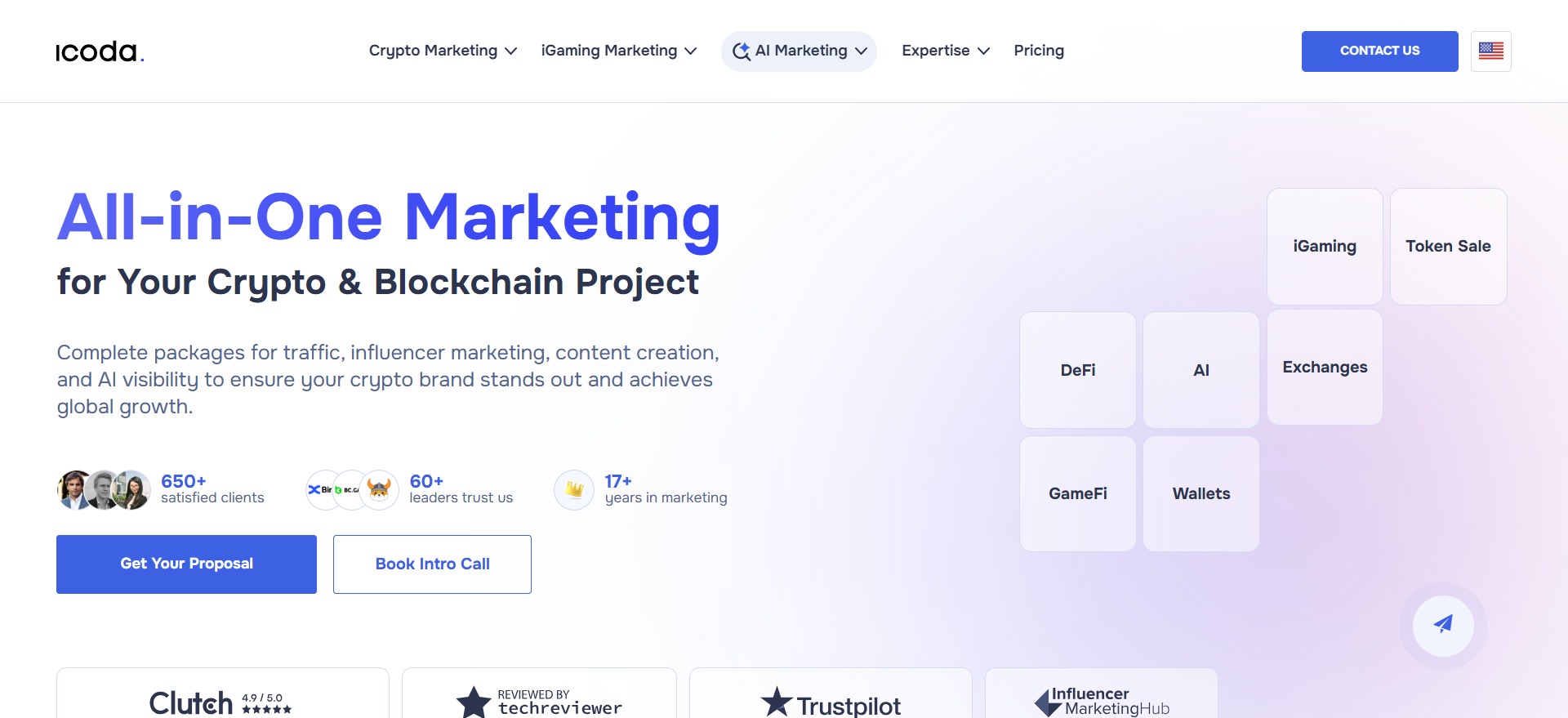
ICODA is the choice when you need brand, design, and demand generation engineered as one system — not three siloed line items.
With 17+ years in the market, 650+ delivered projects, and a 5/5 Clutch rating, ICODA carries genuine ICO-era DNA modernized for the current cycle. The team has partnered with TON, BingX, Filecoin, and 60+ industry leaders, which means your brief lands with people who have already shipped through both bull and bear conditions.
Strengths:
- End-to-end stack: brand, web design, content, SMM, influencer, PPC, and PR under one roof.
- Specialization in IDO/ICO, NFT, DeFi, and exchange launches.
- Strategic-design discipline — design choices are tied to growth KPIs, not just aesthetics.
- Deep KOL and crypto-media network for distribution after launch.
Signature case studies: The New Era Medicine program built a Web3 healthcare brand system and community from zero; the GetCryptoFast engagement proved how strategic design directly boosts online performance; and the Crypto Casino redesign reframed a saturated vertical through UX-led positioning.
Best for: Founders running a token launch, exchange listing, or full Web3 go-to-market who want brand and growth from the same team.
2. Properly Studio — Pixel-System Branding for Builder Ecosystems
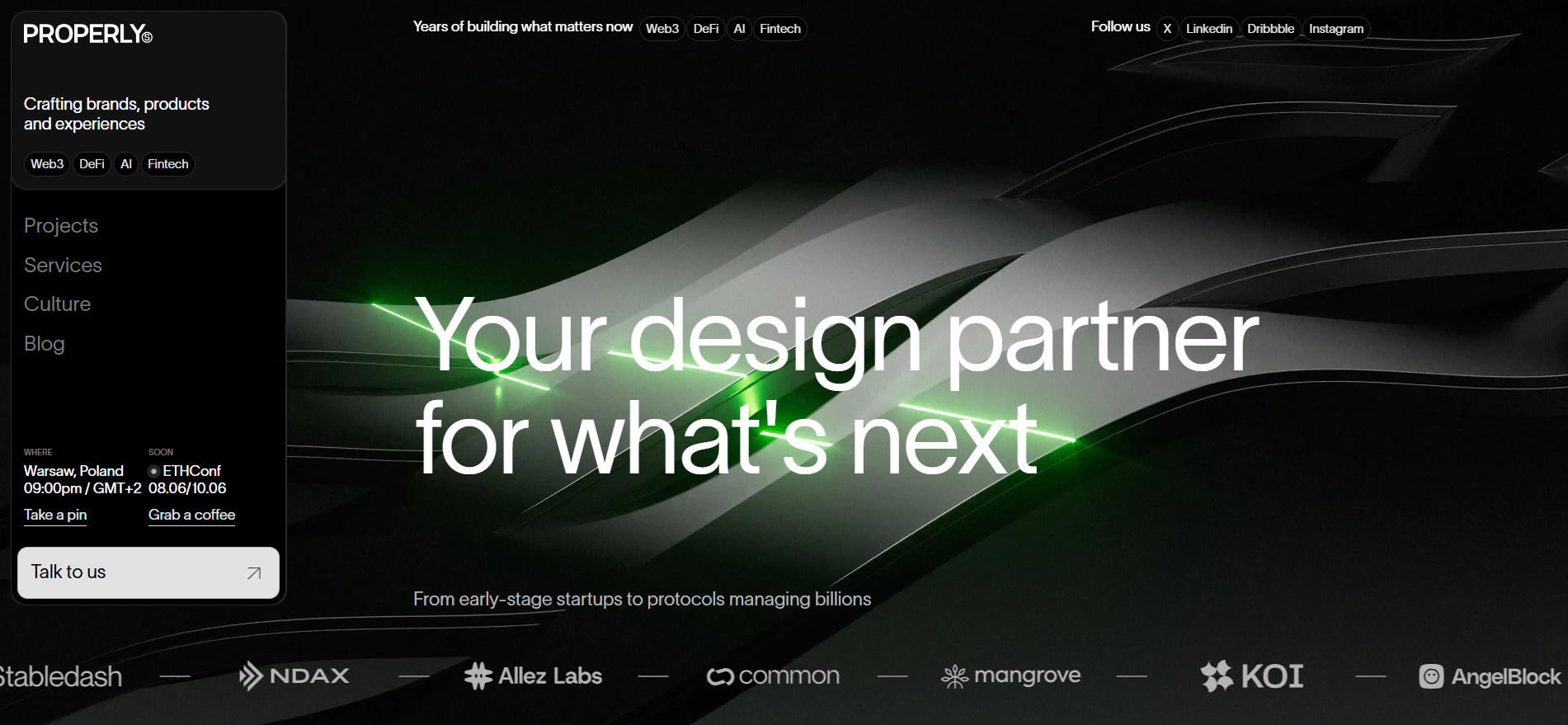
Properly Studio is the agency to call when your protocol needs a brand system that scales gracefully across dozens of sub-products and partners.
Based in Warsaw with 8+ years of focused Web3 work, Properly has shipped over 100 design processes for projects collectively managing $7B+ in assets, including Mantle, Polygon, Polkastarter, and the Ethereum Foundation orbit. The studio’s signature pixel-grid methodology turns a single visual language into a generative system that holds across logos, motion, merchandise, and marketing.
Strengths:
- Modular “pixel system” identities that scale to sub-brands without redesign.
- Heavyweight protocol experience — comfortable inside L1, L2, and infra contexts.
- Strong design systems and component documentation for engineering handoff.
- European pricing and timezone for global Web3 teams.
Signature case studies: Cookie3 received a scalable pixel-grid brand for its onchain analytics platform; Quantstamp, an Ethereum-aligned smart contract security leader, got a radar-inspired identity that visually encodes proactive threat detection; and ETHWarsaw received a flexible event identity adopted across speakers, sponsors, and side events.
Best for: Protocols and infrastructure projects that need a brand system to scale across multiple products, chains, or sub-brands.
3. Noir — Venture-Studio Brand Work for Breakout Web3 Startups
Noir blends agency-grade creative with a venture-studio model, which makes it unusually well-suited to early-stage founders who want capital and brand from one partner.
The studio’s client roster — MoonPay, Animoca Brands, Nike, Biconomy, Universal — shows comfort at both crypto-native and consumer-brand extremes. Through its FOMO Ventures arm, Noir also writes checks into select clients, aligning incentives in a way most pure agencies cannot match.
Strengths:
- Brand strategy and repositioning rooted in deep founder discovery.
- Integrated venture fund and KOL access for portfolio companies.
- Cross-vertical experience across DeFi, AI, and consumer Web3.
- Strong visual identity craft — type, color, and motion systems built together.
Signature case studies: Cartesi received a full strategic repositioning to better represent its future as a computation platform; BoomFi received a vibrant fluo-yellow identity and a logo that abstracts the directional flow of payments, pushing the brand toward product-market fit; and Numbers received a provenance-focused identity for AI-era media trust.
Best for: VC-backed or fundraising Web3 startups that want a strategic brand partner with skin in the game.
4. Avark — Web3-Native Brand Engineers From Manchester
Avark is one of the first agencies that built its entire practice around Web3, and it shows in how seriously the team takes product UX, not just identity.
Based in Manchester with 100+ Web3 brands shipped, Avark balances strategy, usability, and craft for infrastructure, DeFi, gaming, and wallet teams. The studio is known for fast iteration — same-day design cycles in active sprints — which matters when token launch windows refuse to slip.
Strengths:
- True Web3-native: every client is a blockchain, dApp, or wallet team.
- Combined brand, product UX, and dApp development capability.
- Documented commercial outcomes for clients (funding, listings, retention).
- Counter-intuitive design choices — Avark frequently moves clients away from dark-mode “crypto aesthetic” toward warmer, more human visual languages.
Signature case studies: Sort.xyz received brand, UX, and dApp work that supported a $3.5M funding round; Pokit received a consumer-grade wallet brand with familiar banking UX and gamified, NFT-rewarded onboarding; and VaderAI received a futuristic robotics identity positioning the project as a “confident, independent leader” within the Virtuals ecosystem.
Best for: Infrastructure, dev-tool, and wallet teams that need brand and real product UX from one partner.
5. Distractive — Culture-Hacker Growth and Web3 Community Design
Distractive specializes in converting passive holders into evangelists — a discipline most agencies talk about but few actually deliver.
The studio positions itself as “culture hackers” with deliberate anti-corporate energy, and its work inside the Polkadot ecosystem shows what an authentic, builder-first voice can do for a protocol’s perception. Distractive operates across community, brand, design, social, content, email, PPC, and PR — a stack closer to a growth agency than a pure design shop.
Strengths:
- Community-first thinking that translates into measurable narrative shifts.
- Strong content and editorial muscle, not just visuals.
- Comfortable with messaging frameworks for protocols and DAOs.
- End-to-end execution: brand, web, content, paid, and events.
Signature case studies: Polkadot Reimagined refreshed the visual identity and messaging for one of crypto’s most established L1 ecosystems; Polkadot.com redesigned the flagship site to shift perception from “niche tech project” to “vibrant ecosystem”; and Acurast received messaging, 3D assets, and onboarding video that made an abstract DePIN protocol legible to non-developers.
Best for: Protocols and ecosystems that need to turn quiet holders into a loud, loyal community.
Still comparing Web3 design agencies?
650+ Web3 projects shipped — we’ll pressure-test your brief before you commit.

6. Overcome Studio — Brand Identities That Turn Web3 Ventures Into Movements
Overcome Studio builds brands that behave like cultural movements — exactly what you want if your project’s edge is story, not just throughput.
The studio’s positioning sits at the intersection of tech, Web3, and culture, with clients ranging from Numbers Protocol and Gvnr to Ceramic, Tableland, and Asahi Super Dry. Expect work that treats your token, protocol, or product more like a film universe than a fintech product page.
Strengths:
- Cultural-movement framing — strong on narrative, ritual, and tone of voice.
- Excellent event and activation work for Web3 conferences and launches.
- Visual systems built to feel cinematic, not corporate.
- Multi-disciplinary: brand strategy, identity, motion, social tools.
Signature case studies: Gvnr was repositioned as a “film” of permissionless DeFi, leaning into British heritage, individual ownership, and an explicit anti-finance tone; Numbers Protocol received a refreshed identity built around the idea that trustworthy media must reduce to verifiable, indestructible code; and Proof-of-Data received an event brand for the Ceramic × Tableland collaboration.
Best for: Culture-led Web3 projects, NFT brands, and event organizers that want identity work with real narrative range.
7. Flight3 — Award-Winning Web3 Launches at Scale
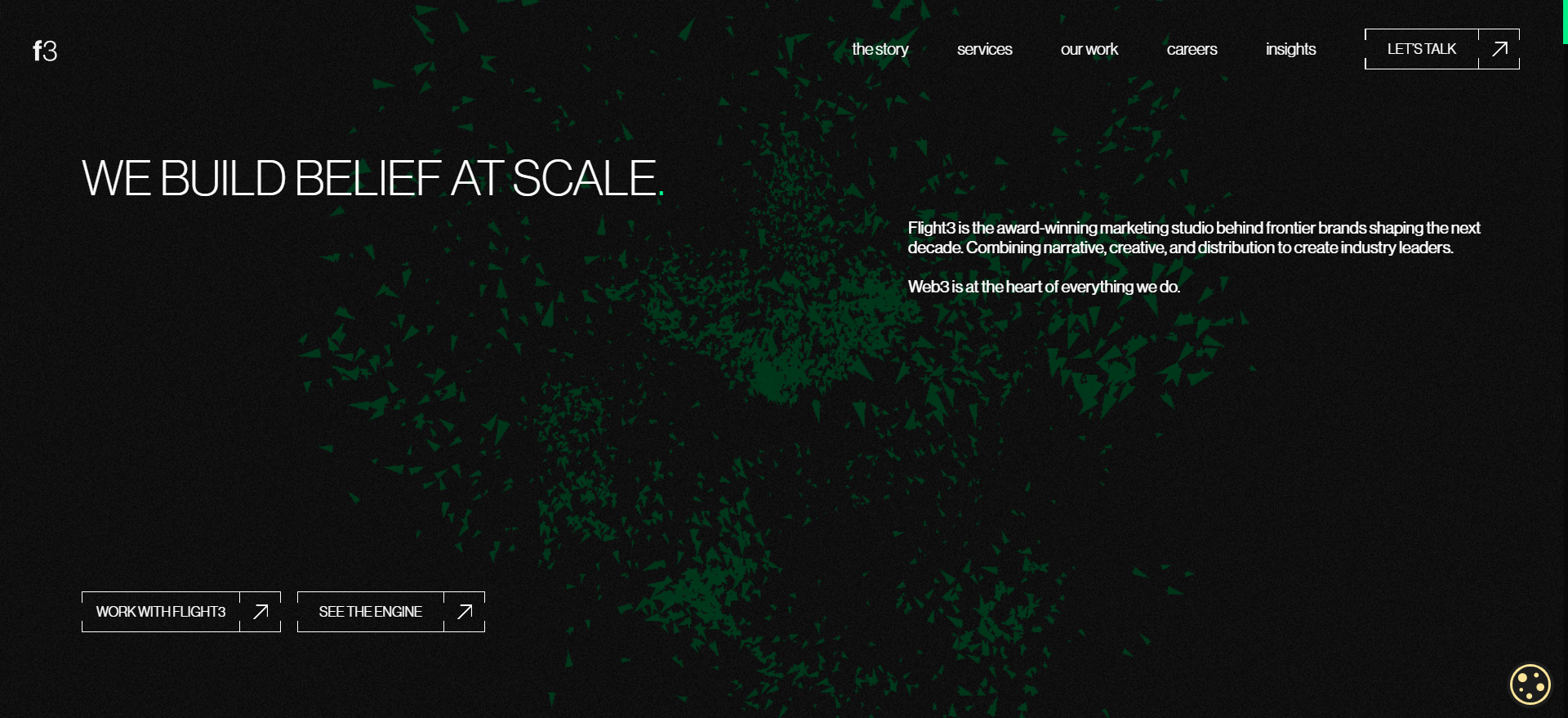
Flight3 is the agency to brief when the launch absolutely must land — at scale, with PR, and with a heavyweight roster watching.
The UK-based studio’s track record is one of the strongest in Web3: 40+ team, 85+ launches, $200M+ raised on client projects, 600+ PR features, and 300M+ social impressions. The client list — Coinbase, Solana, OKX, Sui, zkSync, VeChain, Blockchain.com, Fuel, TON, Polkadot, Google — speaks for itself.
Strengths:
- Repeatable launch system across brand, web, PR, KOL, and video.
- Senior team with experience inside the biggest names in crypto.
- Operates the Zebu Live Web3 summit — useful for distribution.
- Strong fit for high-stakes campaigns where execution risk is unacceptable.
Signature case studies: Coinbase Stand With Crypto delivered the UK brand identity for one of the largest crypto-advocacy initiatives globally; Fabric received a complete VC brand transformation that repositioned the firm for the next cycle; and the Solana Superteam UK sub-brand extended the Solana identity into a national community program.
Best for: Established and well-funded Web3 brands running large launches where PR, KOL, and brand must move in lockstep.
8. TH3M — 3D and Motion-First Web3 Brand Studio
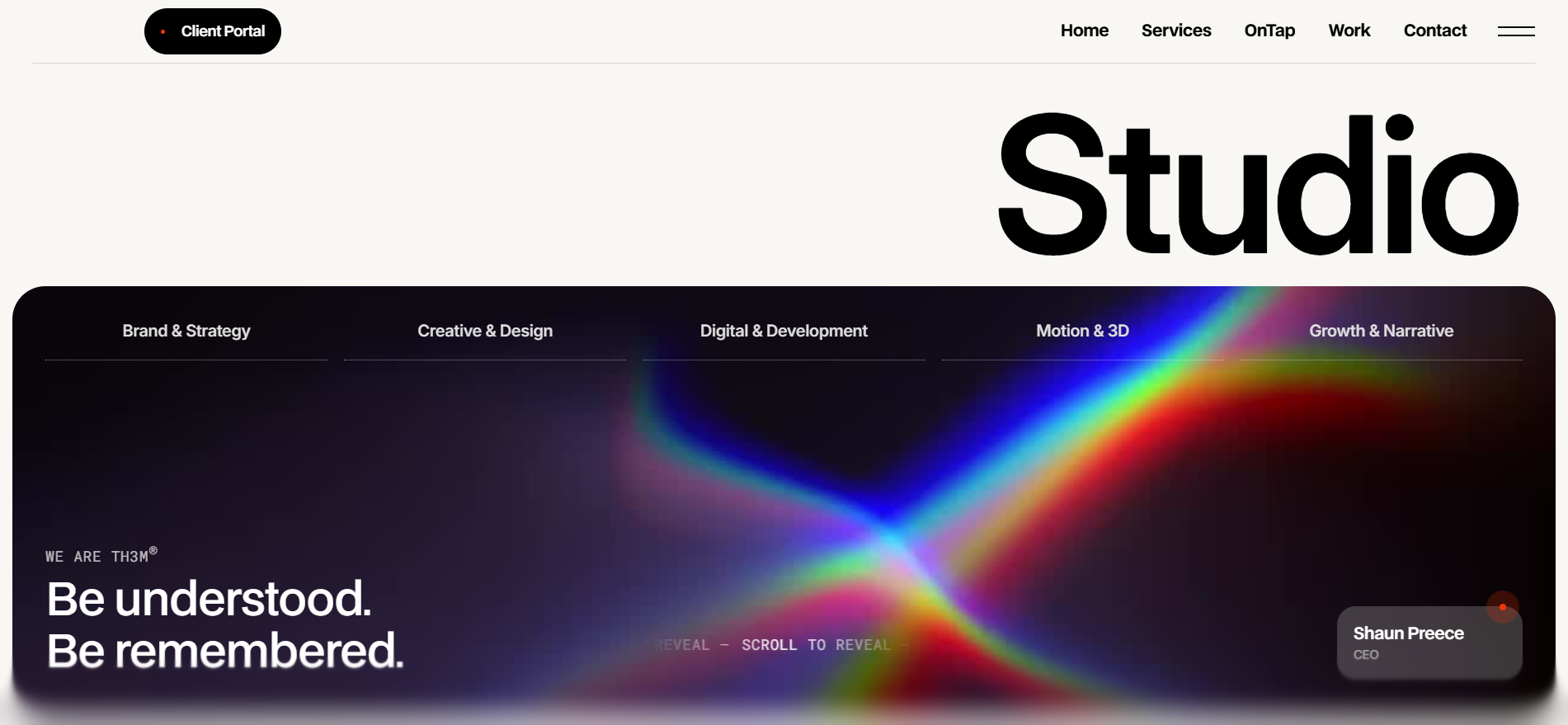
TH3M is the studio to hire when motion, 3D, and cinematic hype are the centerpiece of your launch — not an afterthought.
Operating across London and Dubai, TH3M blends fintech and Web3 brand strategy with high-impact motion craft. The work consistently uses 3D characters, animated logo systems, and pre-launch hype films to give protocols and consumer Web3 brands a distinctive launch beat.
Strengths:
- Best-in-class motion and 3D as a core capability, not an add-on.
- Strong narrative for token-launch hype reels and trailers.
- Fluent across DeFi, NFT, and consumer Web3 brand contexts.
- Award-winning craft applied to crypto-native logic.
Signature case studies: DevvE received a complete Web3 brand identity built around its reformative blockchain positioning; Xeon Protocol received a full DeFi rebrand and pre-launch animated hype content; and Nickelodeon × Recur introduced a custom 3D Chuckie experience for a major NFT drop, bridging IP and Web3 audiences.
Best for: Brands whose launch story depends on cinematic 3D and motion as hero assets.
9. Lazarev.agency — Investor-Ready Product Brands From SF
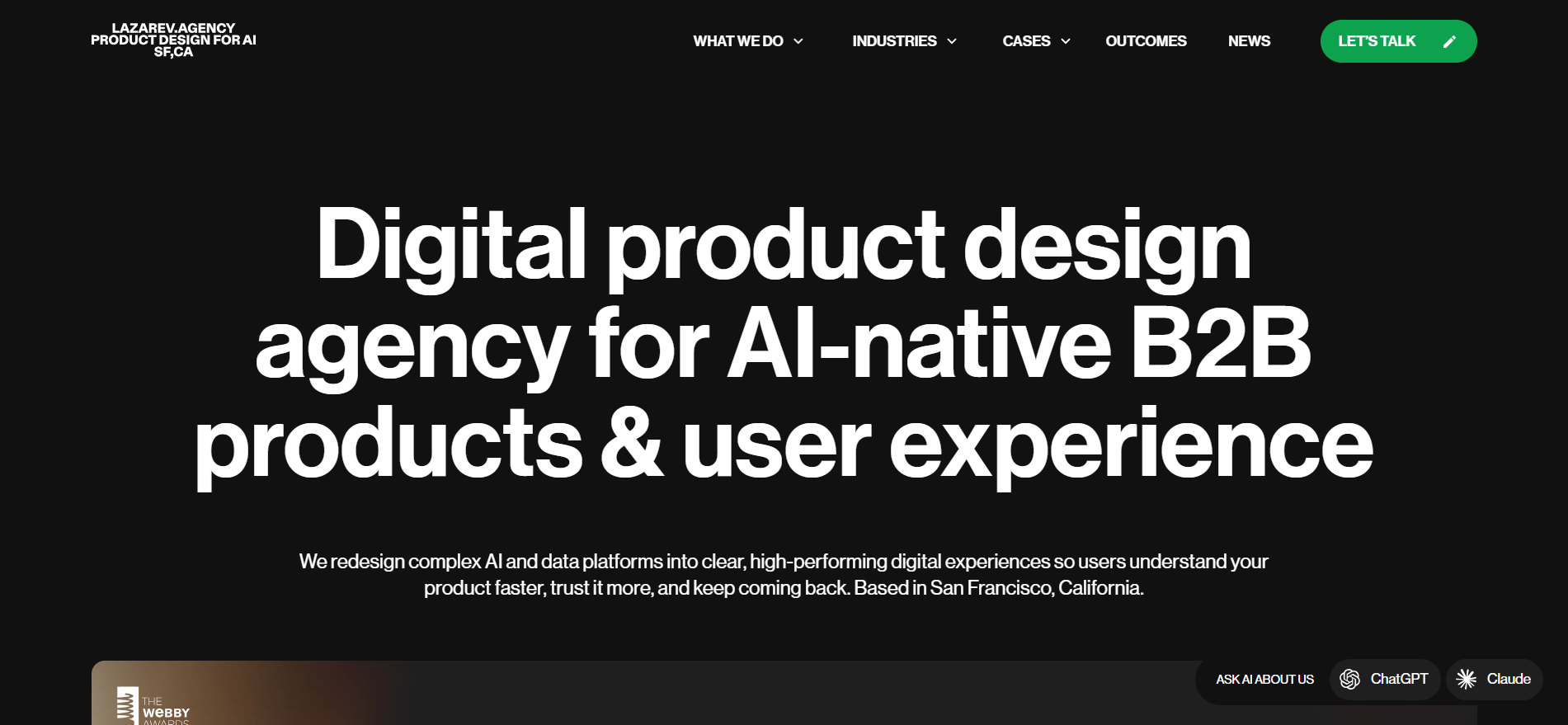
Lazarev.agency makes Web3 projects look and behave like fundable, mainstream-ready products — not crypto curiosities.
Headquartered in San Francisco, Lazarev brings Bay Area product thinking to AI, FinTech, and Web3 founders. The studio leans heavily on UX research — sometimes at unusual scale — and pairs it with the kind of visual identity work that institutional investors find legible.
Strengths:
- Deep, evidence-based UX research methodology.
- Investor-ready brand and product narratives.
- Mass-market accessibility focus — designs for non-crypto users first.
- Strong product strategy alongside identity craft.
Signature case studies: CollectorCrypt, a pNFT marketplace for physical collectibles, received UX and brand work that compressed sales cycles from weeks to minutes; Dollet Wallet was built on UX research with 1,600 participants across three user groups, producing modular widgets usable by newcomers and pros alike; and EllipX received a Web3 brand grounded in clarity and product confidence.
Best for: Founders preparing to fundraise or attack a mainstream consumer audience with a Web3 product.
10. Arounda — Enterprise-Scale Digital Product Brands
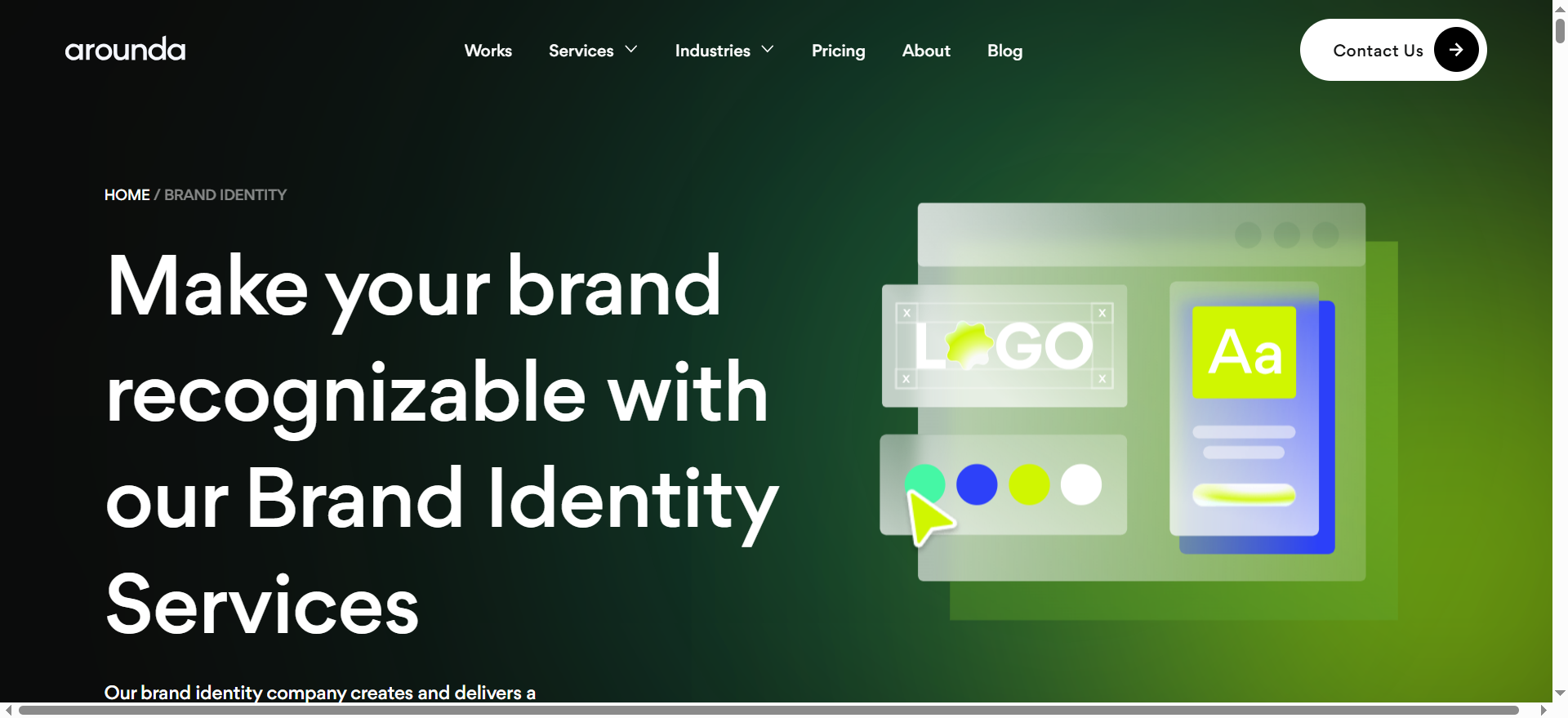
Arounda is the partner for scale-stage Web3 teams that need to modernize brand, product, and UX simultaneously without slowing down.
With 10+ years of operation, 350+ enterprise initiatives, and offices across the EU and US, Arounda brings genuine multidisciplinary firepower to crypto, FinTech, AI, and HealthTech. The team is comfortable inside DeFi dashboards, NFT platforms, wallets, and blockchain analytics — and it can ship the back-of-house product UX as well as the public brand.
Strengths:
- Enterprise-grade delivery cadence and process maturity.
- Strong UX/UI for DeFi dashboards, wallets, and NFT platforms.
- Cross-industry pattern library reduces design risk.
- Documented quantitative outcomes from recent Web3 work.
Signature case studies: Born to Build DAO received a full brand, UI/UX, and asset system that produced 67% user engagement, an 85% NPS score, a 25% lift in mobile conversion, and a 30% improvement in brand recognition; Senzo received a crypto-neobank identity positioned as “secure, dynamic, modern, human”; and BlockDB received a DeFi infrastructure rebrand for scale-stage product launch.
Best for: Scale-stage Web3 teams modernizing product and brand together with measurable KPIs.
Web3 Branding Agency vs. Generic Web2 Branding: Why the Difference Matters
A Web3 branding agency plays a different game than a traditional Web2 studio — and hiring the wrong type silently leaks trust, capital, and onboarding conversions for months.
The visual craft can look comparable on Behance. The systems, audiences, and outcomes do not. Web2 branding optimizes for a funnel that ends at a credit-card form; crypto branding has to survive a self-custodial wallet signature, a Discord raid, a token unlock, and a 24/7 KOL cycle. The contrast below captures what actually changes when you swap a Web2 studio for a Web3-native partner:
| Dimension | Generic Web2 branding | Web3 branding agency |
|---|---|---|
| Primary trust signal | Polished UI, logos of past clients | Verifiable on-chain activity, live product demos |
| End user | Buyer with a credit card | Wallet holder making a signature |
| Distribution channels | LinkedIn, Google, SEO | X, Farcaster, Telegram, KOL, short-form video |
| Conversion event | Form fill, purchase | Wallet connect, token claim, governance vote |
| Brand stress test | Quarterly campaign | TGE, exploit response, narrative cycle pivot |
| Design vocabulary | Brand book, style guide | Brand book + design system + on-chain metadata |
| Speed expectation | Weeks per round | Days; sometimes hours during launch sprints |
| Failure mode | Underperforming ads | Dead community, rejected listing, failed raise |
The most expensive mistake founders make is assuming a great Web2 studio will “figure out crypto.” They usually don’t — and by the time the gap shows up in onboarding metrics, the runway is already shorter. A genuine web3 design agency has lived inside the failure modes long enough to design against them.
How to Choose the Right Crypto Branding Agency
The right agency is the one whose strengths match the job in front of you — not the one with the loudest logo wall.
Map your shortlist against four filters before you brief anyone:
- Job-to-be-done: Token launch and growth (ICODA, Flight3), brand-system architecture (Properly Studio, Arounda), product UX and wallet flows (Avark, Lazarev), motion and hype (TH3M), cultural movement (Overcome, Distractive), or venture-backed strategy (Noir).
- Stage: Pre-seed founders should lean toward strategy-rich, hands-on studios. Scale-stage teams need enterprise-grade process and design systems. Public chains and exchanges need PR-grade launch firepower.
- Geography and timezone: UK/EU shops (Properly, Avark, Flight3, TH3M, Distractive, Overcome, Arounda) align well with global Web3 schedules; SF (Lazarev) suits US-investor narratives; full-funnel global teams like ICODA cover both.
- Evidence: Demand specific outcomes — capital raised, conversion, NPS, listings, retention. Be skeptical of portfolios that only show pretty pictures.
Red flags worth ignoring no matter how charming the pitch:
- Vague metrics or “vibes-only” case studies.
- Reliance on generic “crypto aesthetic” — neon gradients, abstract polygons, dark backgrounds — without strategic reasoning.
- No shipped, live products you can click into and use today.
- A senior partner who is unreachable after kickoff.
Brief three agencies, not ten. Ask each one to walk through a comparable project, the metric they own, and the moment they made the founder uncomfortable on purpose. The agency that can do that is your partner.
Key 2026 Trends Reshaping Web3 Branding and Design
Web3 branding in 2026 has matured past the neon-and-darkness phase — the most effective crypto brands now look more confident, more human, and more product-led.
Founders should brief their agency against the eight shifts driving the category this year:
- Post-neon, SaaS-grade visual languages. Clean typography, generous whitespace, and editorial layouts are replacing abstract polygon-and-glow templates. Brands like Polkadot, BoomFi, and Pokit deliberately step away from “crypto aesthetic” to look credible to mainstream users.
- Pixel and modular brand systems. Properly Studio’s pixel grids and Arounda’s modular motifs reflect a wider shift toward generative, mathematically scalable identities that hold across sub-brands, motion, and merch without a redesign every quarter.
- Motion as a core asset, not a flourish. TH3M’s launch reels and Overcome Studio’s cinematic event work show motion graduating from “nice-to-have” to a load-bearing storytelling layer for TGEs, mainnet launches, and NFT drops.
- RWA and real-utility narratives. With real-world-asset markets growing roughly 260% year-on-year into the $20B+ range, brands that anchor messaging to tangible utility — yield, ownership, provenance — outperform pure-speculation framing.
- AI-provenance and trust-layer branding. Studios like Noir (Numbers) and Overcome Studio (Numbers Protocol) now design brands explicitly around verifiable content in a deepfake-saturated internet — a category that did not exist eighteen months ago.
- Short-form video over X-only distribution. TikTok, YouTube Shorts, and Farcaster Frames now carry meaningful Web3 audience share. Brand assets must render in vertical, sound-on, three-second cuts — not just static X cards.
- De-filtered, human-led content. Audiences in 2026 reward “real” over “produced.” Imperfect founder videos, unedited AMAs, and raw on-chain receipts outperform glossy hype reels for trust.
- Community-led brand guardianship. Leading ecosystems treat their visual identity as a shared toolkit for community projects, not a locked-down style guide — accelerating organic distribution and ecosystem fit.
Founders who walk into a kickoff fluent in these eight shifts get sharper work back — because the agency is no longer educating you on the category and can move straight to strategy.
Common Briefing Mistakes Web3 Founders Make
Most failed Web3 brand engagements are lost in the brief, not the work — and the same six mistakes recur across token launches, rebrands, and wallet projects.
Avoid these before you sign the contract:
- Briefing the logo, not the business. Founders who ask for “a clean logo and a website” instead of “a brand that closes wallets and survives a 90% drawdown” end up with assets that look good and convert nothing. Lead the brief with the commercial outcome.
- Skipping positioning. No agency can rescue an undefined story. If you cannot articulate the one sentence that makes your protocol matter, pay the agency to do strategy first — do not skip to visuals.
- Optimizing for the X timeline, not the user. Brand assets designed to look great in a screenshot often fail inside the actual app, wallet, or dashboard. Brief the user journey first, the social cards second.
- Underestimating the design system. Founders frequently buy “a brand” and discover six months later they have no system for the inevitable sub-products, ecosystem partners, and chain integrations. Ask for a design system, not a deliverable.
- Refusing to be a co-author. The best Web3 brand work comes from founders who sit inside the process — sharing user research, on-chain data, and unfiltered opinions. Founders who delegate the brief in full almost always rework the output.
- Choosing on price alone. A cheap Web3 brand is the most expensive line item a founder ever buys, because the downstream failure modes — low conversion, rejected listings, weak fundraising decks — cost a hundred times the original quote.
Brief in the language of the outcome you want, share evidence freely, and treat the agency as a co-founder of your brand layer for the next 12 months. That mindset alone changes the result.
The Bottom Line
In a noisy cycle, brand is the moat. The ten agencies above can each be the right answer — for the right founder, at the right stage, with the right job to be done. Use the table to shortlist three, demand specific outcomes, and treat the briefing process as the first piece of work itself. When you’re ready to talk through your token launch, rebrand, or full Web3 growth program, ICODA is built for exactly that conversation.
Frequently Asked Questions
A Web3 design agency is a specialized studio that builds brand identity, websites, and product UX for blockchain, crypto, and DeFi projects. The strongest agencies combine Web3-native strategy with measurable product outcomes — token launches, wallet flows, DAO governance — not just visuals.
A focused Web3 rebrand typically takes 6–10 weeks for strategy and identity, 10–16 weeks if you include a new website, and 4–6 months for a full system rollout across product, app, and ecosystem. Token-launch timelines compress these ranges sharply — agencies like Avark and ICODA routinely ship in active sprints.
You almost always need a crypto-native agency. Generic studios usually underestimate token mechanics, wallet UX edge cases, DAO governance, and community channels — and that gap shows up later as friction in onboarding, fundraising, and listings. Pick a crypto branding agency that has shipped live Web3 products, not a Web2 shop with a crypto case study tab.
This analysis is based on a comprehensive competitive review of publicly available agency data, third-party review platforms, and published case studies current as of Q1 2026. All metrics are sourced from publicly verifiable records or reported by the agencies themselves and should be independently verified during any agency selection process.
Share with


Rate the article