



What Is iGaming SEO?
iGaming SEO is search engine optimization for online casinos, sportsbooks and gambling affiliate sites. The work is the same as in any SEO: keywords, content, technical health and links. The constraints are what make it different: licensing rules in every market, Google’s strictest quality bar, geo-blocked pages, scarce link inventory and AI answers that treat betting and casino queries differently.
Paid channels are narrow: Google’s ad-policy log lists 21 gambling changes for 2025, and Meta and TikTok admit gambling ads only with authorization. Benchmark CPA per first deposit runs from $10–25 in Uzbekistan to €200–400 in Germany, and a new brand pays about twice that (iGaming CPA index).
In short, from our 2026 data:
- Google shows AI Overviews on 12% of gambling queries, against 77% of finance and health queries. Betting gets them; casino almost never does.
- AI Mode, Gemini and Perplexity named an offshore brand in 13 of 16 grey-market answers. ChatGPT named none.
- Parasite SEO moved to sports media: Racing Post ranks first in the UK for “best online casino”.
- Regulators move rankings faster than Google: bet365.com’s Brazilian traffic fell from 21.1M to 1.4M visits a month after the switch to .bet.br.
- Only 15–30% of last year’s top-10 URLs for money keywords are still there.
Full data: iGaming SEO trends 2026. Start with the checklist, or talk to our casino SEO team.
What Makes iGaming SEO Different?
Google holds gambling pages to its YMYL (“Your Money or Your Life”) bar. The rater guidelines don’t name gambling there, but Google’s spam policies use it as the standard example of abuse: a “best casinos” page on a medical site, casino content on a former elementary school’s domain.
Three things set the vertical apart:
- Regulation decides the keywords. The law sets which pages you may publish, what they may show and who is liable. Our casino SEO strategy starts there.
- Links are scarce. Most publishers won’t link to gambling. The pool that will is small: trade press, sports and finance media with a betting vertical, a few general sites with a gambling policy.
- Competitors attack. We checked 30 gambling and crypto brands: all 30 had a site on their brand searches sending players to a rival (brand protection guide).
iGaming SEO Checklist: 12 Checks to Run First
These failures cost gambling sites the most. The 27-point version with test steps is in our online casino SEO audit.
| # | Check | Failure signal |
|---|---|---|
| 1 | Googlebot reaches pages despite geo-blocks | A US fetch gets a 403, a redirect or “not available in your region” |
| 2 | Content sits under the age gate, not behind it | Crawled HTML contains only the age modal |
| 3 | Templates render without JavaScript | No title, text or links in raw HTML for lobby, game or promo pages |
| 4 | Firewall lets search and AI bots through | Cloudflare or WAF challenges for Googlebot or OAI-SearchBot |
| 5 | Each licensed domain ranks in its own market | The offshore .com outranks the local licensed site |
| 6 | hreflang pairs only equivalent, indexable pages | en-UK instead of en-GB; alternates blocked or noindexed |
| 7 | Mirrors are known and consolidated | Full duplicates with self-canonicals |
| 8 | Offers are legal where the page ranks | Over 10× wagering on a UK page; non-whitelisted brands on a German page |
| 9 | Expired promos don’t rank | Past offers still getting impressions in Search Console |
| 10 | License seals verify | Image-only seal, dead link, or the orange Curaçao seal (invalid since 15 October 2025) |
| 11 | Reviewers and review method are real | Stock-photo authors; reviews that copy operator text |
| 12 | The brand appears correctly in AI answers | Unlicensed rivals named for your market’s money prompts |
Fix in this order: what blocks indexing of money pages, then what risks a penalty or a regulator, then the rest by deposit impact.
Keyword Research for Gambling Sites
Intent and Brand Share Decide the Economics
| Intent | Example (US volume, KD) | What the page needs |
|---|---|---|
| Navigational | “chumba casino” (1.1M, KD 62), “draftkings app” (12K, KD 2) | Brand defense: own the whole first page |
| Transactional | “best online casino” (26K, KD 84), “no deposit bonus” (11K, KD 71) | Ranked list with a published method, dated offers |
| Informational | “how does sports betting work” (3.4K, KD 42), “what is rtp in slots” (300, KD 45) | Direct answers that build topical authority |
| Legal status | “is sports betting legal in texas” (4.8K, KD 65) | Answer first, regulator named, date given |
Ahrefs, US, October 2026.
Two-thirds of sports-betting search volume in our query set is a brand name. For online casino the share is 17%, for crypto casino under 1%. So sportsbook SEO is mostly brand defense (login, app, review, “is [brand] legit”, clones), while casino generic demand is open but expensive.
New Sites Start with Long-Tail
“Online casino” has a KD of 66 in the US and 88 in the UK. A new domain won’t rank for it. Compare: 20 pages on queries like “crypto casino no deposit bonus 2026”, 40 visits each at 5% conversion, give 40 depositors. One head-term page with 5,000 visits at 0.2% gives 10.
Low difficulty can be a trap. The two easiest markets to rank in, Brazil and India, are the two their governments are closing.
Every Market Speaks Differently
- UK: bookies, fruit machines, accas, each-way bets
- US: sportsbook, parlay, moneyline, prop bets, sweepstakes casino
- Germany: Sportwetten, Spielothek, Wettanbieter
- Brazil: apostas online, casa de apostas, caça-níqueis, bets autorizadas
- India: cricket satta, IPL betting odds
Research each market from scratch; don’t translate your keyword list.
Events: Publish Weeks Ahead
Americans were expected to bet $3.3 billion legally on March Madness 2026, and 49% of UK sports bettors bet on the 2025 Grand National (OLBG). Keyword tools report this demand late; time pages with Google Trends. Prediction markets now compete for the same queries: Kalshi, Polymarket and DraftKings Predictions went from 4 to 10 positions on our money keywords in a year.
Content Strategy and On-Page SEO
Topic Clusters: Authority First
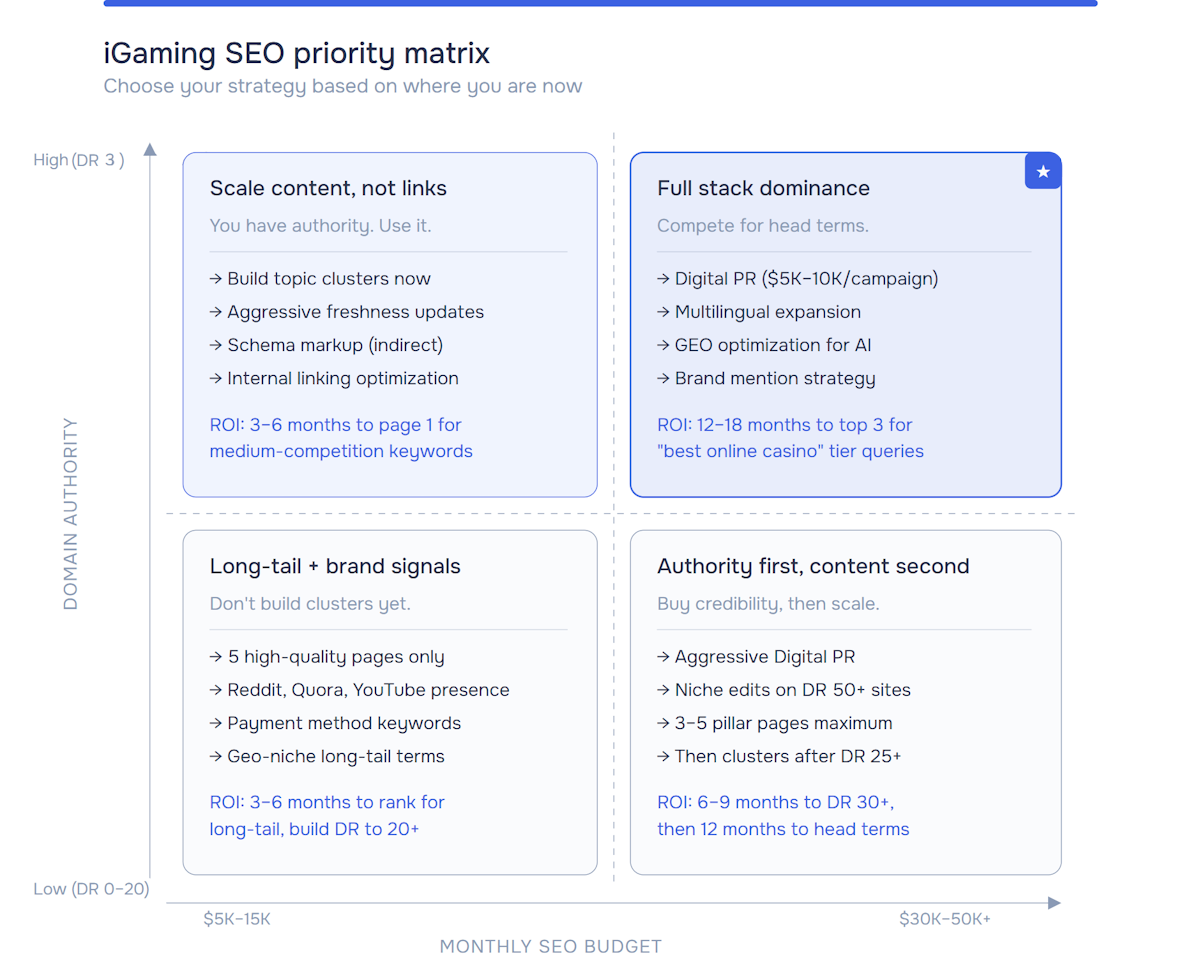
Build one cluster per license: pillar, game guides, reviews, bonus explainers, payment pages, responsible gambling. Each market’s rules decide what its pages may show. Clusters don’t rescue a new domain, though: on a DR 0 site, 30 cluster pages are 30 pages Google won’t rank. Publish 3–5 strong pages, earn links to DR 20+, then scale.
What Ranks for Money Queries
The top 10 for “best online casinos” is ranked lists: comparison table, mini-reviews, methodology, FAQ. In the UK, sports publishers hold many of these slots (see link building).
Freshness: Plan an Annual Rewrite
Of September 2025’s top-10 URLs on our 303 money keywords, 15% to 30% were still there a year later. YouTube went from 2 to 17 top-10 positions on our US keywords.
- Bonus pages: weekly; end expired offers with a 410 or
unavailable_after, never a mass redirect to the homepage - Reviews: every 1–3 months
- “Best of” lists: every 3–6 months, with the year in the title
- Every money page: a full rewrite once a year
Schema Markup for iGaming Sites
Google never excluded gambling from rich results. Two other changes explain the myth: FAQ rich results disappeared for all sites on 7 May 2026, and stars for reviews of your own business have been ineligible since 2019.
| Schema type | Use it for | What it does in 2026 |
|---|---|---|
| Organization | Operator or affiliate entity, license details, sameAs profiles | Entity understanding, knowledge panels |
| WebSite, BreadcrumbList | Site structure | Breadcrumbs in results |
| Person | Named reviewers and authors | Ties reviews to a real author |
| Review / AggregateRating | Affiliate reviews of third-party casinos | Review snippets only when reviewing someone else |
| SportsEvent | Fixtures and odds pages | Describes the event; no gambling-specific feature |
| FAQPage | Q&A sections | Valid markup, no visible feature since May 2026 |
Technical SEO for Casino and Betting Sites
Geo-Blocks, Age Gates and Firewalls
Googlebot crawls mostly from US IPs, and licensed operators often must block US players. Block Googlebot and Google indexes the block page; let it in while blocking US visitors and you are cloaking. Keep a public layer readable from anywhere (brand, license, responsible gambling, games, sports, promotion summaries) and geo-block only registration, login, cashier and game launch.
Content behind an “I’m 18+” click never reaches Googlebot, which doesn’t keep cookies; keep it under the gate. Firewalls block silently: since July 2025 Cloudflare blocks AI crawlers by default on new domains. In our scan of 4,689 gambling and crypto sites, 20.9% blocked at least one major AI crawler, and sites behind Cloudflare blocked 2.4 times as often.
JavaScript Lobbies
Many casino platforms are single-page apps. Google renders JavaScript with a delay; GPTBot, ClaudeBot, PerplexityBot and OAI-SearchBot don’t run it at all. Render every template you want indexed or cited on the server, and keep filter URLs, finished events and expired promos out of the sitemap.
Core Web Vitals
Targets: LCP under 2.5 seconds, INP under 200 ms, CLS under 0.1. Gambling is mobile: 87% of US “online casino” searches come from phones (Ahrefs), and so did 58% of European online gambling revenue in 2024 (EGBA and H2 Gambling Capital). Typical fixes: WebP jackpot banners with srcset, lazy-loaded game grids, tracking scripts and live chat deferred until interaction, fixed dimensions for age-verification overlays.
Domains and hreflang
Domain choice follows the license. Brazil requires .bet.br. Germany doesn’t require .de, but brands must be on the GGL whitelist. Pair only equivalent pages in hreflang: a Curaçao .com and a UKGC .co.uk differ in games, bonus caps and terms, and an x-default pointing offshore can show the .com to UK searchers.
In an SEOProfy case, a new casino site for Canada and New Zealand reached 170,000 monthly organic visitors in 18 months once duplicates, speed and hreflang were fixed and country-specific content and links added.
Link Building in the iGaming Niche
Paid placements are the norm in iGaming. Since the December 2022 link spam update, Google mostly ignores bought links instead of penalizing the site, so the risk sits in the host, not the payment. Links pay over quarters: in a Rhino Rank case, $3,750 a month for nine months took a casino site from 3,500 to 36,000 monthly visitors. Anchors, vetting and measurement: iGaming link building guide.
| Tactic | What it is | Turnaround | Best for |
|---|---|---|---|
| Digital PR | Original data pitched to journalists | 6–10 weeks | High-authority links to pillar and money pages |
| Niche edits | A link added to an existing, ranking page | 1–3 weeks | Fast gains on low-competition terms |
| Guest content | A bylined article for the host’s audience | 3–6 weeks | Recurring publisher relationships |
| Sports sponsorship | Club, league or event partnerships | Season-long | Brand authority and editorial coverage |
iGaming Niche Edits
A niche edit (link insertion) adds a contextual link to an article that already ranks, so it registers within weeks. It’s only as good as the host page. Check before you buy:
- The host page ranks and gets organic traffic now.
- The site covers gambling, sports, finance or industry trade topics.
- The link fits a sentence already on the page.
- The domain’s outbound links aren’t a casino-spam cluster.
- The audience matches your licensed markets.
Price follows the host page’s traffic and topic more than its DR.
Parasite SEO Moved to Sports Media
Off-topic hosts lost their gambling rankings: coupon pages on CNN and USA Today in May 2024, Forbes Advisor that September (forbes.com/betting went from about 383,000 modeled monthly visits to zero), and in March 2026 some of Clickout Media’s bought newsbrands, one of them a children’s charity domain (Press Gazette).
Sports publishers took the slots. Racing Post ranks first in the UK for “best online casino”, and publishers’ betting sections went from 5.4% to 17.3% of the UK top 10 in a year. Since 30 August 2026, site reputation abuse manual actions no longer apply in the EEA. Pick media partners by sports audience, not Domain Rating.
Restricted and grey markets run on owned infrastructure (PBNs, satellites, domain rotation), covered in iGaming SEO on restricted markets.
Case Study: #1 for “Top Crypto Casinos”
A crypto casino client reached #1 for “top crypto casinos” through rating articles on CoinMarketCap, NewsBTC and CryptoDaily, 10 Quora threads, five YouTube videos and Medium and LinkedIn posts. No single link type did it (full case study).
Mentions Matter Alongside Links
In our 69-domain panel, gaining referring domains went with growth (ρ = +0.36), but Domain Rating alone protected no one (ρ = −0.15). AI answers cite pages outside the top 10, so budget for mentions in media, Reddit and YouTube as well as links.
Struggling to build authority in iGaming?
We helped a crypto casino reach #1 in Google through multi-channel SEO — zero paid traffic.

E-E-A-T and YMYL Compliance
Google’s rater guidelines give the Lowest rating to pages “created to benefit the owner of the website with very little or no attempt to benefit visitors” and treat fake author profiles as deception. Since 26 August 2026, Google Ads requires gambling advertisers to show license details and affiliates to link only to licensed operators: Google’s own list of trust signals for the vertical.
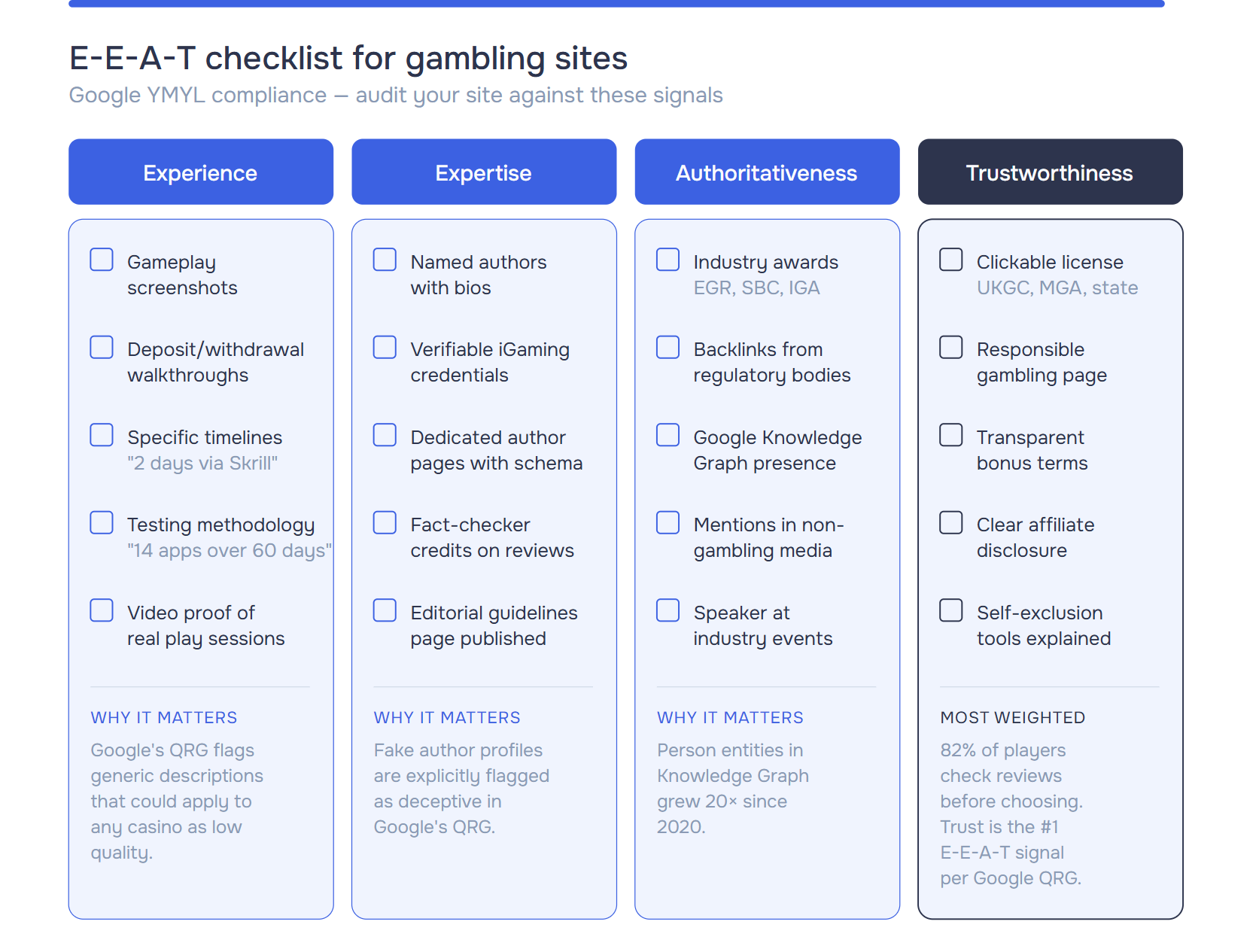
- Experience: real gameplay screenshots, deposit and withdrawal tests with timings (“withdrawal took 2 business days via Skrill”), a published testing method.
- Expertise: named authors with verifiable backgrounds. Casino.org lists a team of 15 writers, each with a bio.
- Authoritativeness: trade-press coverage, EGR and SBC awards, mentions by regulators and sports media.
- Trust: seals that verify (UKGC number linked to the register record, dynamic MGA seal, green Curaçao seal), bonus terms next to bonus amounts, affiliate disclosure, market-correct age markers and helplines, and published editorial rules like Gambling.com’s.
Every top-ranking gambling site also has a responsible gambling page, support links and self-exclusion tools, though Google hasn’t confirmed them as a ranking signal.
Localization and Regulation by Market
Payment-method searches (PIX, Interac, Trustly Pay N Play, BLIK) come right before a deposit and are less contested than generic terms. Give each a URL (/payment-methods/interac/) with deposit and withdrawal steps, processing times and a casino comparison.
| Market | What changed | What happened in search |
|---|---|---|
| Brazil | Regulated market opened with 66 licensed companies (Jan 2025) on .bet.br; affiliates liable for ads (17 Jul 2026); fixed-odds betting banned by MP 1.394 (25 Sep 2026, pending Congress) | bet365.com’s Brazilian traffic fell from 21.1M to 1.4M visits a month; illegal bets still 38–44% of the market |
| US | 11 states banned sweepstakes casinos in 2025–2026; California’s AB 831 makes media affiliates liable | Sweepstakes pages aimed at California carry legal risk |
| India | Online gaming act enacted Aug 2025, in force 1 May 2026; 8,376 URLs blocked | No compliant money pages; 23% of betting queries still get an AI Overview |
| UK | Slot stakes capped at £5, £2 for 18–24s (2025); CAP Code covers non-paid marketing (Sep 2025); wagering capped at 10× (19 Jan 2026) | 2025 bonus pages with 35× wagering now advertise illegal offers; hacked and expired domains fell from 11.4% to 3.6% of the top 10 |
| Curaçao | LOK framework in force (24 Dec 2024), about $55,000 a year in fees | Old sub-licence seals no longer verify |
| Sweden | Tax raised to 22% (Jul 2024); credit gambling banned from 1 May 2026; bonuses only on first play | No reload or cashback clusters; payment pages drop credit cards |
Status as of 28 September 2026.
For each change on your calendar, ask three questions: does our URL change, does any content become illegal, does liability move to the publisher? Where regulators draw the line on promotion: PR for regulated iGaming markets.
How AI Search Treats Gambling Queries
Google’s AI Answers Betting and Skips Casino
Ahrefs found AI Overviews on 1.4% of gambling queries in late 2025. Our September 2026 check of 4,242 queries in six markets found 12.1%, against 77.2% for finance and health. Non-branded US betting queries got one 69% of the time, casino queries 12%; naming a US state raised the rate to 76%. Half of the cited URLs sat outside the organic top 10, and regulators got 1% of citations.
So for sportsbooks, state and legal-status pages are AI-answer pages. For casinos, AI Overviews are rare and unstable; don’t move budget into “AI Overview optimization” yet.
Other AI Engines Name Offshore Brands
On markets with no licensed option, AI Mode, Gemini and Perplexity named an unlicensed brand in 13 of 16 answers in our panel; ChatGPT named none, and on regulated markets no engine did. The panel was small, but Investigate Europe found seven chatbots recommending unlicensed sites in about 75% of replies across ten countries in March 2026.
Licensed operators: run your ten main money prompts through each engine every quarter, per market, and log which brands appear.
How to Get Cited (GEO for iGaming)
- Answer first: the answer in the first paragraph, the regulator named, the rule dated.
- Use question headings in the words players and journalists use.
- Publish quotable numbers: withdrawal times, wagering terms, RTP, license numbers.
- Serve cited pages without JavaScript and let search bots (OAI-SearchBot, PerplexityBot, Claude-SearchBot) through. Blocking training bots (GPTBot, CCBot) is a separate decision.
- Join Reddit and YouTube without promoting. Reddit is 6.6% of all Perplexity citations; the often-quoted 46.7% is its share among Perplexity’s ten most-cited domains.
Case study. We got 1win into the top 3 of Google AI Overview and Top Stories for “best crypto casino in India” with listicles on crypto media, without ad spend (full case study).
AI can draft structure, FAQs and metadata, but it can’t test a withdrawal: reviews, compliance copy and responsible gambling text need a named human editor.
Measuring iGaming SEO Success
- First-time deposits (FTD) are the conversion that counts. A new brand converts fewer registrations at first: one operator’s Kazakhstan plan expected to lose 40–50% of the market’s 15–30% rate.
- Player value by product. In DATA.BET’s client data, casino players who started betting on sport were worth up to four times as much (AGBrief). Cross-product content pays.
- Affiliate terms. RevShare runs 25–45% for casino and 15–40% for sportsbook (Scaleo). Hybrid deals were 41% of new contracts in 2026, with CPA from $40 to $450 by market (Track360).
- Share of top-10 slots for your money keywords, against named competitors; your own traffic trend can’t separate your gains from the market’s.
- The market baseline. Across 72 ranking gambling domains, median organic traffic fell 9.8% in a year. A 10% drop may be the market; a 40% drop is your site. Our 34 affiliates lost 30% in two years, while operators that kept their domains held at −2%.
- Vertical tools. Beyond Ahrefs or Semrush: SISTRIX visibility for European markets, Blask for iGaming benchmarks, NetRefer for affiliate programs (Kindred, LeoVegas) and Voluum for server-to-server FTD attribution.
Realistic Timelines
- Months 1–3: technical audit, architecture, first content
- Months 3–6: long-tail terms appear on pages 2–3
- Months 6–12: medium-competition terms reach page one
- Months 12–18: head terms approach page one
- Months 18–24+: top-3 for high-value terms in competitive markets
Frequently Asked Questions (FAQ)
Long-tail terms move in 3–6 months, medium terms reach page one in 6–12, and top-3 for competitive money terms takes 18–24 months. A regulatory change can reset a market faster.
Over time, yes. Benchmark CPA per first deposit runs from $10–25 in the cheapest markets to €200–400 in Germany, and new brands pay about twice that. SEO costs more up front and less per depositor once pages rank.
As safe as the host page. A link on a ranking, relevant page with real traffic is a normal placement; an off-topic or spun page is the risk. Since 2022 Google mostly ignores bad bought links instead of penalizing the site.
For betting, yes: 69% of non-branded US betting queries got one in our data. For casino, rarely. AI Mode, Gemini and Perplexity matter more for casinos, because they name brands where Google stays quiet.
Yes, for entity understanding: Organization, Person, BreadcrumbList and, for affiliates, Review markup on third-party reviews. FAQ rich results disappeared for all sites in May 2026; Google never excluded gambling from rich results.
Usually authority. Cluster pages on a DR 0 domain don’t rank however good they are. Build 3–5 strong pages, earn links to DR 20+, then scale.
Share with


Rate the article