




Most crypto marketing teams hit the same wall. Google Ads blocked. Meta blocked. Programmatic networks blocked. For Godex, organic had been quietly declining for over a year — dragged down by algorithm updates and well-funded regulated exchanges that could outspend on paid acquisition.
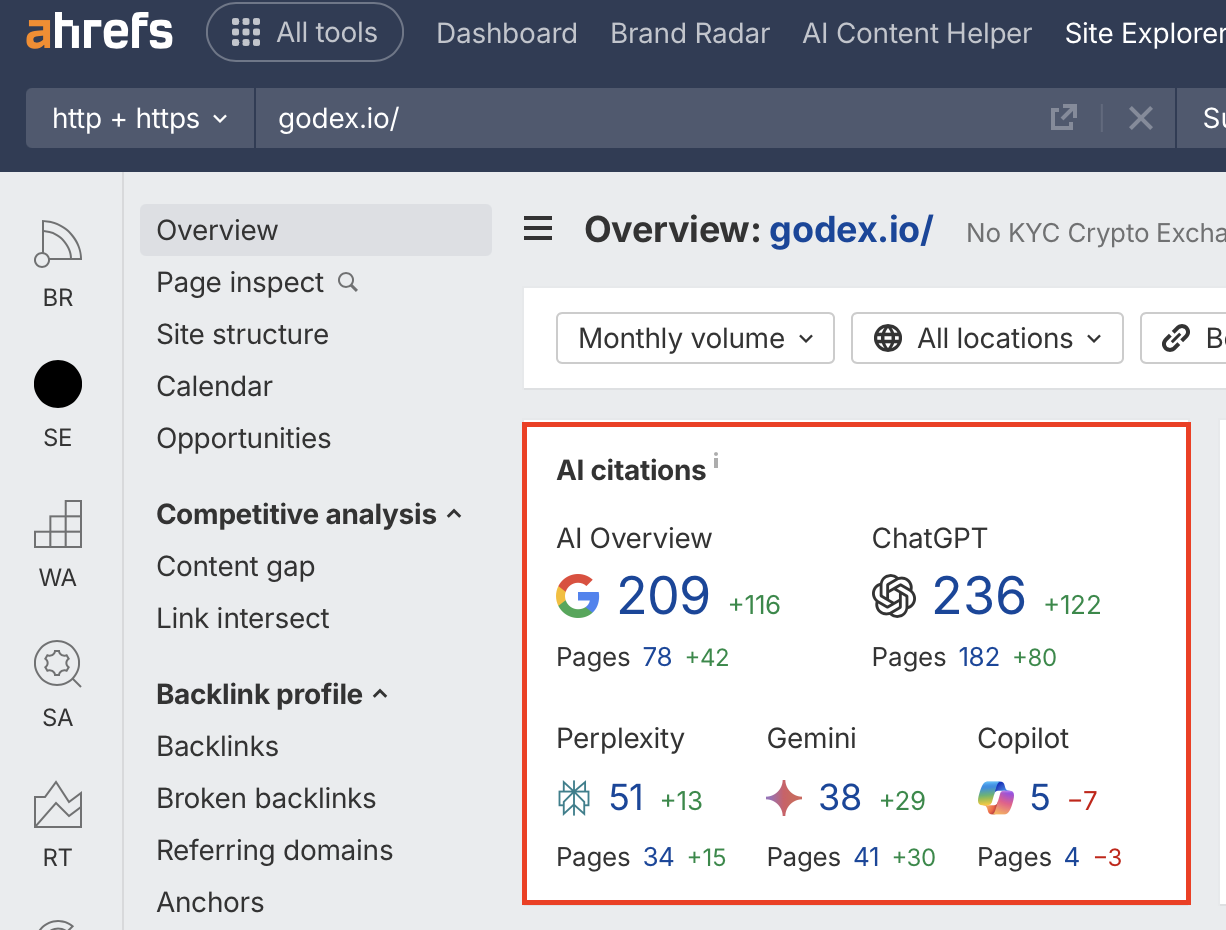
The shift came from treating AI search as a primary acquisition channel: ChatGPT, Perplexity, Google AI Overviews, Bing’s Copilot. Six months later, ChatGPT referral traffic was up 688%. Perplexity citations had increased 268%. Godex accumulated over 500 AI citations across platforms. Conversion rate from AI-referred sessions ran 34% above the site average.
Why Paid Ads Couldn’t Fix This
The advertising restrictions facing a no-KYC exchange aren’t temporary. They’re structural. Google’s certification requirements exclude most privacy-focused exchanges. Meta bans crypto advertising outright. For a platform whose value proposition is trading without identity verification, the paid-channel ceiling is permanent.
The entire acquisition budget had to flow through organic, which was already struggling. That’s when Godex partnered with ICODA, an AI marketing agency with proven results, specializing in growing crypto projects’ visibility. The insight that triggered the pivot came from an analytics audit: direct traffic was outperforming expectations while organic was declining. Existing users trusted Godex. New users couldn’t find it. And as AI search captured a growing share of crypto queries, Godex was invisible there too — for queries like “best no-KYC exchange” or “crypto swap without registration,” AI platforms were already surfacing recommendations from competitors.
The Strategy: AI SEO and PR as One System
The most common mistake brands make — and what ICODA sees repeatedly as a crypto-focused AI marketing agency — is running SEO and PR as separate workstreams. The SEO team optimizes the site. The PR team chases placements. Neither talks to the other, and the results show it.
This campaign ran on a different premise: every PR placement is an LLM citation opportunity, and every piece of content needs to be built for AI retrieval. One system, not two.
Step 1: Intent-Based Keyword Clustering
Rather than chasing head terms against Coinbase and Binance, the strategy focused on intent clusters regulated exchanges can’t credibly target:
- Transactional / privacy-specific: “no-KYC crypto swap,” “anonymous exchange no registration” — high commercial intent, near-zero regulated competition
- Informational / trust-building: “how does a no-KYC exchange work,” “what is KYC in crypto” — the exact questions AI platforms answer directly, making these prime citation targets
- Pair-specific / programmatic: hundreds of long-tail pages for specific trading pairs (“BTC to XMR swap,” “swap ETH to LTC anonymously”) covering both search and AI retrieval
Step 2: Content Architecture for AI Retrieval
AI systems look for content that directly answers a question — clean structure, well-defined entities, no answers buried in caveats. The content audit found three recurring problems: non-self-contained responses, feature descriptions without clear factual claims, and almost no FAQ-format content. A refresh across 200+ pages fixed each one. Every new piece needed at least one extractable answer a language model could lift as a standalone response.
Step 3: PR as Citation Infrastructure
AI systems can tell the difference between organic editorial mentions and manufactured link-building. Placement farms don’t move citation counts. What worked were substantive features in industry publications where Godex was cited in context — as a reference, not an ad slot. Every placement was evaluated for citation potential, not just referral traffic.
What the Work Actually Looked Like
| Work Area | What Was Done |
|---|---|
| Keyword architecture | Full rebuild around intent clusters; transactional, informational, pair-specific tiers |
| Programmatic SEO | New pages for crypto pair use cases; crawl and internal linking optimization |
| Content refresh | 200+ pages restructured for AI extractability and E-E-A-T alignment |
| Structured data | Schema markup (Organization, FAQ, Breadcrumb) across all key pages |
| Bing optimization | Webmaster Tools setup; entity-clarity language in titles and meta descriptions |
| PR placements | Editorial features in crypto-native media, fintech outlets, privacy publications |
| Brand entity | Consistent brand narrative standardized across owned and third-party content |
Dominating the Queries That Matter
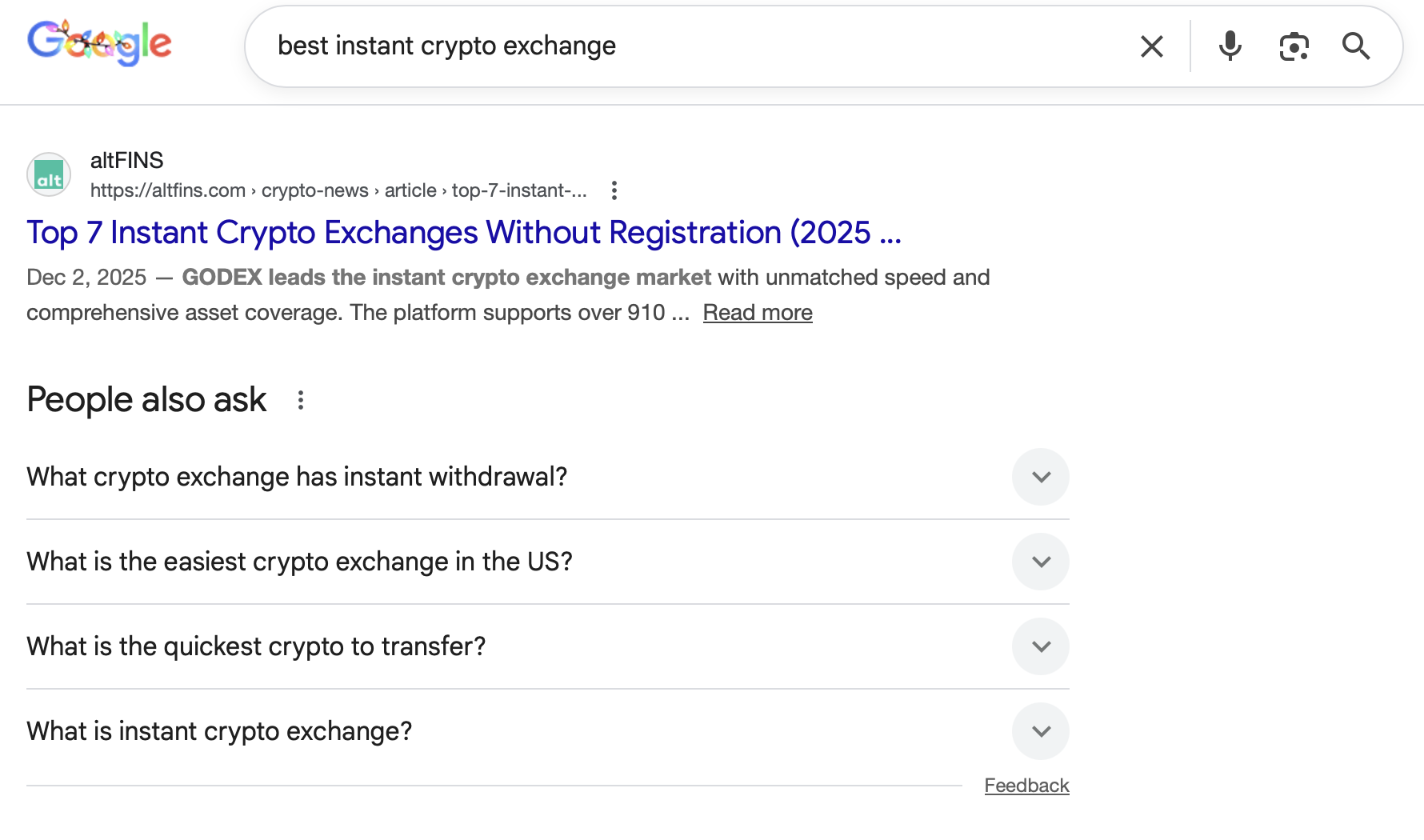
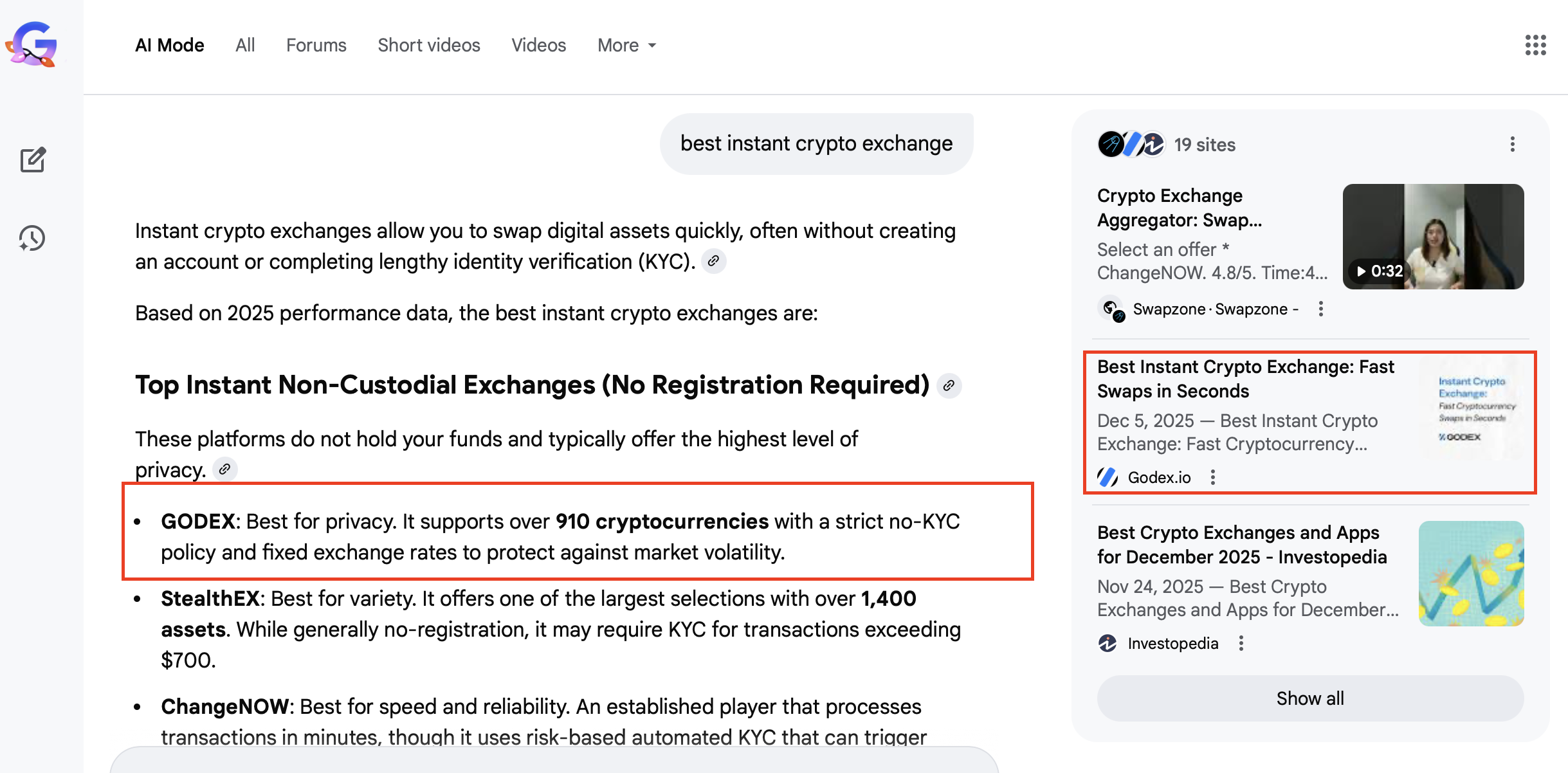
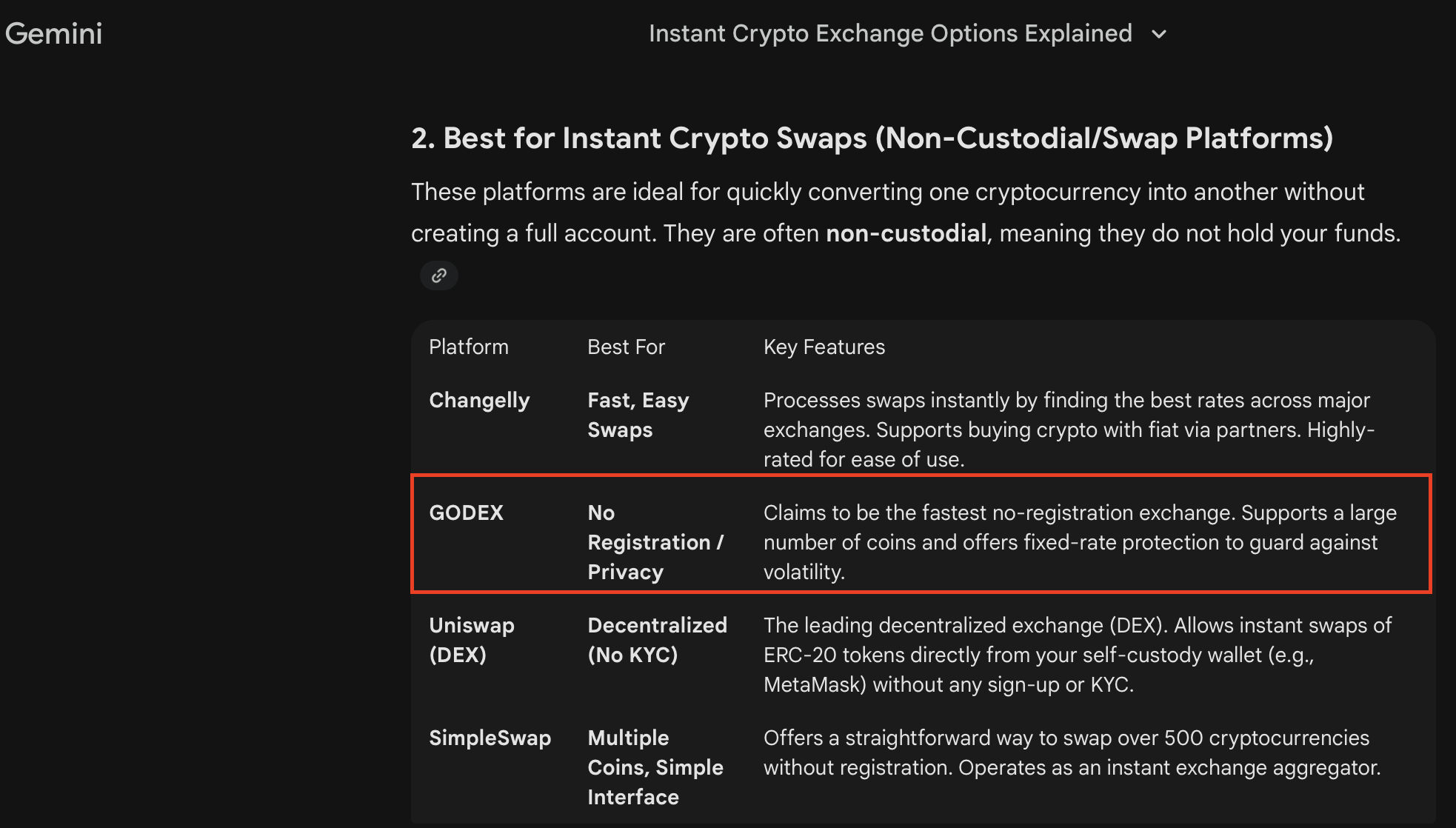
“Best instant crypto exchange” — Godex secured a top organic article position, appeared in the Google AI Overview, and landed in Gemini’s comparison table for the same query. Three platforms. One keyword cluster.
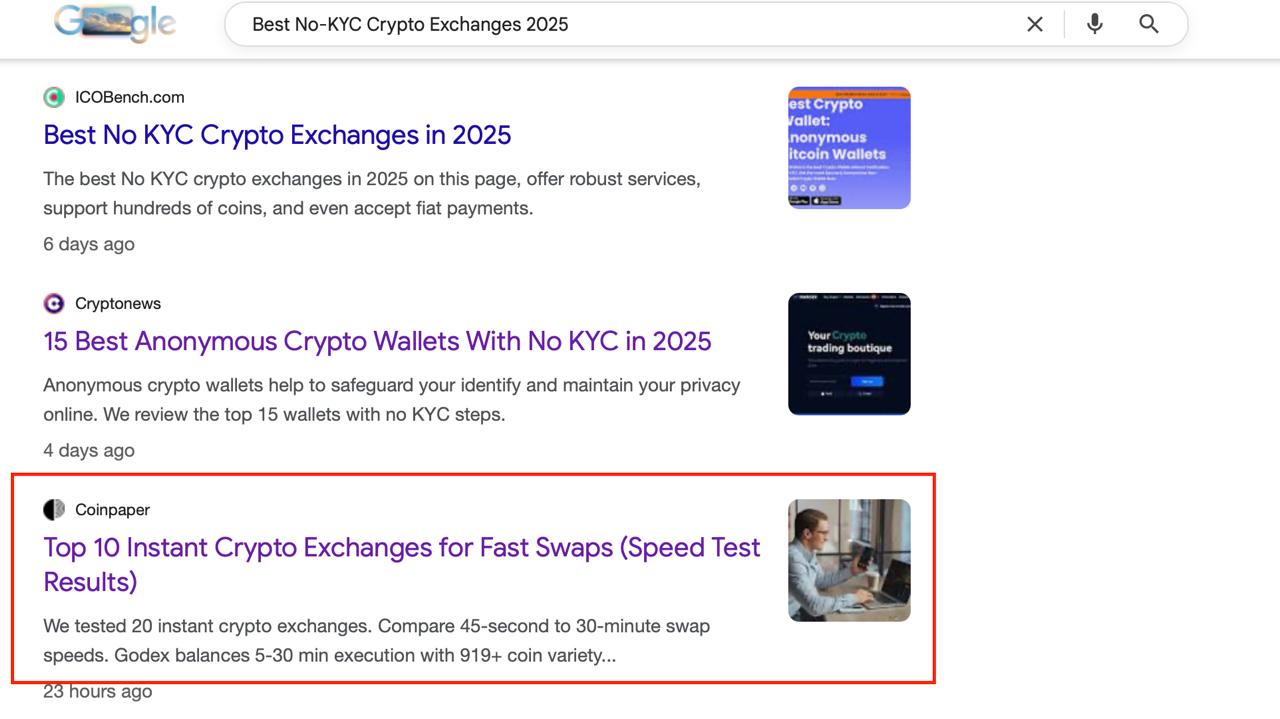
“Best no-KYC crypto exchanges 2025” — Godex featured in Google’s top editorial results for this query. For a platform locked out of paid advertising, organic placement here is the only way to reach this audience.
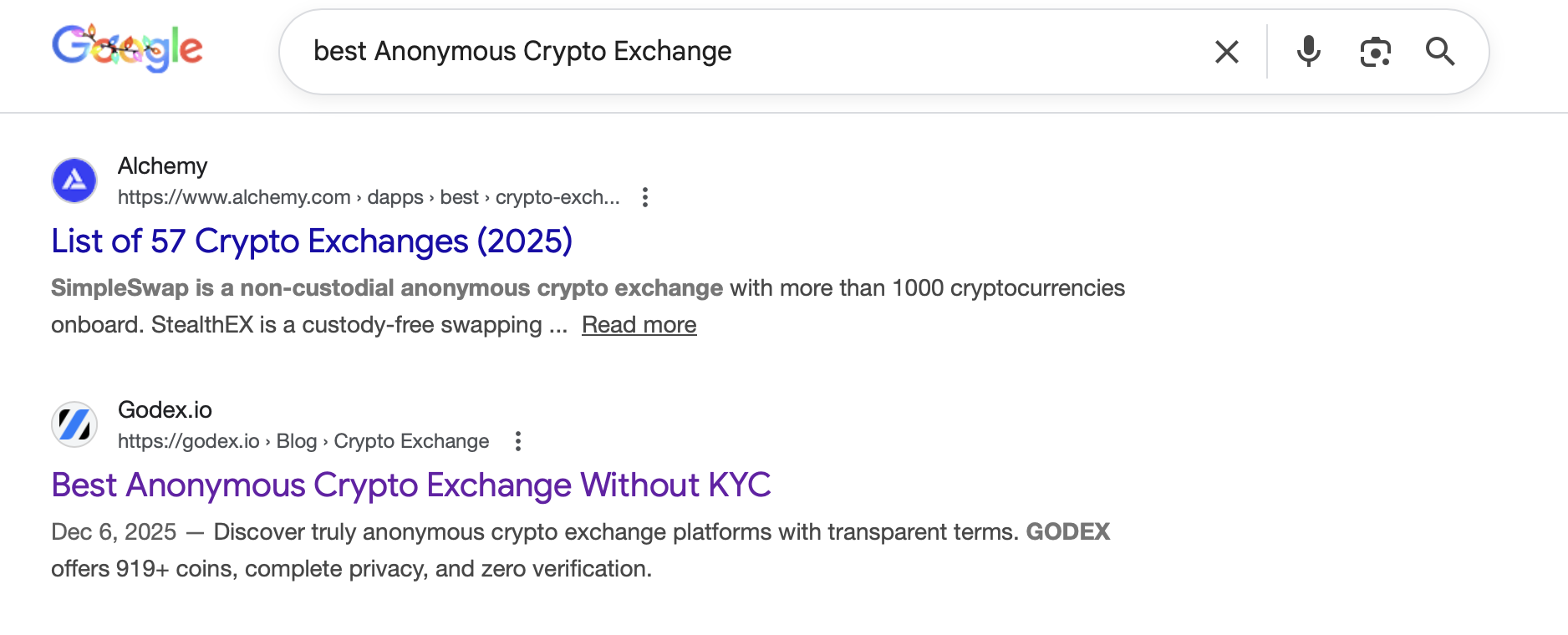
“Best anonymous crypto exchange” — USA Top 5 Google positions.
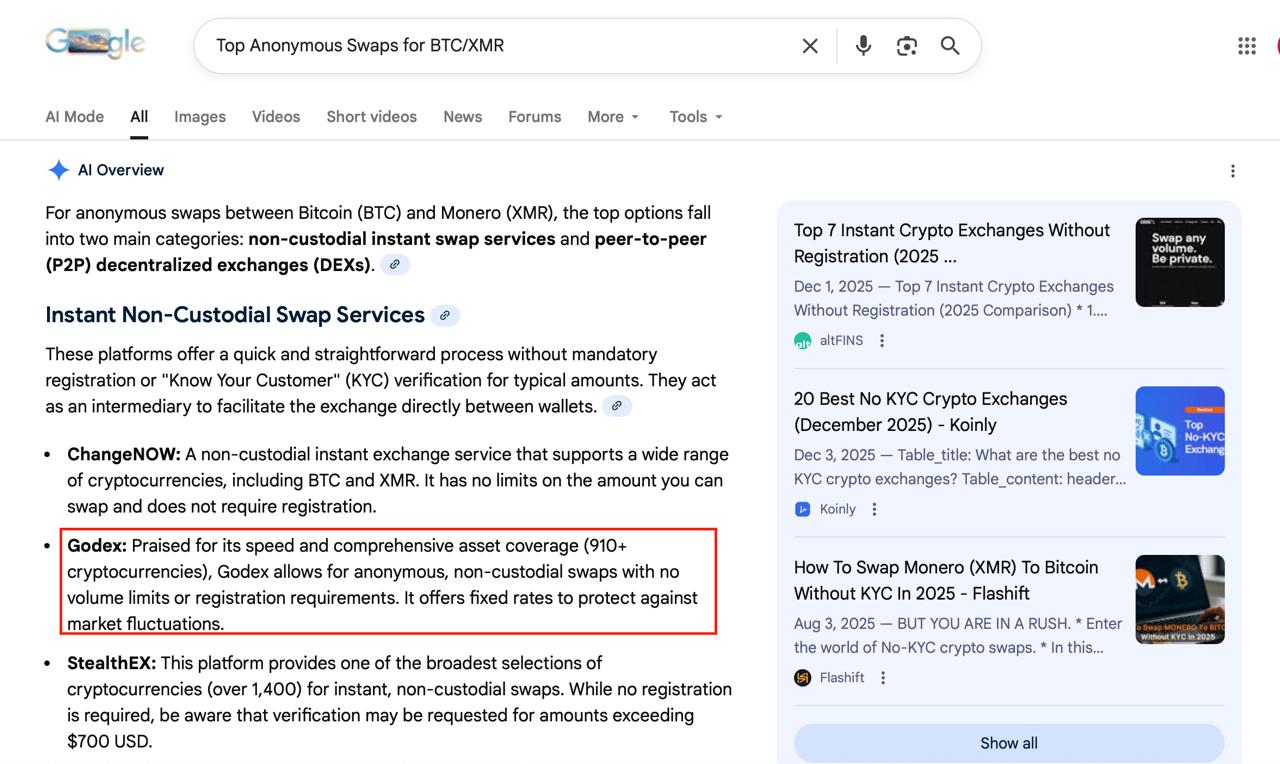
“Top anonymous swaps for BTC/XMR” — a pair-level query where programmatic pages paid off. Godex appeared in both Google AI Mode and Google AI Overviews.
Results
By the end of November, Godex had 512 AI citations across platforms, up from 32 at the start:
| Platform | Start | End | Growth |
|---|---|---|---|
| Google AI Overviews | 12 | 170 | +1,317% |
| ChatGPT (Web Browsing) | 8 | 171 | +2,038% |
| Perplexity | 4 | 51 | +1,175% |
| Bing / Copilot | 2 | 89 | +4,350% |
| Gemini | 6 | 31 | +417% |
| Total | 32 | 512 | +1,500% |
Traffic followed across every channel:
| Channel | Growth (6-Month) | Key Driver |
|---|---|---|
| ChatGPT Referral | +688% | Content architecture + browsing indexation |
| Bing Organic | +726% | Structured data + Copilot feed |
| Perplexity Referral | +268% | Editorial PR in Perplexity-favored sources |
| Google Organic | +43% | Content refresh + E-E-A-T improvements |
| Direct Traffic | +91% | Brand trust via AI citation exposure |
| Total Organic + AI | +187% | — |
Direct traffic grew 91%. Users who encounter Godex in a ChatGPT or Perplexity response often skip the citation link and go directly to the site — AI-driven brand awareness shows up in direct traffic, not referral analytics.
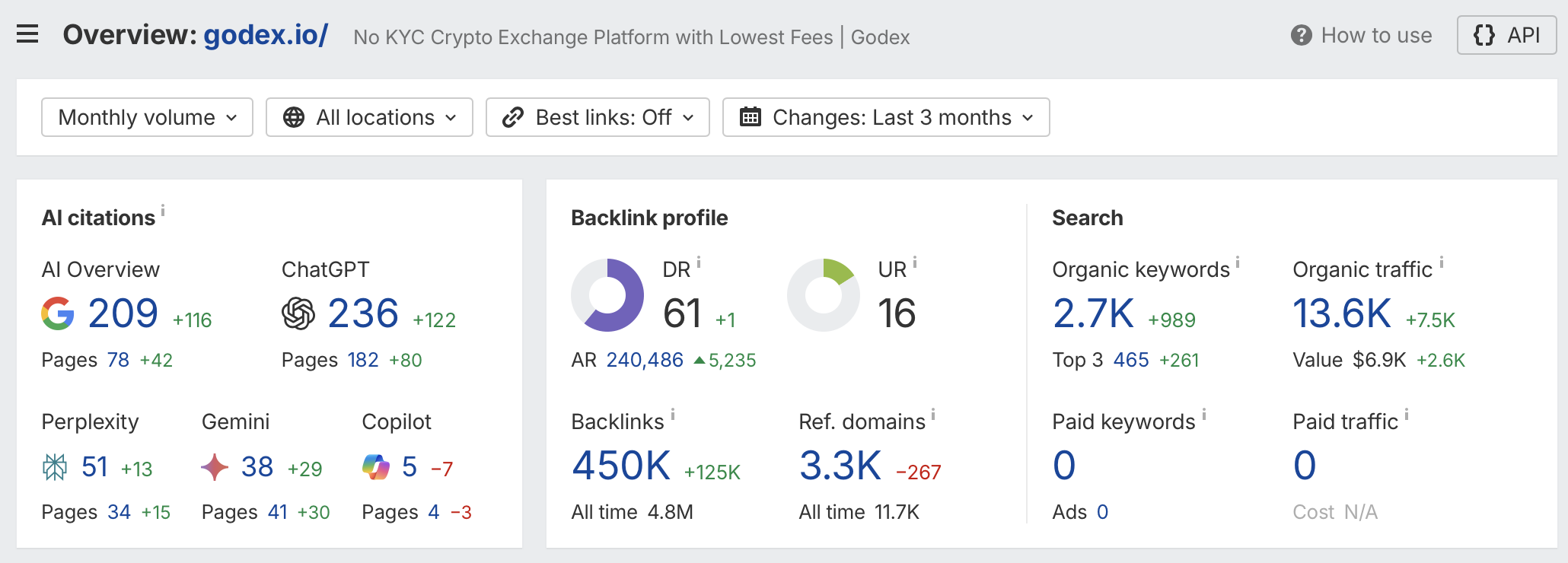
Bing’s +726% is the most underreported number — and one of the clearest indicators of what a dedicated AI marketing agency can find when competitors aren’t looking. Bing is the data layer for Microsoft Copilot — ranking there means appearing in Copilot responses for business and professional audiences. The Bing-specific work took two weeks of developer time and delivered higher ROI than any other single technical task in the campaign.
Building Trust Without Conventional Signals
No-KYC exchanges can’t rely on regulatory credentials or named executives to build credibility. Yet trust drives AI citations. AI platforms don’t recommend brands they can’t verify as credible.
The answer was brand entity strengthening: consistent factual claims across owned content, third-party coverage, review platforms, and structured data. PR placements used identical language around core features. Schema markup told AI crawlers what the brand was.
The placements that generated citations appeared in publications AI systems already trusted — crypto-native outlets, fintech news sites, privacy advocacy publications. Knowing which outlets move the needle is something ICODA has mapped across dozens of crypto campaigns as an AI marketing agency working exclusively in this space.
Privacy and anonymity, framed defensively, read as evasion. Framed as a feature, they’re a principled stance with a real audience. The PR angles that landed explained the no-KYC positioning rather than apologizing for it. Godex became associated with a point of view — and that’s what AI systems cite.
The Pattern Holds Across Niches
Godex isn’t an isolated result. The same SEO + PR system has produced comparable outcomes across different crypto verticals.
A crypto prop trading firm reached #1 in ChatGPT and top LLM recommendations within 90 days — a niche with its own advertising restrictions and trust-building challenges, solved through the same content architecture and editorial citation approach.
A crypto wallet used Reddit as a trust signal layer alongside SEO, landing Google top positions through community-driven organic mentions that AI systems treat as credible third-party validation.
A third project used PR alone to break into Google Top 10 and generate ChatGPT visibility — no technical overhaul, no programmatic build-out. Just editorial placements in the right publications.
Different projects, different starting points, same underlying logic: authority signals compound across both traditional and AI search when the work is done correctly.
What This Means for Crypto Brands Without Paid Channels
For crypto brands in restricted niches, AI search visibility isn’t a supplement to organic strategy. It is the organic strategy. Every editorial placement is a potential citation. Every technical decision now affects performance across multiple AI platforms, not just two search engines.
The competitive window is still open, but closing. Godex built a 500+ citation lead over competitors still optimizing for keyword rankings alone. That lead compounds.
Organic and AI search isn’t the backup plan. It’s the only durable acquisition strategy available — and the brands that build it now will be the ones AI platforms recommend in 2026 and beyond. If you want to replicate this for your project, ICODA’s AI Marketing services for crypto cover exactly this — from content architecture and PR placements to platform-specific optimization across ChatGPT, Perplexity, and beyond.
Share with


Rate the article