




AI content creation tools are software platforms that use large language models and generative AI to produce written, visual, or video content for marketing, publishing, and brand communication. Adoption has reached 87% among marketing teams (Salesforce State of Marketing, 2026), 94% plan to use AI in content creation this year (HubSpot State of Marketing, 2026), and the market is projected to hit $80.12 billion by 2030 (Grand View Research). The question is no longer whether to use AI — it is which tools earn their cost and how to combine them without the sprawl.
The right AI tools compress entire production cycles — research, drafting, design, video, SEO — into workflows a lean team can run in hours, automating repetitive work and freeing capacity for. This guide ranks six tools by output quality, workflow fit, SEO impact, and AI answer engine citability (Generative Engine Optimization, or GEO — optimizing content so LLMs like ChatGPT, Gemini, and Perplexity cite it as a source). Answer Engine Optimization (AEO) structures content for featured snippets and zero-click answers; query fan-out — one question triggering multiple sub-queries across AI platforms and traditional search — makes multi-channel visibility essential.
Why Trust This List: Our Evaluation Methodology
ICODA’s content team has run campaigns for 500+ clients across crypto, fintech, SaaS, and iGaming for seven years — and now these tools are part of our daily production stack. We scored each on five criteria:
- Output quality (editor-ready with minimal revision);
- Workflow integration (CMS, SEO, and publishing compatibility);
- SEO + AI visibility (ranks in Google and gets cited by ChatGPT, Perplexity, and AI Overviews);
- Real-tier value (tested at paid plans, not free demos);
- Output consistency across dozens of use cases.
Quick Comparison: 6 Best AI Content Creation Tools at a Glance
| Tool | Best For | Starting Price | SEO Features | AI Visibility Features | Key Limitation |
|---|---|---|---|---|---|
| Jasper | Marketing teams & brand consistency | $59/mo (Pro) | Surfer SEO integration, Content Score | Brand voice across AI outputs | Requires setup investment; overbuilt for solo creators |
| Surfer SEO | SEO-optimized content | $99/mo (Essential) | Content Editor, SERP Analyzer, Topical Map | AI Tracker, AIO monitoring, Citation tracking | Not for creative or brand storytelling |
| Claude | Long-form writing & research | $20/mo (Pro) | None native (pairs with SEO tools) | Web search grounding, structured research | No built-in brand voice or campaign management |
| Canva AI | Design & visual content | $15/mo (Pro) | None | None | AI image quality below dedicated generators |
| Descript | Video & podcast editing | $24/mo (Creator) | Auto-generated SEO descriptions | AI captions, transcript-based content | Optimized for spoken-word, not cinematic production |
| Midjourney | AI image generation | $10/mo (Basic) | None | None | Learning curve; primarily Discord-based |
Jasper — Best for Marketing Teams and Brand-Consistent Content at Scale
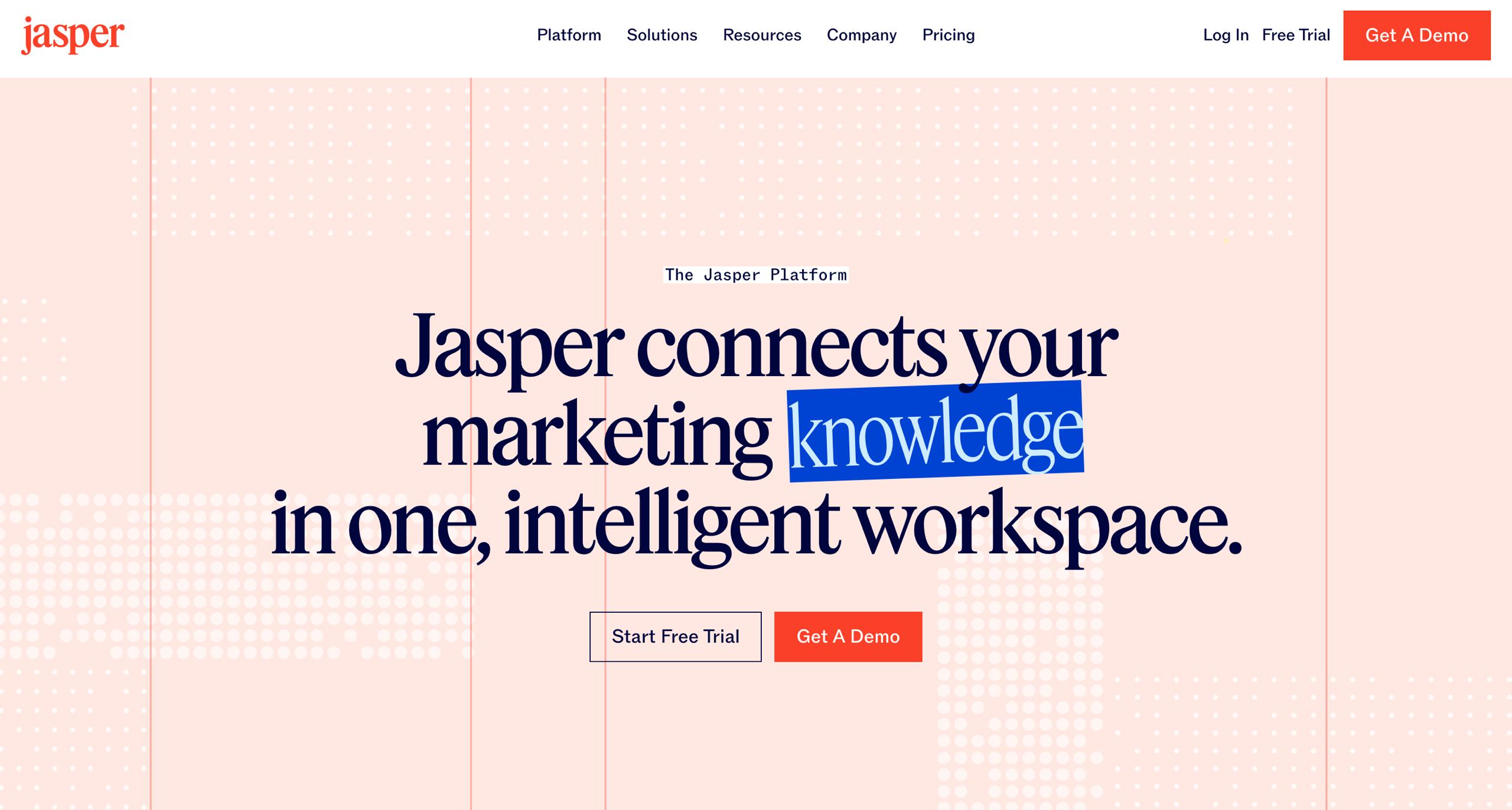
Use it for: High-volume marketing campaigns, multi-brand agencies, and teams that need on-brand output across email, blog, ads, and social — all from one brief.
Jasper routes prompts through multiple LLMs (GPT-4o, Claude, proprietary models), selecting the best engine per task. Its brand voice system enforces style guidelines across blogs, emails, ads, and social content at scale. Content Pipelines turn one campaign brief into coordinated multi-channel assets. Surfer SEO integration adds real-time scoring; the browser extension works inside WordPress and HubSpot.
Limitations. Requires setup time. Overbuilt for solo creators.
Best for: Teams producing 10+ pieces per week across multiple channels.
Surfer SEO — Best for SEO-Optimized Content and AI Search Visibility
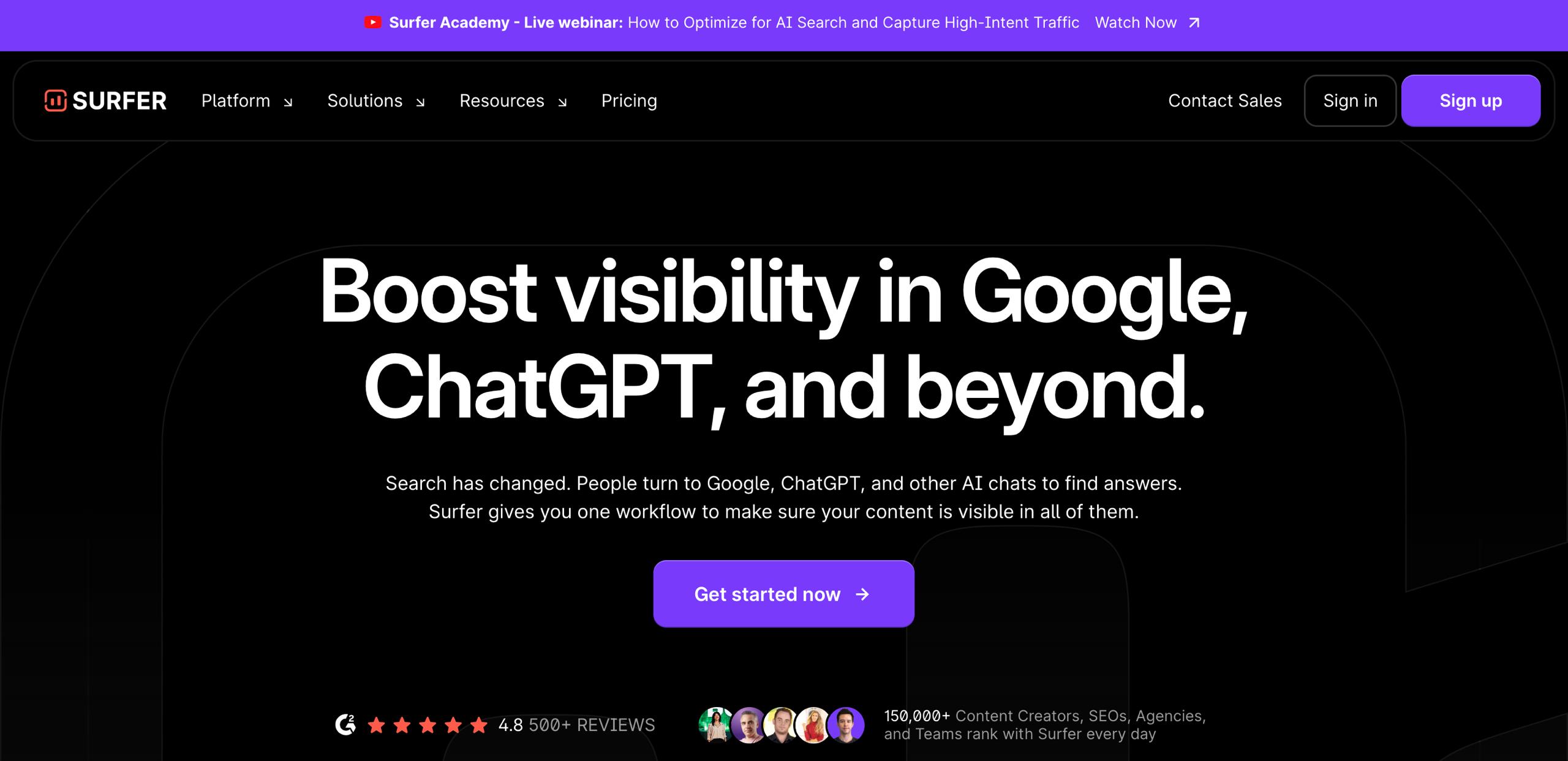
Use it for: SEO-driven blog content, topical authority building, and tracking how often your brand gets cited by AI search engines.
Surfer is an AI visibility platform, not a general-purpose writer. Its Content Editor scores content against top-ranking pages in real time — keywords, structure, semantic coverage. Surfer AI analyzes ~300,000 words of competitor content before drafting, producing articles that need less revision than standard LLM output. The standout feature: AI Tracker monitors citation frequency across ChatGPT, Gemini, Perplexity, and AI Overviews. Topical Map builds the authority clusters AI models draw from. No competing content tool goes this deep on AI citation insight.
Limitations. Built for search-intent content — not creative copy or social media.
Best for: SEO teams who need content that ranks in Google and gets cited by AI answer engines.
Claude — Best for Long-Form Writing, Research, and Nuanced Content
Use it for: Long-form articles, whitepapers, case studies, and any content where reasoning quality and original analysis matter more than speed.
Claude maintains a consistent editorial voice across long outputs where other LLMs drift. Its 200K-token context window processes entire documents, research reports, and competitor articles in one conversation. Built-in web search grounds outputs in current data; file analysis handles spreadsheets directly. Feed it a detailed brief and it returns drafts that read like a senior strategist wrote them. Pair with Surfer SEO for optimization.
Limitations. No brand voice training, campaign management, or native SEO scoring.
Best for: Writers producing research-heavy, long-form content where depth and originality matter most.
Canva AI — Best All-in-One Platform for Design, Visual Content, and Social Assets
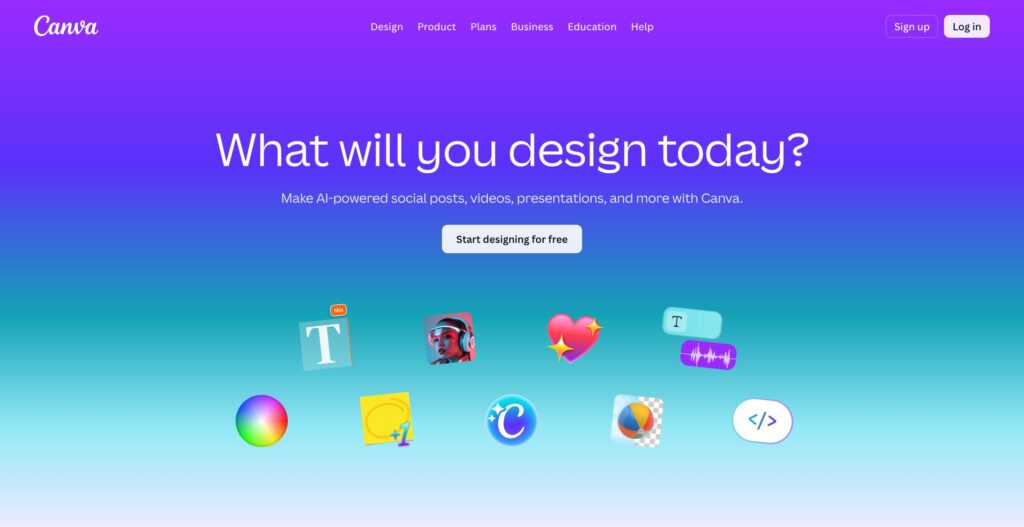
Use it for: Social media graphics, presentation decks, email headers, and any visual asset a lean team needs to produce quickly and consistently.
Magic Design generates branded layouts from a prompt. Magic Write handles copy inside the editor. Magic Media creates images and short videos. Brand Kit enforces fonts, colors, and logos across every asset. A social media manager can go from concept to platform-resized, scheduled post without leaving the app — no designer required.
Limitations. AI image quality trails Midjourney. Video covers basics only.
Best for: Solo creators and small teams who need visual content fast without specialized design skills.
Descript — Best for Video and Podcast Editing with AI-Powered Workflow
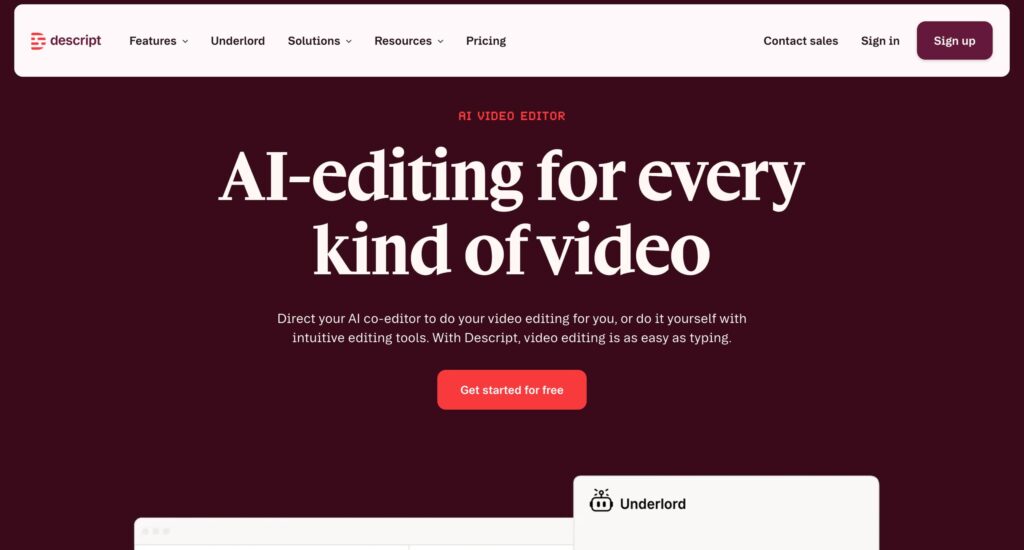
Use it for: Editing interviews, webinars, podcasts, and tutorials — then repurposing them into clips, transcripts, and blog posts without switching tools.
Descript lets you edit video by editing text — delete a line from the transcript, it disappears from the video. Editing time drops an estimated 60–70%. Underlord handles cuts, silence removal, and captions via plain-language commands. Studio Sound upgrades audio to professional quality. Overdub fixes spoken mistakes by typing corrections in your cloned voice. New in 2026: text-to-video generation, AI avatars, and 30+ language dubbing.
Limitations. Built for spoken-word content — not cinematic production or VFX.
Best for: Podcasters, YouTubers, and teams producing regular video or audio.
Midjourney — Best for High-Quality AI Image Generation
Midjourney produces photorealistic images, stylized illustrations, and brand visuals that creative directors actually approve — the quality gap versus DALL-E, Stable Diffusion, and Adobe Firefly remains wide, especially on complex compositions and lighting. Style references maintain visual consistency across a content series. Aspect ratio controls output platform-ready formats (16:9, 9:16, 1:1). Use it for hero-level creative; Canva for everyday layout work.
Use it for: Hero images, article headers, YouTube thumbnails, and brand visuals where stock photos or generic AI images are not good enough.
Limitations. Prompt craft takes 1–2 weeks to develop. Primarily Discord-based. Check commercial licensing terms.
Best for: Creators and agencies who need publication-ready custom visuals.
How to Build Your AI Content Stack — Choosing, Combining, and Budgeting Without Sprawl
Choosing the right ai tools for content creation starts with identifying your primary content bottleneck. If writing is your bottleneck, invest in a strong writing tool first. If distribution across formats is the problem, prioritize video and visual tools. If content ranks but gets no AI visibility, start with an SEO and AEO optimization platform. Tool selection flows from strategy — not the other way around.
The Tool Sprawl Problem
Most small marketing teams accumulate AI subscriptions reactively. Someone signs up for a writing tool. Then a design tool. Then a video editor. Then an “all-in-one” platform that quietly duplicates features they already pay for elsewhere. Within six months, the team is spending $200+/month on overlapping capabilities and using 40% of what they pay for.
The fix is intentional stack architecture: identify which tools cover which production stages, eliminate overlaps, and invest in platforms that integrate with each other rather than compete.
Recommended Stacks by Team Size
| Solo Creator | Small Team (2–4) | Growth Team (5+) | |
|---|---|---|---|
| Budget | $50–80/mo | $120–200/mo | $250–400/mo |
| Writing | Claude Pro | Jasper Pro | Jasper Business + Claude Team |
| SEO & AI Visibility | — | Surfer SEO | Surfer SEO |
| Design | Canva Pro | Canva Pro | Canva Pro + Midjourney |
| Video | Descript (free) or Opus Clip | Descript Creator | Descript Business |
| Add when ready | Midjourney (if visuals matter) | Midjourney | AEO monitoring layer |
The Human-in-the-Loop Imperative
The teams seeing real ROI from AI content tools in 2026 follow a consistent pattern: AI handles research, first drafts, formatting, and distribution optimization. Humans handle strategy, original insights, brand voice refinement, and quality review. AI handles final optimization and repurposing across formats.
This is not a philosophical position. It is a practical one. AI-generated content that publishes without human review consistently underperforms on engagement, bounce rates, and long-term ranking stability. The tools accelerate production. Humans ensure the output is worth producing.
The AEO/GEO Layer: The Most Overlooked Selection Criterion
Here is the selection criterion that virtually no competitor guide mentions: does this tool help your content get cited by AI answer engines?
In 2026, ChatGPT, Perplexity, Gemini, and Google AI Overviews answer hundreds of millions of queries daily. When these systems cite your content as a source, you earn visibility that traditional SEO cannot deliver. Content structure, topical authority, entity optimization, and schema markup all influence whether AI systems select your content — and most AI writing tools are completely blind to these signals.
This is why Surfer SEO’s AI Tracker and Topical Map capabilities matter so much. And it is why your tool stack should include at least one platform that measures and optimizes for AI search visibility, not just traditional rankings.
Common Mistakes to Avoid
- Publishing AI first drafts without editorial review;
- Relying on a single LLM for every content type;
- Ignoring video and visual content in favor of text-only output;
- Neglecting AI-generated content disclosure requirements on YouTube, TikTok, and other platforms that now mandate transparency about synthetic media;
- Choosing tools based on feature lists rather than actual output quality under your specific production conditions.
Conclusion: Why the Right Tools Only Work with the Right Strategy
The best AI writing and visual creation tools in 2026 amplify human strategy rather than replace it. The teams generating real ROI are not the ones with the most tools. They are the ones that match tools to workflows, maintain brand voice across every output, and optimize for both traditional search and AI answer engines simultaneously.
Tool selection is one piece of the puzzle. The strategy behind how content is planned, optimized for discoverability, and distributed across channels determines whether AI tools deliver measurable pipeline growth or just produce more noise at lower cost.
If the complexity of building a content engine that performs across Google, AI Overviews, ChatGPT, and Perplexity feels overwhelming — that is exactly the gap an AI Marketing partner fills. The right strategic layer turns individual tool investments into a coordinated system that drives traffic, earns citations, and converts. Not more content. Better content, in the right places, found by both humans and machines.
Frequently Asked Questions (FAQ)
There is no single best tool — it depends on your use case. Jasper leads for marketing teams needing brand-consistent content at scale. Surfer SEO is strongest for search and AI visibility optimization. Claude excels at long-form, research-heavy writing. Canva AI covers design and social visuals. Descript handles video and podcasts. Midjourney produces the highest-quality AI images.
Pricing varies by use case. Claude Pro starts at $20/mo, Canva Pro at $15/mo, and Midjourney at $10/mo for individual creators. Jasper Pro starts at $59/mo, Surfer SEO Essential at $99/mo, and Descript Creator at $24/mo for teams. Most offer annual billing discounts of 15–20%.
Start with your bottleneck. If writing is the constraint, prioritize a strong LLM (Claude or Jasper). Add Surfer SEO for optimization, Canva AI for visuals, and Descript for video only when each stage becomes a bottleneck. Limit your stack to tools that integrate with each other and cover distinct production stages.
Most cannot — but Surfer SEO is a direct exception. Its AI Tracker monitors citation frequency across ChatGPT, Gemini, and Perplexity. Its Topical Map builds the authority clusters AI models draw from when selecting sources. For broader GEO strategy, pairing Surfer with a structured content plan and strong entity coverage gives the best results.
Yes, when it meets quality standards. Google’s stance is that helpful, original, well-structured content ranks regardless of how it was produced. The risk is publishing unreviewed AI drafts — these tend to underperform on engagement and ranking stability. Human editorial review remains essential for long-term SEO performance.
Share with


Rate the article