




Introduction
What if everything you knew about search visibility was about to change? According to Bain & Company research, about 60% of Google searches now end without a click [1]. Users get their answers directly from the search results page — or increasingly, from AI assistants like ChatGPT, Perplexity, and Google’s AI Overviews.
Think about your own behavior. When you need a quick answer, do you scroll through ten blue links, or do you ask an AI directly? If you’re like most people, the latter is becoming second nature. In fact, 80% of consumers now rely on AI-generated summaries for at least 40% of their searches, reducing organic website traffic by an estimated 15–25% [2].
This shift creates a significant problem for businesses still focused exclusively on traditional SEO. You might rank on page one, but if an AI summarizes your competitor’s content in a direct answer — and users never click through to your site — your visibility effectively drops to zero.
But here’s the opportunity: most businesses haven’t caught on yet. They’re still playing the old game while the rules are changing. AI-driven search traffic has grown sevenfold since 2024, with ChatGPT alone now accounting for nearly 78% of all AI referral traffic worldwide [3]. Those who understand how to optimize for answer engines now will capture the visibility that others miss entirely.
What Is Answer Engine Optimization?
Answer Engine Optimization (AEO) is the practice of optimizing your content to be selected, summarized, and cited by AI-powered systems that provide direct answers to user queries.
Unlike traditional search engines that present a list of links for users to explore, answer engines synthesize information from multiple sources and deliver a consolidated response. These systems include Google AI Overviews (formerly SGE), ChatGPT’s browsing capabilities, Perplexity AI, Gemini, and similar tools. What they share in common is a fundamental goal: give users the answer they need without requiring them to visit multiple websites.
This doesn’t mean traditional SEO is dead. Far from it. AEO is better understood as an evolution of SEO — a new layer that builds on existing best practices while requiring additional considerations. Your content still needs to rank well to be discovered by AI systems in the first place. But ranking alone is no longer enough. And while the fundamentals are shifting, keywords still play a role — they just need to be approached differently in an AI-first context.
The critical shift is this: in traditional SEO, success meant appearing on page one. In AEO, success means being the source that AI chooses to cite when formulating its response. Your goal moves from “get the click” to “be the trusted authority the AI references.”
This matters because user behavior is fundamentally changing. When someone asks ChatGPT “What’s the best project management tool for remote teams?” they’re not looking for a list of links to explore. They want an answer. If your content provides that answer clearly, authoritatively, and in a format AI can easily process, you become the cited source. If it doesn’t, you’re invisible — regardless of your search rankings.
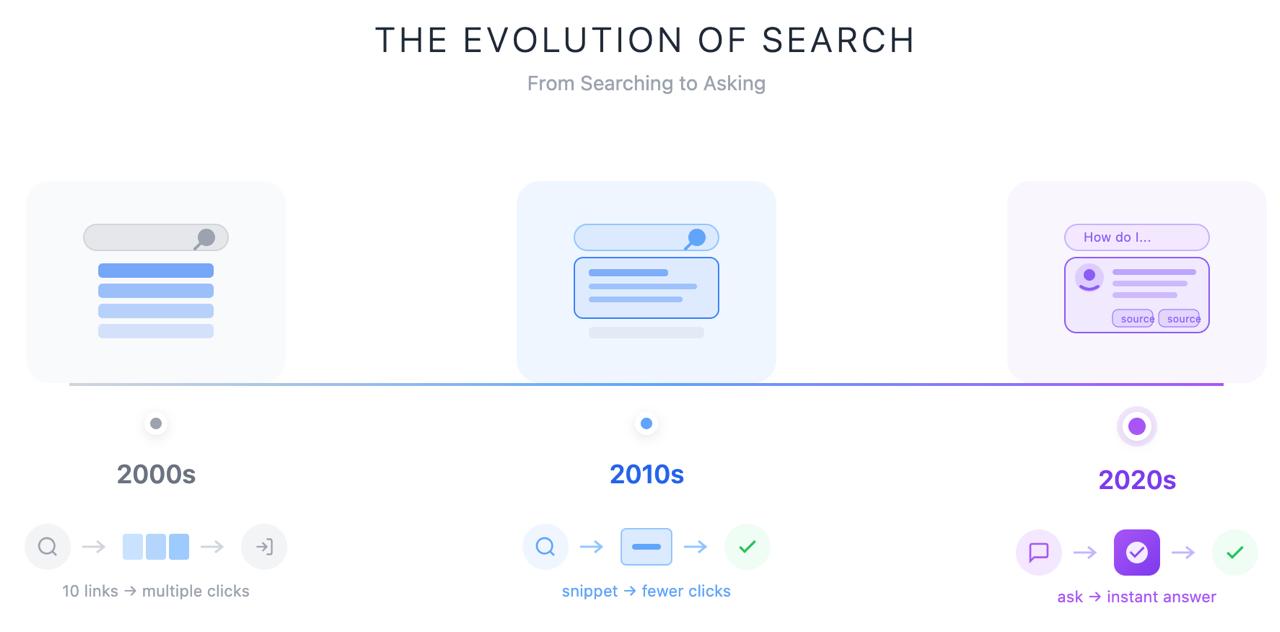
The businesses that understand this shift are positioning their content not just for human readers, but for the AI intermediaries that increasingly stand between their content and their audience.
How AI Chooses What Content to Cite
This is where strategy really matters. Understanding how answer engines select and cite content gives you a significant advantage over competitors who are still guessing.
Answer engines don’t simply grab the first search result and summarize it. They employ sophisticated processes to evaluate, cross-reference, and synthesize information from multiple sources. Here’s what actually influences their selection:
Authority and Trust Signals
AI systems are trained to identify authoritative sources. They look for signals like domain reputation, author expertise, citations from other reputable sources, and consistency of information across the web. If your content contradicts widely accepted information without strong supporting evidence, AI systems will likely favor other sources.
This is why E-E-A-T (Experience, Expertise, Authoritativeness, Trustworthiness) matters more than ever. Content that demonstrates genuine expertise — through detailed explanations, original research, or clear credentials — gets prioritized.
Clarity and Directness
AI systems favor content that provides clear, direct answers to questions. If a user asks “How do I calculate customer acquisition cost?” the AI is looking for content that answers that question concisely, ideally within the first few paragraphs.
Content that buries the answer beneath lengthy introductions, excessive context, or keyword-stuffed filler gets passed over. The AI needs to extract a usable response efficiently.
Structure and Format
Well-structured content with clear headings, logical hierarchy, and organized information is significantly easier for AI to process. Lists, tables, step-by-step instructions, and FAQ formats give AI systems clean data to work with.
When your content is structured around questions and answers, you’re essentially pre-formatting it for AI consumption.
Freshness and Relevance
For topics where recency matters — like technology trends, market data, or current events — AI systems factor in content freshness. Outdated information, even from authoritative sources, may be deprioritized in favor of current material.
Cross-Source Verification
Answer engines don’t rely on single sources. They cross-reference information across multiple websites to verify accuracy. If your content aligns with and expands upon widely corroborated information, it’s more likely to be cited. If it contains unique claims without support, AI systems may treat it with skepticism.
Real-World Query Examples
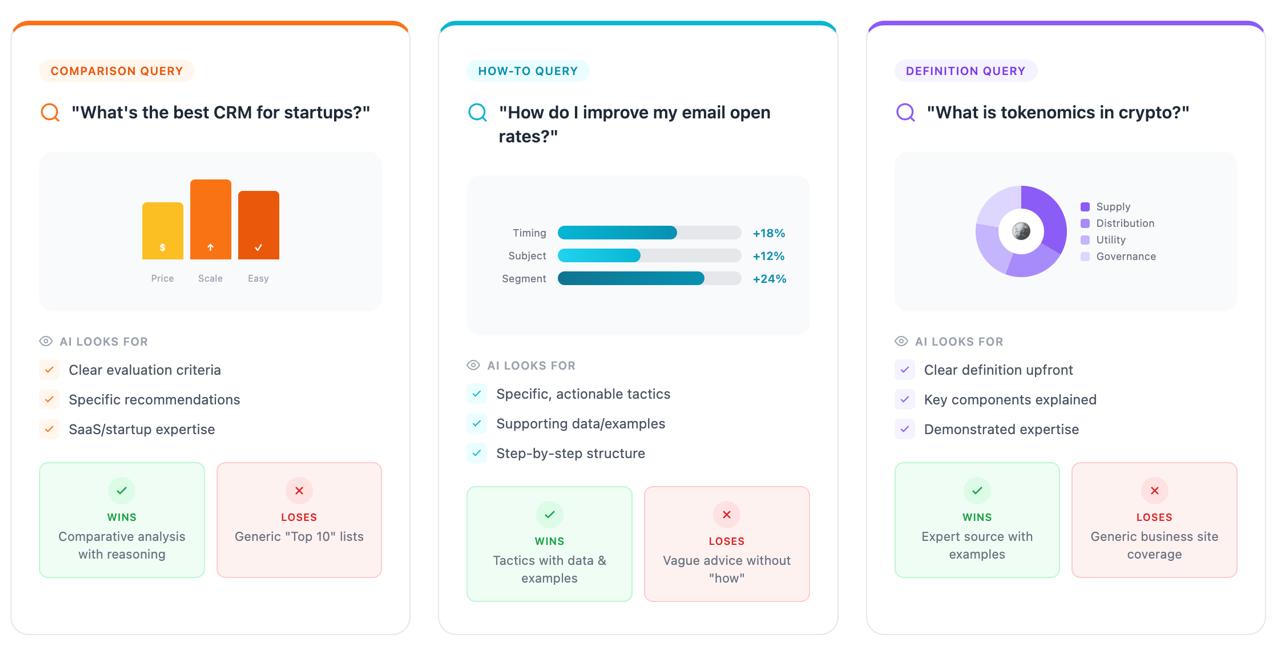
To make this concrete, consider how AI might handle these common queries:
Query: “What’s the best CRM for startups?”
An AI would look for content that defines clear criteria (pricing, scalability, ease of use), provides specific recommendations with reasoning, and demonstrates expertise in the startup/SaaS space. Generic “top 10” lists without substantive analysis would likely lose to content that offers genuine comparative insight and addresses specific startup needs.
Query: “How do I improve my email open rates?”
The AI would favor content that provides specific, actionable tactics (optimal send times, subject line strategies, list segmentation) with supporting data or examples. Content that offers vague advice like “write better subject lines” without explaining how would be deprioritized.
Query: “What is tokenomics in crypto?”
For this query, AI would seek content that provides a clear definition, explains key components, and ideally includes examples. Content from sources with demonstrated blockchain expertise would be favored over generic business sites covering the topic superficially.
The common thread? AI rewards content that directly, clearly, and authoritatively answers the question being asked. The better you understand your audience’s questions and the more precisely you answer them, the more likely you are to be cited.
Traditional Content vs. AEO-Optimized Content
Understanding the practical differences between traditional SEO content and AEO-optimized content helps clarify what changes you need to make. While there’s significant overlap — good content remains good content — the emphasis shifts.
Traditional SEO content typically focuses on keyword placement, length for “comprehensiveness,” and optimizing for click-through from search results. AEO-optimized content prioritizes answer clarity, structural accessibility for AI parsing, and establishing genuine authority.
Here’s a direct comparison:
| Aspect | Traditional SEO Content | AEO-Optimized Content |
|---|---|---|
| Primary Goal | Rank on page one, earn clicks | Be cited as authoritative source by AI |
| Content Structure | Often front-loaded with keywords, answer may appear anywhere | Direct answer near the top, clear hierarchical structure |
| Format Preference | Long-form for “comprehensiveness” | Concise, scannable, with clear Q&A sections |
| Keyword Approach | Target keywords and variations throughout | Target questions and conversational queries |
| Success Metric | Rankings, organic traffic, CTR | AI citations, brand mentions, referral quality |
| Authority Signals | Backlinks, domain authority | E-E-A-T signals, expert authorship, cross-source verification |
The key insight: AEO doesn’t replace good SEO fundamentals, but it does require you to think differently about content structure and intent. You’re optimizing for a reader who may never visit your site — the AI that summarizes your content for the end user.
How to Optimize Your Content for Answer Engines
Let’s get practical. Here are the specific strategies you can implement to improve your content’s chances of being selected and cited by answer engines.
01 Identify Question-Based Search Intent
Start by understanding how your audience actually phrases their queries. People asking AI assistants tend to use natural, conversational language. Instead of typing “CRM software comparison,” they ask “What CRM should I use for my small business?”
Use tools like AnswerThePublic, Google’s “People Also Ask” sections, and actual AI interfaces to research how questions in your niche are being phrased. Build content that directly addresses these question formats.
Why AI favors this: Answer engines are literally designed to answer questions. Content structured around actual questions matches user intent precisely.
02 Structure Content for Direct Answers
Provide a clear, concise answer to the main question within the first 100-150 words of your content. Then expand with context, details, and supporting information.
Think of it as the “inverted pyramid” approach from journalism: lead with the most important information, then provide supporting details for those who want to go deeper.
Why AI favors this: AI systems can extract your core answer efficiently without parsing through introductory content. The easier you make extraction, the more likely you are to be cited.
03 Use Clear Headings and Logical Hierarchy
Structure your content with descriptive H2 and H3 headings that often mirror questions or clearly state what each section covers. Avoid clever or vague headings in favor of clarity.
For example, use “How to Calculate Customer Lifetime Value” rather than “The Numbers That Matter Most.”
Why AI favors this: Clear hierarchical structure helps AI understand content organization and locate relevant sections for specific queries.
04 Implement Schema Markup
Schema markup is structured data code that helps search engines and AI systems understand your content’s context. FAQ schema, How-To schema, and Article schema are particularly relevant for AEO.
While implementing schema requires some technical knowledge, most modern CMS platforms offer plugins or built-in tools that make it accessible. At minimum, ensure your content includes FAQ schema when answering multiple related questions.
Why AI favors this: Schema markup provides explicit signals about content type and structure, making it easier for AI to categorize and extract relevant information.
05 Build Topical Authority
Rather than creating isolated pieces of content, develop comprehensive coverage of your topic areas. Create content clusters with pillar pages and supporting articles that interlink and demonstrate deep expertise.
When AI systems see consistent, high-quality content across a topic area, they’re more likely to view your site as authoritative in that space.
Why AI favors this: AI systems assess source authority partly by evaluating the breadth and depth of expertise demonstrated across a domain.
06 Keep Content Fresh and Updated
Regularly audit and update your existing content. Add new information, refresh statistics, remove outdated references, and update publication dates when making substantial changes.
For fast-moving industries, this is particularly critical. Content from 2022 about AI trends, for instance, is already significantly outdated.
Why AI favors this: For topics where recency matters, AI systems prioritize fresh information. Updated content signals active maintenance and current relevance.
Common AEO Mistakes
Even well-intentioned optimization efforts can go wrong. Here are the mistakes that most commonly undermine AEO effectiveness:
| Mistake | Why It Hurts AI Visibility | How to Fix |
|---|---|---|
| Writing for keywords, not questions | AI matches content to user questions; keyword-stuffed content often misses actual query intent | Research actual questions your audience asks; structure content as Q&A |
| Burying answers deep in content | AI may not parse through 1,000 words to find your answer; competitors with clearer structure win | Put core answers in first 150 words; use clear headings |
| Ignoring structured data | Without schema markup, AI has fewer signals about content type and relevance | Implement FAQ, How-To, and Article schema at minimum |
| Thin or generic content | AI cross-references sources; content that doesn’t add unique value gets passed over | Provide specific insights, original data, or expert perspective |
| Outdated information | AI prioritizes freshness for many query types; stale content loses to current sources | Regular content audits; update statistics and references quarterly |
| No clear expertise signals | AI evaluates E-E-A-T; anonymous or credential-free content appears less authoritative | Add author bios, cite sources, demonstrate subject matter expertise |
The good news? Most of these mistakes are straightforward to fix. A content audit with these factors in mind can significantly improve your AEO positioning.
How to Measure AEO Results?
Measuring AEO success is more complex than tracking traditional SEO metrics, partly because the tools and tracking methods are still maturing. However, several signals can indicate whether your AEO efforts are working.
1️⃣ Monitor AI Citations Directly
Periodically test relevant queries in ChatGPT, Perplexity, and Google AI Overviews to see if your content is being cited. While manual, this provides direct feedback on your visibility.
2️⃣ Track Branded Search Volume
If AI is citing your content, you may see increases in branded searches as users look for more information from sources the AI mentioned. Monitor brand name search volume as an indirect indicator.
3️⃣ Analyze Referral Traffic Sources
Some AI platforms send referral traffic when they cite sources. While not all do, tracking traffic from AI-related referrers can indicate citation activity.
4️⃣ Monitor Engagement Quality
AI-referred visitors often have high intent — they’ve already received context and are seeking deeper information. Look for changes in engagement metrics (time on page, pages per session) from AI referral sources.
Measurement in this space is evolving rapidly. New tools and analytics capabilities are emerging regularly, so stay informed about developments in AEO tracking.
Conclusion
The shift from traditional search to AI-powered answer engines represents one of the most significant changes in how people find and consume information online. Users are no longer just searching — they’re asking, and they expect direct answers.
For businesses, this means visibility increasingly depends not just on ranking, but on being the source that AI systems trust and cite. The core principles we’ve covered — providing clear, authoritative answers; structuring content for AI accessibility; building genuine topical expertise; and maintaining fresh, accurate information — form the foundation of effective Answer Engine Optimization.
The businesses that adapt their content strategies now, ahead of the competitive landscape of 2026, will establish authority that becomes increasingly difficult for latecomers to challenge. As AI systems learn which sources to trust, that trust compounds over time.
If navigating this shift feels complex, you’re not alone. Many businesses are finding value in partnering with specialists who understand both the technical and strategic dimensions of AI SEO. Expert guidance can accelerate your positioning and help you avoid costly mistakes during this critical transition period.
The question isn’t whether answer engines will shape how your audience finds you. They already are. The question is whether you’ll be the source they cite — or the competitor they never mention.
Sources:
- [1] Bain & Company – Goodbye Clicks, Hello AI: Zero-Click Search Redefines Marketing, 2025
- [2] Bain & Company – Consumer Reliance on AI Search Results Signals New Era of Marketing, 2025
- [3] SE Ranking – AI Traffic in 2025: Comparing ChatGPT, Perplexity & Other Top Platforms, 2025
Frequently Asked Questions (FAQ)
Answer Engine Optimization (AEO) is the practice of optimizing content to be cited and summarized by AI-powered search tools like ChatGPT, Google AI Overviews, Perplexity and emerging AI platforms. Unlike traditional SEO that focuses on rankings, AEO focuses on becoming the trusted source that AI references when generating direct answers.
Traditional SEO aims to rank your pages on search engine results pages and earn clicks, while AEO focuses on getting your content selected and cited by AI answer engines. SEO gets you on page one; AEO makes you the source AI trusts to answer user queries directly.
No, AEO does not replace SEO — it builds on it. Your content still needs to rank well for AI systems to discover it, but AEO adds a layer of optimization for AI readability, structured answers, and citation-worthiness that traditional SEO alone doesn’t address.
Answer engines are AI-powered systems that synthesize information from multiple sources to provide direct answers to user queries. Examples include Google AI Overviews, ChatGPT with browsing, Perplexity AI, Gemini (and other AI platforms) — all designed to deliver consolidated responses without requiring users to visit multiple websites.
To optimize for AI search, structure your content with clear headings, provide direct answers to questions early in your content, use schema markup, build topical authority, and keep information fresh and accurate. Agencies like ICODA specialize in AI SEO strategies that help businesses improve visibility across both traditional and AI-powered search platforms.
With 60% of searches ending without a click and 80% of consumers relying on AI summaries, businesses that ignore AEO risk becoming invisible to their target audience. Optimizing for answer engines ensures your brand remains the cited authority as user behavior shifts from searching to asking.
Share with


Rate the article