




share


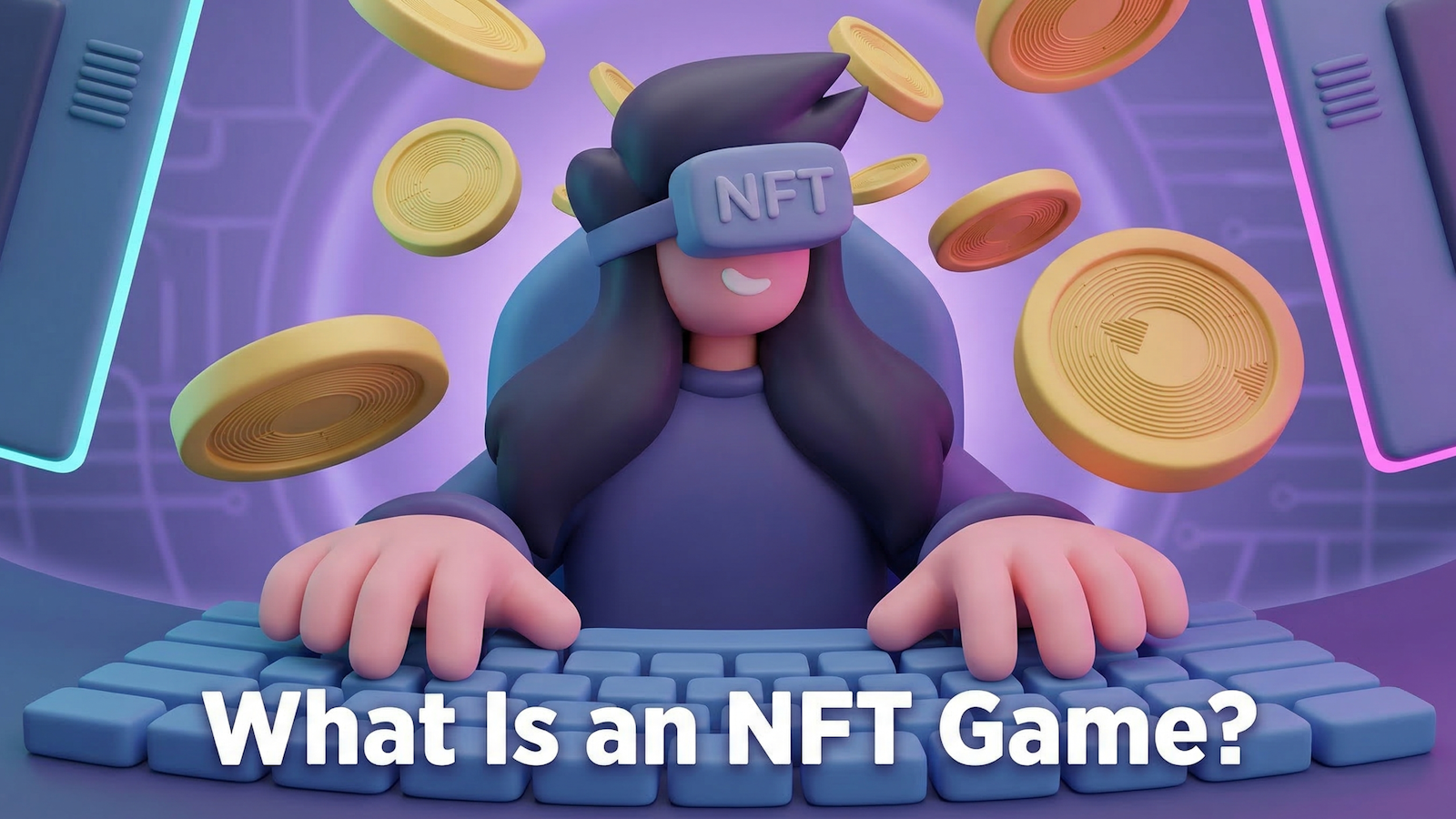
An NFT game is a blockchain-based video game in which in-game assets — characters, items, and land — exist as non-fungible tokens (NFTs) on a public ledger. Players can truly own, trade, and sell these assets outside the game, turning gameplay into a potential source of income through play-to-earn (P2E) mechanics.
Non-Fungible Tokens have become the foundation of blockchain gaming, where NFTs function as tradeable in-game items and characters. Players can earn by upgrading their characters, participating in contests, and selling NFTs — including in-game trophies and rare collectibles.
Key Takeaways:
- NFT games let players own in-game assets as blockchain tokens
- Two main models: Play-to-Earn (investment required) and Free-to-Play
- Top chains: Ethereum, Polygon, Immutable X, Ronin, Solana
- Entry cost ranges from $0 (free-to-play) to $500+ (P2E)
- The blockchain gaming market was valued at $21.6 billion in 2025 and is projected to reach $301.5 billion by 2030 (Grand View Research, 2026) — but the sector lost 69% of its market capitalisation year-over-year, underscoring both the opportunity and the risks
We wrote more about what NFTs are and what makes them special in another article: “Non-fungible Token Development: How to Create Your Own NFT Token?».
What Are NFT Games?
Simply put, an NFT game is a blockchain game that uses NFTs and tokens to create a real economy based on digital assets. Unlike most traditional video games, users of NFT games can receive, buy, collect, and trade NFTs with other players to earn an income from the game (play-to-earn, P2E). NFT games have revolutionized the gaming industry and are part of the digital future where cryptocurrencies and blockchain technology play the leading roles in the financial system.
Initially, NFT games were developed on the leading blockchain in the Ethereum DeFi ecosystem using ERC-20 (Fungible Tokens), ERC-721, and ERC-1155 (Non-Fungible Tokens) standards. One of the first blockchain games was CryptoKitties, launched in 2017. Users bred virtual cats, took care of them like a Tamagotchi, and then sold them at a higher price. The rarer the specimen, the more expensive it could become. The game quickly gained popularity and became so popular that it temporarily almost brought the Ethereum network to a standstill due to the huge number of transactions. While CryptoKitties is no longer among the most-played blockchain games, it was a landmark project that proved the viability of NFTs in gaming and inspired the entire GameFi category that followed.
However, later NFT games appeared more and more actively in other blockchain networks, such as BNB Chain, Tron, WAX, Ronin, Polygon (Layer-2 solution for Ethereum network), Fantom and others. As of late 2025, the leading blockchain networks for gaming have shifted considerably: according to DappRadar’s Q3 2025 report, opBNB leads with 1.05 million daily active wallets, followed by Sei Network (802,000 wallets), and Ronin (419,000 wallets). Newer chains like Kaia have also surged, growing gaming activity by 229% in a single quarter. NFT games occupy their own niche in the gaming industry and have formed their own field called GameFi.
NFT Games vs Regular Games
| Feature | NFT Game | Regular Game |
|---|---|---|
| Asset ownership | Player (stored on blockchain) | Game developer |
| Can trade or sell items | Yes, on open marketplaces (OpenSea, etc.) | No |
| Earn real money | Yes, via play-to-earn mechanics | No |
| Entry cost | $0–$500+ depending on the game | $0–$70 (one-time purchase) |
| Requires a crypto wallet | Yes | No |
| Items survive if game closes | Yes (NFT remains on-chain) | No (assets lost) |
| Transparent item scarcity | Yes (verifiable on blockchain) | Controlled by developer |
Types of NFT Games
As in the field of traditional video games, they are divided into categories and genres. In GameFi, there are two main categories – Play to Earn and Free to Play. The difference between them is that Play to Earn NFT games require investment, and usually quite a lot of it so that users can earn an income and make more money from the game.
In the second case, players do not need any initial investment to start playing and earn income. For example, in the popular card game Gods Unchained on the WAX blockchain, players are given a starter set of cards to fight with and win trophies, which can then be converted into real cryptocurrency.
In the spring of 2022, another NFT game concept gained popularity — Move to Earn. For example, the Stepn NFT game lets you earn native GMT tokens just by walking or jogging down the street — in other words, by moving around. GMT was sold at $0.01 during its March 2022 token sale and briefly surged to an all-time high of $4.11 — a roughly 410x increase — within weeks of launch. However, as of March 2026, GMT has retraced nearly all of those gains and trades at approximately $0.011, close to its original sale price. The STEPN team has since introduced GMT token burns and a GMT Pay feature to support long-term demand.
The more distance you walk or run, the more tokens you earn. To start earning, players need to buy NFT sneakers on the STEPN marketplace. At launch in spring 2022, the cheapest sneakers cost roughly $1,000, but as of early 2026, entry-level Common Sneakers can be purchased for just a few dollars — a sign of how much Move-to-Earn economics have cooled since the initial hype.
The Move-to-Earn category attracted significant attention in 2022, with STEPN leading the charge. Since then, the sector has matured considerably. While STEPN remains active — with ongoing token burns and new features like GMT Pay — the explosive user and price growth of 2022 has given way to a smaller, more stable user base. Readers should evaluate M2E projects based on long-term sustainability rather than expecting the rapid gains seen during the initial wave.
How Do NFT Games Work
Thanks to digital games on the blockchain, users can not only store their NFTs and unique digital collectibles in a crypto wallet but also use them as a character, avatar, or in-game item in a video game, earning money at the same time. Players can participate in contests and sweepstakes to win valuable rewards that act as NFTs and have real value. After receiving a reward for winning a game, you can exchange it for digital assets on the NFT marketplace provided by the game’s developers or on third-party websites.
Many NFT games offer a full-fledged DeFi platform where you can not only play in-game but also trade NFT assets through the marketplace and even stake Non-Fungible Tokens or digital farm assets in liquidity pools. For example, on the Mobox NFT gaming platform, users can buy and upgrade NFTs called MOMOs and generate mining revenue. In addition, players can win native MBOX tokens by playing NFT games and then farm these tokens by adding MBOX and BNB to liquidity pools on Mobox.
All in-game actions, such as obtaining an in-game item in the form of NFTs or a digital asset, are executed through smart contracts, ensuring the autonomy of GameFi platforms. To understand how NFT games work on the blockchain, let us analyze the mechanics using a competitive game as an example.
Players place a bet to win valuable prizes and trophies from other players. They add their game items to smart contracts and block them until the end of the competition. Then a contest is held on the NFT gaming platform, and at the end, the results are summed up. The Smart Contract automatically unlocks the NFTs in the game and transfers them to the wallets of the winners.
Much more interesting is the implementation of the mechanic in the famous blockchain game CrypoKitties: the developers create a secret contract called geneScience, which randomly distributes rare genes to new pets after crossbreeding. These breeds have a much higher value than regular pets, and players compete against each other to get a rare pet. Gamers have even tried to develop tools to help them estimate the likelihood that a rare gene will emerge from a crossbreed.
Disadvantages of NFT games
Like any field, blockchain games are not without their drawbacks. Before you consider them as a way to make money, you should be aware of all the pitfalls in this field. This way, you can understand how it suits you. Now let us talk about the disadvantages of NFT games.
High Entry Threshold
One of the biggest disadvantages is the entry cost. To earn money, players have to buy items and characters. And the more popular the game becomes, the more expensive its characters and items become, making it difficult for beginners to get started. Besides, without investments, it becomes problematic to compete with other players and earn income since they have invested their money to improve them. And the more money you invest, the more you can earn, but at the same time, the risks of investing increase significantly. However, there are also free-to-play NFT games.
Money Laundering
The second major problem that affects the entire DeFi sector and the crypto community is money laundering. Decentralized applications and protocols cannot restrict attackers who use blockchain games for their purposes in any way.
High Risks
If you just want to play NFT games for fun without investing, it’s not a problem. Your money will be safe. However, if you invest, you will bear risks ranging from possible loss of value of digital assets to fraud. Let us list the main risks that users of NFT games can face.
Decreasing the Cost of Tokens
The stronger the hype around the game, the faster the cost of in-game items and characters offered in the form of NFTs increases. Accordingly, by buying loot boxes and in-game NFTs that have increased in price, players risk losing their investments when the game’s popularity begins to decline and, as a result, the value of in-game assets decreases.
In addition, classic fungible tokens are also used in NFT games, such as AXS in the Ronin network or MBOX in the BNB chain (BEP-20). They are usually used to buy game items and upgrade characters, and due to volatility, the value of these tokens can rise or fall.
Hacking of the DeFi Protocol
For example, in March 2022, hackers hacked into the Ronin network, which runs the popular game Axie Infinity, and extracted about $625 million in cryptocurrencies. This was the largest hack in the history of cryptocurrencies. Security also applies to individual protocols. The presence of vulnerabilities in smart contracts can lead to the loss of players’ funds, including their Non-Fungible Tokens.
Rug Pull
In DeFi, the Rug Pull scheme has become one of the most common scams, along with phishing attacks. The essence of the Rug Pull method is that the attackers intentionally create a fraudulent NFT game to deceive users and siphon their funds through the backdoors in the smart contract. One of the best examples of Rug Pull was the Squid Game project based on a famous TV series of the same name.
After listing the SQUID token on the PancakeSwap DEX, its price increased by 45,000% within the first few days. However, users soon found that they could not sell the tokens. As a result, the attackers managed not only to raise money by selling the token to deceived investors but also to sell SQUID tokens themselves, taking advantage of the liquidity on the PancakeSwap exchange and lowering the token’s price. A team of scammers even managed to get verified on CoinMarketCap to list their token. By the way, the SQUID token is still listed on the CMC website.
Most Popular NFT Games
Back in 2017, when the game CryptoKitties became popular, there were so few interesting games that you can hardly find enthusiasts now who would remember other NFT games. Although, in reality, there were quite a few, most of the games had poor mechanics or were released in raw form, which was not very interesting for users.
Since then, hundreds of blockchain games have launched. Below we list some of the most well-known NFT games that won the sympathy of players, game companies, big publishers and investors and inspired game developers to create more and more new NFT games, driving the development of the industry. For the sake of simplicity, we have divided the games into genres such as metaverses, RPGs, epic games, collectible games and card games so that you can more easily find your way while reading the article.
While Play-to-Earn remains a popular concept, the model has faced significant sustainability challenges since its 2021–2022 peak. Several high-profile projects — including Nyan Heroes and Ember Sword — shut down in 2025 after failing to retain players or secure ongoing funding. Industry investment in blockchain gaming dropped to $129 million in Q3 2025, a fraction of the $2.5 billion raised in Q1 2022 alone (DappRadar, BGA Games Report). Today, the industry is shifting toward models that prioritise gameplay quality and long-term tokenomics over short-term speculative returns.
Card and Collectible NFT Games
Splinterlands
Leading NFT trading card game with over 300,000 players. Splinterlands was released on the Hive and WAX blockchains. Despite the fact that the most popular blockchain with smart contracts is Ethereum, games developed on this blockchain have not found this popularity due to the expensive transactions.
Splinterlands, unlike many classic games of this genre, is designed for quick fights, which has become one of the factors for its popularity: the more games that can be played in a short time, the more players can earn. The cards won in the game are traded on popular marketplaces such as OpenSea and Monster Market.
Gods Unchained
One of the first PVP card RPGs in this gaming industry, where users compete against each other to earn trophies in the form of NFTs, build unique card decks, and upgrade their collections to make their team stronger and win matches more often.
Like Splinterlands, the NFT game Gods Unchained was developed on the Immutable X (Ethereum Layer 2) and belongs to the free-to-play category: upon registration, each user receives a starter set of cards with which they can compete with other players.
PVP, MMORPG and Epic Games
CryptoBlades
CryptoBlades is a popular play-to-earn and PVP game in the spirit of popular computer role-playing games in the early days of their creation, which immediately catches the eye when visiting a game site. The game runs on as many as five blockchains: BNB Chain, Polygon, Heco, Avalanche and OEC (OKX Chain). Players control virtual characters from a fantasy world.
The game has complex mechanics, complicated by the classic graphical interface of old computer games from the 90s and the 00s. Beginners may find this game outdated, but fans of old-school RPGs will definitely like it. Players buy characters with SKILL tokens, upgrade weapons and ammo to win battles and get valuable rewards.
Chainmonsters
Another game based on the famous Pokemon, like Axie Infinity, is only in the MMORPG genre. Free to play Chainmonsters is built on the FLOW blockchain. Players collect Chainmons and in-game items, which they can then sell on the marketplace. The game is planned to be released for PlayStation, Xbox and Nintendo Switch game consoles and is now available on Steam.
Lightnite
Lightnite is an online multiplayer game made in the likeness of the famous Fortnite game (as you might guess from the name) by the same game developers who created the popular gaming portal Satoshi’s Games. The other part of the name reflects the fact that the game uses the Lightning Network (LN), a second layer network for scaling and improving the privacy of the Bitcoin blockchain.
LN allows you to make instant and free transactions through special payment channels that open between two parties that receive and send bitcoins to each other. Lightnite players are rewarded with fractions of BTC for winning PvP battles.
NFT Gaming Platform, Metaverses and Virtual Worlds
Alien Worlds
A metaverse where users rent or buy spaceships to explore the virtual universe, complete missions and earn real Trilium (TLM) cryptocurrency.
Play to Earn NFT game Alien Worlds supports 3 blockchains: Ethereum, BNB Chain and WAX. Players also collect and collect NFT cards, as well as digital goods, which can grow in value over time and bring additional income. By the way, NFT cardholders can mine tokens.
The Sandbox
A virtual metaverse that combines elements of Free to Play and Play to earn, inspired by the popular game Minecraft. In Game The Sandbox, players can buy and own virtual plots of land, build on them and interact with other players in the multiverse.
You can create your own unique virtual world, embody any fantasy and feel like a real artist. Perhaps your art will be appreciated by players willing to buy your site for a large amount of SAND – native tokens for which you can buy and sell virtual properties in The Sandbox. There are also NFTs in the game that you can use to upgrade your avatar.
Upland
Upland is an NFT metaverse created on iOS and Android mobile platforms and running on the EOS blockchain. An interesting feature of the NFT game Upland is that the real estate in the game is matched with addresses from the real world. In other words, when you buy real estate and items in Upland, you own a virtual copy of the real-world object in this metaverse.
Players collect branded collections and participate in treasure hunts, receiving valuable rewards and earning cryptocurrency in this way. Purchased real estate also brings profit to players. You can team up with other players and, together with them, become tycoons of the Upland game metaverse.
Mobox
Mobox, also known as MOMOverse, is an NFT gaming platform on the BNB Chain blockchain. The native tokens of the Mobox MBOX game were distributed on the largest crypto exchange Binance as part of the launchpad, and the company itself joined the project as an investor. By the end of 2021, interest in the game skyrocketed, leading to the price of MBOX tokens rising to $12. Since then, however, activity on Mobox has dropped significantly, and the price of MBOX has fallen well below its peak.
NFT drops take place regularly on the Mobox platform: users receive in-game NFTs that mine tokens and generate passive income. They can also be upgraded so that they bring more income. Farming and various mini P2E NFT games are also available on the platform, such as Block Brawler, Token Master and ChainZArena. Users compete against each other by solving increasingly complex tasks. The best are rewarded with the MBOX digital currency and other valuable prizes that help improve the game characters.
Mining and Farming
Farmers World
The first and most played farming game on the WAX Blockchain in the Play to Earn category, one of the top 3 NFT games by the number of players with over 100,000 users. The essence of the NFT game Farmers World consists of players buying land to raise livestock and harvest crops.
Players buy tools for real tokens that generate income. However, this is not a passive way of earning: to earn income. You need to actively work on the farm and extract resources (wood, food and gold) which are FWW FWF and FWG tokens, respectively.
However, users complain that they get banned if they try to make money without investing. In addition, even users who have invested their money get banned, and, despite its popularity, the game, in terms of mechanics and even the appearance of the site, looks more like a poorly made pyramid. The game is still more suitable for entertainment for users who are fond of farming than for making money.
Virtual Pets
Axie Infinity
A blockchain-based Play to Earn video game in the style of Pokemon. Players grow and upgrade virtual pets, which can then be sold as NFTs on the marketplace. The better and more unique the pet, the higher its value will be on the market. The game was released by the well-known studio Sky Mavis on the Ronin sidechain, which was hacked in March 2022. However, the Sky Mavis team promised to refund all users who were affected by this hack.
The game requires native AXS tokens, which are traded on major crypto exchanges, including Binance. In 2021, the game became so popular that the price of AXS tokens increased more than 100 times in just a few months, surpassing the $165 mark. However, like much of the GameFi sector, AXS has since declined sharply. As of March 2026, AXS trades at approximately $1.20 — down over 99% from its all-time high. Sky Mavis has introduced a new tokenomics model called bAXS (Bonded AXS) in early 2026, which ties rewards to in-game reputation, and is developing the Atia’s Legacy MMO to revitalise the ecosystem.
CryptoKitties
CryptoKitties is one of the first NFT gaming Play to Earn games based on the Ethereum blockchain, launched in 2017. The gameplay is quite simple: players breed and sell virtual pets and also cross them with each other to get valuable offspring. The lucky ones manage to breed rare species of virtual pets that are highly valued by enthusiasts: the price of some species exceeds 10 ETH.
The game is not as popular as it was in 2017 when it created a stir among crypto enthusiasts. Today, CryptoKitties is best understood as a historically important project — the game that first proved blockchain-based gaming was viable — rather than a competitive title in the current market. Its legacy, however, lives on in the hundreds of GameFi projects it inspired.
How Can You Make Money Playing NFT Games?
No matter which game you choose – P2E, F2P or M2E – users are offered many ways to make money from it, from investing or trading NFTs to participating in gameplay, mining and lending. There are several ways you can make money with NFT games. Let us take a closer look at them.
Buy and Save NFTs or Game Coins
HODL is the simplest yet effective investment strategy that has been repeatedly proven effective by many owners of large projects such as Bitcoin, Ethereum, Binance Coin, Solana, Cardano, Tron and many others. You do not have to participate directly in the game to earn.
Instead, you can take the easier route: buy NFT art, digital images, virtual lands and items, or native game tokens, and then just keep them in your wallet, waiting for the best moment to sell them.
However, a word of caution: the 2022–2025 bear market demonstrated that most GameFi tokens and NFT assets lost 90–99% of their peak value. HODL strategies carry significant risk in the volatile blockchain gaming sector, and past performance is not a guarantee of future results.
Mining or Farming
Did you know that some non-fungible tokens allow you to mine or even farm tokens? For example, owners of NFTs issued on a DeFi platform and Biswap decentralized exchange in the BNB chain ecosystem can deploy them and earn income in the native tokens of the BSW platform. In addition, NFTs can be upgraded to generate more income.
Another way to make money with NFTs is to lend them. You can rent out your NFTs. On this platform, for example, owners of NFTs rent out their MOMOs for a fee in MBOX tokens to other users, who in turn use them to boost characters, increasing players’ chances of being included in the list of winners and getting their share of rewards for successfully completed quests.
Moreover, you can make money not only by renting NFTs but also by borrowing them. For example, users have borrowed NFTs from the Bored Ape Yacht Club and Mutant Ape Yacht Club collections, whose owners received free APE tokens from the creators of these collections. Thus, some of these users were able to earn tens of thousands of dollars without buying the NFTs themselves, but only by renting them and spending only small amounts on commissions and lending fees.
Play to Earn
Some players earn $1000 or more per month just by playing the game. Sounds incredible, but it’s true. In practice, however, not everything is as simple as it may seem to beginners. The complexity of this method is that you need a lot of free time to understand the game.
Also, consider the high competition and the large number of people who want to make money with blockchain games. This leads to the fact that those who invest a lot of money in NFT games are the most likely to make money, while the rest of the players gradually leave the game because they realize that they have nothing to do here. This approach has a negative effect on both the development of a single video game and the GameFi industry as a whole.
If you want to make an income but are not willing to invest large sums or do not have any, try Free to Play or F2P games like Gods Unchained, Guild of Guardians, Chainmonsters, or Splinterlands to get started.
Create Your Own NFT Game
Another way to make money with NFT games is to create them. You are not limited by anything and can develop games in any genre: Card games, MMORPGs, metaverses, horror and indie games. Complete freedom is limited only by your imagination and investment opportunities.
Game publishers get unlimited opportunities to make money with blockchain games: you can create your own NFT game platforms, release an unlimited number of games, create new tokens, including NFTs, which investors will buy, and bring you huge revenues.
Game development is expensive. The service ICODA offers comprehensive services, including game development, NFT promotion, smart contract creation and more. You can find a full list of services on the company’s website and also request a free consultation.
How to Start Playing NFT Games: A Step-by-Step Guide
Getting started with NFT games takes 20–40 minutes if you follow these steps in order.
Step 1: Choose your game Browse active NFT games on PlayToEarn, ChainPlay or DappRadar — filter by blockchain, genre, and required investment. For beginners, Free-to-Play titles like Gods Unchained (card game, no upfront cost) or Alien Worlds (Wax blockchain, free entry) are the lowest-risk starting point.
Step 2: Set up a crypto wallet Install a non-custodial wallet compatible with your chosen game:
- MetaMask — for Ethereum, Polygon, and BNB Chain games
- Phantom — for Solana-based games
- Ronin Wallet — specifically for Axie Infinity
Setup takes approximately 5 minutes. Write down your seed phrase and store it offline — losing it means losing access to all assets permanently.
Step 3: Fund your wallet (if required) For play-to-Earn games, purchase the required cryptocurrency on a centralised exchange such as Binance, Coinbase, or Kraken. Transfer only the amount you plan to invest — NFT game assets are volatile and not guaranteed to retain value.
Step 4: Acquire your starter NFT assets Buy starter items either on the game’s native marketplace or on a secondary market such as OpenSea or Magic Eden. Check floor prices (the cheapest available item) before buying — they fluctuate significantly with game popularity.
Step 5: Connect your wallet and play Go to the game’s official website, click “Connect Wallet,” and authorise the connection. Never connect your wallet on unofficial links — NFT gaming is a common target for phishing scams.
What Are the Risks of NFT Games?
NFT games carry financial and technical risks that players should understand before investing:
- Market volatility: NFT asset prices can fall 90%+ (as seen with Axie Infinity’s SLP token in 2022 and GMT’s 99% decline from its 2022 peak).
- Smart contract risk: bugs or exploits can result in loss of assets.
- Game shutdown: if a developer closes the game, NFTs may lose utility. In 2025 alone, several well-funded projects including Nyan Heroes and Ember Sword shut down after failing to sustain player engagement.
- Regulatory uncertainty: several jurisdictions are reviewing P2E models as gambling.
- Scams and phishing: NFT gaming is a frequent target for fake websites and wallet-draining attacks. Always connect your wallet only through a game’s official domain.
Final Thoughts
According to Grand View Research, the global blockchain gaming market was valued at approximately $13 billion in 2024 and is projected to reach $301.5 billion by 2030, growing at a CAGR of 69.4%. The opportunity is real — but so are the risks.
The NFT gaming industry has matured significantly since 2022. Early hype-driven projects have given way to a more selective market where gameplay quality, sustainable tokenomics, and genuine player retention determine which games survive. For players, this means more choices but also a greater need for due diligence. For developers and publishers, blockchain gaming offers a unique opportunity to build player-owned economies — provided the focus remains on building genuinely engaging games rather than speculative token mechanics.
Are NFT games still popular in 2026?
Yes. In 2026, the NFT gaming market was valued at around $7 billion, indicating a transition from early hype cycles to more sustainable, utility-focused growth. Games like Axie Infinity and Gods Unchained maintain active communities, while new titles on Ethereum Layer 2 networks have reduced entry costs significantly.
It depends on the game type. Play-to-earn games typically require an initial investment in NFT assets (often $50–$500). Free-to-play NFT games, such as Gods Unchained, require no upfront payment.
In regular games, in-game items are owned by the developer. In NFT games, items are stored on a blockchain as NFTs, giving players verifiable ownership and the ability to trade or sell assets on open markets.
NFT games are built on multiple blockchains. Ethereum was the first, but high transaction fees pushed most developers toward faster, cheaper alternatives. Today, the most common networks for NFT gaming are Polygon, Immutable X, Ronin (used by Axie Infinity), Solana, and BNB Chain. Each offers different trade-offs between speed, cost, and security.
Yes. NFT game assets are speculative investments — their value can drop sharply if a game loses popularity or shuts down. In 2022, Axie Infinity’s SLP token lost over 95% of its peak value. Players should treat any initial spend as money they can afford to lose, not a guaranteed return.