





A serious investor finds your token the way they research a used car or a new doctor: they open ChatGPT and ask, “Is this project legitimate?” The answer that comes back — clear, vague, or nothing at all — decides whether they ever reach your website.
That shift breaks most of the crypto presale playbook teams still run. The 2021 approach was built for a market that found tokens through Telegram raids, paid influencer posts, and a flood of press releases. That market is gone. Due diligence now starts with an AI assistant, the channels have been reweighted, and the projects that survive listing day are the ones that built credibility months ahead.
This guide covers the crypto presale marketing strategy that works in 2026: which channels convert, why wallet quality beats raise size, how AI visibility became the make-or-break layer, and the 90-day timeline that turns cold traffic into holders who stay.
What Is a Crypto Presale, and Why Has the Old Playbook Stopped Working?
A crypto presale is the early funding stage where a project sells its token to a limited group of investors before public listing, usually ahead of the token generation event (TGE) — the moment the token is created on-chain and distributed to contributors. Presales fund development and seed a community, but in 2026 they’re won on credibility, not noise.
The discovery path changed. In 2021, attention was scarce and whoever shouted loudest won. Today attention is cheap and trust is scarce: investors verify before they buy, using tools (AI assistants, on-chain analytics, independent research) that reward projects credible to machines and skeptics rather than hype-chasers.
The consequence: earned credibility takes 60–90 days to build and can’t be bought in the final two weeks. Start at D-14 and you get a loud launch that doesn’t convert.
Why Wallet Quality Matters More Than Raise Size
The best predictor of whether a token survives its listing is wallet composition, not how much the presale raised. A large raise from the wrong wallets dumps on day one; a smaller raise from conviction holders holds price and supports a second round.
| Scenario A | Scenario B | |
|---|---|---|
| Amount raised | $10M | $4M |
| Contributors | ~400 wallets | ~1,200 wallets |
| Composition | Bots and Sybil farmers | Conviction holders |
| TGE day | Heavy sell pressure, price dumps | Price holds, demand absorbs supply |
| After launch | No community, no second round | Engaged community, room to grow |
| Survives? | No | Yes |
Scenario A raises more than twice as much and is the weaker outcome. The headline number flatters the team while the wallet structure guarantees a collapse.
So the goal of crypto marketing shifts from “raised” to retained: filter for real humans, accept a smaller announcement number, and measure success in non-Sybil wallets rather than dollars.
What Crypto Marketing Channels Work In 2026 — and What’s Dead
The channels that work in 2026 are earned, evergreen, and machine-readable; the dead ones are paid, high-volume, and easy to fake. Pay-to-spam has degraded into noise, and in some cases flipped into a red flag investors actively avoid.
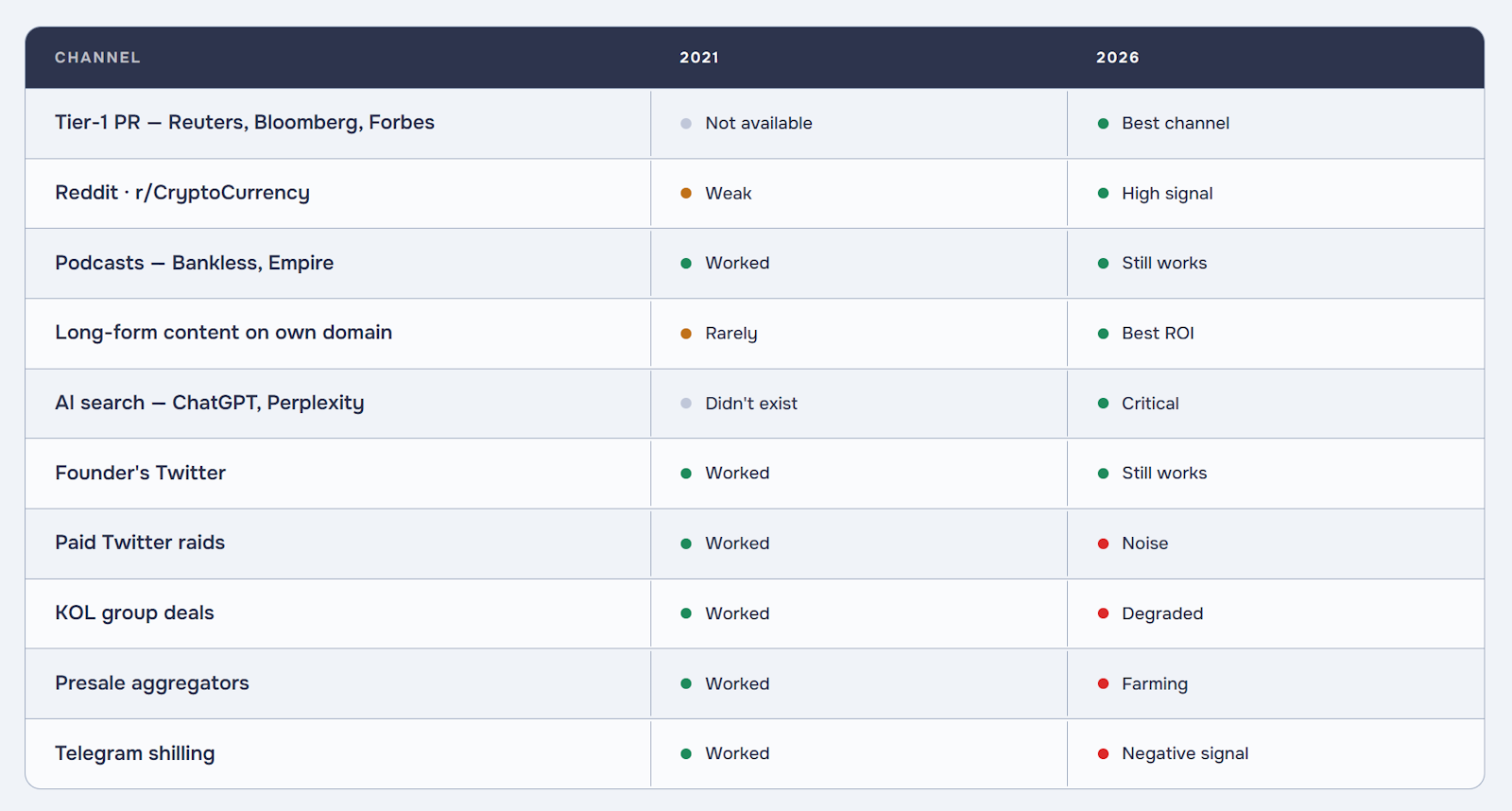
The pattern: anything you can buy in bulk has lost its weight; anything that takes real work — an article a journalist chose to write, a 4,000-word research piece, a founder showing up daily — gained weight because it can’t be faked at scale.
Crypto press is no longer a discovery channel. CoinDesk is down roughly 59% in organic traffic year over year and Decrypt around 71%, with even Cointelegraph, the largest, sliding. A placement is still worth getting, but only as a credibility signal that AI systems and researchers pick up. You’re buying a citation, not a traffic spike.
This is where web3 marketing diverges from traditional ICO marketing: ICO marketing leaned on volume and reach; the modern approach leans on proof: verifiable work, independent validation, and a presence that holds up under scrutiny.
The 2026 Crypto Marketing Strategy: 6 Tools Across Three Layers
The most reliable crypto marketing strategy in 2026 uses six tools across three layers: Earned, AI, and Human. No layer carries a launch alone; each answers a question the investor is silently asking.
Layer 1: Earned Authority (Evergreen)
“Has anyone credible vouched for this?”
- Tool 1 — Tier-1 mainstream PR. One earned article in Reuters, Bloomberg, or Forbes during the announcement window converts better than ten crypto-media placements. Earned is the operative word: sponsored placements don’t count, and both investors and AI systems can tell the difference.
- Tool 2 — A research moat of long-form content. Three to six pillar articles, 2,500–5,000 words each, on your own domain. Slow to build, it pays off for years: it feeds SEO, becomes the source AI assistants cite, and gives KOLs something to reference. The best ROI in the stack.
Layer 2: AI Visibility (GEO)
“What does the AI say when someone asks about you?” Its single tool is Generative Engine Optimization (GEO) — making your project legible and citable to ChatGPT, Perplexity, Grok, and Gemini.
Layer 3: Human-Readable Presence (Proof-of-Work)
“Are real people building and watching this?”
- Tool 4 — The founder’s Twitter/X. A builder writing about real development, 3–6 months before launch, is the highest-converting individual channel, and it can’t be outsourced.
- Tool 5 — Selective, long-form KOL collaboration. Podcasts, Spaces, and written interviews rather than paid posts. A KOL with 40,000 builders beats one with 400,000 farmers.
- Tool 6 — On-chain reputation (infrastructure, L2, and AI-crypto projects). Testnet integrations from named teams, audits by Trail of Bits, OpenZeppelin, or Halborn, and paid bounties on Immunefi or HackenProof.
The common budget mistake: six figures on KOLs, zero on AI coverage. The marginal dollar belongs on Layer 2.
Want to Start a Crypto Presale Marketing?
We’re ready to evaluate and share our insights.

AI Visibility: Why GEO Is Now the Make-or-Break Layer
AI visibility, your project’s presence inside AI assistants, is the layer most teams underfund and most investors check first. GEO is the discipline of making sure that when someone asks ChatGPT, Perplexity, Grok, or Gemini about your project, the answer is accurate, current, and favorable.
If the answer is empty, outdated, or wrong, the investor forms a verdict before loading your site. Four surfaces matter now: ChatGPT, Perplexity, Grok, and Gemini. Each indexes differently; strength on one doesn’t guarantee presence on the others.
Generative engine optimization vs traditional SEO
GEO and traditional SEO share DNA but optimize for different endpoints, which changes how you write.
| Traditional SEO | Generative Engine Optimization (GEO) | |
|---|---|---|
| Goal | Rank in a list of blue links | Become the cited source inside an AI answer |
| Unit of success | A click to your site | A correct mention, with or without a click |
| What it rewards | Keywords, backlinks, page speed | Clear claims, structured facts, citable authority |
| Format that wins | Pages optimized for a query | Content an AI can extract and attribute cleanly |
| Failure mode | You’re on page two | The AI invents or omits an answer about you |
You don’t have to choose: strong SEO content is what GEO feeds on. But you write differently: state facts plainly, structure them so a model can lift and attribute them without distortion, and host the authoritative version where an AI will trust it. Research moat and AI visibility get built together.
Crypto Influencer Marketing and KOLs: What Actually Changed
Crypto influencer marketing still works in 2026, but only the version that’s hard to fake. Paid posts and group raids have collapsed in value; genuine long-form collaboration remains one of the strongest conversion channels.
KOL meaning in crypto: KOL stands for Key Opinion Leader — an influential figure whose audience trusts their take on projects and tokens. In crypto they range from anonymous trading accounts to well-known builders and researchers.
What changed is which KOLs matter and how you work with them:
- Audience quality over size. A KOL followed by 40,000 builders outperforms one followed by 400,000 airdrop farmers. Farmers don’t hold; builders evaluate and stay.
- Long-form over one-liners. Podcasts, Spaces, and written interviews let a KOL actually engage. A paid hype tweet signals you bought attention you couldn’t earn.
- Short half-life on paid posts. Even placements that work decay fast: a paid KOL post drives results for roughly 60 days, then stops. Poor return next to evergreen content that compounds for years.
7 Mistakes That Kill a Presale Launch
Most failed presales die from a handful of repeatable mistakes, ranked here by damage. Use it as an onboarding checklist before committing budget.
- Chasing raise size while ignoring wallet composition. (Critical.) $10M from bots is worse than $4M from holders. Track “retained,” not “raised.”
- Compressing credibility work into the last two weeks. (Critical.) Earned PR, long-form content, and GEO each need 60–90 days. Starting at D-14 guarantees a noisy launch that doesn’t convert.
- Spending six figures on KOLs and zero on GEO. (Critical.) The serious investor asks an AI assistant first. An empty answer means they never reach your site.
- Outsourcing the founder’s Twitter. (Critical.) Ghostwritten content is spotted instantly. The fix: 30 minutes a day of the founder’s real time.
- Relying on crypto press as a discovery channel. (High.) Organic traffic to the major outlets has cratered. Useful as a link signal for AI, but not for traffic.
- Paid raids, KOL group deals, and Telegram shilling. (High.) The signal has flipped negative. Diligence reads these as red flags.
- Building your dashboard from raise size, KYC counts, and follower numbers. (Medium.) These grow independently of quality. Track non-Sybil wallets, median contribution, AI answer accuracy, and message-per-user ratio instead.
Four of the top five are about time and credibility, not budget. You can do everything right on a modest spend and still fail by starting late.
The 90-Day Presale Timeline: A Floor, Not a Ceiling
A credible crypto presale needs at least 90 days of runway before the token generation event, and 90 days is the minimum. Before D-60 there’s no campaign yet, only the foundation everything else depends on.
| Phase | Window | Focus | Key actions |
|---|---|---|---|
| Foundation | D-90 → D-60 | Build the base | Pillar long-form content live · GEO indexing across all four AI surfaces · launch founder’s Twitter |
| Preparation | D-60 → D-30 | Line up credibility | Tier-1 PR negotiations · onboard long-form KOLs · AI search audit · testnet / on-chain proofs |
| Activation | D-30 → D-14 | Go public | PR in the announcement window · podcasts and Spaces · open Telegram/Discord · Reddit presence |
| Conversion | D-14 → TGE | Turn interest into holders | KYC flow live · conversion push · wallet-composition monitoring · bot and Sybil filtering |
The risk is structural: credibility work has to start at D-90. A client who arrives at D-30 has two honest options: push the TGE date back, or accept weak conversion. You can’t compress 90 days of earned trust into 30.
A competent crypto PR agency should hold you to this timeline. A partner who promises a full presale campaign in two weeks with no caveats is telling you something about them, not offering a shortcut.
How to Measure a Presale That Will Actually Survive
Measure quality of demand, not volume of noise. Vanity metrics — raise size, KYC counts, follower totals — grow independently of whether your launch holds. Build your dashboard from metrics that resist gaming:
- Non-Sybil wallet count — distinct, real humans in your presale.
- Median contribution — a healthy distribution beats a few whales who can dump.
- AI answer accuracy — how correct and complete the four AI surfaces are about your project.
- Message-per-user ratio — real conversation versus a channel padded with bots.
Track these from D-90 and you’ll catch problems early. Track raise size alone and you’ll learn your real wallet composition on the worst possible day — listing day.
The Takeaway: Build Credibility Before You Ask for Capital
The 2026 crypto presale is won by the project that looks credible to a skeptical investor and a citing machine months before the token generation event. If you do nothing else:
- Start at D-90. Earned trust can’t be compressed.
- Optimize for retained wallets, not raised dollars.
- Fund AI visibility. GEO across all four surfaces is table stakes now.
- Make the founder show up. Thirty minutes a day in public beats any agency-written feed.
- Treat earned authority as an asset. Tier-1 PR and a research moat compound for years; raids decay in weeks.
The teams that get this aren’t spending more — often less. They spend earlier, on work that compounds, in channels that can’t be faked. That’s the strategy.
Frequently Asked Questions (FAQ)
KOL stands for Key Opinion Leader — an influential person whose audience trusts their views on tokens and projects. In 2026, a KOL with a small audience of builders typically drives better presale conversion than one with a large audience of airdrop farmers, because builders evaluate and hold while farmers sell.
A token generation event is the moment a project’s token is created on-chain and distributed to contributors, marking the transition from presale to a live, tradable asset. The 90-day marketing runway counts backward from the TGE date.
Traditional SEO aims to rank a page in a list of search results and win a click. Generative Engine Optimization (GEO) aims to make your project the accurate, cited source inside an AI assistant’s answer, measured in correct mentions rather than clicks. Strong long-form content feeds both, but GEO requires writing facts plainly and structuring them so a model can extract and attribute them cleanly.
At least 90 days before the token generation event, and that’s a floor. Earned PR, long-form content, and AI visibility each take 60–90 days to build. Starting later produces a loud launch that fails to convert.
Yes, but for a different reason than before. Organic traffic to major crypto outlets has fallen sharply, so a placement is no longer a meaningful discovery channel. It’s worth getting as a credibility signal that AI systems and human researchers pick up — a citation, not a traffic source.
Share with


Rate the article