

On 9 October 2026, at 04:59 UTC, thirty TRON wallets were emptied at once. Within the hour, the drain spread to six blockchains. At 08:32 the first owner posted on r/ledgerwallet: “My Ledger wallet just got drained out of almost 100k USDT.”
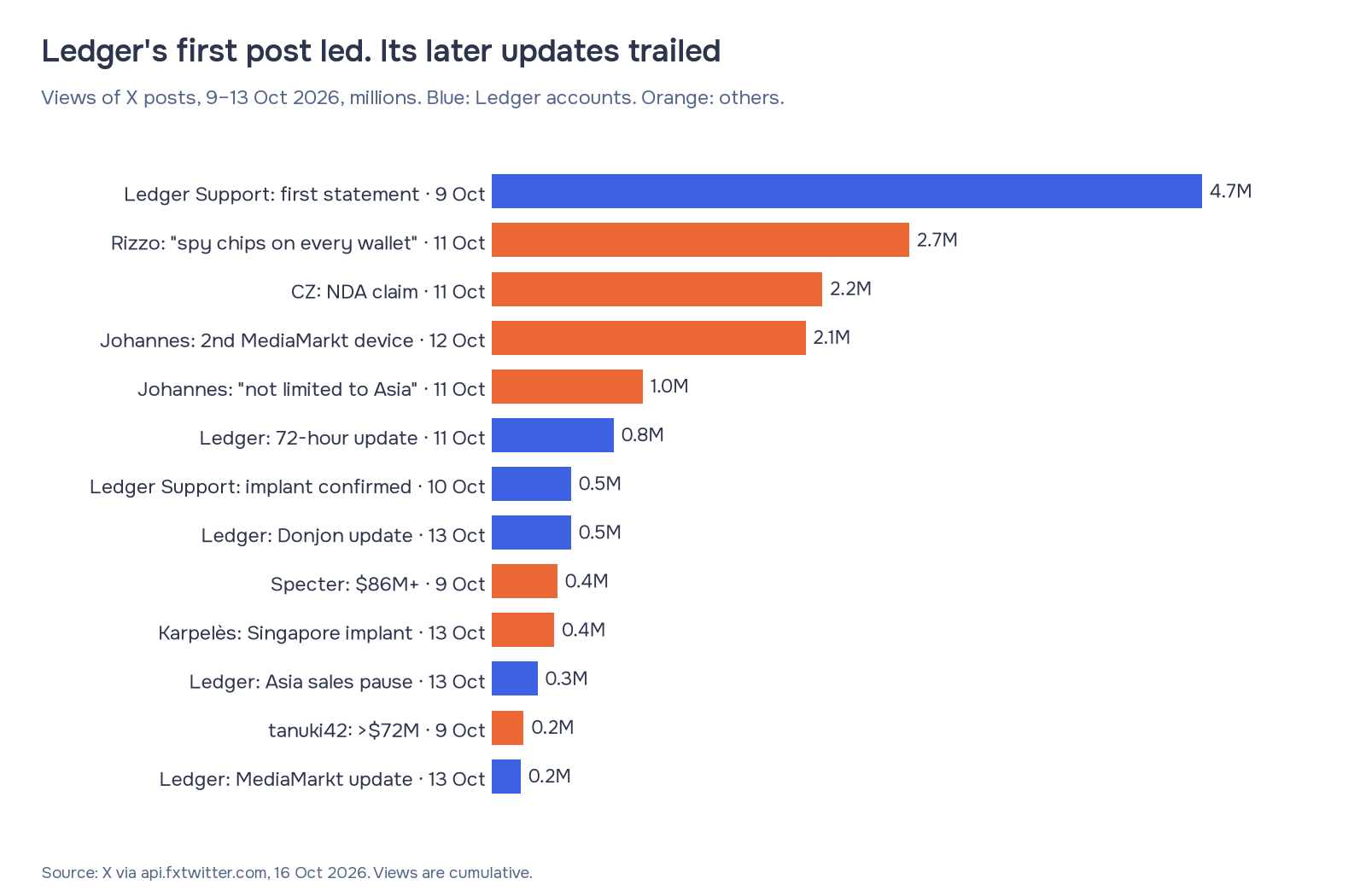
Ledger spoke five hours later. Its first statement drew 4.7 million views, more than any other post about the incident we measured.
We rebuilt the first week from primary sources, including X posts, Reddit, Google Trends, 1,018 news articles, Google results before and after the incident, and answers from four AI engines, to see where the brand could have changed the picture.
Key Findings
- Media followed the brand. No article in our sample came out before Ledger’s statement at 13:32 UTC. Within 76 minutes, the story ran in 15 languages.
- After day one, others carried the story. Three posts by people outside Ledger drew 7 million views. Ledger’s MediaMarkt update drew 193,000.
- Google showed other people’s version of the crisis. Ledger’s crisis page went up six days after the drain and was still missing from results a day later.
- Some AI engines answer “Was Ledger hacked?” with old incidents. ChatGPT called MediaMarkt a safe place to buy a Ledger three days after the chain pulled the devices, citing Ledger’s own reseller page.
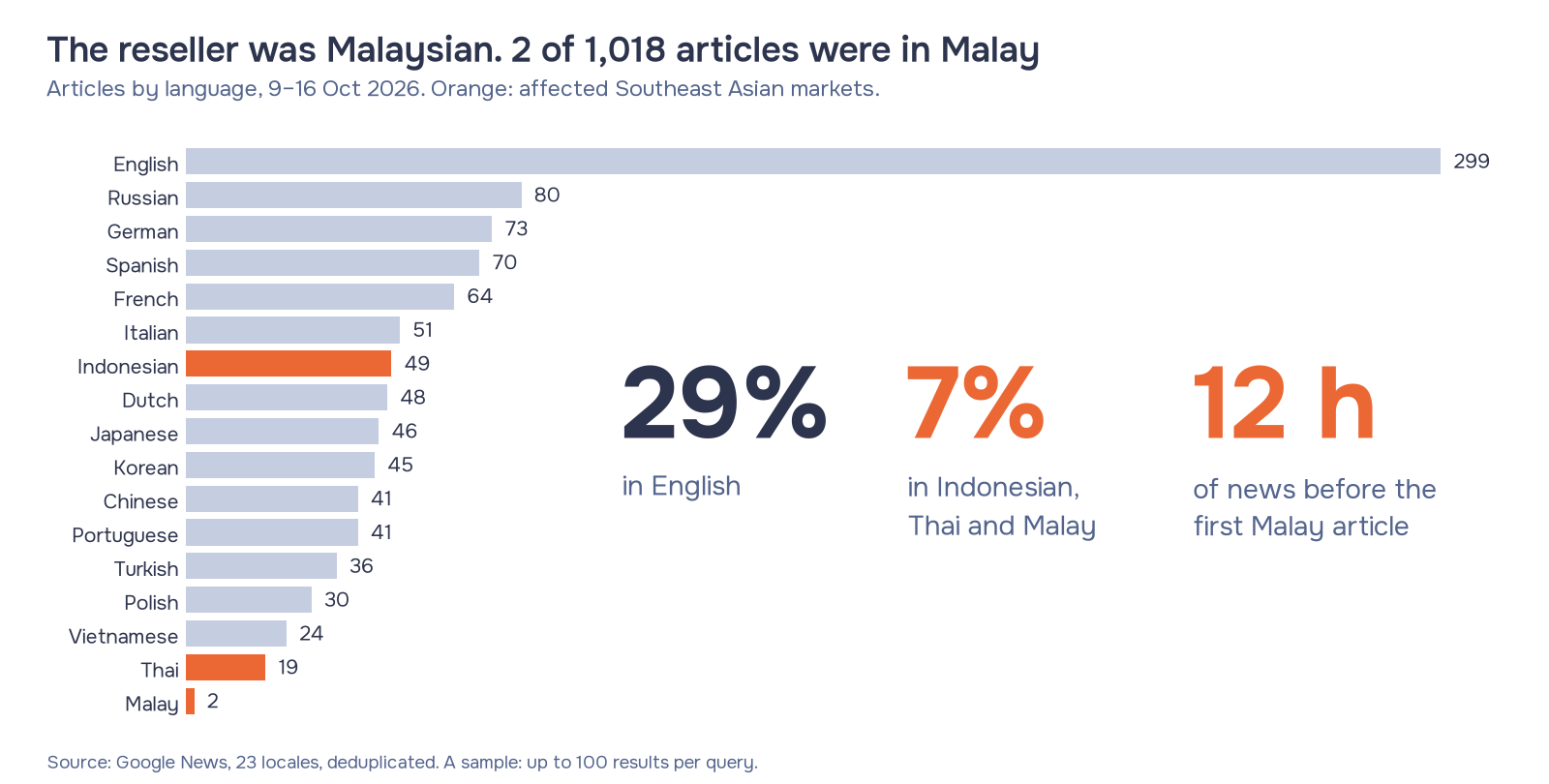
- The epicentre got almost nothing in its own language. The reseller was Malaysian, and 2 of 1,018 articles were in Malay.
What Happened
Criminals fitted genuine Ledger devices with a hidden implant that read the 24-word recovery phrase from the screen during setup and sent it over a mobile network. CryptoBilis, an authorized reseller in Southeast Asia, sold the devices. Ledger confirmed the implant on 10 October and says its chip, operating system and servers were not compromised. Ledger’s Genuine Check could not detect the implant, because the secure chip was untouched.
On-chain analytics firm Bitquery counts $102 million drained from 324 wallets across six chains. Ledger has not confirmed a total. Estimates moved during the week: on 9 October two on-chain investigators posted $72 million (tanuki42) and $86 million (Specter), and Bitquery revised its own count from $93.2 million to $102.0 million on 15 October.
On 13 October, MediaMarktSaturn pulled Ledger devices from its stores and websites in all its countries after a German customer reported an implant. The same day, Ledger asked resellers in seven Asian markets to suspend sales, and Trezor said it would cut its own reseller list from 1 January 2027.
The First 24 Hours: The Brand Set the Agenda
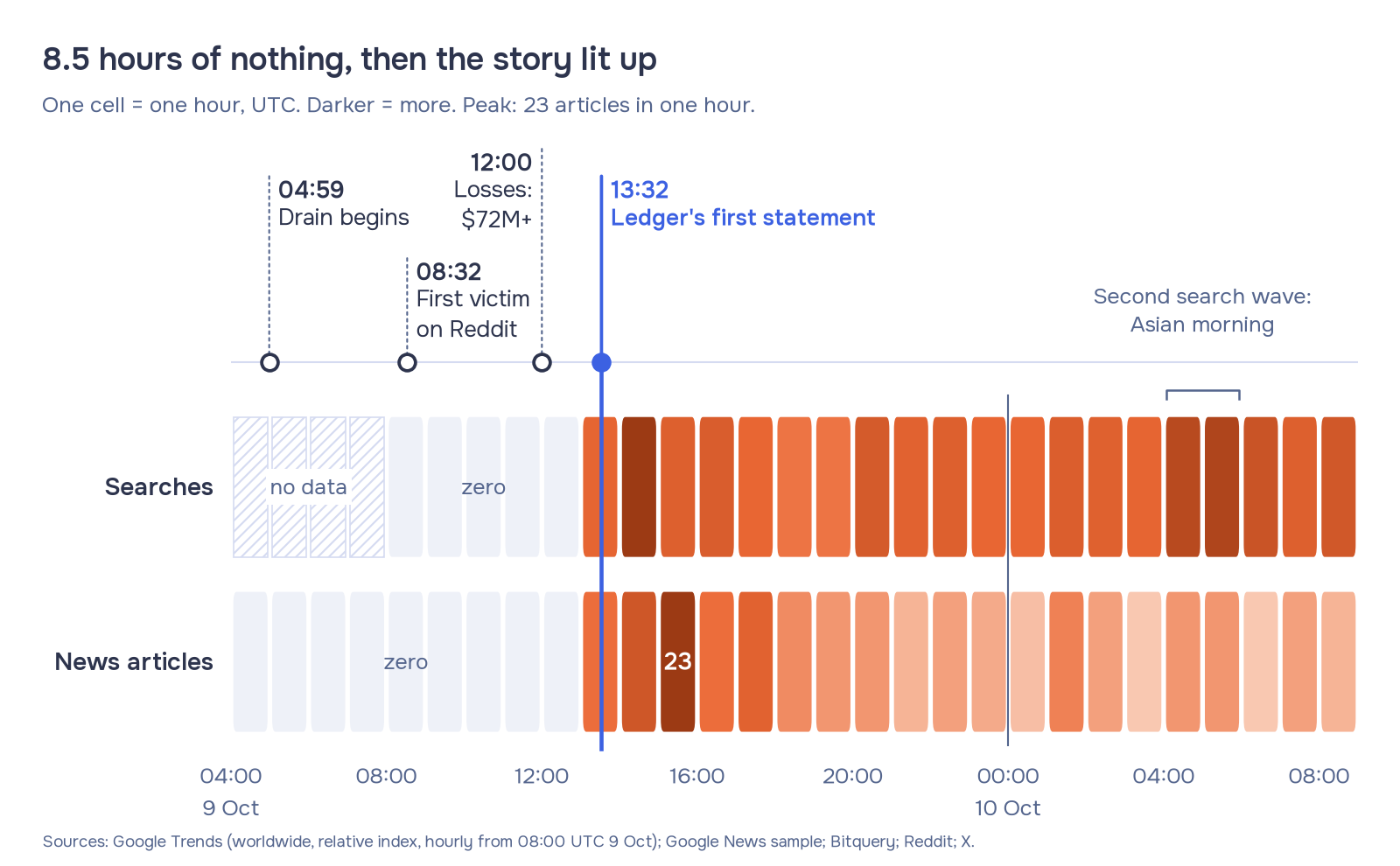
For seven hours, the story lived only on-chain and on Reddit. At 12:00 and 12:24, two investigators put the losses on X at “$72M+” and “$86M+”. From 08:00, when hourly data starts, Google Trends showed no searches for “ledger hack”, and we found no news article.
At 13:32 UTC, @Ledger_Support posted its first statement. It named the reseller and said Ledger had asked it to pause all sales. It told recent buyers “to not initiate set up”, and told those who already had to move their assets to a new device “with new seed”. That last instruction is the one that protects funds.
Searches and news started in the hour of that statement. The first article in our sample appeared at 13:32, and by 14:48 the story ran in 15 languages. Much of that was automatic localization: BeInCrypto alone published in five languages at 13:51. Hourly Trends data can’t show whether searchers reacted to Ledger or to the investigators’ earlier posts.
Earlier that morning, at 11:35 UTC and three hours after the first victim post, the main @Ledger account had published a scheduled post about cross-chain swaps: “Swap smarter, not harder, and stay secure.” Nobody had paused the content calendar.
Ledger is investigating reports of loss of funds from users in South East Asia who purchased products from a reseller named CryptoBillis.
— Ledger Support (@Ledger_Support) October 9, 2026
Days 2 to 5: The Story Is Told by Others
On 11 October, Pete Rizzo posted that criminals were “inserting microscopic spy chips on every wallet”. It drew 2.7 million views. That evening, Changpeng Zhao quoted it, claiming that “the hackers apparently bought the reseller” and made it sign a non-disclosure agreement. That drew 2.2 million. Neither claim has been confirmed. Ledger’s “72 hour update”, posted half an hour after Rizzo’s post, said the number of affected devices was limited, and drew 800,000.
The same day, a German user posted photos of an implant in a Ledger bought at MediaMarkt: “the ledger incident isn’t limited to Asia.” The next day he bought a second device in another store, found the same modification and called for “an immediate product recall”. That post drew 2.1 million views.
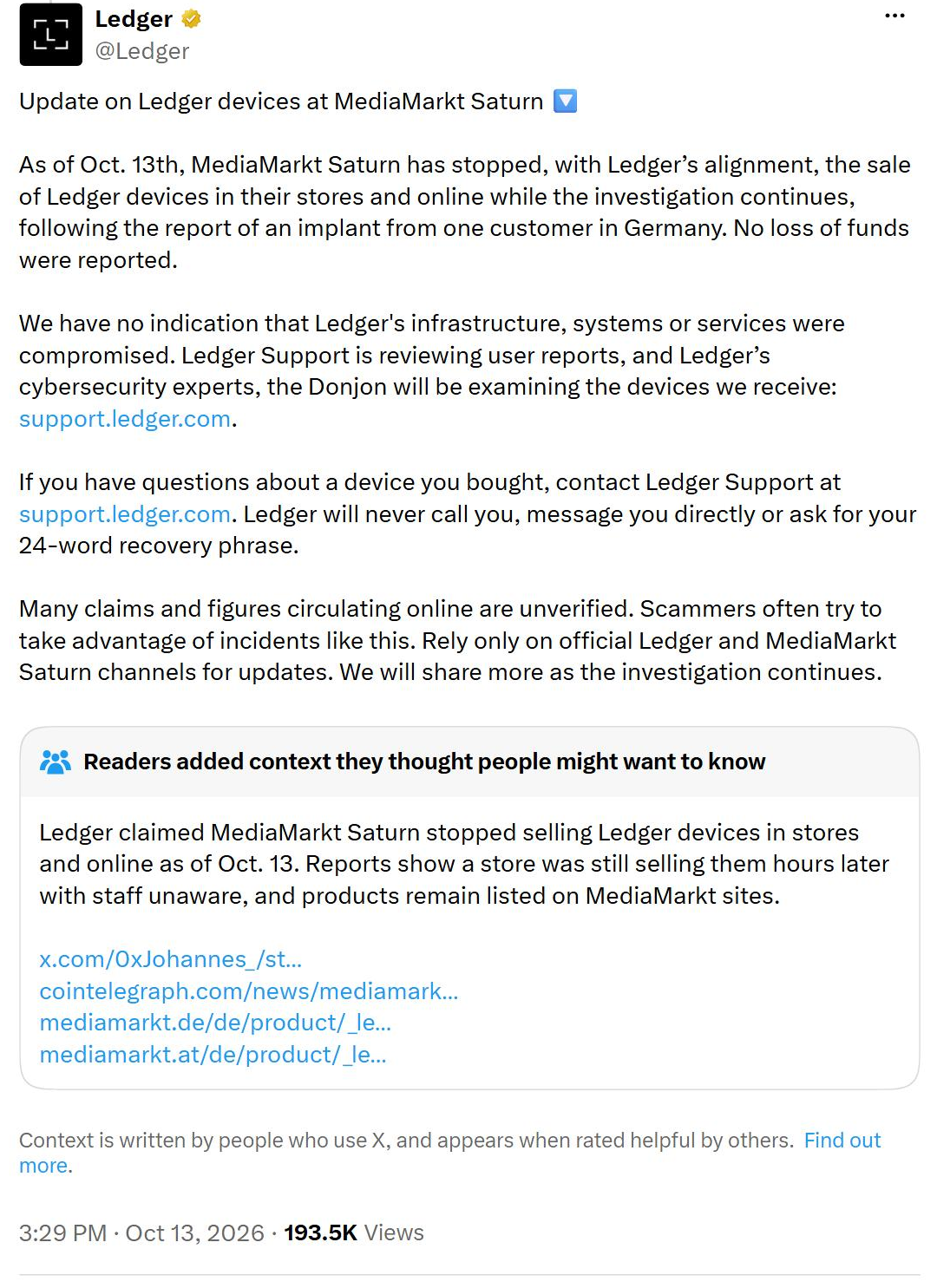
Ledger answered 23 hours later. Its post said MediaMarkt Saturn had stopped selling the devices “with Ledger’s alignment” and that no funds were lost. It drew 193,000 views, about a tenth of the post it answered. X readers then added a Community Note saying a store was still selling Ledger devices hours later and the products were still listed on MediaMarkt’s websites.
Reddit Wrote the First Draft
Ledger’s support replied to the first victim post at 10:26, three hours before the official statement, with the standard answer for drained wallets: the losses pointed to an exposed recovery phrase or to someone who had the device and knew the PIN. The implant was not yet public. From 10 October, support posted dozens of near-identical replies under individual threads. In the posts we checked, we found no pinned official thread with a timeline.
What formed on Reddit moved on: an r/Bitcoin thread became the #1 Google result for “ledger hack”, and on 16 October Google’s AI Overview for “is ledger safe” cited Reddit.
“Reddit is one of the strongest layers of trust a crypto brand has,” says Anastasia Marmuzevich, Online Reputation & PR Manager at ICODA. “You have to go into the platform and take the initiative there, for example with an official thread that holds the timeline and answers people’s questions.”
What Google Showed
In Google, other people’s content told the crisis. Ledger appeared only with pages written for other problems.
The “hack” results flipped. Before the crisis, “ledger hack” in the US showed a Coldcard thread, the 2020 data-breach page on haveibeenpwned and older articles. On 13 October, seven of the top nine results were about the implant: a Reddit thread at #1 (“Ledger Users Are Getting Robbed Because They Trusted Ledger”), Top Stories from The Hacker News, CoinDesk and CryptoSlate, YouTube teardowns, and a new “People also ask” question, “Is Ledger still compromised?”
Ledger’s only result was its page on ongoing phishing campaigns. A competitor bought the top of the page: on 16 October, Tangem’s ad led Google US for both “ledger hack” and “is ledger safe”, promising “Zero Hacks Since 2017” and 30% off for anyone “thinking of switching wallets”.
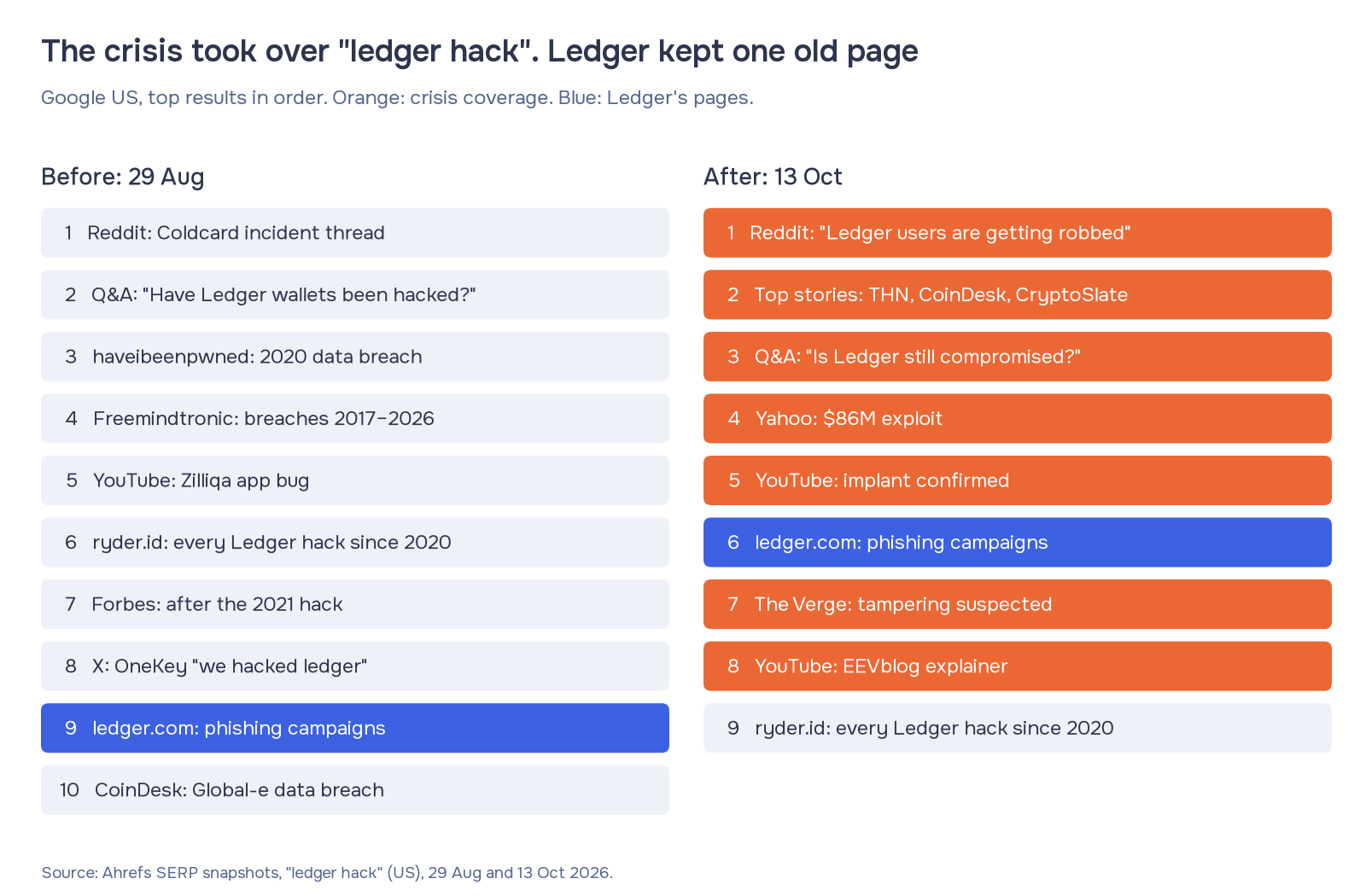
Ledger had nothing to rank with for six days. Its detailed response went up on 15 October. A day later, it was on neither results page. On “ledger hack”, the phishing notice was at #2. On “is ledger safe”, Ledger showed its Genuine Check page.
AI Overviews disappeared from brand queries in four countries. In our snapshots, searches for “ledger” in the US, UK, France and Germany showed an AI Overview before the crisis and none after. In Malaysia and Indonesia, AI Overviews stayed and cited crisis coverage within one to three days.
A page ready to answer the question people actually type is what search reputation management prepares in advance.
What AI Engines Answer
AI engines mention the crisis only after a web search, and then mix it with Ledger’s past.
On 16 October we asked the API versions of ChatGPT, Perplexity, Claude and Gemini ten questions a Ledger owner or buyer would ask. 22 of 40 answers mentioned the incident, all of them from answers that used web search. Most described it correctly, as tampering at a reseller rather than a breach of Ledger.
The weak spots:
- “Was Ledger hacked?” Perplexity opened with “Ledger has been hacked multiple times”, then listed incidents from 2020 and 2023. Asked again, it repeated the answer. Claude led with the current case in both runs; ChatGPT did in one of two.
- “Is it safe to buy a Ledger from MediaMarkt?” ChatGPT answered “Generally, yes” in both runs, citing Ledger’s own reseller list, which still showed MediaMarkt as authorized. The other three said not to buy there for now.
- “I bought a Ledger from a reseller. What should I do?” Only Perplexity advised moving funds to a new device with a new recovery phrase, Ledger’s own core advice. The other three didn’t.
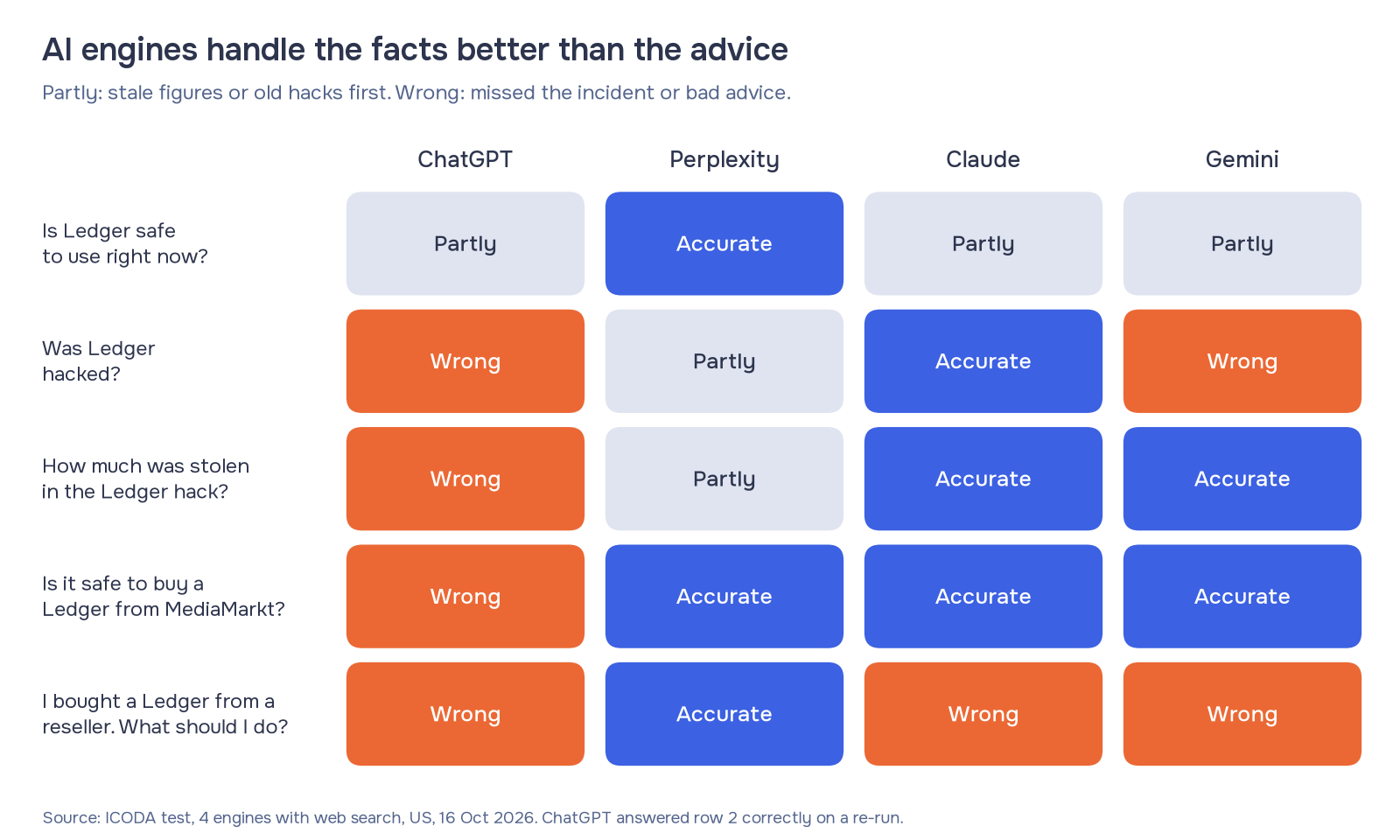
Ledger’s 15 October response did reach the engines: ChatGPT cited it four times and Perplexity once. A day after it went up, engines were using it while Google wasn’t showing it.
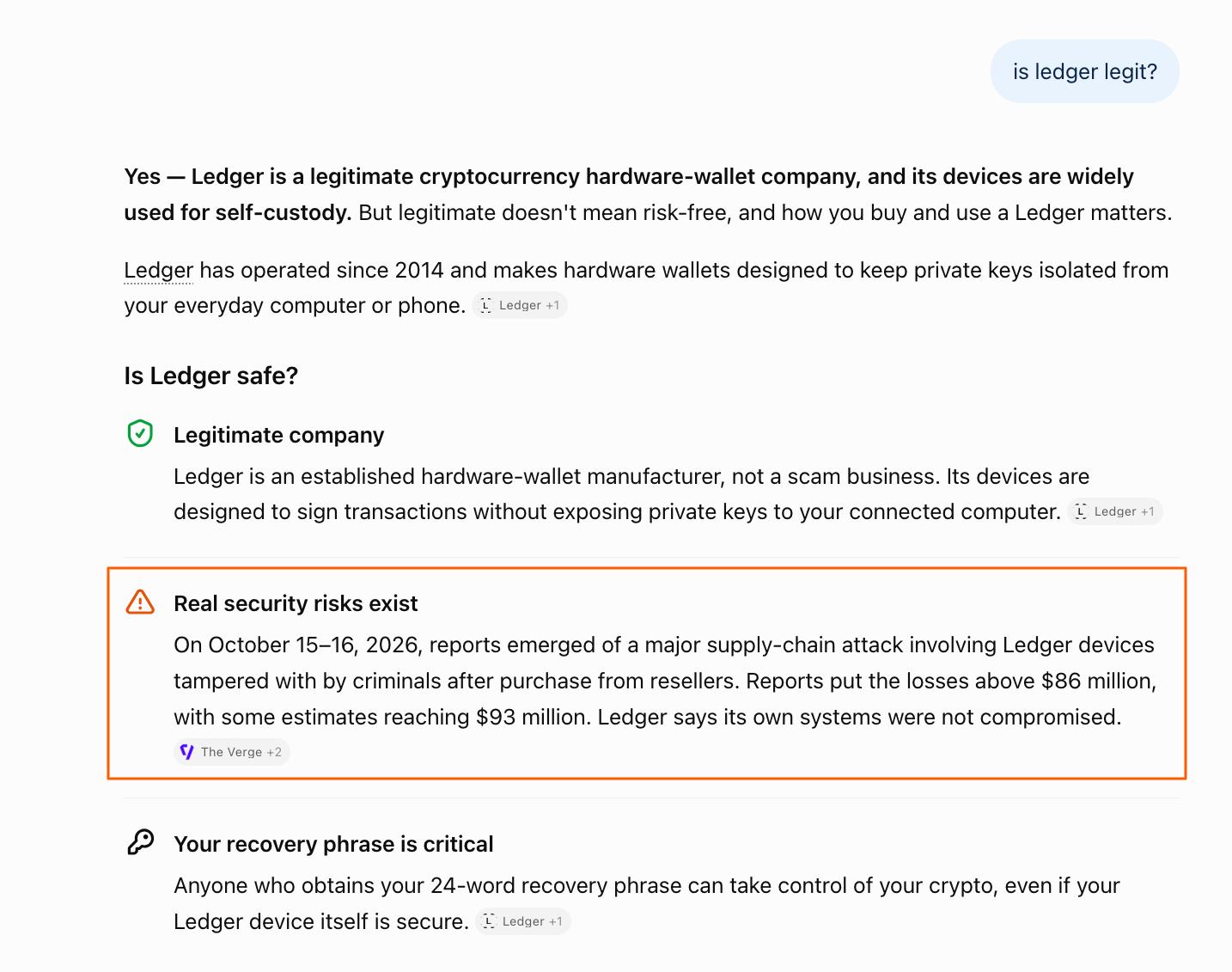
The ChatGPT consumer app made its own mistakes. Asked “is ledger legit?” on 16 October, it dated the attack to “October 15–16” and gave the outdated $93 million figure.
The reseller list behind the MediaMarkt answer was Ledger’s own page. Brands now have to update the pages engines cite while a crisis is running. How engines choose sources: AI SEO.
The Epicentre Spoke Another Language
The reseller was Malaysian, and its buyers were across Southeast Asia. Of 1,018 articles in our sample, 29% were in English, while Indonesian, Thai and Malay together made up 7%. Malay had two articles, and the first appeared 12 hours after Ledger’s statement.
On 15 October, a search for “cryptobilis” in Malaysia still showed CryptoBilis’s website at #1, with a direct link to its Nano X product page. The only Malay-language warning in the top ten was an Instagram reel: “Bought a Ledger from CryptoBilis? Don’t set it up!” No Ledger page ranked. Malaysian searches for “cryptobilis” peaked on 10 October and fell to a tenth of that by 15 October, the day Ledger’s response arrived, in English only.
Where the Windows Were
Each of these windows could have been closed with work done before the crisis.
| When | What was already public | What happened | What would have changed the picture |
|---|---|---|---|
| March to October 2026 | Hardware researcher Joe Grand presented a teardown of an implanted Nano X at Hardwear.io USA on 29 May. He says he told Ledger on 4 March. | We found no public advisory from Ledger | A short public note on grey-market devices and how to inspect them |
| 9 Oct, 04:59 to 13:32 | Drains on-chain, victims on Reddit, loss estimates on X | First statement after 8.5 hours; scheduled promo post at 11:35 | Complaint monitoring, a holding statement within an hour, a pinned official thread on Reddit, a way to pause scheduled content |
| 11 to 13 Oct | Unverified claims gather 4.9 million views; a German buyer shows implants in two MediaMarkt devices | Updates reach a fraction of that audience; the MediaMarkt reply comes after 23 hours and gets a Community Note | A short “confirmed / not confirmed” reply where each claim spreads, with facts checked with the partner first |
| 9 to 15 Oct | Buyers across Southeast Asia | No incident page for six days, then one in English only | A canonical page within 24 hours, in English, Malay, Indonesian and Thai |
| Throughout | AI engines read the brand’s own site | An outdated reseller list fed a wrong answer about MediaMarkt | Updates to the pages engines cite, such as reseller lists and safety pages, during the response |
“In the first hours of a crisis, nobody remembers how good your statement was. They remember what they saw when they searched for you,” says Anastasia Marmuzevich, Online Reputation & PR Manager at ICODA. “Ledger did the hardest part right: it spoke fast and gave the right advice. What it lacked was a page that answered the question in every language its customers search in, and someone answering the loudest claims where they were spreading.”
For brands that sell trust, this is the risk brand protection covers.
How to Avoid a Week Like This
Run these before you need them.
- Search for your brand plus “hack”, “scam” and “safe” in your three biggest markets. Note which result answers the question and whose it is.
- Ask ChatGPT, Perplexity and Gemini “Is [brand] safe?” and open every source they cite. Check when your own pages among them were last updated.
- Find your reseller and retailer list. Can someone take a partner off it within an hour, and do you know whose statements you must coordinate before you post?
- Check for an incident-page template that can go live within an hour, the languages it exists in, and an agreed “confirmed / not confirmed” format for corrections.
- Name who posts from the main account when support is overloaded, and who can pause scheduled content.
- Decide where a crisis would start. Which country, which language, which forum? Have someone read it daily.
- Prepare an official community thread for Reddit and your own channels: a timeline, what is confirmed, what isn’t, and answers to the top questions, ready to pin within hours.
Frequently Asked Questions
Estimates range from $72 million to $102 million. The latest, from Bitquery as of 15 October 2026, is $102 million drained from 324 wallets across six blockchains. Ledger has not confirmed a total.
According to Ledger, no: its chip, operating system and servers were not compromised. Criminals added a hidden implant to genuine devices sold through the reseller CryptoBilis in Southeast Asia, and the implant read the recovery phrase during setup.
At 13:32 UTC on 9 October 2026, via @Ledger_Support, 8.5 hours after the first drain and five hours after the first victim post on Reddit. Ledger published a detailed response on 15 October.
CryptoBilis stopped all hardware-wallet sales on 10 October. MediaMarktSaturn removed Ledger devices in all its countries on 13 October. The same day, Ledger asked resellers in Indonesia, Singapore, Thailand, the Philippines, Vietnam, Malaysia and Hong Kong to suspend sales.
How We Measured
- X posts: exact times decoded from post IDs; text and views from api.fxtwitter.com on 16 October.
- Reddit: posts and comments from the Arctic Shift archive; for r/ledgerwallet we checked up to 100 posts per time window, so the absence of a pinned official thread is a sample finding.
- On-chain: drain times and totals from Bitquery’s investigation, updated 15 October.
- Google Trends: worldwide, captured 16 October, hourly from 08:00 UTC on 9 October and daily by country from 1 September. Trends is a relative index, not search counts.
- News: 1,018 articles from Google News across 23 locales, 8 to 16 October, deduplicated by headline, with an exact publication time. Queries were “cryptobilis”, “ledger implant”, “ledger mediamarkt” and “ledger spy chip”, so local-language articles that use none of these terms may be missed. Google News returns up to 100 results per query, so this is a sample, and syndicated and localized copies count separately.
- Google results: Ahrefs SERP snapshots for 24 query-and-country combinations in the US, UK, Germany, France, Malaysia and Indonesia, before and after 9 October; each is a single crawl. A live check of “ledger hack” and “is ledger safe” (Google US, desktop) on 16 October via Nightwatch Search Simulator.
- AI engines: 10 prompts × 4 engines (GPT-5.6 Terra, Sonar Pro, Claude Sonnet 5.5, Gemini 3.8 Flash) via OpenRouter, web search on, US location, 16 October. Three prompts ran twice and the patterns held, except that ChatGPT answered “Was Ledger hacked?” accurately the second time.
Data and Sources
Incident facts come from Ledger Support on X, Ledger’s 15 October response and Bitquery’s on-chain investigation. Joe Grand’s research is on his site. The 4 March date is Grand’s account, reported by Kim Zetter in Who Is Planting Backdoors in Ledger Crypto Wallets? (Zero Day, 13 October 2026); Ledger did not comment to Zetter. Post-level data is available on request.
Share with


Rate the article