




Search “crypto PR distribution” and you’ll find the same thing on every page: ranked listicles where the publishing agency places itself at #1, padded with vague promises and zero performance data. We counted — 90% of the top-ranking articles contain no measurable campaign outcomes. No traffic numbers. No engagement rates. No conversion data. Just descriptions and pricing.
This article is different. We tracked 74 PR placements across 44 publications in 3 live crypto campaigns during Q1 2026. We pulled GA4 session data, engagement rates, purchase conversions, SERP positions, Google AI Overview inclusions, and ChatGPT/Gemini/Perplexity mentions. We verified Domain Rating for every publication through Ahrefs on March, 2026.
Three assumptions didn’t survive the data: Domain Rating does not predict traffic or revenue. AI visibility is now a measurable — and arguably the most valuable — PR outcome. And 5 strategically placed articles can outperform 39. Most articles ranking for “best crypto PR agencies” won’t tell you this, because they don’t measure it.
The shift to AI search happened faster than anyone projected. 25.6% of all referral traffic to US crypto media now comes from AI tools. While 85% of crypto projects still haven’t optimized for LLM discoverability, the ones who have are capturing citations that compound over months. Here’s what the data shows.
Why Most Crypto Press Release Distribution Advice Is Obsolete
The crypto market reached 741 million global owners in 2025 (Crypto.com Research). M&A activity surged to 265+ transactions totaling ~$8.6 billion — nearly 4x the prior year. PR demand is at an all-time high. But the playbook most crypto PR agencies use is built for a market that no longer exists.
Three structural shifts broke the old model.
AI search reached critical mass. ChatGPT now has 900 million weekly active users. Google AI Overviews reach 1.5 billion monthly users. Perplexity processes 780 million queries per month. 44% of consumers now name AI search their primary source for buying decisions — ahead of traditional search at 31% (McKinsey, 2025).
Google’s algorithms punished even the biggest names. CoinTelegraph — one of the highest Domain Rating publications in crypto — lost approximately 82% of its US organic search traffic between July and December 2025. Outset PR’s analysis attributed this to algorithmic authority reweighting. If the most well-known crypto publication can lose four-fifths of its organic traffic in six months, DR is not the safety metric the industry treats it as.
Zero-click searches are eating visibility. Ahrefs studied 300,000 keywords and found AI Overviews reduce clicks to the #1 organic result by 58%. But brands cited inside AI Overviews see +35% organic CTR (Seer Interactive) — making AI visibility the new high ground.
The media landscape is consolidating alongside this shift. Outset PR’s Q4 2025 analysis of 130 US crypto publishers found 53 tier-1 outlets capture ~95% of all visits. Tier-2 captures 4%, tier-3 just 1%. Total US crypto-native media traffic fell 28% quarter-over-quarter. Publication selection matters more than ever: you’re either in the traffic zone or competing for scraps.
Relevance and AI-readiness now predict PR outcomes better than Domain Rating or publication prestige. The data below shows why.
3 Campaigns, 74 Placements, 44 Publications: Our Methodology
We analyzed three crypto PR campaigns executed in Q1 2026:
Campaign A — a niche-focused presale token. 39 articles placed across crypto media, with tier-1 placements on major exchanges and business publications. Full GA4 tracking enabled, giving us session-level data with engagement rates, purchase events, and revenue attribution.
Campaign B — a P2E logistics blockchain in presale phase. Multiple placements across crypto media with SERP and AI visibility tracking but no GA4 access.
Campaign C — a privacy-centric crypto exchange. Only 5 articles placed, 4 in tier-1 publications. SERP positions and AI Overview inclusions tracked.
We verified Ahrefs Domain Rating for all 22 unique publications on March, 2026. DR ranged from 0 to 87, with a median of 75.
Domain Rating Doesn’t Predict Traffic: Here’s the Proof
Campaign A is the only campaign with full GA4 data, which makes it the most revealing. Here’s what 280 sessions across 10 tracked publications showed:
| Publication | DR | Sessions | Engagement Rate | Purchases | Revenue |
|---|---|---|---|---|---|
| LiveBitcoinNews | 64 | 141 (50.4%) | 52.48% | 6 | $626.83 |
| NFT Plazas | 62 | 26 (9.3%) | 46.15% | 0 | $0 |
| Benzinga | 86 | 15 (5.4%) | 46.67% | 0 | $0 |
| FinanceFeeds | 73 | 12 (4.3%) | 83.33% | 0 | $0 |
| The Block | 82 | 11 (3.9%) | 81.82% | 0 | $0 |
| Blockonomi | 73 | 10 (3.6%) | 70% | 0 | $0 |
| TechBullion | 80 | 10 (3.6%) | 90% | 0 | $0 |
| The Crypto Updates | — | 9 (3.2%) | 66.67% | 0 | $0 |
| DeFi Planet | 0 | 8 (2.9%) | 75% | 1 | $200 |
| 99Bitcoins | 78 | 7 (2.5%) | 14.29% | 0 | $0 |
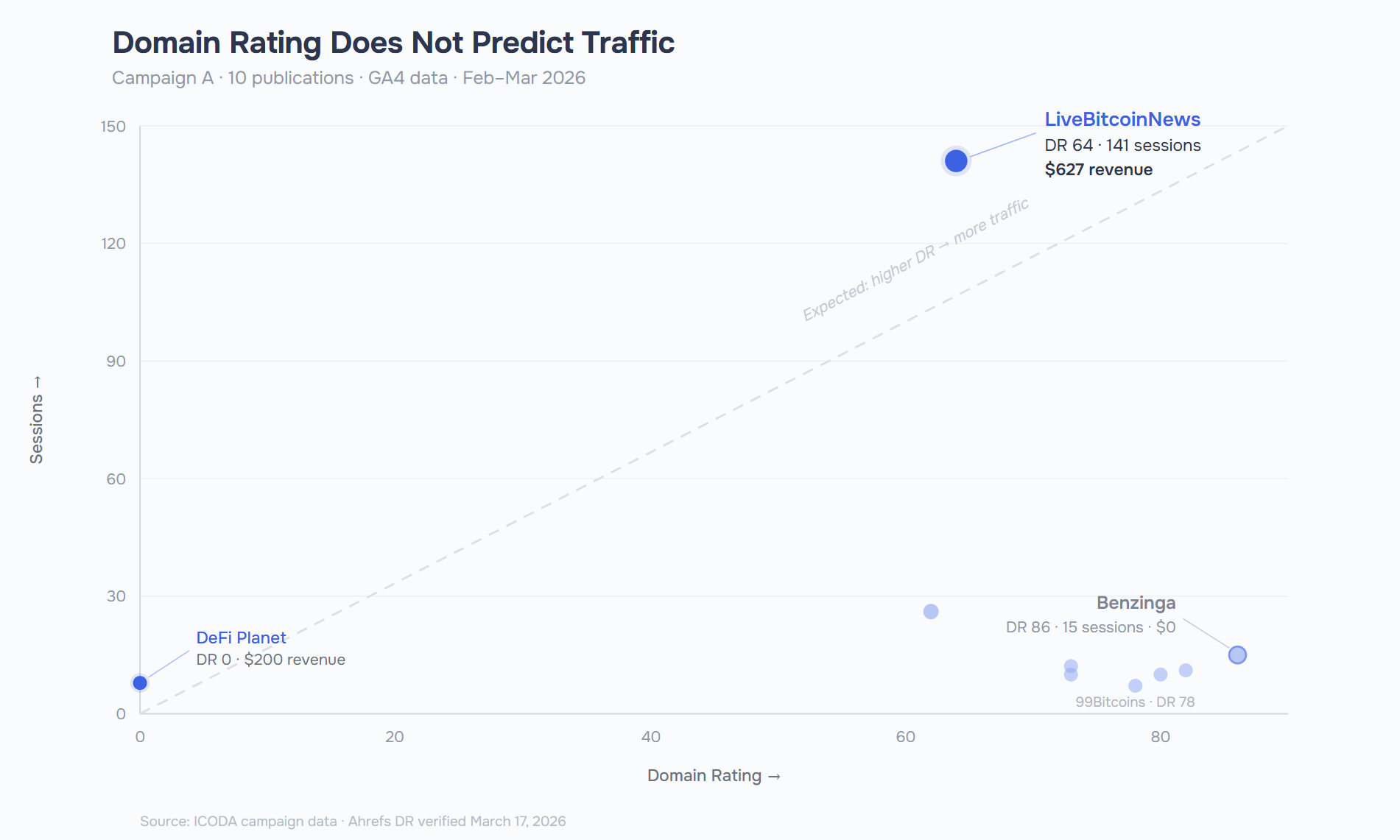
Read that table carefully. LiveBitcoinNews (DR 64) drove 50.4% of all sessions and 85.7% of all revenue. Benzinga (DR 86) — 22 points higher in Domain Rating — drove 5.4% of sessions and zero revenue. 99Bitcoins (DR 78) delivered the worst engagement of any source at 14.29%. DeFi Planet (DR 0) generated a $200 purchase, outconverting The Block (DR 82).
The correlation between DR and traffic in this dataset is not just weak — it’s negative. The few crypto PR agencies that have moved past DR-based selection are already outplacing competitors who still sort media lists by authority score.
Campaign C tells the same story from a different angle. altFINS, with a DR of just 48 — the lowest in the entire campaign — achieved the #1 position in Google News for a target query and earned a Google AI Overview inclusion. The Market Periodical (DR 50) captured #2 positions for “best anonymous crypto exchange” and “best crypto swap platform.” The publications with the highest relevance to the niche drove the strongest search results, not the ones with the highest authority scores.
LLMs favor large but narrowly focused publications that aren’t flooded with sponsored content. These outlets are selective about what they publish — and that editorial restraint makes each article carry more weight in AI-generated answers. A niche publication that runs 20 pieces a month signals expertise. A generalist that runs 200 signals noise.
Google officially does not use Domain Authority or Domain Rating. John Mueller stated this explicitly across four separate instances between 2019 and 2022. A documented experiment on the Xamsor Blog showed that purchasing Ahrefs DR 50 costs about $50 on Fiverr — with zero impact on actual ranking power. Search Engine Land listed DA/DR among metrics to retire before 2026, recommending revenue contribution and AI platform mentions as replacements. Yet most crypto PR firms still use DR as their primary publication selection metric.
“There’s no universal publication that works for every project. I always start with what the project is about and match media specifically to their target audience.” — ICODA’s Head of Media Relations
The alternative to DR-based selection: audience-publication fit. Match the publication’s topical focus and readership to your project’s niche. Track actual organic traffic (not DR), direct traffic percentage as a proxy for audience loyalty, and AI referral share as a signal of future discovery readiness.
Want the same SERP and AI visibility for your project?
We build crypto PR campaigns around data, not article counts.

How PR Placements Now Feed AI Search — And Why That Changes Everything
All three campaigns achieved AI/LLM visibility — in ChatGPT, Google AI Overviews, Gemini, and Perplexity — without specifically optimizing for it. The PR placements did the work.
Campaign A: ChatGPT listed the project as #1 in “Top Emerging Meme Coins (Q1 2026)” and cited it in AI-generated responses for niche queries. Google AI Overview included it for presale-related searches.
Campaign B: ChatGPT provided detailed descriptions of the project’s platform, tokenomics, and use case — all sourced directly from PR articles. Multiple publication citations appeared in AI responses.
Campaign C produced the most striking result. 5 articles generated 3 Google AI Overview inclusions. The project appeared alongside established competitors in AI-generated answers to queries like “leading instant crypto exchanges” — purely from earned media coverage.
The mechanism behind this is now well-documented. 82% of citations driving brand visibility in AI responses come from earned media (Muck Rack, 1 million+ citations analyzed). Edelman’s 2025 research puts the figure at up to 90%. A Stacker/Scrunch study from March 2026 found 97% of earned-media-distributed stories earned at least one AI citation, with a median 239% lift in AI search visibility compared to owned content. A University of Toronto peer-reviewed paper independently confirmed AI search exhibits systematic bias toward earned media over brand-owned content.
“You can’t buy your way to the top of an AI-generated answer. In a world where visibility is earned, not paid, brands must proactively shape how they appear in LLM outputs.” — Brian Buchwald, Edelman Global Chair of AI and Product
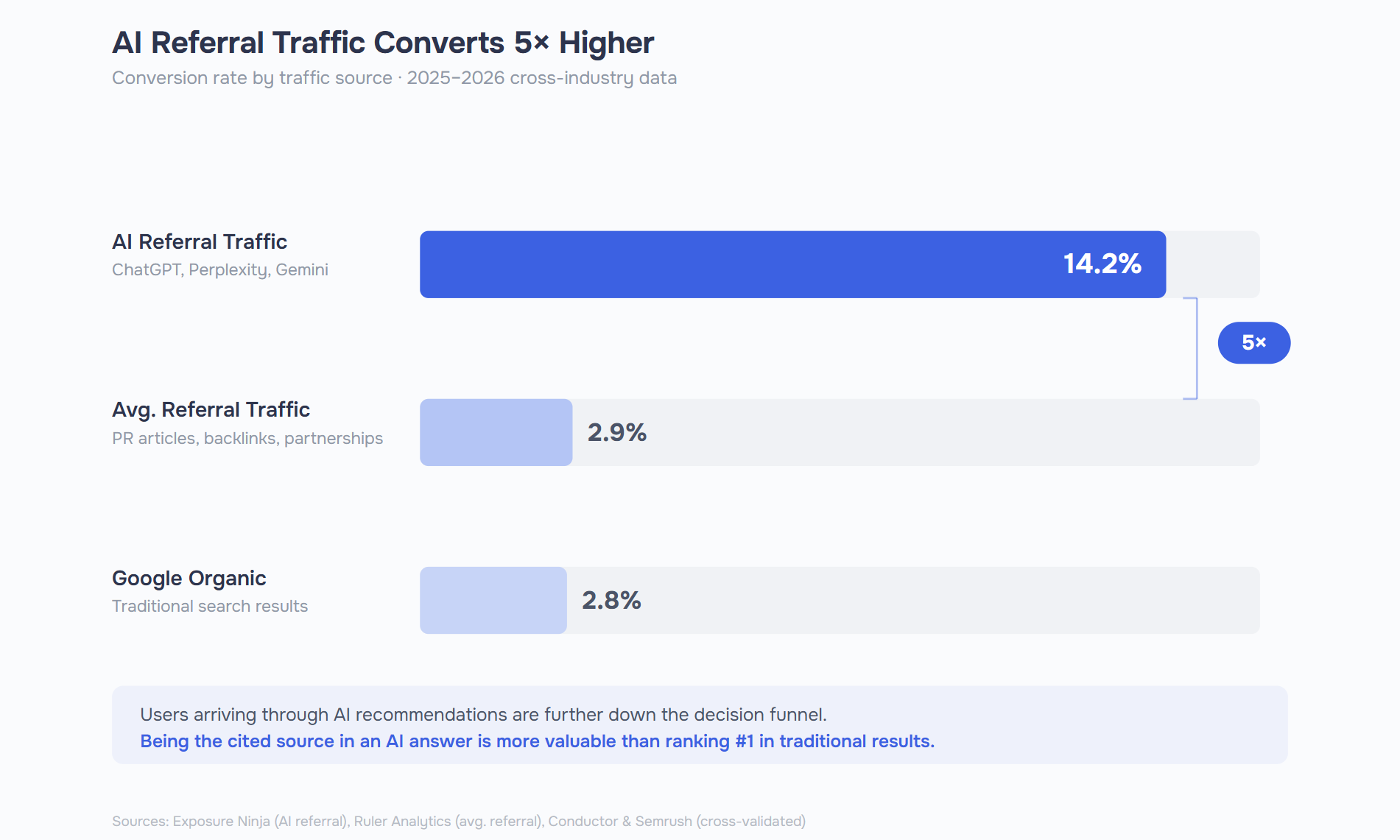
The conversion premium is real. ChatGPT referral traffic converts at 14.2% versus 2.8% for traditional Google organic, according to cross-validated data from multiple sources. Users arriving through AI recommendations are further down the decision funnel — they’ve already asked a specific question and received your project as the answer.
80% of URLs cited by LLMs don’t rank in Google’s traditional top 100 (Ahrefs). AI models operate with a different source logic than search engines. Muck Rack found only 2% overlap between the journalists PR teams typically pitch and the journalists AI actually cites — a massive realignment gap that most crypto PR firms haven’t addressed.
“LLMs respond well when a project publishes in media relevant to its niche. If it’s a crypto prop trading firm, it needs to be in financial media. What matters is content quality and relevance, not the publication’s rating.” — ICODA’s Head of Media Relations
Less than 15% of crypto projects have optimized for LLM discoverability. The window for dominating niche queries in AI Overviews is narrowing as more projects discover generative engine optimization (GEO).
Content freshness matters enormously: pages updated within 2 months earn 28% more citations (AirOps), and the first 7 days post-publication generate the highest citation rates in ChatGPT and Claude. RAG-based systems like Perplexity and Google AI Overviews can cite articles within hours of publication. Training-based systems absorb content over months. Both pathways reward consistent earned media coverage — a single campaign isn’t enough.
5 Articles That Outperformed 39: What Strategic Crypto PR Looks Like
Campaign C placed 5 articles. Campaign A placed 39. Both achieved SERP domination for their target queries.
Campaign C’s 5 articles covered the full user journey — discovery, evaluation, and trust — in 5 pieces. The SERP results:
| Query | Position | Publication | Article Focus |
|---|---|---|---|
| no verification exchange | #1 | Cryptopolitan | No-KYC verification USP |
| [brand] exchange | #1 | Cryptopolitan | No-KYC verification USP |
| [brand] security | #1 | altFINS | Security review (non-custodial) |
| best anonymous crypto exchange | #2 | The Market Periodical | Speed test vs 10 competitors |
| best crypto swap platform | #2 | The Market Periodical | Speed test vs 10 competitors |
| [brand] review | #2 | altFINS | Security review (non-custodial) |
Six top-two positions from 5 articles — plus 3 Google AI Overview inclusions. All organic, no paid search. Each article served a distinct function: platform review (CoinGape), fee comparison (NFT Plazas), security audit (altFINS), privacy angle (Cryptopolitan), speed benchmark (The Market Periodical).
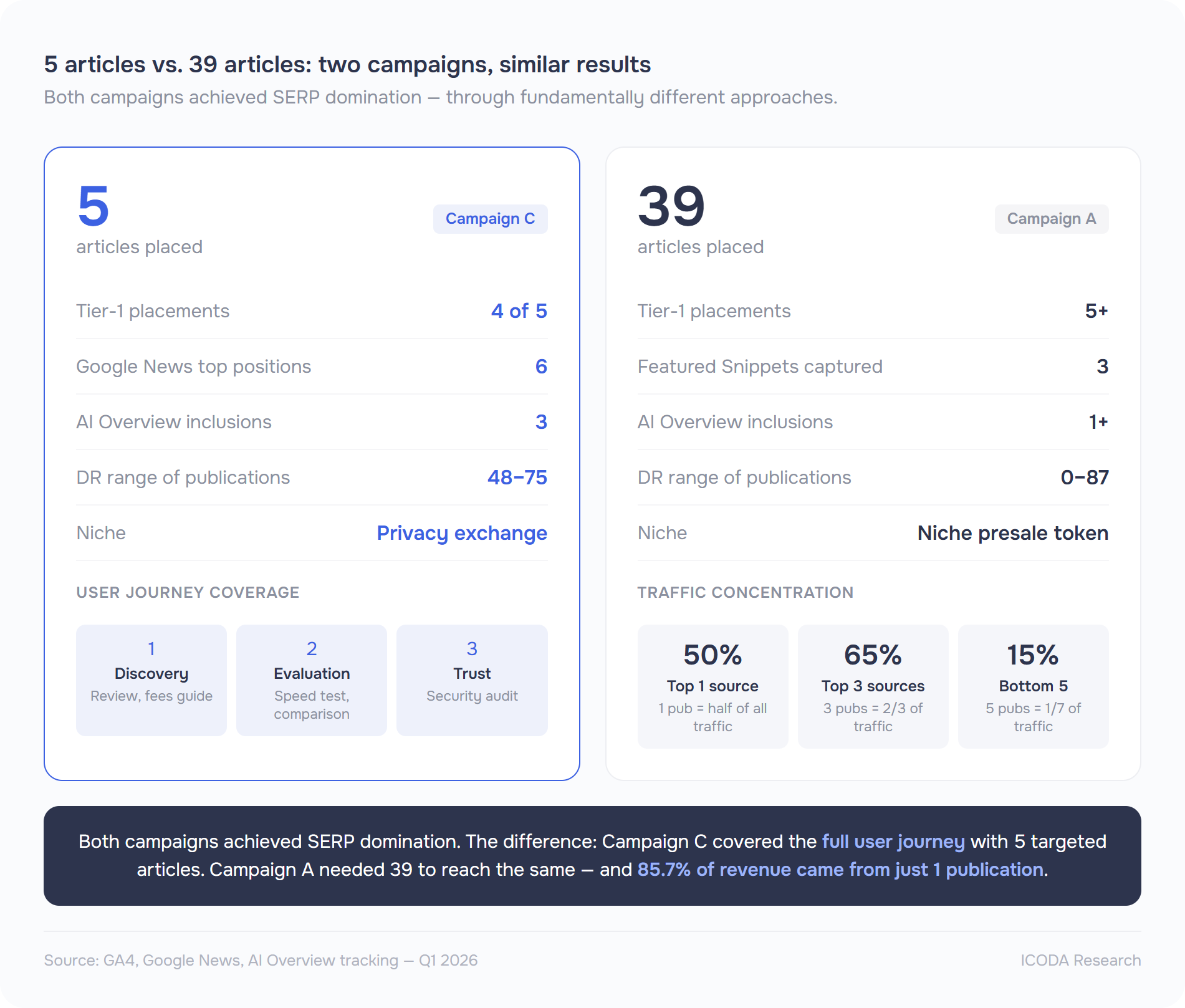
Campaign A’s 39 articles drove broader coverage but showed extreme concentration. The top 3 publications captured 65% of all sessions. LiveBitcoinNews alone accounted for 50.4% of traffic and 85.7% of revenue. The bottom 5 sources combined drove 14.6% of sessions. The 80/20 rule applied with precision. While most campaigns still measure success in article counts, the market is shifting toward intent coverage — and the projects that recognized this early are dominating queries their competitors haven’t even targeted.
This doesn’t mean the other 36 articles in Campaign A were wasted. Exchange reprints — Bitget republishing Crypto Daily content, MEXC republishing Blockonomi content, Binance featuring editorial coverage — didn’t drive measurable direct traffic. But they function as trust amplifiers: backlink authority signals, social proof for investors, and verification touchpoints for LLMs scanning multiple sources to confirm a project’s legitimacy.
“The currency of large language models is not links. The currency of large language models is mentions — specifically, words that appear frequently near other words — across the training data.” — Rand Fishkin, Co-founder, SparkToro
The practical takeaway: design campaigns for user journey coverage, not article count. Five articles that address distinct decision stages in relevant publications can outperform three dozen placements scattered across high-DR but audience-mismatched outlets. A crypto PR agency that reports “30 placements delivered” is answering the wrong question. The right question is: what did those placements do?
A Practical Framework for Crypto PR Distribution in 2026
The starting point is queries, not publications. Define 5–10 search queries your target audience actually uses — branded queries (“[project name] review”), non-branded discovery queries (“best crypto presale 2026”), and AI-native queries (“suggest a privacy-focused exchange”). Once you have those queries, map publications backward from them: which outlets rank for these terms? Which ones appear in AI Overviews for related searches? If you’re a DeFi protocol, a placement on altFINS (DR 48) may drive more SERP and AI visibility than Benzinga (DR 86). The question is audience-publication fit, not DR.
One tactical note: the pool of publications that AI Overviews pull from rotates. What appears in this month’s citation set may not appear next month. Monitoring which outlets LLMs are currently citing for your target queries — and placing content there while the window is open — is a tactical edge that most campaigns miss entirely.
From there, design content to cover the full user journey — not with ten variations of the same announcement, but with distinct articles serving distinct decision stages. Campaign C proved this can be done with as few as 5 articles: one for discovery, one for comparison, one for trust. Structure each piece for AI extraction: clear heading hierarchies, specific data points early, and self-contained answer chunks of 50–150 words. LLMs extract structured content with specific statistics 28–40% more frequently than unstructured prose.
Finally, track beyond placements. Session data, engagement rates, conversion events, SERP positions for target queries, AI Overview inclusions, LLM mentions. If your crypto PR firm only reports article count and DR, you’re measuring the wrong things.
The distribution landscape in 2026 breaks into three models:
| Distribution Model | Price Range | Best For | AI Visibility Impact |
|---|---|---|---|
| Wire services (GlobeNewswire, PR Newswire) | $350–$3,000+ per release | Regulatory disclosures, institutional reach | Low — syndicated content ranks briefly |
| Crypto-native networks (Chainwire, peers) | $1,399–$13,499 per campaign | Guaranteed placements, rapid indexing | Moderate — depends on outlet relevance |
| Full-service crypto PR agencies | $8,000–$100,000+/month | Strategy-led earned media, SERP + AI planning | High — editorial placements compound |
The question to ask any crypto PR agency before signing: “Show me engagement data from your last three campaigns — not just placement counts.” Ask specifically about AI visibility outcomes — AI Overview inclusions, ChatGPT mentions, Perplexity citations. Among the best crypto PR agencies, these metrics are becoming standard reporting. If a firm can’t demonstrate them, it’s still operating on the 2023 playbook.
“AI engines don’t invent authority; they detect it. They don’t generate trust; they borrow it from credible sources.” — Gini Dietrich, Founder & CEO, Spin Sucks
The crypto PR firms leading in 2026 aren’t the ones with the longest media lists. They’re the ones tracking what happens after the placement goes live — across Google, across AI platforms, and down to the session level.
The data from 74 placements across 3 campaigns points to three conclusions. Domain Rating does not predict traffic, engagement, or revenue — niche relevance does. AI visibility is now a measurable PR outcome, with 82–90% of AI citations flowing from earned media. And strategic placement design — covering the user journey with fewer, better-targeted articles — outperforms volume-based distribution.
The projects acting on these findings now are building citation footprints that compound. The rest are still optimizing for metrics that Google itself doesn’t use.
Frequently Asked Questions About Crypto PR Distribution
In our Campaign A data, 280 PR-driven sessions generated $826.83 in direct revenue at a 2.5% conversion rate. But direct conversions understate PR’s value. PR placements feed AI search visibility, where referral traffic converts at 14.2% versus 2.8% for traditional organic search. The compounding effect of SERP ownership and AI citations makes PR one of the highest-ROI channels when measured beyond first-click attribution.
No. Our data shows a negative correlation between DR and traffic/revenue. LiveBitcoinNews (DR 64) outperformed Benzinga (DR 86) by 9.4x in sessions and drove 85.7% of revenue. altFINS (DR 48) achieved #1 in Google News and AI Overview inclusion. Google does not use DR as a ranking factor. Prioritize audience relevance, topical authority, and actual organic traffic over Domain Rating.
82–90% of AI citations come from earned media (Edelman, Muck Rack, University of Toronto). PR placements directly feed what ChatGPT, Gemini, Perplexity, and Google AI Overviews recommend. All three of our tracked campaigns achieved AI visibility through PR alone. Projects that optimize for AI discoverability now capture compounding citations, while the 85% that don’t are invisible in the fastest-growing search channel.
Costs range widely: basic wire distribution starts at $350 per release, crypto-native networks charge $1,399–$13,499 per campaign, and full-service crypto PR agencies run $8,000–$100,000+/month depending on scope. Budget benchmarks by stage: pre-launch token awareness campaigns average $20,000–$50,000/month across PR, KOLs, and community, while scaling projects allocate $100,000+/month for multi-channel coverage.
Wire services (GlobeNewswire, PR Newswire, Chainwire) guarantee distribution through syndication — your content appears on partner sites, typically tagged as a press release. A crypto PR agency develops strategy, pitches journalists for earned editorial coverage, and manages SERP and AI visibility outcomes. Earned media carries more weight with LLMs: Muck Rack found press release AI citations grew 5x between July and December 2025, but editorial placements still generate higher engagement and longer ranking longevity.
Share with


Rate the article